Evolution of the NHL Defenceman - Part 3
Defencemen involved in the offence on the penalty kill has changed, but how much it has helped is another matter.

In the first part of this series, we reviewed the changes in shot attempts and assists by defencemen from 2007 through 2026, both at 5-on-5 and on the power play. In Part 2, we covered the changes in shots on net and goal-scoring in that timeframe, again at 5-on-5 and on the power play.
The focus was on 5-on-5 and the power play because that is where most of the goals are scored. There is another significant change in how defencemen are generating offence, though, and it’s an unlikely source: the penalty kill.
Data from this write-up is from Evolving Hockey.
Teams being aggressive on the PK is nothing new. This was written about more than a decade ago by Matt Cane (now the director of analytics for the New Jersey Devils), expanded upon by Mike Pfeil back in 2019, and championed by Shayna Goldman and Alison Lukan. The general idea 10 years ago was that trying to score goals while short-handed generally led to teams creating a better PK goal differential. There would inevitably be instances where that aggressiveness led to goals against, but on balance over the course of a season, it would limit the goal differential damage, and in a sport with razor-thin margins where a single puck bounce can decide wins and losses, finding those small margins is important.
Before we get too far ahead, there are two things true about scoring on the penalty kill:
· On a 60-minute basis, there has been a dramatic rise. From 2007-2016, the year Cane wrote about PK goal scoring, teams averaged 0.74 goals per 60 minutes while short-handed. Since 2016, that goal rate is 0.92, an increase of about 24%.
· As a share of all goals scored, the rise in PK goal scoring is more complicated.
Goal scoring across the league has risen over the last decade, so that PK goal rates have also increased makes sense. However, when we look at PK goals as a share of all goals scored in a particular season, a different story emerges:
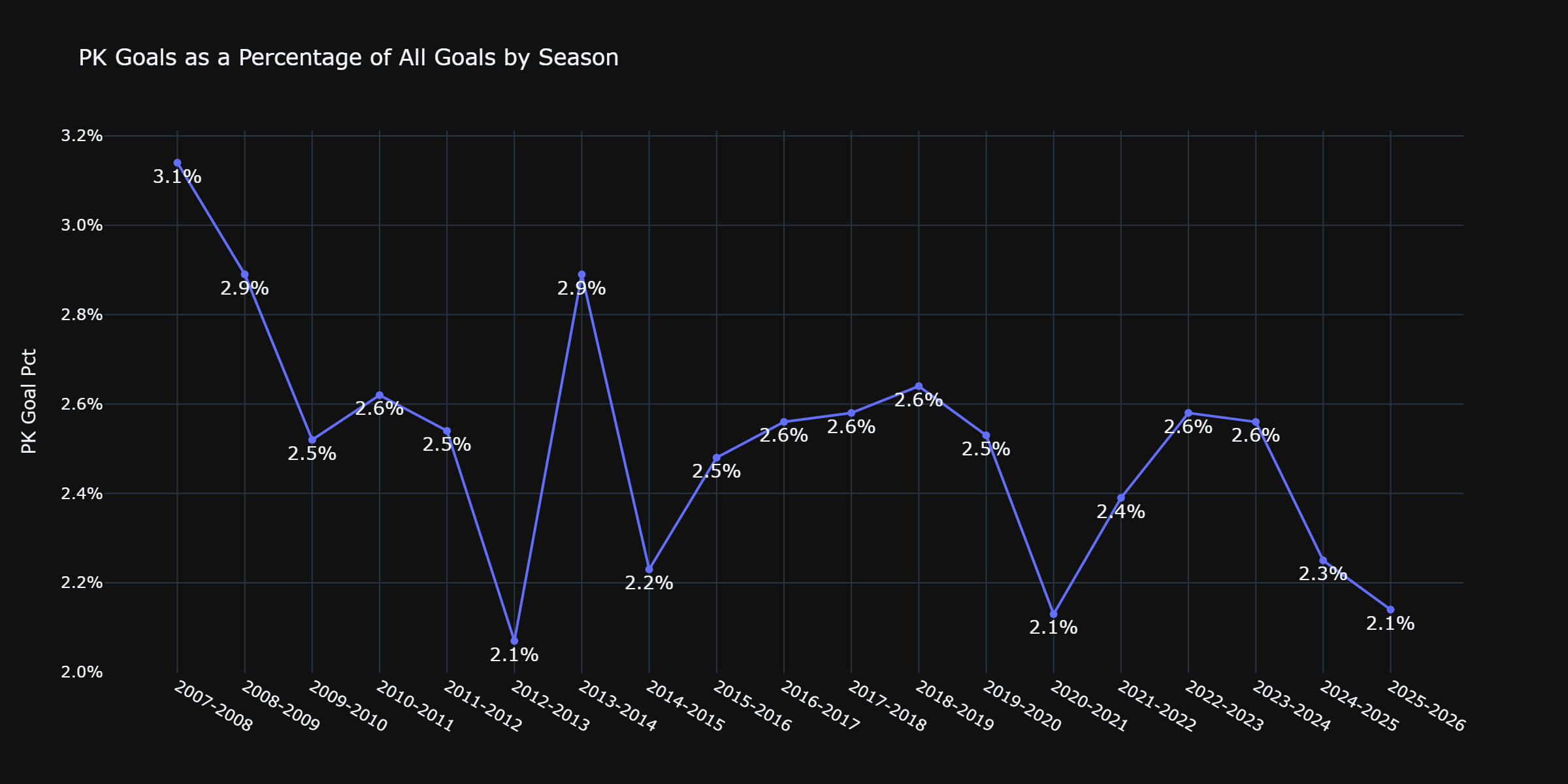
The three seasons where short-handed goals as a percentage of league scoring were their highest were 2007-08, 2008-09, and 2013-14, so it’s been 12 years since the peak. There has even been a decline over the last three seasons, and if we exclude the shortened Bubble 2021 campaign, the last two years have the lowest PK goal scoring shares of the last decade. There has been a lot more stability, ranging from 2.1-2.6% since the last peak in 2013-14, but the importance of PK goal scoring hasn’t exploded.
However, we are here to talk about defencemen, and there was an explosion in their involvement. If we look at the percentage of PK shot attempts taken by defencemen (blue line) and the percentage of all shot attempts taken by teams while short-handed (orange line), we can see how the defenders became more involved:
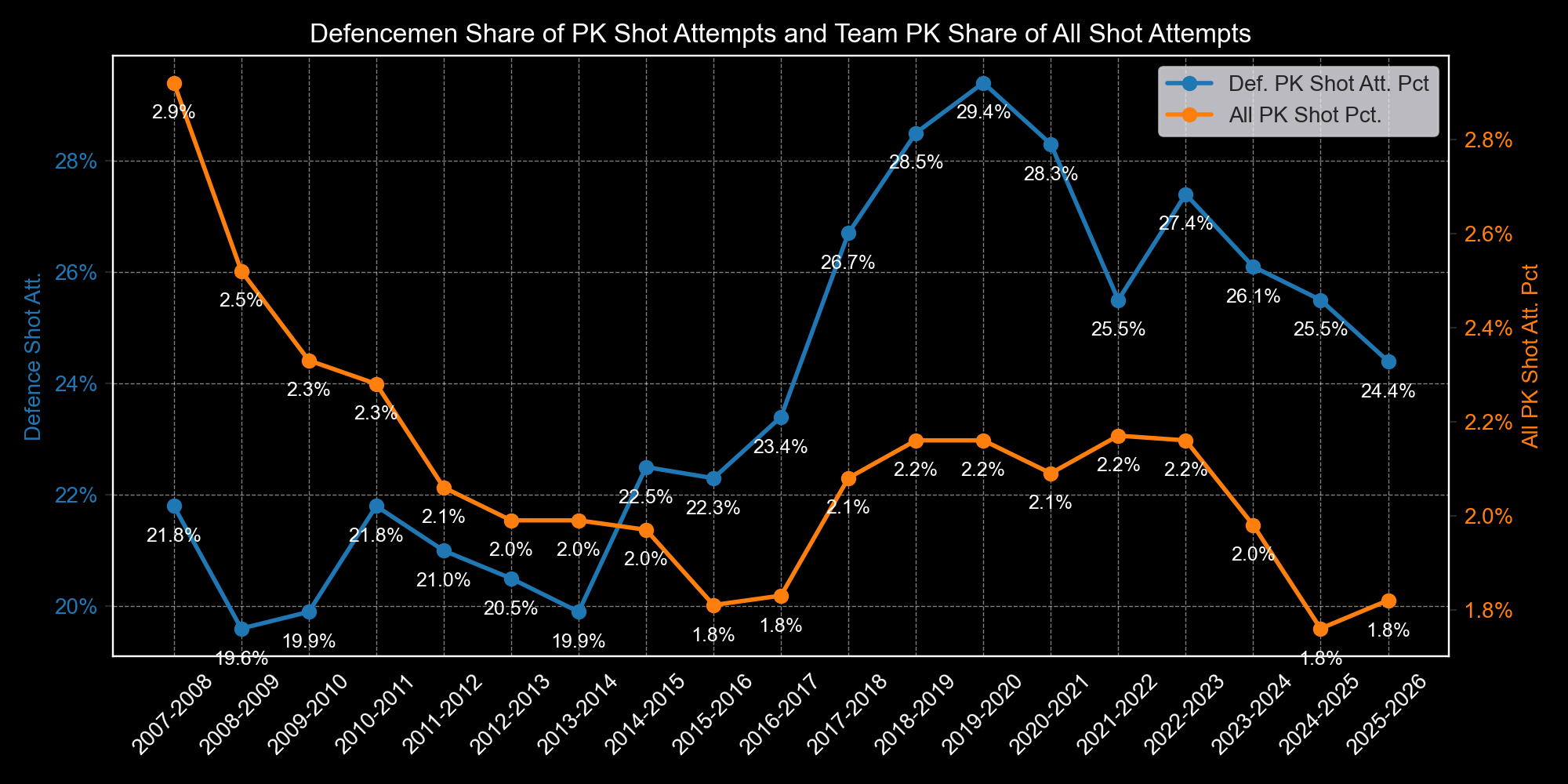
There is an interesting pattern here. The 2014-15 season is the year where we see the ascension of defencemen taking shots on the penalty kill start in earnest, going from under 20% of the shot attempts in 2013-14 to nearly 30% six years later. That is a massive increase in their involvement, and this timeframe coincides with the stability in PK goals that we saw earlier, too. So, the question is whether defencemen getting more involved on offence while short-handed resulted in capping the amount of goals scored while short-handed, or whether defencemen getting more involved kept the goal rate from dropping further?
This is where things get interesting. Considering what’s happened just since 2014-15 – the year defencemen started taking a larger share of the shot attempts on the penalty kill – the results are muddled. If we calculate the league average percentage of PK shot attempts in each season, find the percentage of PK shot attempts by defencemen from each team, group those teams into either ‘Above Mean’ or ‘Below Mean’, we don’t see much relationship between 60-minute goal-scoring rates on the PK and how much of a team’s PK shots are taken by their blue liners:
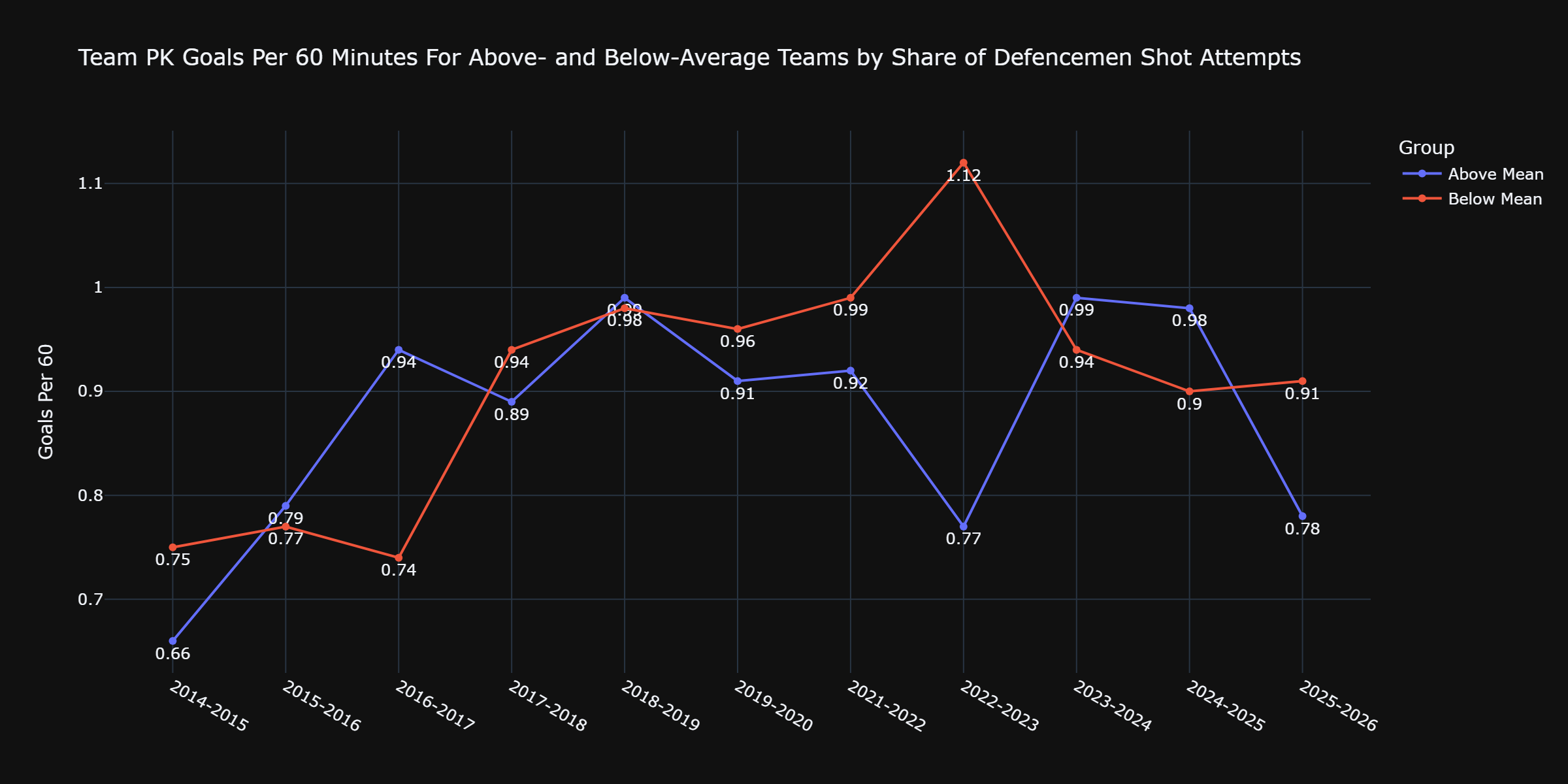
There are 11 seasons on that chart. In six of those seasons, teams whose defencemen took a below-average share of the PK shot attempts exceeded the goal rate of teams whose defencemen took a below-average share of the PK shot attempts, and the other five seasons belonged to the above-average group. In other words, the share of shot attempts taken by defencemen, at least compared to the league average, didn’t have much impact on the PK goal-scoring rate across those 11 seasons. It was basically a coinflip as to whether it helped or not.
That includes what every team did in each of those seasons. It is possible that there is a different story if we just look at the extremes, so what if we took the eight teams whose defencemen had the highest share of PK shot attempts relative to the league average in each season, and compared them to the eight teams with the lowest PK shot attempt share? Maybe the teams whose defencemen took a lot of the shots got more goals, the teams whose defencemen took a much smaller percentage of the shots got fewer goals, and the middle-of-the-road teams threw off the results? Well, not quite:
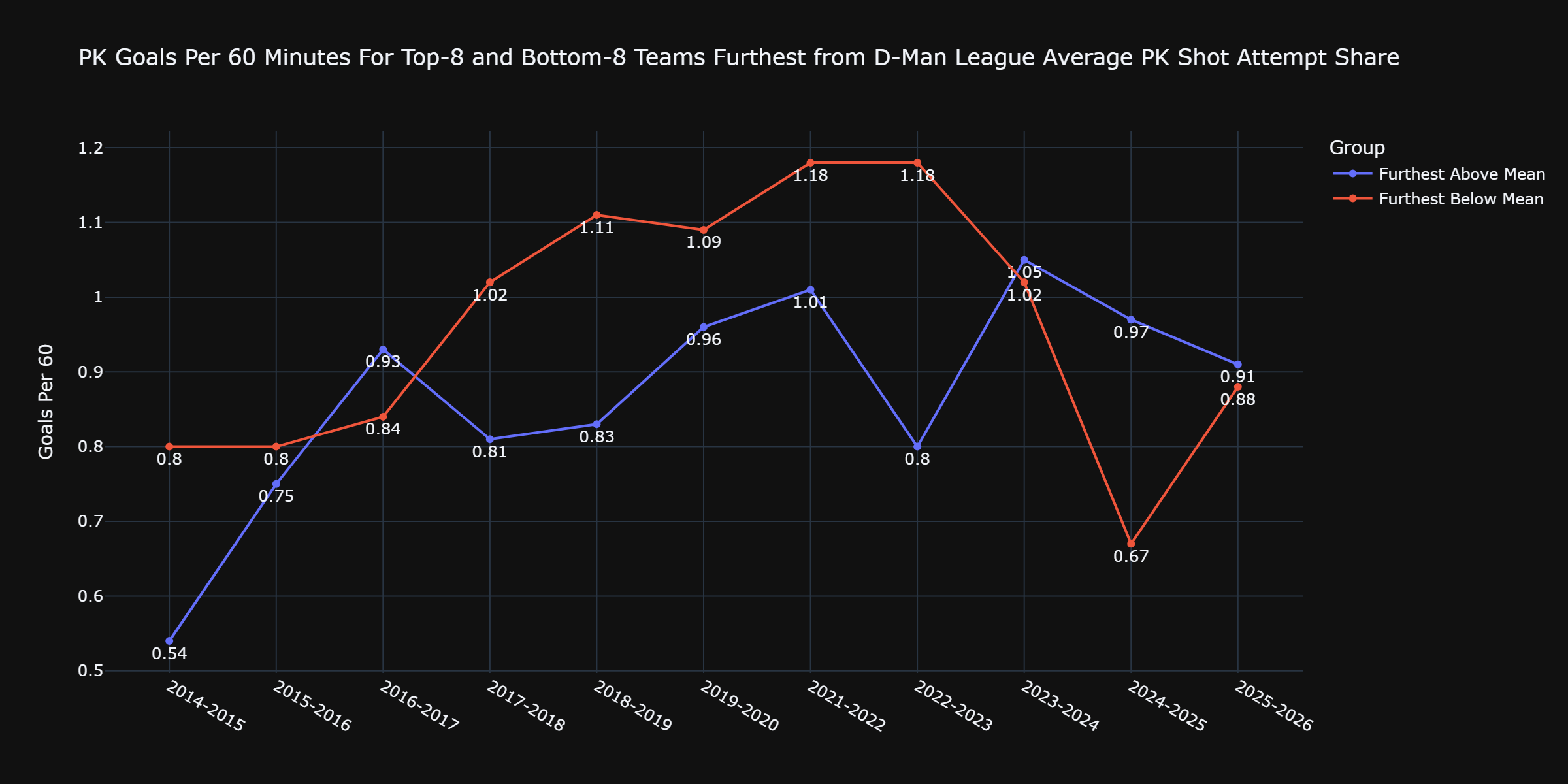
Seven of the seasons saw the eight teams furthest below average score more goals than the eight teams furthest above. However, each of the last three years from 2023-2026 saw the above-average group exceed the below-average one. Two of those years are very close, but considering the sizeable gap in 2024-25, blue liners getting heavily involved in the offence on the penalty kill has become much more important to goal scoring.
Let’s bring this all back to the point at the top of the article and relate it to our discussion: Does getting defencemen involved in the PK offence help create better PK goal differentials? Using team PK goal share, and focusing again just on the top-8 and bottom-8 rosters, the answer is ‘sort of’:
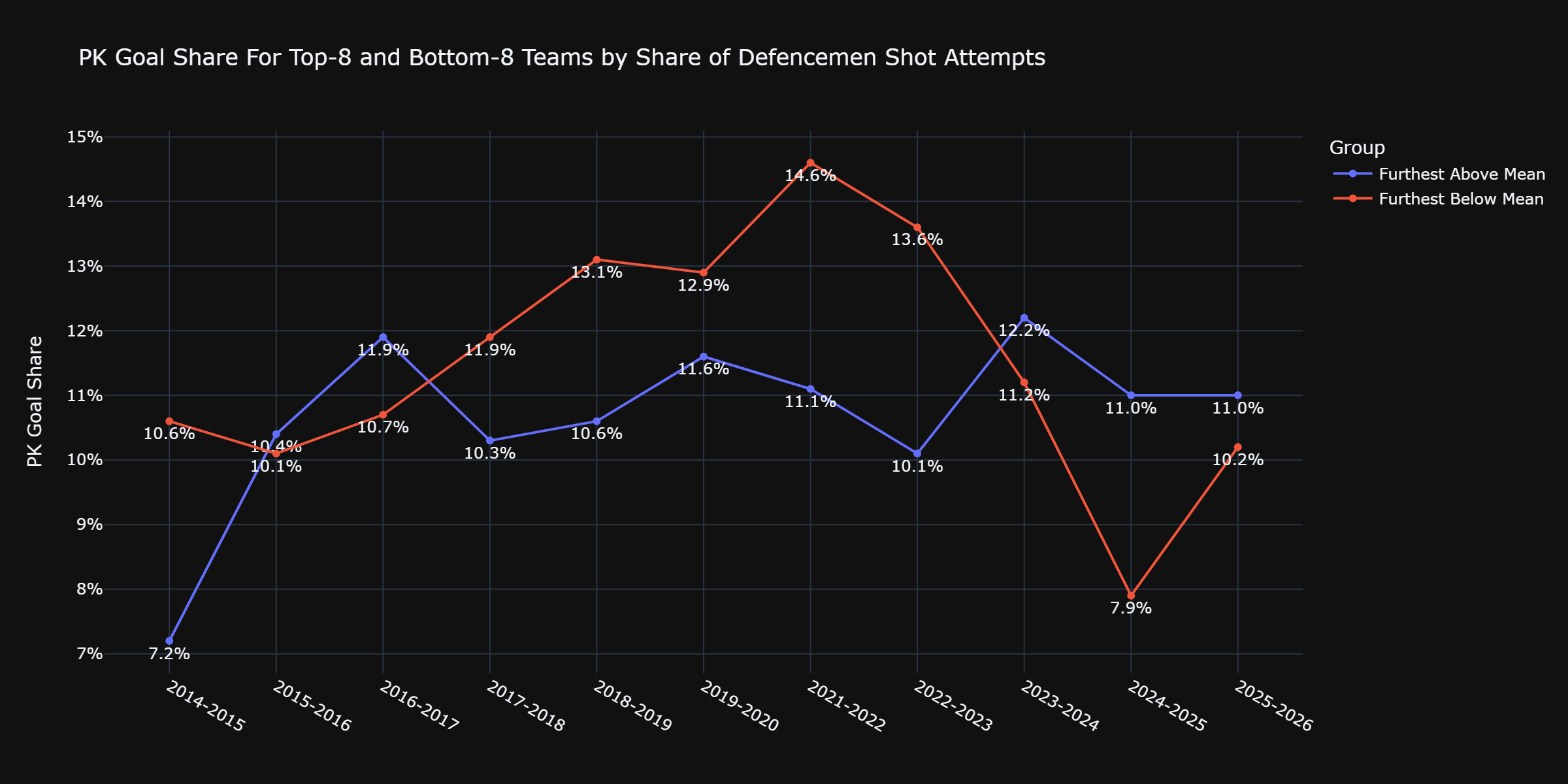
For years, teams whose defencemen took a significant share of the PK shot attempts actually performed worse by PK goal share, but as with the goal-scoring rate, the goal share has tipped in favour of the teams whose defencemen get heavily involved offensively over the last three years.
If we look at all the teams in the league and separate by above- and below-average squads by defencemen share of PK shot attempts, the recent picture is a little fuzzier:
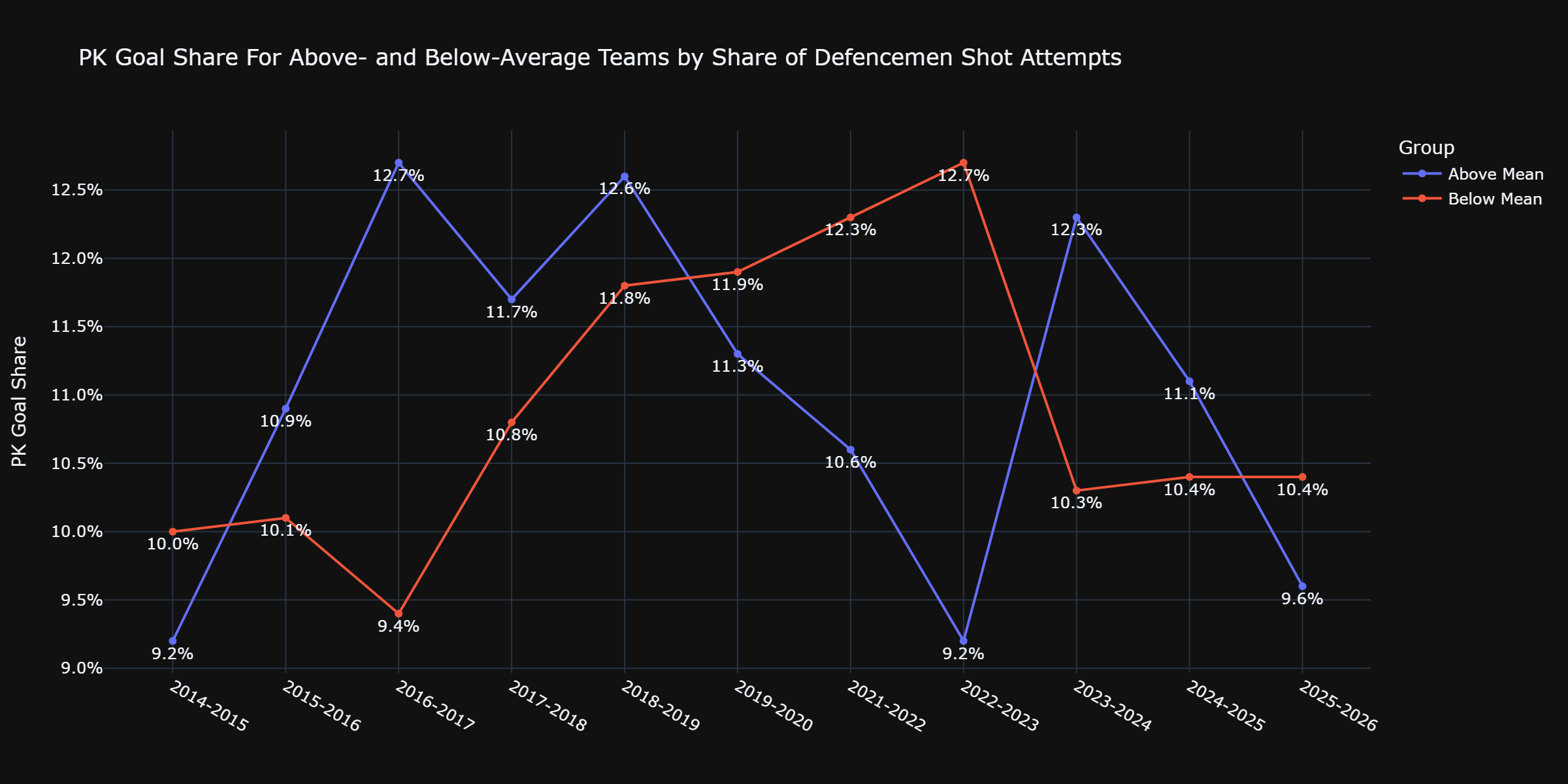
There is a goal-share spike in 2023-24 where the above-average teams jumped to 12.3%, and that would be roughly a top-10 penalty-killing team. But that group has dropped each of the last two years, and the 2025-26 season saw them perform worse than the teams whose defencemen got involved less often. Is this the start of a new trend, or just a blip? We won’t know until next season is over, but it is notable that the group of below-average teams by defencemen PK shot attempts have stabilized around 10.3-10.4% in each of the last three years, with a lot more variance in the above-average teams. It might be a question of individual team philosophy more than anything.
To sum it up, yes, blue liners jumping into the offence on the PK has helped create better goal differentials, but that is a recent development, it is important for rearguards to be heavily involved rather than just above average, and that aggressiveness may have cost their teams for several years.
Until next time.