Evolution of the NHL Defenceman - Part 8
We have seen offensive changes among defencemen and how those without offensive skills hurt their teams. There are specific defencemen whose reputation far outstrips their performance.

In last week’s entry, we reviewed Evolving Hockey’s Regularized-Adjusted Plus-Minus model, or RAPM, how poor offensive defencemen have hurt their teams over the years, and how that injurious gulf is widening. With that in mind, there is an old Twitter Hockey adage that has not left my brain since the first time I heard it over a decade ago: The hardest minutes any player has to play is with bad line mates. It is fair to wonder about the veracity of that statement, but for today, we’ll piggyback off last week’s article and dig into how much specific defencemen have hurt their individual teams.
We are again going to use Evolving Hockey’s RAPM model, look across the last five seasons, and limit the player pool to those with at least 2250 even-strength minutes, giving us 224 blue liners. We will select five blue liners from those whose xGF play-driving is at least one standard deviation below average, have skated top-4 minutes for their teams in recent seasons, and will play in the upcoming campaign.
Colton Parayko (St. Louis Blues)
One of my favourite bits of analysis always relates to players who have a high public opinion, or at least their team has a high opinion of them, but the results tell us another story. This is true for Parayko, an interesting case because early in his career, he was a genuine top-pair defenceman for years, and sometimes a true number-1. That was 5-10 years ago, though. He is now 33 years old with nearly 900 total NHL games played, and that’s a lot of miles for the big man.
Below is a chart that shows St. Louis Blues forwards who skated at least 375 even-strength minutes with Parayko in any of the previous five seasons, the team’s goal share with that forward/defence duo on the ice, and the team’s goal share with the forward on the ice without Parayko. Any of the dots below the gray line show us which forwards had a better goal share when they were on the ice without Parayko:
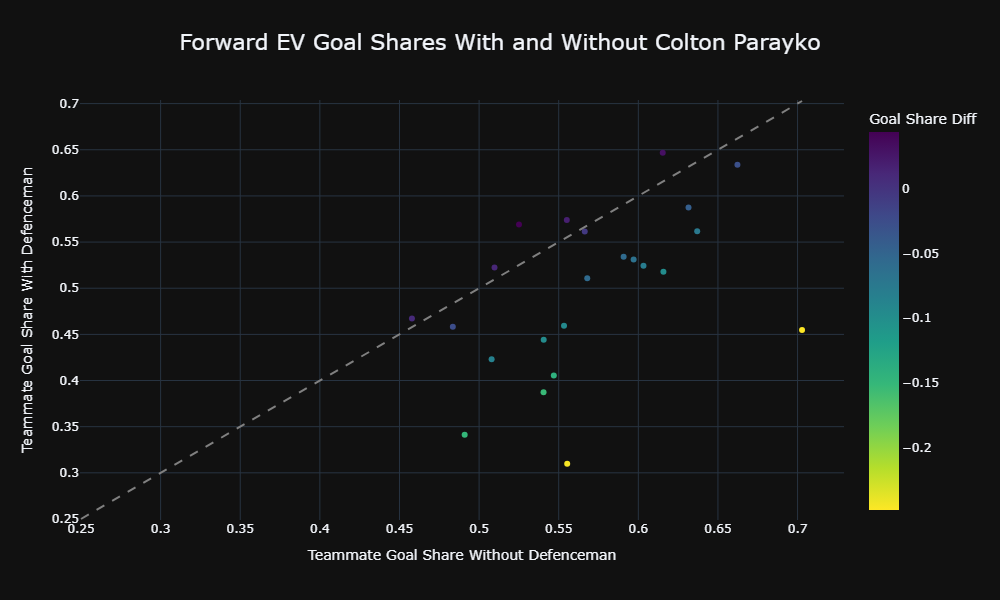
There are 23 forward seasons represented on that chart. Of those 23 seasons, there were only five instances when the team had a better EV goal share when the forward was on the ice with Parayko than without him. Not only that, but of the five times a forward performed better with Parayko, the goal-share difference compared to the minutes without him never exceeded 5%. Conversely, there were 14 times when the forward’s goal-share difference without Parayko exceeded 5%. Maybe he has a late-career resurgence, but if not, the player Parayko was in 2019 is nowhere near the player he is in 2026, regardless of what Olympic rosters or NHL usage have to say.
Justin Faulk (Detroit Red Wings)
Much like Parayko, there were several years earlier in Faulk’s career where he was a genuine top-pair defenceman. It has been several seasons since that has been the case, though, and he is now 34 years old with over 1100 combined regular season and playoff games. Unlike Parayko, the results haven’t been all that bad.
Using the same chart for Faulk as we just demonstrated with Parayko, here are the goal shares for different St. Louis Blues forwards when they were on the ice with Faulk, and when they were on the ice without him:
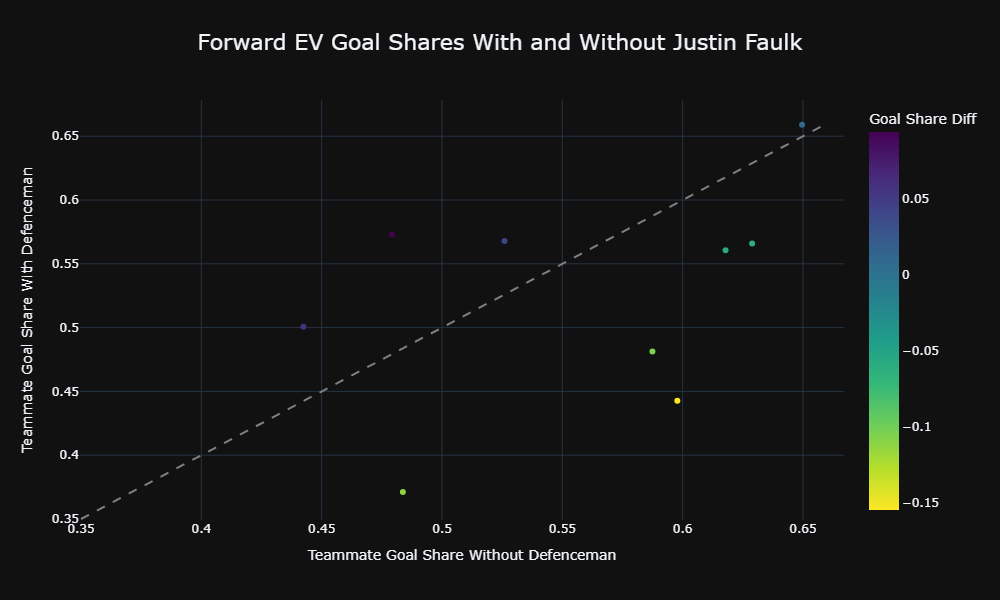
There are fewer data points here, and the split is a lot more even. However, as with Parayko, those that were better with Faulk on the ice were generally overshadowed by what happened when Faulk was off the ice: there were three times when a Blues forward had a goal share over 10% higher without Faulk on the ice (Jordan Kyrou in 2022-23 and both Brayden Schenn and Pavel Buchnevich in 2024-25), but zero times when a Blues forward’s goal share was 10% higher with Faulk on the ice. Even if it’s a bit more evenly split overall, the top impacts show a wide disparity.
Ben Chiarot (Detroit Red Wings)
By HockeyViz’s Synthetic Goals measurement, which provides an estimate for overall player value, the last time Chiarot performed as just a bottom-pair defenceman in an 82-game season was before the COVID pandemic. Sometimes, it’s hard to align what a team sees in a player with what is actually going on, and Chiarot is a poster boy for that. Using the same chart style, here is how Detroit has performed when Chiarot has been on or off the ice with/without various forwards:
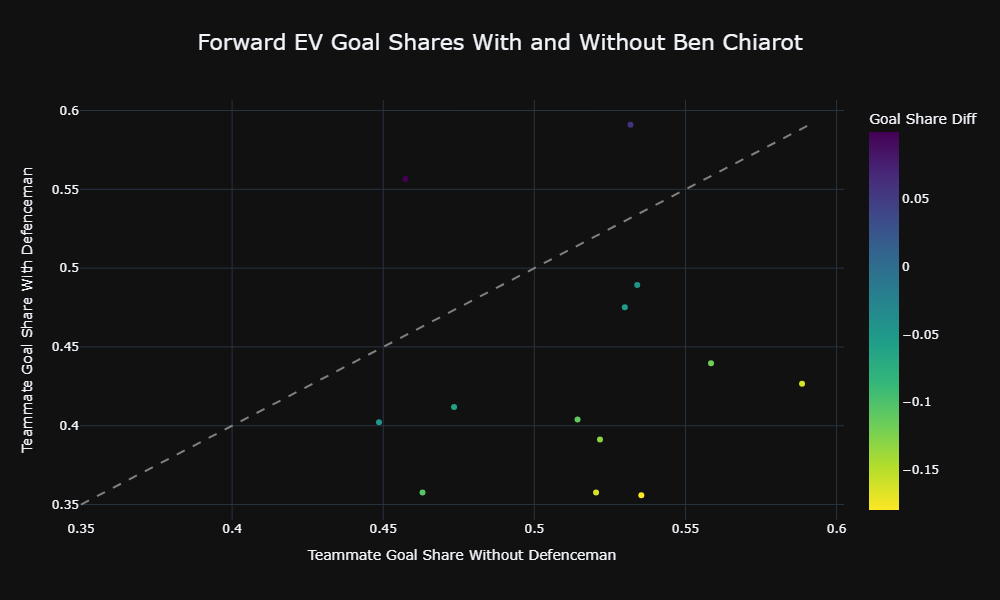
Of the 13 data points, a forward had a higher goal share with Chiarot on the ice than without him just twice (Alex DeBrincat and Andrew Copp in 2025-26). Even those two individual seasons never saw a goal share difference higher than 10%, but there were seven times when the goal share difference for a forward without Chiarot on the ice was 10% higher. Additionally, those instances range from middle-6 forwards like J.T. Compher and Marco Kasper to top-line forwards line Dylan Larkin and Lucas Raymond. That Chiarot has been a regular number-2 or number-3 defenceman in Detroit for years is a mystery for which even the Hockey Gods have no answer.
Jake Middleton (Calgary Flames) & Ryan Lindgren (Seattle Kraken)
We will finish things with a pair of defencemen who had good seasons earlier in their career but had poor years in 2025-26. Middleton was traded to the Flames this offseason while Lindgren signed with the Kraken last season, and it’s a wonder how they can help their new(ish) teams. Here is how forwards fared with them on and off the ice at even strength in each of the last five seasons:
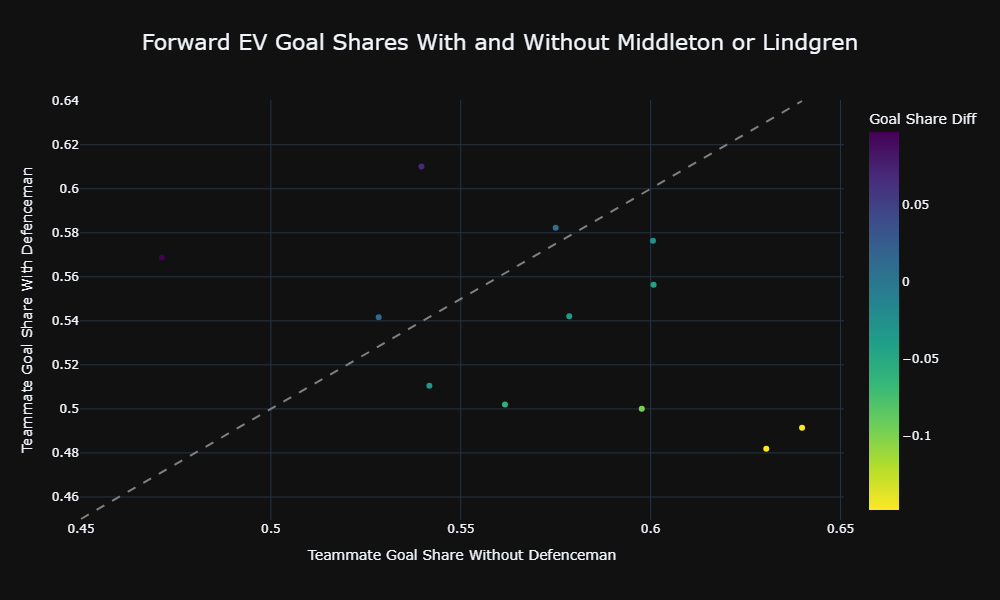
There are 12 data points. Of those 12 points, there were eight times when a forward’s goal share without their respective defenceman on the ice was at least 2% higher compared to just twice above that mark with them. The three highest values without a defenceman all belong to Middleton from the 2023-24 season, and they were across both top two lines. Here is the kicker: none of the data points are from the 2025-26 season, which was Lindgren’s worst year by RAPM goal differential and Middleton’s second-worst year, ahead of only 2023-24.
These are just five specific defencemen from across the league, but I thought it was worth providing concrete examples of how poor offensive defencemen can hurt their teams. Even good defensive defencemen, which Parayko and Middleton have been, cannot make up for their lack of offensive skill. There is a lesson here, but we should also say a brief prayer for Detroit Red Wings fans. Chiarot and Faulk in the same lineup? Good luck.
Next week, we'll wrap up the series and provide some thoughts on where we go from here.