10 Interesting (To Me) Stats For This Week - October 27, 2026

Welcome back to another week of ’10 Interesting (To Me) Stats’. We are a month into the season and while the samples aren’t large yet, there are still some trends we can dig into.
The sweet spot for goal scoring is volume and efficiency. Creating a lot of shots, and the shots being high-quality, is where production really soars. For example, from 2023-2026, forwards who A) had an above-average rate of unblocked shot attempts per 60 minutes at 5-on-5 and B) had at least a mid-first line rate of unblocked attempts per expected goal wound up scoring about 21% more goals per 60 minutes at 5-on-5 than the league average.
Today, let’s look at those things. We will cover which forwards have an above-average rate of unblocked shot attempts per 60 minutes at 5-on-5 (Fenwick) and whose unblocked shot attempts per expected goal are in the top-50 of the league. There is a minimum ice time of 100 minutes (about 10 forwards per team) and data is from Natural Stat Trick. We are looking for players in the top-right quadrant of the following graphs, and the size of the team logos reflects the 5-on-5 ice time per game of each player; the larger the logo, the more ice time per outing.
1 – Joel Eriksson Ek (Minnesota Wild)
Eriksson Ek’s shot quality typically isn’t great, but he has been often skating on a top line with Kirill Kaprizov and Matt Boldy this season, and it shows as he has by far the lowest rate of unblocked attempts per expected goal among Wild forwards:
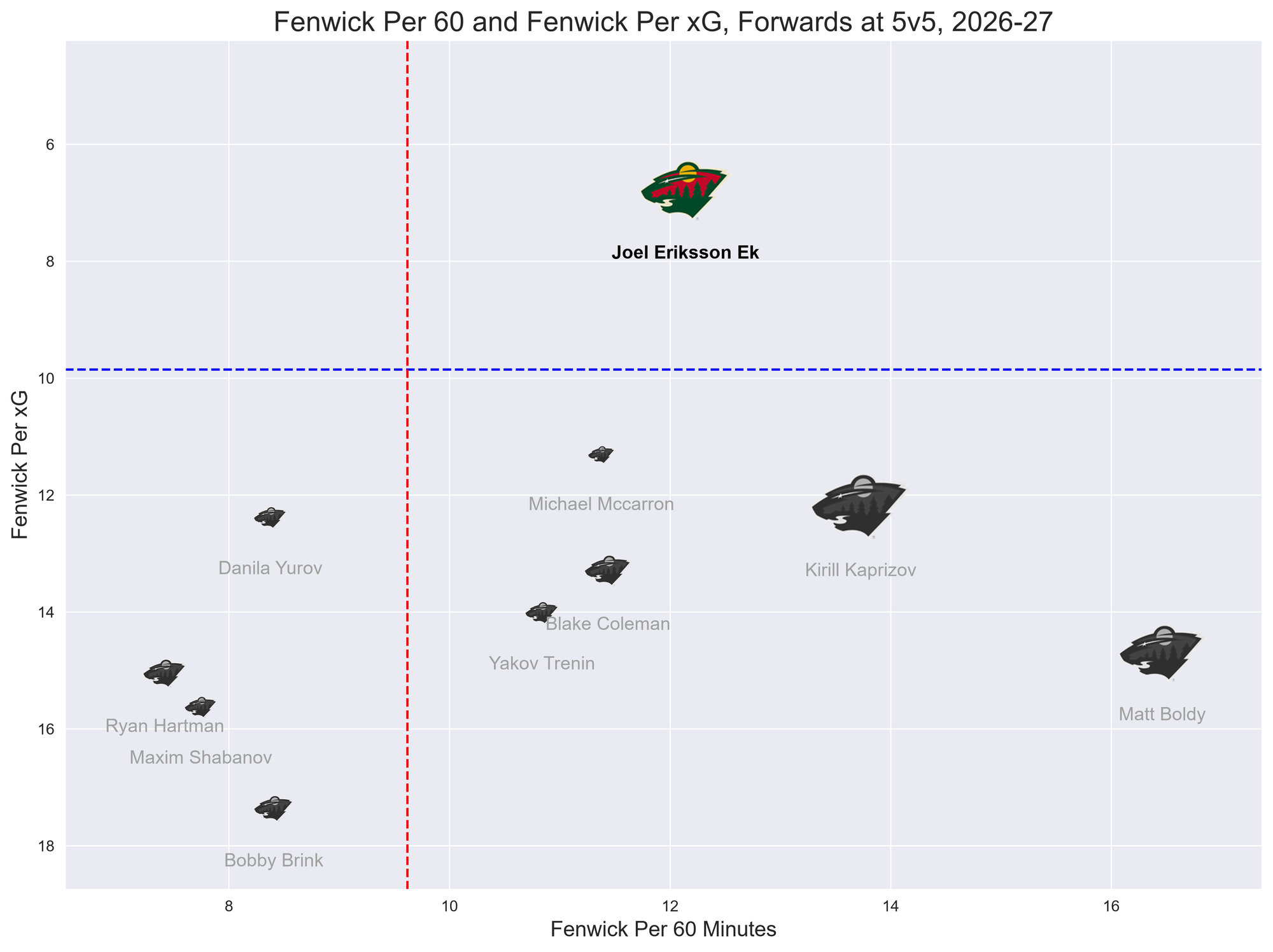
It hasn’t translated to goals yet as he’s scored just twice at 5-on-5 in 13 games played. He generally is an average 5-on-5 goal scorer, so this isn’t new, but this is also within the context of a season where he’s creating tremendous efficiency with his shots. He won’t stay at this level, but if he can keep even 75% of this efficiency, it is hard to not see his modest goal-scoring rate really taking off.
2 – Phillip Danault (Montreal Canadiens)
Danault is typically better with efficiency than Eriksson Ek, but not by a lot, being about league average over the prior three seasons. However, his third line with Alex Texier and Zach Bolduc has been creating a lot of quality shots which has elevated Danault’s shot rate and efficiency:
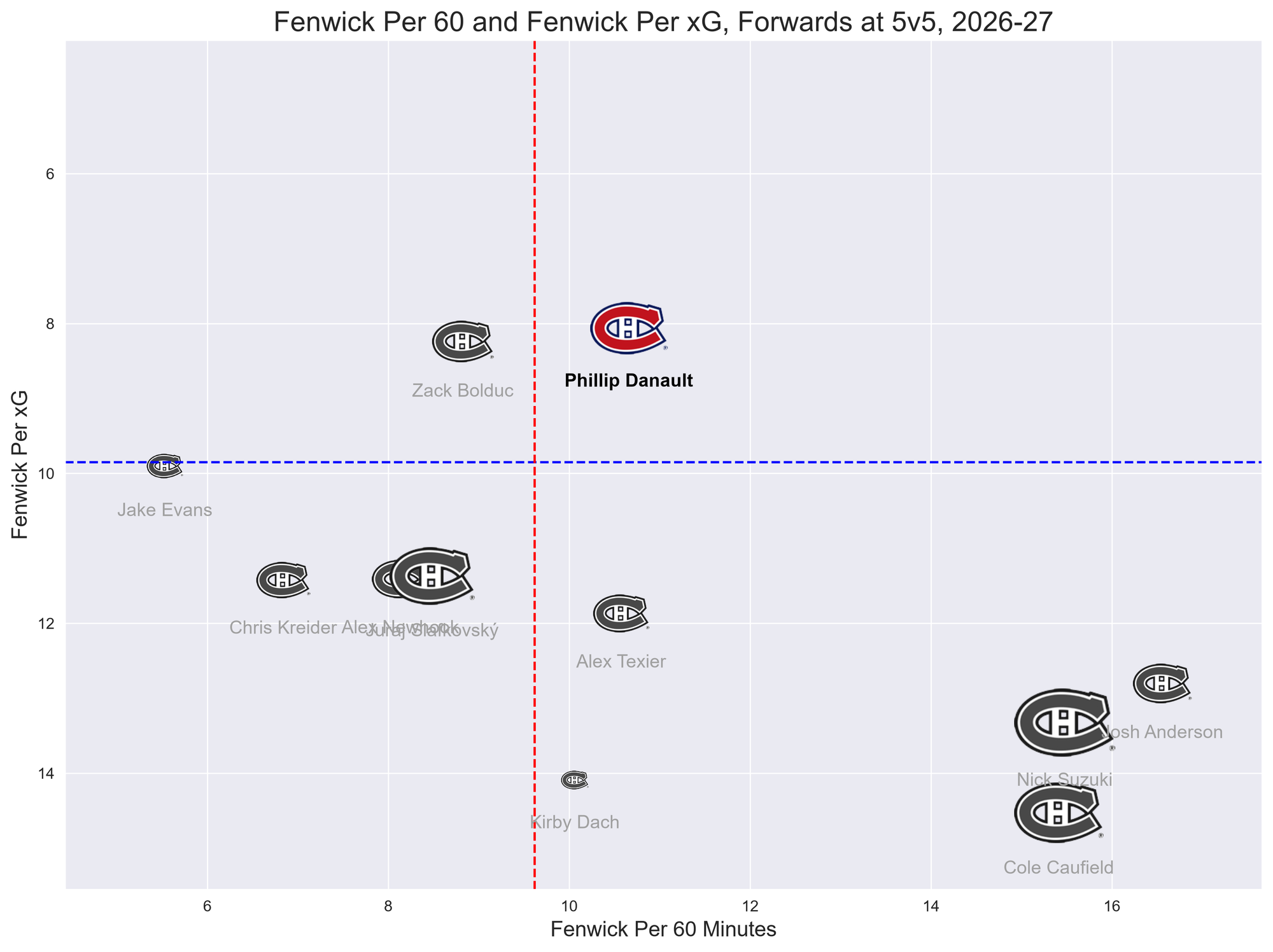
Danault has yet to score at 5-on-5 this season, but it’s certainly not for lack of trying, or lack of quality. He shot under 8% at 5-on-5 across the prior three seasons, so he’s unlikely to have a goal-scoring rate that matches his efficiency and expected goals, but he won’t remain this snakebit for much longer. With the team’s current injuries to Nick Suzuki and Ivan Demidov, depth scoring from someone like Danault would be most welcome.
3 – Victor Eklund (New York Islanders)
Out of the 50 forwards that are in consideration for this article, Eklund is the only rookie. He is on pace for a 25-goal season, which would be a great year from him. His solid goal-scoring start reflects creating both shot volume and shot quality:
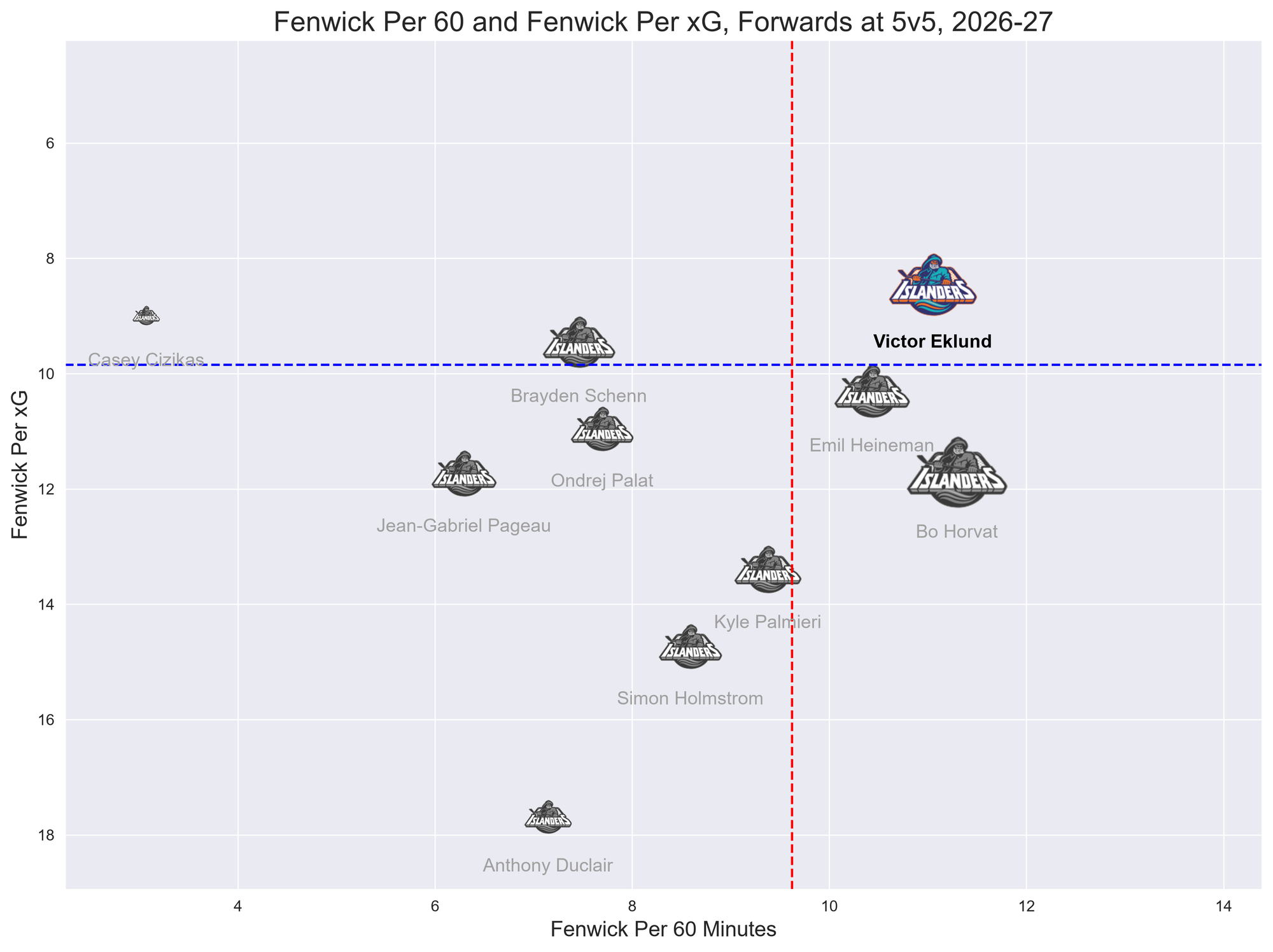
Eklund is technically fourth among Islanders forwards by 5-on-5 ice time per game, but after team-leading Bo Horvat, they have seven forwards within 30 seconds of each other, so the ice time is being spread around. Eklund is currently shooting 15.4% at 5-on-5, and that will come down, but this kind of volume and efficiency means that he’s a true 20-goal threat, which would be a great year for a rookie skating under 14 minutes a game.
4 – Alex Tuch (Washington Capitals)
The three players mentioned thus far are solid or below-average by 5-on-5 scoring. That is not the case with Tuch, who currently sits 2nd in the league by 5-on-5 goals per 60 minutes among forwards with 100 minutes played. Shooting over 31% at that strength is a big reason why, but he has shown very good volume and efficiency to go along with it:
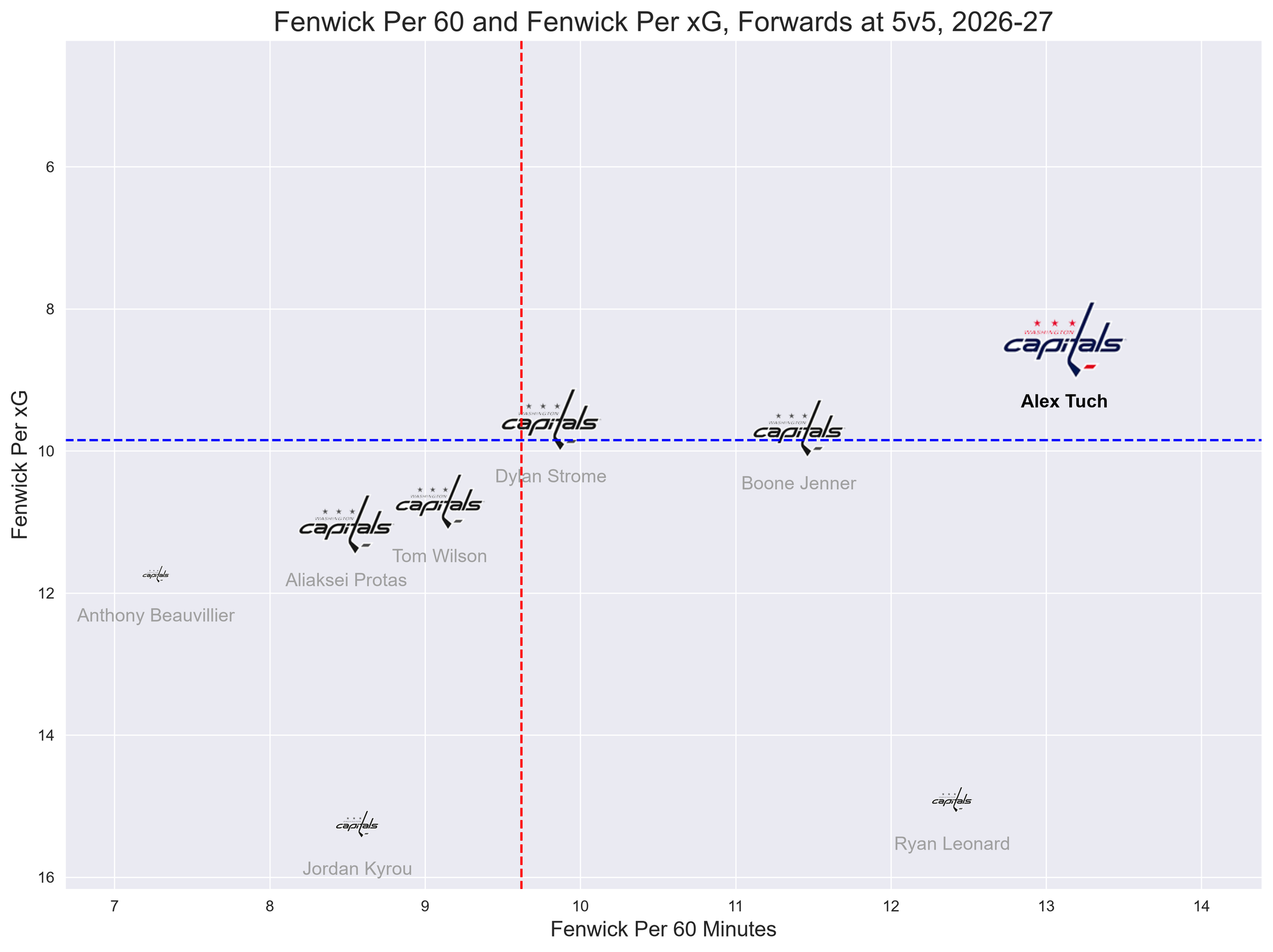
Tuch’s unblocked attempts per 60 minutes are around the 90th percentile of forwards, and his individual expected goal rate is inside the top-10. Washington gave him a large contract in the offseason, and that bet has paid off in a big way through the first month of the season. He won’t stay near this scoring level, but he averaged 35 goals per 82 games across the prior two seasons. If he can start producing on the power play, he might reach 40 goals for the first time.
5 – Nico Hischier (New Jersey Devils)
From 2023-2026, Hischier shot 14.4% at 5-on-5 in 228 games played. That he’s shooting under 8% to start this season indicates that he’s getting a bit unlucky, and that notion is reinforced by the shot volume and quality he’s produced so far this season:
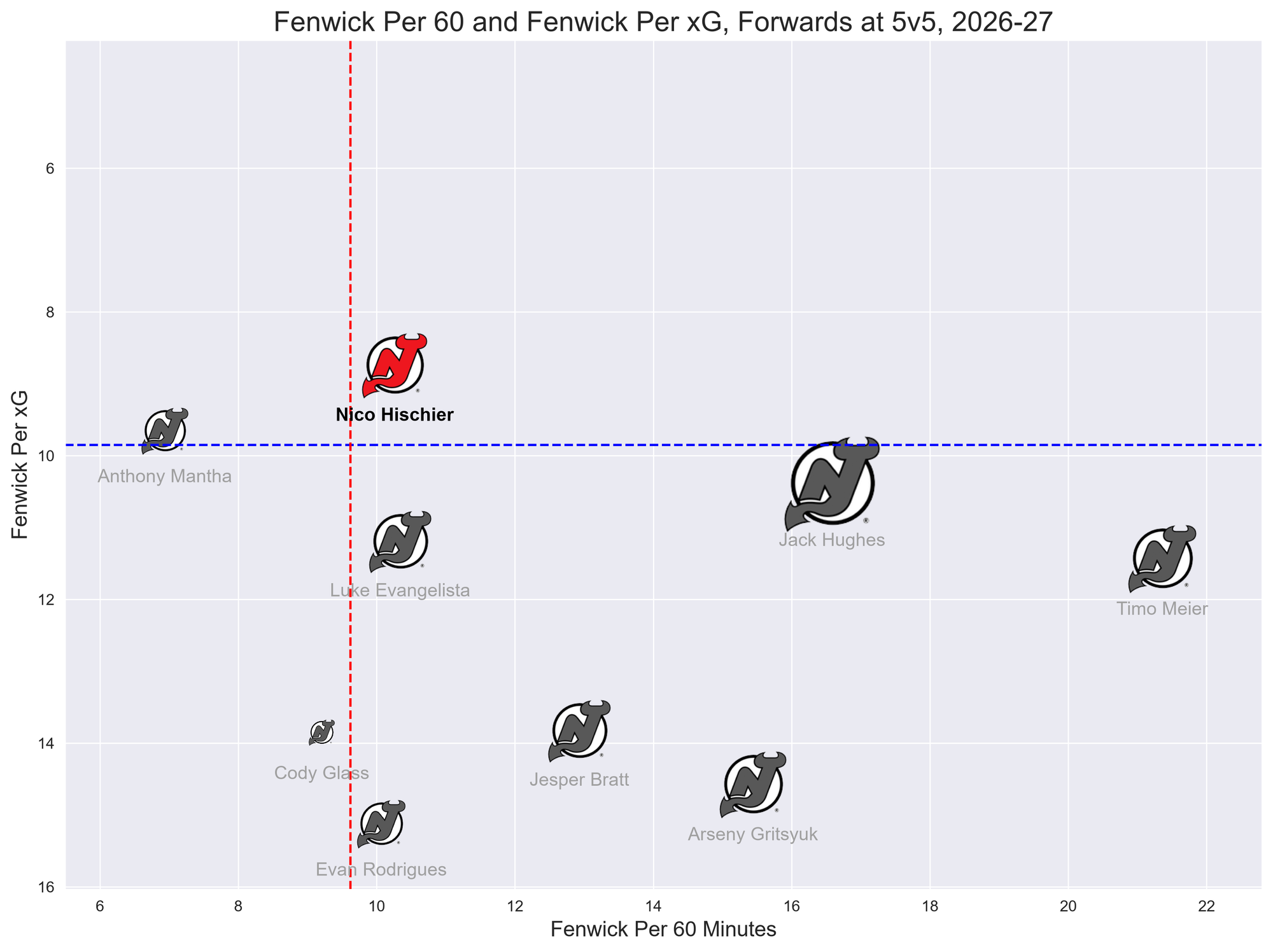
Hischier has five goals in 10 games, but four of those goals have come on the power play. He can’t keep up that rate all year, so he needs to do more at 5-on-5 to push for another 30-goal season, and perhaps even tempt 40 goals. If he can maintain this kind of volume and efficiency, his 5-on-5 scoring rate should increase from here on out, making his line with Timo Meier and Luke Evangelista a very dangerous three-man unit.
6 – Gabe Perreault and Will Cuylle (New York Rangers)
One is a highly-skilled rookie skating on the top line, the other is a physical power forward skating on the third line, but both have shown excellent shot volume and efficiency to start the season:
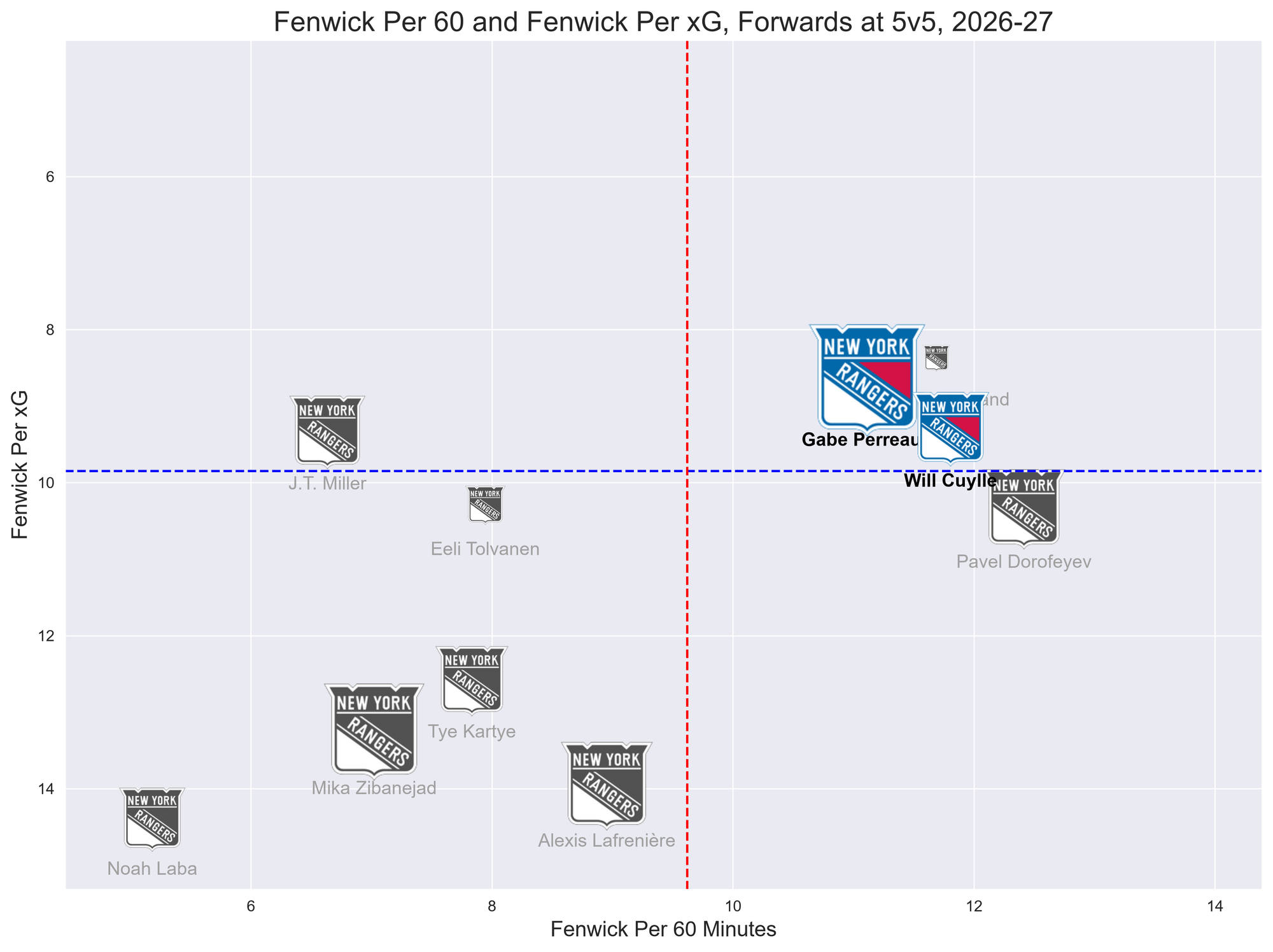
For posterity, the name underneath them is Oliver Bjorkstrand, who is off to a great start but is on the fourth line and shooting over 26%.
Unlike many names on this list, Perreault and Cuylle are not having goal problems as both are scoring at low-end, top-line rates. It might be flying under the radar because of Alexis Lafrenière’s tremendous production, but both Perreault and Cuylle have the volume and efficiency numbers to back up their scoring. If the Rangers can get great production from stars like Mika Zibanejad and Adam Fox, and then also get production like this from their ‘secondary’ offensive weapons, this becomes a very balanced, and dangerous, offensive squad.
7 – Jack McBain (Utah Mammoth)
My preseason fantasy projections were high on McBain, a lot having do with his projected hit volume, and he does have a whopping 52 hits in 11 games, fifth among all forwards. He has just one goal, though, but it’s not for lack of volume or lack of efficiency:
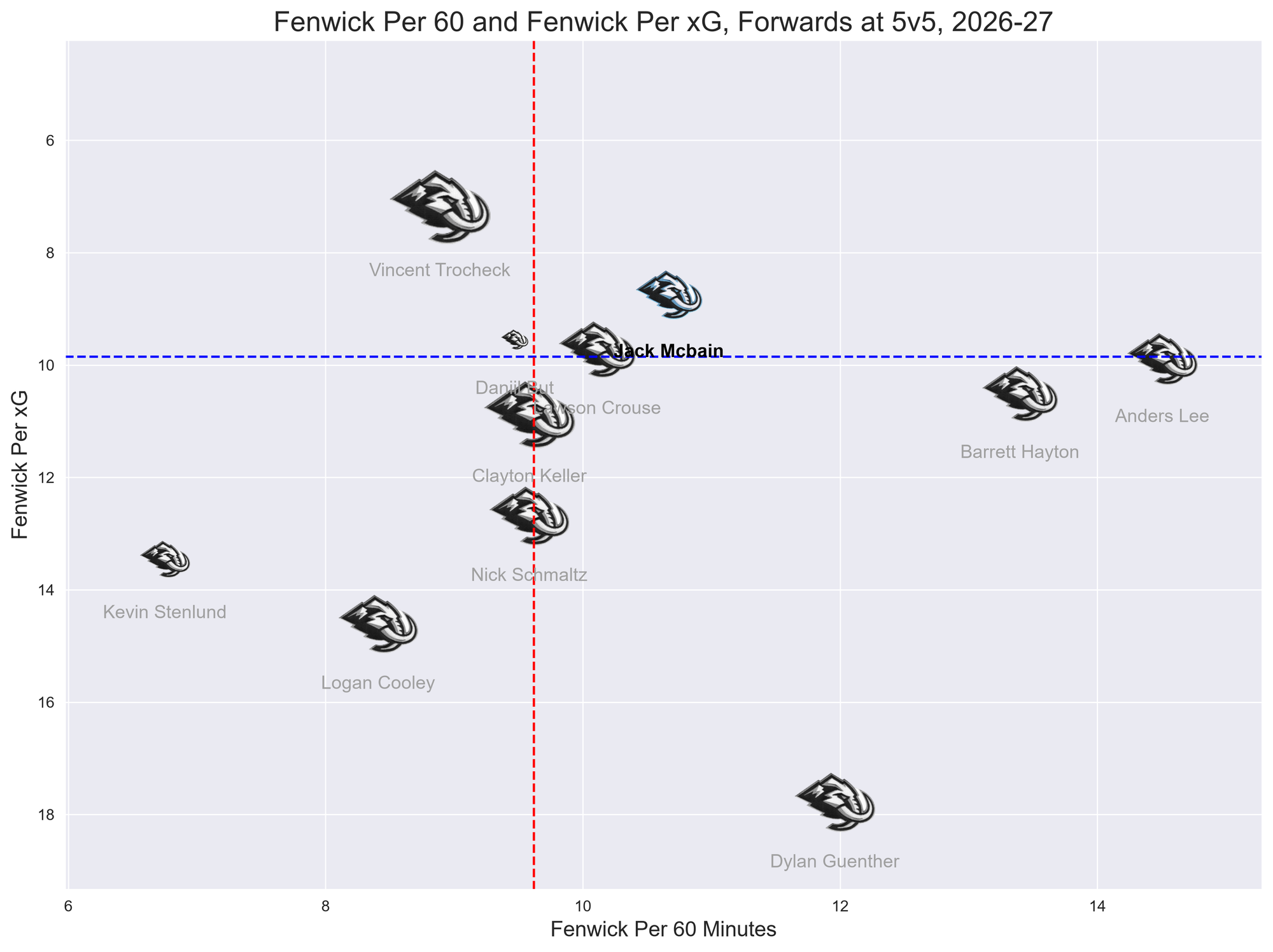
A big problem is missing the net: just 46% of his unblocked shot attempts have landed on goal. Across the prior two seasons, that number was nearly 64%. A lack of ice time means he won’t post a high goal total, but once he starts landing more shots on target, this is a guy who can reach at least 10 goals, if not push for 15, from a fourth-line role. That is very good news for the Mammoth.
8 – Mason McTavish (St. Louis Blues)
It has been a great start for McTavish’s Blues tenure with 6 goals and 4 assists in 10 games. That he’s shooting 19.4% is a big part of why he’s scoring so much, but as with Tuch earlier, that is also a reflection of very good volume and efficiency:
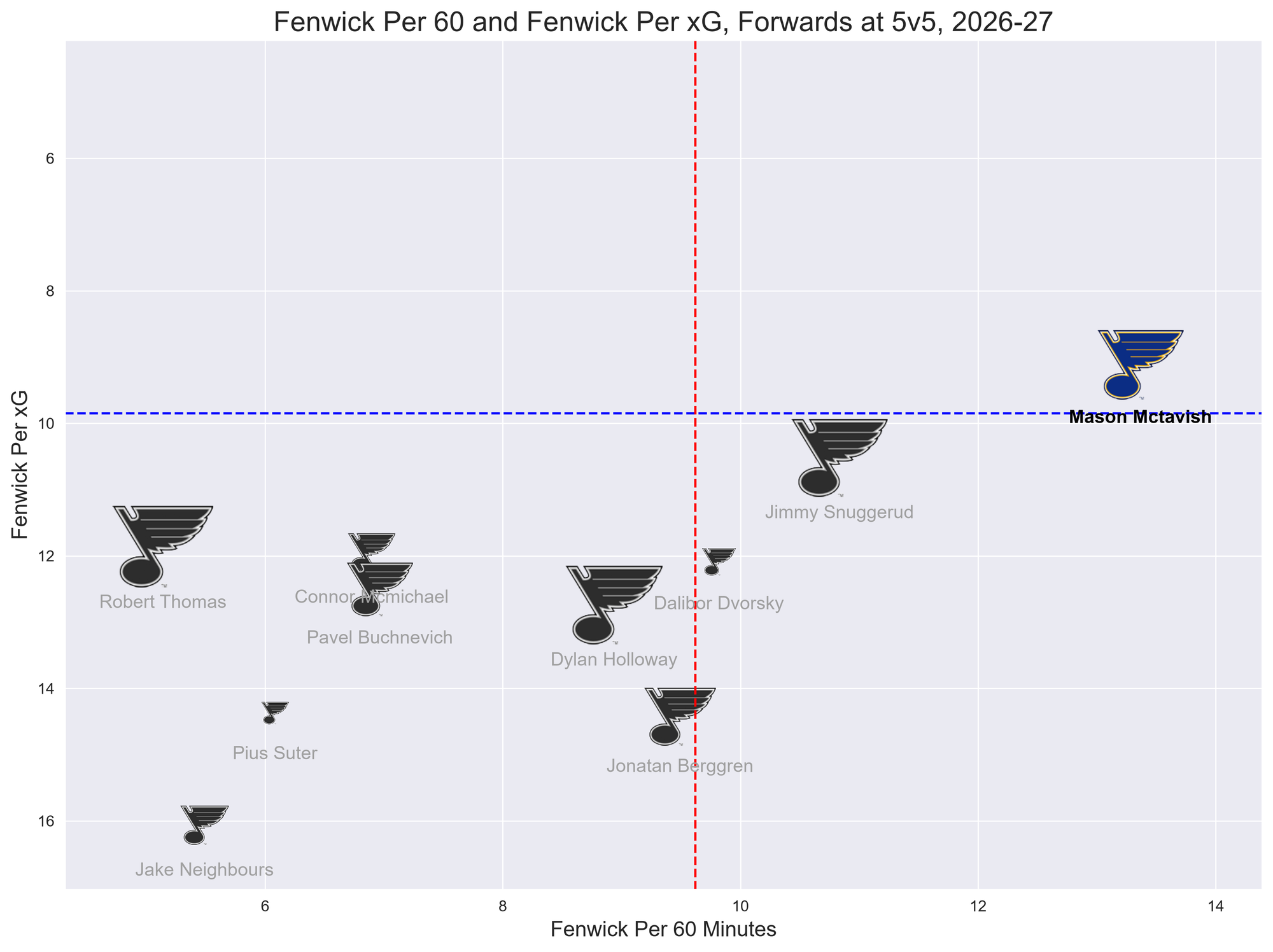
It should be a concern for the Blues that several of their forwards are in the bottom-left quadrant, and McTavish won’t stay at this goal-scoring level skating 16 minutes a night, but the team couldn’t have asked for more from him through his first 10 games of the season. It has helped keep the Blues from falling too far behind in the playoff race as they wait for the top line to get going.
9 – Zach Benson (Buffalo Sabres)
We have seen several players create good volume and efficiency yet struggle to score through the first four weeks of the season, and with zero goals at 5-on-5 this season (or at all, for that matter), we can add Benson’s name to the list:
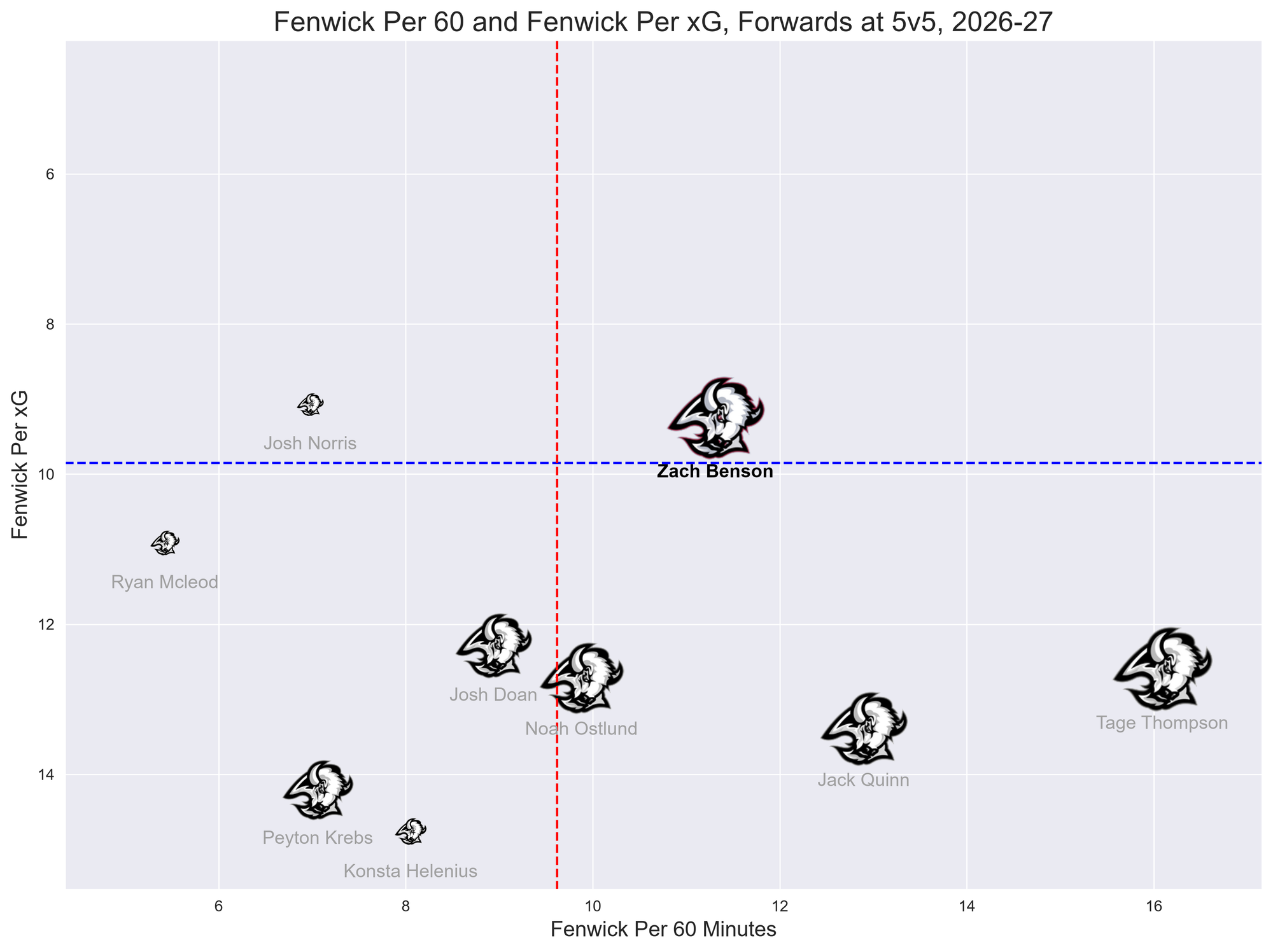
It is fair to wonder how much of the shot numbers is Benson and how much is skating on that great second line in Buffalo, because his unblocked shot rate is up 27% from his career average. All the same, he is an excellent young player and he’s undoubtedly a big reason why that line has found so much success. If he can hold on for anywhere near this kind of volume and efficiency, the goal-scoring will take off sooner rather than later.
10 – Ryan Winterton (Seattle Kraken)
I love doing these lists because we inevitably get a few ‘that guy?’ names to sift through. Winterton is one of those names as he’s been able to create good volume and efficiency so far this season:
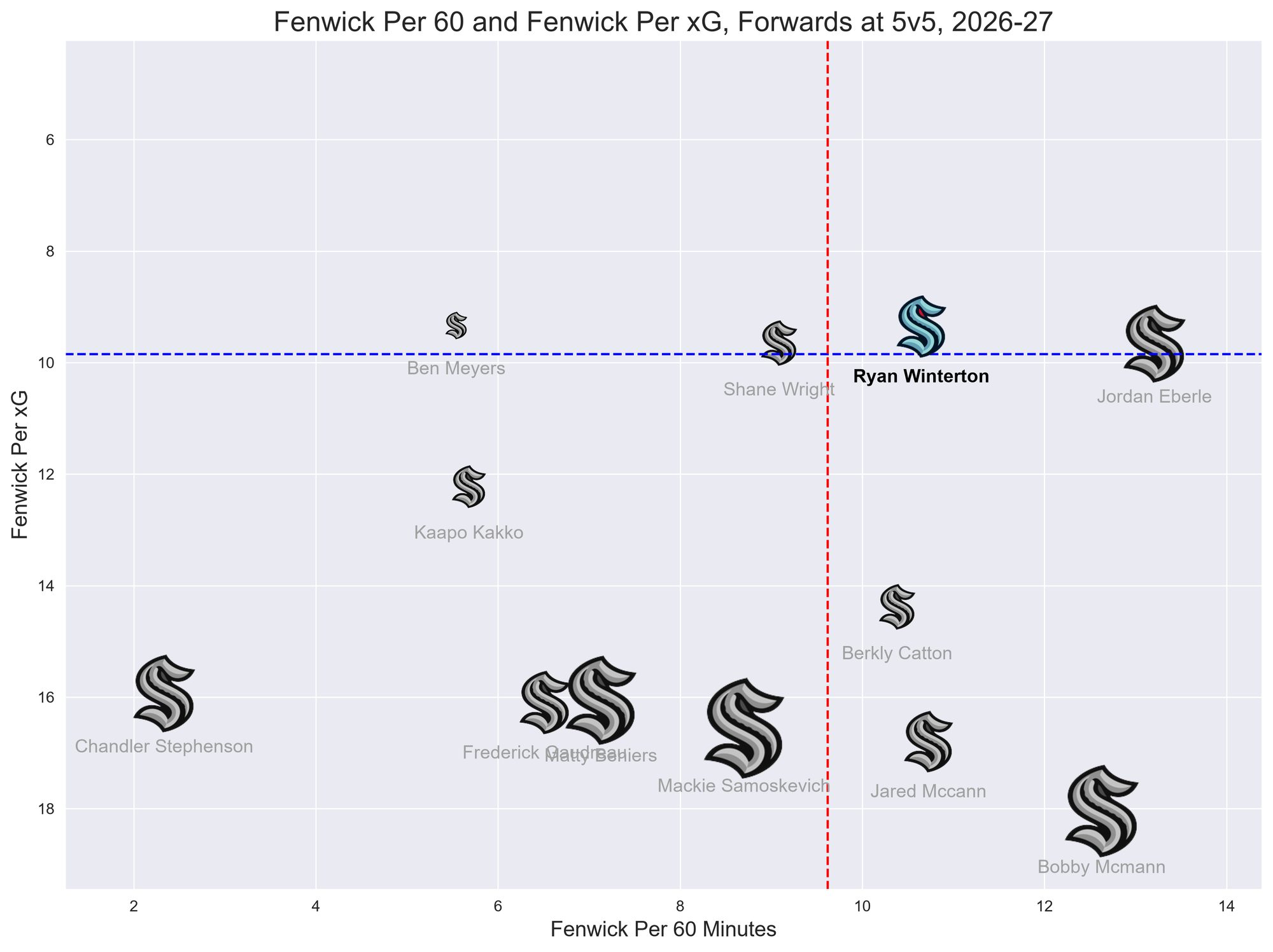
Winterton’s goal-scoring rate is above average but not great, but the interesting part is that going back to the start of the 2024-25 season, he has 0.95 primary assists per 60 minutes at 5-on-5 in 92 games played. That is second among Kraken forwards and a very high rate across the league. I am skeptical he stays that high, but even 75% of that assist rate would be that of a top-line forward. And if he can do that while holding onto his above-average goal scoring? The Kraken might have a genuine diamond in the rough here.
Until next week.