10 Interesting (To Me) Stats For This Week - October 13, 2026

Welcome back to another week of ’10 Interesting Stats’. We are two weeks into the NHL season, and while the samples are very small, there are ice time trends we can key in on. Last week, we looked at early shared ice time between specific defencemen and their team’s forwards. With the benefit of a few more games from each team, we’re doing the same thing this week.
The boxes in the following charts show the percentage and total TOI of a defenceman’s minutes spent with specific forwards. We are doing this to see if we can see why some early-season trends for offensive opportunities (or the lack thereof) are showing up.
Data is scraped from NHL play-by-play and charts are my own. Additional data from Natural Stat Trick.
1 – Zach Werenski and No One (Columbus Blue Jackets)
Sometimes, sharing ice time isn’t about overloading one specific duo, but spreading the ice time. That is what’s going on with Werenski and the Columbus forwards as he hasn’t spent one-third of his EV ice time with any single Blue Jackets attacker:
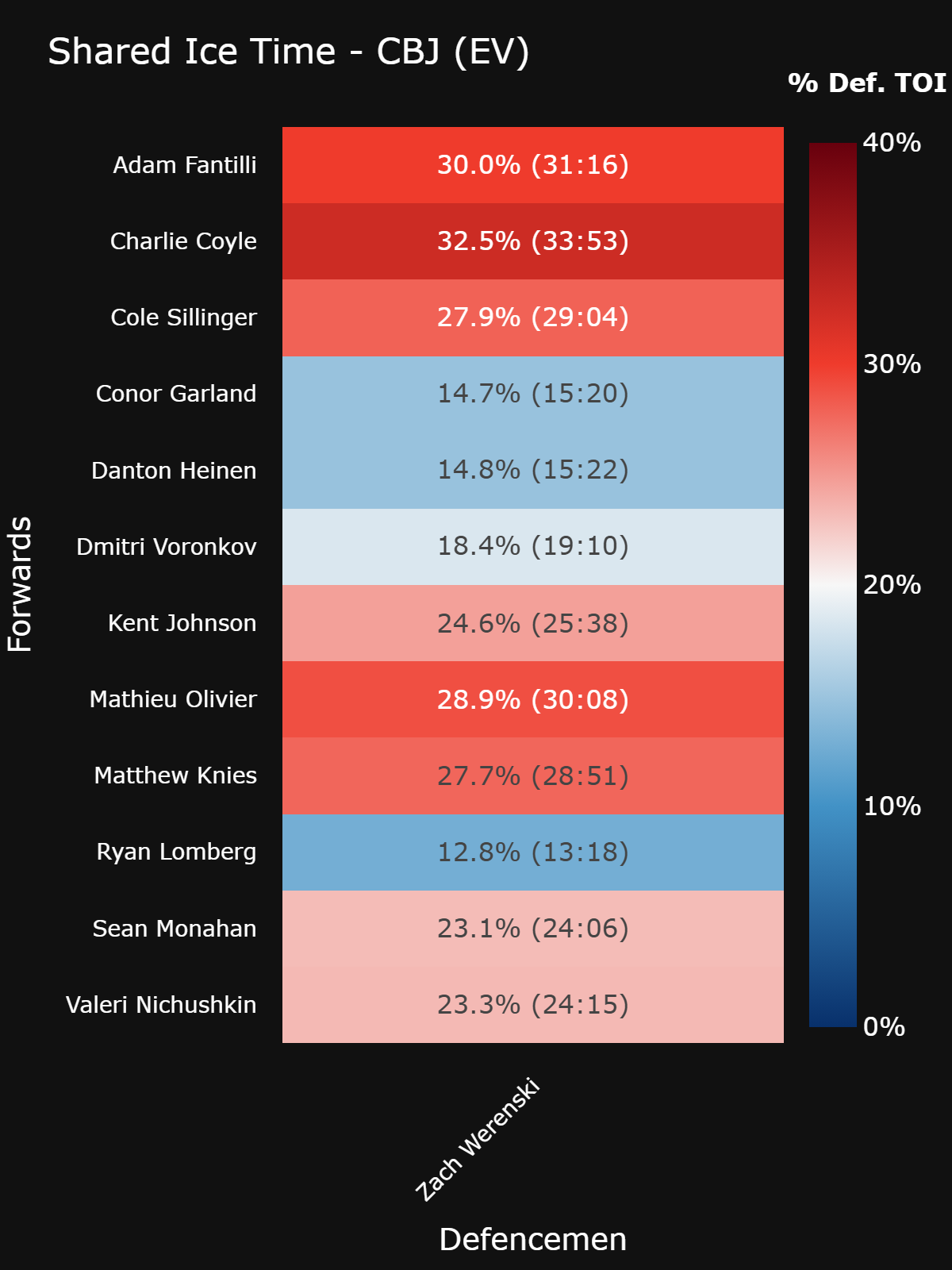
This was the case last year, too, as Werenski’s most-common forward line mate was Adam Fantilli, and that constituted less than 33% of Werenski’s even-strength ice time. This can help raise the scoring floor of their secondary and tertiary scoring options, but it can also limit the offensive upside of guys like Fantilli and Matthew Knies as they get more ice time with the likes of Erik Gudbranson and Jake Christiansen.
2 – Bowen Byram and Patrick Kane (Chicago Blackhawks)
In contrast to Werenski, there is some heavy overlap in Chicago between their top defenceman and their (ostensibly) top winger, as Kane has been on the ice for nearly 50% of Byram’s even-strength ice time:
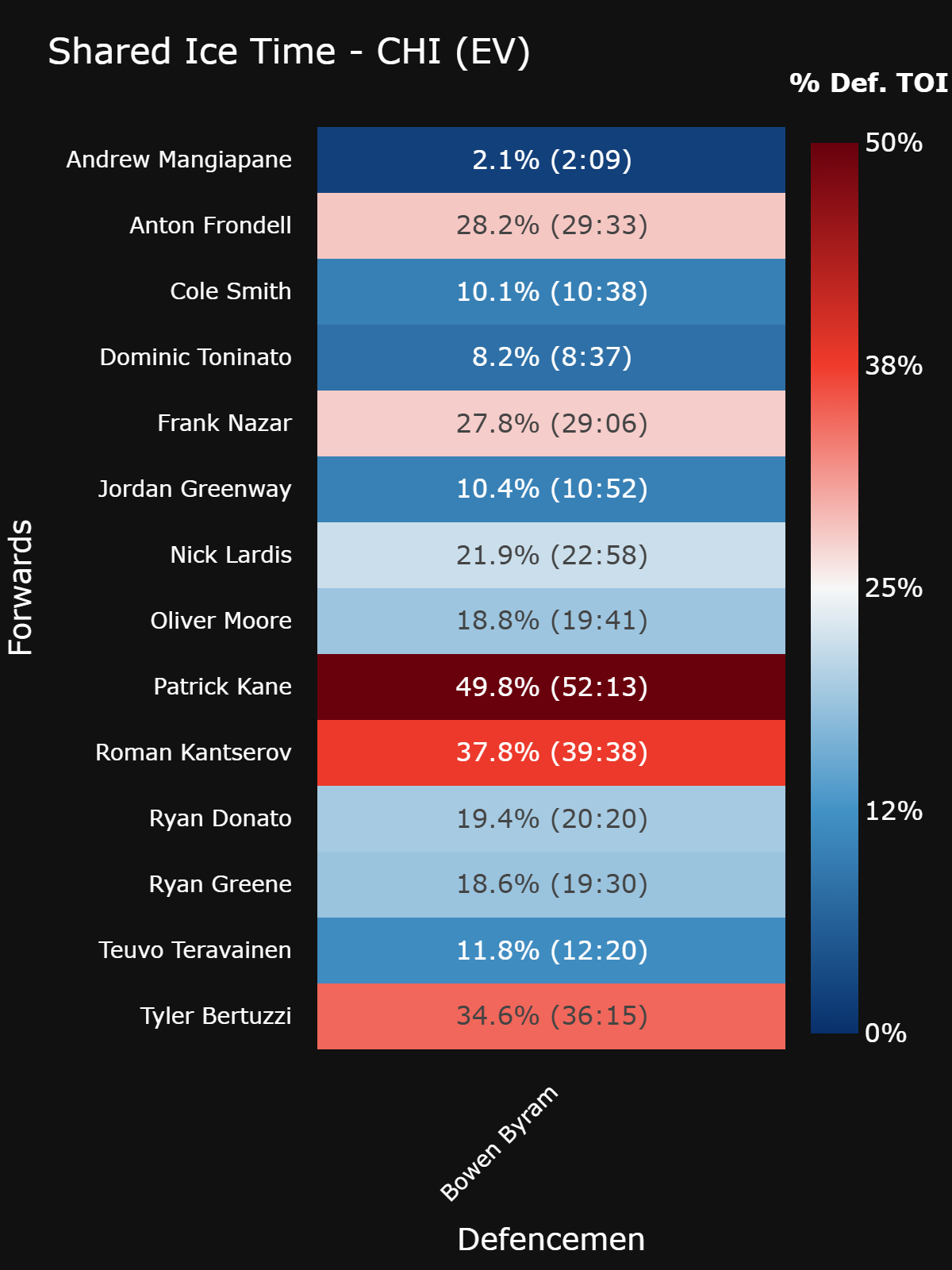
The goals haven’t been there yet, but Chicago actually has a positive shot attempt differential with those two on the ice at even strength (+49/-47). Considering the Blackhawks, as a team, have a -80 shot attempt differential at even strength so far this season, that duo being on the positive side of the ledger is a good sign. It is a wonder if their ice time sharing eventually changes to balance the rest of the roster, but this is encouraging to see in an otherwise discouraging start to their season.
3 – Miro Heiskanen and Mikko Rantanen (Dallas Stars)
Last year, Heiskanen’s most common forward at even strength was Jason Robertson and that represented about 38% of Heiskanen’s ice time. That is why it’s notable that so far this season, it is Rantanen that is Heiskanen’s most common forward, and with a larger ice time share:
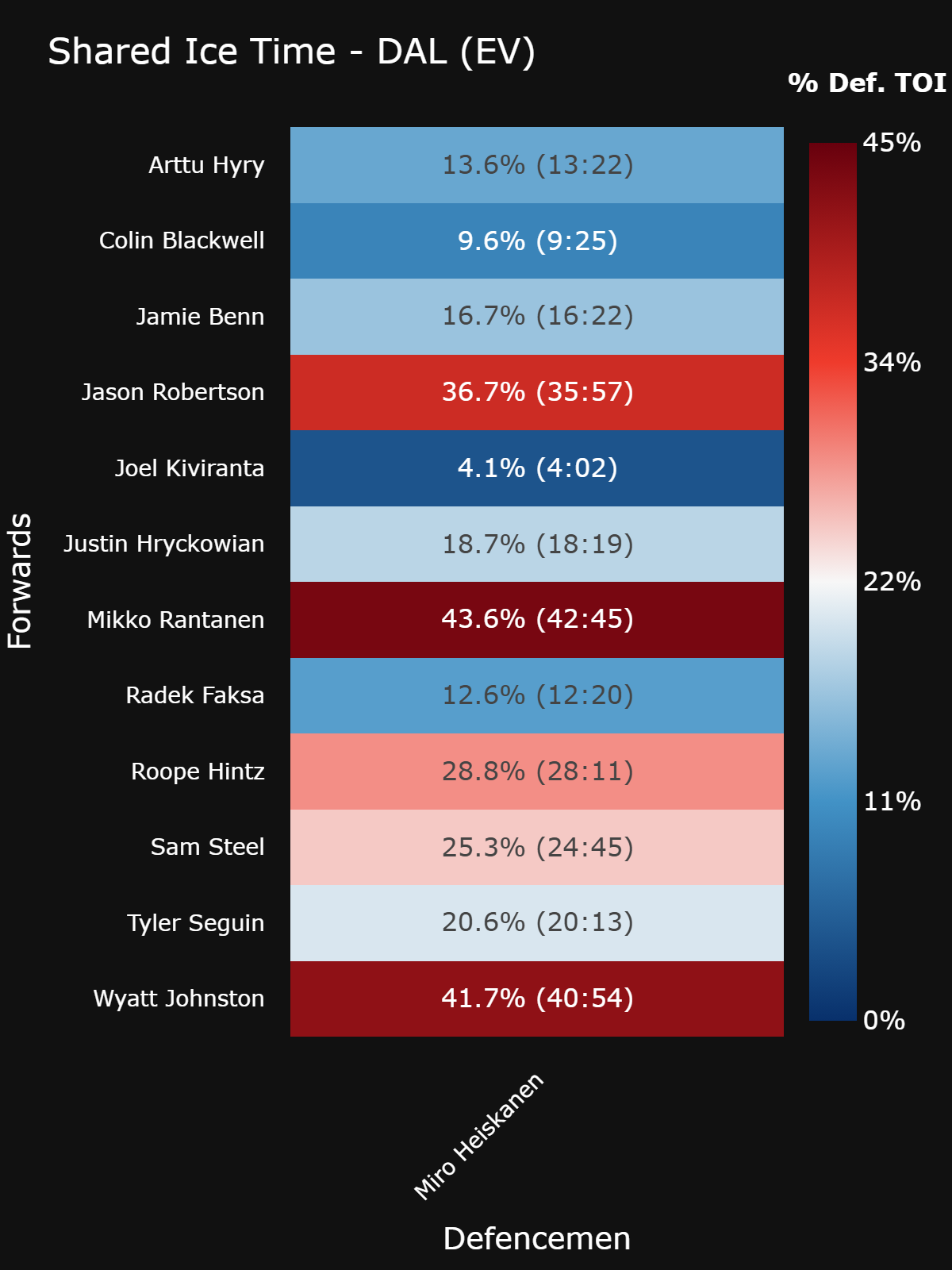
Heiskanen is more generally being used exclusively with the team’s top forwards, but it’s clear that the Stars want to use him, Rantanen, and Wyatt Johnston in some more shutdown minutes. The early returns of this usage are mixed, but Dallas isn’t creating a lot of shots at even strength, anyway, so the mixed returns apply to more than just Heiskanen and Rantanen.
4 – Jared Spurgeon and Kirill Kaprizov (Minnesota Wild)
The injury to Brock Faber has moved Spurgeon to the top pair with Quinn Hughes. Hughes typically plays with the top of the roster, so that means Spurgeon is now, too, and that is obvious when looking at his shared ice time among the forwards:
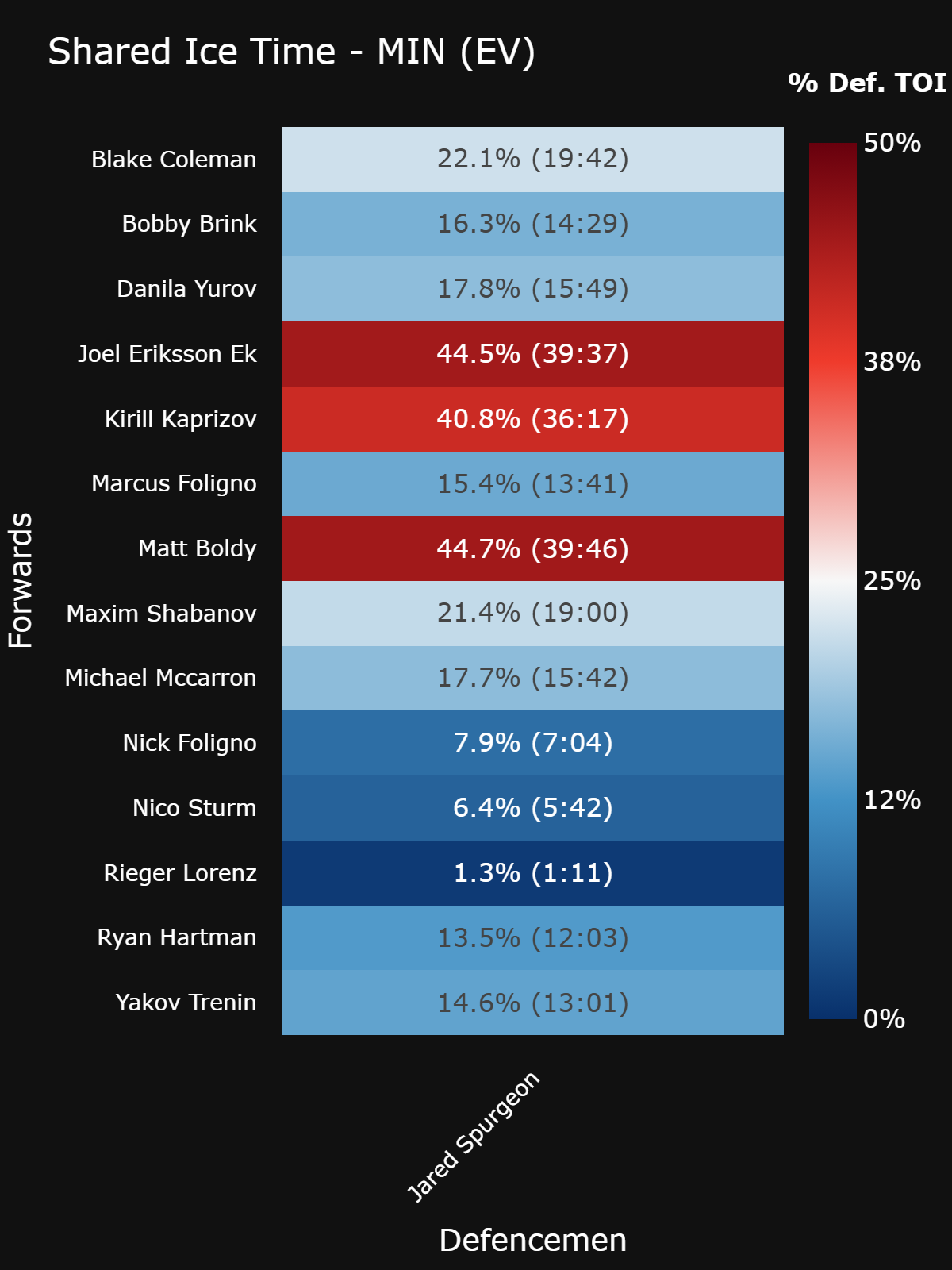
In 2025-26, Spurgeon managed just 0.28 points per game, his lowest rate of any season since his rookie 2010-11 campaign. So far in 2026-27, he has five points in five games, and skating so much with Hughes, Kaprizov et al. is certainly helping. This may only last until Faber returns, but his fractured skull injury has no timetable, so Spurgeon is going to be a big beneficiary of the unfortunate (and brutal) injury to his teammate.
5 – Jamie Drysdale and No One (Philadelphia Flyers)
Drysdale is a defenceman I had high hopes for this season, but he, along with most of the Flyers roster, has been a huge disappointment. That is why it’s worth highlighting how much (or little) Drysdale has played with top-of-the-roster forwards:
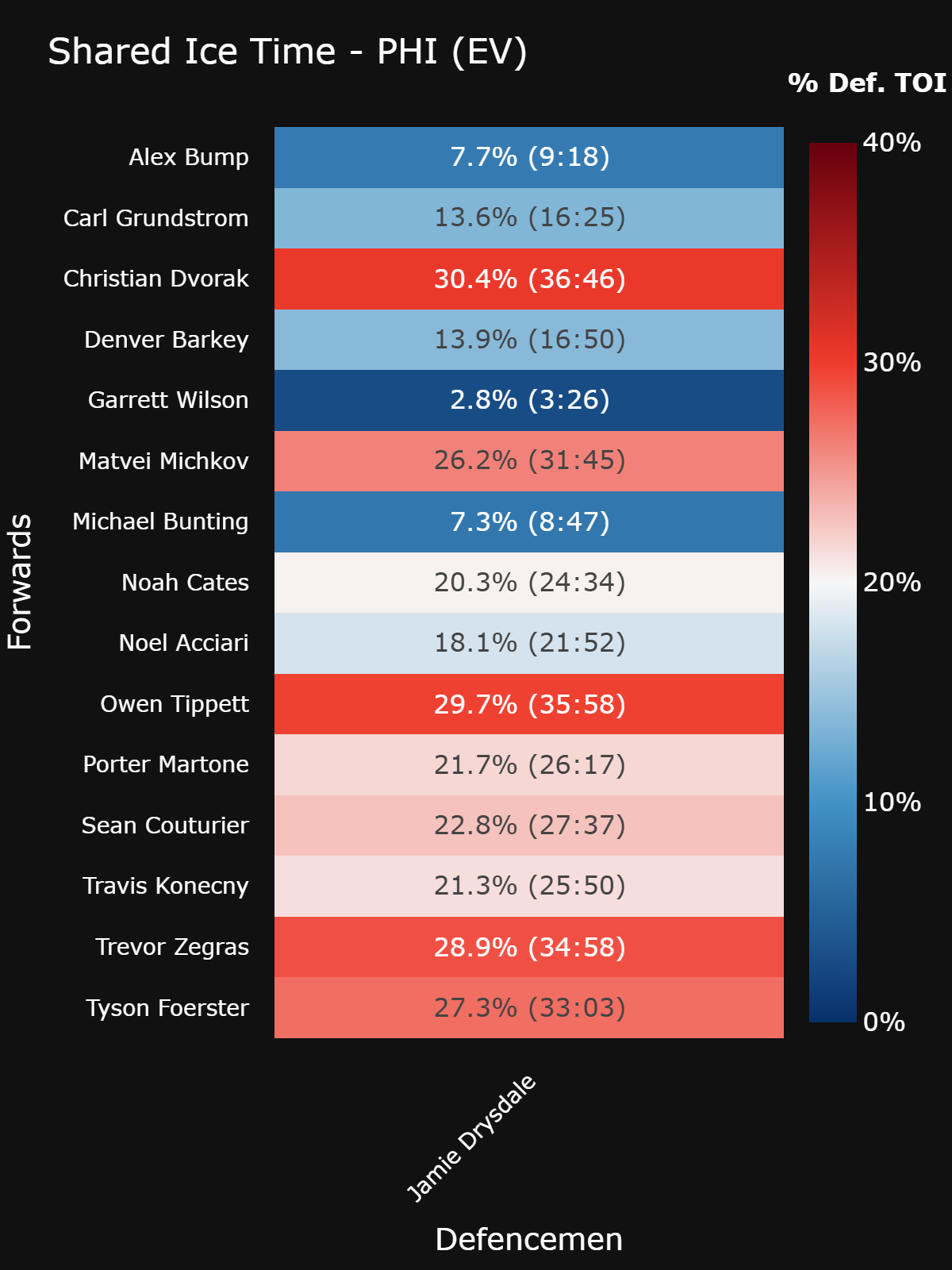
Drysdale has not spent one-third of his ice time with any forward, and only Christian Dvorak is over 30%. The Flyers are generating just 35.7 shot attempts per 60 minutes at even strength with Drysdale on the ice, last on the team’s blue line, and third-worst mark in the league. There is more to the Flyers’ woes than Drysdale having a poor start, but they need him to be a lot better if Philadelphia’s forwards are going to turn the ship around.
6 – Erik Karlsson and Sidney Crosby (Pittsburgh Penguins)
The Penguins were electric offensively with this duo on the ice at even strength last year, scoring 65 shot attempts and 3.9 goals every 60 minutes. It has been an entirely different story this year with 54 shot attempts and 2.8 goals every 60 minutes, which is why we should highlight the heavy overlapping ice time:
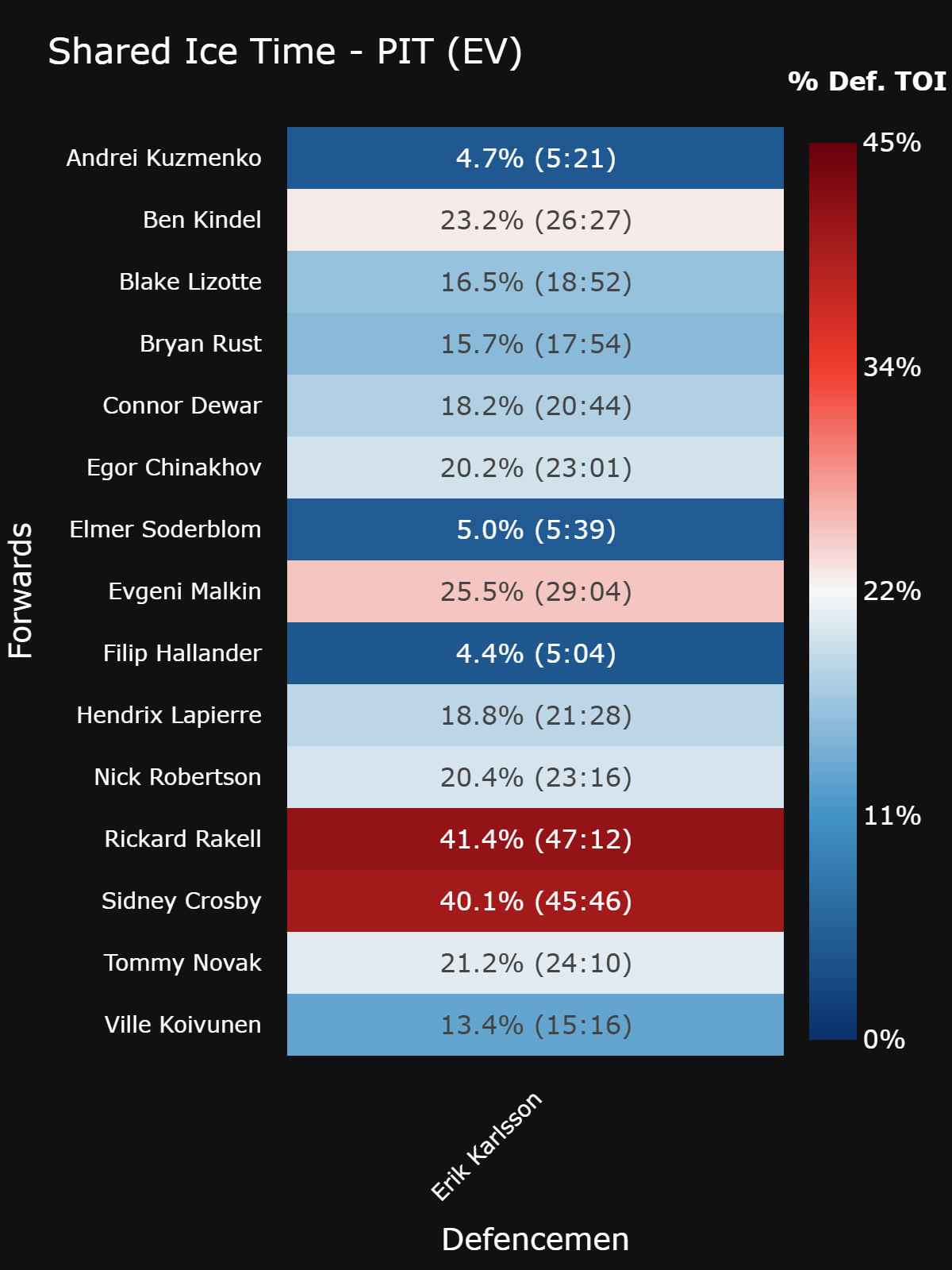
This isn’t a huge sample, so we’ll see where things stand in 4-6 weeks’ time, but each player has been more successful offensively without the other on the ice so far this season. They have earned the right to work this out, but in a hyper-competitive Eastern Conference, the Penguins cannot afford to have this duo be so pedestrian for very much longer.
7 – Philip Broberg and Robert Thomas (St. Louis Blues)
Last year, Broberg did not spend 30% of his ice time with any single Blues forward. So far this season, the top-line duo of Thomas and Dylan Holloway are both over 30% of Broberg’s ice time, with the former approaching 34%:
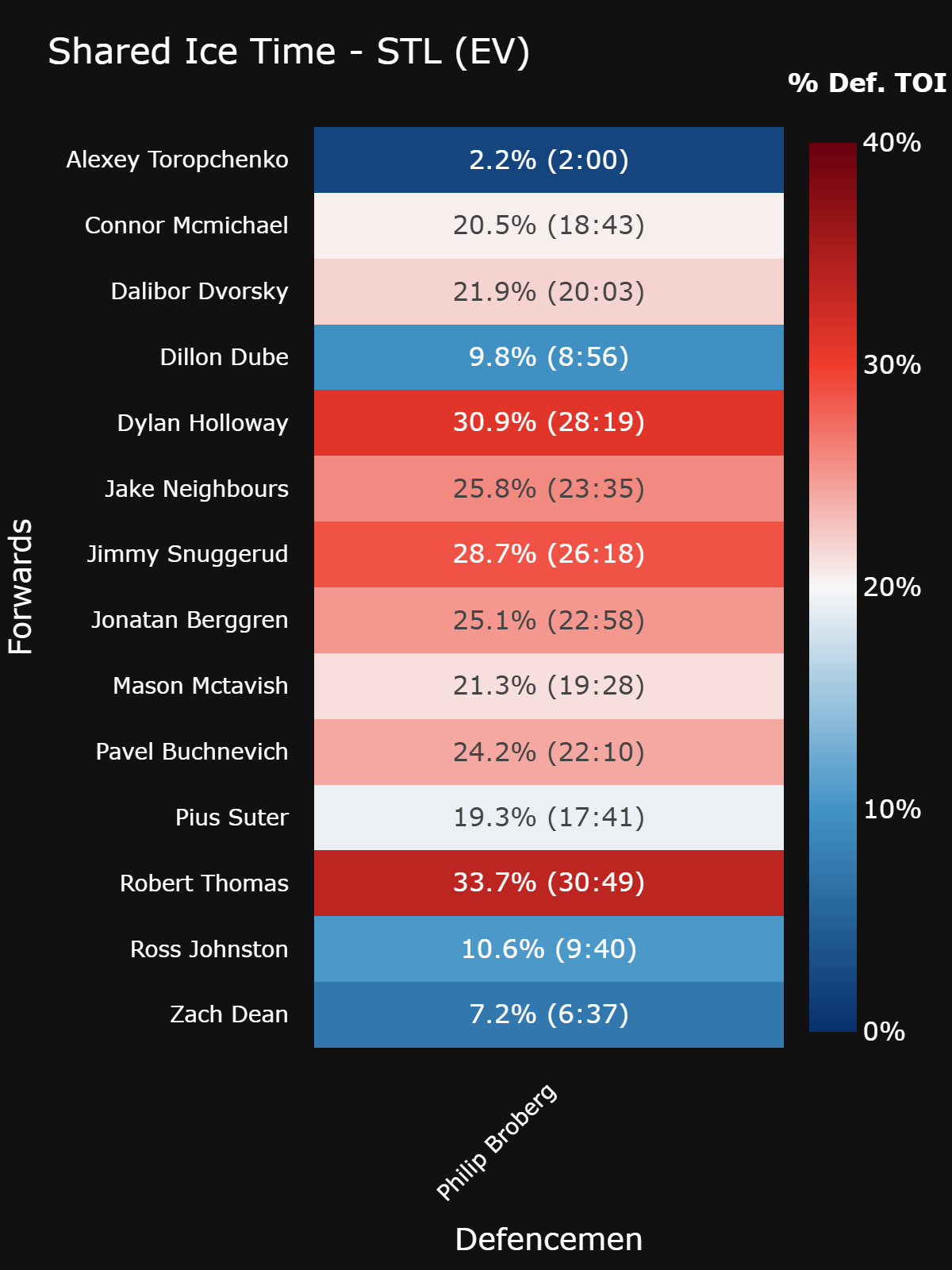
This isn’t a significant leap, but it is something to keep an eye on. Broberg is easily the best puck-moving blue liner that St. Louis has, and if he spends more ice time with Thomas and his top line, it’s the kind of symbiotic relationship that can raise the floor for all players involved. The Blues’ offence hasn’t taken flight yet, so maybe the coaches switch things up, but this is the kind of change that can pay dividends over a six-month season.
8 – Darren Raddysh and the Top-6 (Toronto Maple Leafs)
In 2025-26, Auston Matthews’ most common defenceman was Jake McCabe at nearly 48% of his even-strength ice time. McCabe is a fine all-around defenceman, but not a high-end offensive rearguard, so that Raddysh is spending so much time with the top of the Toronto lineup is important:
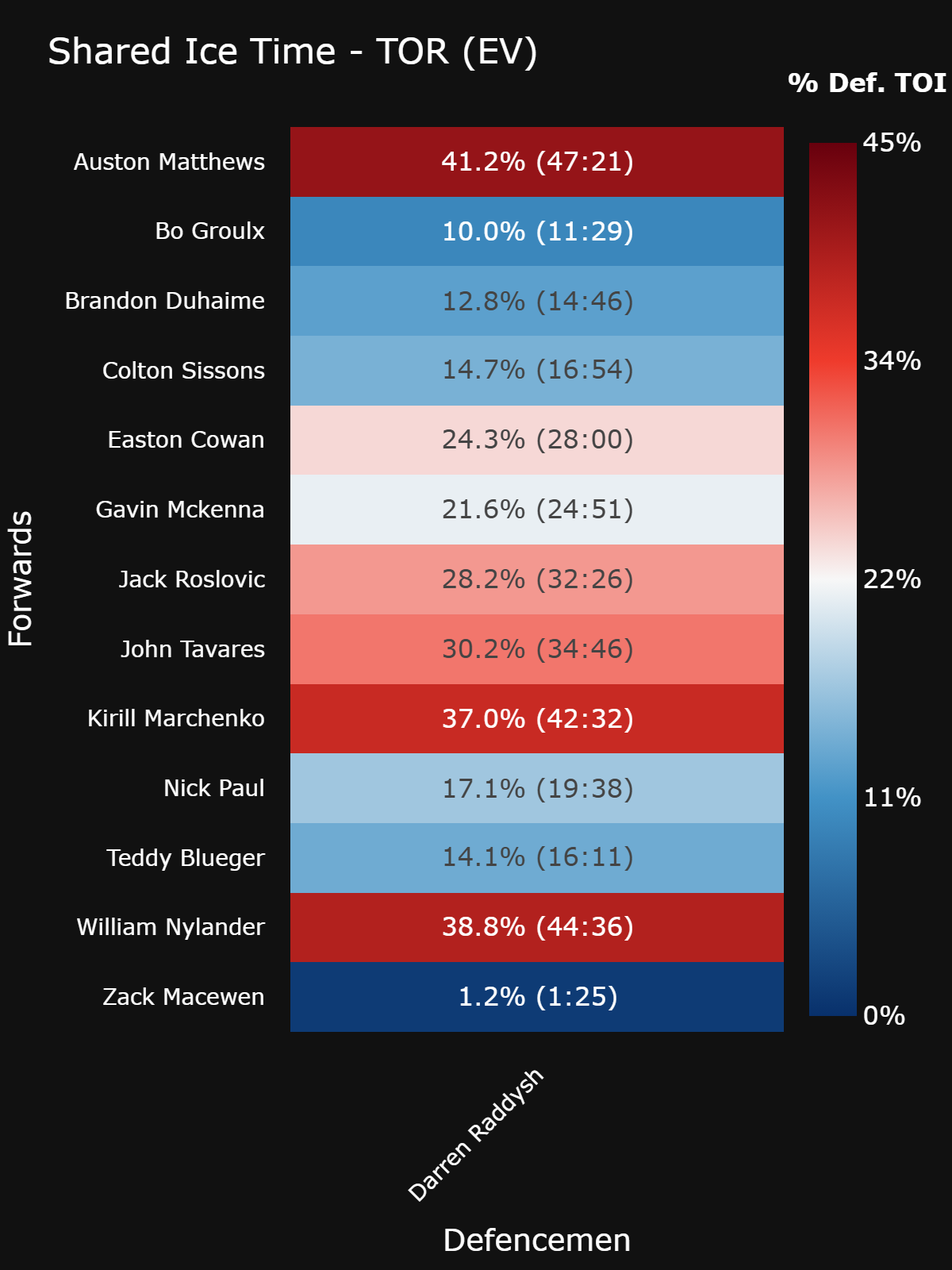
To this point, the team is scoring just 2.5 goals per 60 minutes at even strength with Raddysh and Matthews on the ice. The team is also shooting just 7.4% in those minutes; the Leafs have shot at least 12% with Matthews on the ice at even strength for six straight seasons. They are generating a lot of shots and expected goals, just not a lot of actual goals yet. Once that shooting percentage climbs, the goals will fly, and that is great news for the offensive upside of their top-6, and the top line in particular.
9 – Depth Defencemen and Viggo Björck (Winnipeg Jets)
Through five games, the Winnipeg Jets have a -6 shot attempt differential with Björck on the ice at 5-on-5. Overall, the team has a -41 shot attempt differential, so Björck doesn’t look bad in that sense. It is also why it’s important to note that he’s spent nearly half his even-strength ice time (about 47%) with one of Winnipeg’s bottom-3 defencemen in Haydn Fleury, Mario Ferraro, and Tyrel Bauer:
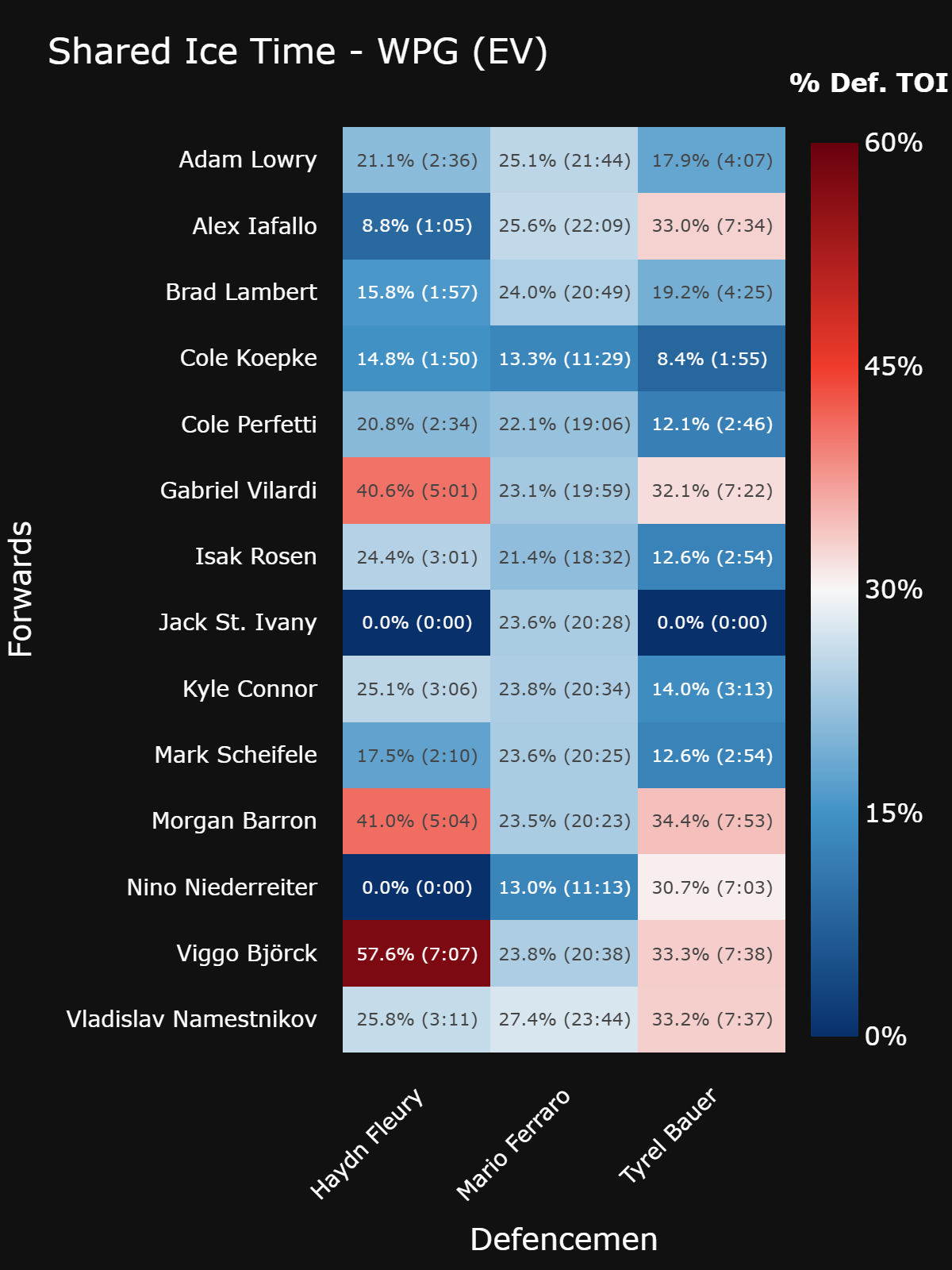
Spending so little time with the team’s top blue liners, comparatively speaking, while still not entirely getting crushed by shot share is a good sign for the rookie forward. It would be nice to see what he can do with more capable puck-moving defencemen playing behind him regularly, but if he can do this with their less-capable puck-movers, it’s nothing but good news for Björck.
10 – The Washington Capitals
The Capitals have five defencemen who’ve played all five games thus far. Among those five defencemen, none have spent at least 35% of their ice time with any single forward, only one duo is over one-third of the ice time (Cole Hutson and Dylan Strome at 34.3%), and there are dozens of pairings between 20-30%:
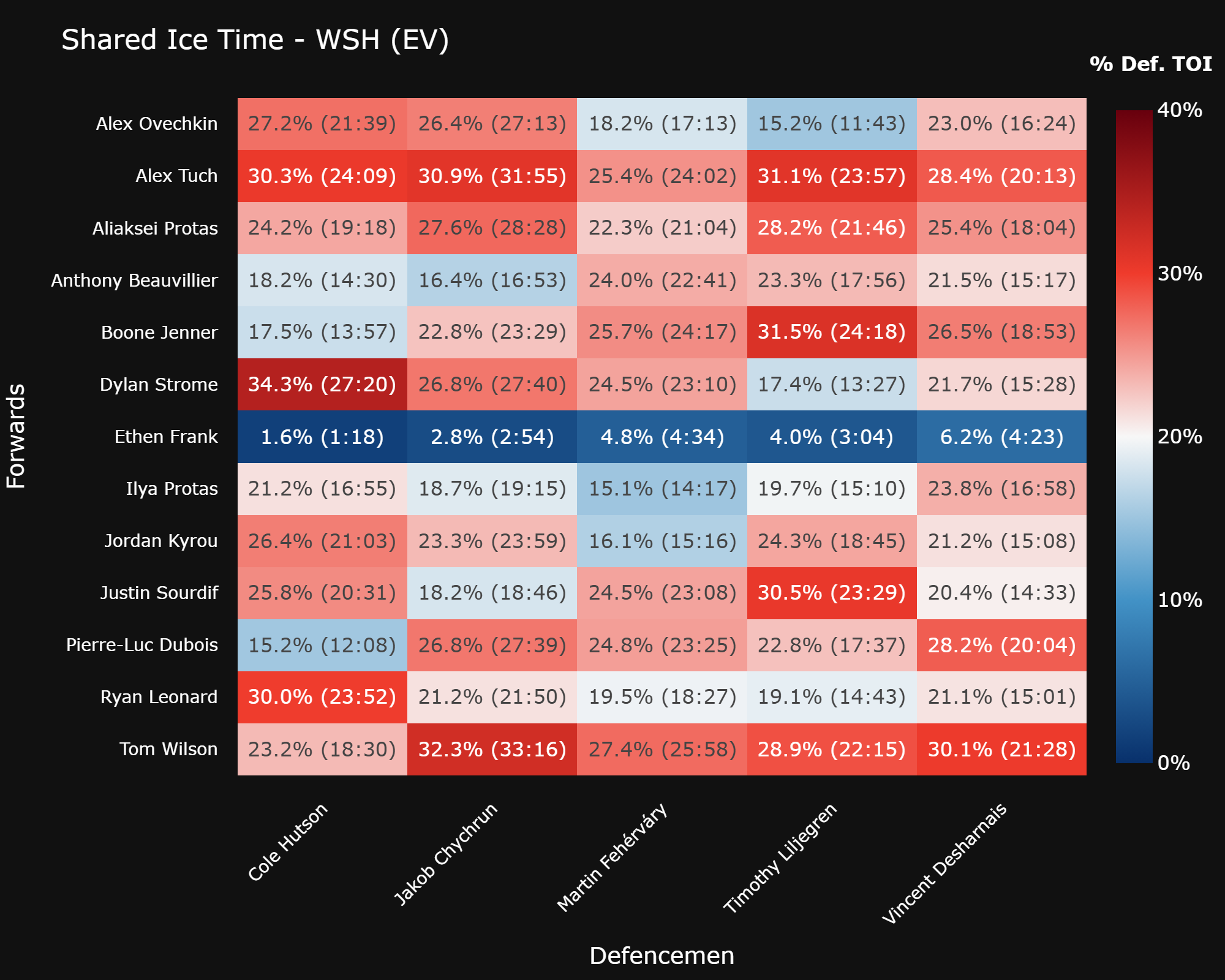
This reflects a team-wide philosophy as no forward has earned 30% of the team’s total EVTOI, not far off last year’s philosophy (only Aliaksei Protas was over 30% in 2025-26). Maybe things change as the season wears on, but it seems the Caps are happy to run whichever defencemen with any forward line, and that speaks to the depth the tremendous forward depth the team has.
Until next week.