10 Interesting (To Me) Stats For This Week - September 29, 2026
Welcome back to another week of ’10 Interesting (To Me) Stats’, and to another NHL season! The new 84-game campaign starts today, and to kick off the season, let’s look at some younger players who can be difference-makers for their teams. These aren’t necessarily rookies, though some are, but players who have the skills and the opportunity to make their mark on the league and push their teams to a better season than they otherwise would have.
We are using player data from Evolving Hockey, tracking data from All Three Zones, prospect evaluations from Hockey Prospecting, and the Synthetic Goals model from HockeyViz. These players are in no particular order, starting with forwards and then moving to defencemen.
1 – Konsta Helenius (Buffalo Sabres)
One reason Buffalo was fine letting Alex Tuch walk in the offseason wasn’t only the growth from young wingers like Zach Benson and Josh Doan, but the sky-high potential of Helenius. For perspective, here are the top point production seasons in the AHL for an age-19 player since the 2012 lockout year (per Elite Prospects):
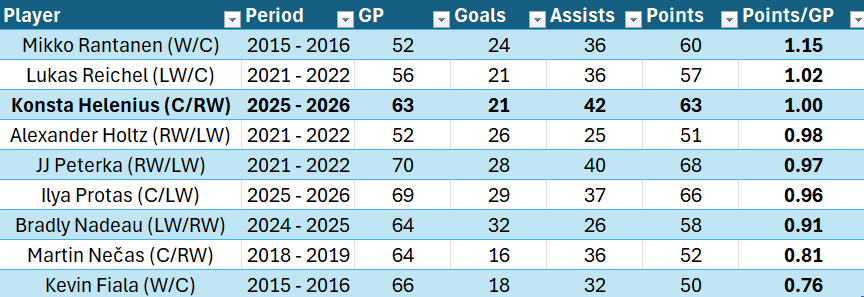
There are a couple of (relative) busts in Lukas Reichel and Alex Holtz, a couple still-developing players in Ilya Protas and Bradly Nadeau, and then four great-to-superstar players in Mikko Rantanen, J.J. Peterka, Martin Nečas, and Kevin Fiala. If we remove Helenius’ name from the list, half the players are star-calibre producers. If Helenius earnestly starts his trek to that level this season, it makes the Sabres a genuine four-line team.
2 – Marco Rossi (Vancouver Canucks)
Evolving Hockey’s RAPM model adjusts player impact at both ends of the ice based on usage, teammates, opponents, and so on. Over the last three seasons, and among players under the age of 25, here is the player that most closely compared to Rossi:

Saying that Rossi as a trajectory similar to Ryan McLeod might seem like faint praise, but whether at Evolving Hockey or HockeyViz, McLeod grades out to a low-end first-line forward. At the age of 25 and in his fourth full season, Rossi is ready to be a key figure for the Canucks, giving them some very much-needed centre depth past Elias Pettersson. It won’t be near enough to get them to the playoffs or anything, but it will be enough for the Canucks to feel secure that they have at least one top 6 centre in the organization for however long he remains with them.
3 – James Hagens (Boston Bruins)
There was plenty of hype for Hagens as he made the transfer from NCAA to the NHL late last season, but he ended up as a healthy scratch for half of Boston’s playoff games. It shouldn’t dampen his expectations, and the Hockey Prospecting model still has one of his comparable forwards to a current American superstar:
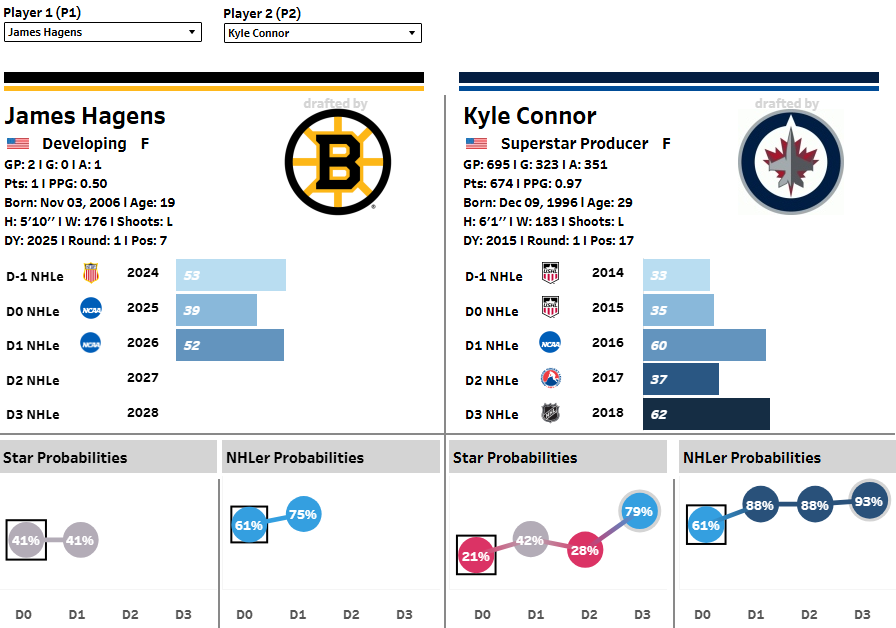
If Hagens can be 80% of Kyle Connor, he’s a future top 6 forward. The question is just how high he can go in 2026-27, but he has a chance to develop skills in a lesser role – likely on the third line – while being a difference-maker for the team. Last year, a big reason Boston made the postseason was their second line was among the best in the league. If they want to get back to the postseason, they need Hagens and his third line to do something similar, and he (and Fraser Minten) can do it.
4 – Cole Perfetti (Winnipeg Jets)
In 2024-25, the Jets were the best regular season team in the league. In 2025-26, they finished 12th in a weak Western Conference. Perfetti needs to become the player he has shown he can be, which is highlighted by the sharp drop in some key tracking stats across the last two seasons compared to his first two seasons:
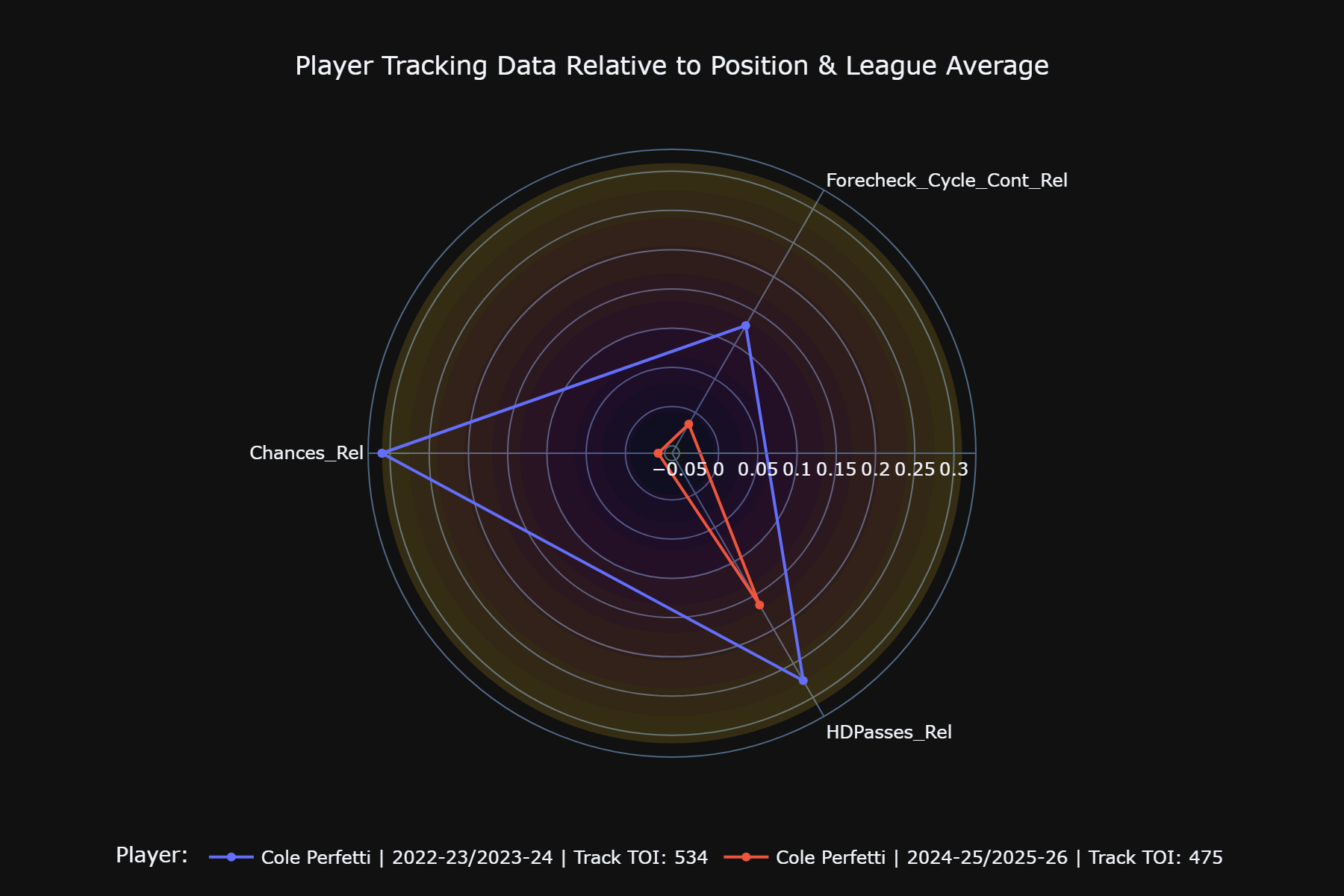
Those are individual scoring chances, high-danger passes, and offensive contributions off the forecheck for Perfetti in his last two pairs of seasons. The 2024-25/2025-26 pair (orange line) is a sharp drop from the abilities he showed earlier in his career. Winnipeg needs a lot to go right to get back to the postseason, and Perfetti being much better than he’s been the last two years is part of it. He can do it, because we have seen him do it, so this is a big season not only for the team, but for Perfetti himself.
5 – Connor McMichael (St. Louis Blues)
Mason McTavish being traded to St. Louis was their big news of the offseason, but we shouldn’t discount the impact McMichael can make. Using the tracking data, when seeking a comparable forward to McMichael by offensive contributions off the forecheck or rush, zone entries carried in, and zone exits with possession relative to their team, one forward popped up:
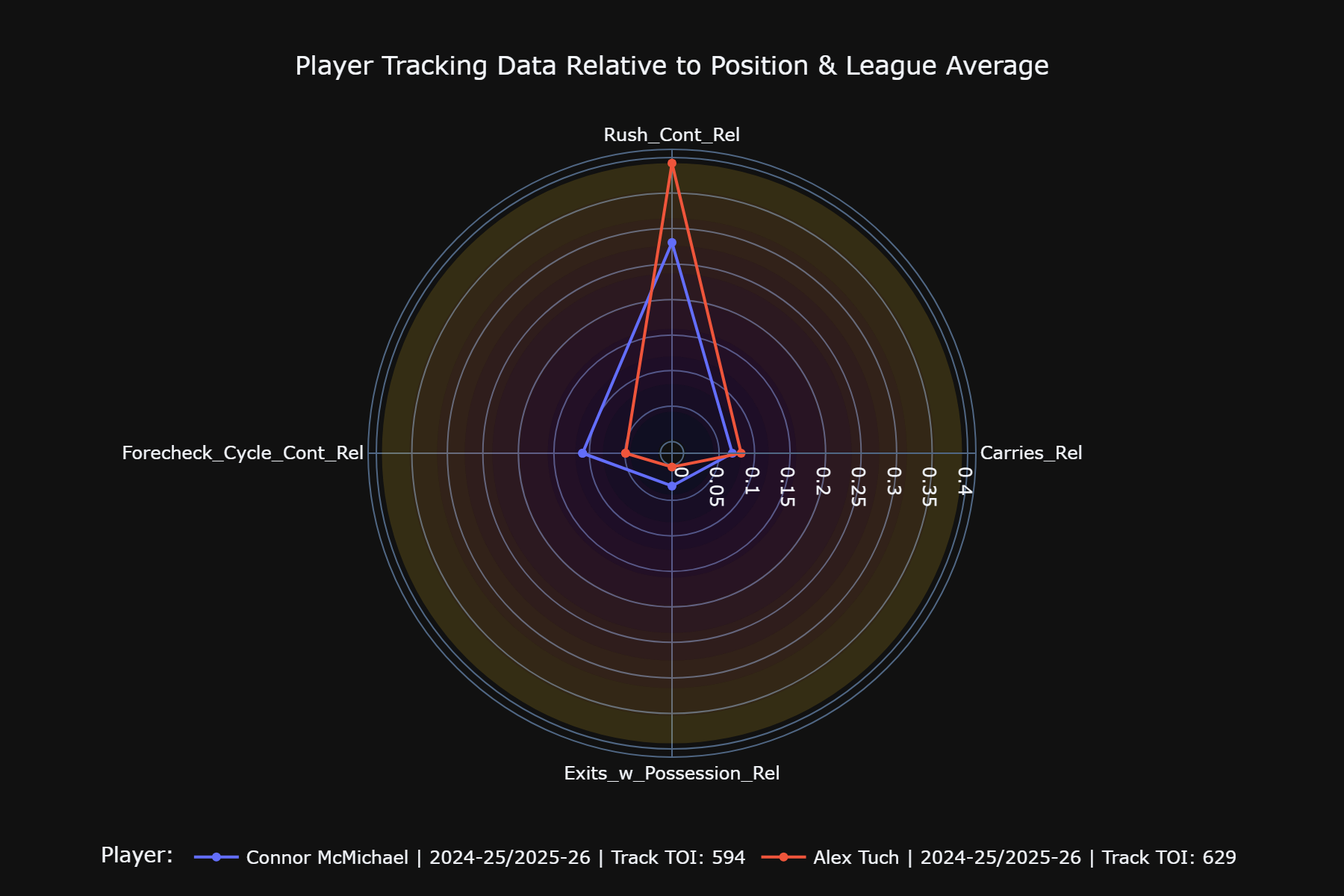
It is interesting that the guy who ostensibly replaced McMichael in Washington (Alex Tuch) is the comp, but the universe is full of these lovely little coincidences. McMichael isn’t necessarily young (he turns 26 in January), and he has defensive issues, but he is a very skilled forward who appears ready to be a second-line contributor. If he and McTavish can give the Blues a genuine second scoring line, it’s a big development for their playoff hopes.
6 – Ben Kindel (Pittsburgh Penguins)
There were few bigger surprises last season than Kindel, who went from 11th overall pick in June of 2025 to third-line centre for a playoff team four months later. It is a bit of serendipity that when looking at individual scoring chances, high-danger passes, and percentage of zone entries carried in over the last two seasons, he compares to one of my personal faves:
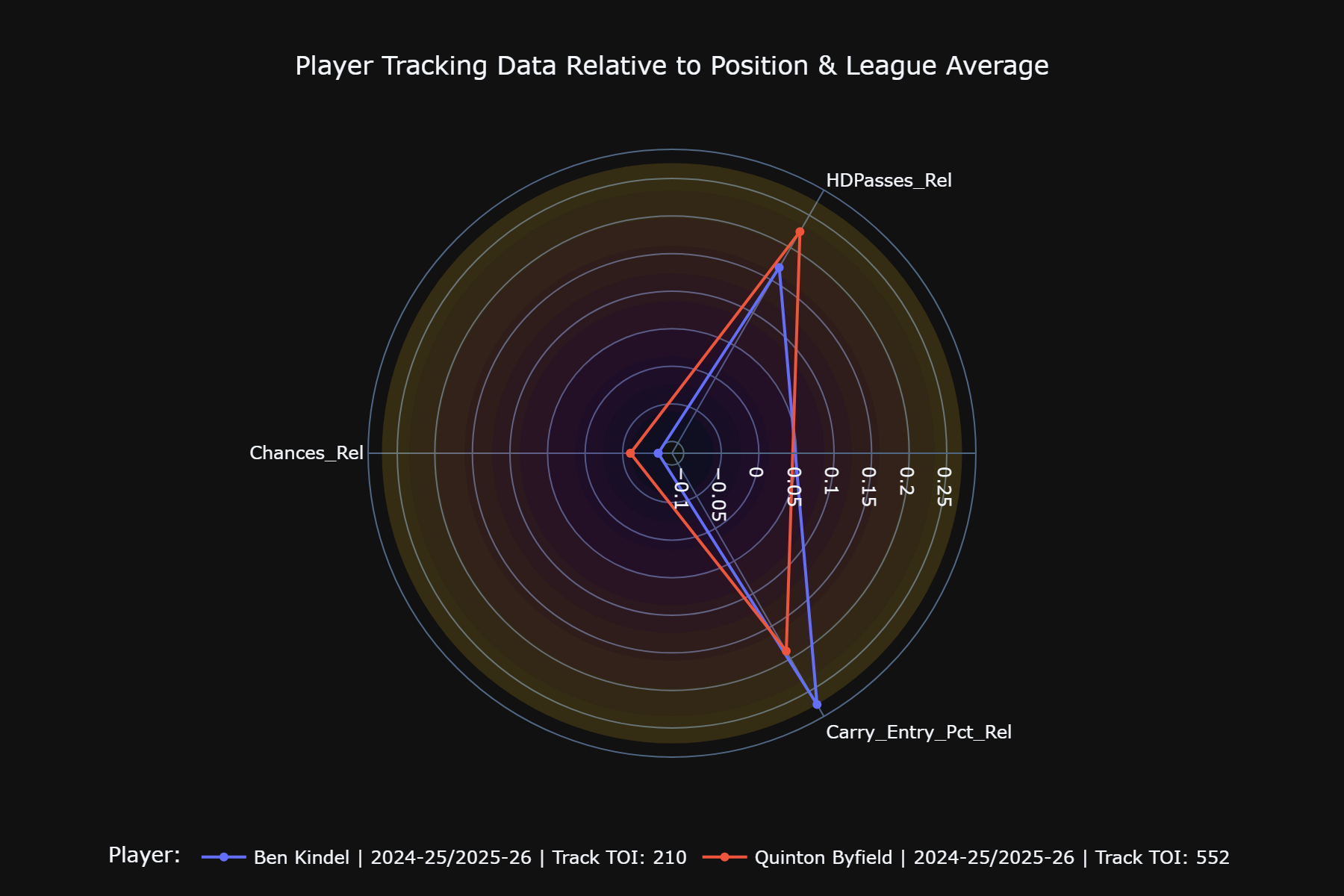
It is no secret that the clock is nearly striking midnight on the current Penguins’ core, but they were a playoff team last year, have revamped the blue line, and still have a lot of offensive talent. If Kindel can not only repeat last year’s success, but improve upon it, his ascension would take some pressure off Sidney Crosby and Evgeni Malkin, and give the Penguins a real shot at returning to the postseason. Let’s just hope the injury he suffered in the preseason isn’t too serious (currently week-to-week).
7 – Frank Nazar (Chicago Blackhawks)
Despite Connor Bedard’s injury, there is reason for excitement in Chicago: rookie seasons from Anton Frondell and Roman Kantserov, the trade for Bowen Byram, and the return of Patrick Kane. However, if the Blackhawks want to be a playoff team, they need a productive third line, which is what makes Nazar’s development over his brief career an issue:
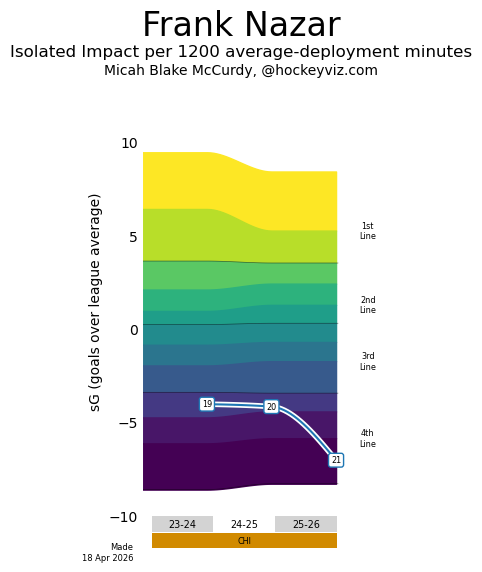
This is the player evaluation model from HockeyViz. Anyone watching Nazar knows how quick he is, and he can be a one-man zone entry and penalty-drawing machine. But he has not shown very much for in-zone offensive skill and his defence leaves a lot to be desired. There is a lot of good, young talent in Chicago, but if Nazar can’t help elevate the middle 6, this will be a top-heavy team facing an uphill battle for the playoffs.
8 – Ryker Evans (Seattle Kraken)
After Vince Dunn and Brandon Montour, Seattle’s blue line looks very thin. Those two can help float their pairs, but how Evans performs will decide whether one of those pairs is fine or great, or perhaps even gives the team a great third pair. That is why Evans’ last two years by contributions to scoring chances, percentage of zone entries carried in, and lack of botched defensive zone retrievals + failed zone exits are comparing to Nikita Zadorov are encouraging:
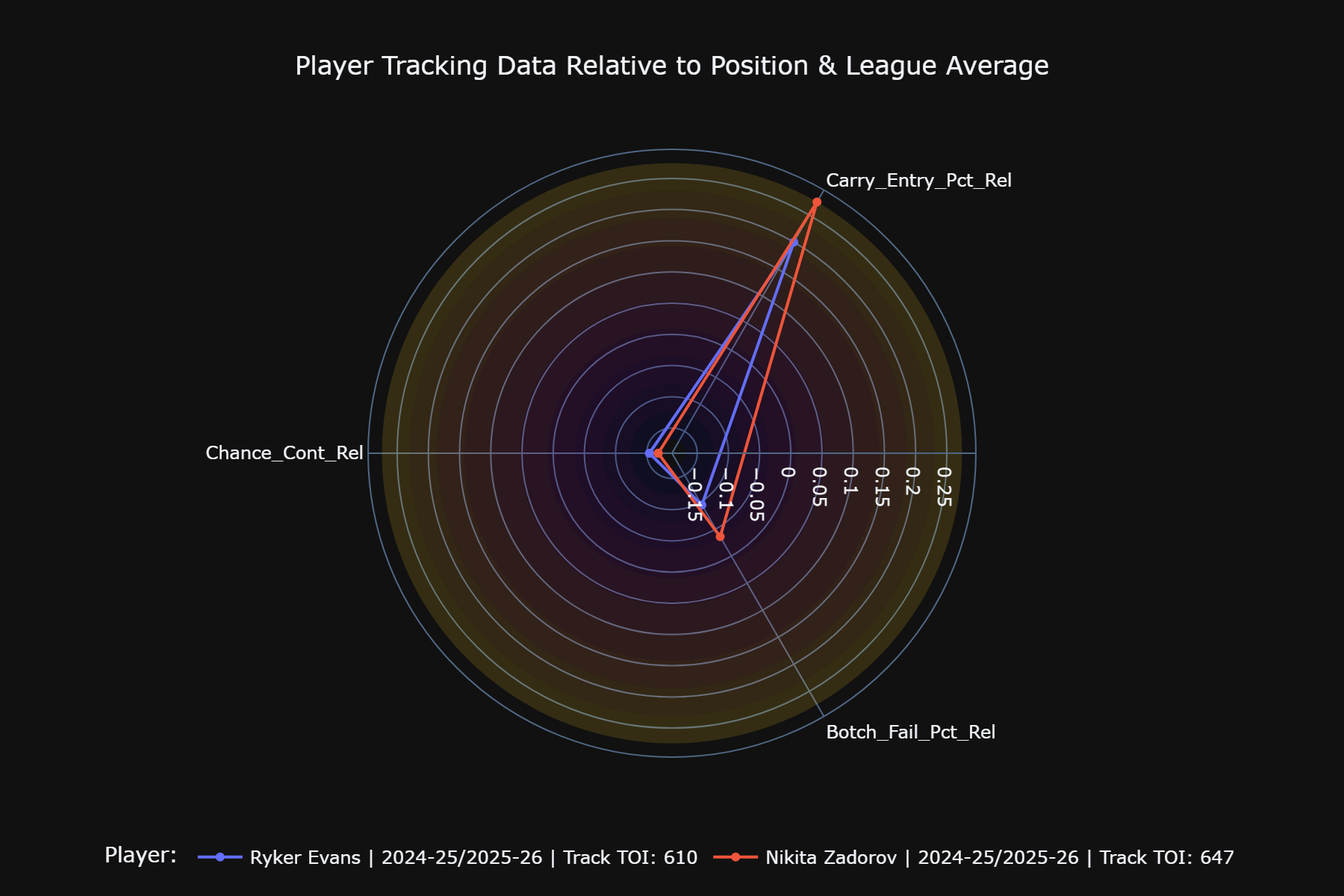
It isn’t that Zadorov is an elite defenceman, but he has consistently performed as a second-pair blue liner for years. Evans being able to maintain that level in 2026-27 would give the Kraken some much-needed defensive depth and help push them towards the playoffs.
9 – Zayne Parekh (Calgary Flames)
The trade for Šimon Nemec gives Parekh direct competition for top power-play time, and the Flames won’t be a good offensive team, so it’s unlikely Parekh posts great back-of-the-card numbers. However, it’s worth noting some key, if limited, tracking data for his first two seasons compare well to a guy in Buffalo who needed a few years to find his footing:
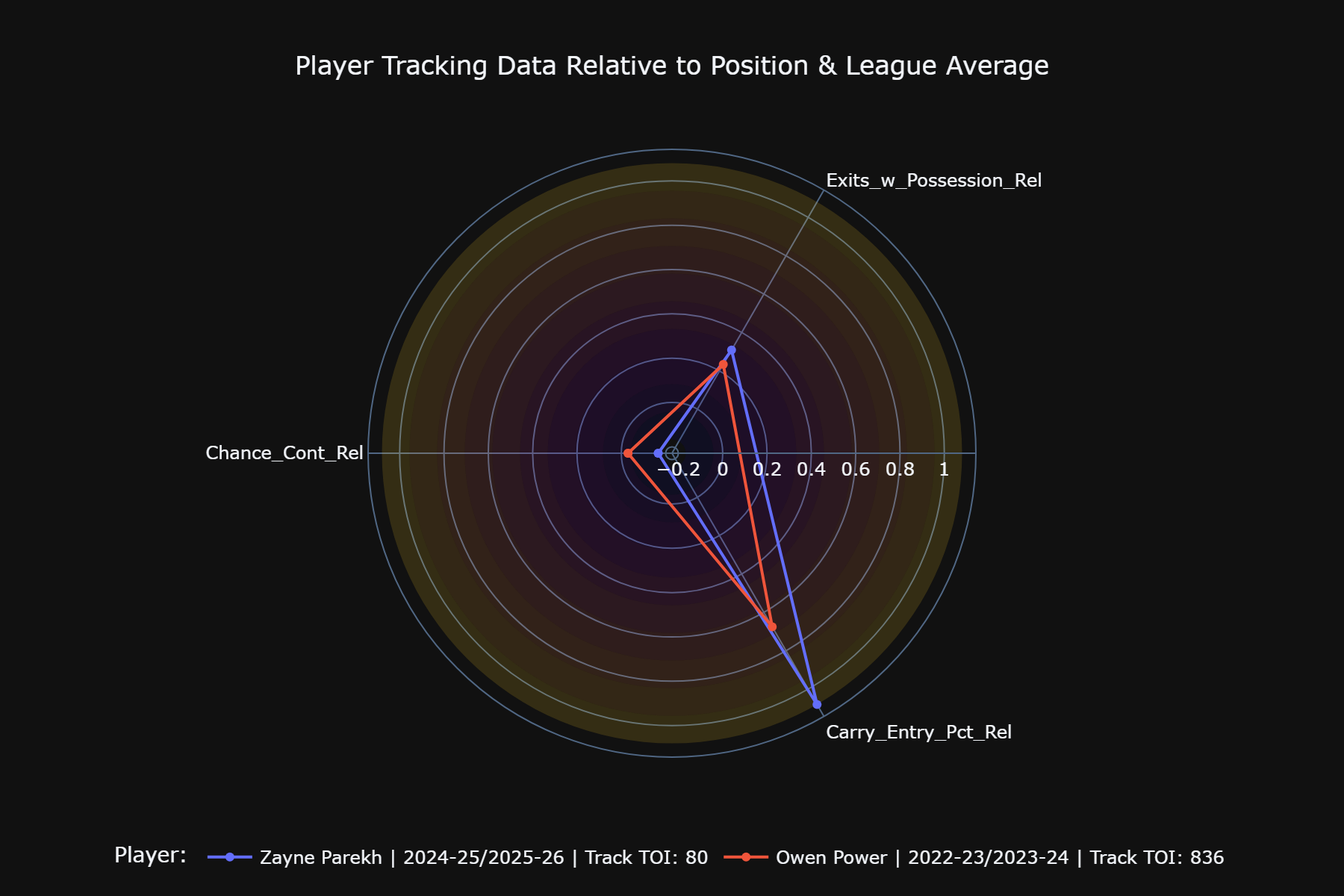
Parekh having a great year won’t get the Flames to the postseason, but it will show management and his teammates that there is a core to build around including himself, Nemec, and Dustin Wolf. There will be plenty of growing pains for Calgary in the years to come, but Parekh has the tools and the opportunity to start showing his upside now.
10 – Carter Yakemchuk (Ottawa Senators)
With Thomas Chabot, Jake Sanderson, and Jordan Spence on the bench across the last two seasons, the Senators have been outscored 87-65 at 5-on-5. They desperately need a third pair that can at least come close to breaking even, which is where Yakemchuk comes into play. After a very good AHL rookie season, the 21-year-old has a comparable from Hockey Prospecting that should make Senators fans salivate:
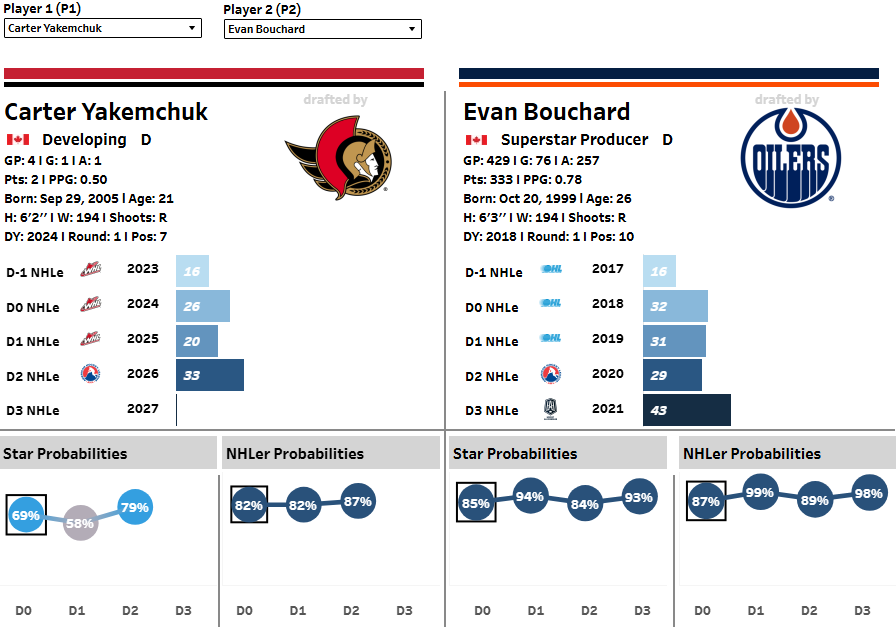
It took Evan Bouchard a few years in the NHL to start scratching his upside, so it may be the same for Yakemchuk, but with those aforementioned three blue liners, he doesn’t need to be a top guy for the Sens right now. That doesn’t mean he can’t be a difference-maker, though, and he has the chance to give the Sens one of the best top-to-bottom defence groups in the league.
Until next week, and enjoy the start of the season, everyone!