10 Interesting (To Me) Stats For This Week - November 17, 2026
Welcome back to another week of ’10 Interesting (To Me) Stats’. With most teams crossing the 20-game threshold, we should start looking around to see where certain teams and players stand. Today, we’ll start with a bit of special teams discussion before moving on to 5-on-5 tracking data from All Three Zones.
The special teams data will include all power play and penalty kill situations, with data taken from Natural Stat Trick.
1 – The Atlantic’s Special Team Problem
Having bad special teams is one way an otherwise good team can miss playoffs. That is what makes the Atlantic Division so curious because there are four teams league-wide whose special teams goal differential is at least -0.5 per game (or worse), three of those teams are in the Atlantic, but two of them are in a playoff spot:

Montreal, Ottawa, and Buffalo have three of the five lowest rate of PP goals per game, but the first two teams have been excellent at 5-on-5 while Buffalo has not. For now, the Canadiens and Senators are surviving the poor special teams outcomes, but if Buffalo does not have a turnaround in both areas over the next month, the division is deep enough that the Sabres might realistically be out of playoff contention by Christmas.
2 – At the Other End
If bad special teams can keep an otherwise good team out of the playoffs, it stands to reason that good special teams can push an otherwise bad team into the playoffs. The Nashville Predators currently have a 5-on-5 goal share that is worse than Buffalo’s, but it hasn’t hurt them too much yet because their special teams goal differential per game leads the league:

Nashville is giving up the fewest power play goals per game (0.29) while the power play sits in the top-10 of the league. They should try to improve that 5-on-5 play if they want to truly be a dangerous team in the West, but if they can sustain this kind of special team performance, they can certainly get back to the playoffs.
3 – Jack is Back
Jack Hughes is currently pacing to surpass 110 points, which would give him his first career 100-point season, let alone 110 points. One reason is that his tracking data shows a preposterous upgrade in his scoring chance contributions (individual chances and assists on teammate chances) while his carried zone entries and zone exits with possession have also increased:
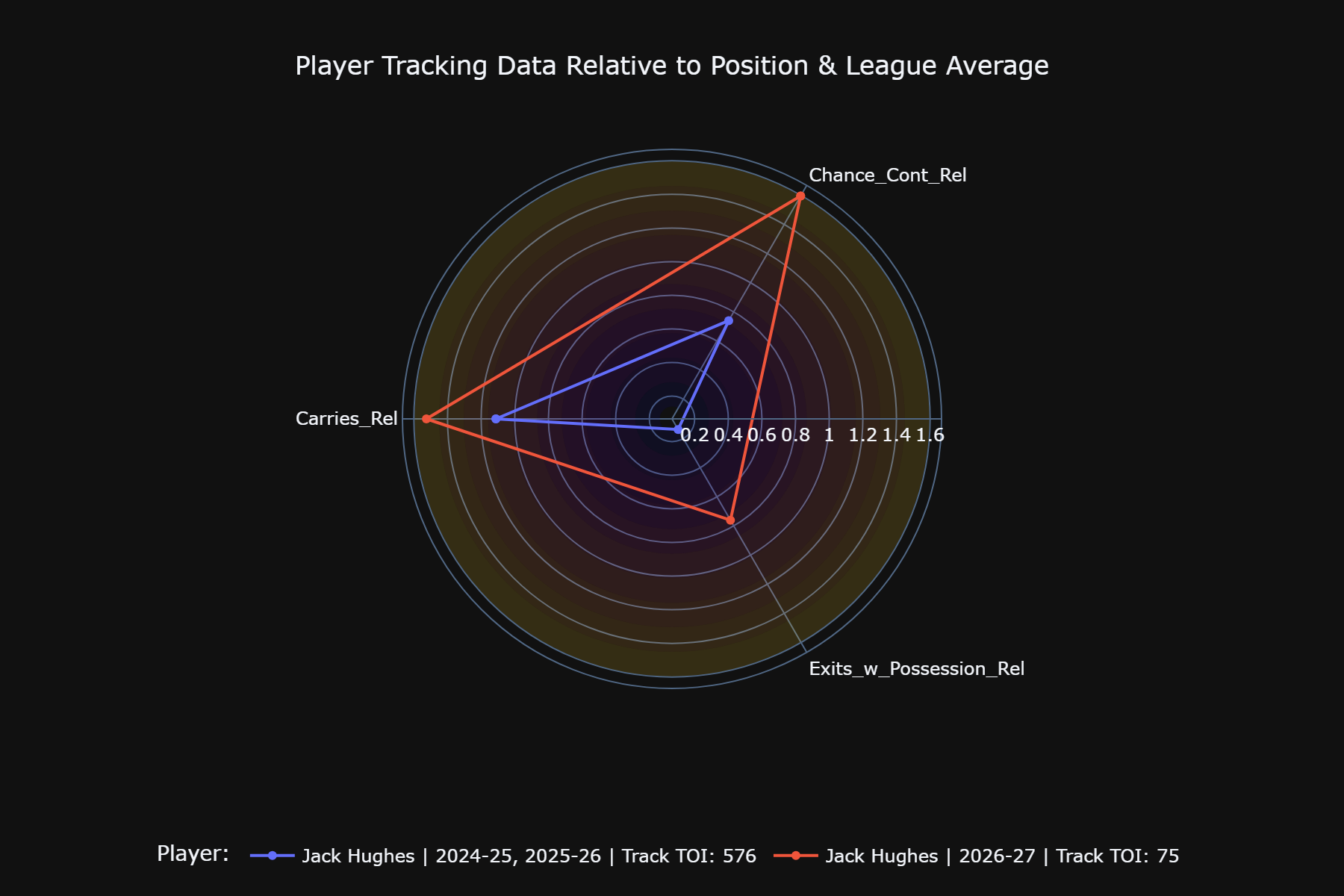
Yes, it’s just seven weeks and a handful of tracked games. The chance contributions are unlikely to stay at the level they are, but a great start like this shows that when he’s at his best, Hughes is among the game’s top forwards. We just need him to stay healthy, which has been the challenge for years.
4 – Mac-Man
The point production for Macklin Celebrini is not what it was last year, and it masks the fact that Celebrini’s work on zone entries is about the same as it was over his first two seasons, but the rate of scoring chance contributions is up 35% from his two-year average:
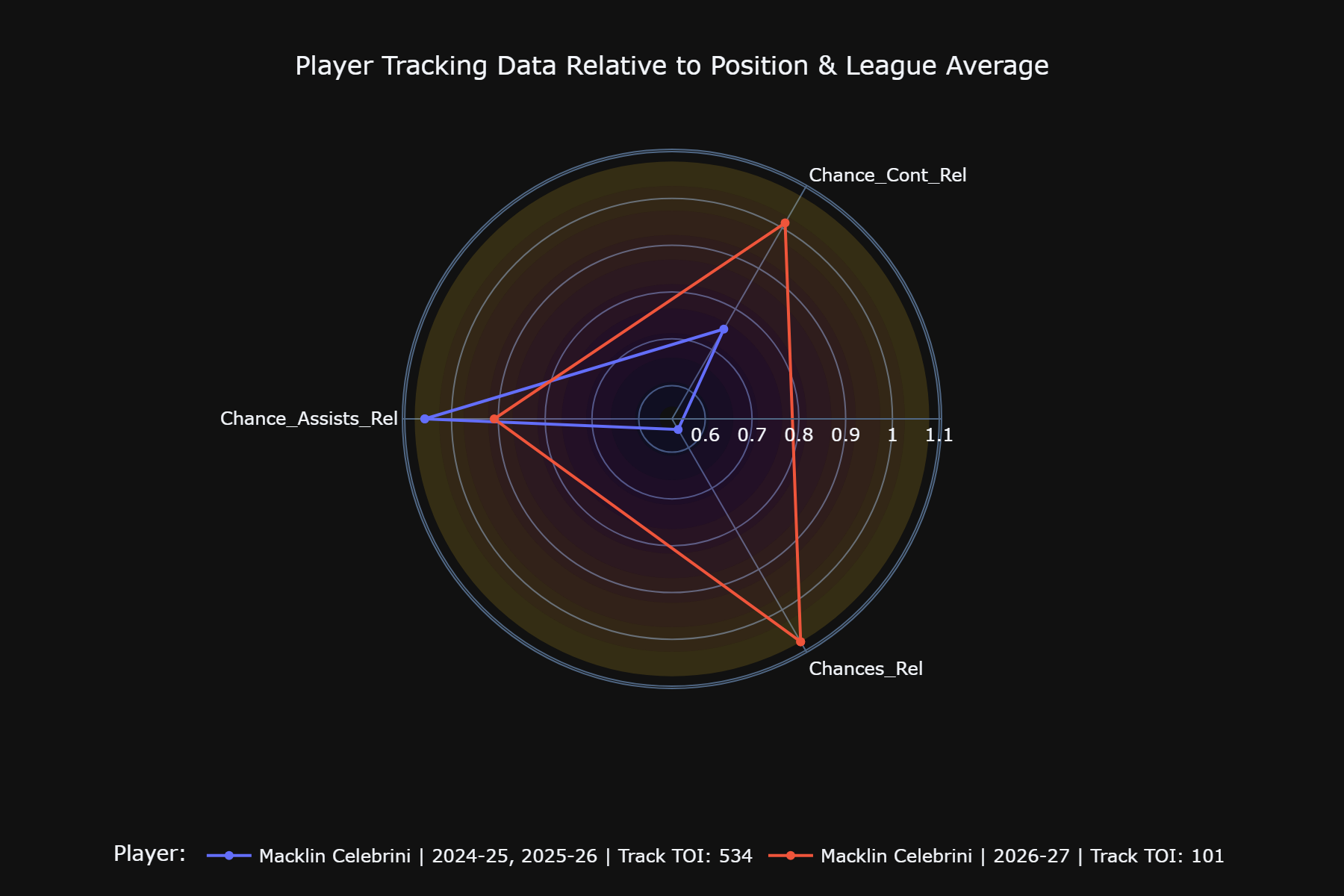
The big reason his production isn’t quite to the level it was last year is his shooting percentage. If he were shooting 15.7% this season (as he did in 2025-26), rather than the 10.2% he’s currently showing, his points per game is actually 9% higher than last year. The Sharks have a very good schedule over the next six weeks, so look for business to pick up in Celebrini’s point column.
5 – Ivar the Great
As mentioned in the Hughes section, keep in mind we’re talking about 20-something games with just a handful of those being tracked. All the same, Sharks rookie Ivar Stenberg has been off to a great start with a pace surpassing 25 goals and 50 points, and his rate of scoring chances, assists on teammate chances, and overall contributions are similar to the two-year average of another young star in the West:
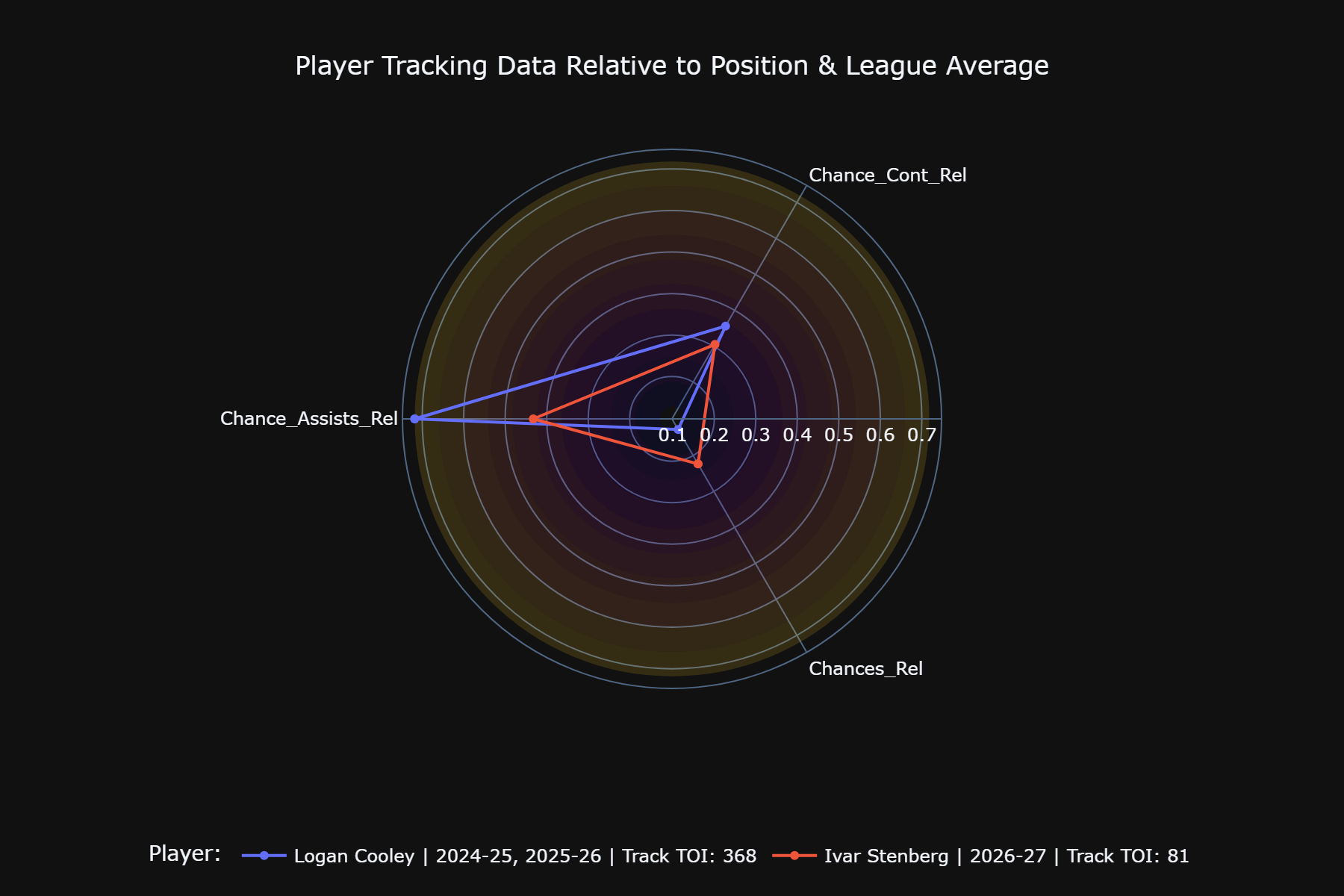
Stenberg’s best numbers are with Celebrini on his line, which is no surprise, but just being able to keep up with Celebrini as a 19-year-old rookie is a great sign for Stenberg. There will be bumps in the road, but for someone who was advertised as a future star winger, there are encouraging signs here.
6 – Another Jack(son)
I have repeated that the Carolina Hurricanes have had a soft schedule as their opponents have a combined .493 points percentage (per Frozen Tools). It shouldn’t take away too much from what Jackson Blake has done to start the year, which is have a rate of scoring chances, chance assists, and zone entries, as well as percentage of entries carried in, comparable to the season-to-date from a superstar in Edmonton:
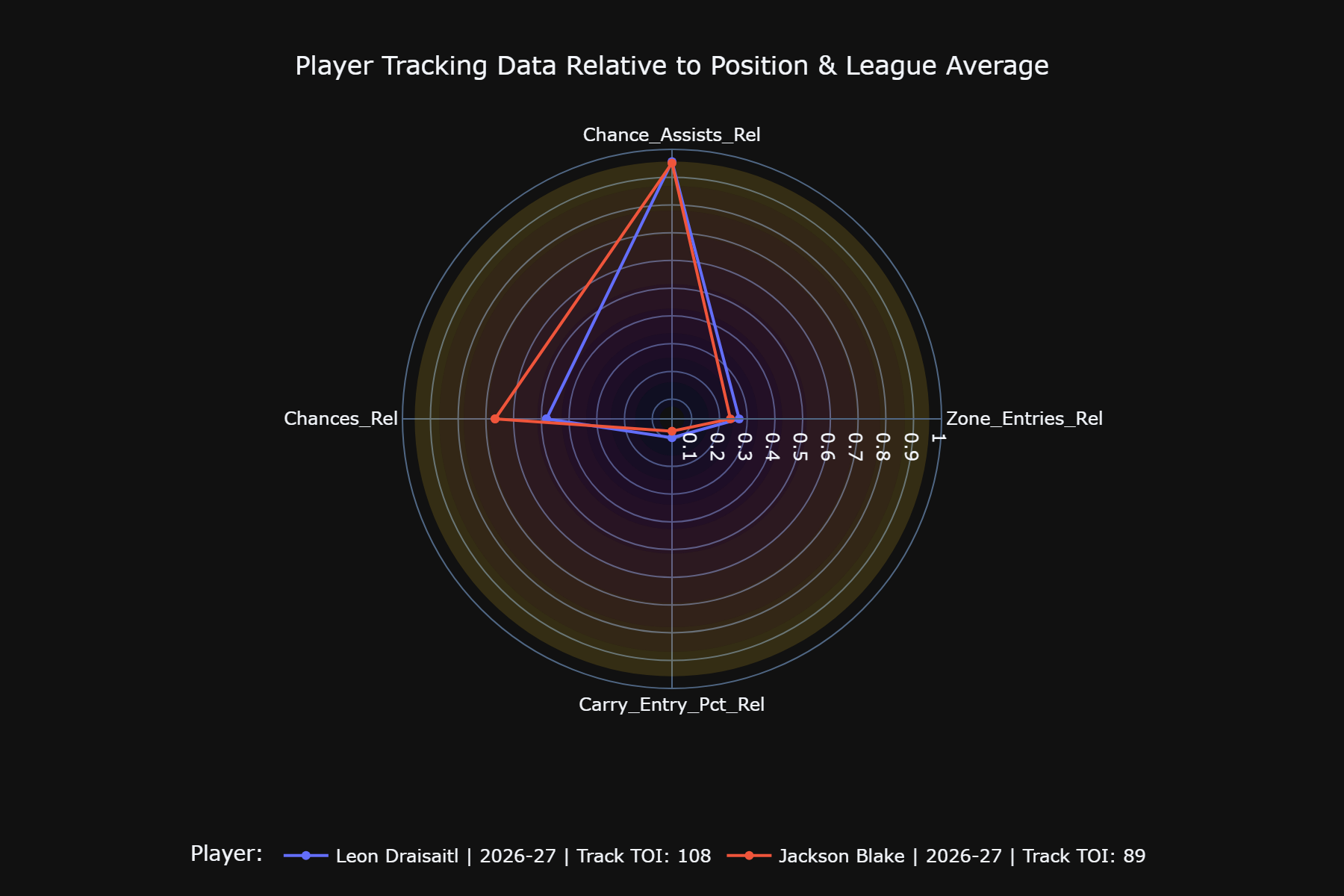
The chance assists stand out as there’s a massive 90% improvement from his two-year average. There is a reason his rate of primary assists on actual goals scored is top-10 in the league. We’ll see where things stand once Carolina’s schedule stiffens up, but Blake is cementing himself as a true top-line winger in this league.
7 – Poor Matty
Some forwards are heavily responsible for getting the puck out of the defensive zone – Jack Eichel and Connor McDavid are examples of this – and though Beniers hasn’t been heavily used in this manner in the past, he is being heavily used in this manner so far in 2026-27:
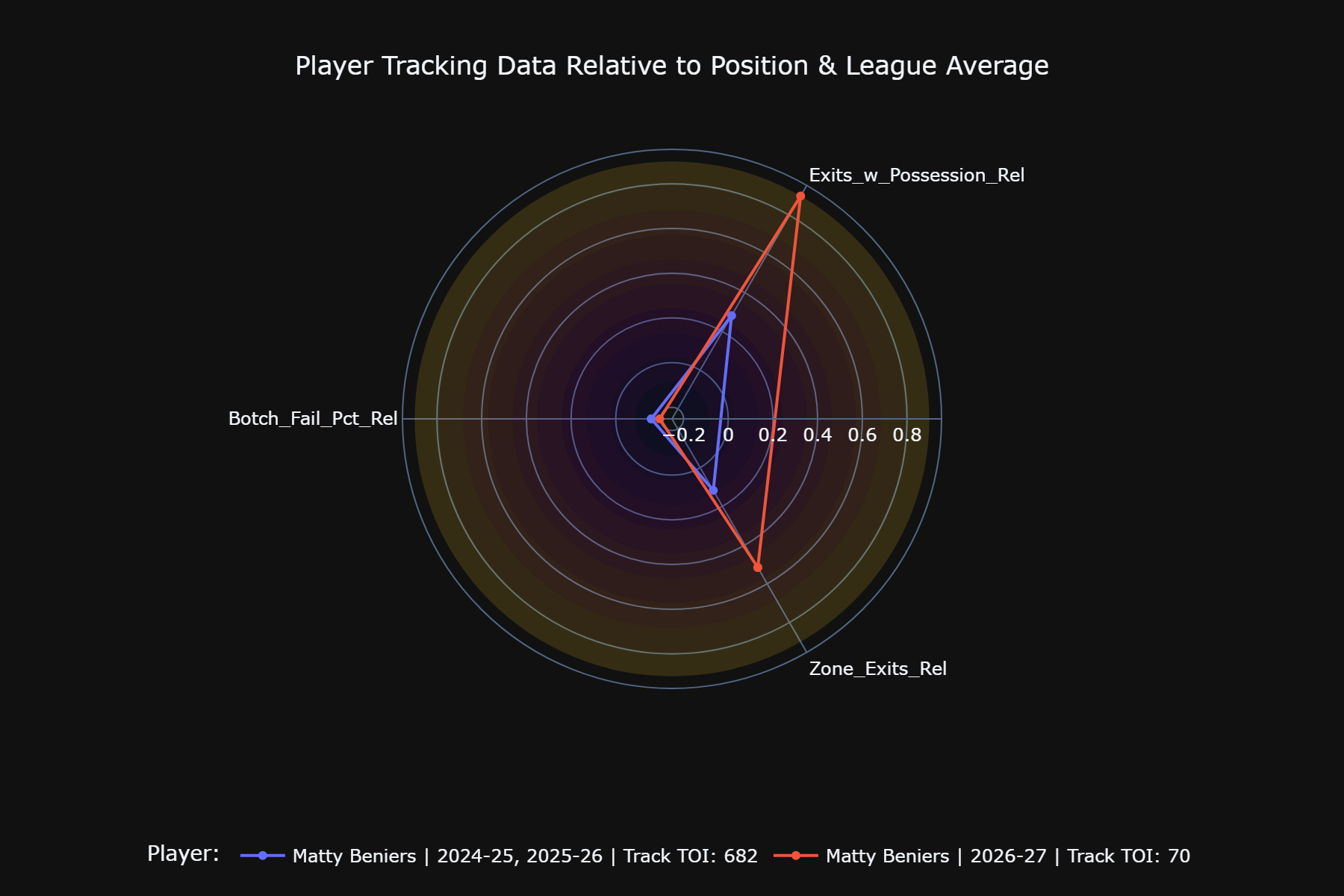
The good news is that Beniers is in the 96th percentile of forwards for zone exits with possession, so the team is keeping the puck when he does it. However, Beniers is not on the Eichel/McDavid level of offensive talent, and it’s a wonder if giving him so much defensive responsibility (including a career-high of defensive zone faceoffs) is what’s curbing his offence this season.
8 – The Other Matt(hew)
Sometimes, this column tries to highlight quirks in the data or undervalued players. Sometimes, though, we just need to laugh at what a player is doing. New York Islanders superstar defenceman Matthew Schaefer is over a point-per-game on an average offensive team as a 19-year-old defenceman, and his rate of scoring chances, assists on chances, zone entries, and carried zone entries are quite far ahead of the guy who might be the best defenceman in the world right now:
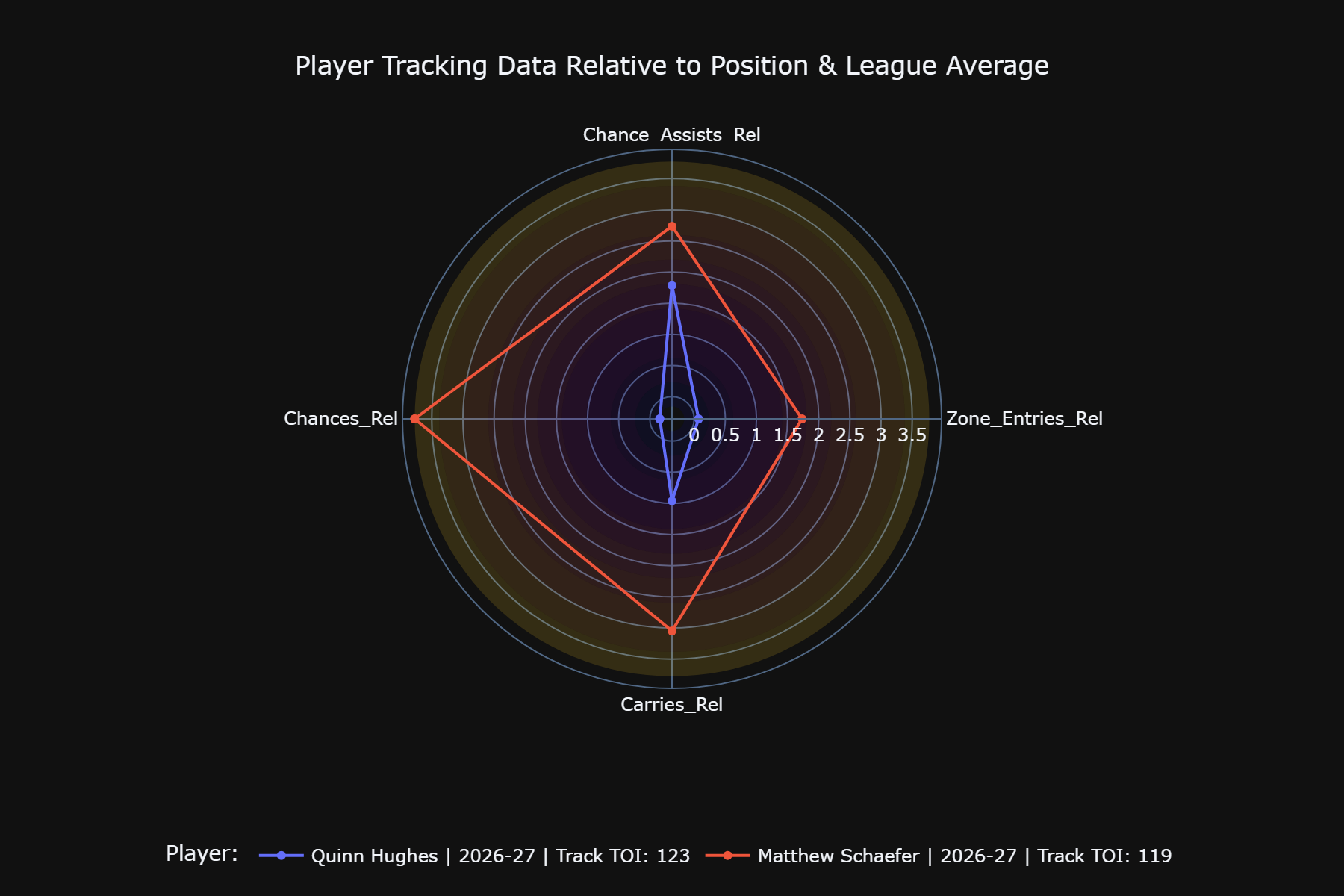
What is preposterous is that Schaefer just turned 19 years old in September; this isn’t a guy who turns 20 years old in the middle of this season. His 55 points in calendar 2026 are tied for 10th among all defencemen and he turned 19 years old two months ago. The term ‘superstar’ is putting it lightly – Schaefer is generational.
9 – The Other Hutson
When discussing rookies so far in 2026-27, one name I don’t often hear is that of Cole Hutson. The Washington defenceman is pacing for over 50 points and it’s not because his team is carrying him to good results. Here are his rates of scoring chances, assists on chances, and zone entries compared to Cale Makar’s previous two seasons:
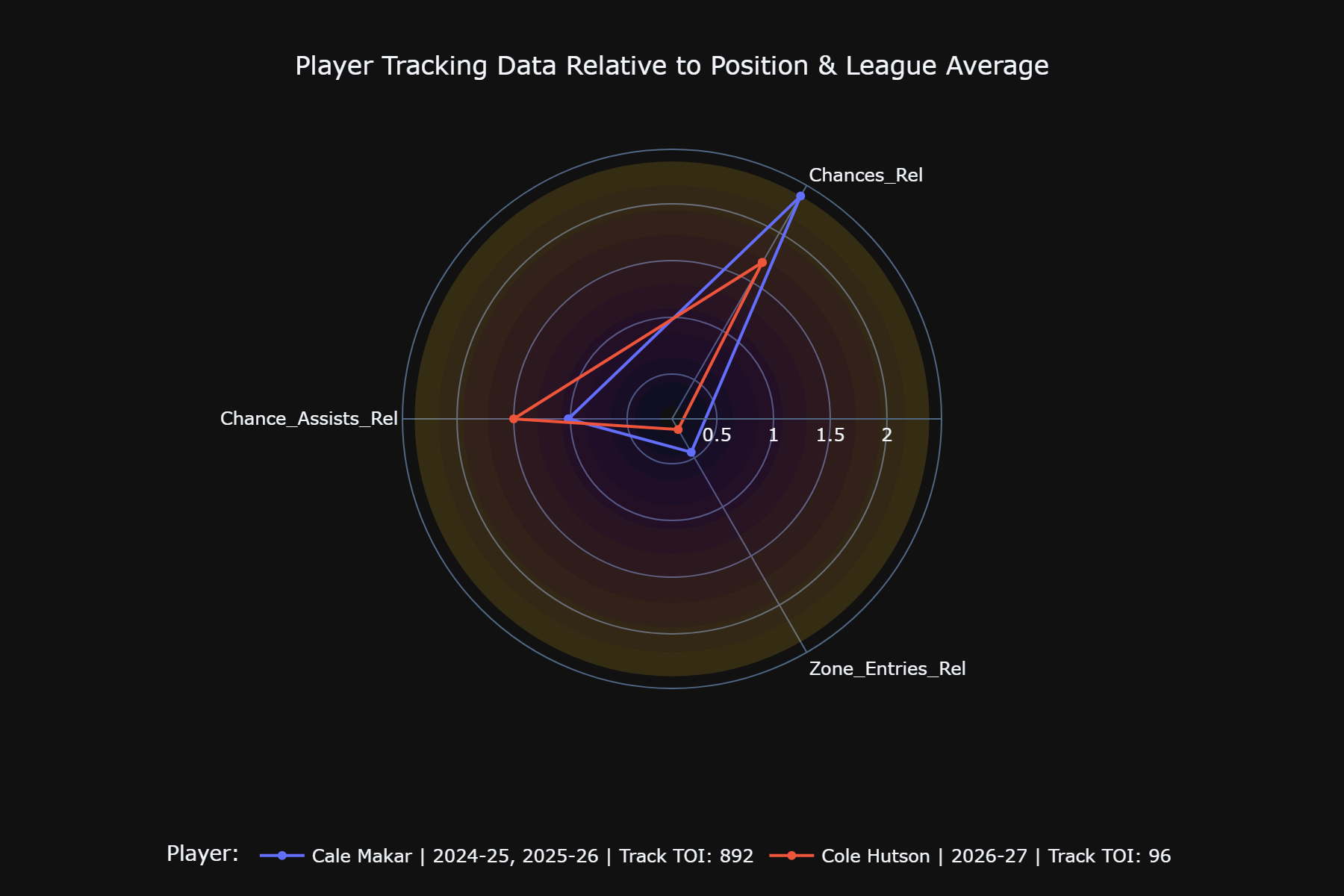
Hutson is 1 of 6 defencemen with at least 200 minutes of 5-on-5 time and whose team is scoring at least 4.0 goals per 60 minutes with him on the ice. The others are Evan Bouchard and Mattias Ekholm from Edmonton, Cale Makar and Devon Toews from Colorado, and Shayne Gostisbehere in Carolina. Hutson being a rookie among those names, and those teams, is absurd. The Caps seem to have a franchise pillar here.
10 – Stay-At-Home Same
Rookie development is not linear and players learn new skills at different times. That seems to be what’s going on with San Jose’s Sam Dickinson as his rate of scoring chances, assists on chances, and zone entries maps on near exactly with a defence-first blue liner from Ottawa:
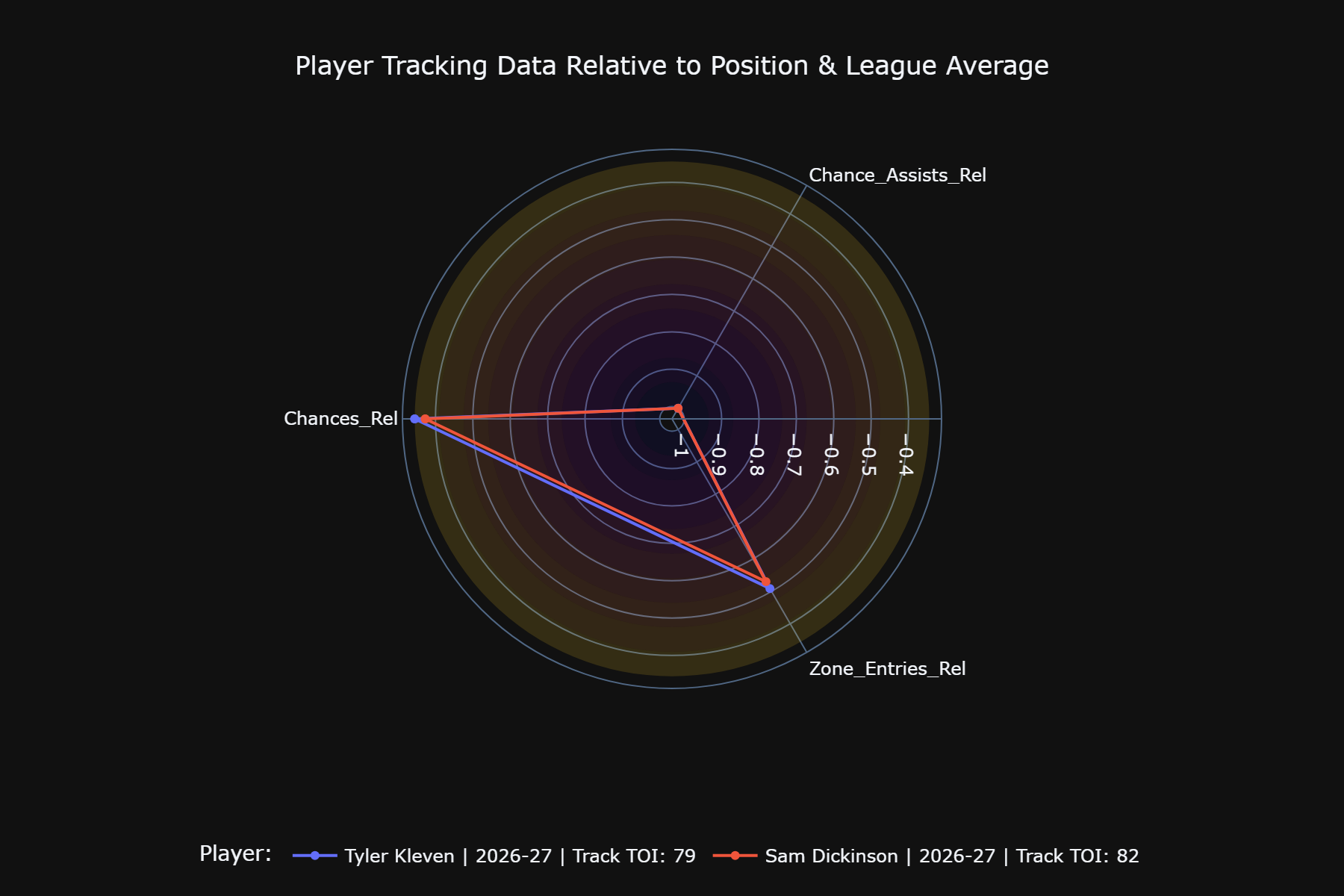
Dickinson is a tremendous skater who, if he reaches his potential, could be one of the better transition defencemen in the league. They are clearly keeping Dickinson from carrying the puck through the neutral zone, focusing on his defensive zone work. We will see how this goes in the years to come, but it’s obvious the Sharks are trying to round Dickinson’s game before giving him the real freedom that comes with being a (future) top-pair defenceman.
Until next week.