10 Interesting (To Me) Stats For This Week - October 20, 2026
Welcome back to another week of ’10 Interesting (To Me) Stats!’. We are a few weeks into the NHL season but are still waiting for some break points for certain stats – at least 10 games per team for new/elevated player roles and about 20 games for team-level performance. That doesn’t mean there aren’t some early surprises, so that’s what we’ll do today: which players, teams, or trends are raising eyebrows? Let’s dig in with data from Natural Stat Trick and some viz from HockeyViz.
1 – Teams Controlling Play but Not Points
Controlling the play is one thing but actually scoring (or saving) goals determines wins, and teams controlling play are struggling with the latter. Using the arbitrary cut-off point of a 52% expected goal share at 5-on-5, here are the average shooting percentages, save percentages, and points percentages of teams above and below that mark:

For posterity, this was not remotely the case last year. At this point in 2025-26, the two groups had near-identical PDO levels (999 vs 1001) and the group above 52% had the much higher points percentage (.580 vs .551). Things like this tend to sort themselves out after six months of regular season play, but it’s interesting, nonetheless.
2 – The Detroit Red Wings’ Second Line
There was a lot of pessimism surrounding Detroit due to the departure of Patrick Kane, trade demand from Dylan Larkin, and Simon Edvinsson still not being signed. That is why their 3-3-2 start stands out. They are keeping themselves in the playoff race, and a big part of that is the wild success of the second-line trio of Emmitt Finnie, Alex DeBrincat, and Michael Brandsegg-Nygård at 5-on-5 (from HockeyViz):
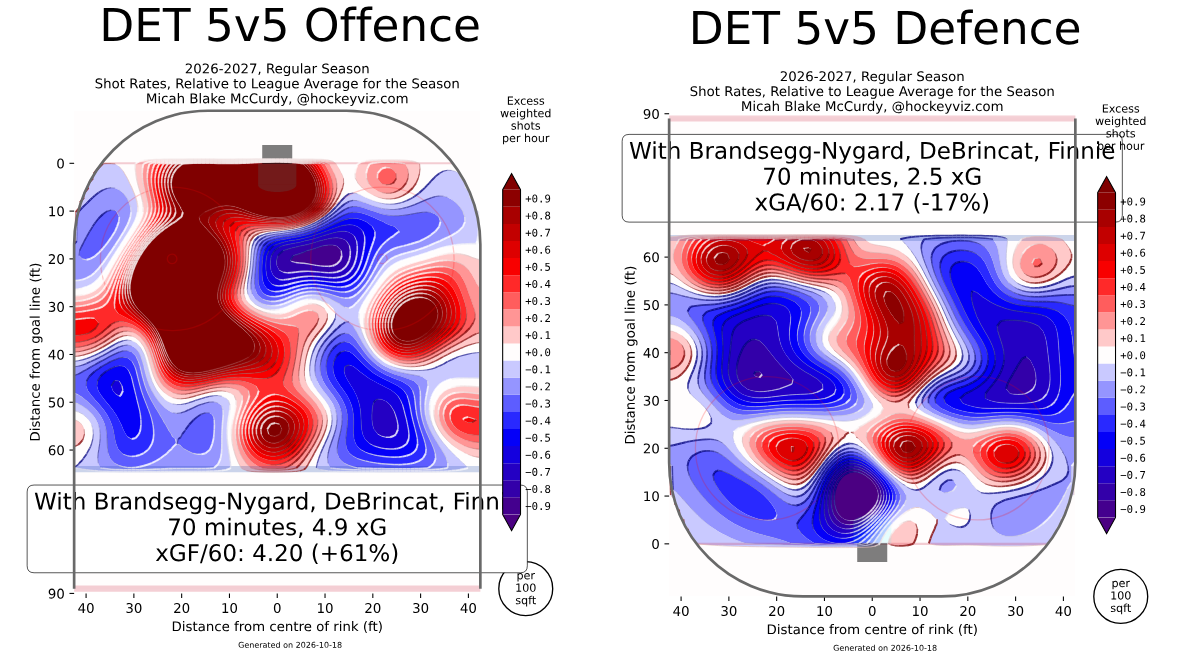
It isn’t just a great expected goal differential, either. They are controlling 59% of the shot attempts when they’re on the ice and have a massive actual goal differential (+7). Detroit, as a team, has been good at 5-on-5, but it’s the second line that stands out above the rest. They’ve been arguably the best second line in the league through three weeks.
3 – The Buffalo Sabres’ Second Line
Detroit’s second line is “arguably” the best second line in the league so far this season just because of what Buffalo’s second line has done. The trio of Jack Quinn, Zach Benson, and Noah Östlund has been outstanding to this point of the season:
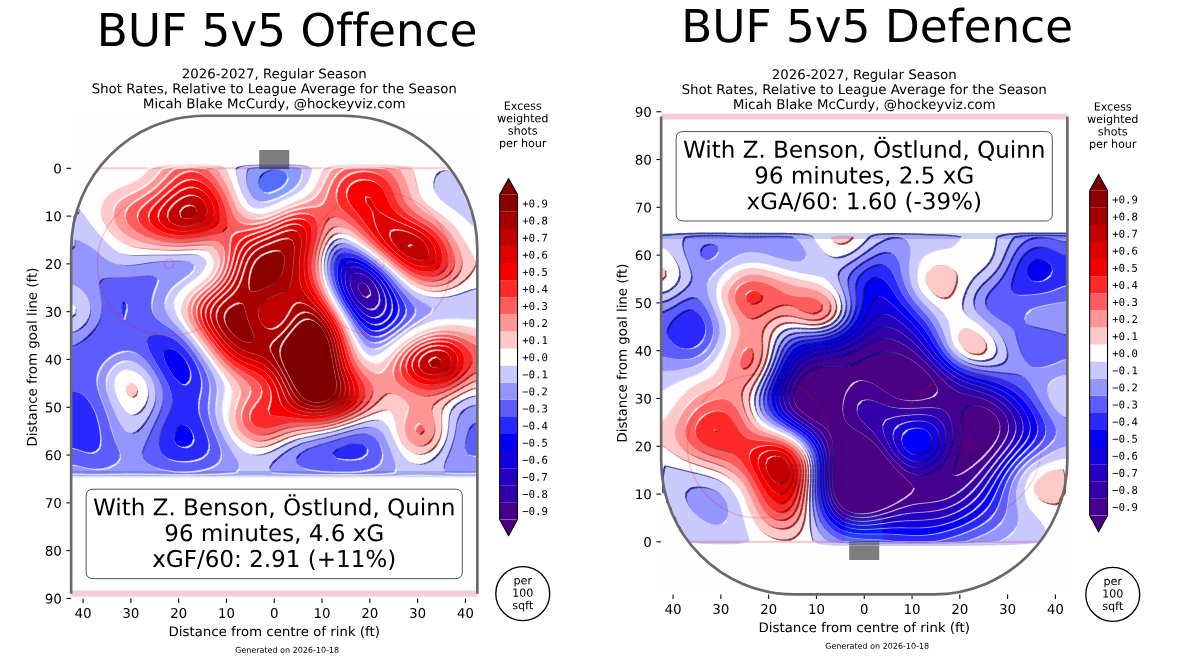
As with Detroit’s second line, it isn’t just the great expected goal differentials here. With this Buffalo three-man unit on the ice at 5-on-5, the Sabres have a massive 66.7% shot attempt share and +5 goal differential. They are the second line in name only as they get about the same 5-on-5 ice time per game as the top line and are helping keep the Sabres afloat as they figure out their special teams.
4 – New York Islanders Giving Some Good D
Once upon a time, the Islanders were a fearsome defensive team. That changed in recent seasons as they ranked 24th and 27th by shot attempts and expected goals against per 60 minutes at 5-on-5 in the two years from 2024-2026. That has completely reversed course so far in 2026-27 as they rank in the top-5 by both those measures, being 1 of 4 teams to do so:
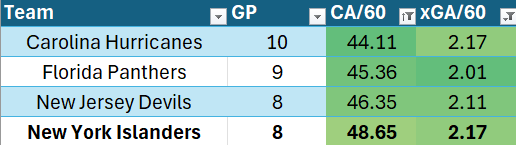
As a result, the Islanders are 1 of 3 teams with fewer than 1.5 goals against per 60 minutes at 5-on-5 so far this season (Dallas and Boston are the others). The offence hasn’t been great, but it hasn’t been awful, and just having a near-average offence with this kind of defence is going to win them a lot of hockey games.
5 – New York Rangers Killing Them All
The Islanders are looking to keep up their great defensive play at 5-on-5, as the Rangers are looking to do the same with the penalty kill. Last year, the Rangers were below league average by shot attempts, expected goals, and actual goals against per 60 minutes at 4-on-5. So far this season, they are 1 of 2 teams to have a top-5 improvement in all three areas:

In 10 games, the Rangers have given up just two goals against at 4-on-5, being just 1 of 3 teams to allow two (or fewer) to this point, and the other two teams (Carolina and Toronto) have played one fewer game. Having a great PK and passable PP can help lift this team from the doldrums in which they landed last year, and can really help make their lives easier in a post-Igor Shesterkin world.
6 – The Philadelphia Flyers’ Kids Are Alright (Or At Least Kind of Ok)
Going from playoff team to winless in nine games to start the season might be surprising in and of itself, but what is even more surprising is that amidst the Flyers’ awful start, the duo of Noah Cates and Porter Martone has been solid. To this point, their 5-on-5 shot attempt and expected goal share sit between 51-53%:

The goals are fine, too, with an even goal differential. The Flyers are dead last in the league by shot attempts and expected goal share at 5-on-5 with a -16 goal differential. Cates and Martone sitting between 51-53% of those play-driving rates with an even goal differential is an oasis in a desert, and a sign that at least parts of this roster will turn their ship around.
7 – Not Singing the St. Louis Blues
If St. Louis wants to be a playoff team, they not only need great years from top guys like Robert Thomas and Philip Broberg, but they need their reclamation projects to have a positive impact. While Mason McTavish and Connor McMichael have been putting up the points, Pavel Buchnevich and Brandon Carlo lead their forwards and defencemen, respectively, by shot attempt share relative to teammates:

The goals aren’t there yet, but Blues are shooting 4.4% with Buchnevich on the ice and their goalies have an .820 save percentage behind Carlo. If these two can maintain their territorial dominance, once those percentages see some positive regression, the goal differentials will improve.
8 – Hinds-sight
The Anaheim Ducks completely overhauled their blue line in the offseason as Jacob Trouba, Olen Zellweger, Radko Gudas, and John Carlson all left the organization. They put the keys to the kingdom in the hands of young defencemen without a proven track record, and it’s so far, so good for Tyson Hinds by relative 5-on-5 shot metrics:
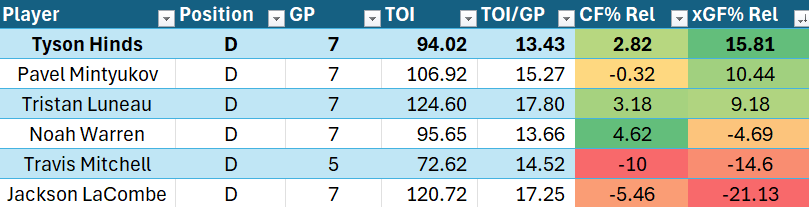
The actual 5-on-5 goal differential with Hinds on the ice is break-even (+3/-3), but if we rewind three weeks and say that Hinds’ start to the season would see good shot-share metrics with an even goal differential, Anaheim fans and coaches would have scrambled to take that result. We will see where things stand 2, 4, or 6 months from now, but it’s still a promising start.
9 – Seattle’s Crackin’ Duo
As a team, the Seattle Kraken are sitting with a 45% expected goal share at 5-on-5, one of the worst marks in the league. That is what makes their third-line duo of Shane Wright and Berkly Catton stand out as they’ve been able to control the play:
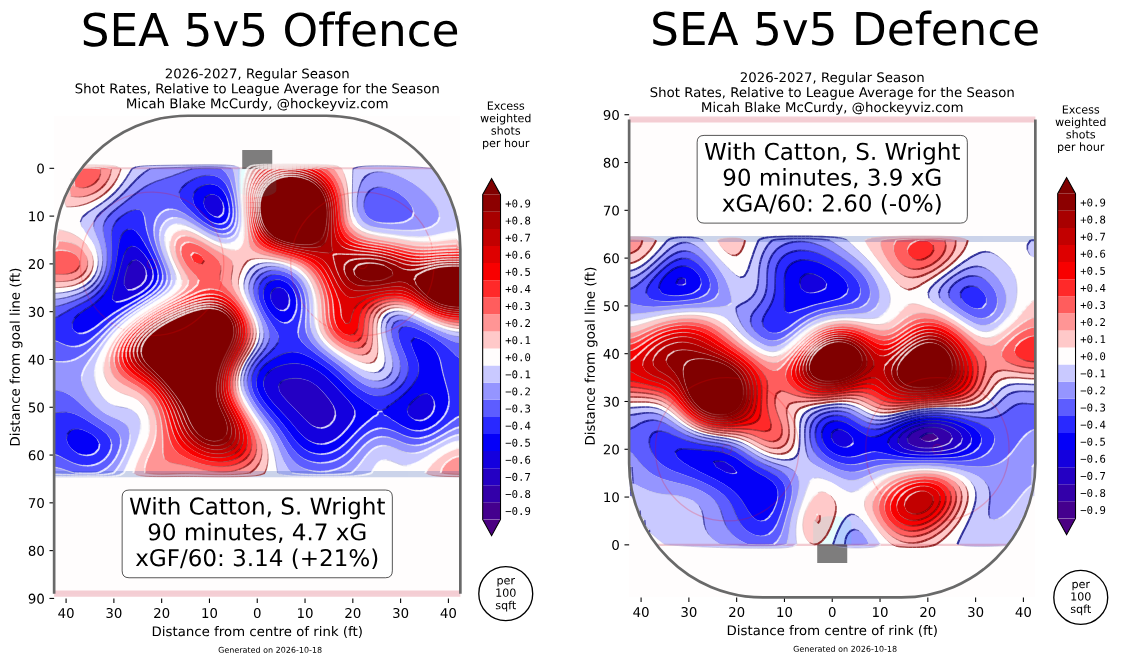
This is both surprising and not. It isn’t because with this duo on the ice last season, the Kraken had a 49% expected goal share and +1 goal differential, compared to 43% expected goal share and -8 goal differential with them off the ice. But a half a season of good play does not guarantee future success, especially on a team that struggles to control the game. Wright and Catton are doing it again, and it’s a positive development for Seattle’s future.
10 – One Down, Three to Go
Continuing the theme of success among struggling teams, the Chicago Blackhawks, of all franchises, are boasting a very successful fourth line. The trio of Jordan Greenway, Ryan Greene, and Cole Smith have been able to control the 5-on-5 play, largely through very good defensive work:
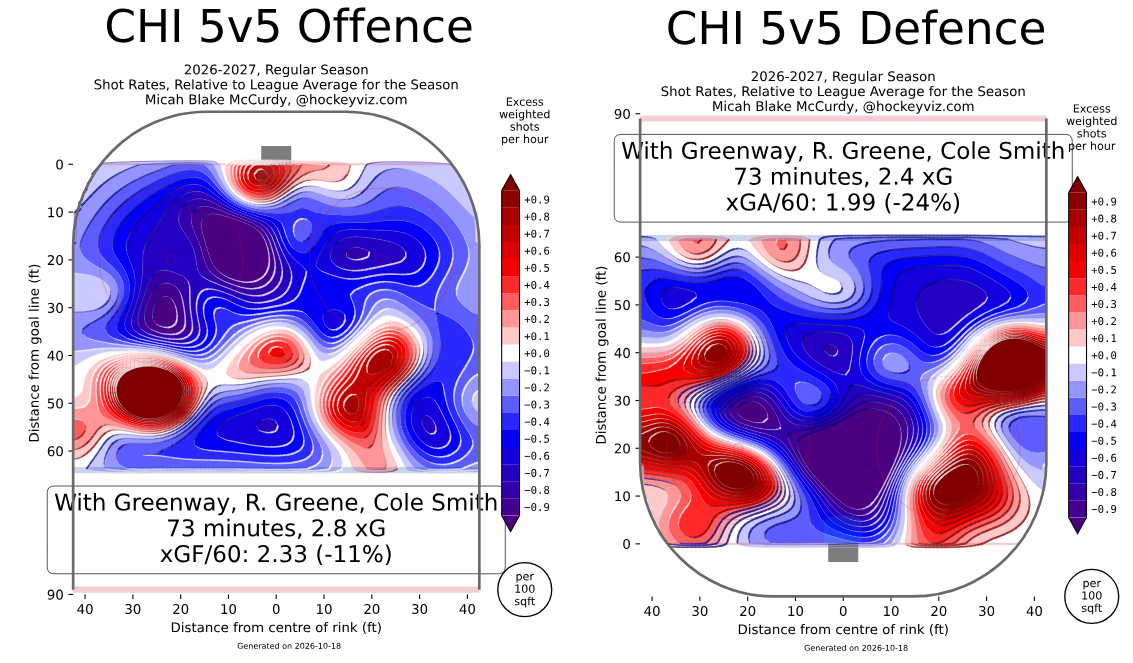
Not only are they controlling the play, but they have a positive goal differential (+1), and are doing all this with the three lowest rates of offensive zone start percentage among the team’s forwards (all between 20-30%). The Blackhawks need a lot more than a great fourth line to turn their season around, but this kind of edge can help, especially if they can alleviate a lot of the defensive responsibilities from their top forwards.
Until next week.