10 Interesting (To Me) Stats For This Week - October 6, 2026

Welcome back to another edition of ’10 Interesting (To Me) Stats’. We are a week into the new NHL season so there isn’t very much useful data right now, but through the preseason I worked on a way to keep track of ice time shared between defencemen and forwards. There are a couple more tweaks to make, but I wanted to go through some forward/defence combos that are sharing (or not sharing) a lot of even-strength ice time together.
This is all pulled from NHL play-by-play and shift data and is current as of the afternoon on Monday, October 5th. The percentages and ice time shown represent the share of ice time from the defenceman, so if Adam Fox has 50 minutes of even strength TOI, and he’s on the ice with Mika Zibanejad for 20 of those 50 minutes, then the matrix will show 40% (20:00). It includes overtime and empty-net situations.
1 – Michael Kesselring and Macklin Celebrini (San Jose Sharks)
Kesselring was traded to San Jose from Buffalo after a tough year with the Sabres that saw him frequently injured and inconsistently effective otherwise. He was looking for a bounce-back year, and there’s not many better ways to do that than be attached to Celebrini at even strength:
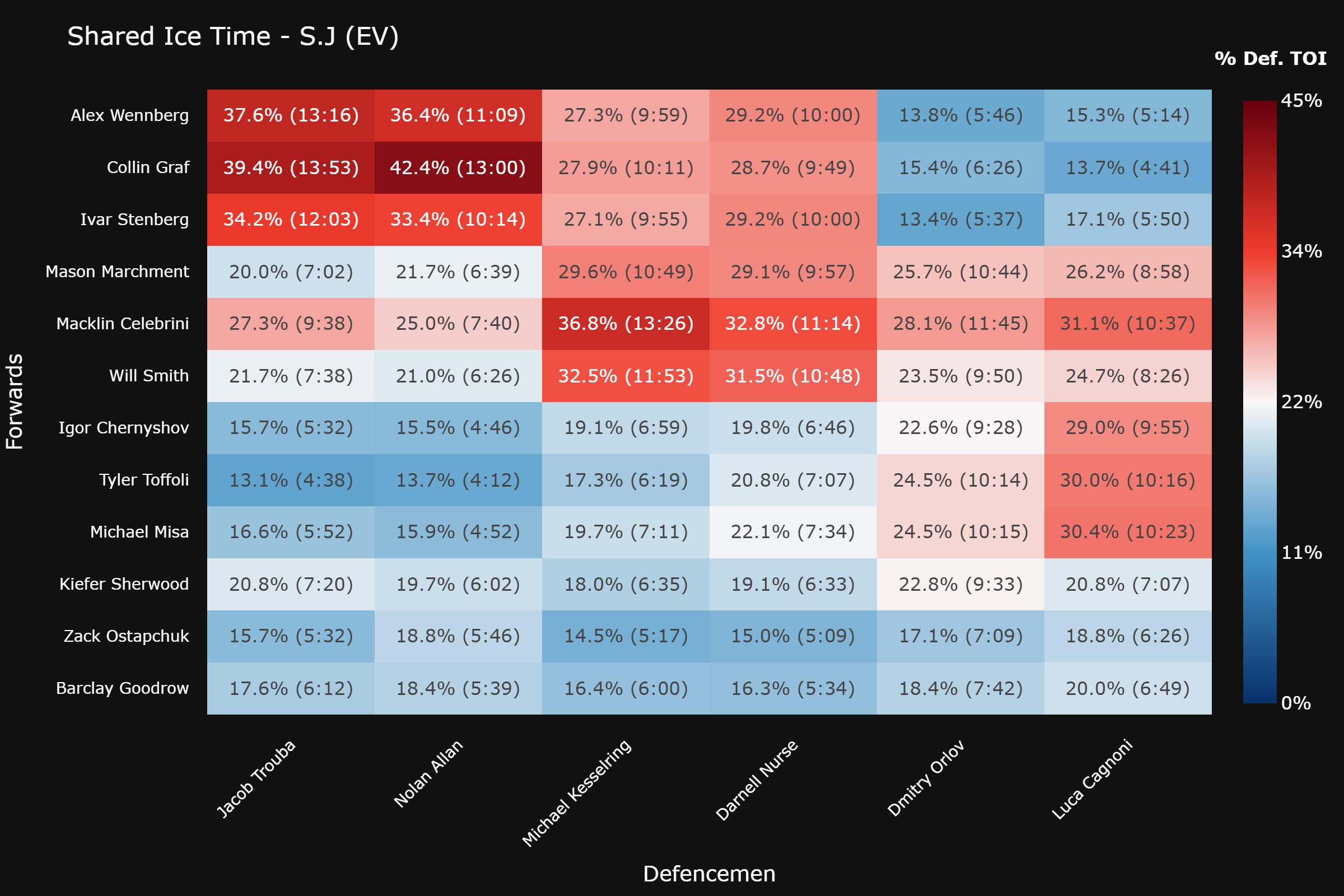
Last year, both John Klingberg and Dmitry Orlov spent between 40-45% of their TOI with Celebrini, so Kesselring’s 36.8% isn’t that high, relatively speaking, and the Sharks have just played two games. However, if Kesselring can hover in the 35-45% range with Celebrini on the ice, it’s a safe bet that he’s going to have a much better year than he did with the Sabres.
2 – Evan Bouchard/Mattias Ekholm and Connor McDavid (Edmonton Oilers)
I can feel the reaction to saying that Edmonton’s top pair and top forward spend a lot of ice time together:

It is one thing to know that they spend a lot of time together, it is another to see just how drastic the usage is:
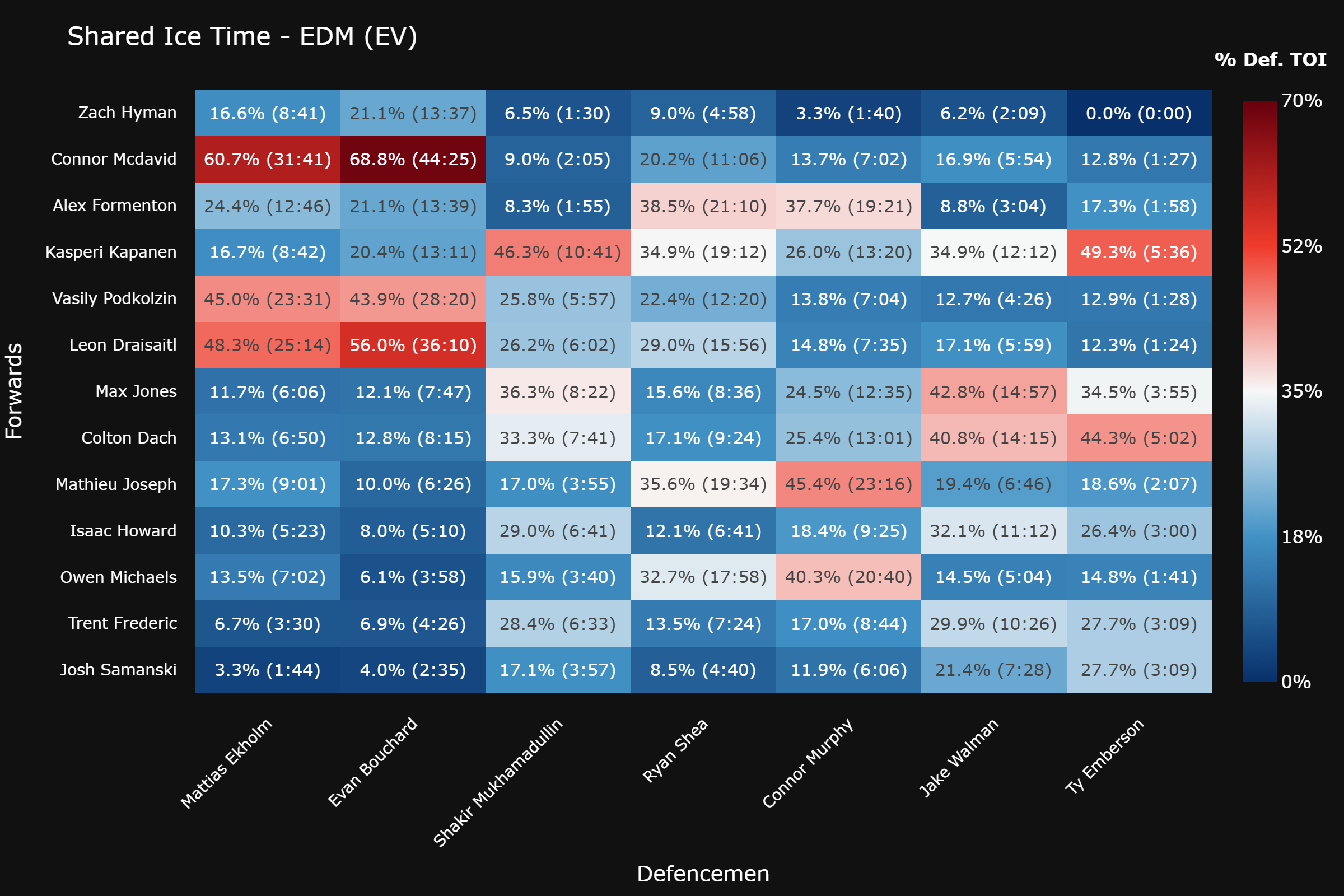
It wasn’t quite this high last season, but it was north of 60%, so this isn’t unusual. It also means the depth defencemen like Jake Walman and Connor Murphy are getting very little ice time with the top of the roster, especially since McDavid and Leon Draisaitl are skating together so much early on. Let’s see what their splits with Draisaitl look like a few weeks from now once the lineup (hopefully) gets healthy.
3 – Cale Makar and the Top Line (Colorado Avalanche)
Historically, Makar spends a lot of time on the ice with Nathan MacKinnon. New year, new me etc. so it’s always worth checking if that is the case once again, and that answer is a resounding ‘yes’:
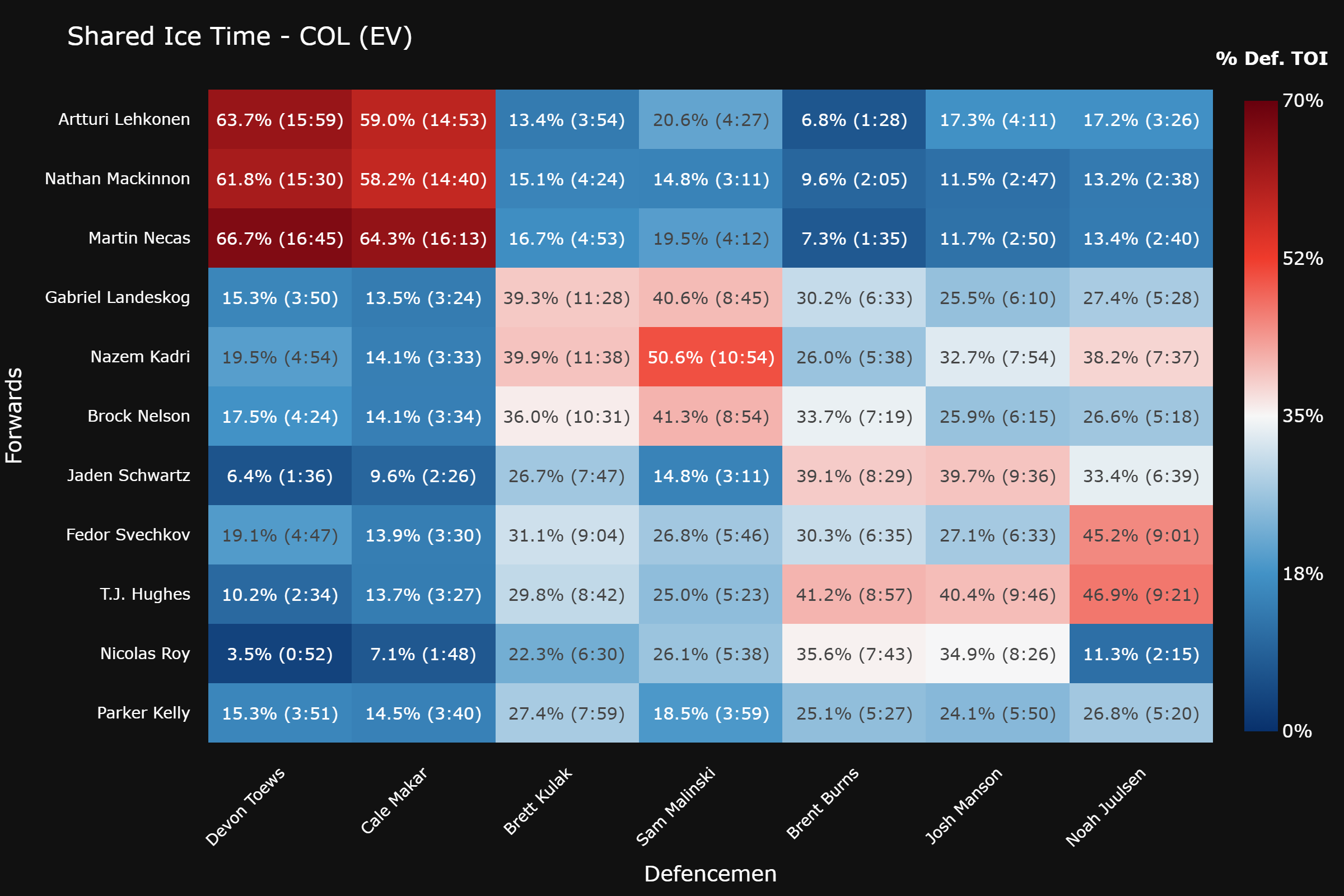
As with Edmonton, this means that the depth defencemen spend very little time with MacKinnon as no one on the blue line outside of Makar’s pair has been on the ice with MacKinnon for even 20% of their ice time. There is enough skill on the second and third lines to help float the scoring of Sam Malinski or Brent Burns, but it does cap what they can do.
4 – Brian Dumoulin and Artemi Panarin (Los Angeles Kings)
Per Evolving Hockey, over the three previous seasons, each of Cody Ceci, Mikey Anderson, Joel Edmundson, and Dumoulin were drags on expected goal play-driving, and all but Edmundson were drags on goal-driving. Knowing that, it’s important to highlight that just one of those four defencemen (Dumoulin) has played at least 25% of their even-strength ice time with Panarin:
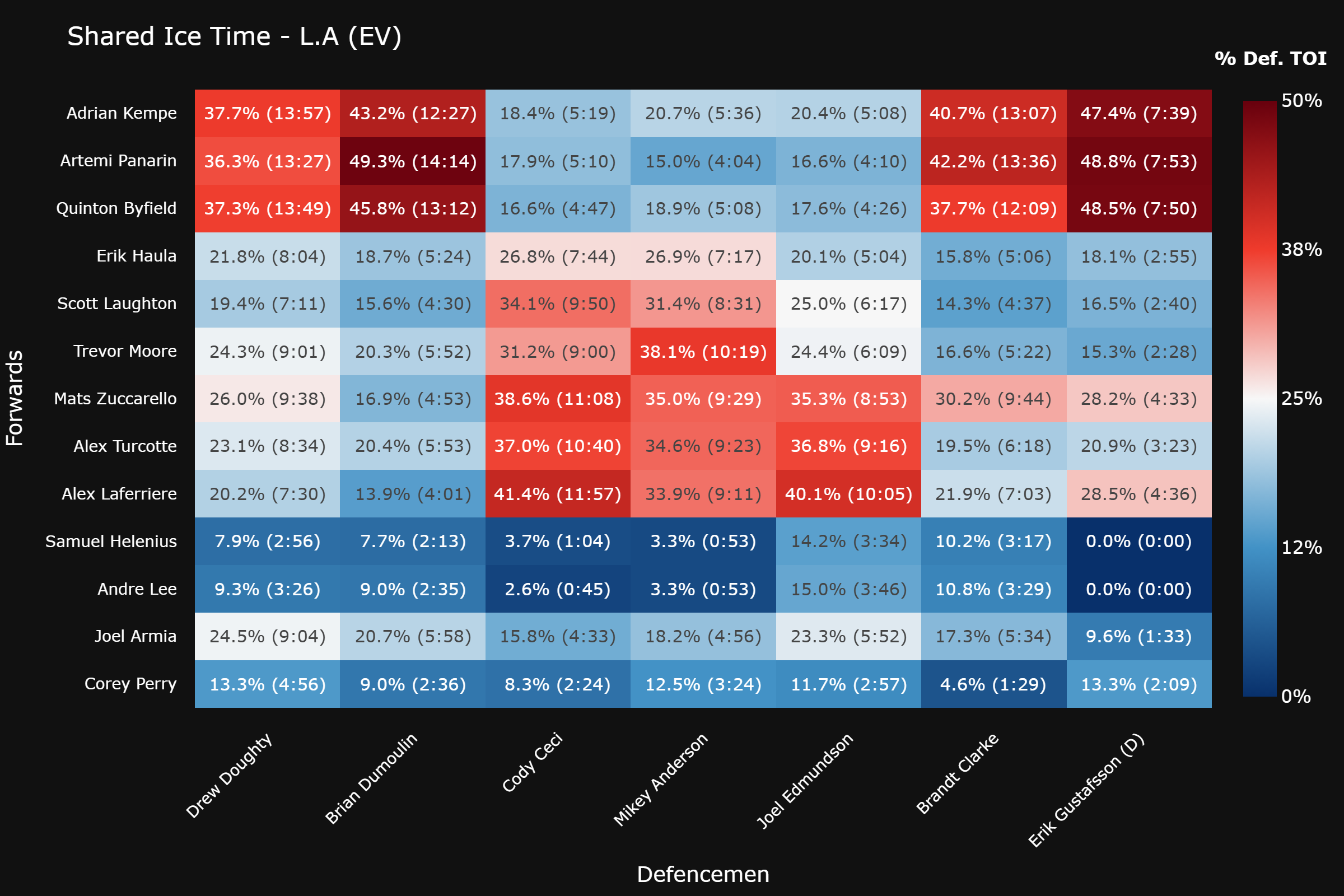
It is also notable that Erik Gustafsson was dressed for one game and the team used him heavily with the top line. It seems the Kings realize most of their defencemen are below-average or outright bad offensively, and are making an active choice to keep them away from their top forwards. Good news for their top forwards, but not good news for the middle-6 guys.
5 – Shea Theodore and Jack Eichel (Vegas Golden Knights)
It isn’t quite to Bouchard/McDavid or Makar/MacKinnon levels, but the rate at which Theodore has been skating with Eichel at even strength through three games this season is exceedingly high:
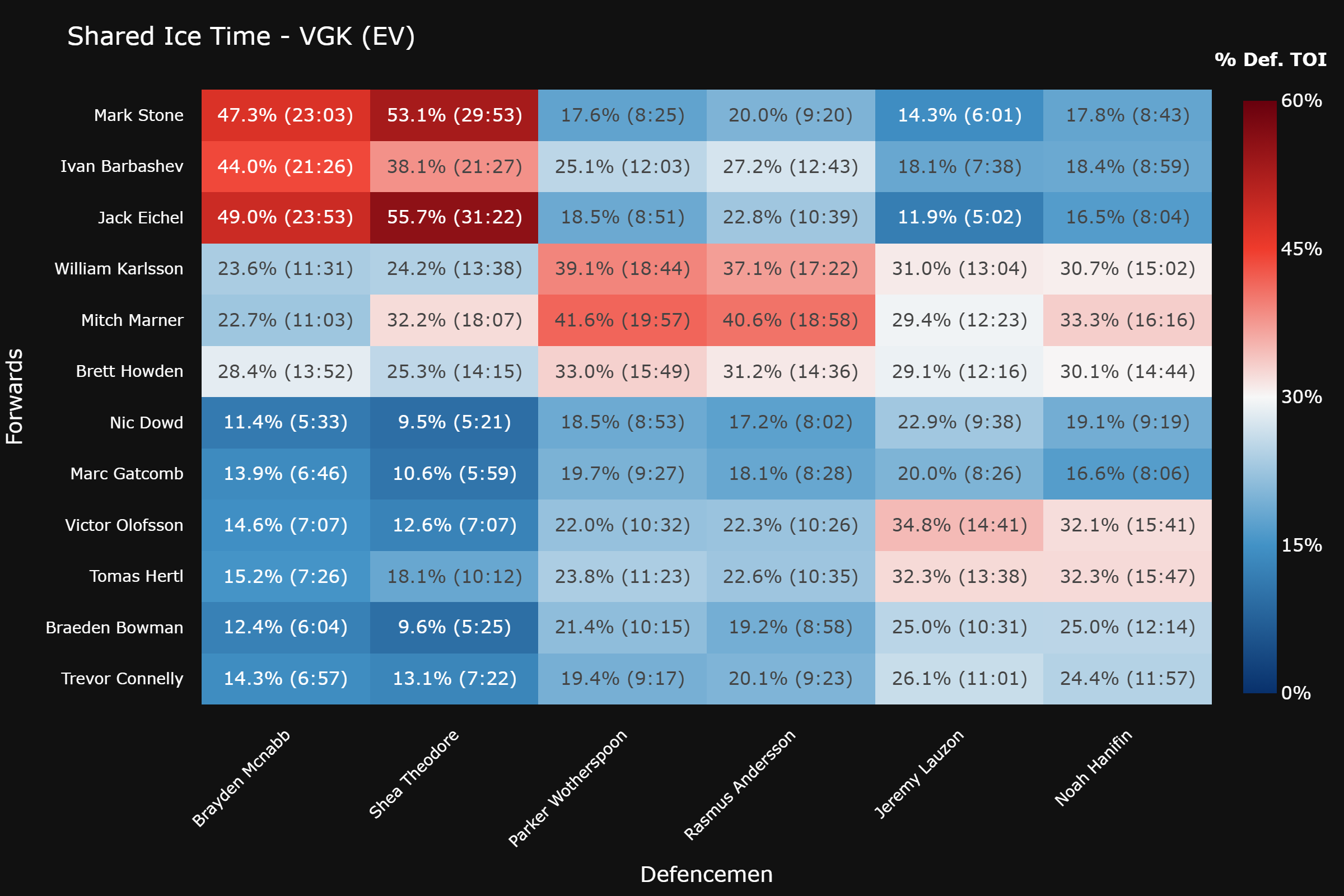
It isn’t that Theodore spending more time with Eichel than anyone else is unexpected – that was the case last year – but being around 55% with Eichel and Mark Stone is far higher than it normally is. Again, this is just three games into the season, but if the Theodore’s share of EVTOI with Eichel is north of 50% once we get 8-10 games under our belts, we could be looking at a career year for the 31-year-old defenceman (provided he hangs onto his top PP role, which is already looking shaky).
6 – Jack Hughes and Everyone (New Jersey Devils)
There are instances like Edmonton and Colorado where a team’s top defenceman will skate a pile of minutes with the team’s top forward. Then there are cases like New Jersey, where every single defenceman is skating between 29-36% of their even-strength ice time with the elder Hughes brother:
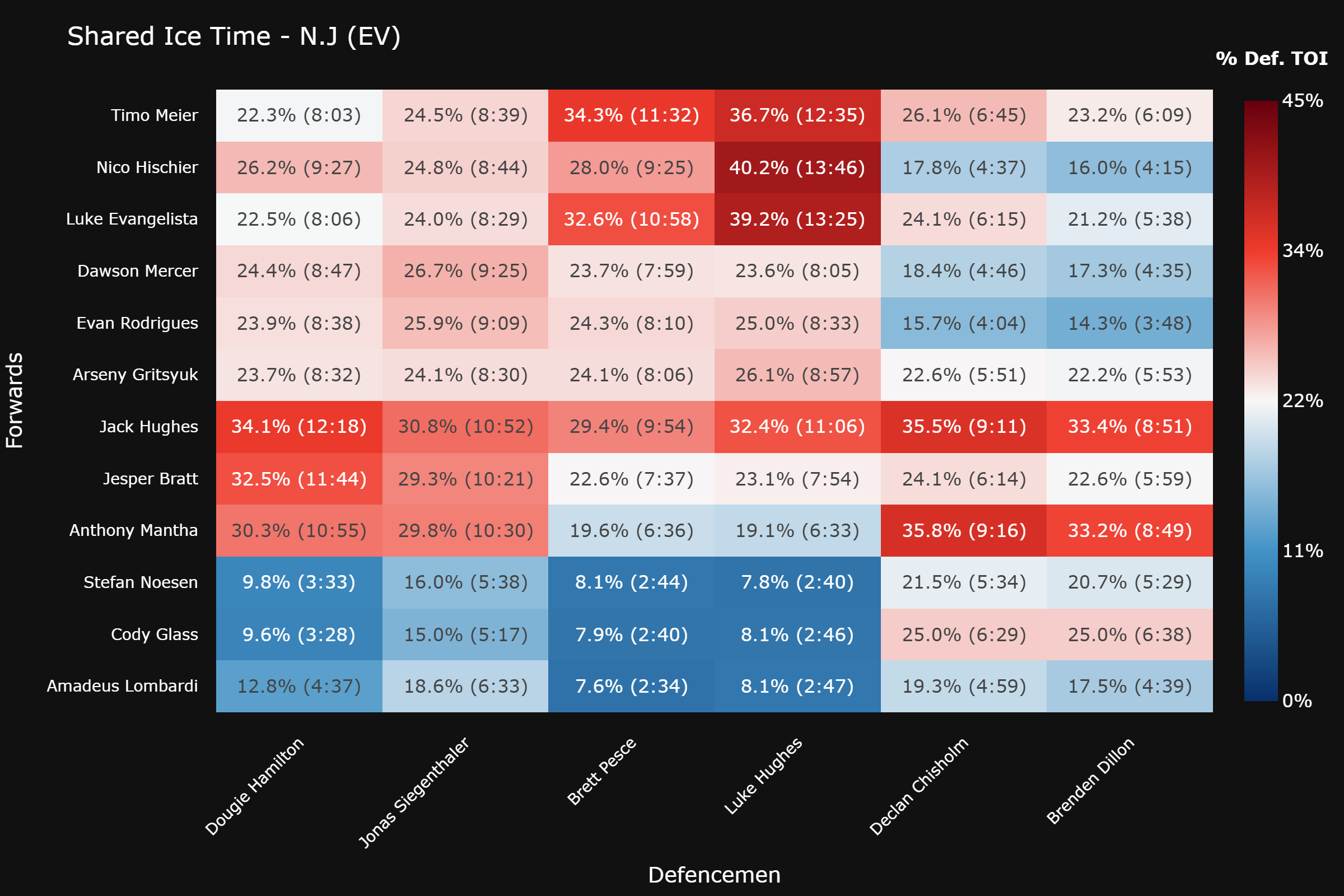
We have played just two games, but this says more about Hughes’ usage than anything. In their two games, Jack has double shifted with the third and fourth lines, something Edmonton does with McDavid if they need a goal but don’t want to entirely punt a shift. It has led to Hughes skating about 35% of the team’s even-strength ice time, the most in the league for any forward outside of Dallas and Detroit (per Frozen Tools).
7 – Matthew Schaefer and No One (New York Islanders)
Mathew Barzal is currently injured so what the ice-time splits look like now and what they’ll look like in a month’s time are not the same thing. However, it is notable that Schaefer’s most common forward is Matias Maccelli at just 33.8%, and no other forward is above 30%:
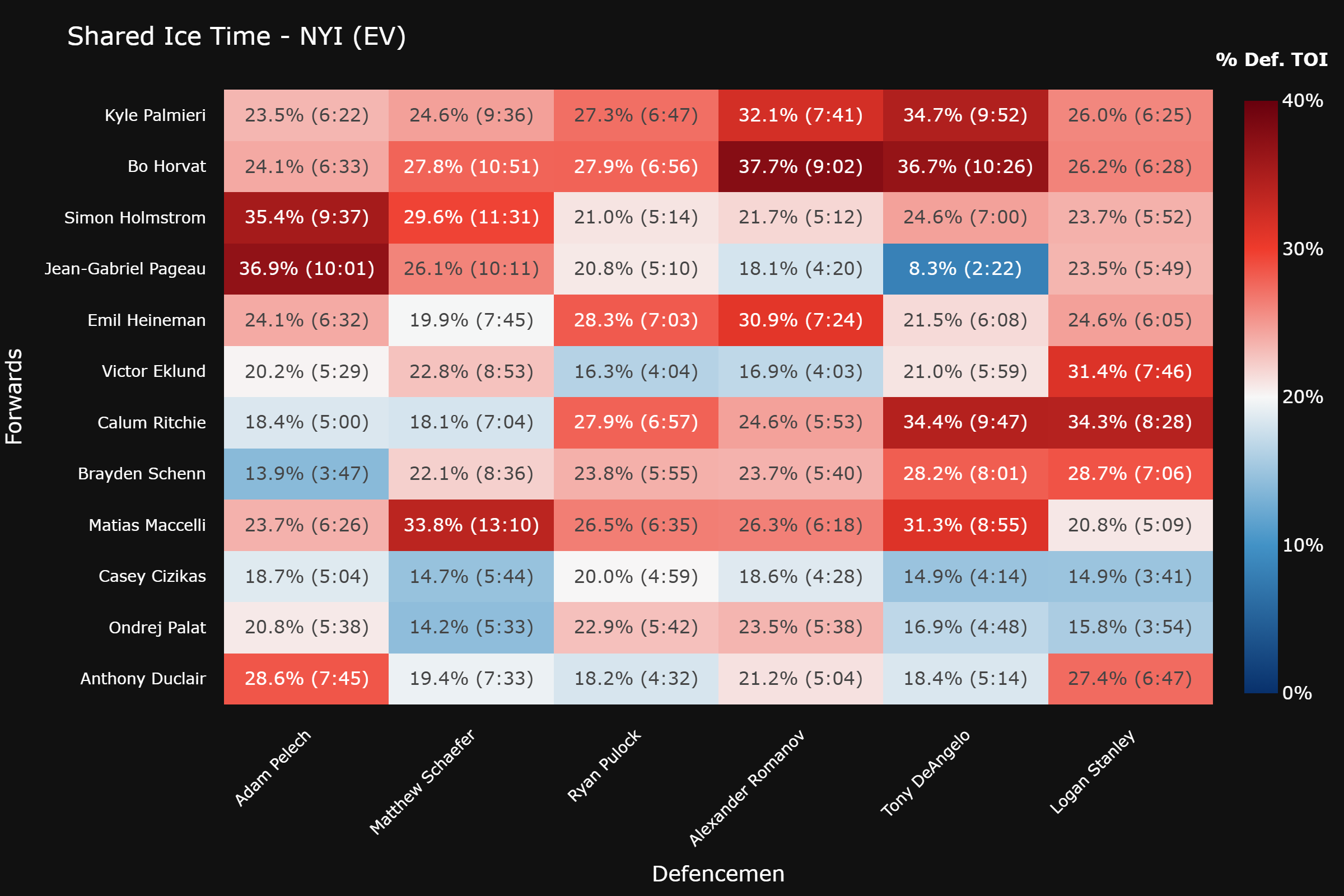
This is largely a function of the way that the Islanders have run their lines; none of their forwards have skated at least 30% of the available even-strength ice time. Last year, Barzal was over 33%, so once he returns, this probably changes. Schaefer’s spread-out usage is something that can help elevate their second and third lines beyond what is expected if the shared ice time was 5-15% rather than 15-30%.
8 – Alberts Šmits and the Top-6 (New York Rangers)
Making the NHL as an 18-year-old drafted three months earlier is one thing, but being effective is another. The coaches have to balance putting Šmits in a position to succeed while also giving the team the best chance to win. That is why it’s worth highlighting that while he’s skating very little with the J.T. Miller line, he’s skating nearly as much with the Mika Zibanejad and Noah Laba lines as he is with the Miller and Joe Veleno lines:
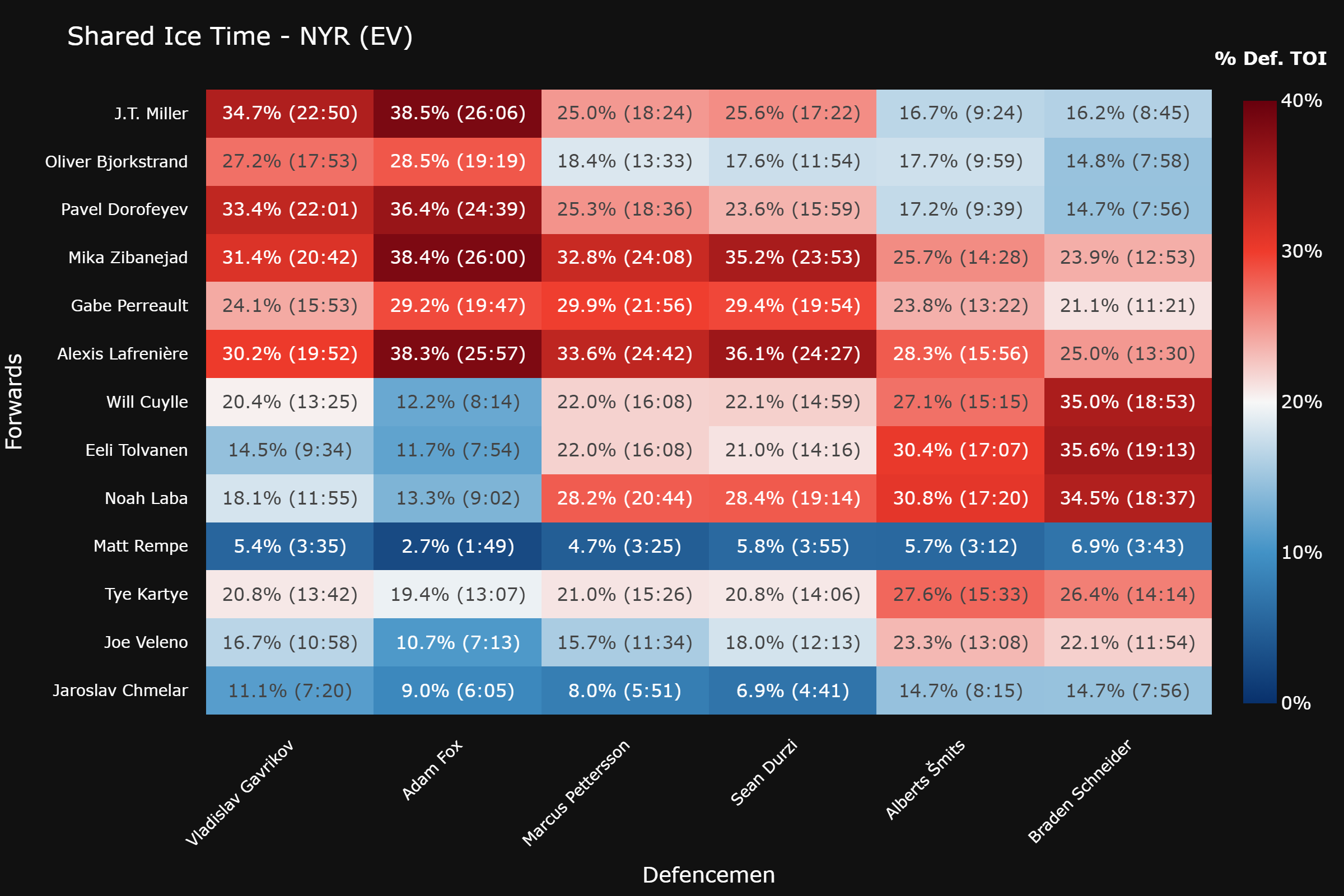
It appears as if the team wants to give him some skilled guys to play with while also giving their top blue liners like Adam Fox and Sean Durzi the bulk of the offensive minutes. The Rangers have played four games, so there is more data to work with here than any other team and this is an interesting way to acclimate a true rookie to the NHL.
9 – John Carlson and Nikita Kucherov (Tampa Bay Lightning)
Last year, Darren Raddysh skated just under 40% of his even-strength ice time with Kucherov on the ice. Carlson was signed in the offseason to be Raddysh’s replacement, and as far as EVTOI is concerned, Carlson is more than Raddysh’s replacement:
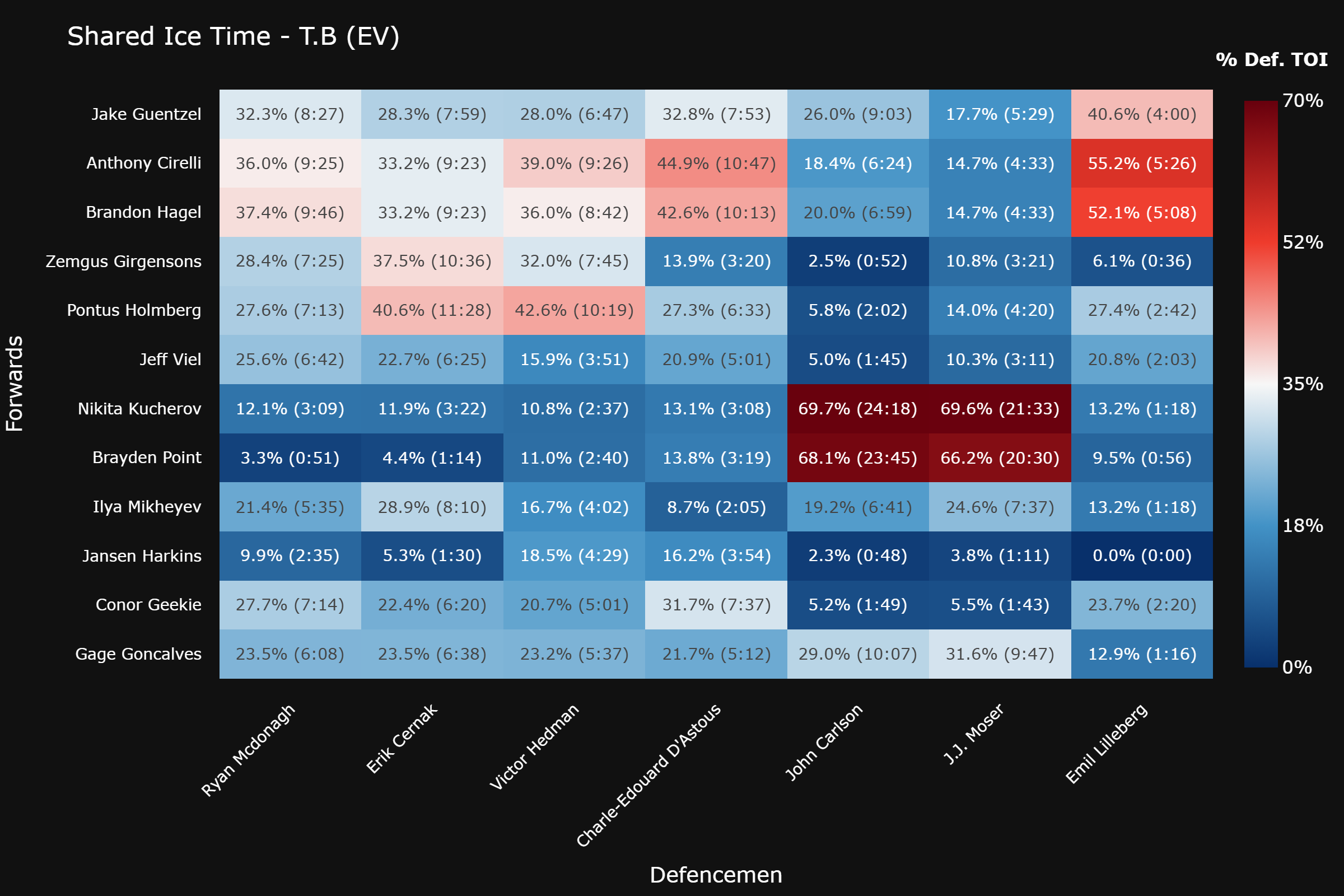
The Lightning have played just two games so this will assuredly come down once we get a few weeks of matchups, but so far, there are defined roles where Carlson skates with Kucherov, Emil Lilleberg skates with Anthony Cirelli, and Erik Černák skates with the defensive Zemgus Girgensons line. It isn’t impossible that Carlson stays with Kucherov for over 60% of his even-strength TOI – Bouchard and Makar are in that range with their respective teams – but if it stays at that level, it changes what we should expect from Carlson offensively.
10 – Moritz Seider and Alex DeBrincat/Lucas Raymond (Detroit Red Wings)
With Dylan Larkin requesting a trade, Simon Edvinsson not even in North America, and Detroit off to an 0-2 start, things aren’t looking great. The silver lining is the team is sticking with skating their best players with their best players, and that means Seider skating nearly 45% of his EVTOI with DeBrincat and Raymond:
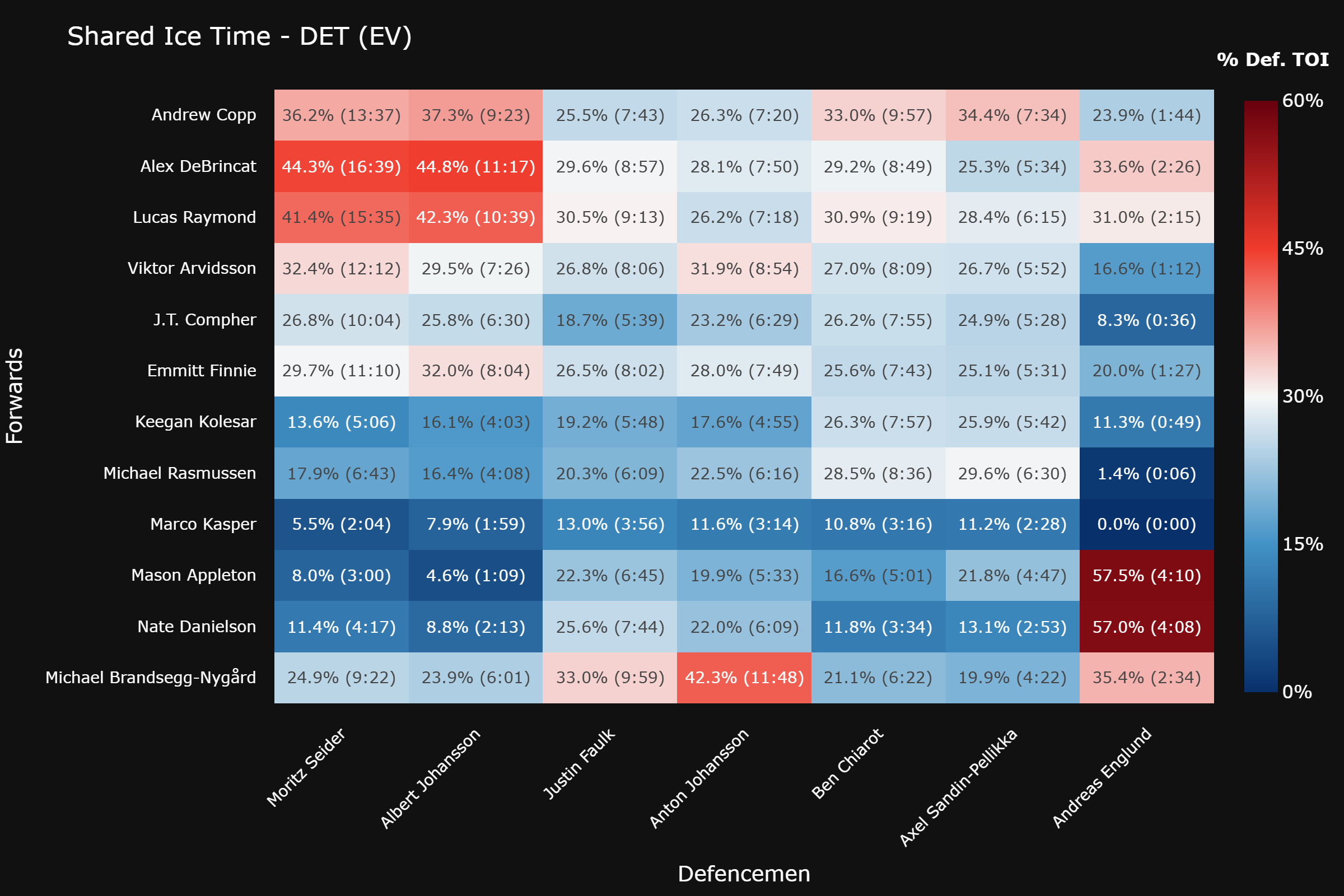
If the Wings are going to generate any offence outside the power play, this is probably the best way to do it. The bottom half of this roster is quite poor, and sending out Seider more with the depth could elevate them, but if someone is drowning and they are suddenly elevated from 10 metres underwater to 5 metres underwater, they are still drowning. May as well throw a lifesaver to those treading water on the surface and saving who you can.
Until next week.