10 Interesting (To Me) Stats For This Week - September 8, 2026

Welcome back to another week of ’10 Interesting Stats’. Two weeks ago, we covered players heading for a decline in their even-strength production. I have finally finished all my projections for goals, assists, shots, power-play points, hits, blocks, penalty minutes, and face-off wins, including empty-net situations.
Now that everything is done, I want to go over some projected improvements among forwards by all-strengths goals and assists per 84 games compared to their two-year average. The focus will be on younger options, so each player on this list has played at least one season and is under the age of 25. Data for the projections comes from Evolving Hockey, Natural Stat Trick, Frozen Tools, and All Three Zones.
In the following graphs, the yellow dots are in the top 25% for positive changes in goals and assists per 84 games compared to their previous two-year average and the blue dots fall short in at least one of those changes. The red lines represent the cutoff for the top 25% improvements.
1 – Leo Carlsson (Anaheim Ducks)
My projections tend to highly rate players who create well off the rush and are great on zone entries. There are few under-25 forwards in the NHL who can compare to Carlsson in those areas, and it’s giving him some of the biggest goal and assist improvements in the league:
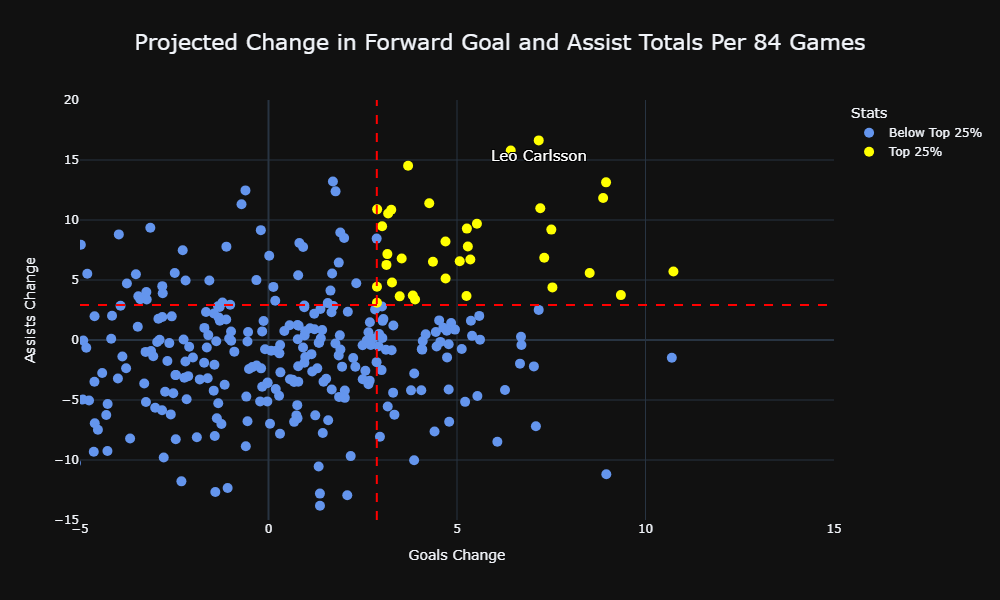
At 22 years old and in his fourth season, it’s no surprise that there’s a leap expected here. It makes me nervous that the Ducks have so much turnover on the blue line, but a player who gets a lot of ice time and is showing this level of skill at his age with a three-year track record checks a lot of important boxes. He should be over a point-per-game player in 2026-27.
2 - Juraj Slafkovský (Montreal Canadiens)
On the topic of 22-year-old players, my early even-strength projections showed a sizeable increase for Slafkovský. Now that we have all strengths and empty-net situations compiled, that sizeable increase remains:
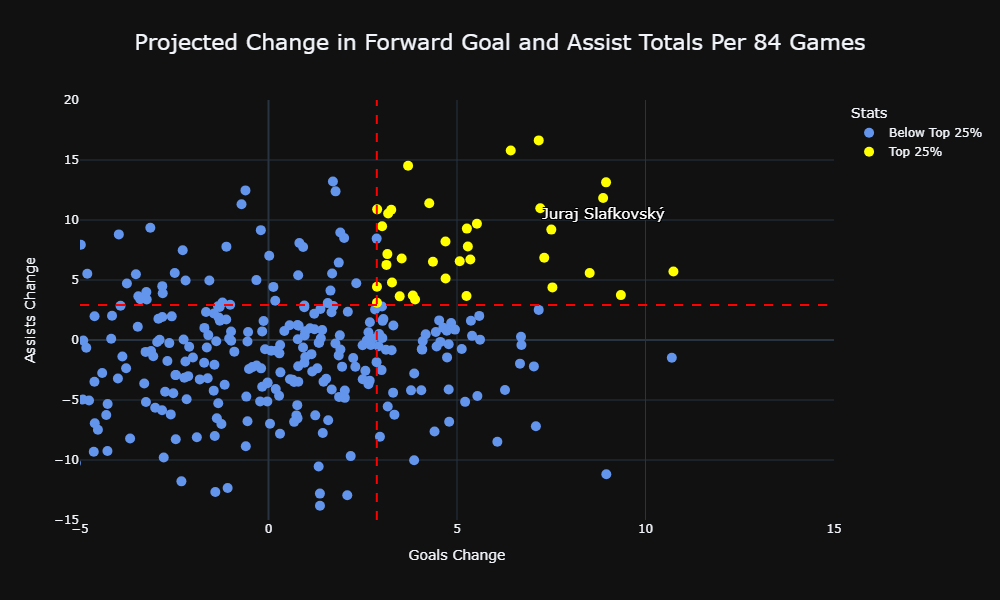
When I dug into what was going on, three things came up: consistent improvements in his playmaking, an improved shot rate, and more ice time defending a lead with the empty net, which is what happened in the late stages of the 2025-26 season. He probably won’t get to the point-per-game plateau, but he shouldn’t be very far off, either.
3 – Luke Evangelista (New Jersey Devils)
Last week, this blog covered why Evangelista was traded from Nashville and why it was a mistake. Right on cue, Evangelista finds himself on our list for improvements in goal and assist totals:
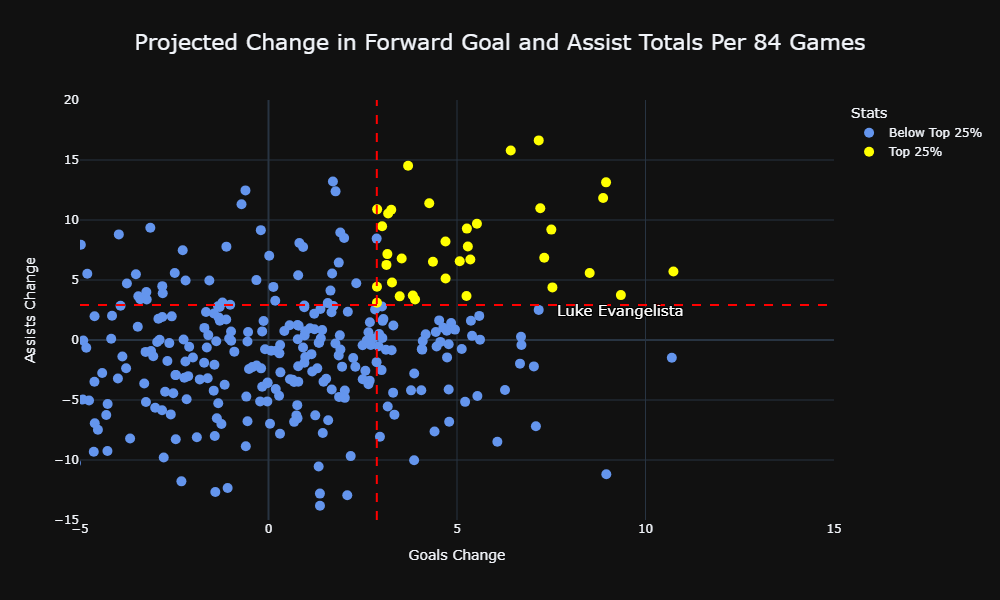
The big change is the goal scoring, and that’s worrisome. Evangelista has shot under 10% in each of the last three seasons and averaged under 8% in that span. These projections assume he’ll get to 12.5%, which isn’t hard for many forwards, but seems hard for him. All that said, going to New Jersey is giving him a big bump, and that could lead to his first 20-goal campaign.
4 – Beckett Sennecke (Anaheim Ducks)
The second Duck on our list is in his second year, and like Carlsson, he created well off the rush and was great on zone entries in 2025-26. That type of profile will typically lead to further scoring improvements, which is what we see for Sennecke here:
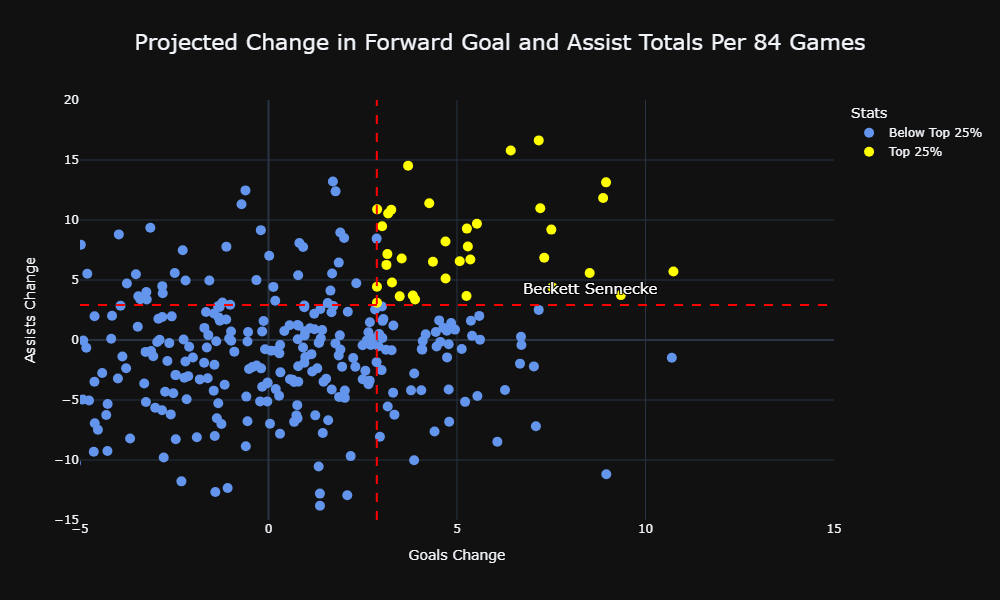
There is a solid improvement in assists but a big improvement in goals. One reason is that he shot 11.7% last year, which is fine, but not great. The other reason is more ice time is expected, particularly in the first half of the season due to the Troy Terry injury. Sennecke was a 60-point rookie, and he looks primed to be a 70-point sophomore.
5 – Mackie Samoskevich (Seattle Kraken)
Nothing makes me more nervous than being high on forwards from the Seattle Kraken, but Samoskevich showed some of the hallmarks of a player verging on a breakout last season, and it seems as if that breakout is here:
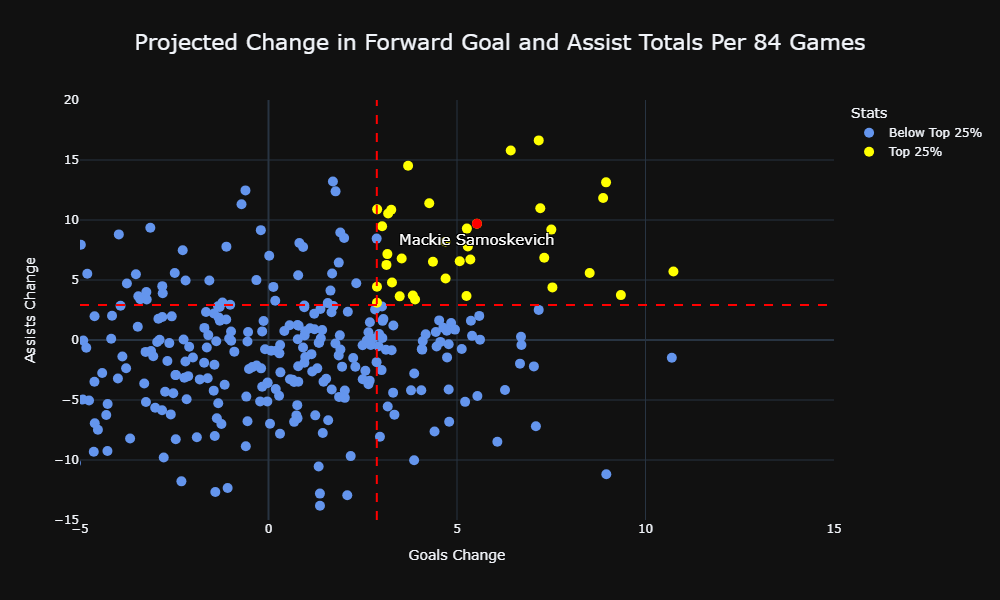
Under the hood, a projected increase in ice time, combined with an improved shooting percentage, gives us what we see here. He isn’t projected for anything extreme – 21 goals, 30 assists – but just that level of production with his physicality brings a unique dimension that can replace, and improve upon, what Eeli Tolvanen offered. Samoskevich looks to be a difference-maker for his new team.
6 – Jackson Blake (Carolina Hurricanes)
The offseason surgery to Seth Jarvis opens a lot of minutes, particularly on the power play. Blake is assumed to take a good chunk of those minutes, and with two full seasons under his belt, he is ready for a leap in production:
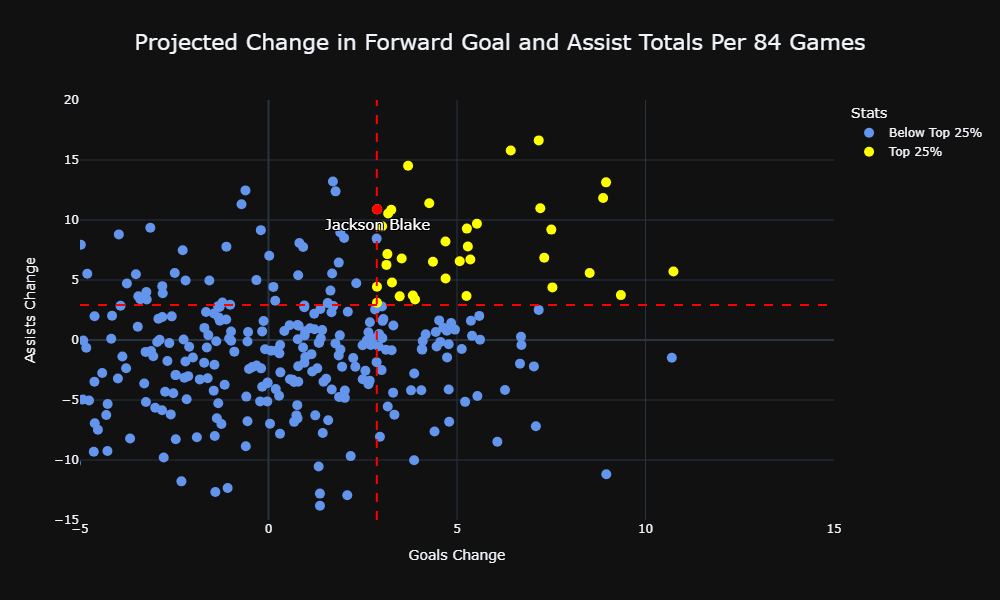
The big jump here is in his assist total, and over half that leap is from the power play. That is important because if someone like Taylor Hall or Logan Stankoven takes Jarvis’s top PP role, Blake would still qualify for assists but fall short of the cutoff for goals. Either way, Blake’s overall point production is expected to rise, but how much he produces will depend on that early PP role.
7 – Quinton Byfield (Los Angeles Kings)
With Phillip Danault traded last season, and Anže Kopitar retiring, the Kings are truly Byfield’s team now. The increases aren’t huge, but are notable for a player who fell under the 50-point mark in 2025-26:
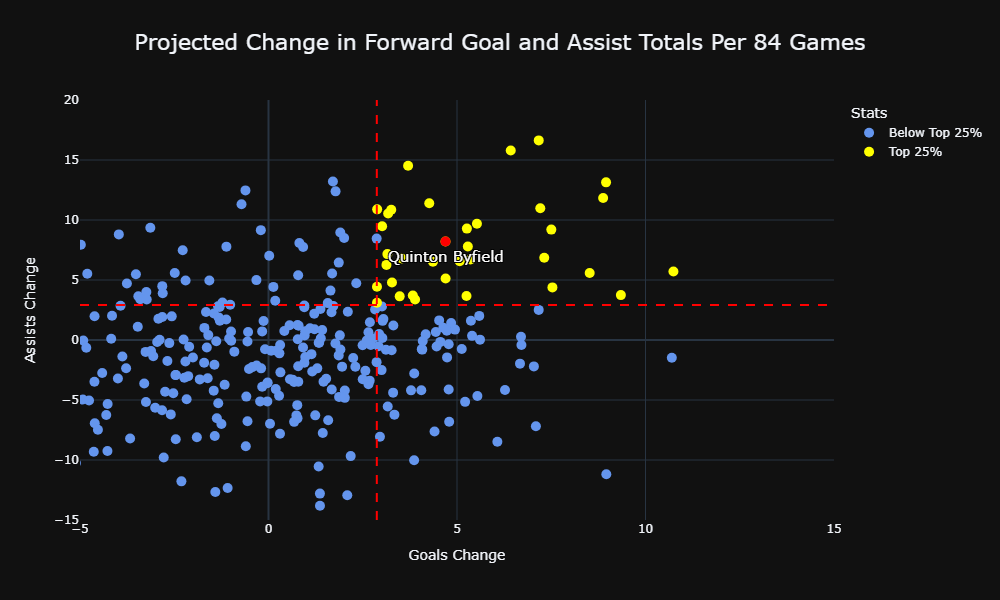
If these projections are accurate, he should push for a 30-goal, 40-assist season. Over half his increases in each stat come from the power play, where he should be a fixture now that he’s the team’s unquestioned top centre. This will technically be his seventh season and he’s still just 24 years old. The 2026-27 campaign is the time for Byfield to establish himself as a star.
8 – Dylan Guenther (Utah Mammoth)
Development isn’t always linear, but sometimes it is, and Guenther has improved his points and shots per minute each season he’s been in the league. At 23 years old and in his fifth season, the young Mammoth winger is ready for a 40/40 season:
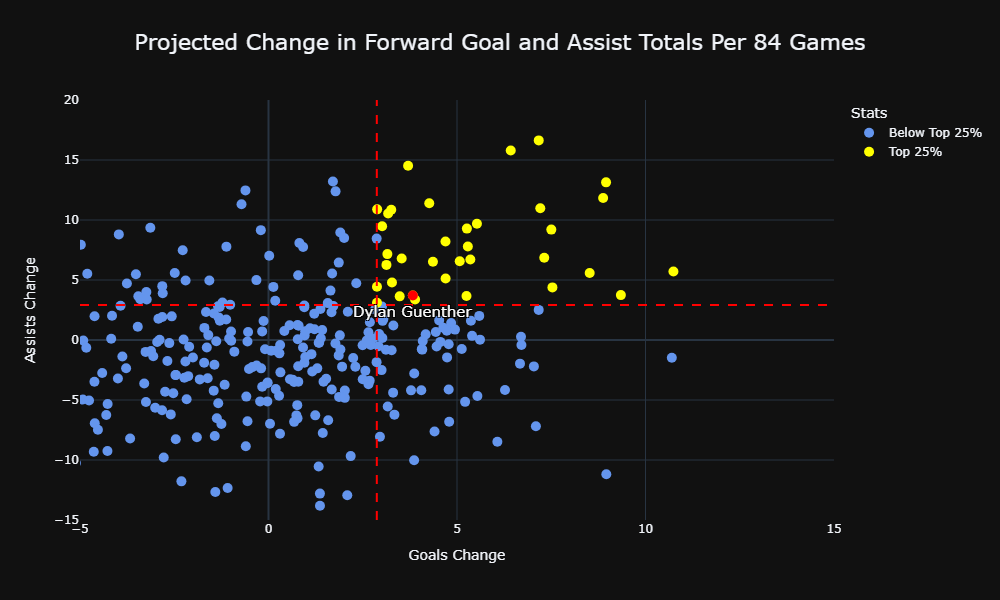
For a young player who has been so good but has also been consistently improving, this isn’t much of a surprise. A full, healthy season from Logan Cooley should give the Mammoth one of the most dynamic young duos in the league, and that should help Guenther establish himself as one of the NHL’s top offensive wingers.
9 – Matt Coronato (Calgary Flames)
After scoring 24 goals in 2024-25, Coronato fell to 18 goals this past campaign. That was on the back of shooting 9.1%, and while the Flames don’t look like they’ll be a high-percentage team, a modest rebound there with some more assists puts Coronato on our radar:
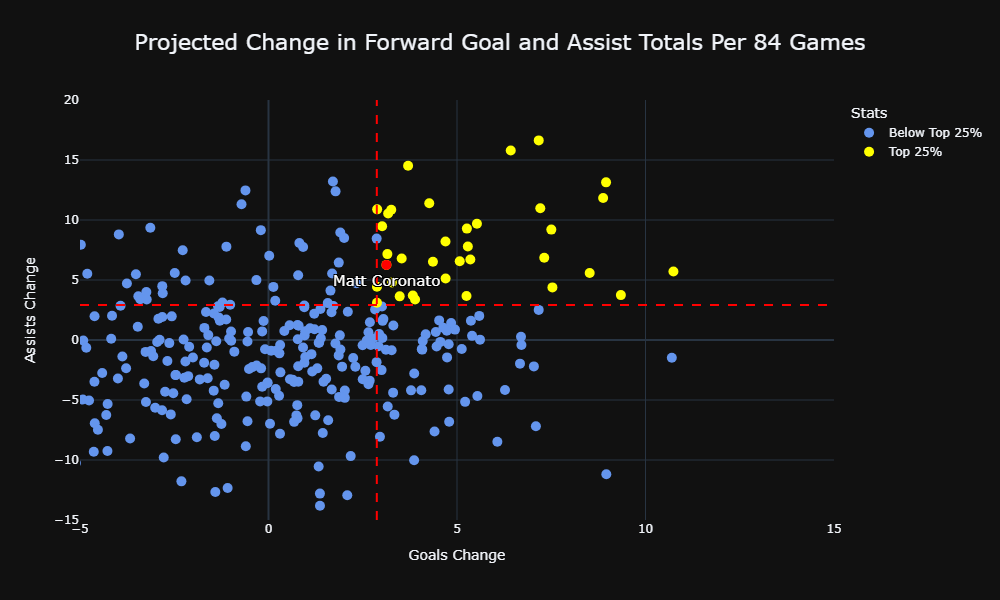
There are a few more goals, but a half-dozen more assists expected. Full seasons from Zayne Parekh and Šimon Nemec should help Calgary be more mobile on the blue line, and that should help their forwards score more. With Blake Coleman gone and Jonathan Huberdeau a shell of his former self, Coronato is in line to be Calgary’s top winger, and that kind of role should help boost his production.
10 – Liam Öhgren (Vancouver Canucks)
Öhgren won’t turn 23 years old until January and has yet to play 100 NHL regular season games. The real breakout might still be a year away, but considering the massive ice-time increase he got after his trade to Vancouver – he added nearly four minutes per game – it makes sense that he’s showing notable goal and assist increases:
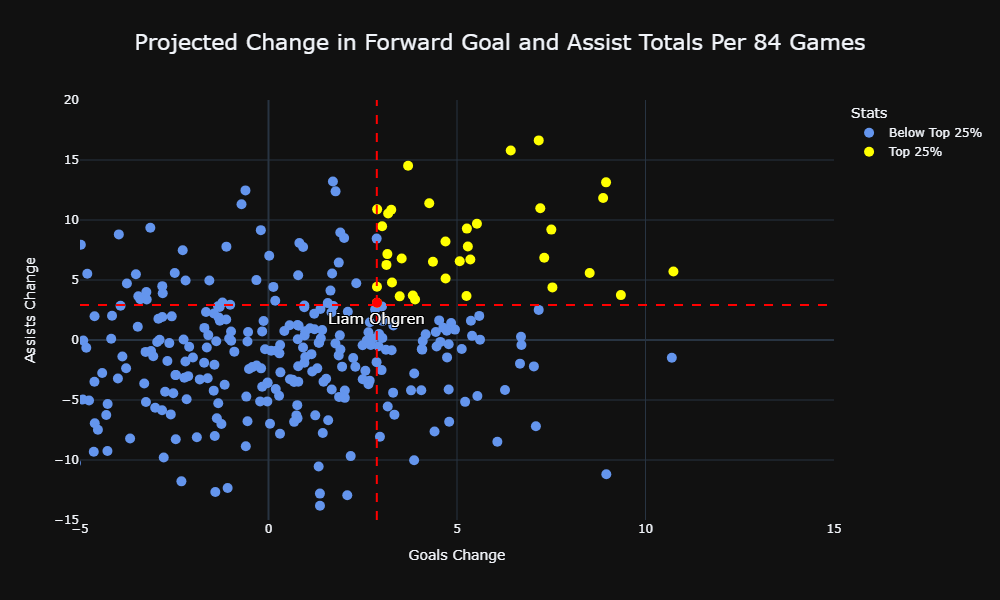
Remember that we aren’t talking about a huge producer, anyway. These kinds of improvements mean a 12-goal, 15-assist season if he plays all 84 games. Öhgren should have plenty of opportunities to establish himself as a third-line winger skating for a franchise just starting their rebuild, and any marginal improvements to their depth scoring would be a welcome addition to the team.
Until next week.