Luke Evangelista and Prospect Depth
Nashville traded Luke Evangelista to New Jersey. Why they traded him matters.
On Tuesday night, the Nashville Predators traded winger Luke Evangelista to the New Jersey Devils for the Colorado Avalanche’s first-round pick in 2028 and a second-round pick in 2028. There are conditions on the first rounder, and it’s possible they don’t get that pick until 2029.
Prior to the 2025-26 season, I wrote about how Evangelista, who had yet to post a 40-point season, had immediate 55-point potential; he finished the year with 56 points. Back in February, I wrote about how his offensive creation above his team average put him in league with Kirill Marchenko from Columbus. Hell, back in the spring of 2024, I wrote about how Evangelista was arguably Nashville’s best forward in their first-round playoff exit.
This is a player I was high on before his breakout, so I might be biased. Don’t just listen to me. Over his three full seasons, Evolving Hockey has him as a top-50 defensive forward in the league, and HockeyViz’s Synthetic Goals model, which evaluates a player’s contributions to play-driving at both ends, shooting talent, playmaking, special teams impact, and penalty differential has him taking a monster step this past campaign:
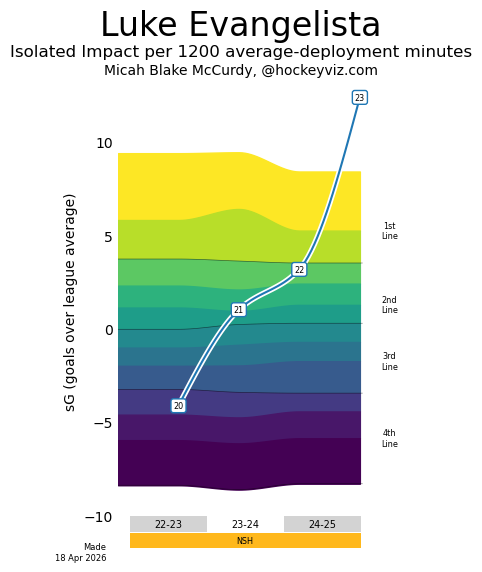
Evangelista’s true talent level, and what he’ll look like over the next 10 years, is up for debate. I think it’s safe to say he’s at least a second-line winger right now and at 24 years old with just 253 regular season games, there potential for further improvement. Maybe he’s not a franchise cornerstone, but he’s a guy who will help his teams win games.
If we’re looking for a reason why the Nashville Predators, a team whose core skaters are all 32-36 years old, have missed the playoffs two years in a row, and finished 23rd in the league last year despite a middling Western Conference, decided to make this trade, it comes down to Evangelista’s contract. More specifically, the contract negotiations. He was an RFA at the end of the 2024-25 season and needed a new deal. As noted earlier, he had shown all the hallmarks of a breakout, but rather than signing Evangelista to a long-term contract, Nashville gave him a two-year bridge deal for $3-million per season. Oh, and they took all fucking offseason to low-ball their second-best winger who was a 23-year-old homegrown talent, reaching an agreement four days before the regular season started.
The worst part is that Nashville didn’t need to bridge Evangelista. Before he signed his contract, the team had a little over $10-million in cap space. Despite the signs of being a breakout player, and despite being a second-line winger at the time, and despite Nashville having the cap space to offer a long-term contract that would have given him a much higher AAV right now but kept a very good player until he was 30 years old, the Predators kicked the can down the road. Our sins incur a debt, and eventually, the bill comes due.
Keep in mind that the AAV on a long-term deal wouldn’t have been massive. Logan Stankoven signed an eight-year deal in July of 2025 for $6-million a season. That is a good barometer for what Evangelista would have gotten, plus or minus a million dollars. Whether Evangelista would have signed that deal is between Evangelista and Nashville, but it’s hard to imagine a second-round pick with 172 career games (at that time) turning down $50-million dollars.
To make matters worse, it’s not as if there’s a massive cap crunch coming in 2027, either. PuckPedia has the Predators with $70-Million in cap commitments for the 2027-28 campaign. They do have five pending RFAs, but none are likely to be massive paydays. Even if they averaged $5-million AAV each, which is a big overestimation, the Preds would still have roughly $18-million in cap space for three roster spots. Take out $10-million for the long-term contract Evangelista could have signed this year – which would again likely be an overestimation – and they would have about $8-million in cap space for two roster spots. They had the ability to sign him long term last year and refused. They had the ability to do it again this year and refused.
It is under those conditions that this trade should be viewed. This isn’t the Anaheim Ducks where they legitimately may not have cap space to extend a young winger; Nashville just decided not to. Whether Evangelista made it clear he wanted to leave the organization is a fair question, but we don’t know that, and may never know that. On its face, Nashville made a huge mistake in the summer of 2025 and it cost them one of the better under-25 two-way wingers in the league.
That is why it was frustrating to see the response to the trade. One common theme, whether it was from Nashville General Manager Chris MacFarland, or from beat writers (here and here), was the organizational depth Nashville has at forward. My response:
I don’t want to pick on the Nashville writers here. They are good at their jobs, and I have no issue with them saying this. My issue is that I see it all the time when it comes to ‘depth’ and it’s overblown.
In 2021, The Athletic’s Scott Wheeler had the Los Angeles Kings with the best prospect pool in the league. Topping the list was Quinton Byfield, and I believe he’s about to turn into a star, so that’s fine. Then we get Alex Turcotte, Arthur Kaliyev, Gabriel Vilardi, Tyler Madden, Helge Grans, Samuel Fagemo, Tobias Björnfot, Rasmus Kupari, and Akil Thomas. Out of the top 10 from the team with the best prospect pool five years ago, we got precisely two top-6 forwards (one of whom is now in Winnipeg) and zero NHL defencemen.
The #2 team for team prospect strength in 2022? The New York Rangers. Do we really need to review that list?
The #4 team? The Detroit Red Wings. Hey, they got Lucas Raymond and Moritz Seider. They’re both elite. Then of their next 18 prospects, not one has turned into a top-half-of-the-roster player. There are a few bottom-6 wingers.
In 2022, Wheeler’s prospect depth rankings had the Buffalo Sabres first. No issue saying that worked out; guys like Owen Power, Jack Quinn, JJ Peterka, Mattias Samuelsson, and Ukko-Pekka Luukkonen all panned out to be impact players. We’ll throw in Peyton Krebs and that makes it 6/20 players turned into regular NHLers, and 5/20 actual impact players.
Again in 2022, the second-place team was Los Angeles. In third was the Minnesota Wild. Matt Boldy, Marco Rossi, and Jesper Wallstedt all panned out. There are a few bottom-6 guys in Marat Khusnutdinov, Jack McBain, and Connor Dewar. Again, 6/20 made it as NHL regulars, but just three became big impact guys (so far, anyway).
This is just a handful of teams over a couple years, but they were the top organizations for prospect depth, and it’s to make the point that ‘depth’ doesn’t mean ‘good’. It certainly doesn’t mean ‘likely’, either. Matthew Wood has already arrived. Brady Martin and Ryker Lee, both wingers, top Wheeler’s list for Nashville’s prospect depth. Here is what the prospect evaluation model at Hockey Prospecting has to say about those two:
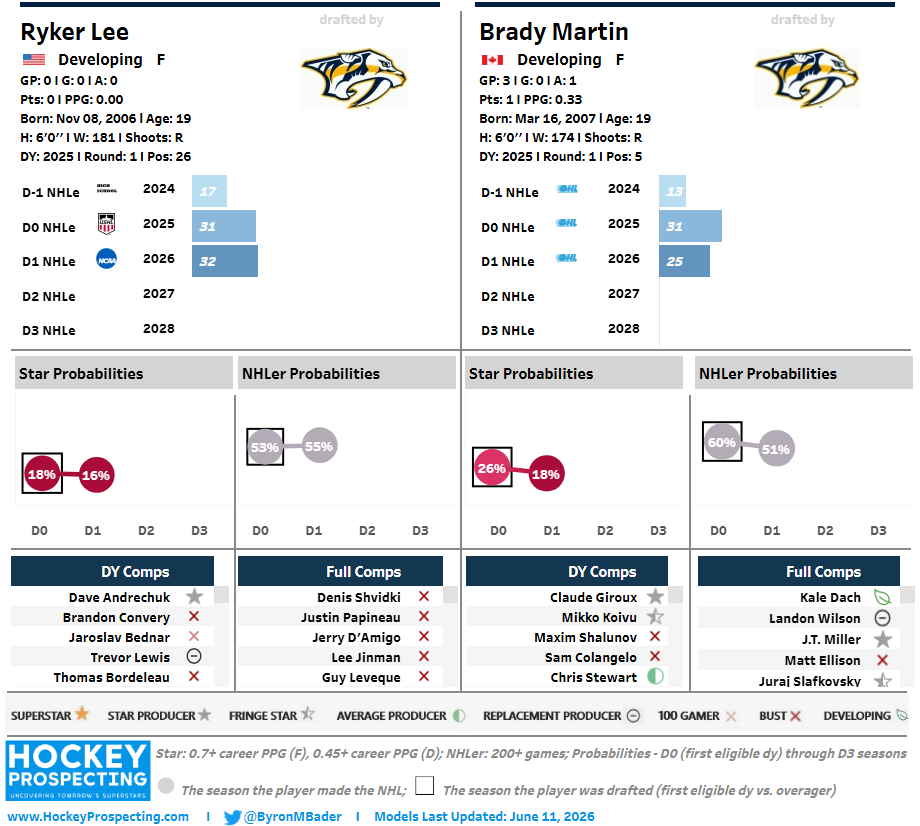
Let’s be generous and say all of Wood, Martin, and Lee turn into regular NHLers, and one of them into a genuine top 6 winger for a Stanley Cup contender. Great. Maybe you get one NHLer more from the rest of the organization, and 2026 10th overall pick Wyatt Cullen turns into a top 6 winger. You have two top 6 wingers, maybe two or three bottom 6 wingers, and that would be a great outcome. You’re still missing a lot of talent. Whatever ‘depth’ the team thinks they have, banking on more than 25% of that depth to become impact players is expecting way too much.
That is if things work out very well, too. What if they don’t? What if this isn’t the 2022 Buffalo Sabres’ prospect pool and instead it’s the 2021 Los Angeles Kings? What if they get one impact player, trade another for some help at a different position, and the rest turn into bottom 6 guys or just never make it? They already had an impact player, and one who was due for a new contract at 25 years old. With the NHL’s pending seven-year limit on contracts, they would have had Evangelista until he was 31. Instead, they have this mythical ‘depth’ I keep hearing about.
The Predators messed this up a year ago, and maybe that just severed the relationship between the player and the team. But now the core of the roster is all 32-36 years old and after that it’s a bunch of hope. Unless they flip those picks to go get another impact player at a similar age, all that’s left is ‘depth’. Don’t worry, though. So far, it’s worked out really well for the Kings, Red Wings, Rangers, and Wild.