10 Interesting (To Me) Stats For This Week - September 15, 2026

Welcome back to another week of ’10 Interesting (To Me) Stats’. There are two weeks until the start of the 2026-27 NHL regular season, and our look ahead to the campaign rolls on.
In last week’s edition of ’10 Stats’, we covered forwards whose 2026-27 projections saw substantial improvements to their goal and assist rates compared to their two-year average. Today, we’ll do the same but move to the defencemen. Data for the projections comes from Evolving Hockey, Natural Stat Trick, Frozen Tools, and All Three Zones.
In the graphs below, the red lines represent the cutoffs for the top 25% for improvements in goal and assist rates. The yellow dots are those who qualify for both increases, the blue dots are those who fall short of at least one of those cutoffs, and the red dots are the players being discussed.
1 – Brett Pesce (New Jersey Devils)
May as well start with one of the bigger surprises among all my projections regardless of position. While they are generally very high on the top New Jersey skaters, it was a genuine shock to see where Pesce landed, which is among the biggest production increases overall, and among the largest assist increases:
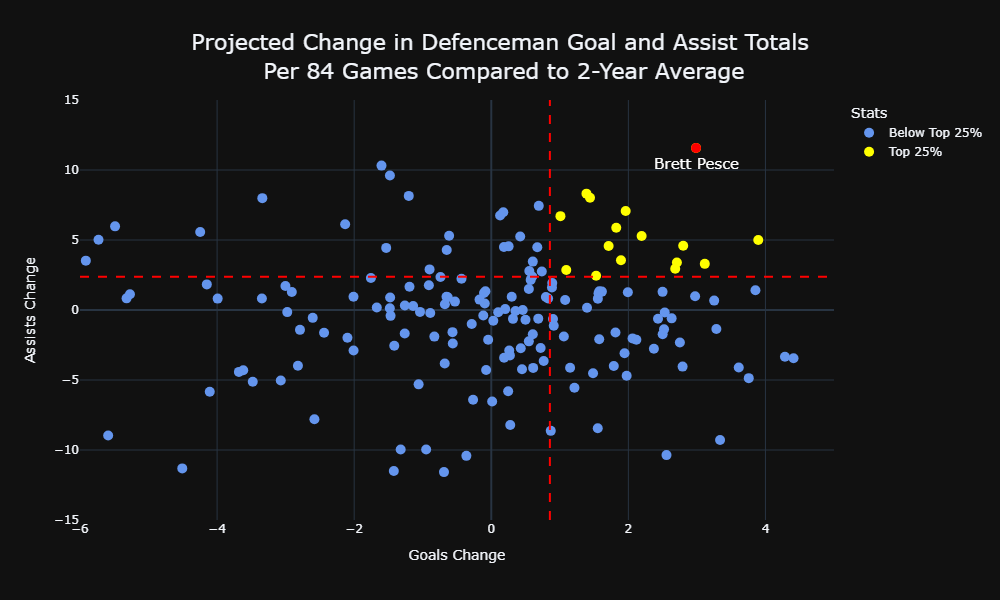
Two reasons for this: an expected ice time increase thanks to Šimon Nemec being traded, and a rebound in New Jersey’s shooting percentage (they shot just 5% with Pesce on the ice at 5-on-5 last year after nine straight years between 7-10%). He won’t be a massive point producer, but if he and the team stay healthy (big ‘if’), he can push for 30+ points.
2 – Brandt Clarke (Los Angeles Kings)
This is much less of a surprise. Clarke has played parts of four seasons, two full seasons, and is 23 years old. He is now approaching his prime production years and is ready for more ice time. That gives him a sizeable jump in goal and assist rates:
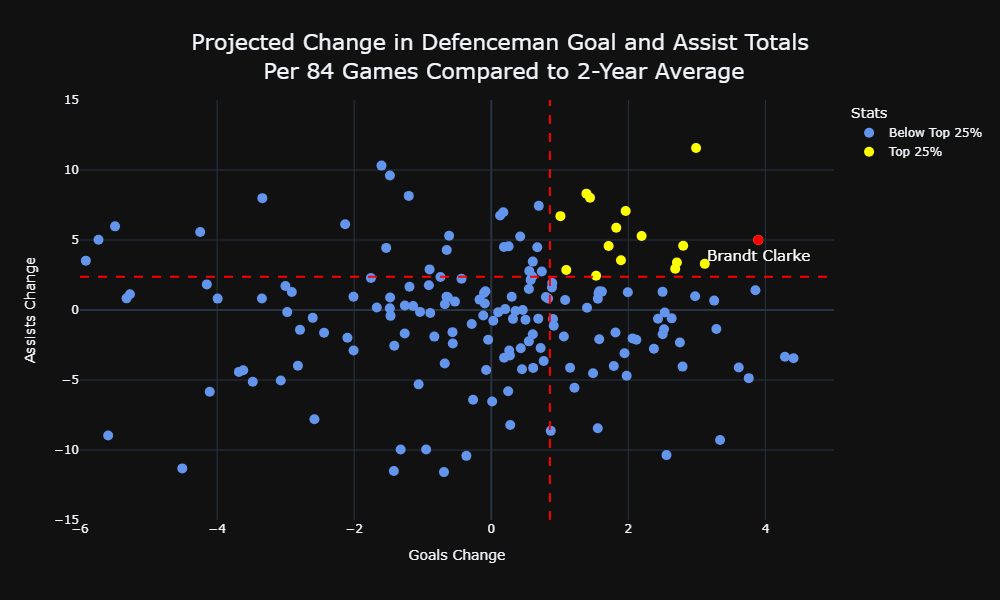
What is notable here is that I’m a person who is still skeptical that the Kings won’t run a 5-forward PP unit for a good chunk of the season (Panarin, Kempe, Zuccarello, Byfield, and Laferriere/Fiala). As such, Clarke’s PP point projection is a modest ~12 PPPs. So, he’s expected to see a sizeable production jump without a huge leap in PP production. Imagine what he can do if he is locked on a good top PP unit.
3 – Nils Lundkvist (Dallas Stars)
Whether due to injuries or healthy scratches (or both), Lundkvist has been in Dallas for four years and has never played more than 60 games. The good news is that his ice time has steadily increased the last couple of seasons, capping at a career-best 16:29 per game in 2025-26. In a full year, my projections are Lundkvist Believers:
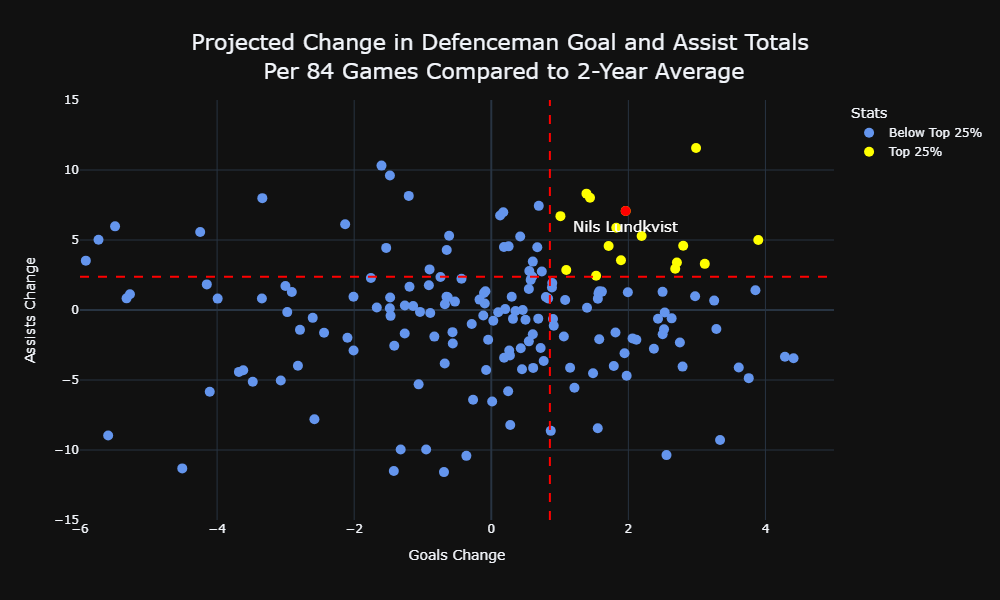
The 26-year-old rearguard can be a good second-pair partner for Thomas Harley, and healthy years from those two could give the Stars one of the best second defence pairs in the league. They do need to stay healthy, though, and that’s been tough for Lundkvist, in particular.
4 – Dylan Samberg (Winnipeg Jets)
This is a bit of a weird one because my projections generally aren’t very high on the Jets. However, Samberg shot 1.1% last season, which will rebound in a big way, and the jump in assists puts him on our list:
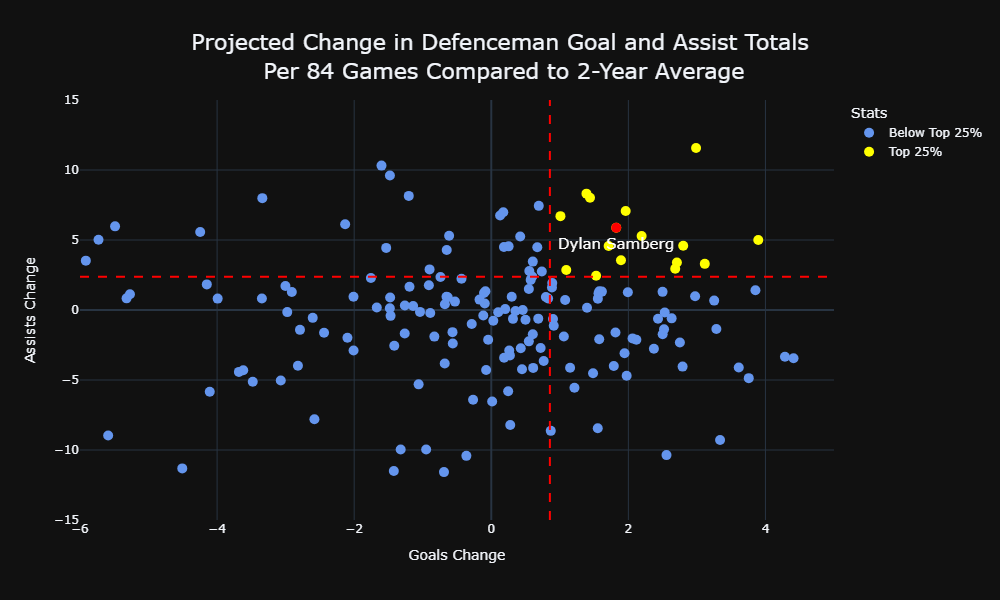
I will say I am skeptical about this. The Jets’ depth scoring was non-existent last year and unless young guys like Cole Perfetti and Brad Lambert take big steps forward, it might not be a whole lot better this year. All the same, Samberg is an excellent talent, and he should be able to elevate their scoring if he’s healthy and performs as he did prior to the 2025-26 campaign.
5 – Alex Vlasic (Chicago Blackhawks)
Bowen Byram qualifies for our list, but I’ve discussed him ad nauseum this offseason, so I thought I’d mention another Blackhawks blue liner. The overall projections aren’t substantial (5-6 goals, 23-24 assists), but that’s a solid improvement over Vlasic’s last two years:
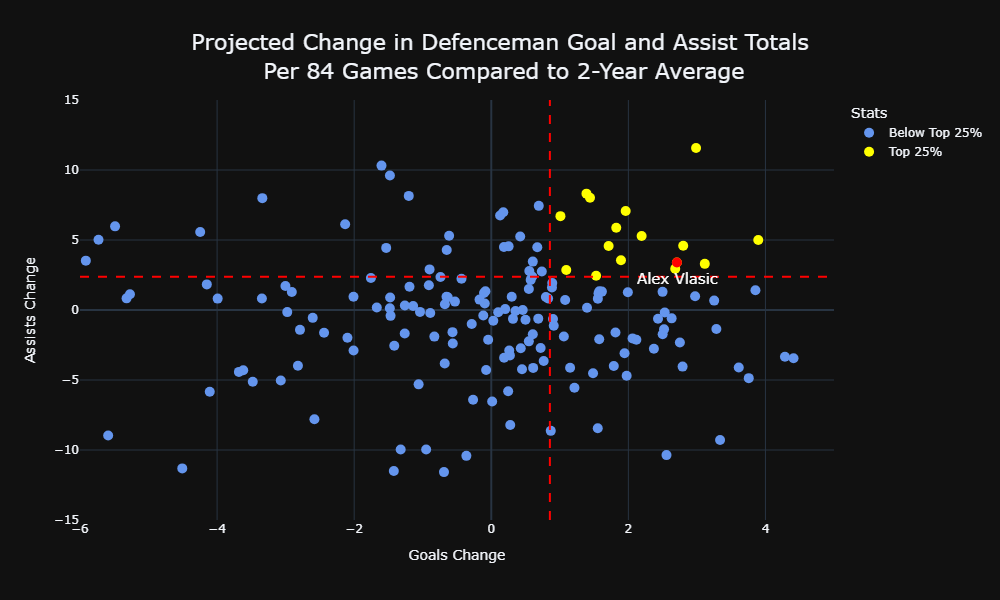
The expectation is that the Blackhawks will be a better 5-on-5 scoring team thanks to the additions of Byram and Patrick Kane, growth from Anton Frondell, Frank Nazar, and Artyom Levshunov, and a good impact from rookie Roman Kantserov. It might not happen until Connor Bedard returns from his surgery, but a rising tide lifts all boats, and that includes Vlasic’s production.
6 – Emil Andrae (Toronto Maple Leafs)
Last year, Auston Matthews missed 22 games and otherwise seemed to often be playing injured. It was also Toronto’s first season without Mitch Marner. Despite those two things, they still had a higher 5-on-5 goals rate than the Philadelphia Flyers. With Matthews healthy, Gavin McKenna being drafted, more offence from Easton Cowan, and Darren Raddysh’s addition, the team should be much better at 5-on-5, and that helps Andrae:
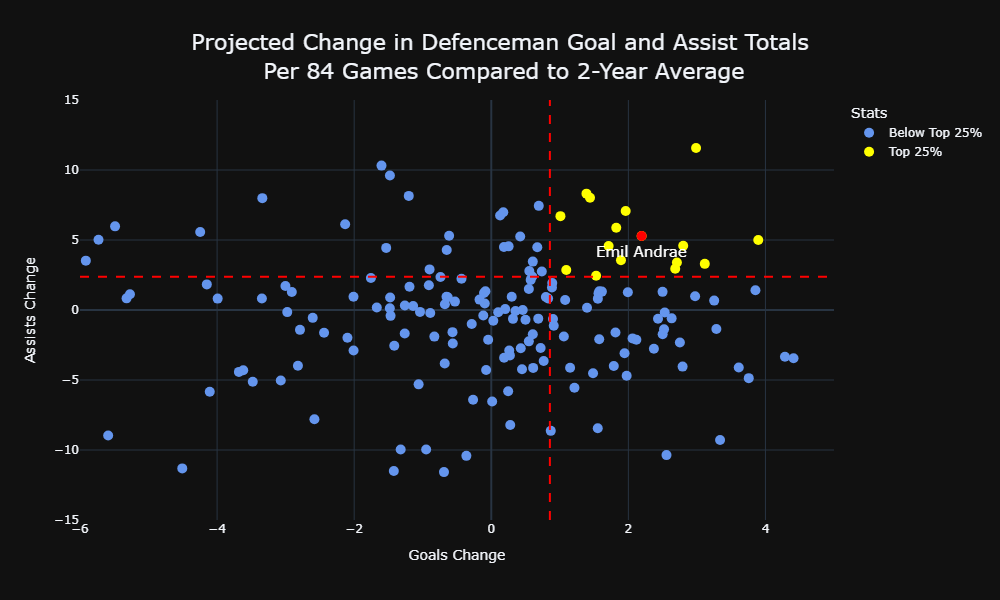
Andrae is Toronto’s sixth defenceman, so he won’t get a lot of ice time, and even these increases from a better offensive squad means just 20-25 points. All the same, he should start making good on his puck-moving tendencies and is a player to keep an eye on this season.
7 – Jackson LaCombe (Anaheim Ducks)
With all the turnover on Anaheim’s blue line, LaCombe is primed to see a minutes boost from his already-stout 24:15 per game. Add that to now being the unquestioned top power-play option, and there are good increases in his production:
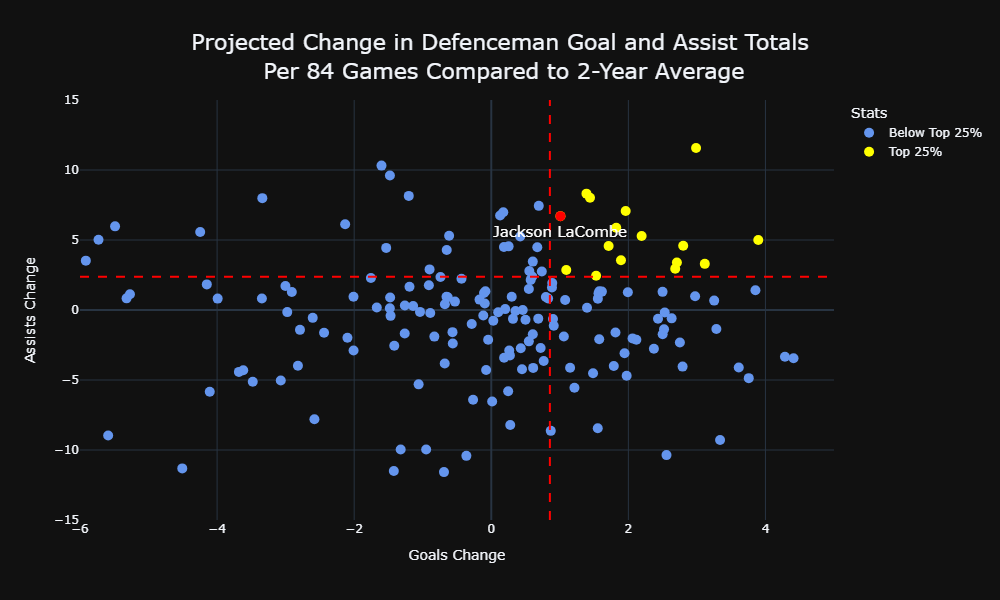
These boosts mean that if he plays a full season, LaCombe should push past the 60-point plateau. He has been steadily improving for the last couple seasons, and at 25 years old in his fourth full season, the Ducks’ top defenceman should establish himself in the tier below the elite blue liners line Quinn Hughes and Adam Fox.
8 – Braden Schneider (New York Rangers)
The additions of Marcus Pettersson and Sean Durzi likely mean Schneider sees a decrease from his career-best 20:27 per game in ice time last season. On the positive side, centre Noah Laba is a year older, and guys like Will Cuylle, Eeli Tolvanen, and Tye Kartye comprise the bottom 6. That depth scoring is helping boost all the Rangers blue liners, Schneider included:
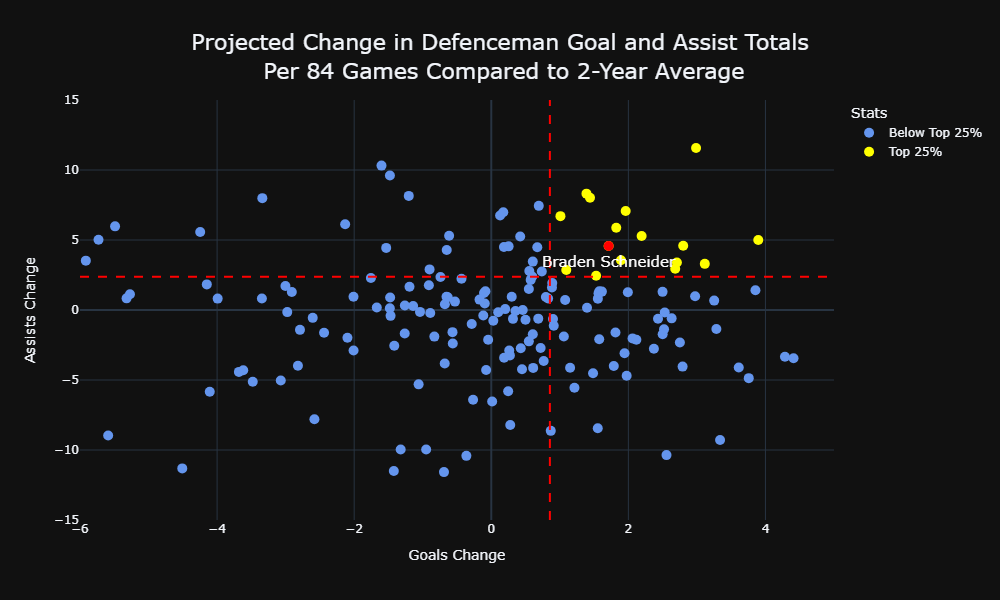
My concern is that Schneider doesn’t lose 1-2 minutes of ice time per game, but 3-4 minutes. In that instance, his production would decline sharply. I am still not quite sure what to make of him as a player, but my projections believe the Rangers will improve their scoring at 5-on-5, giving Schneider a lift.
9 – Sam Malinski (Colorado Avalanche)
The Avalanche traded blue liner Samuel Girard last year, largely because of the emergence of Malinski. He is an excellent puck-moving blue liner who skates on arguably the best offensive team at 5-on-5. Like LaCombe, Malinski already had his breakout year, but that doesn’t mean he’s done improving:
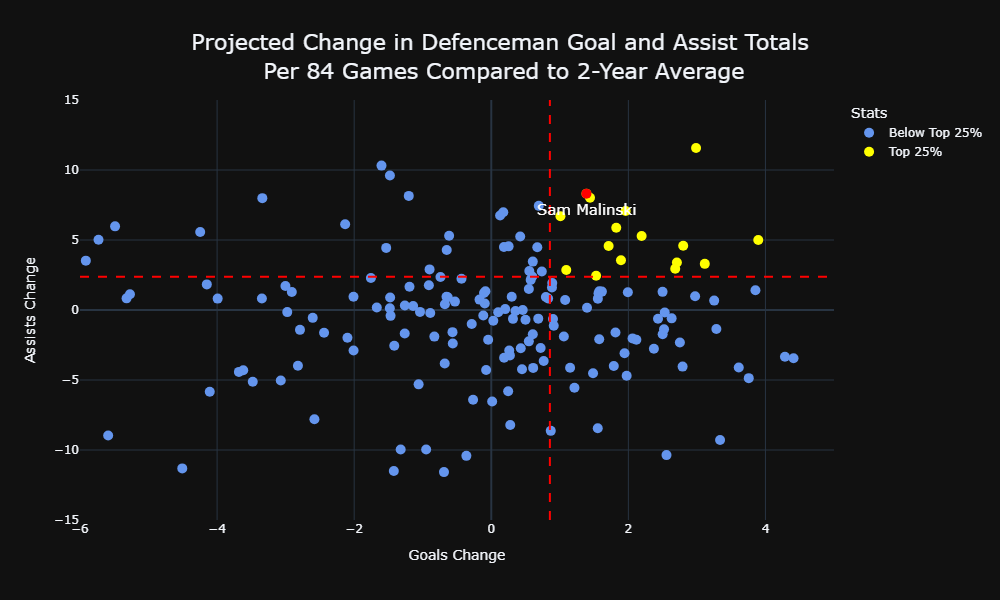
Keep in mind that these are comparisons against a 2-year average, and Malinski has only had one productive season; his overall projection is basically in line with what he did in 2025-26. Regardless, he added nearly 2:30 per game in TOI in the second half of last season, so that means 40 points is now the expectation rather than the breakout.
10 – Zach Whitecloud (Calgary Flames)
Last week’s review of forward improvements included Flames winger Matt Coronato. It is only right, then, that we have a Flames defenceman on our list of blue liners, and we indeed find Whitecloud:
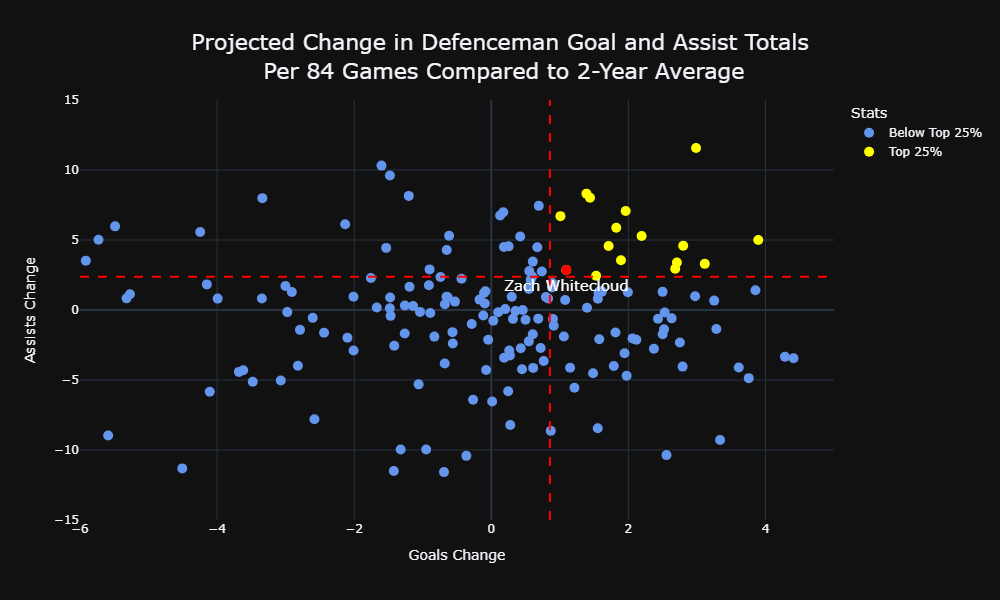
The improvements are modest – about 1 goal and 3 assists – but the reason is his role. After last season’s Trade Deadline, Whitecloud skated 23:10 per game. For comparison, in his last two seasons with Vegas, Whitecloud skated 17:59 per game. My projections have him at roughly 21:30 per game, and it gives him a legitimate chance for his first career 20-point season, even if the Flames are a poor offensive roster.
Until next week.