10 Interesting (To Me) Stats For This Week - July 21, 2026
On my Ghost blog yesterday, I wrote about changes in tracking data over the last decade, and one finding was that forwards were becoming much more responsible for zone exits, and zone exits with possession, over the last 10 years. It got me thinking as to which forwards had their defensive zone transition responsibilities improve or decline substantially of late, so let’s do that.
*Reminder: This newsletter will move to Ghost in the coming months, so to ensure you keep getting them, be sure to subscribe there. Just follow this link.
We are going to take two pairs of seasons: 2022-23 and 2023-24 being the first pair and 2024-25 and 2025-26 being the second pair. Three categories will be discussed: zone exits, zone exits with possession, and botch/fail percentage. That last one is the percentage of defensive zone retrievals botched plus the percentage of zone exits failed. Lower percentages are better because it means you’re botching/failing less.
All this will be relative to other forwards and the league average in each pair of seasons, with a minimum of 400 tracked minutes in each pair of seasons. Data is from All Three Zones.
Let’s start with the improvements.
1 – Trevor Zegras (Philadelphia Flyers)
Mr. Zegras, welcome to Rick Tocchet hockey. Among the 185 forwards in our sample, Zegras had the second-largest improvement in possession exits, the second-best improvement in botch/fail percentage, and the eighth-largest improvement in overall zone exits:
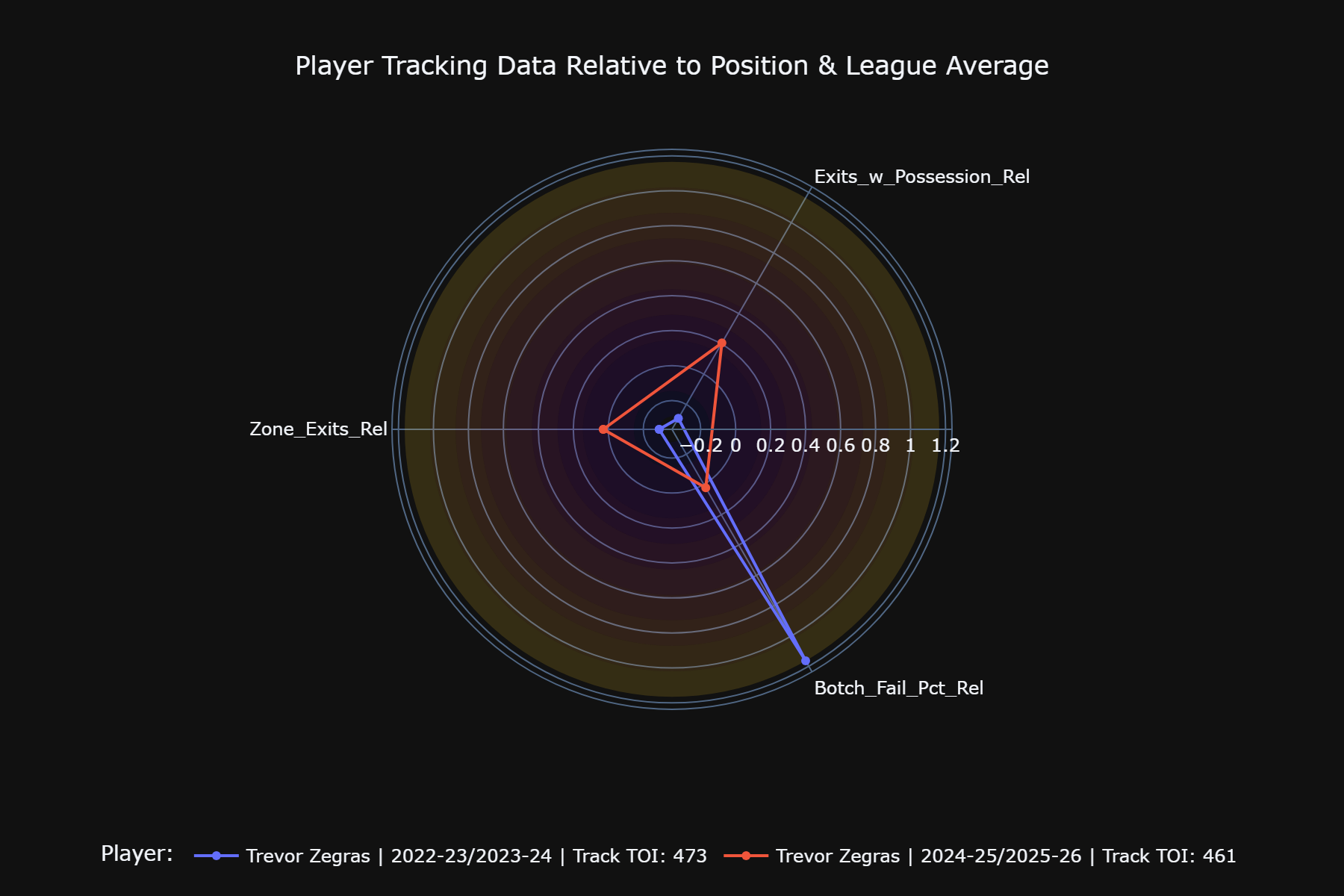
It probably isn’t a coincidence that this happened as Evolving Hockey has Zegras’ 2025-26 campaign being (arguably) the best defensive season of his career. If things improve again offensively – Matvei Michkov can help here – then Zegras could very well turn into a bona-fide top-line forward, not just one that has to play top-line minutes on a team with a thin forward group.
2 – Ryan McLeod (Buffalo Sabres)
A year ago, I had a reader mention to me just how much the Sabres relied on their forwards to get the puck out of the zone, and at least for McLeod, this has indeed been the case over the last two years:
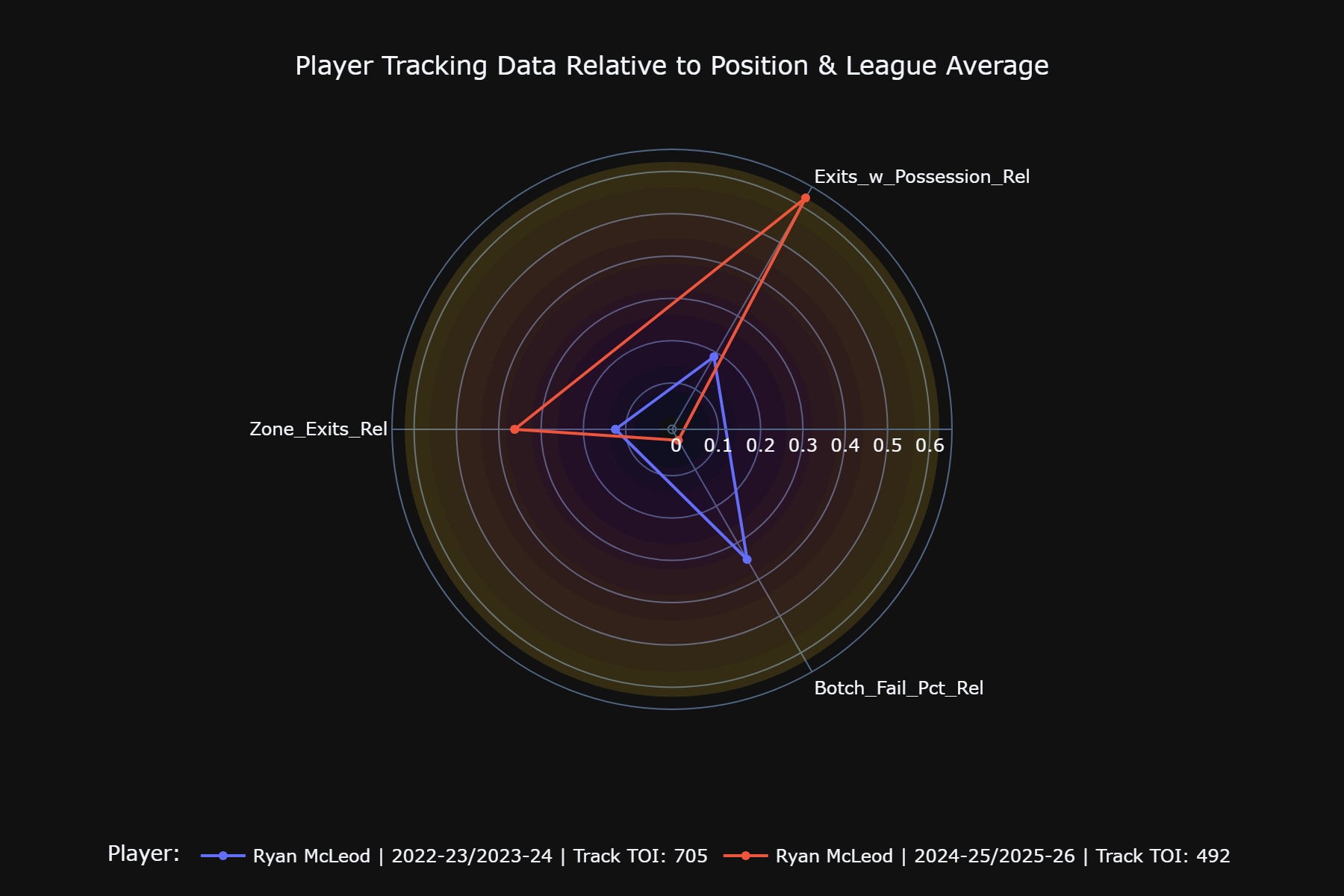
It isn’t just that he’s getting the puck out with control regularly, but he’s really minimized the defensive zone turnovers, too. That kind of combination can help boost his team’s goal-scoring rate, and that is exactly what has happened as Buffalo’s 5-on-5 goal-scoring rate with McLeod on the ice over the last two years, relative to his teammates, is similar to Kirill Kaprizov and Mathew Barzal.
3 – Mikael Granlund (Anaheim Ducks)
In the blog post linked at the top, we found that teams might not want their forwards constantly being responsible for zone exits, but with Anaheim’s blue line having significant turnover, maybe it’s a good thing that Granlund has been doing this lately:
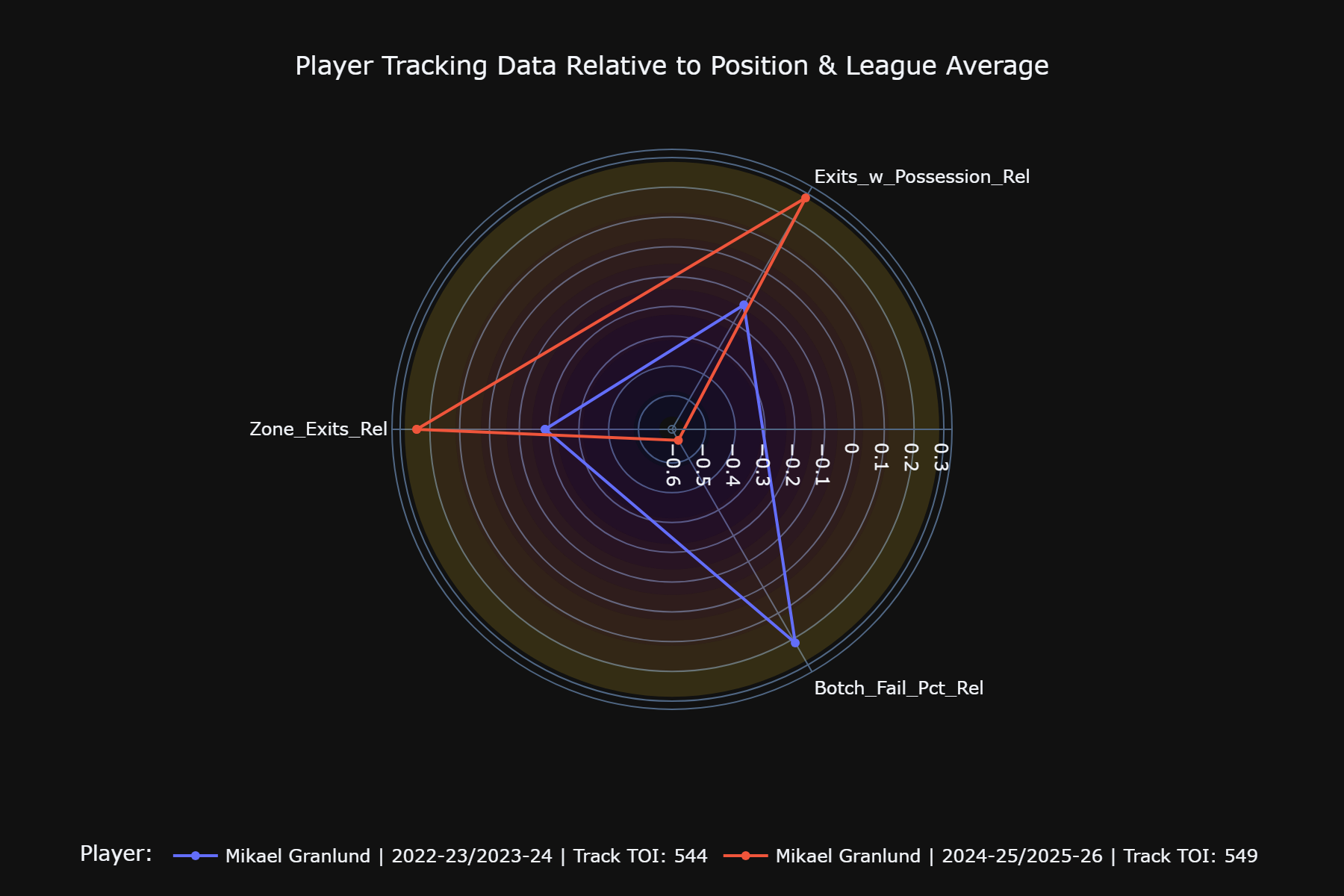
Granlund’s expected goals against rates are typically worse than his actual goals against rates, so it’s a wonder if there’s something going on here with his defensive involvement. Either way, it’s a nice safety blanket to have for a Ducks defence group that has seen so much change this summer.
4 – Washington Capitals Forwards
I won’t post all the graphs, but three forwards who found themselves among the biggest zone exit improvements were all from Washington: Tom Wilson, Pierre-Luc Dubois, and Aliaksei Protas. Seeing as Wilson is the veteran who has been there for over a decade, we’ll show his chart:
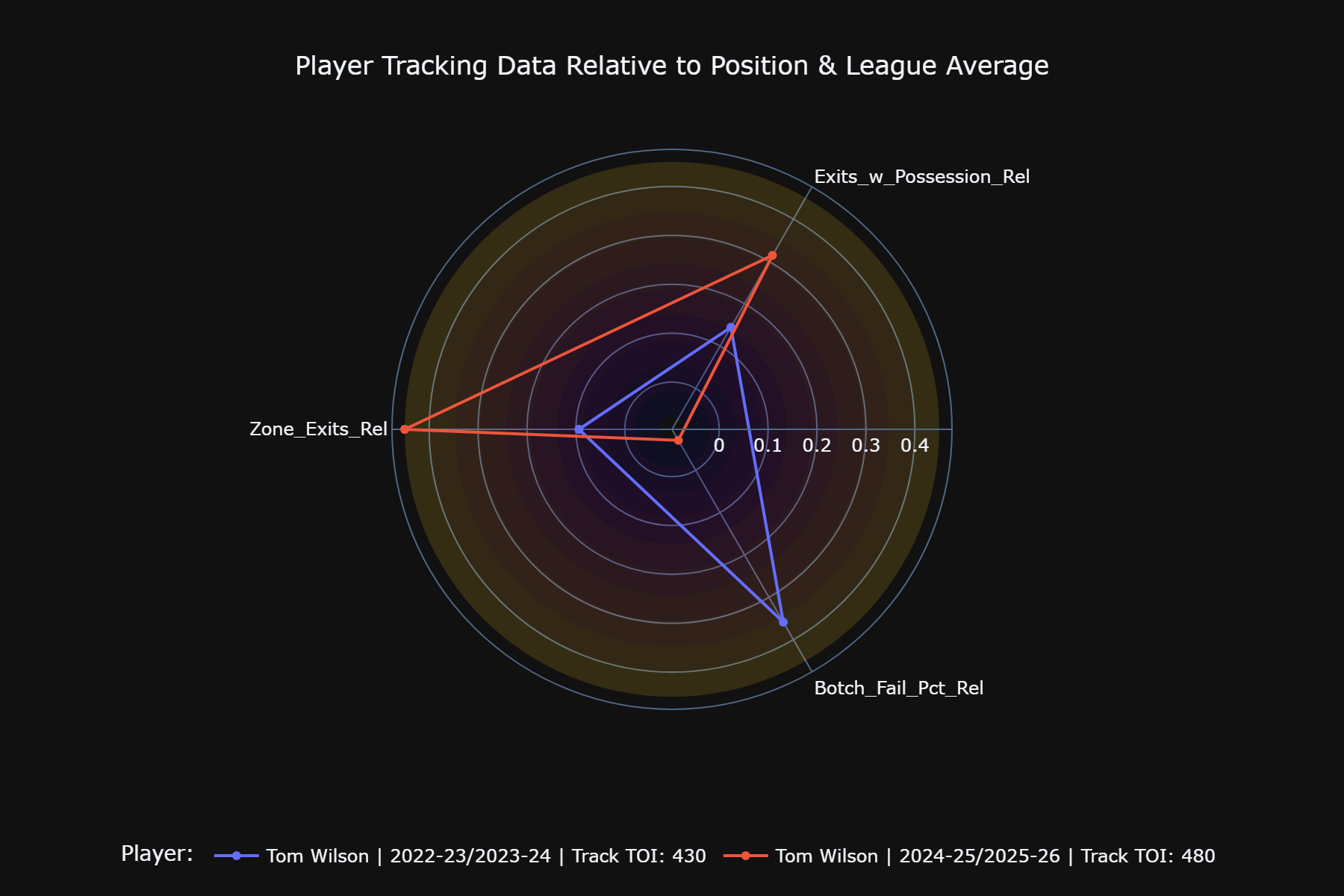
Both Dubois and Protas had charts similar to this, so it appears to be a team philosophy rather than some kind of genuine skills change. Either way, with John Carlson gone, they may need to rely on their forwards to move the puck out of the zone a bit more than usual, and the Caps are well-equipped to do just that.
5 – Alex DeBrincat (Detroit Red Wings)
While his botch/fail percentage has gotten a bit worse, it’s nothing major, and the fact that DeBrincat has increased his other zone exit stats is notable:
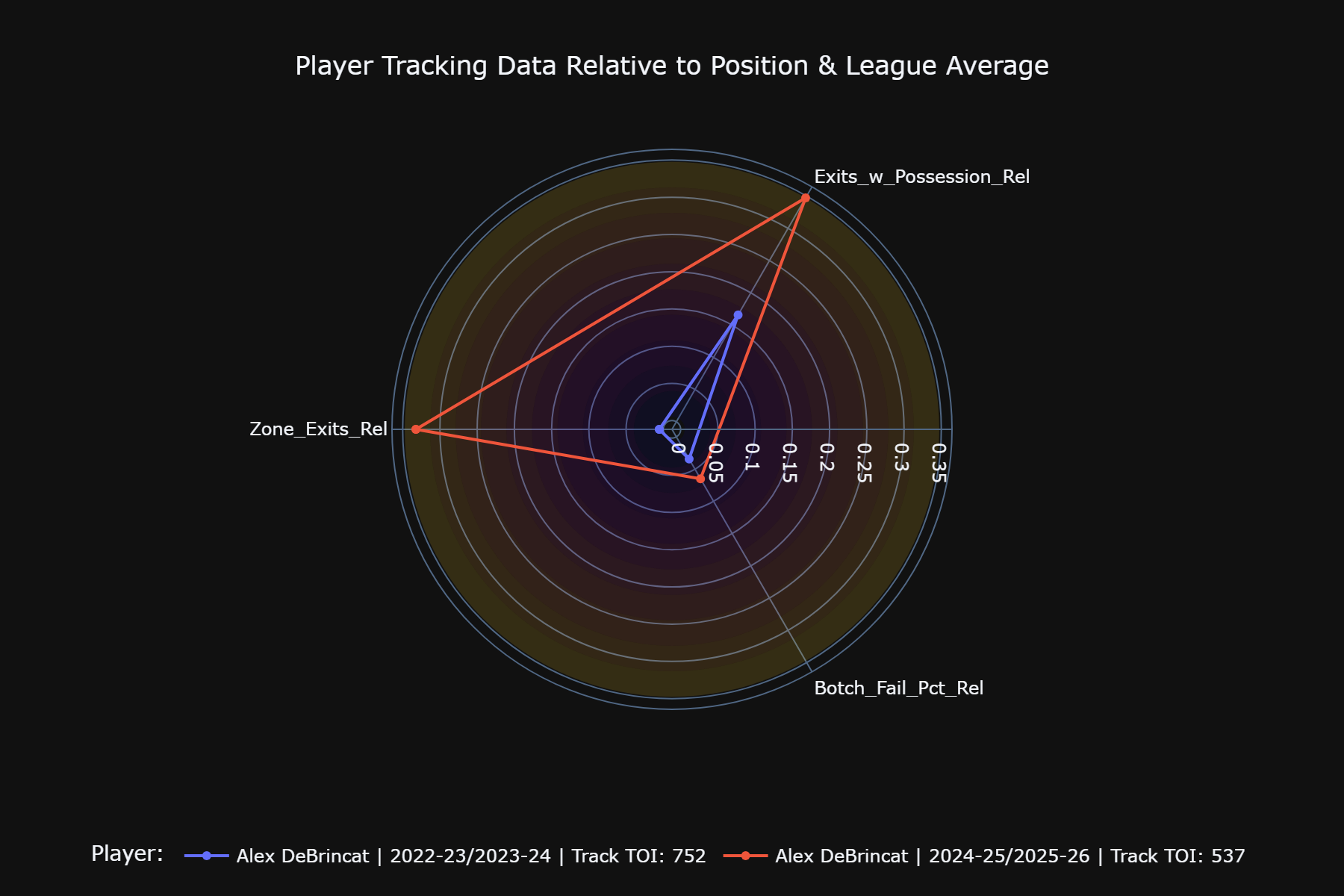
Being a 40-goal winger who stands 5’8” brings its preconceptions, one of them being that he’s not reliable defensively. The reality is that DeBrincat just completed what was arguably the best defensive season of his career and the best since arriving in Detroit. He can score 40 goals, is good at setting up teammates, and gets the puck moving out of his zone, often with possession, much more frequently. I don’t say this lightly: there may not be a more underrated forward in the league than DeBrincat.
Those are some of the key increases in zone exits. Which players saw some declines?
6 – Jonathan Marchessault (Nashville Predators)
This is an interesting case because we have a clear delineation of two years with Vegas and now two years in Nashville. Where Marchessault was a key piece of the zone-exit scheme with the former, that role has disappeared with the latter:
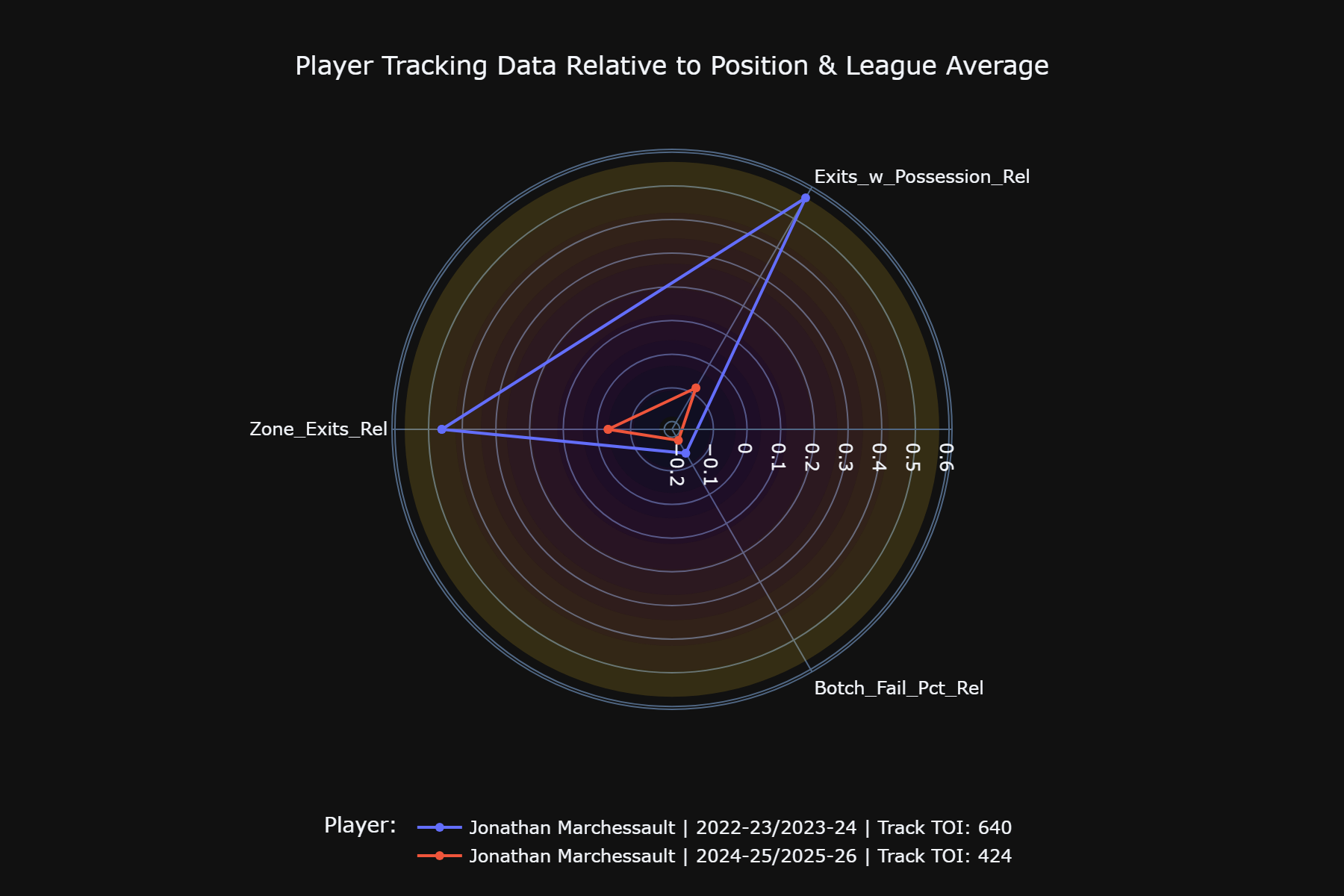
Overall, Marchessault had the largest drop in zone exits with possession and the second-largest drop in all zone exits among in the forward sample. Maybe it’s just a coincidence, but it is notable that this dramatic decline in defensive zone responsibility mirrors a dramatic decline in his overall effectiveness at both ends of the ice. On the other hand, maybe he’s just aging as he turns 36 years old in December.
7 – Nikolaj Ehlers (Carolina Hurricanes)
As with Marchessault, Ehlers has seen a big decrease in his involvement in defensive zone exits over the last couple of seasons:
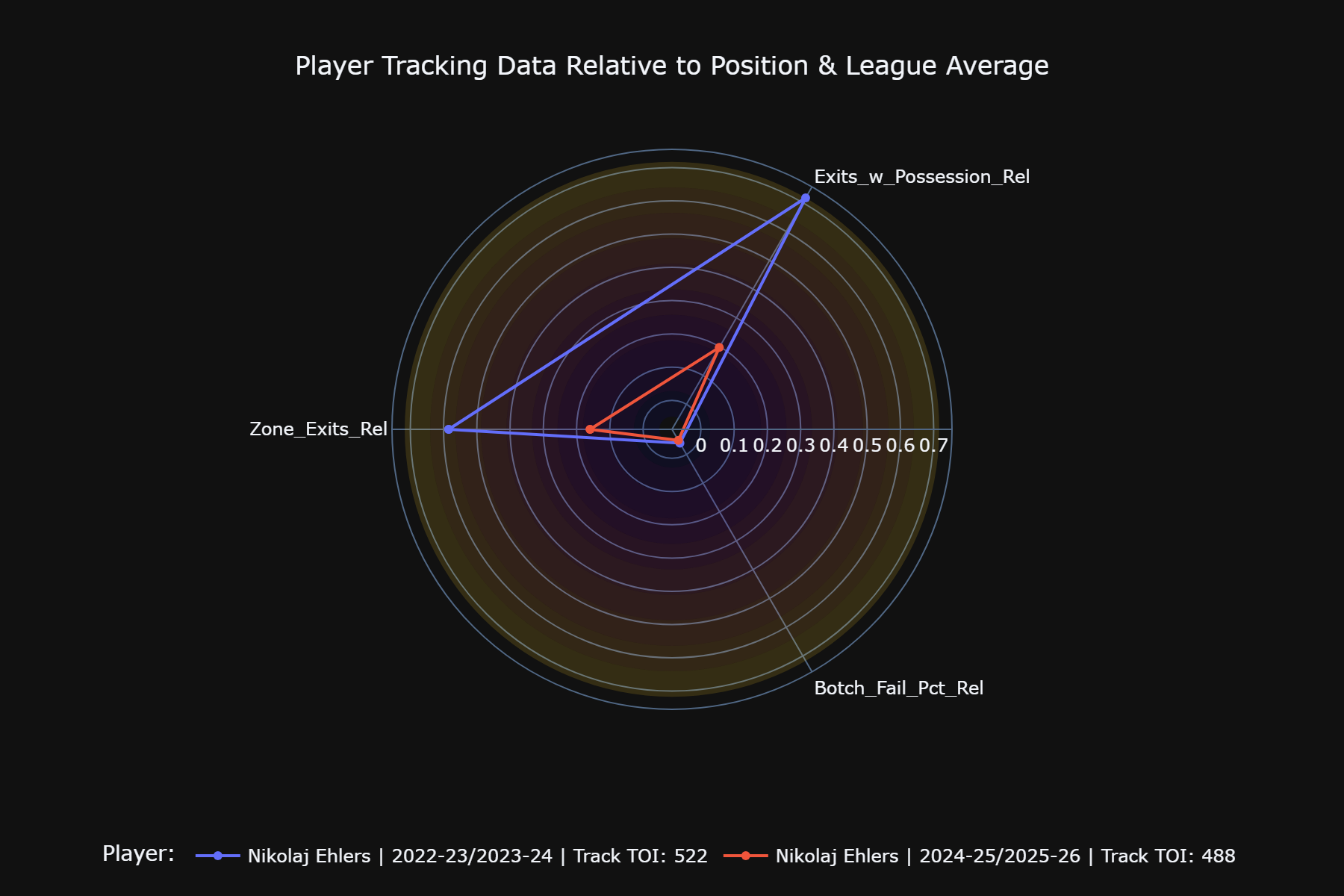
Unlike Marchessault, this isn’t solely because Ehlers changed teams a year ago. His zone exit work has declined each of the last four seasons, going from a whopping 97% above league average by possession exits in 2022-23 to 56% the year after, to 37% after that, and down to basically league average this season. The decline in total zone exits is basically identical.
What is notable is that his botch/fail percentage in 2025-26 was his best of any of the last four years (18.4%) and less than half the rate from 2024-25 (38.9%). He may be less involved overall, but he’s turned the puck over with declining frequency too, and that also matters.
8 – Jack Roslovic (Toronto Maple Leafs)
Roslovic got a lot less involved in his team’s zone exits over the last two years, but maybe that’s a positive development as his botch/fail percentage got demonstrably worse:
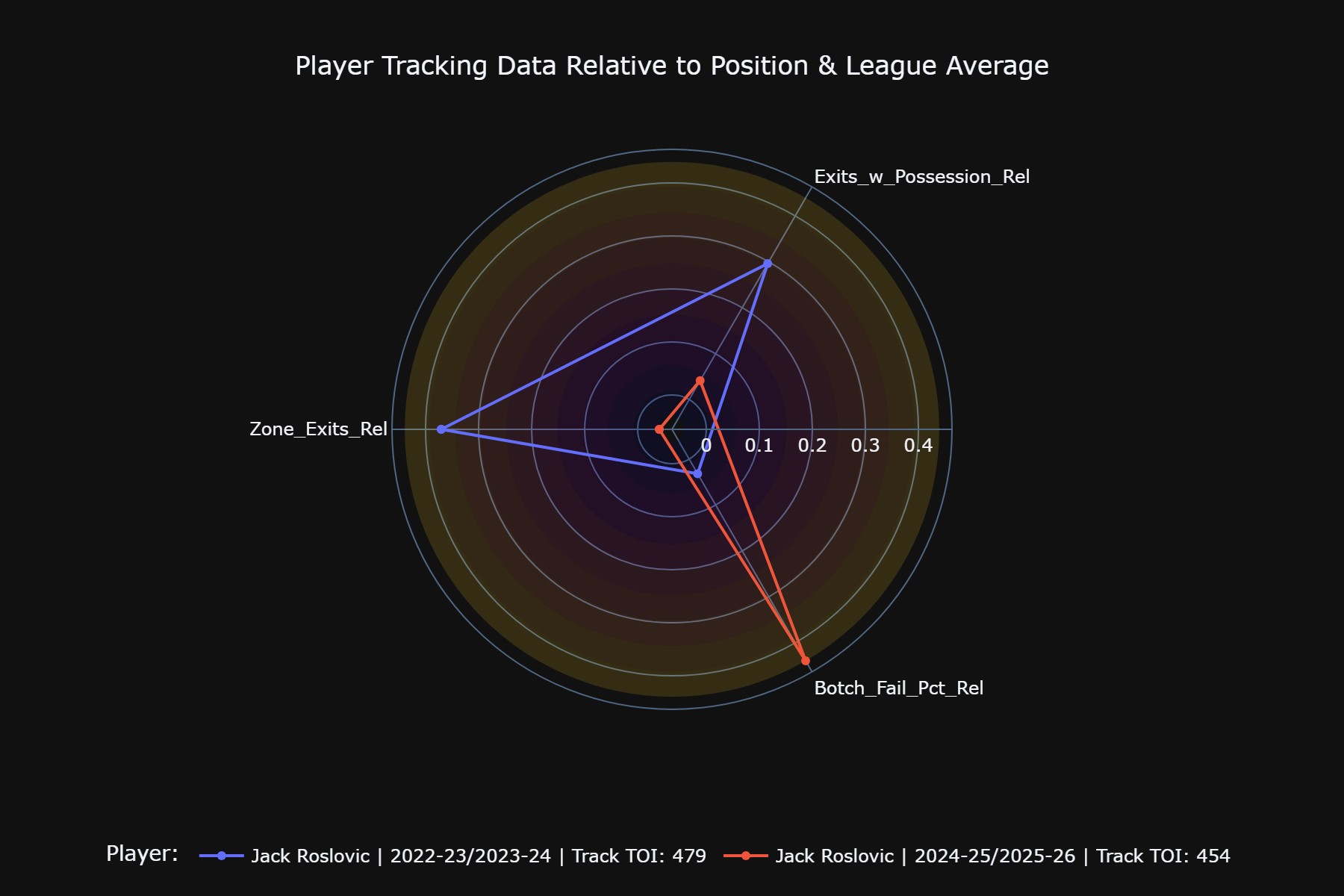
There is a bit of good news here. While the 2025-26 Toronto Maple Leafs relied on their forwards to get the puck out at a rate higher than the league average, they also brought in Darren Raddysh and Emil Andrae, trading away Brandon Carlo and Simon Benoit. That will improve the mobility of the blue line and make the team less reliant on their forwards to get the puck out of the defensive zone. That should help Roslovic, because he’s not someone to rely on in that area.
9 – Connor McDavid (Edmonton Oilers)
There is a bit of a double whammy here as not only has McDavid gotten less involved in the defensive zone exit work, but his botch/fail percentage relative to the league average has gotten worse over the last couple of years:
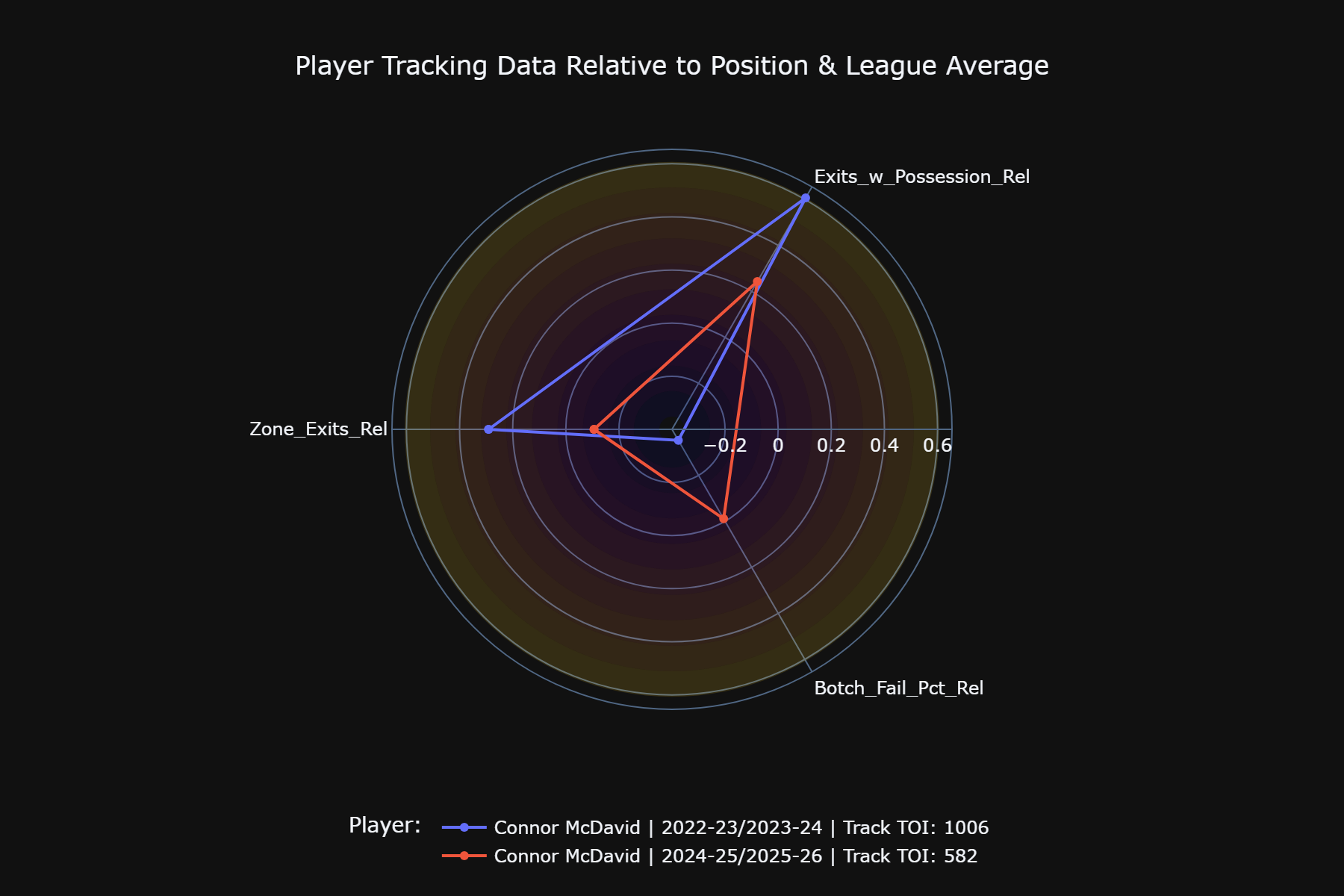
What is interesting is that as the botch/fail percentage has increased, Edmonton’s 5-on-5 goal-scoring rate with McDavid on the ice has decreased. That is a phenomenon more associated with defencemen than with forwards, but given McDavid’s super-elite skill, he’s a player who can get the puck into dangerous scoring situations much more often than 95% of the league, regardless of position.
The Oilers have a new coach and Darnell Nurse has been traded. If McDavid can be the zone-exit machine he was a few years ago, it bodes well for a 5-on-5 scoring increase. If not…
10 – Roope Hintz (Dallas Stars)
As we saw with McDavid, not only has Hintz’s zone exit work decreased in recent seasons, but his botch/fail percentage has skyrocketed from a league-best in 2022-23/2023-24 to 20% worse than league average over the last two years:
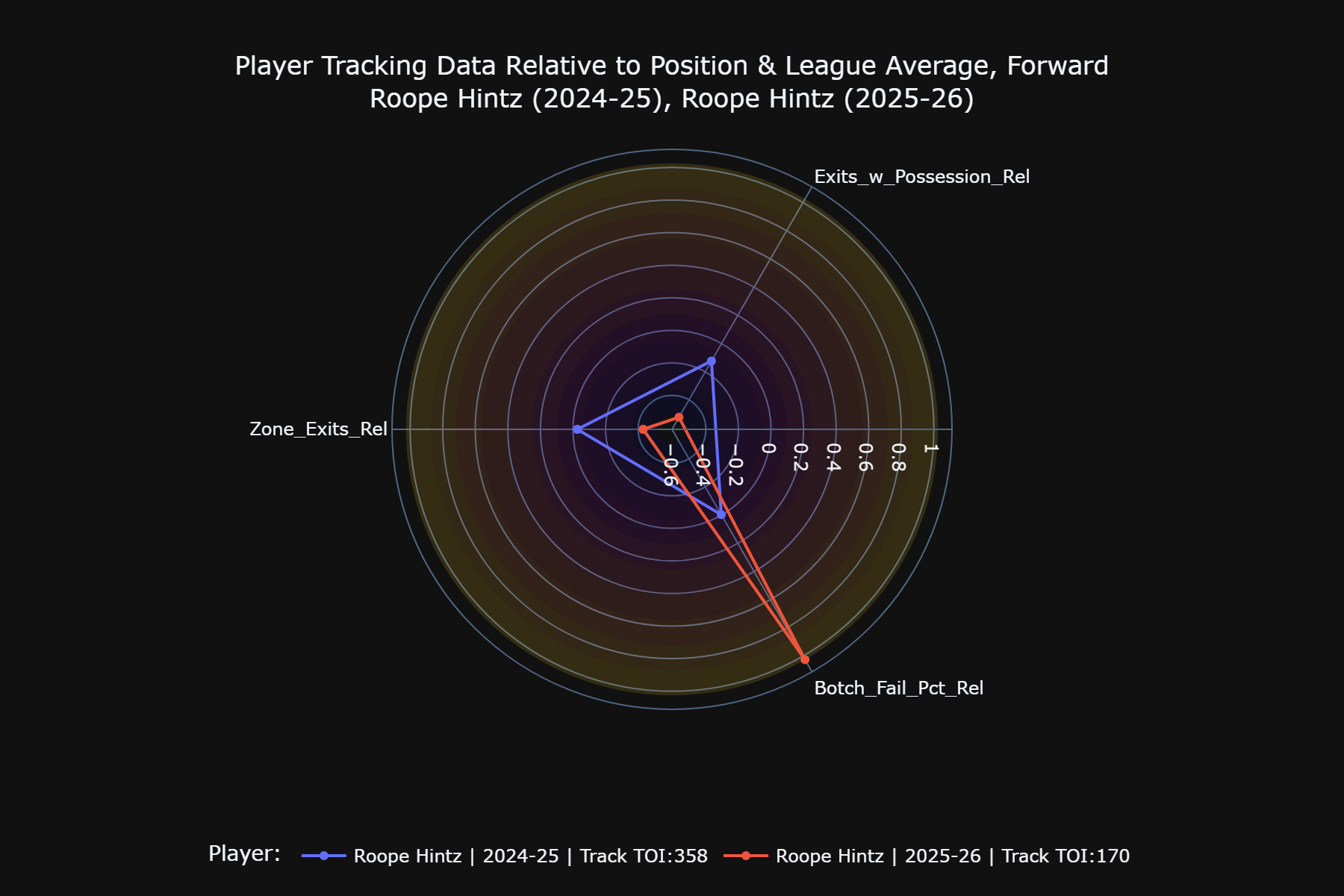
Again, like McDavid, that sharp increase in botch/fail percentage for Hintz coincides with a team decline in 5-on-5 goal scoring when he’s on the ice. What was once elite is no longer high-end, and that is a problem for a team with Stanley Cup aspirations. Hintz has been playing through various injuries over the last couple years, and maybe a lengthy offseason to heal (his last game was March 6th) will do him and the Stars a lot of good in the long run.
Until next week.