Tracking the Canada-USA Round Robin Four Nations Cup Game
Tracking the USA/Canada game from Saturday night, looking only at 5-on-5 play, one thing was very clear: this was a defensive battle.
At 5-on-5, Canada’s forwards managed 4.2 shots and assists on shots off the rush per 60 minutes. For a reference point, the league average in the NHL this season among forwards is 7.98 shots/assists off the rush per 60 minutes. There was no quick-strike offence available for the Canadians, which stands out when we realize that their only goal came from a great rush by Connor McDavid.
As stifling as USA’s team defence was, Canada’s was equal to the task. Here are the rate of zone entries, percentage of entries carried in, and percentage entries dumped in by both teams:

They don’t add up to 100% because the rest are failed entries, of which the USA side had more. While Canada did carry the offensive play – HockeyViz had the total expected goals in Canada’s favour 3.0-2.5 while MoneyPuck had USA getting over half their expected goals for the entire game in the final few minutes when Canada had the empty net – it is notable that Canada’s percentage of entries dumped in was basically identical to USA. The Canadian side was constantly stifled in the neutral zone, breaking through for a quality chance with very low frequency.
Things are a bit more bleak on Canada’s end when looking at who was doing the work on zone entries. Nearly one quarter of all of Canada’s carried zone entries (10/43) belonged to Connor McDavid. He had 10 carried entries in his 5-on-5 ice time, Brad Marchand had six, and Nathan MacKinnon had four. This is what that breakdown looks like:

For another reference point here, the NHL average for percentage of entries carried in by forwards this season is 50.5%. In that sense, McDavid, MacKinnon, and Marchand did very well here, but the rest of the team did not. To put it another way, if one of McDavid, MacKinnon or Marchand was entering the zone, they were doing so with the same frequency that Kirill Kaprizov does in Minnesota. The other nine forwards were doing so with the frequency of Parker Kelly in Colorado.
Drilling down a bit further, this was a particular problem for the Tampa Bay line of Brandon Hagel, Brayden Point, and Anthony Cirelli. Those three rarely carried the puck into the zone when the puck was on their stick:

To bring another Tampa Bay forward into the mix, Zemgus Girgensons is carrying the puck into the zone 27.7% of the time this NHL regular season. In other words, the trio of Hagel, Cirelli, and Point had the same zone entry prowess as Zemgus Girgensons. That doesn’t seem ideal. (Also, two of the six carry-ins came from Point in the waning minutes with the empty net. If we remove those to make it true 5-on-5 play, it gets even worse.)
It does make some sense because that trio was up against Jack Eichel and the Tkachuk brothers for most of the game. They wanted to limit mistakes, which they did, as none of them were on for a goal against and they carried the shot attempt share when they were on the ice. It does seem clear that this at the direction of their coaches considering Hagel-Cirelli-Point have combined to carry the puck in 63.4% of the time in the NHL regular season.
They also did create some offence. Canadian forwards completed just three high-danger passes at 5-on-5 in this game (passes either across the slot or from behind the net), and two of them came from Hagel:
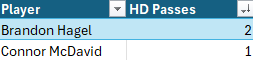
From Natural Stat Trick, Hagel was on the ice for 3.66 expected goals-for per 60 minutes against USA, and high-danger shot attempts were 3-0 in Canada’s favour with him on the ice. He, and the line, had an excellent game.
Getting back to Marchand for a second, he had a great individual game. Some of the shot/expected goal metrics don’t look very good, but he led the team’s forwards by entries per 60 minutes, carried entries per 60 minutes, and the only player close to him was the best player in the world:

Marchand and line mate Sam Bennett were the only two forwards with more than one shot off the rush as well. Canada struggled to create much off Marchand’s zone entries unless it was directly off the rush, though, so we’re probably going to see either a line change for the game against Finland, or Travis Konecny back in the lineup.
Looking at the defencemen, the good news is that it was a tremendous game from the emergency pair of Thomas Harley and Drew Doughty. Doughty replaced Alex Pietrangelo before the tournament due to an injury, and Harley joined the team mid-tournament because of an illness to Cale Makar. Here is how that duo compared to the other Canada defence pairs in this game by how often they were targeted for a zone entry, how often USA carried the puck in against them, and how often the pairs denied a zone entry:

Individually, Harley denied a zone entry five times and every other Canadian defenceman combined to do it six times. Harley was on the ice for Jake Guentzel’s first-period goal, but that was a soft goal allowed by goalie Jordan Binnington where Devon Toews, who was on the ice as Harley’s partner at the time, got caught in the offensive zone.
Overall, it was a really impressive game from Harley. Not only was he largely excellent defensively, but he was the only Canada skater – forward or defence – to have at least one unblocked shot at the USA net off the rush, off the forecheck, and off the cycle. One big positive from Canada’s loss is that Harley stepped in and played extremely well (on top of the good tracking data, Natural Stat Trick had him with a 90.2% expected goal share at 5-on-5), and he and Doughty were an excellent pair, especially considering neither were on the roster two weeks ago.
It was also quietly a very good first game for defenceman Travis Sanheim. Like Harley, he was on the ice for a goal against (Dylan Larkin’s), but that was a 2-on-1 where Canada’s defencemen got caught in a line change after Sidney Crosby turned the puck over just inside the offensive zone. It is hard to blame Sanheim for that.
Sanheim wasn’t targeted very much by USA on zone entries – they were going after Toews a lot – but he had the second-lowest percentage of carried entries against among Canada’s defencemen, and also had the highest percentage of defensive zone exits with possession:
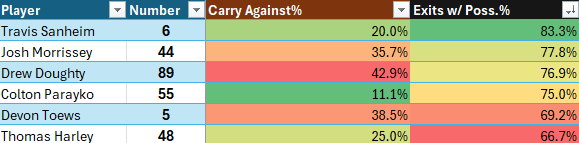
Natural Stat Trick had Sanheim with the second-lowest expected goals against rate of all Canadian defencemen (only Harley was lower), and when seeing how little he allowed the zone to the USA attack, as well as how efficient he was moving the puck out of the zone, that makes sense.
Overall, this was a good defensive game from Canada. One soft goal from Binnington and one bad turnover from Crosby was the difference. Conversely, Team USA did a great job at shutting down the neutral zone and allowing very little on the counterattack. Should these two teams meet again in the Four Nations Final, Canada will need to break down that defensive neutral zone structure from the USA side, or else we may see another low-scoring game go in USA’s favour.