Buying Into Buium's New Contract
The Vancouver Canucks recently extended young defenceman Zeev Buium to an eight-year contract with a cap hit of $9.38-million per season. He has one year left on his entry-level deal, so this extension doesn’t kick in until next offseason. The cap is expected to rise to about $113.5-million for the 2027-28 campaign, giving Buium a cap hit of about 8.2% of the cap. Per PuckPedia, the comparable defencemen of his age getting that kind of deal are Lane Hutson, Jake Sanderson, Brock Faber, Owen Power, and Luke Hughes. Those guys are all either current or soon-to-be top-pair defencemen. While the rising cap will make Buium’s cap hit more palatable as it wears on, the expectation is that he’ll be a top-pair defenceman in the next 2-4 years, full stop.
The good news is that if the NHL salary cap keeps rising as expected, four years from now Buium’s cap hit will be that of a high-end number-2 defenceman. He won’t be paid like Rasmus Dahlin or Evan Bouchard are now; more like Thomas Chabot and K’Andre Miller.
A common refrain is that Development Isn’t Linear. This is certainly true, and it’s the reason why I don’t get very hung up on single-season impact metrics for rookies. I am very much a proponent and user of the various player impact measurement models from places like Evolving Hockey and HockeyViz. It is just my belief that when we are specifically viewing young players, and rookies in particular, we need to look not only at their single-season impact, but the actual on-ice skills shown.
Here are some examples of why this is my approach to young players. In 2025-26, Evolving Hockey had Buium with -0.048 xGAR/60 minutes (Expected Goals Above Replacement, which is an overall value for contributions on offence, defence, the penalty kill, power play, and penalty differentials). Going back to 2013-14, here are rookie defencemen aged-21 or younger to have played at least half the season and whose xGAR/60 was within one standard deviation of Buium’s:
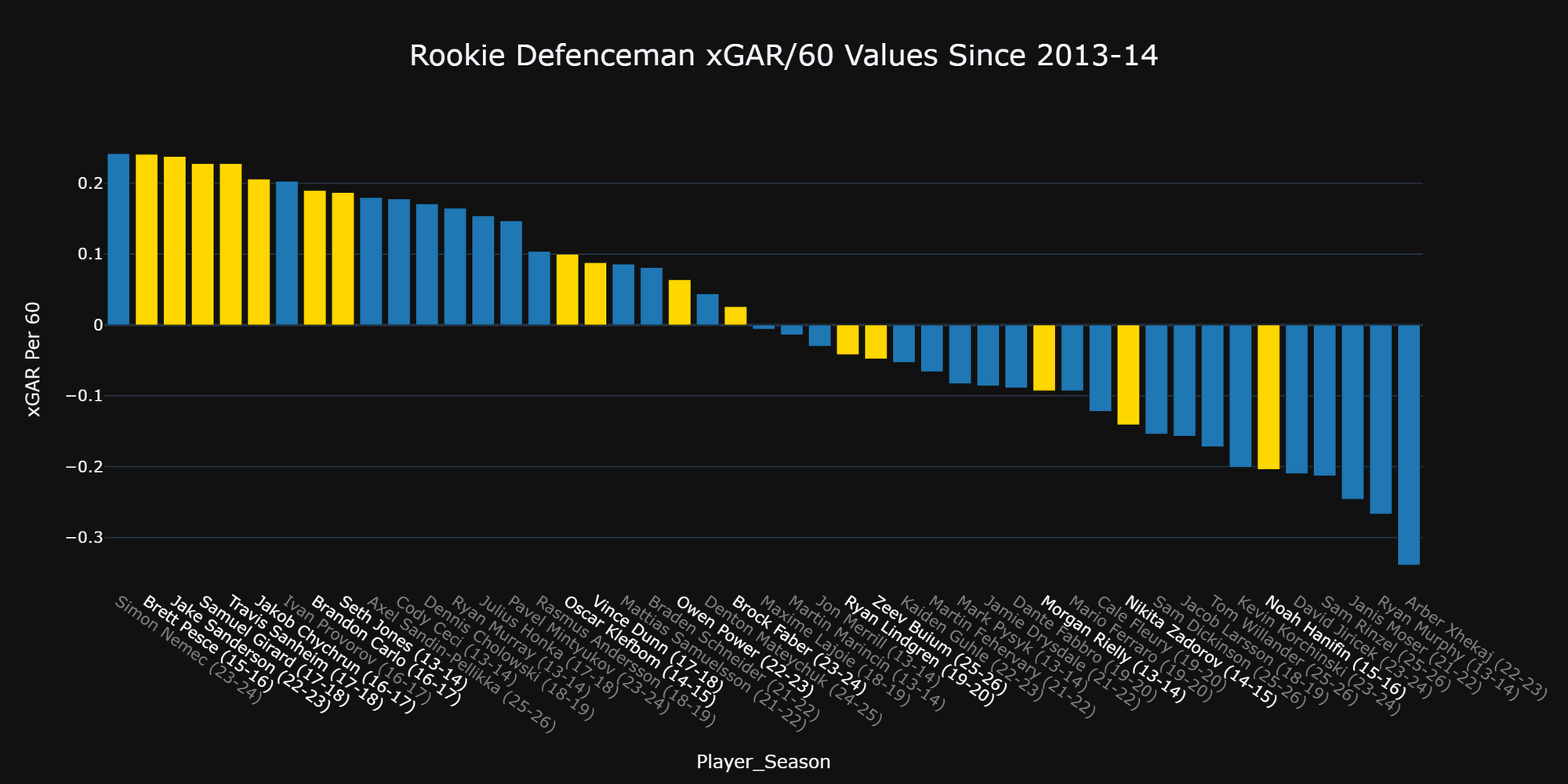
There are several players whose value is yet to be determined like Šimon Nemec, Axel Sandin-Pellikka, Tom Willander, Sam Dickinson, Denton Mateychuk, Kevin Korchinski, David Jiříček, and Sam Rinzel. If we take out them and Buium, we are left with 35 defencemen. Of those 35 defencemen, there are 15 names highlighted in our chart. Those 15 names have all had at least two seasons of top-pair impact by Synthetic Goals, which is the player value model from HockeyViz. Well over half of those 15 defencemen – Jake Sanderson, Jakob Chychrun, Seth Jones, Brandon Carlo, Brett Pesce, Travis Sanheim, Vince Dunn, Morgan Rielly, Noah Hanifin – became true top-pair defencemen for their teams. It may have taken a few seasons, their value varies between a low-end top-pair option and an all-star, and some of the older names have since fallen off, but they all became top-pair blue liners for at least three years, nonetheless.
In addition to that, there are players who had tough starts to their careers but have been slowly ascending like J.J. Moser and Jamie Drysdale. Their 2025-26 campaign showed top-pair impacts, and considering their slow ascension, we might be able to add them to the list, too. If one of them, and three of the young blue liners with more to prove like Nemec, Dickinson, and Mateychuk become top-pair guys in the next few years, then the number grows to 19 players out of 45 on the original list, which is a hit rate of 42%.
That list obviously has a lot of misses; for every Vince Dunn there is a Cale Fleury. But given what we know about player development, if a team drafted 10 defencemen in the first three rounds of the draft across five seasons, and four of them became top-pair rearguards five years hence, we’d assume the team’s scouts were wizards.
Yes, we would like Buium to have a massive, immediate impact like Lane Hutson did, but that just isn’t realistic for a lot of defencemen. Hell, Rasmus Dahlin had a very mediocre first couple of seasons to his career, started ascending, and has played to a Norris Trophy-level for several years.
All that is why we should look for skills, either offensively or defensively, rather than impact. For this article, I will stick with offensive skills, but to be a high-impact blue liner in the future, Buium will need to at least be competent defensively. He doesn’t need to be Prime Jaccob Slavin, but he can’t be late-career Nick Leddy, either.
Being able to get the puck out of your defensive zone with control, and into the offensive zone with control, is important. Those things aren’t the end-all, be-all to offensive play – retrieving the puck cleanly, being able to forecheck, having good playmaking skills – all play a factor, too, but it’s hard to score goals if your team doesn’t have the puck. Earlier, I said that it would have been nice if Buium’s rookie season had the same impact as Lane Hutson did in 2024-25. That was intentional, because if we take their respective rookie seasons, and look at total zone entries, carried zone entries, total zone exits, and zone exits with possession, all relative to the league average for defencemen in their respective rookie seasons, we get an interesting result:
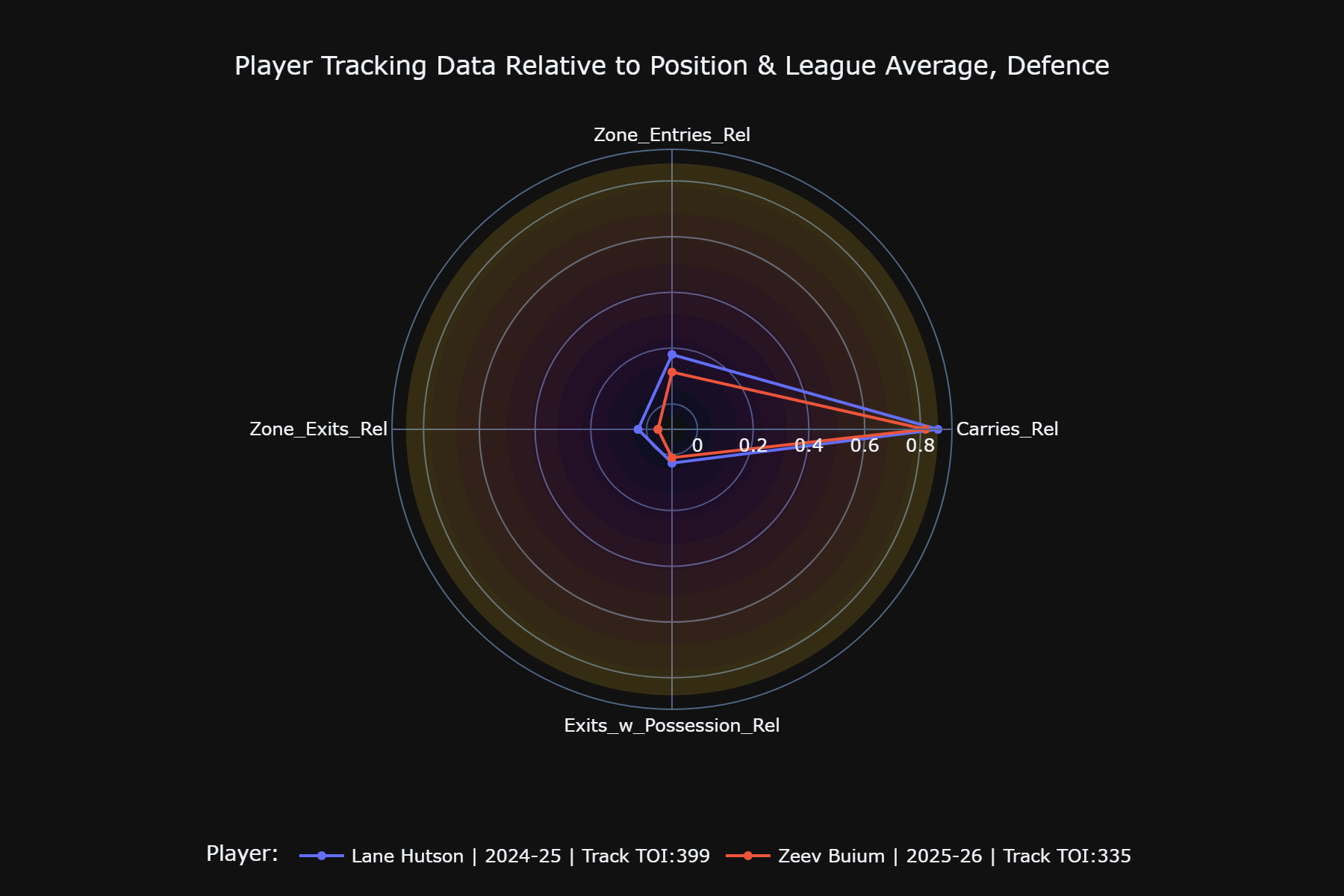
Hey, would you look at that.
In fact, if we extend past Hutson and look across the last five seasons, there are three defencemen who had seasons that compared to Buium’s 2025-26 campaign by zone exits and entries, carried entries, and exits with possession:
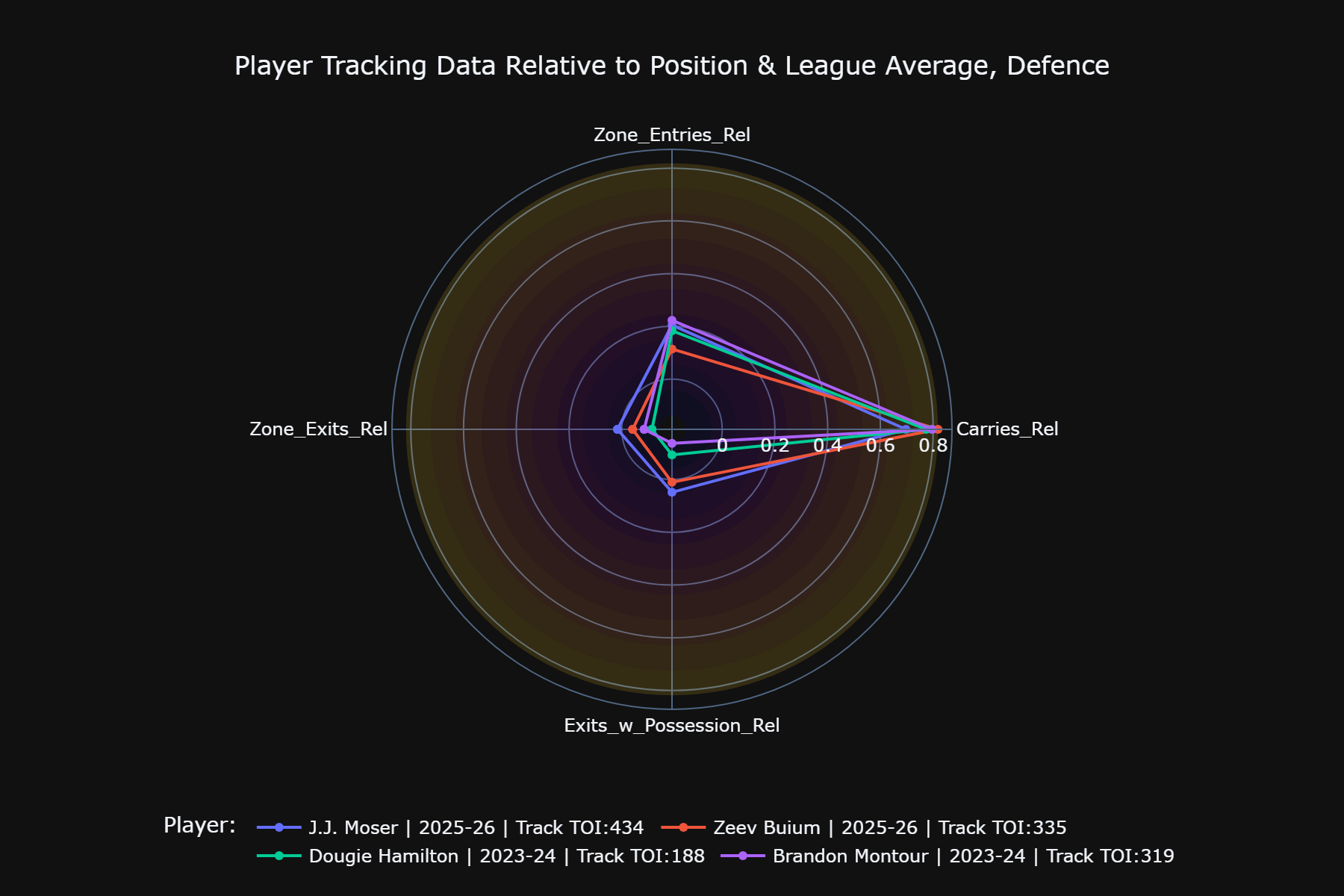
Forget whatever you’ve read about Buium or his rookie season or his expectations or his contract. Just think about this: If I told you there was a rookie defencemen who had key transition rates similar to recent seasons from Lane Hutson, Brandon Montour, Dougie Hamilton, and J.J. Moser (whose 2025-26 was a breakout year), and asked you if there was a reason for a lot of optimism about that rookie’s future, what would you say?
Once again, there are shortfalls here. While the transition rates from Buium were great, the playmaking rates were not. In fact, they were well below average. To be a truly great offensive defenceman, being a good, or hopefully great, playmaker is pretty much a necessity. There are defencemen we think of as goal scorers who aren’t great playmakers like Chychrun and Bowen Byram, but the truly elite like Quinn Hughes, Adam Fox, Cale Makar, Rasmus Dahlin, and Zach Werenski are all great playmaking defencemen. For Buium to be more than just very good, that aspect of his game needs to improve significantly. In other words, there’s a skill we want to see him develop in the next few years. That makes this contract a gamble because without it, maybe he doesn't reach the level he needs to live up to his salary, but he has years to figure that part out.
Whether Buium is the next Julius Honka, the next Jakob Chychrun, or the next Quinn Hughes won’t be known for several years. My guess is that he won’t be Hughes, but he won’t be Honka, either. When we think of the term ‘top-pair defenceman’, that is a wide range from perennial Norris Trophy contenders like Hughes, Fox, and Makar to very good players like Hanifin, Montour, and Dunn. Where Buium lands is known only to the Hockey Gods, but considering his modest overall player impact wasn’t that bad when looking historically, and he had excellent transition skills that stack up to recent efforts from very good-to-elite defencemen, there are plenty of reasons for optimism.