10 Interesting (To Me) Stats For This Week - September 1, 2026

Welcome back to another week of ’10 Interesting (To Me) Stats’. The NHL regular season is four weeks away, so we need to kick our 2026-27 outlook into high gear. I have (mostly) finished my projections as they’re just missing empty-net situations and rookies. There are further tweaks to come, but I wanted to share some players whose fantasy projections stood out to me.
These projections are relative to a ‘replacement level’ player at their position, and on a per-game basis. ‘Replacement level’ is determined to be the average value of the 132nd fantasy forward and 60th fantasy defenceman last year, based on goals, assists, shots, blocks, hits, and power-play points. I take the average of a group of players on either side of those player cutoffs for an aggregate ‘replacement’ value and use that as our comparison for 2026-27 projections.
1 – Sam Reinhart (Florida Panthers)
The hockey world expects Florida to have a big rebound year, especially with the addition of Brady Tkachuk. In that sense, it didn’t surprise me that Reinhart is projected for a large improvement. What surprised me is that his projection is that of a top 10 fantasy forward, and similar to the top wingers from Minnesota:
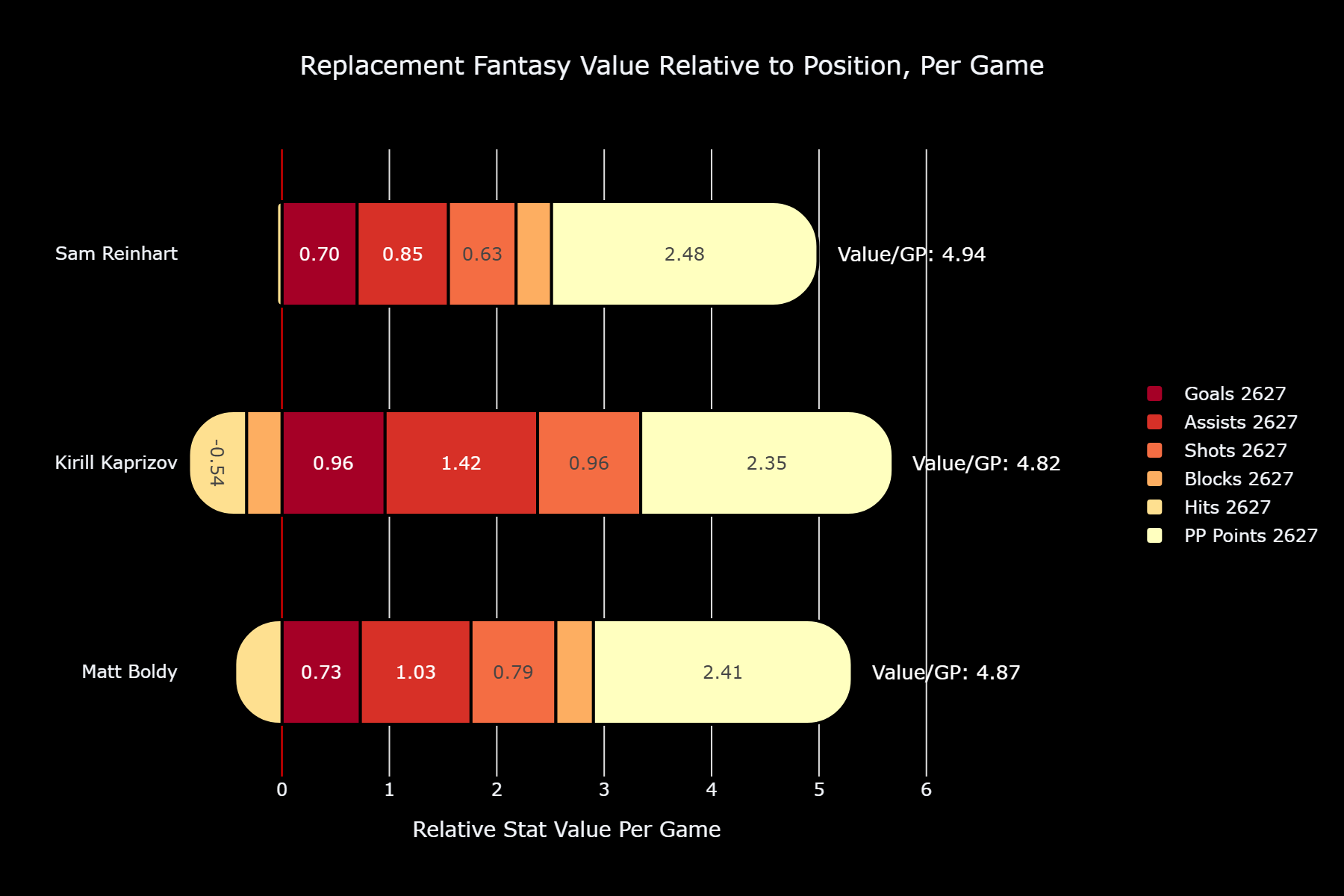
Using this format, Reinhart was the third overall forward back in 2024-25 and a huge chunk of that was putting up 213 shots, 103 hits, 62 blocks, and 30 power-play points. My projections have him being similarly productive across the board in 2026-27, and that makes him easily a second-round pick in multi-cat leagues.
2 – Nico Hischier (New Jersey Devils)
My projections are high on several Devils skaters, Hischier included. His outlook is that of a point-per-game player who will push for 30 power-play points, and considering he’s averaged 71 points and 27 PP points every 82 games over the last two years, maybe it’s not far off:
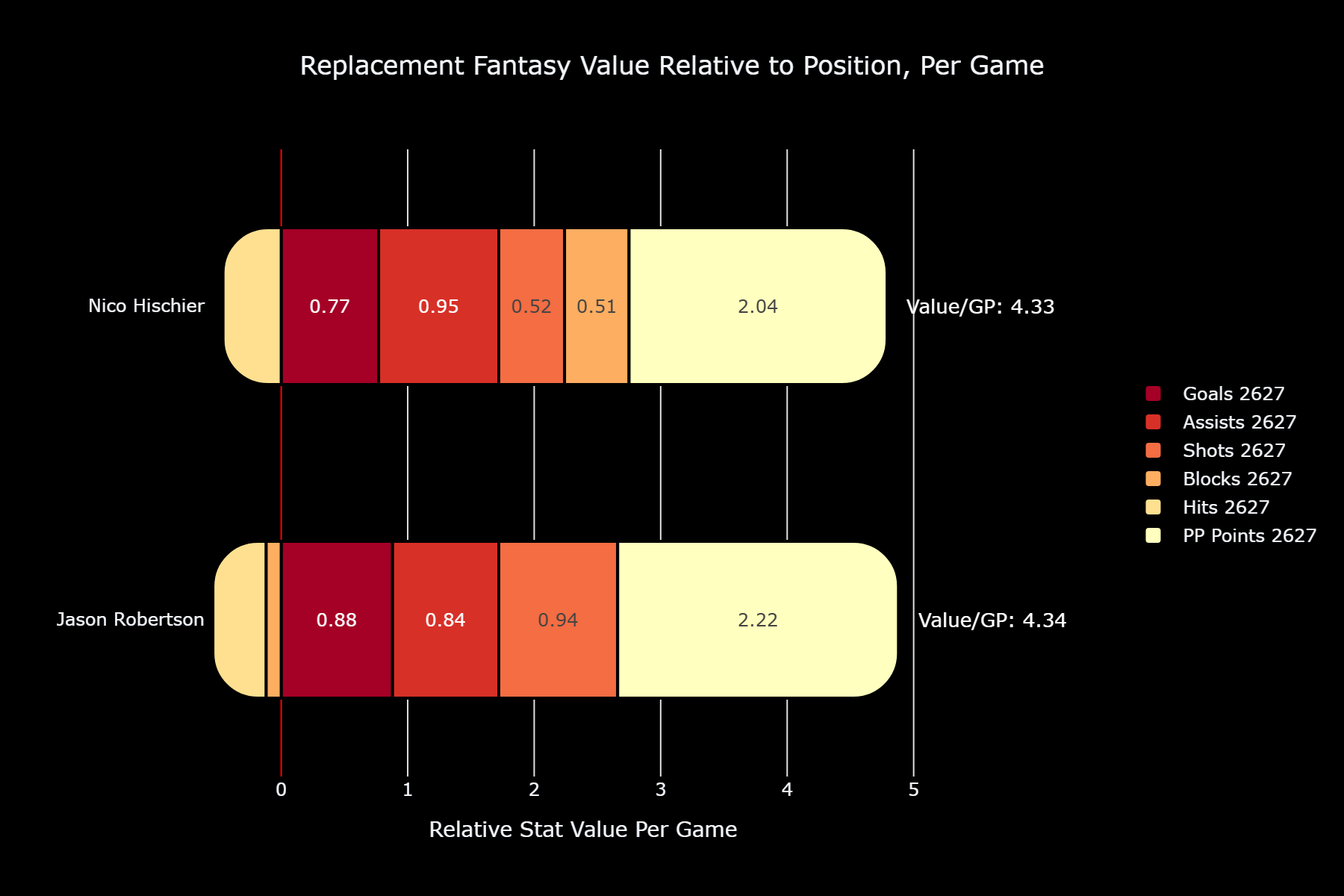
It did surprise me to see his overall fantasy production similar to one of the top players from 2025-26, but that highlights just how bullish my projections are on the Devils. That is perhaps a fool’s errand – few teams have been as disappointing over the last few years as New Jersey – but considering the modest ADPs for guys like Hischier and Luke Hughes, it presents a great draft opportunity.
3 – Auston Matthews (Toronto Maple Leafs)
The decision tree goes like this: Is Auston Matthews fully healthy? If the answer is yes, he’s probably a top 10 fantasy player. If the answer is no, then he won’t be. The answer to that question is unknowable, but my projections aren’t enthusiastic about his downturn over the last two years, and it brings his value in line with another Ontario-based centre:
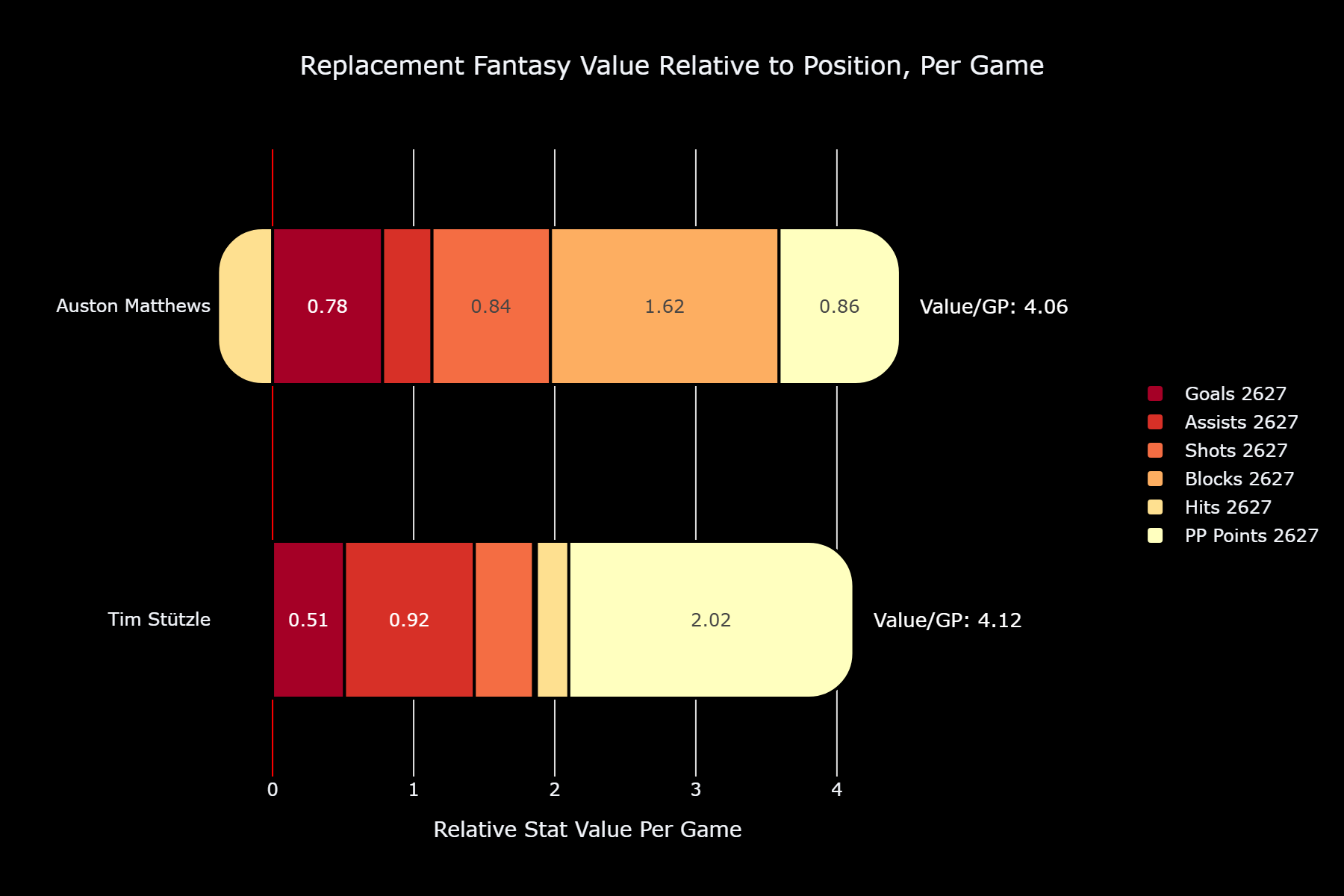
This one worries me. The projections are for roughly 35 goals and 20 power-play points. Across the last two seasons, he’s averaged 39 goals and 24 PPPs every 82 games. If Matthews can rebound, he’ll blow my projections out of the water. The problem is he’s being drafted as a late-first, early-second-round player, and that means a big rebound is required. It makes me nervous and probably makes him a player to pass on.
4 – Joel Eriksson Ek (Minnesota Wild)
With Marco Rossi gone, Minnesota’s centre group is Eriksson Ek, Ryan Hartman, and Danila Yurov. In other words, it’s Eriksson Ek and Some Guys. The expectation of him having a massive role leads to a big projection in line with a guy who has three 40-goal seasons in the last four years:
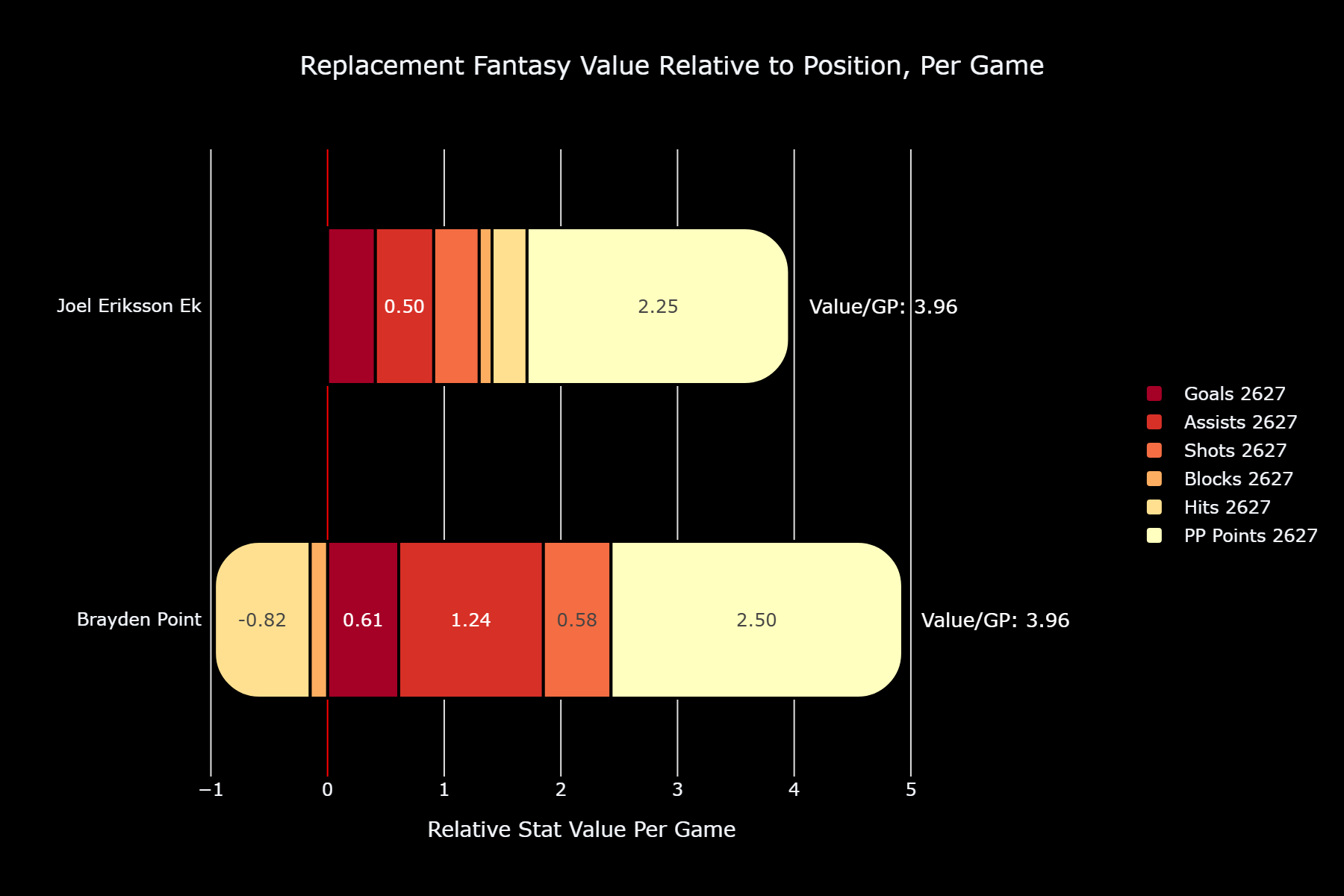
A big portion of this is the power play, where he’s expected to put up between 20-25 PPPs. That he’s averaged exactly 20 PPPs per 82 games over the last three years means this projection isn’t far off, and with the solid peripherals, he makes a great across-the-board option. His issue is he’s never played 80 games in a season, so staying healthy is paramount.
5 – Elias Pettersson (Vancouver Canucks)
For a couple years, I’ve been banging the ‘Pettersson’s Knee Isn’t Healthy’ drum and considering he’s averaged 57 points every 82 games over the last two years, I think that’s correct. That is why it was downright shocking to see his overall fantasy value projection fall in line with a 103-point forward from last season:
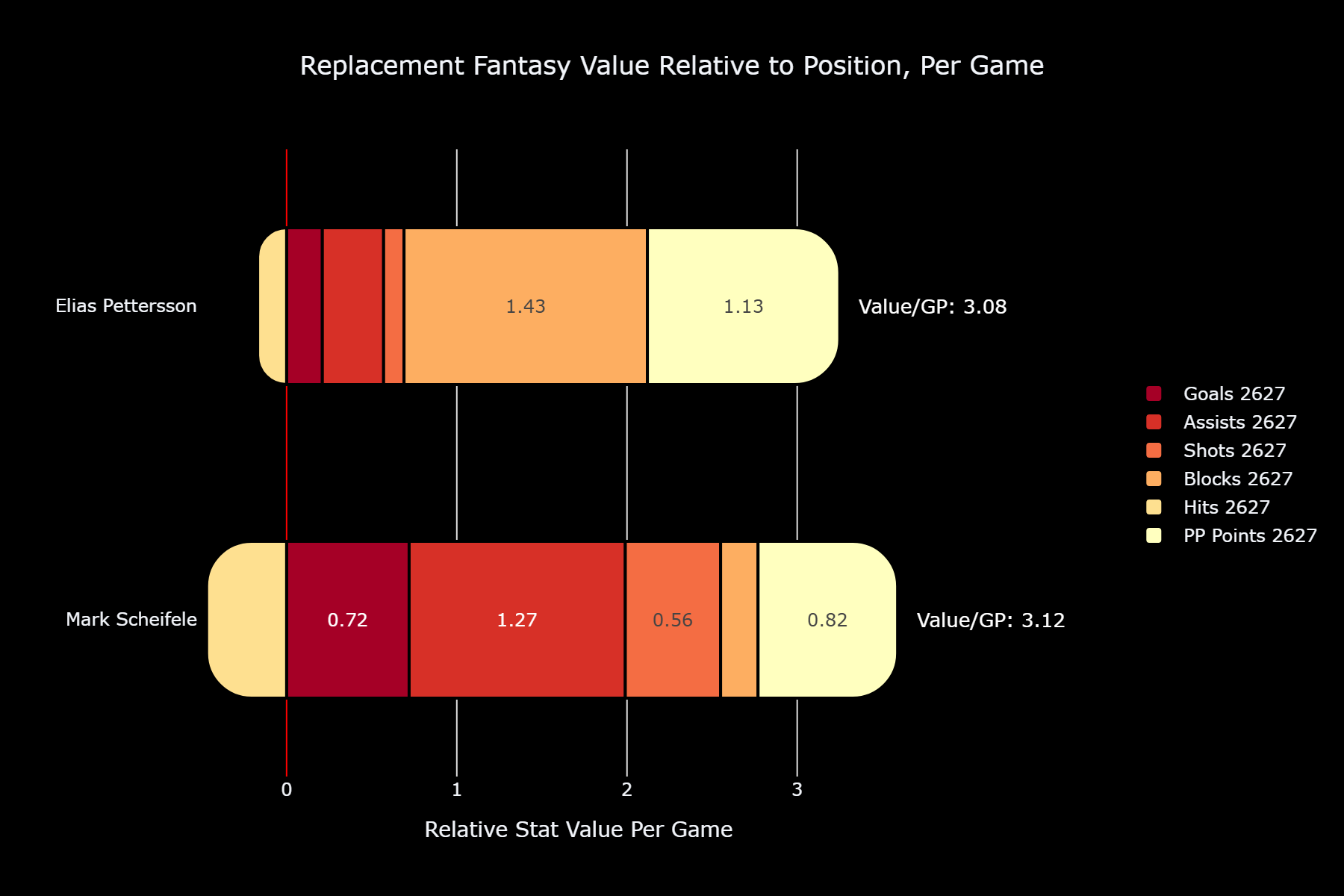
The power-play production stands out, but even in Pettersson’s decline, he’s only averaged two fewer PPPs per 82 games than Mark Scheifele. Pettersson also provides a huge number of blocks for a forward, and that matters a lot. My projections have EP40 falling just shy of 60 points but getting a huge chunk of those points on the PP while providing roughly 100 blocks. That unique profile makes him a valuable fantasy option.
6 – Mitch Marner (Vegas Golden Knights)
Did anyone notice Marner fell below the point-per-game mark last year? He had 80 points in 81 games, and he did that with a higher points/60 rate at 5-on-5 than his 102-point season in Toronto. Marner lost 1:22 per game in ice time, and with Jack Eichel and Mark Stone on the power play, Marner is no longer the focal point for carrying the puck into the zone, or for distribution. It drops his projection in line with a guy who has never had a 70-point season:
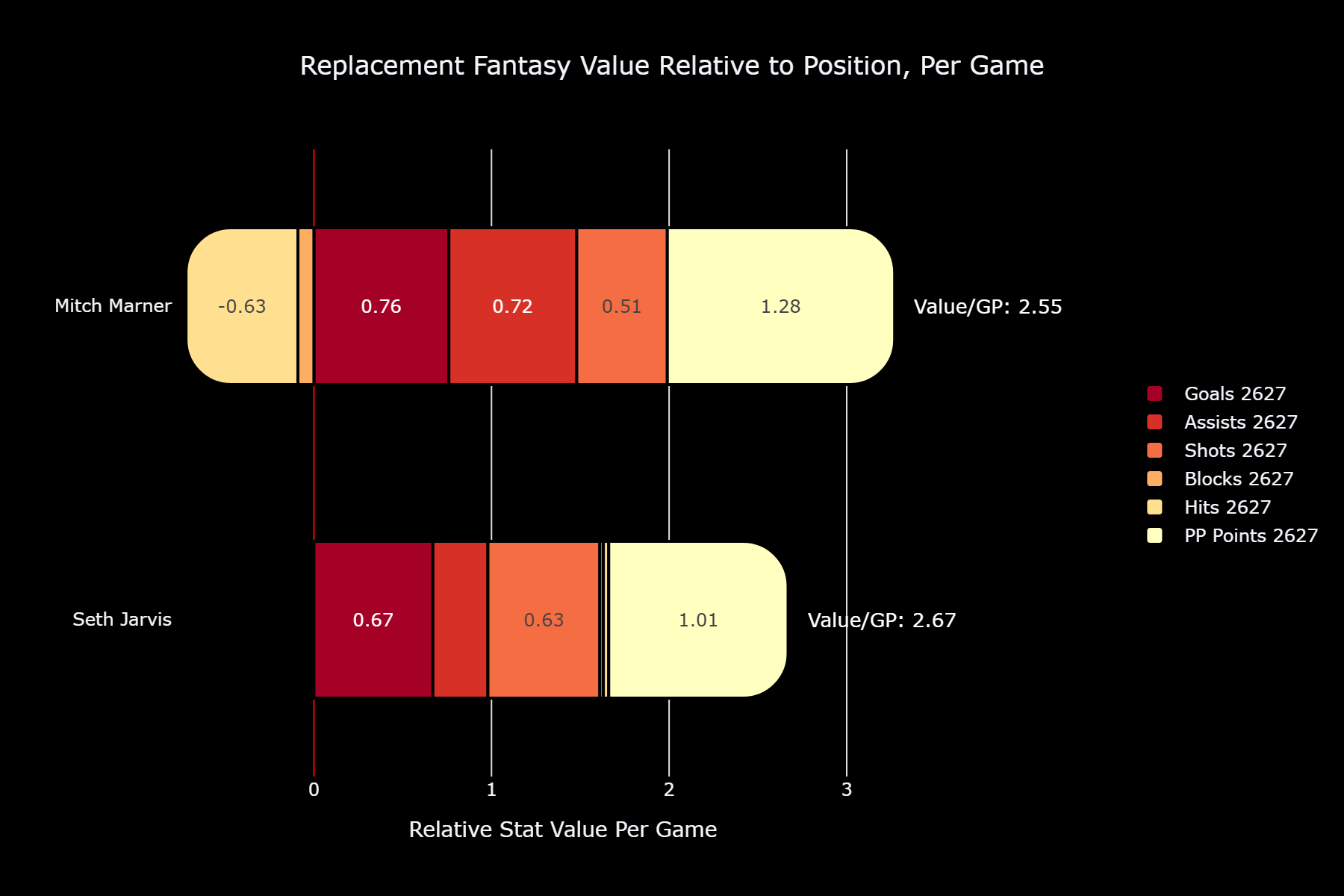
Seth Jarvis is injured to start the year, but this highlights that Marner’s situation in Vegas is not what it was in Toronto. At best, he’s second fiddle to Eichel, and if Stone is healthy and productive, he might be third fiddle. That isn’t ideal when considering a player whose ADP is in the first three rounds of most fantasy drafts.
7 – Alex Laferriere (Los Angeles Kings)
There are two things that make Laferriere valuable. First is that none of the six categories pop up as negative, meaning he contributes something across the board. The other is that his peripherals are very good and that accounts for 75% of his value. It makes him similar to one of the most hyped, young multi-cat wingers in the league:
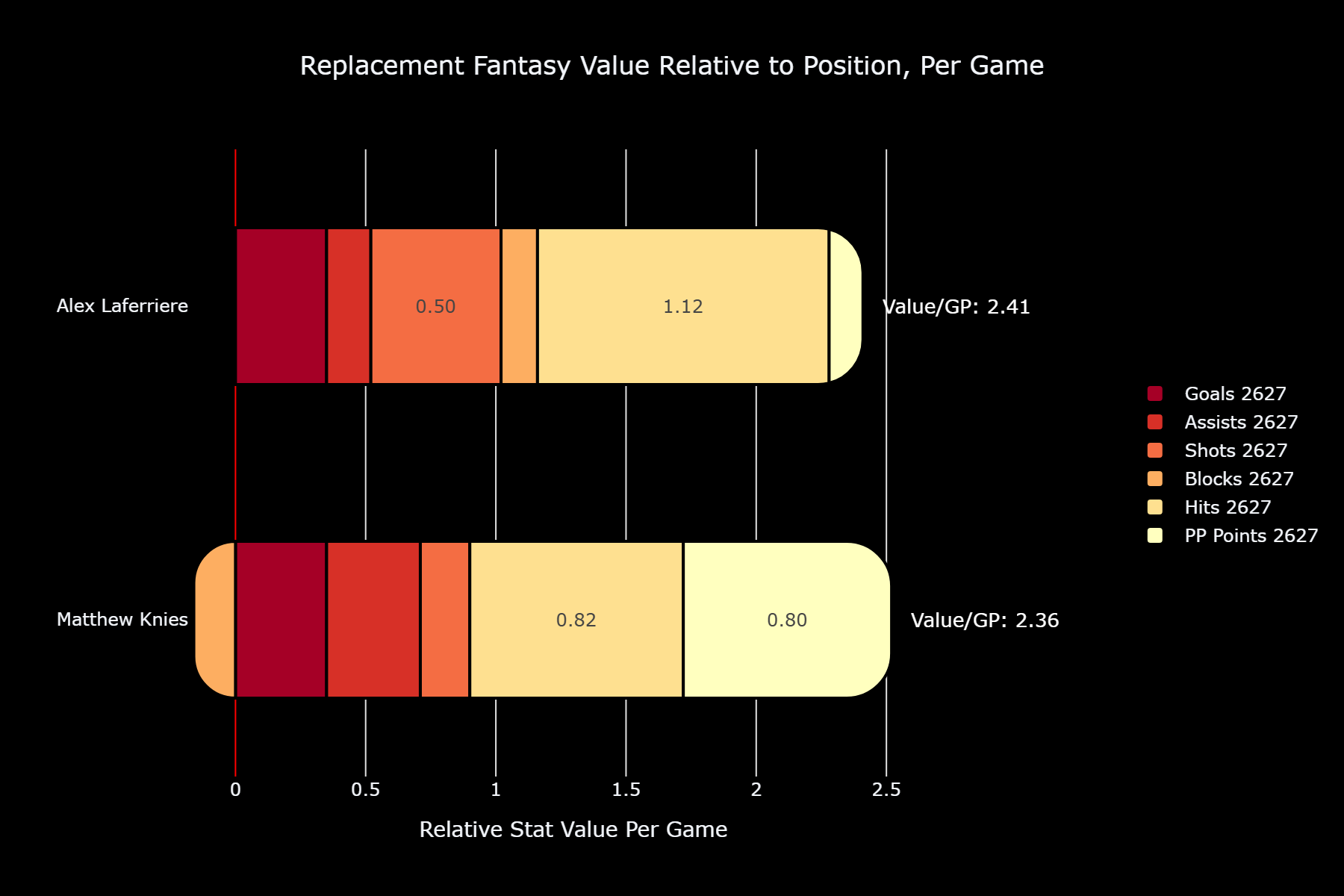
It isn’t that Laferriere is expected to be an outstanding fantasy player, but he is projected to be a fringe top 60 forward. Add in a couple dozen defencemen and goalies, and he should be a 10th or 11th-round pick. He is going much later than that in most drafts, and that makes him a solid fantasy value for 2026-27.
8 – Rasmus Dahlin (Buffalo Sabres)
What do you get when you have one of the best playmaking defencemen who can score 20 goals and is on a team that has hit its stride offensively? You get Rasmus Dahlin coming in as my third rearguard and in line with someone who had 95 points last year:
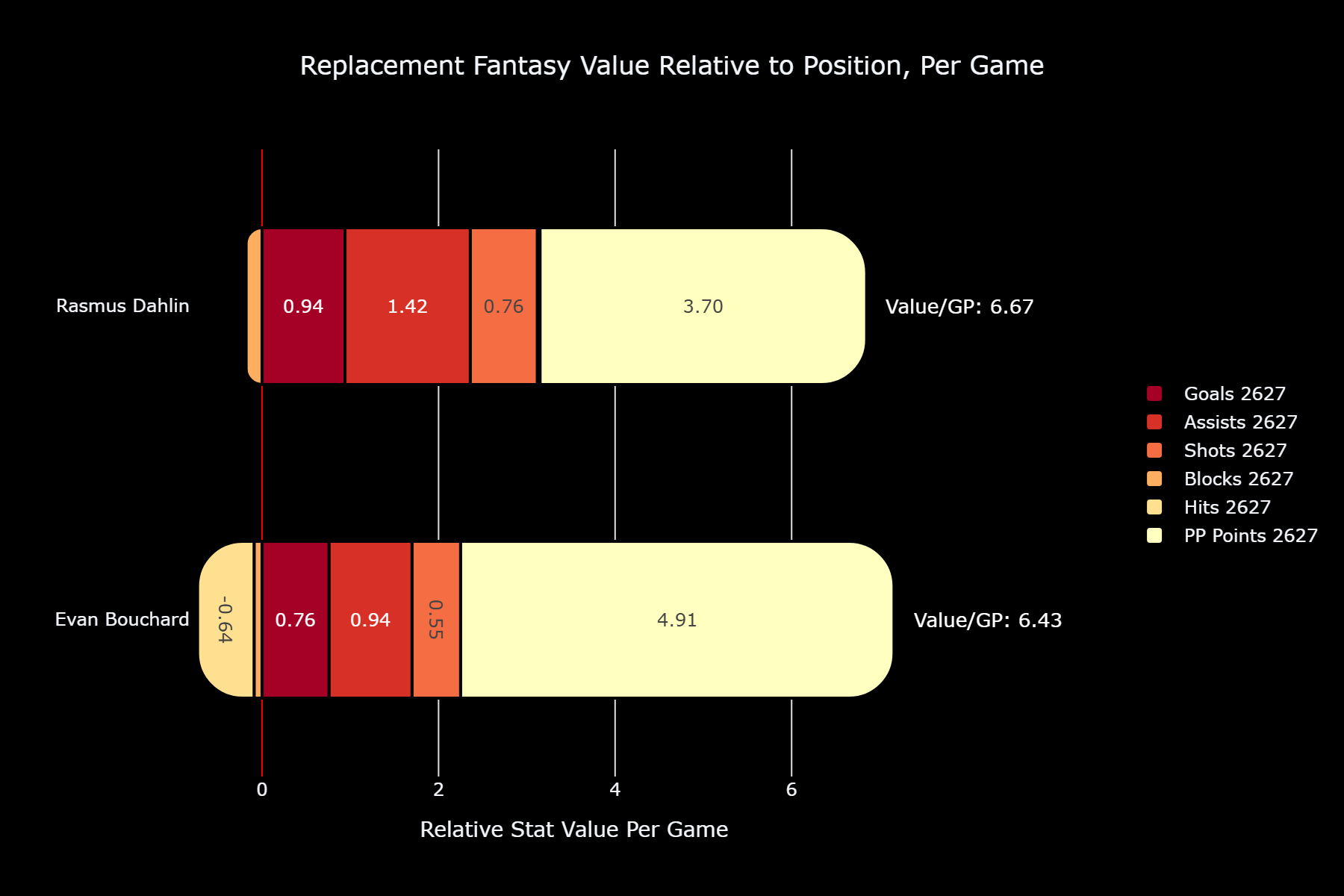
The key is the power play. Dahlin had 22 PPPs in 77 games last year, and that’s very good, but it’s not elite. These projections assume he’ll fall just short of the elite tier but tack on a half-dozen PPPs. Add that to a sizeable boost in his assists and there’s a good argument for Dahlin being at least a top 5 fantasy blue liner, if not top 3. It is a gamble, but I would be perfectly fine passing on Bouchard or Zach Werenski and waiting for Dahlin.
9 – Miro Heiskanen (Dallas Stars)
This is one that could go very wrong, very fast. When nearly 90% of a player’s fantasy value comes from their power-play projection, we should sit up straight:
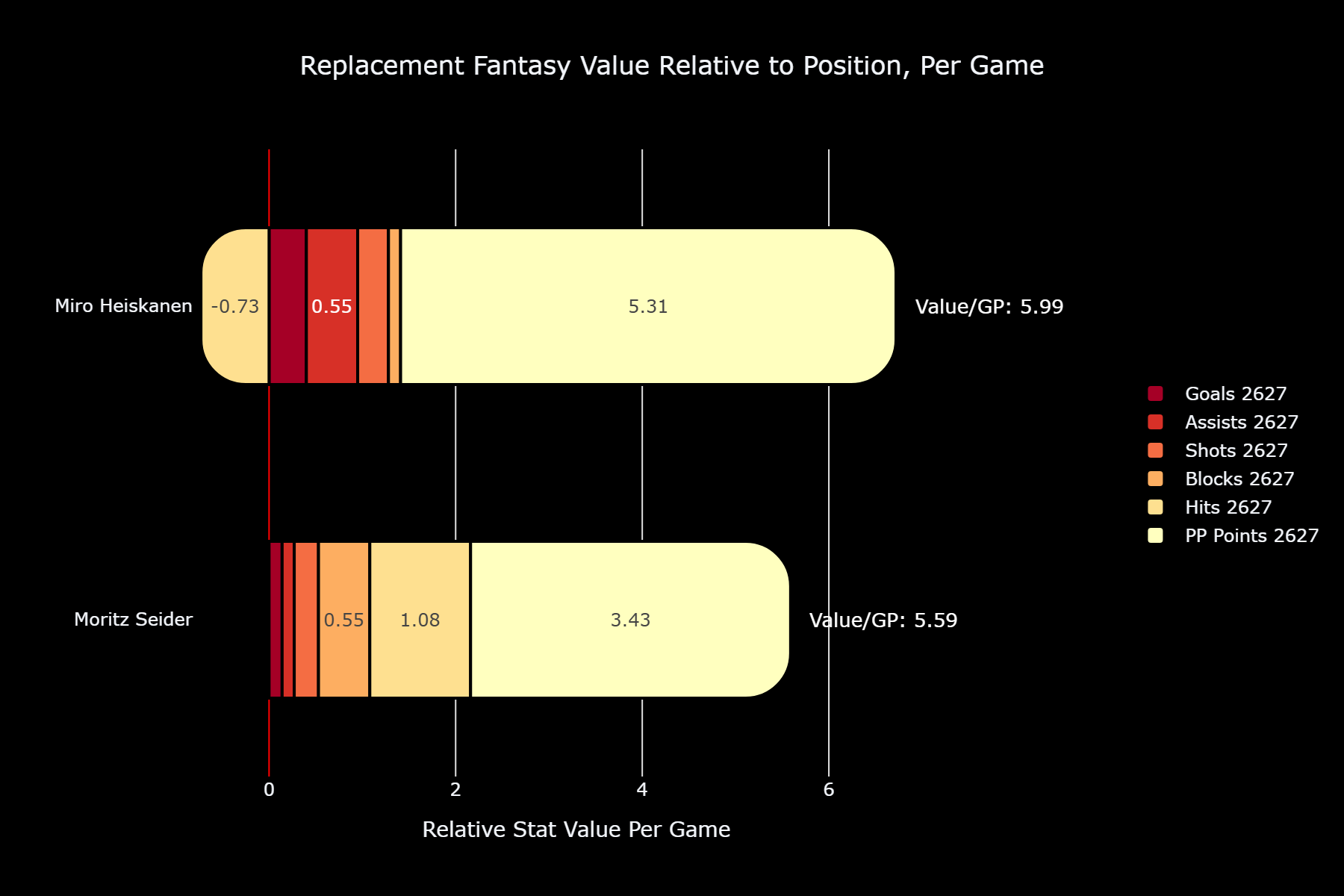
Heiskanen had 28 PPPs last year, tied with Moritz Seider, but doing so in five fewer games. The anticipation is Heiskanen running PP1 for Dallas and putting up roughly 30 PPPs again. If the Dallas power play isn’t as great as last year, or Heiskanen is supplanted by Thomas Harley for any stretch of time, then Heiskanen’s value is cooked. He would go from a fringe top 10 defenceman to top 40. That is… a problem.
10 – Dougie Hamilton (New Jersey Devils)
Last year, I was very high on Hamilton, and that burned me. It only feels right, then, that this year’s projection is very low on Hamilton:
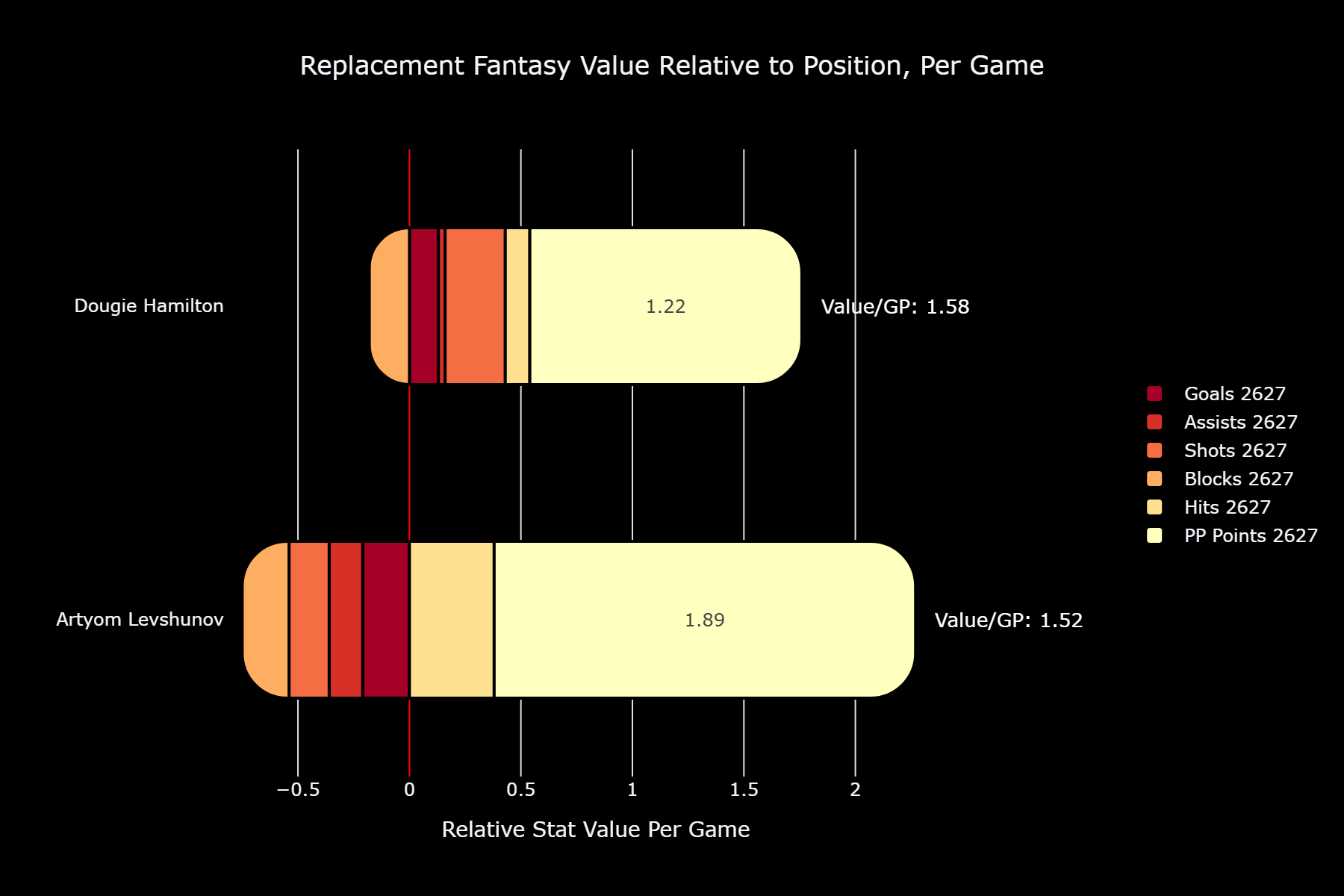
The comparison is to another guy who is not projected for top PP time, but who also doesn’t bring much besides that. This is more about Hamilton and how much can change: If he gets the top PP role over Luke Hughes, Hamilton goes from a top 30 defenceman to top 15. The decision of Hughes vs. Hamilton is going to burn a lot of people, let’s just hope we’re on the right side of the coin flip.
Until next week.