10 Interesting (To Me) Stats For This Week - October 21
Welcome back for another week of ’10 Interesting Stats’. We are now two weeks into the NHL season and while we can’t make any firm determinations besides ‘holy hell San Jose sucks pondwater’, it’s always worth looking at early trends. Let’s see if we can notice why certain players or teams are off to their respective starts, or players and teams that may be too hot or cold.
All data is from Evolving Hockey and is current as of the morning of Monday, October 20th.
1 – A Nice Surprise
The Pittsburgh Penguins are off to a 4-2 start and one of the bigger surprises has been the play of rookie Ben Kindel. Taken 11th overall in the 2025 draft, Kindel has been centering the third line, and the team is even by goal differential at 5-on-5 with him on the ice. Below is a graphic of rookie forwards and their respective shot attempts per 60 minutes (iCF/60) and shot attempts per individual expected goal at 5-on-5. Look at the names in the bottom-right:
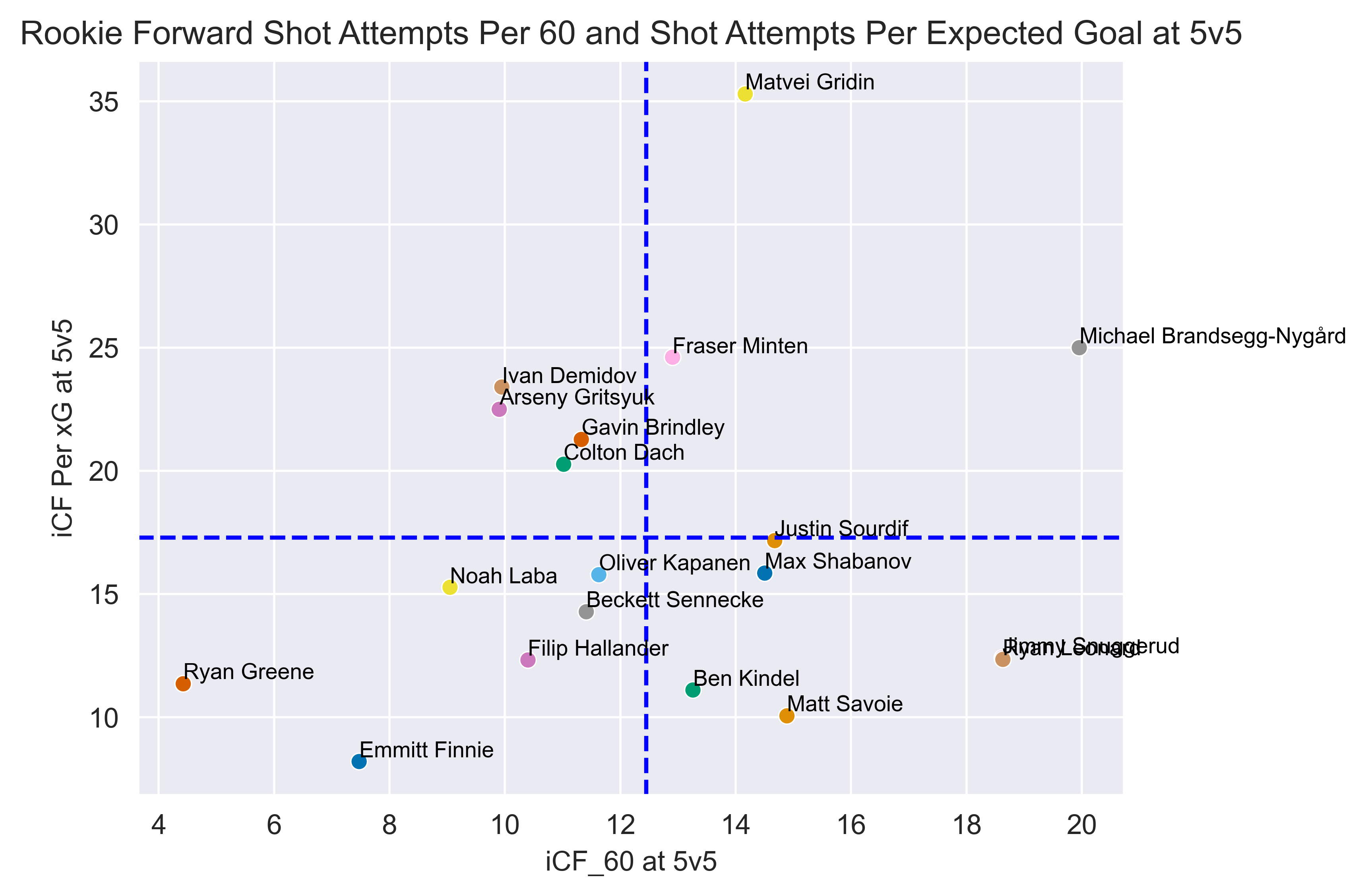
Those are players who are better than the average rookie by iCF/60 and better than average by attempts per expected goal. Simply, they are shooting often, but don’t need a lot of shots to create good quality. The overlapping names are Ryan Leonard and Jimmy Snuggerd, we have Matt Savoie and Max Shabanov, and then there’s Kindel. He has been one of the less-heralded rookies to start the season, but it’s a stellar start to his career.
2 – Nik at Night
One question for Carolina’s blue line was how well K’Andre Miller would fit in (the answer there seems to be ‘pretty well’). The other was how rookie defenceman Alexander Nikishin would fare in his first full season. Below is a graphic just like the one we saw for rookie forwards, only this time it’s rookie defencemen, and again we’re looking for names in the bottom-right quadrant:
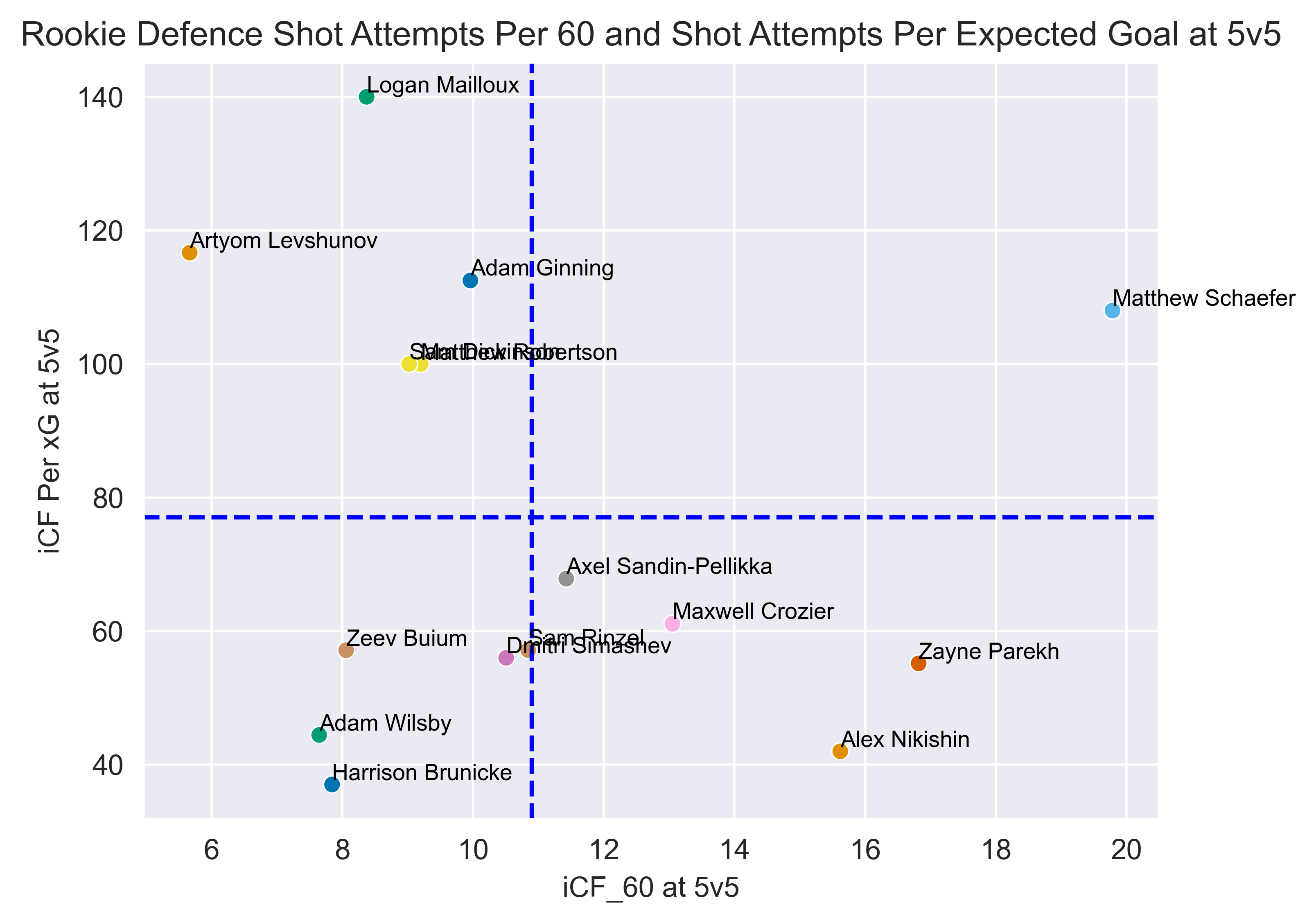
Only Zayne Parekh and Matthew Schaefer are shooting more often, and only Harrison Brunicke requires fewer shot attempts per expected goal, than Nikishin. The Hurricanes are also +6 by goal differential with him on the ice at 5-on-5 (+8/-2). This will regress, and it’s a long season, but it’s been an impressive five games for Nikishin.
3 – The Past and Present
Taking the same idea of looking at iCF/60 rates and attempts per expected goal at 5-on-5, let’s expand to all forwards across the league. There are two names I want to highlight because of their excellence in very different circumstances:
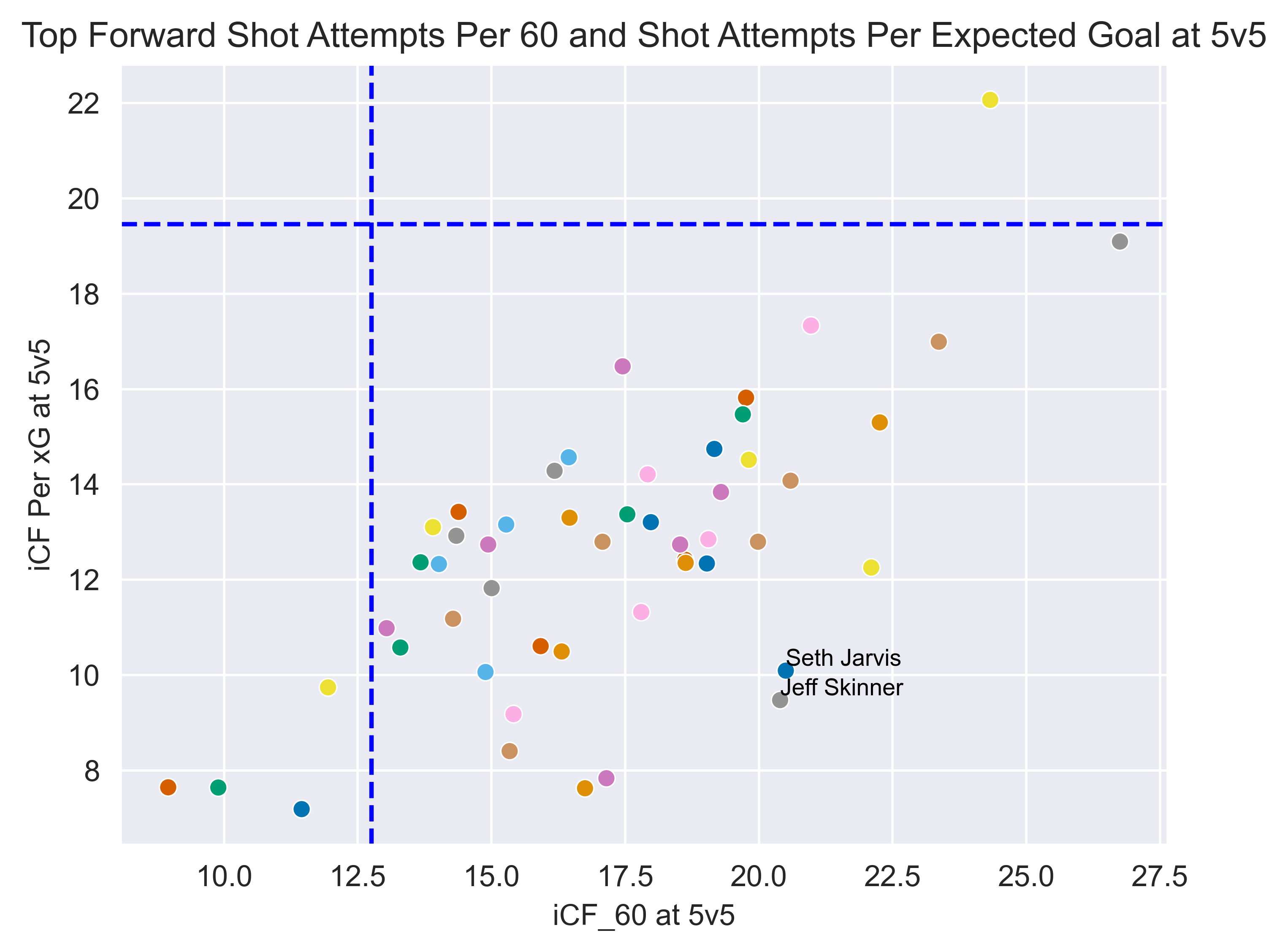
Seth Jarvis is over 20 attempts per 60 minutes while being one of the lowest rates of attempts needed per expected goal. For a two-time 30-goal scorer on this Carolina team, that does make sense, but it highlights one reason why he has six goals in five games.
Then there is Jeff Skinner, the former Hurricane and current San Jose Shark. The Sharks are an abomination to professional hockey, but Skinner has three goals in five games – as many as he had in his first 20 games with Edmonton – despite starting the season on the third line while skating under 13 minutes a game. We’ll see how long this lasts, but a nice resurgence from the six-time 30-goal scorer.
4 – Can We Get A Do-Over?
Let’s shift gears and look at on-ice team results for specific defencemen. Below is a graphic looking at ice time per game at 5-on-5 and expected goal differential relative to teammates at 5-on-5. We are highlighting players that are skating top-pair minutes per game and are also in the 90th percentile (or higher) by that relative expected goal share:
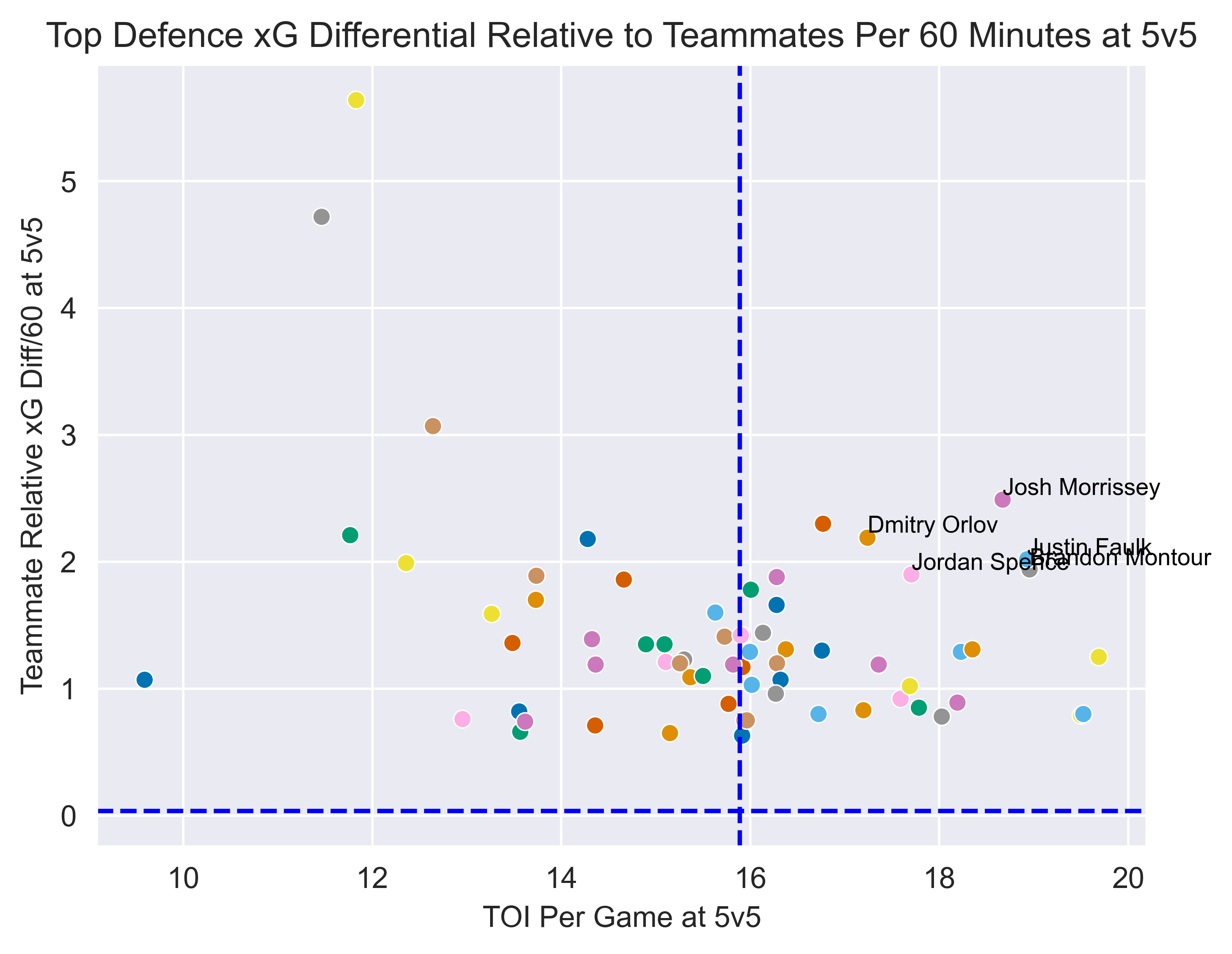
We have five names here: Josh Morrissey, Justin Faulk, Brandon Montour, Dmitry Orlov, and Jordan Spence. All notable for one reason or another, but it’s Spence that sticks out. He was effectively dumped by Los Angeles in the offseason and replaced with Cody Ceci. Spence has been one of the top performers among all defencemen in the league and Ceci, uh, well… he’s certainly still in the NHL. That has to count for something.
5 – The Net-Front Future
Having a good net-front player on the power play can mean a lot – we saw that for years with Chris Kreider in New York and more recently with Stefan Noesen in New Jersey – which is what makes Josh Doan crucial for Buffalo: from 2023-2025, the Sabres were 28th in the league by goals per minute on the power play. After a slow start in 2025-26, they are now fourth. A big part of that is Doan who, since the start of last season, has been one of the best forwards at creating a lot of expected goals with few shot attempts on the power play:
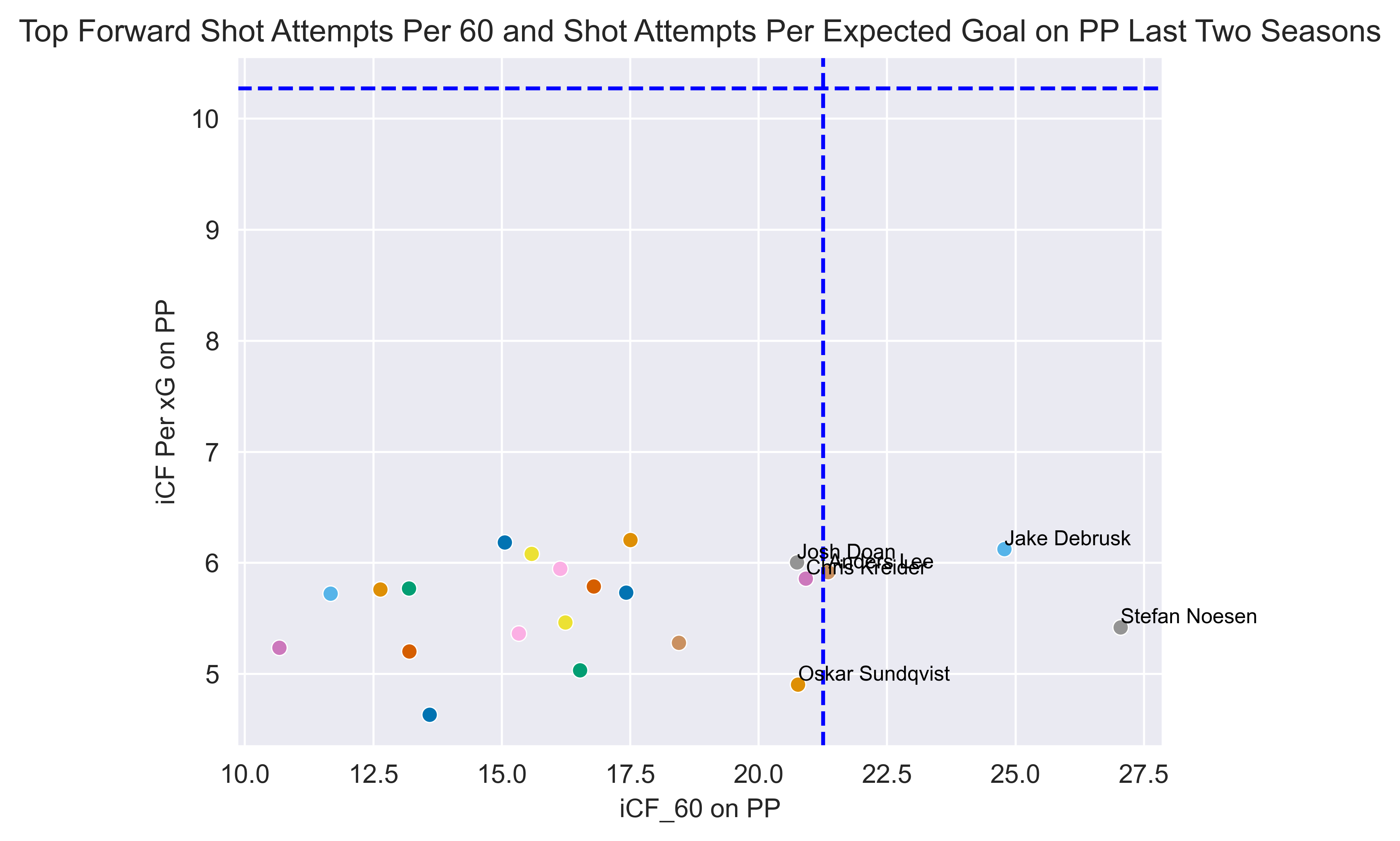
We see Kreider and Noesen, as well as Anders Lee, Oskar Sundqvist, and Jake DeBrusk. Other than Lee, they are all good PP goal scorers. Doan had two PP goals on Saturday, and if he helps turn the Sabres power play into a weapon rather than a liability, it gives them something they haven’t had in years.
6 – Look Out, Below!
Staying with Buffalo, while the PP has turned things around, the penalty kill is showing signs of stress. Below is a graphic of teams shot rates allowed while down a man, and their team save percentage. Being in the top-right means allowing a lot of shots but having a very high save percentage that will regress:
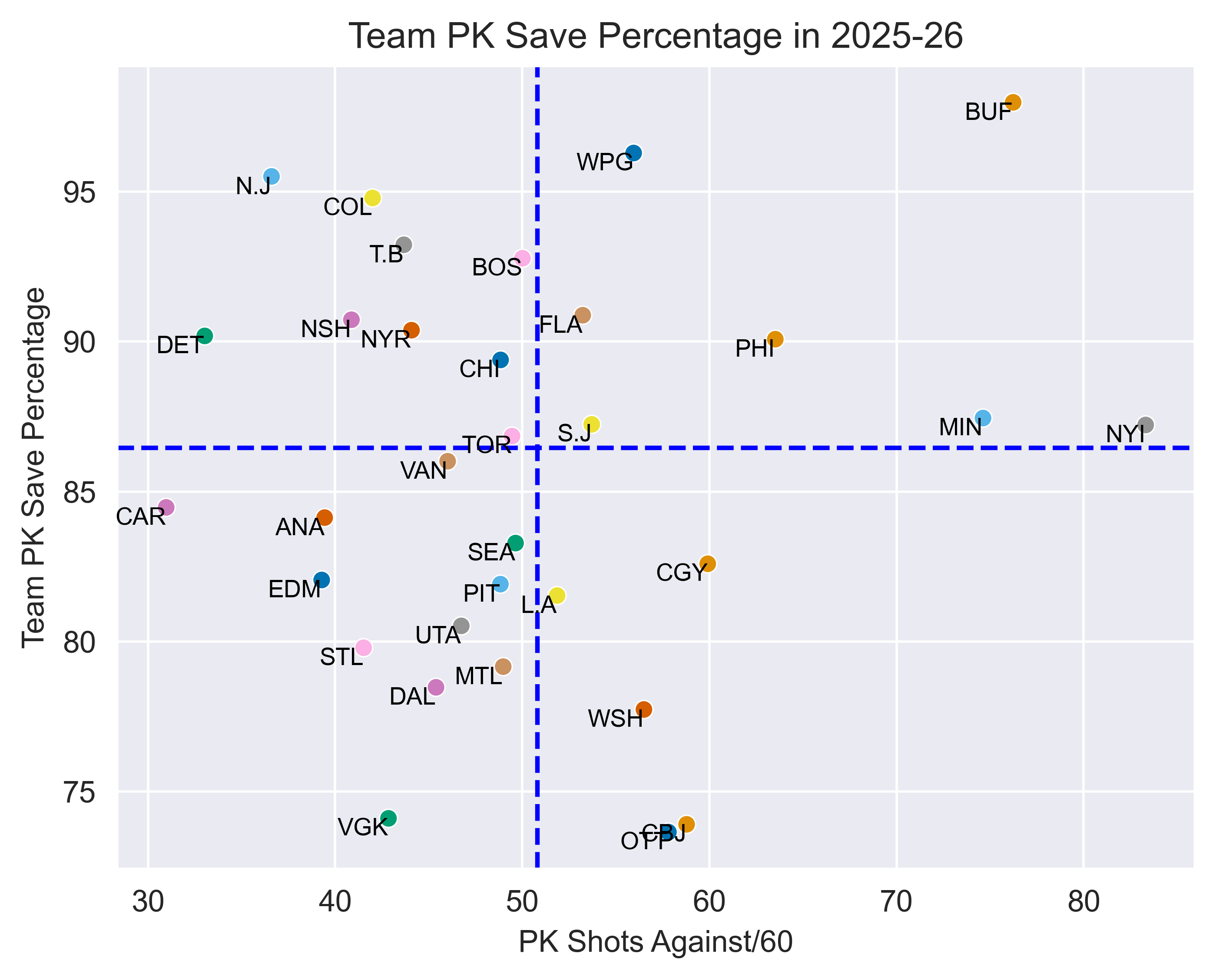
Gonna go out on a limb and say Buffalo won’t maintain a .980 (!) save percentage at 4-on-5. Combined with giving up the second-most shots against, and this PK could be in for a severe correction, undoing all the good an improved power play can bring.
A quick shout out to Detroit (all the way to the left) as their early PK returns have been very good and considerably better than last year. That can be a difference-maker if they keep it up.
7 – Arrived?
Chicago has won three of its last four games in no small part to Artyom Levshunov. He was scratched for their first game, so they are now 3-1-2 with him in the lineup and they have a plus-4 goal differential at 5-on-5 with him on the ice. Importantly, he’s driving positive expected goals results for the top of the lineup as Chicago’s top forwards largely have better expected goal shares with Levshunov (horizontal axis) than their overall numbers (vertical axis):
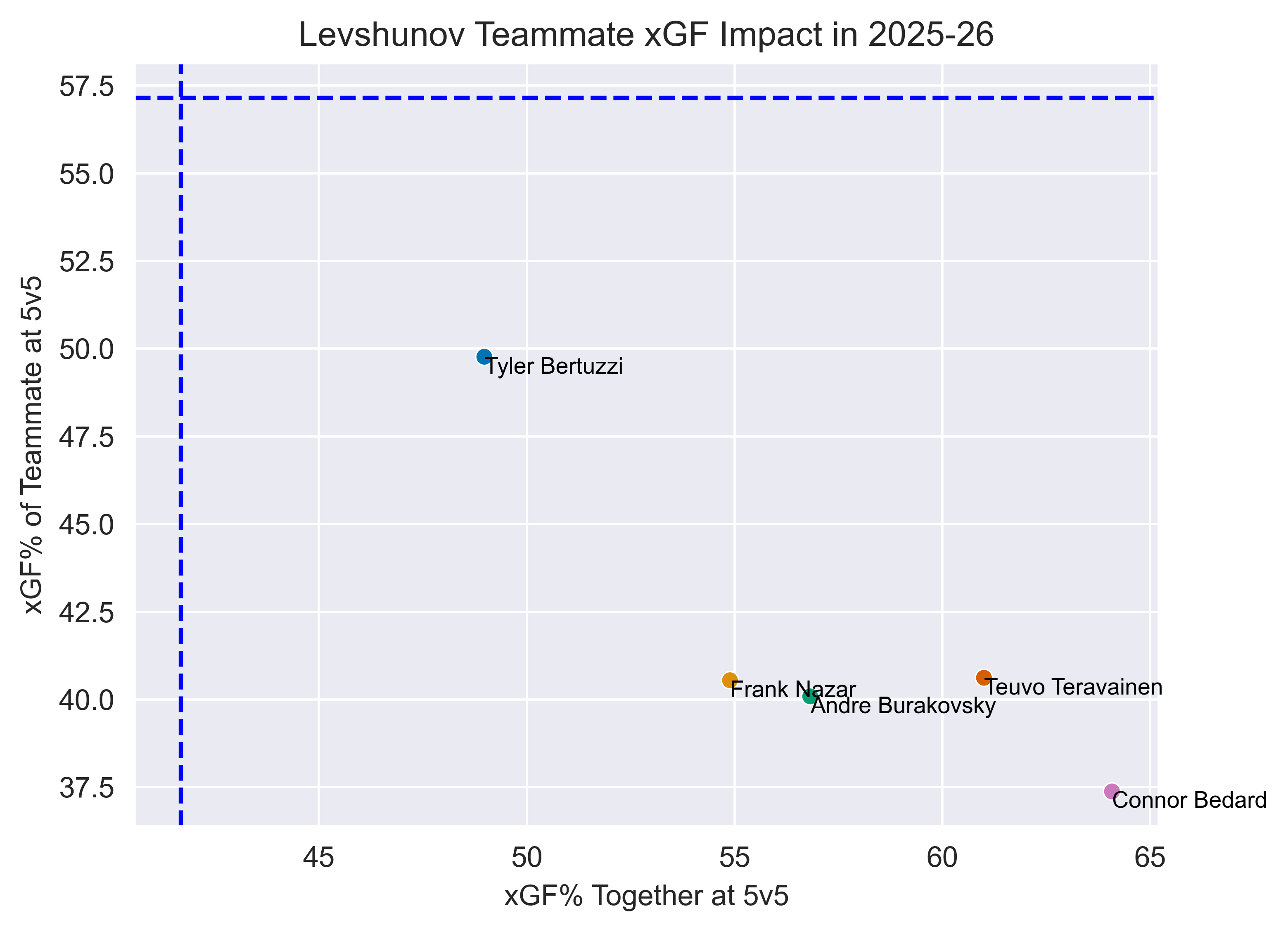
They aren’t giving him much ice time – under 16 minutes a game over those last four games – but the ice time he does get has helped tilt the ice for the Blackhawks.
8 – There’s Some Good in This World
Let’s do the same type of analysis with Sharks rookie defenceman Sam Dickinson that we just did with Levshunov. Everyone to the right of the vertical blue line has had better (in some cases, much better) expected goal shares with Dickinson on the ice than their overall performance:
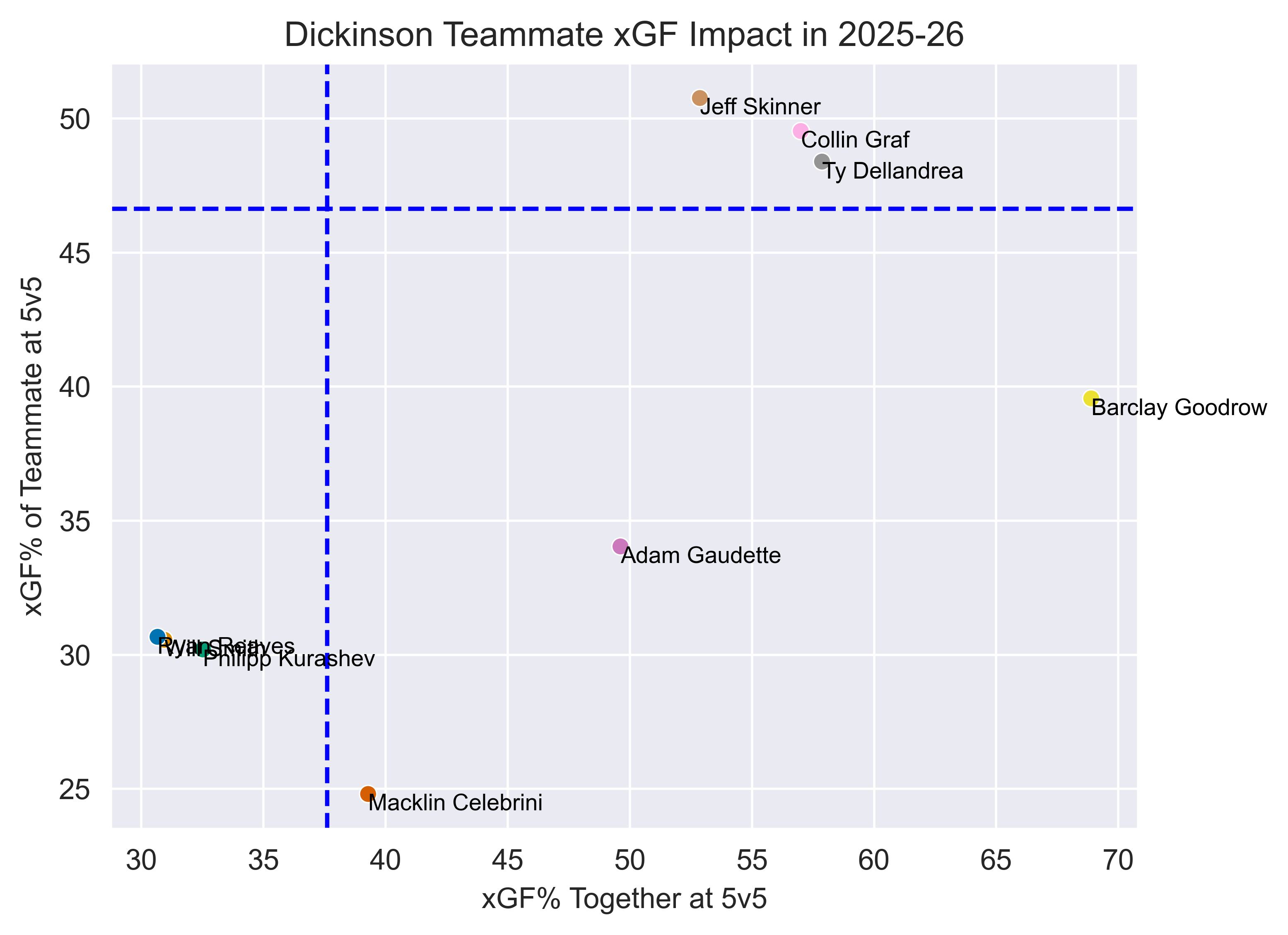
These are very small 10- to 20-minute samples, and he’s only played four games, so let’s see where things stand a month from now. But if he can keep this up, he might be the team’s number-1 defenceman down the stretch (low bar, but still).
9 – More to Give
Detroit is off a magnificent 5-1 start, but the odd thing is that winger Alex DeBrincat has yet to score on his 20 shots on goal. It hasn’t been for lack of trying as these are top-6 forwards whose iCF/60 is in the top-20 and backed by a first-line expected goals rate:
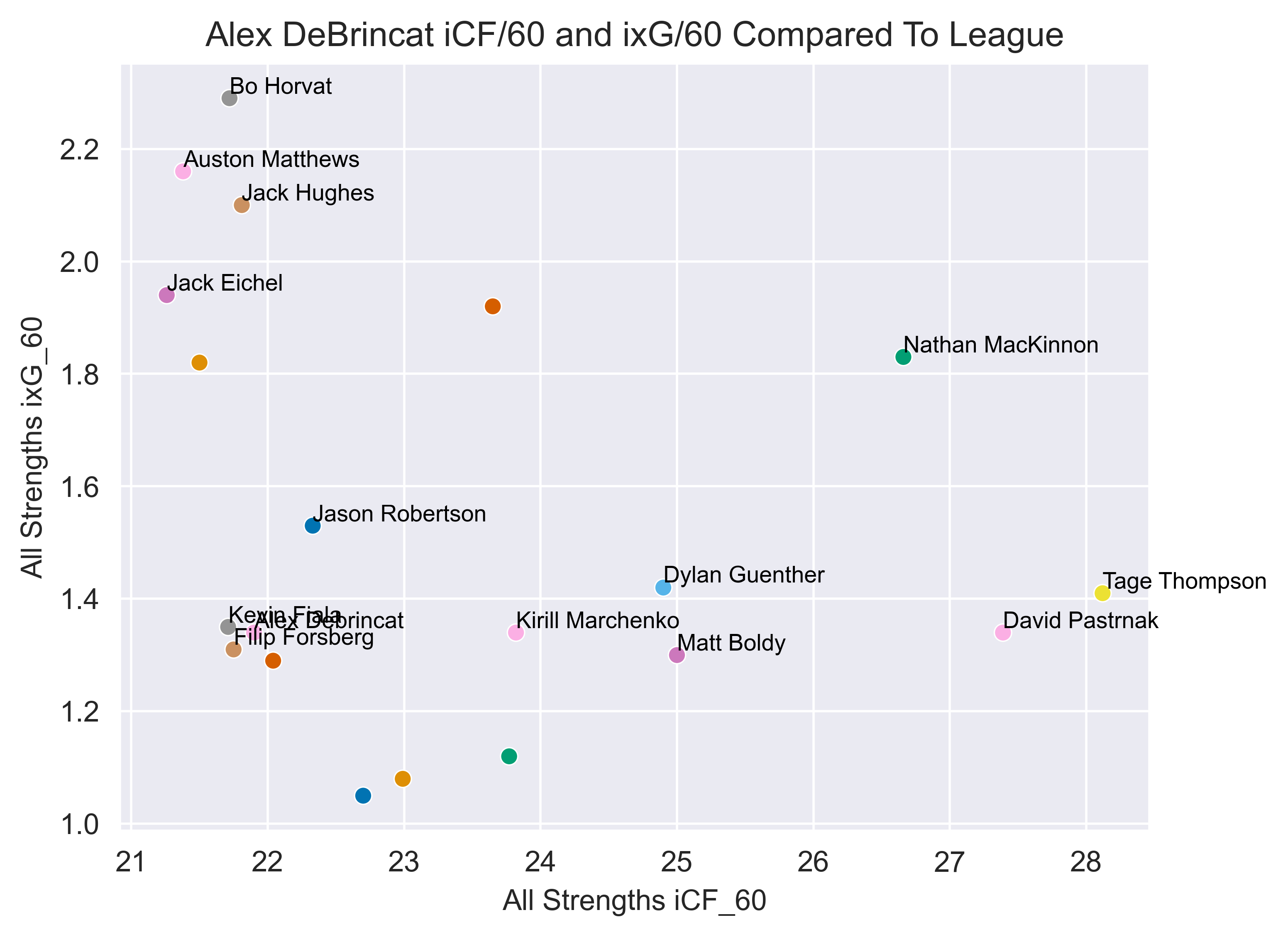
In the bottom-left is a group with DeBrincat, Kevin Fiala, and Filip Forsberg. Overall, though, those names are a who’s-who of high-end goal scorers. Performing like this, it’s just a matter of time before DeBrincat starts filling the net.
10 – Crash and Burn?
Winnipeg is off to a 4-1 start which, considering their offseason losses and preseason injuries, feels like a miracle. Of course, goalie Connor Hellebuyck is in the middle of all this, allowing two-or-fewer goals in three of his four starts. That shouldn’t mask the fact that at 5-on-5, his average shot distance faced is less than 33 feet away, by far the closest of his last five seasons:
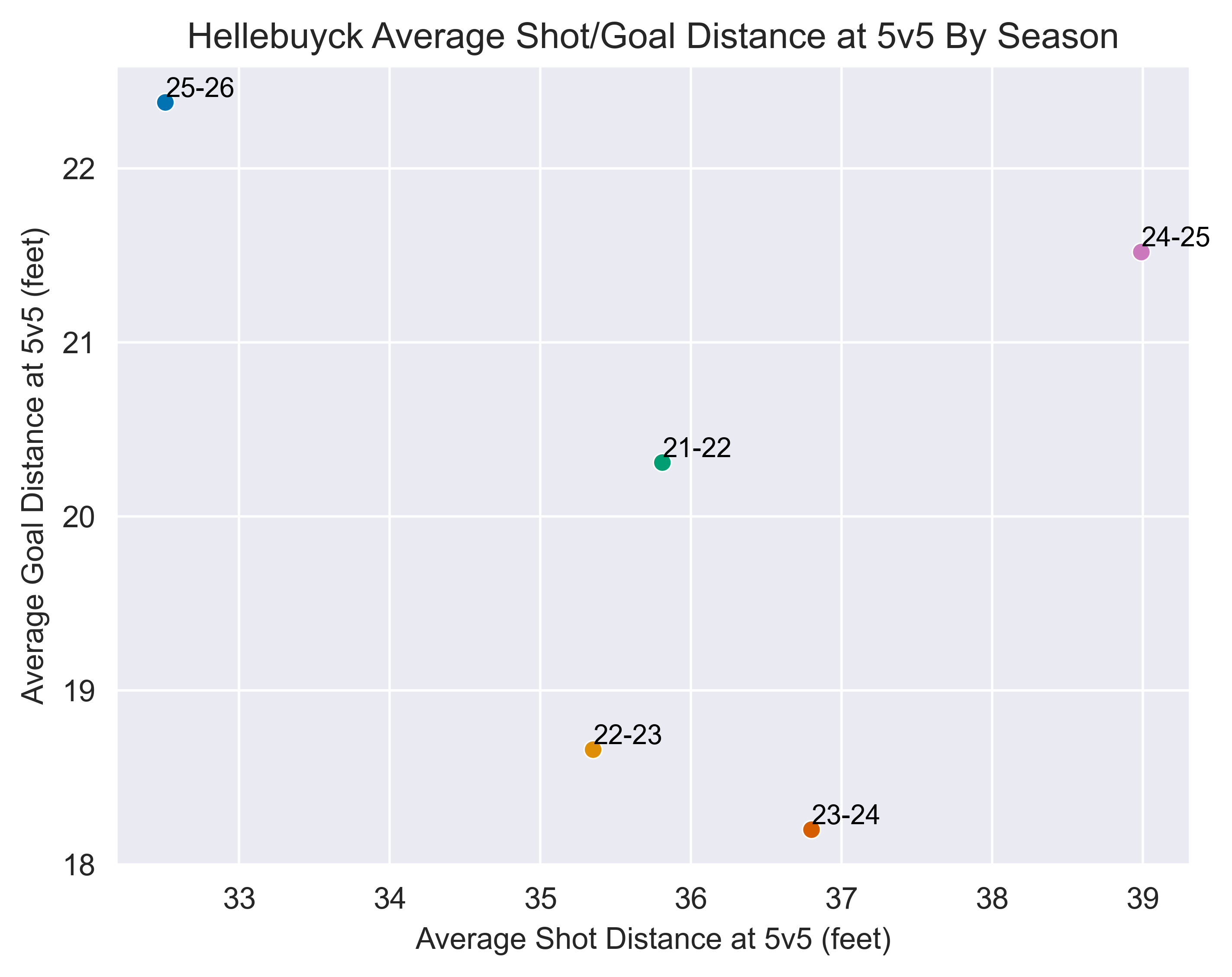
Notice that each of the prior four seasons saw an average shot distance over 35 feet, and last season was around 39 (!) feet away. It is nice for the Jets to bank points, but this has not been the same defensive team as last year. Let’s wait and see what they look like when Adam Lowry and Dylan Samberg are healthy, but until then, this is an area of concern.
Until next week.