10 Interesting (To Me) Stats For This Week - February 24
Welcome back for another week of ’10 Interesting (To Me) Stats’! This week we’re doing an update. Back on December 2nd, this newsletter covered early-season performances from this year’s crop of rookies. Now that we’re two-thirds of the way through the campaign, let’s take another gander at how the first-year players are performing.
This column will focus strictly on tracking data provided by All Three Zones. The skaters are separated by forwards and defencemen, and this is at 5-on-5 only. This will also exclude the top rookies like Matthew Schaefer, Ivan Demidov, Ben Kindel, and Beckett Sennecke to try and give others some more shine.
The red and blue dotted lines on the graphs are the rookie averages at that position in that specific stat. Any additional data is from Evolving Hockey.
1 – Moore is More
While the Chicago Blackhawks’ future hinges on top picks like Connor Bedard and Artyom Levshunov becoming elite players, for sustained franchise success, they need their later picks to become impact players. One of those picks is Oliver Moore, taken 19th overall in 2023. He has modest production, even in a lesser role, but he’s 1 of 5 names among our sample of 29 rookie forwards to be above average by contributions (shots and assists) off the rush and contributions off the cycle+forecheck:
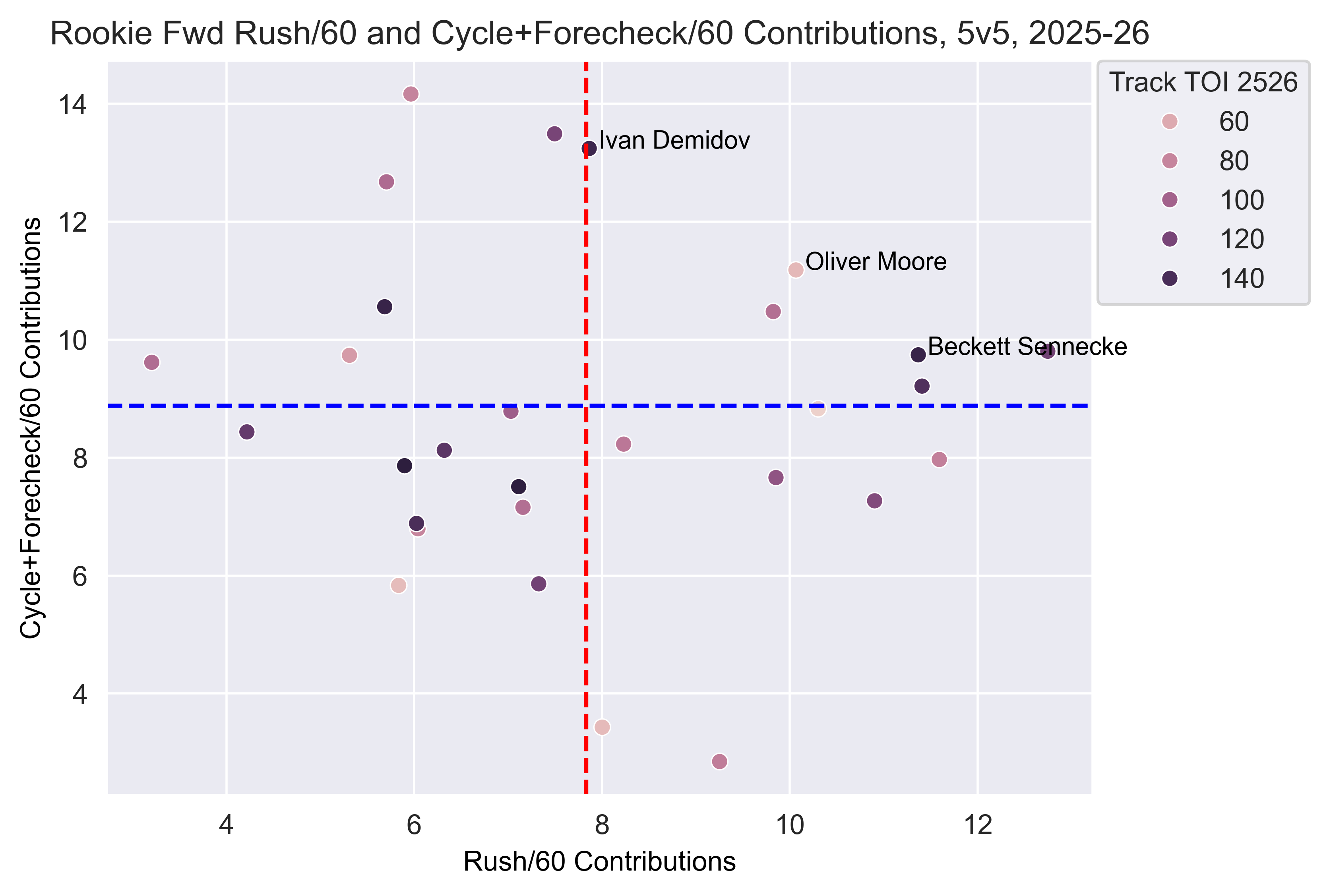
The caveat here is that Moore has a very low tracking data sample – only a handful of games – so we’ll see what this looks like at the end of the year. If he can perform like this the rest of the way, it’ll be a great sign for his and Chicago’s future.
2 – Karl’s Mark
Using a minimum of 400 minutes played, the only rookie forward with a higher points/60 minutes rate than Vancouver’s Linus Karlsson (2.32) is Demidov (2.73). When we see what he’s done off the cycle and forecheck, it’s little wonder why he’s been so productive, especially when we consider he has a bigger tracking sample than the aforementioned Moore:
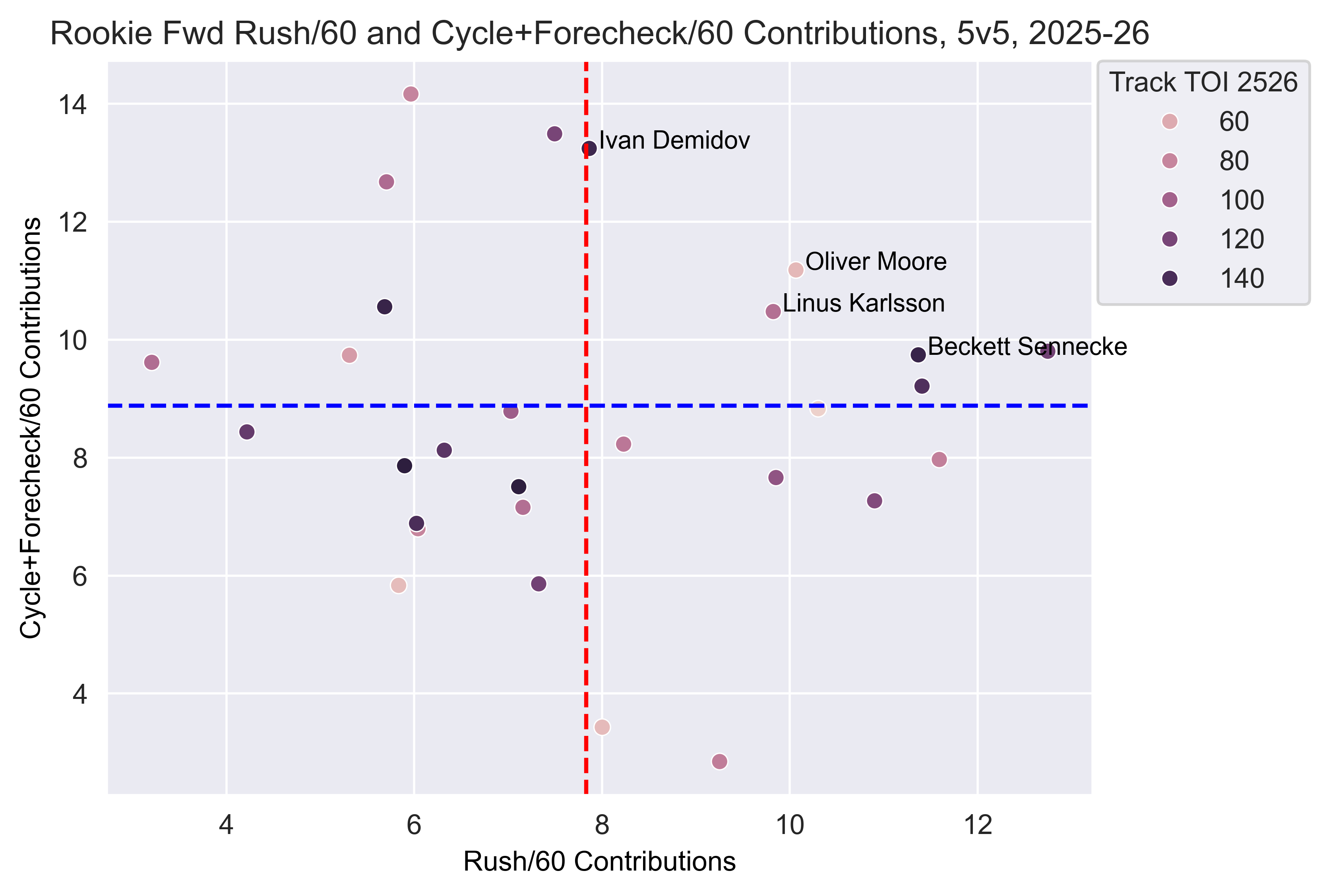
Importantly, the only forward Karlsson has spent more than 30% of his 5-on-5 time with is Max Sasson, a 25-year-old with 79 career NHL games. At 26 years old, Karlsson is an old rookie, but if Vancouver wants to be competitive in the next five years, players like Karlsson will need to be top-half-of-the-roster options. With continued improvement from this level, he will be.
3 – Cow-A-Fun-Guy
In the newsletter on rookies a couple months ago, Toronto’s Easton Cowan was highlighted because of his ability to drive goal scoring and goal differential. The goal scoring has fallen off since, but it’s not for lack of good tracking data, because his rate of scoring chance assists (passes leading to teammate chances) and shot attempts are both very strong, especially the chance assists:
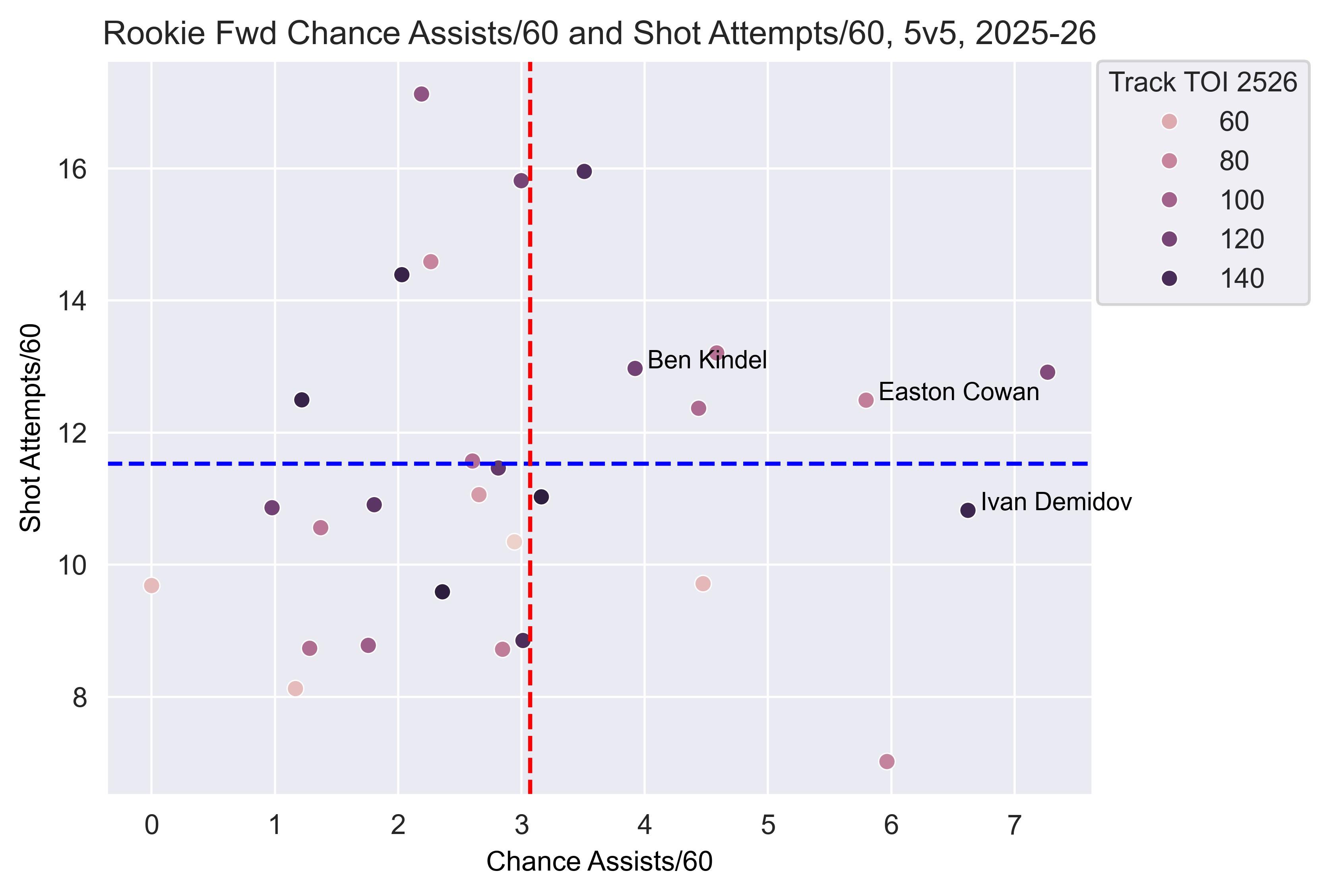
Not included is his rate of zone entries, which not only leads all rookie forwards, but all forwards in the league (minimum of 75 tracked minutes). Cowan is showing some very high-end puck skills with a solid shot rate. Let’s see where his numbers land at the end of the season, but he has extremely encouraging tracking data so far.
4 – Jimmy’s Good!
When a team is having a poor season like St. Louis is, players having good-but-not-elite seasons will get little press. That fits winger Jimmy Snuggerud, especially without eye-popping back-of-the-card stats. It shouldn’t be discouraging for Blues fans, though, because using the same chance assist and shot attempt data as Cowan, Snuggerud is showing very well:
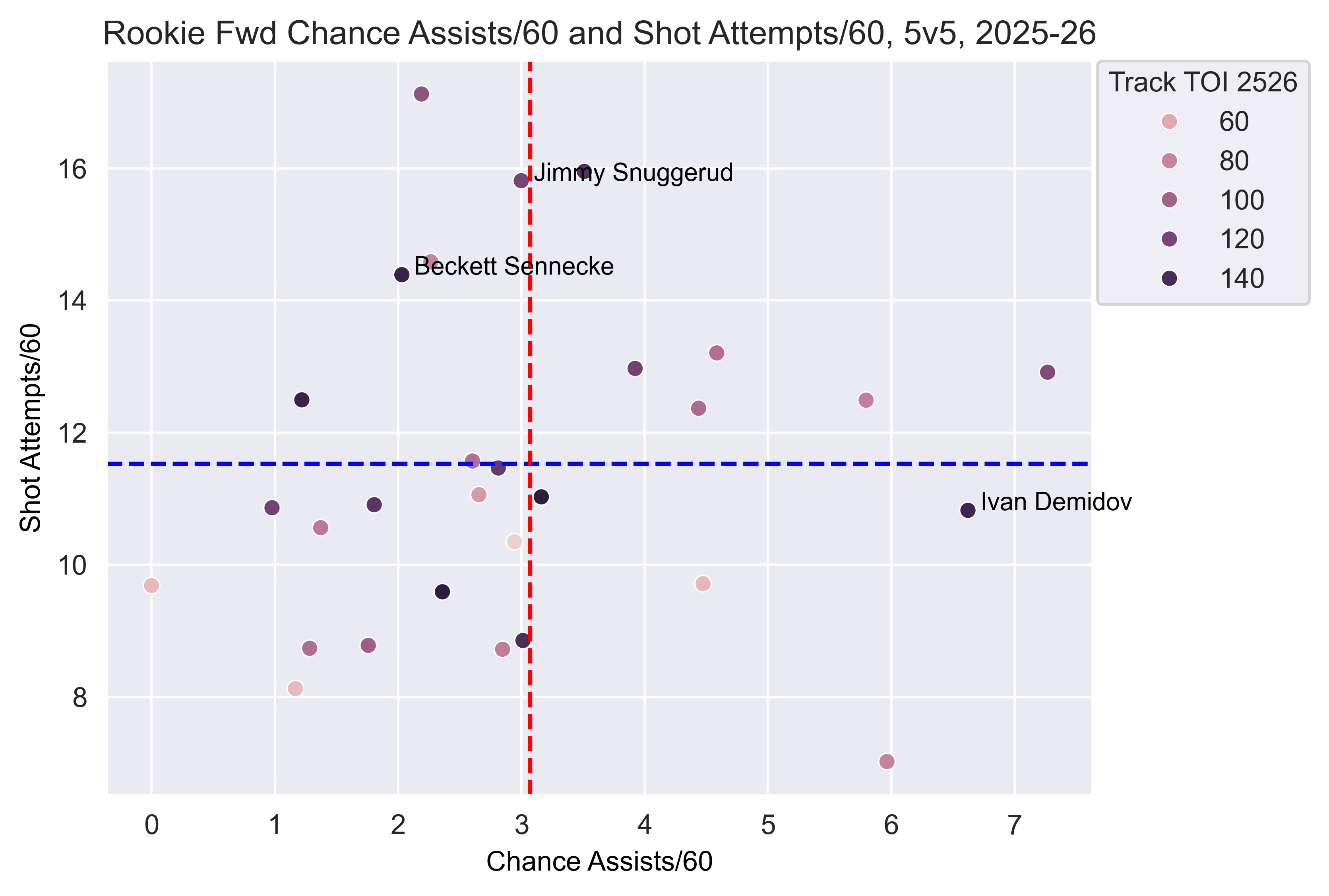
With both Robert Thomas and Dylan Holloway expected back from injury when play resumes this week, Snuggerud has reinforcements coming to help his production. Regardless, high shot volume with an average chance assist rate is a very positive sign for a rookie.
5 – Instant Grits
There are several areas where New Jersey winger Arseny Gritsyuk stands out, not the least being his expected goal RAPM differential – a measure of play-driving adjusted for things like teammate quality – leading all rookie forwards. A lot of tracking data looks good, too, particularly his rate of zone entries and percentage of entries carried in:
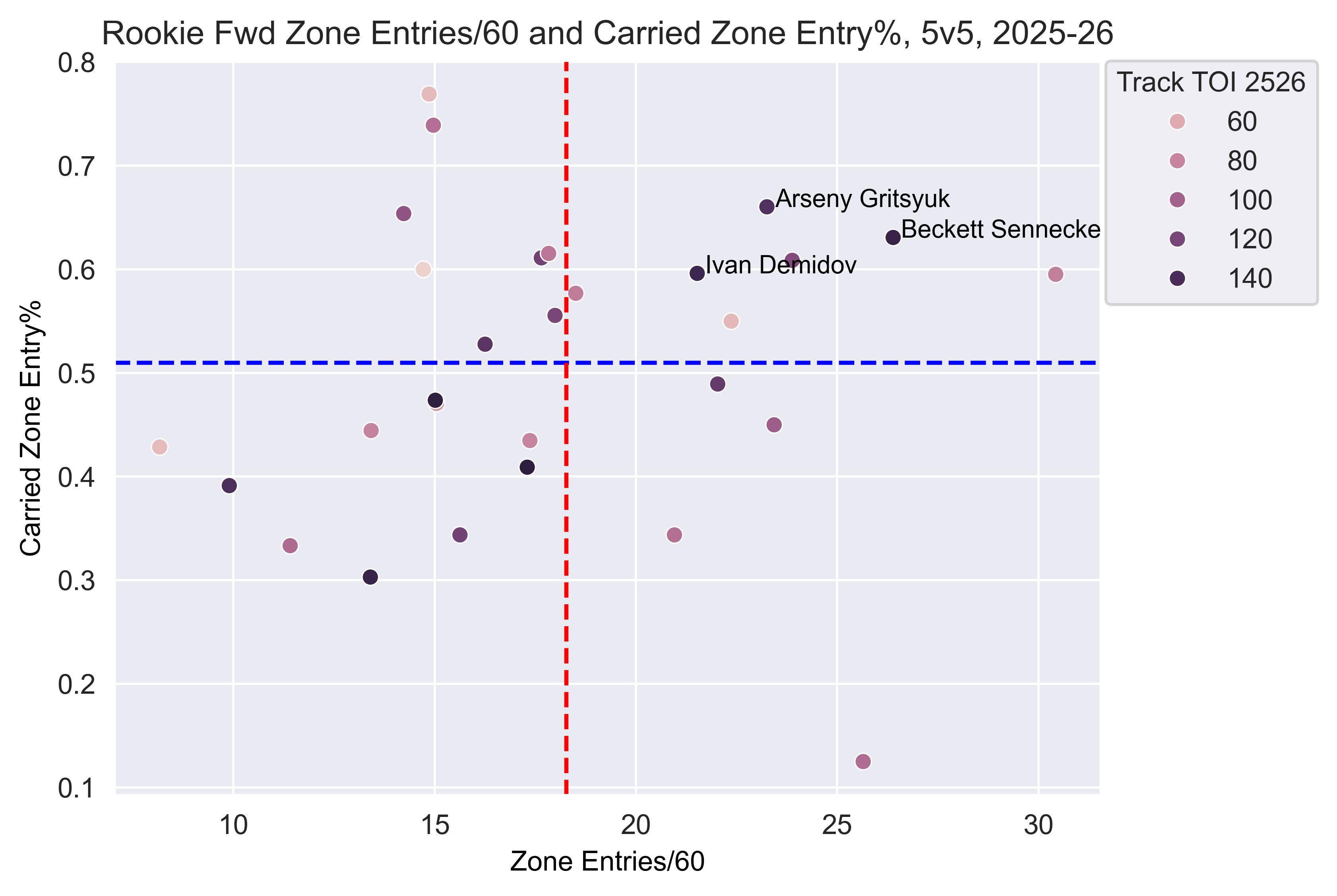
Gritsyuk also leads by shots per 60 minutes at 5-on-5, so there have been several positive aspects to his rookie season. The Devils may not be a contender this year, but if Gritstyuk continues to develop like this, they have a genuine top-6 scoring winger in the making.
6 – … What?
By far the worst carried zone entry percentage among all rookie forwards belongs to Dallas’ Justin Hryckowian. The curious part is that after Cowan and Sennecke, he has the third-highest rate of zone entries per 60 minutes:
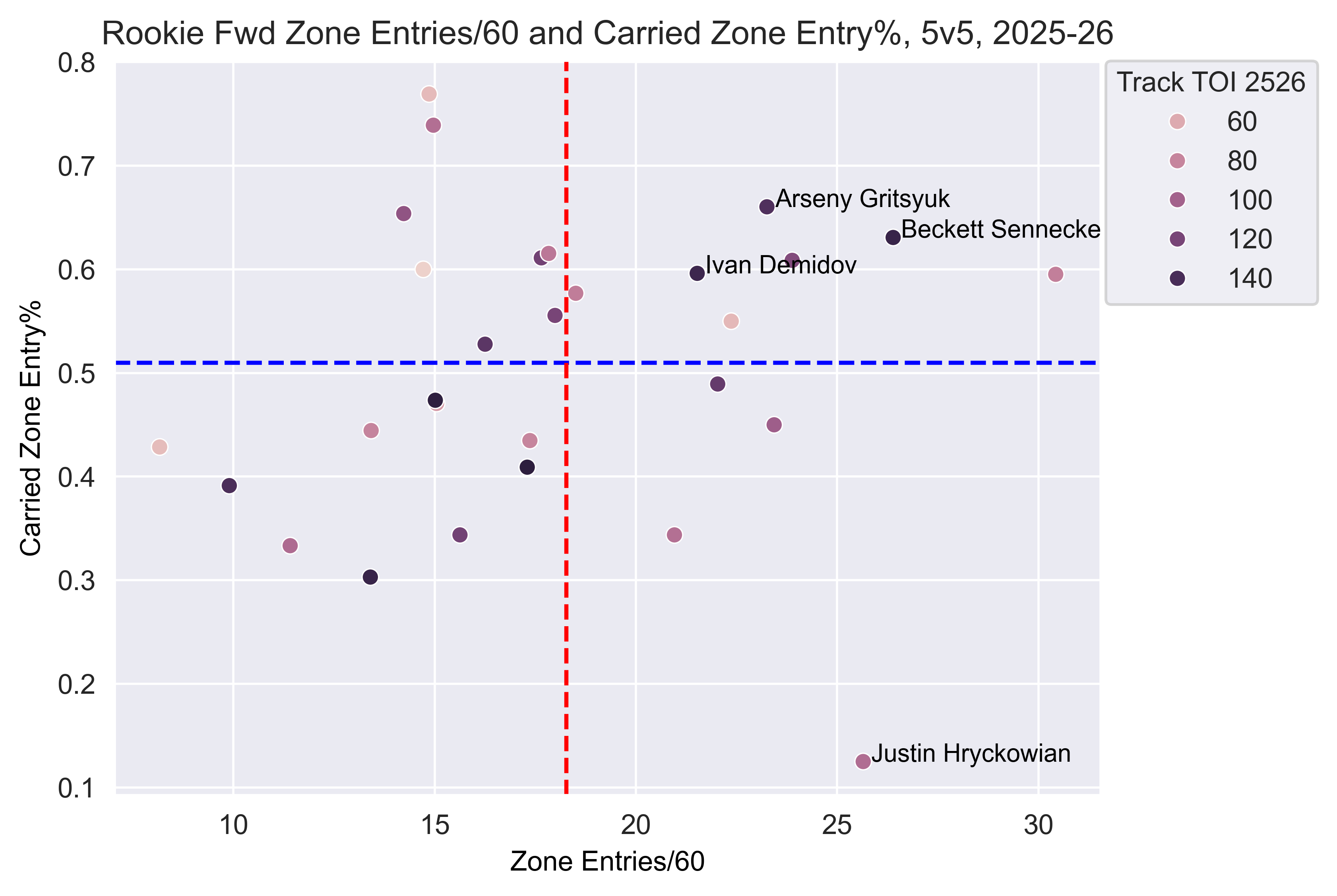
Dallas’ forwards carry the puck in less than 45% of the time and the league average is 51.7%, so this roster does not prioritize carrying the puck. However, a 12.5% carry rate is very low no matter the context, but that he loves to have the puck on his stick is a good sign. Lots of players can be successful dumping the puck in frequently (Toronto and Florida have done this for years), but given Hryckowian’s high entry rate, it would be nice to see some improvement on the carries the rest of the way.
7 – Where There’s a Wilsby, There’s a Waysby
Moving to the blue line, Nashville’s Adam Wilsby has nine assists at 5-on-5 this season. That is as many as Alex Nikishin (in nearly 200 fewer minutes) and two fewer than Matthew Schaefer (in 373 fewer minutes). It is for good reason as he’s been heavily involved in the rush offence and about average for rookie defencemen by cycle+forecheck offence:
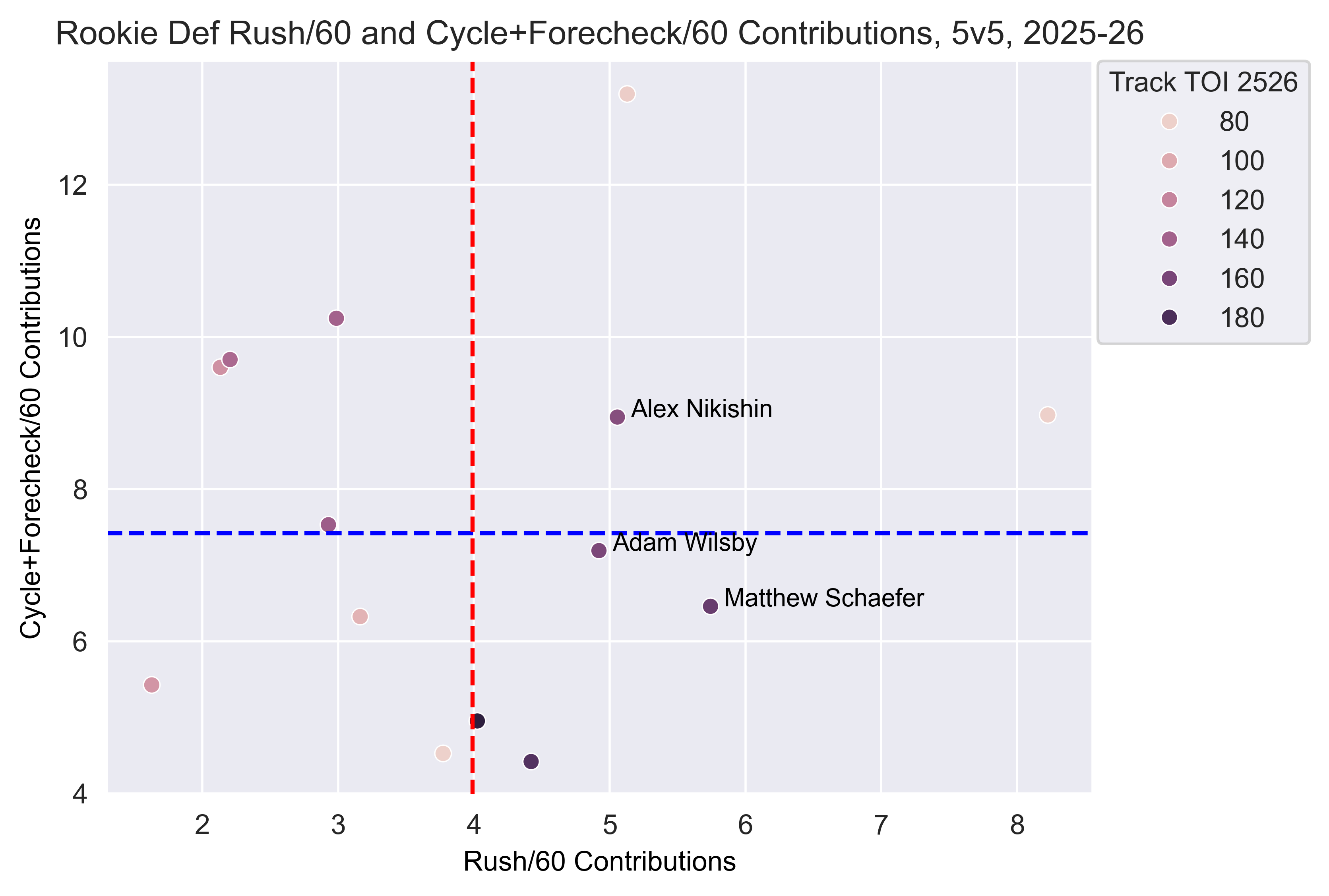
Wilsby is not a highly touted prospect and has just 44 points in his last 146 games in the AHL. He is not expected to be a productive offensive defenceman, but the numbers are what they are, so let’s see if he can finish the season strong.
8 – The Rinzler
At the outset of the season, Chicago defenceman Sam Rinzel was skating on the top PP unit with nearly 20 minutes a night overall. Suspect defensive play saw him demoted to the AHL, but there’s no denying that he’s been good offensively as he’s tied for the lead among rookie blue liners by points/60 minutes at 5-on-5, and his rate of chance assists and shot attempts are average-to-strong:
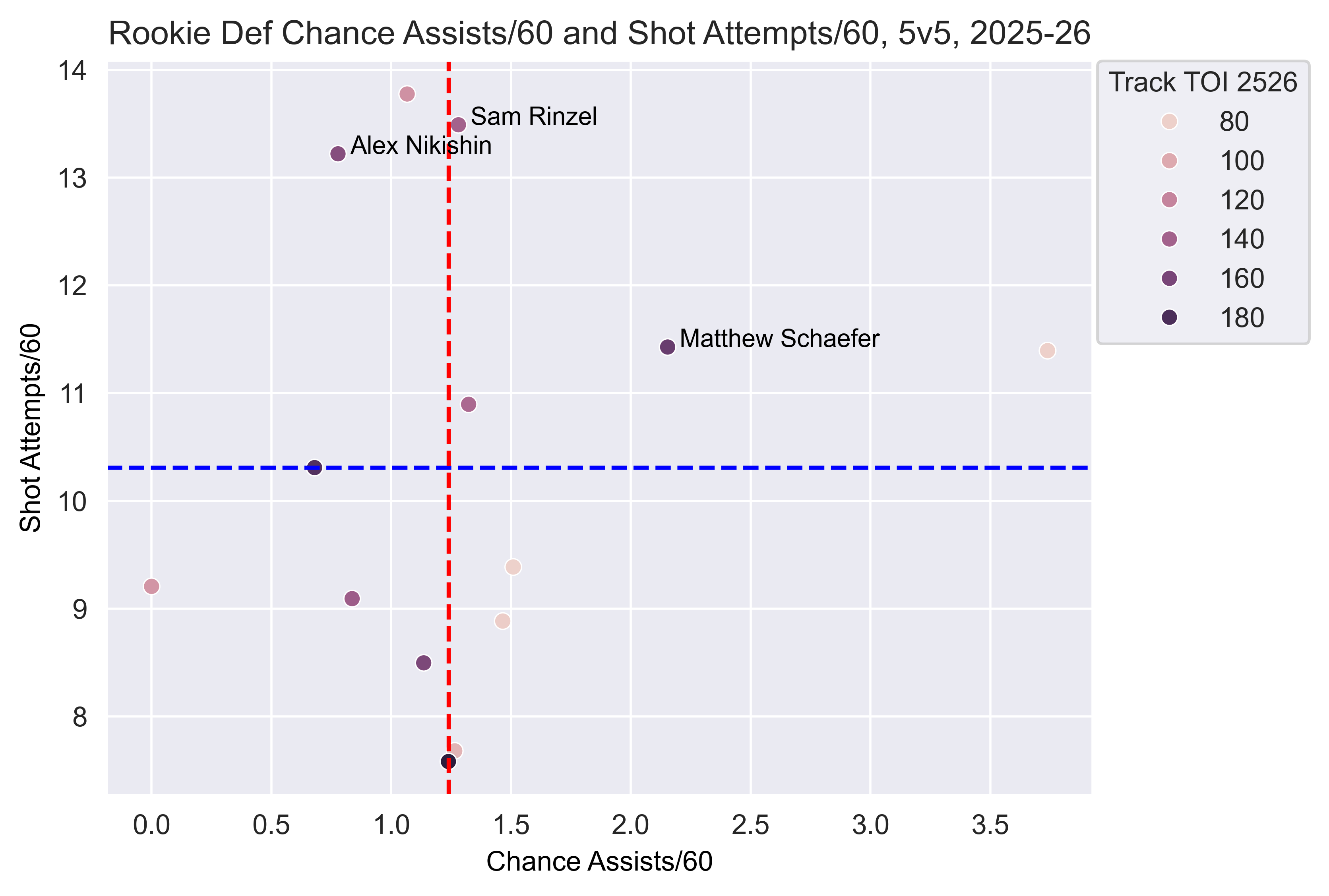
Rinzel was called up for a few games just before the break and skated 20-26 minutes in all three appearances. It is clear the Blackhawks believe in his upside, and he’s shown solid offensive skills so far.
9 – The Piece
Vancouver defenceman Zeev Buium was one of the centrepieces in the Quinn Hughes trade, and there have been subpar defensive results thus far. While the offensive results haven’t been great, either, he is heavily involved in the transition play when we look at entries and carried entry percentage:
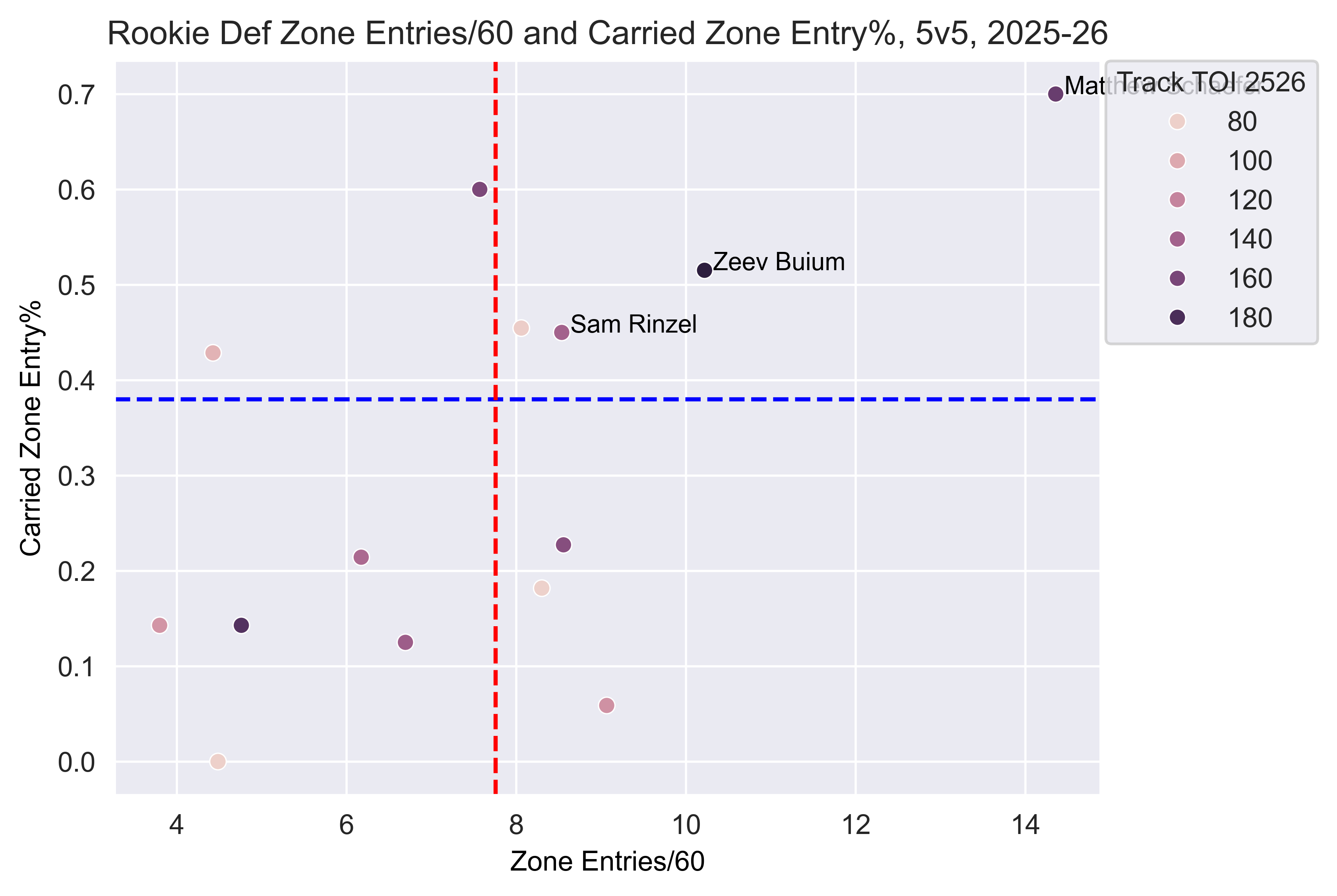
Way up in the top right is Matthew Schaefer in a league of his own, but Buium has been arguably the second-best rookie defenceman when it comes to zone entries. It’s just one piece of a profile, but an important one for an offensive rearguard, and a good start to Buium’s career, regardless of the on-ice results.
10 – Less is Moore
The sample for Anaheim defenceman Ian Moore isn’t large, so grain of salt and all that, but of our rookie defencemen, he has the fourth-lowest rate of combined botched defensive zone retrieval percentage and failed zone exit percentage. Add that to being above-average by total zone exits and entries per 60 minutes, and Moore is off to a good start:
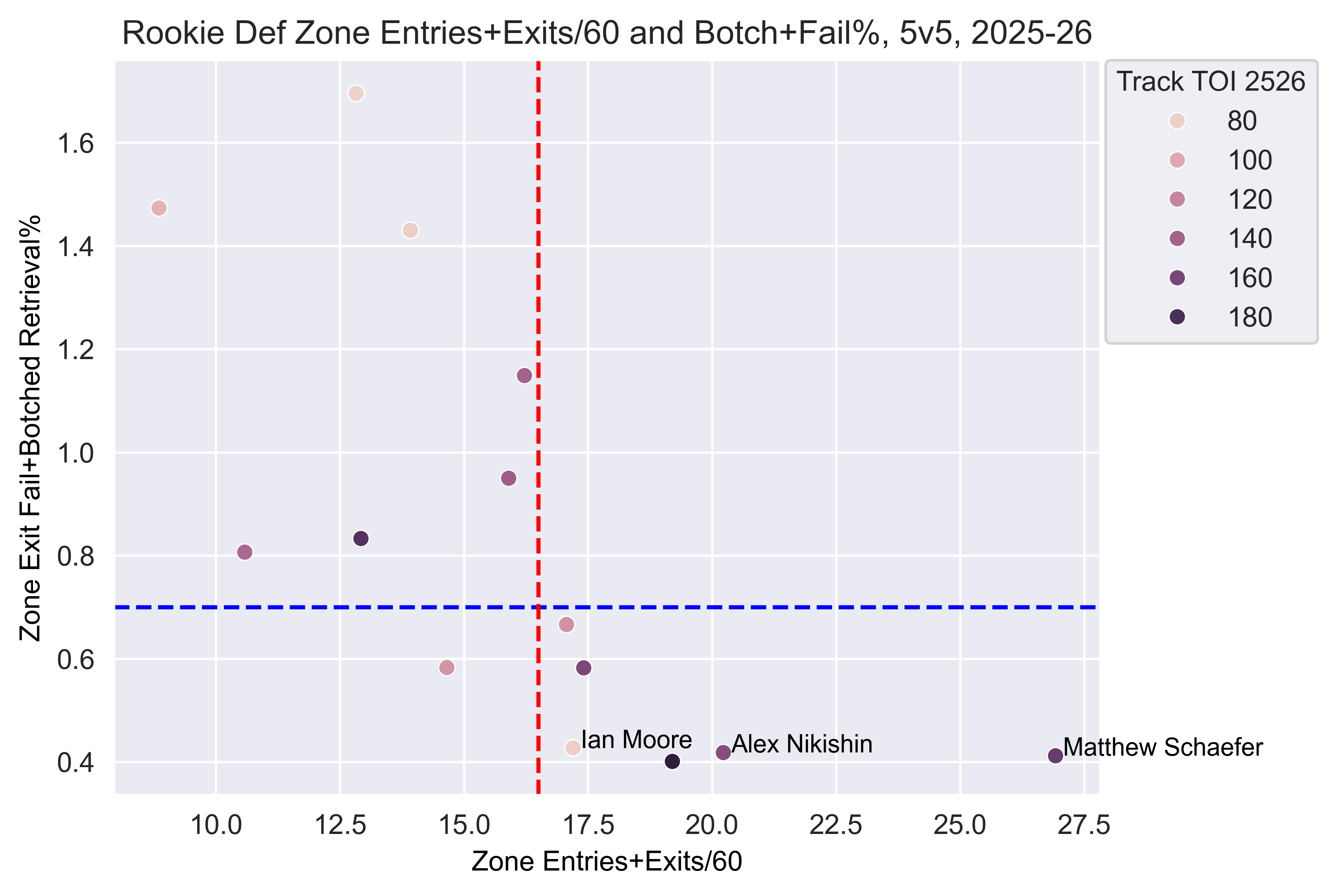
In 41 games, Moore leads all Anaheim defencemen by expected goal differential and has the lowest goals-against rate. He also has an above-average shot rate, so there is a lot of good here besides his transition work, but that is what stands out among his tracking data. He is another guy where we’ll see what the numbers look like when we get to the end of the season, but in his 41 games thus far, things look promising.
Until next week.