10 Interesting (To Me) Stats For This Week - May 12
Welcome back to another week of ’10 Interesting (To Me) Stats’ as we reach the mid-point of the second round of these NHL playoffs. In last week’s ’10 Stats’ column, we previewed one matchup from each team that could be a big factor in whether they proceed to the Conference Finals or not. This week, we are going to review those matchups to see how they’re going and what the effects have been.
Data is taken from Natural Stat Trick.
1 – Washington
The key to this series highlighted last week was Washington’s ability to create shots from high-danger areas at an excellent rate. Conversely, Carolina is a team that generally limits shots, but the ones they do give up were disproportionately of the high-danger variety.
That is indeed the case in the second round. Through three games, Washington has the lowest rate of shots per 60 minutes at 5-on-5 of any second-round team, but also has the highest percentage of shots from high-danger areas:

What is saving Carolina, quite literally, is goaltender Frederik Andersen. He has yet to allow a high-danger goal against at 5-on-5 in this series, stopping all 16 HD shots against. For reference, his save percentage on those shots in the regular season was .818. Andersen has been tremendous, which is both good for Carolina but also a warning sign of what can happen if he starts to regress a bit.
2 – Carolina
Last week, we discussed how Carolina’s Andrei Svechnikov was doing a great job boosting the 5-on-5 puck possession of every line he was on. That hasn’t been the case so far in the second round as he’s largely skated on the top line with Sebastian Aho and Carolina is basically breaking even by expected goal share at 5-on-5 with that duo on the ice:

The goals are in favour of Carolina with Aho/Svechnikov on the ice at plus-1, but as we just discussed, the Hurricanes are being bailed out frequently by their goaltender. If Carolina wants to start asserting themselves in this series, they need more from their top stars.
3 – Toronto
The question of how Toronto’s old fourth/new third line of Steven Lorentz-Scott Laughton-Calle Järnkrok would stack up against Florida’s depth was a key part of the matchup between the two teams. Suffice to say that things have not gone well as that trio has yet to be on the ice for a Toronto goal at 5-on-5 in the series, has been on for two goals against, and has been completely run over by shot attempt share and expected goal share:

With that trio off the ice, the Leafs are plus-3 (10 goals-for, 7 goals against) at 5-on-5. In a series where the four games have been decided by a total of five goals, every margin matters, and this Leafs line is a big problem for Toronto.
4 – Florida
The reason why Toronto’s bottom-6 forwards were so important to the series was because of Florida’s new third line of Brad Marchand-Anton Lundell-Eetu Luostarainen. That trio was plus-4 in the first round with a 55.5% expected goal share and plus-2 in 50 minutes together in the regular season. Toronto’s bottom-6 forwards would need to slow them down, and they haven’t really been able to yet as that Florida line is plus-2 at 5-on-5 with a good shot attempt share and great expected goal share:

This Florida line has four of the Panthers’ 14 goals in the series. If they keep finding the success they have been enjoying against the Leafs, then Toronto is in real trouble.
5 – Edmonton
The Edmonton Oilers, despite that brutal last-second loss on Saturday night, find themselves up 2-1 in their series against Vegas. What is especially curious about this is that Edmonton’s power play is just 1-for-7 in the matchup and the two games they won were games they failed to score with the man advantage. In fact, they are tied for the worst special team goal differential so far in the second round:
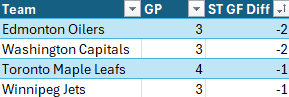
This is why Edmonton’s performance through the three second-round games is a double-edged sword. They have the series lead and have done so without much from their special teams. If that aspect can get going, it adds a much-needed dimension to the team. If it doesn’t? Well, they better hope their depth keeps producing as they have been.
6 – Vegas
The play of William Karlsson was highlighted last week, and he continues to be one of the bright spots for Vegas in the second round. Not only is the team plus-3 with him on the ice at 5-on-5 so far in their series against Edmonton, but the difference between the team’s goal share with him on the ice and with him off the ice is the largest of any forward in the second round:

Like Edmonton’s power play, Karlsson’s results at 5-on-5 are both great and disheartening for Vegas fans. It is awesome to see him have so much success in the postseason and factor heavily into their success, but it also demonstrates that this has pretty much been a one-man show at 5-on-5. They need more from everyone else on the roster or they’re going home.
7 – Dallas
With the return of Miro Heiskanen looming – he has been skating regularly for Dallas for a couple weeks now – it was uncertain what would happen with Dallas’s third pair, a pair that was very good in the first round. That stellar play has persisted through the first three games of Round 2, as the team is up 2-0 in goals for/against at 5-on-5 with the Alex Petrovic-Lian Bichsel duo on the ice, and has huge shot attempt and expected goal share numbers:

Petrovic even got on the scoreboard in Game 3 with a game-winning goal early in the third period. Over Dallas’s final 32 games of the regular season, all games without Heiskanen, the team was minus-9 at 5-on-5 with their top two defence pairs off the ice. In the playoffs, they are plus-1 with their top two defence pairs off the ice. What was a weakness is now a strength, and a lot of credit must be given to Petrovic and Bichsel.
8- Winnipeg
Keep in mind that Winnipeg started their series with Dallas with Josh Morrissey injured. That is why Dylan Samberg, a player highlighted last week as well as a few times this season, was going to be so important. Samberg was great in the first round, but things have not gone his way in the second round as he’s the only Winnipeg defenceman to appear in at least two games against Dallas and has yet to be on the ice for a Winnipeg goal at 5-on-5:
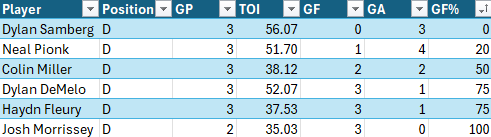
The underlying numbers for him and partner Neal Pionk aren’t awful, but this is the playoffs, and good results pay the bills. This pair needs better results from here on out if the Jets want to advance to the West Final.
9 – Steal The Rhythm While You Can, Walman
There have been a handful of impactful acquisitions from the trade deadline, but it is very much underrated just how important Jake Walman has been to Edmonton’s success. So far in the postseason, Edmonton has a plus-3 goal differential at 5-on-5 when Walman is on the ice without either of Connor McDavid or Leon Draisaitl. In the second round alone, that is plus-1. Compare that to how the Oilers fared with McDavid and Draisaitl off the ice in the regular season up until the trade deadline:

A returning Evander Kane has helped the middle-6 scoring, but Walman has helped drive results without Edmonton’s stars on the ice ever since the trade in early March. That has persisted in the playoffs and is a reason why the Oilers are finding success from their depth forwards.
10 – Revenge Tour
While Carolina has been struggling a bit defensively against Washington, the second pair of former Caps defenceman Dmitry Orlov and his partner Jalen Chatfield has been excellent for the Hurricanes. The goals are just 1-0 in their favour, but they are doing a great job of limiting quality shots against as they are boasting the lowest rate of expected goals against per 60 minutes at 5-on-5 of any of Carolina’s three defence pairs:

The Jaccob Slavin-Brent Burns pair has been very good, too, so it’s not just Orlov-Chatfield, but considering the struggles of the third pair, the team really needs Orlov-Chatfield to keep this up. If they can, it could be enough to stymy the Washington attack and get the Hurricanes to the East Final.
Until next week.