10 Interesting (To Me) Stats For This Week - February 10
Welcome back to another week of ’10 Interesting (To Me) Stats’! This week, we’re reviewing some unsung heroes of the 2025-26 season thus far. We are focusing on secondary forwards who’ve been difference-makers in the lesser roles they are given while their team’s stars get the headlines.
General player and team data is from Evolving Hockey while tracking data is from All Three Zones.
1 – Coll Me, Maybe
Of course, Macklin Celebrini is the MVP of the San Jose Sharks (and maybe of the league). However, that underrates what winger Collin Graf has done this season. By goal differential per 60 minutes relative to his teammates at even strength, and goals against rate per 60 minutes while short-handed, Graf ranks among some of the top players in the league:
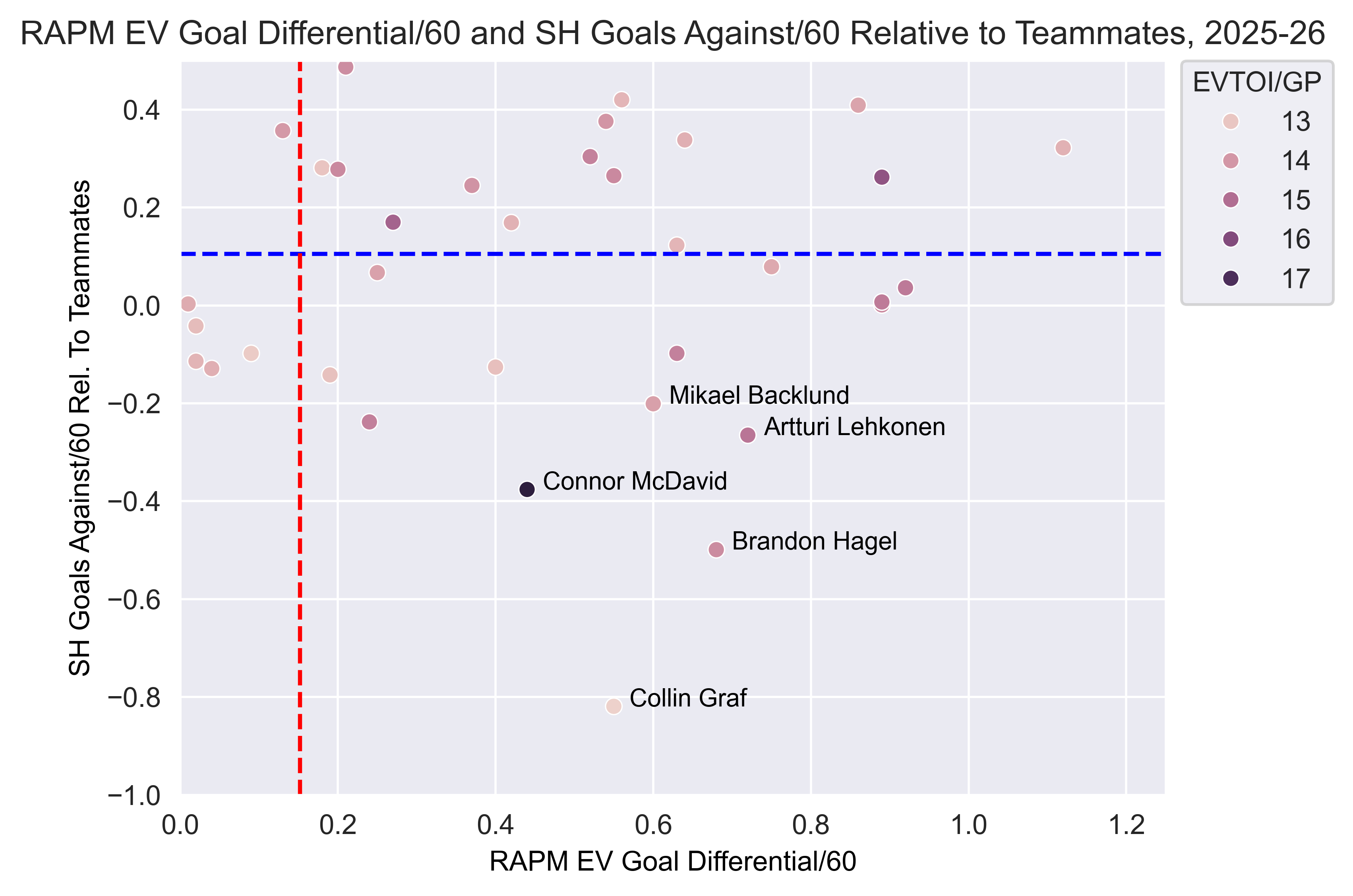
Included in that chart are players who’ve been skating top-6 minutes at even strength (roughly 12:45 per game or higher) with at least 60 minutes of short-handed ice time. Graf’s excellent penalty killing has been crucial for the Sharks (5.0 goals against/60 at 4-on-5 with nearly 30 more minutes than the next-closest Sharks forward), and with he and Celebrini on the ice at 5-on-5, the Sharks control over 60% of the goals (Celebrini’s goal and expected goal differentials all get worse without Graf on his wing). Playing all over the lineup with great penalty-killing contributions has made Graf a valuable part of the Sharks’ playoff push.
2 – Nailin’ Poehling
Part of the return in the Trevor Zegras trade was Ryan Poehling, who may have been an afterthought at the time, but has been vital to Anaheim’s success this season. Using the same EV/SH goal measures we just used for Graf, while also including how often a player’s shift starts in the defensive zone at even strength (colour of the dots), Poehling is in company with few others:
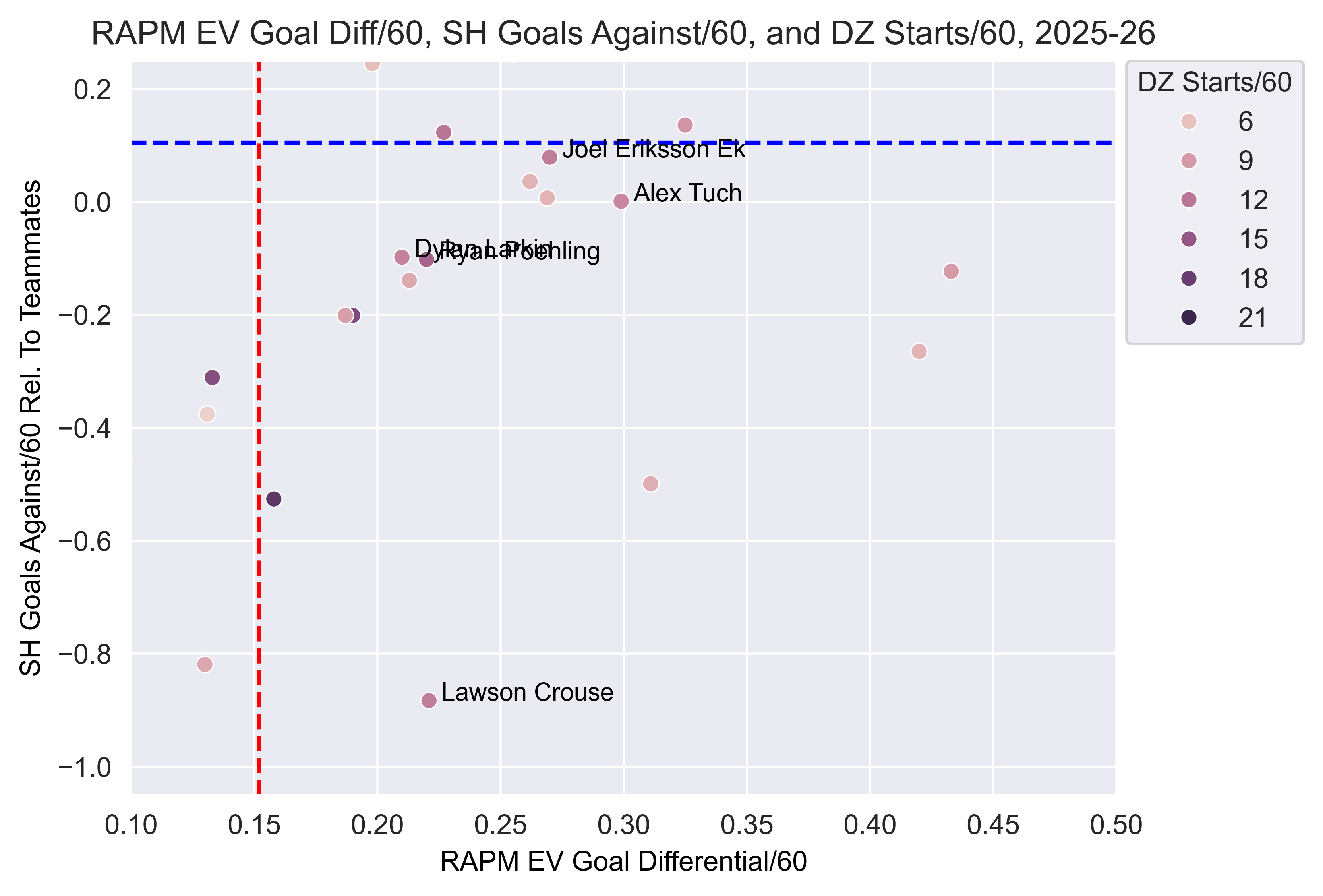
Poehling is the name overlapped with Dylan Larkin, we have a Utah Mammoth winger we’ll get to in a second, and then two top-6 skaters for playoff teams. Poehling eats a lot of the defensive responsibilities, allowing his offensive teammates to be put in better situations, and is succeeding.
3 – Better Than Marner?
The Utah Mammoth have several reasons for their success this season, but one is certainly Lawson Crouse, the winger who has been with the team for 10 years. Not only have his short-handed results been excellent by goals against, but his rate of primary points (goals and first assists) at 5-on-5 combined with those short-handed results put him in great company:
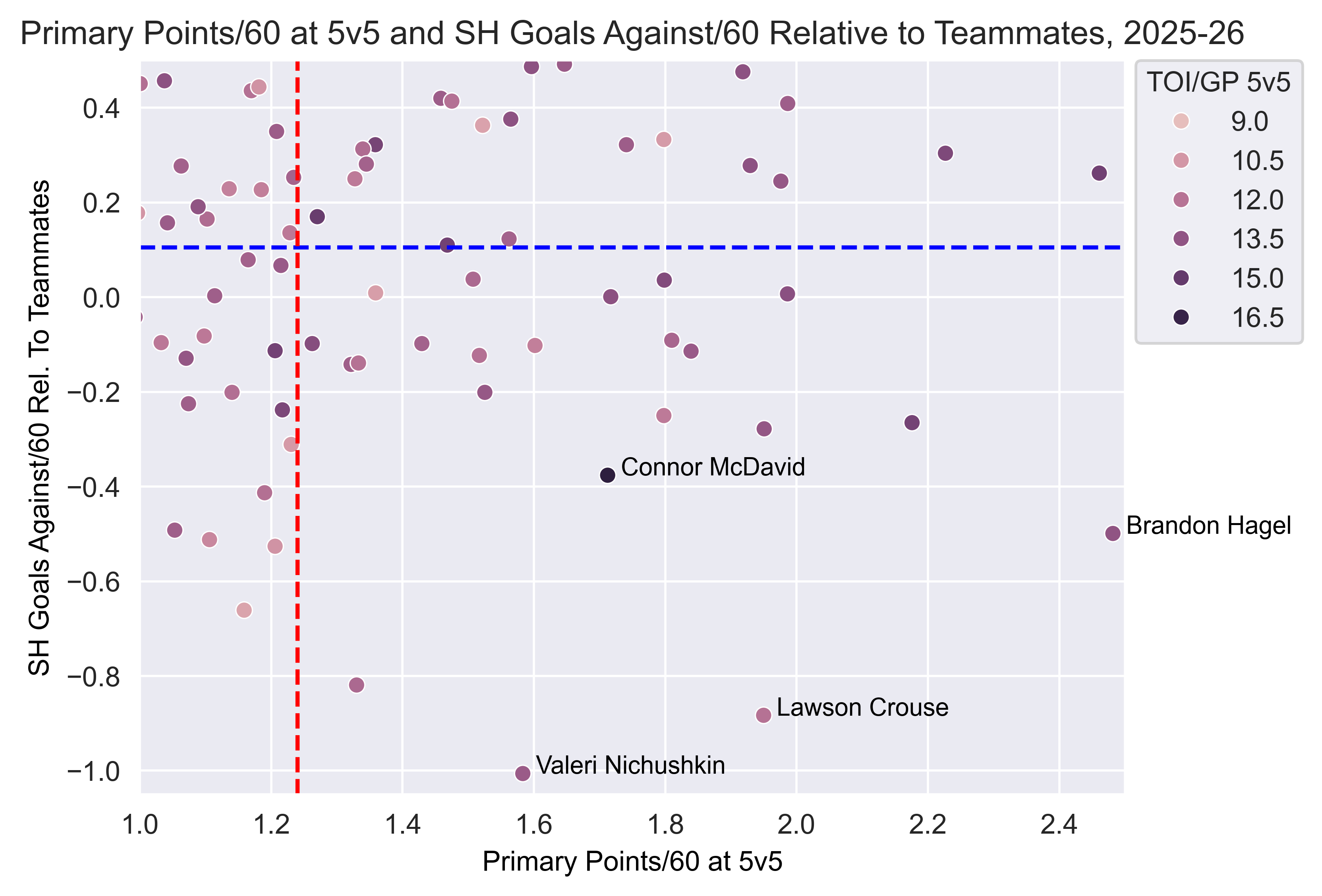
Whether skating on the top line or third line, Crouse has been able to produce at 5-on-5 and done so with tremendous penalty killing numbers. He is a big part of Utah’s forward depth that has helped the Mammoth thrive this season.
4 – Oli the First
Heading into the Olympic break, Montreal’s Oliver Kapanen is 1 of 3 rookies with at least 20 primary points at 5-on-5 (Kapanen has 20, teammate Ivan Demidov has 21, and Beckett Sennecke leads with 23). One thing that separates Kapanen is his work on the penalty kill, so let’s use the same short-handed and primary points parameters we just used for Crouse and apply them to Kapanen:
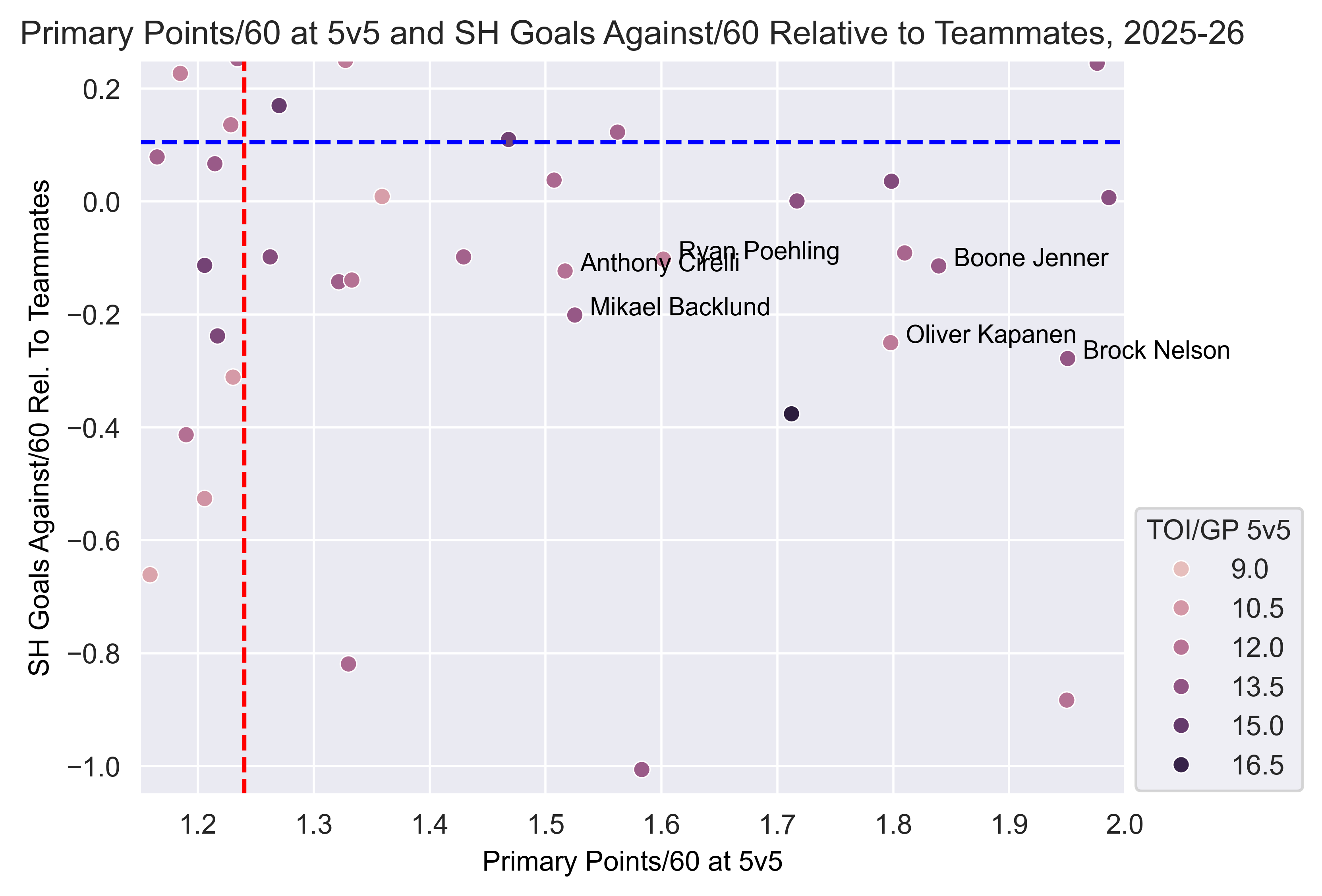
We’ve already gone over Poehling, and the other four names are all top-6 centres for their respective teams with a couple are among the best two-way centres in the league. Kapanen’s goal-scoring has been aided by skating with Demidov, but his short-handed contributions cannot be overlooked in his stellar rookie campaign.
5 – Oli the Second
Columbus’ Mathieu Olivier may have only been known for his fighting prowess a few years ago, but a breakout 2024-25 season has been followed up with a very good 2025-26 season. Here are all the players at least one standard deviation (top ~16%) above average by even strength goal, and expected goal, differential per 60 minutes with at least a 50% defensive zone start rate:
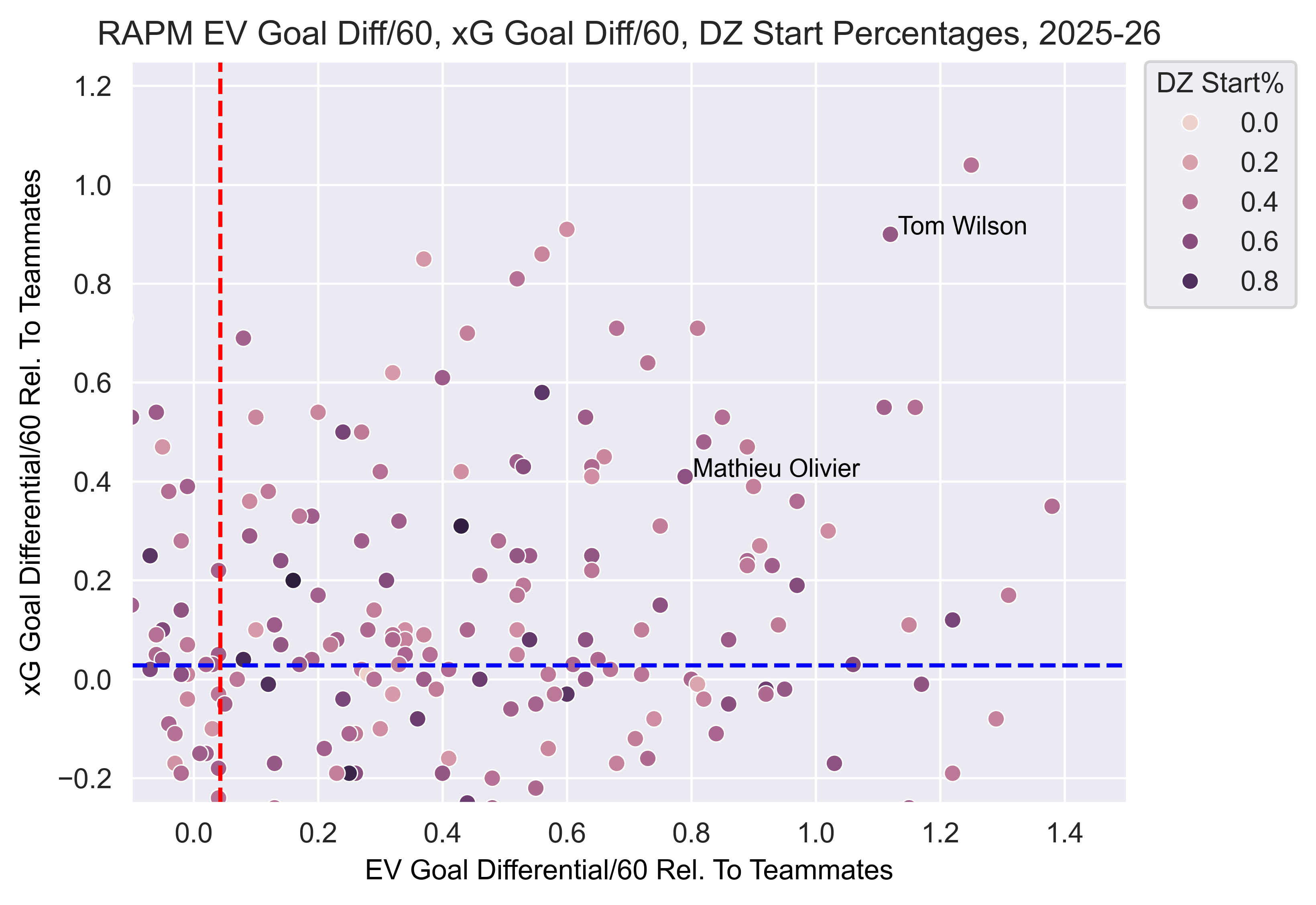
The other name on that chart is heading to the Olympics as part of an elite forward group. Olivier isn’t on the level of Tom Wilson, but Olivier has been a tremendous depth forward for the Blue Jackets, absorbing a lot of defensive responsibility and thriving all the same.
6 – Back Again
New York Islanders centre Bo Horvat missed five games just before Christmas and nine games in January. In those 14 games, the Islanders went 7-5-2, nine of those 14 games came on the road, and included wins over Tampa Bay, Minnesota, and Edmonton. In those 14 games, here is how the Islanders fared by goal (GF%) and shot attempt (CF%) share at 5-on-5 with and without Barzal on the ice:
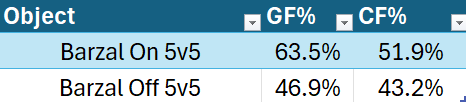
Overall, New York outscored the opposition 23-12 with Barzal on the ice in those 14 games while he posted 16 points. Ilya Sorokin’s play obviously helps here, but he was also in net when Barzal wasn’t on the ice, and we see the poor results that followed. Barzal’s performance in that 14-game stretch is probably the difference between the Islanders being in or being out a of playoff spot right now.
7 – Kindel Surprise
Just staying in the NHL as an 18-year-old drafted outside the top-10 picks is one thing. Scoring at a middle-6 rate at 5-on-5 is another. For the Pittsburgh Penguins to use rookie Ben Kindel as they have is something else entirely. Going back to 2007, here are all the 18-year-old rookies to score at a middle-6 rate at 5-on-5, skate at least 30 minutes of short-handed ice time, and at least 100 minutes on the power play:

Scoring as he has at 5-on-5, while also being regularly used both on the power play and penalty kill, is an obscenely valuable rookie season. Many skaters from the Penguins are having resurgent years, but there may be no more unique and surprising season in the league than Kindel’s.
8 – Making a Mint
Like Pittsburgh, Boston has seen a big turnaround compared to their 2024-25 season and one reason has been the great play from Fraser Minten. In his first full season, he has had excellent results by goals for and against at even strength, as well as good expected goal differentials. In fact, here is he who he compares to by those measures using Evolving Hocke’s Rate Adjusted Plus/Minus:
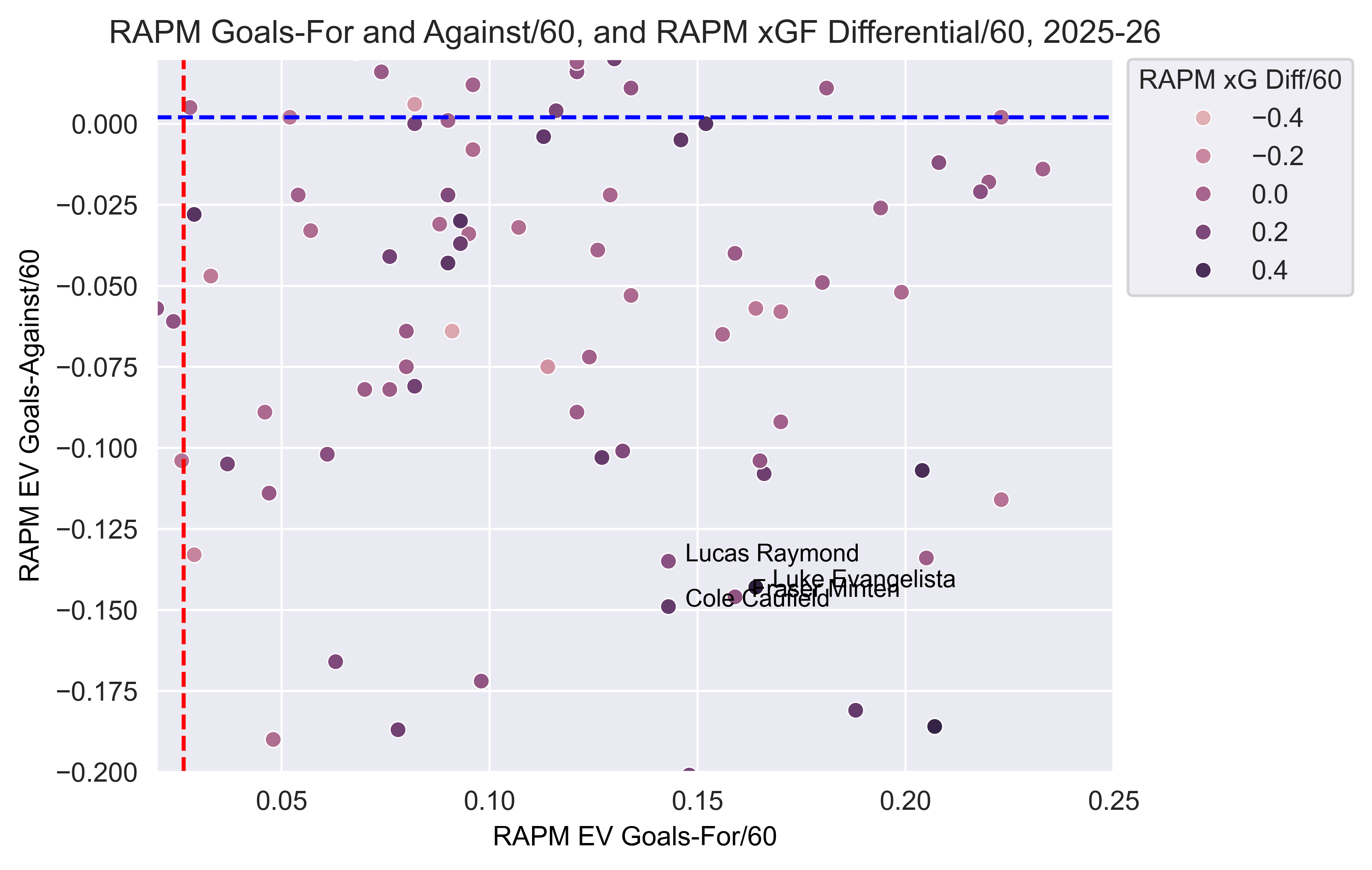
Those names overlapped with Minten are Luke Evangelista, Lucas Raymond, and Cole Caufield. Minten being put into that category with even strength play at both ends of the ice explains why he’s been such a valuable forward for the Bruins, and he’s been getting a bigger role over the last couple of months because of it.
9 – I Was Saying Luuuuke-urns
Let’s write about Luke Evangelista again, because his 2025-26 season has been absolutely preposterous. As in, if he keeps this up over the final third of the season, he’ll have one of the best even-strength seasons in the last 20 years. Going back to 2007, by RAPM goal and expected goal differentials per 60 minutes, here’s who he compares to:
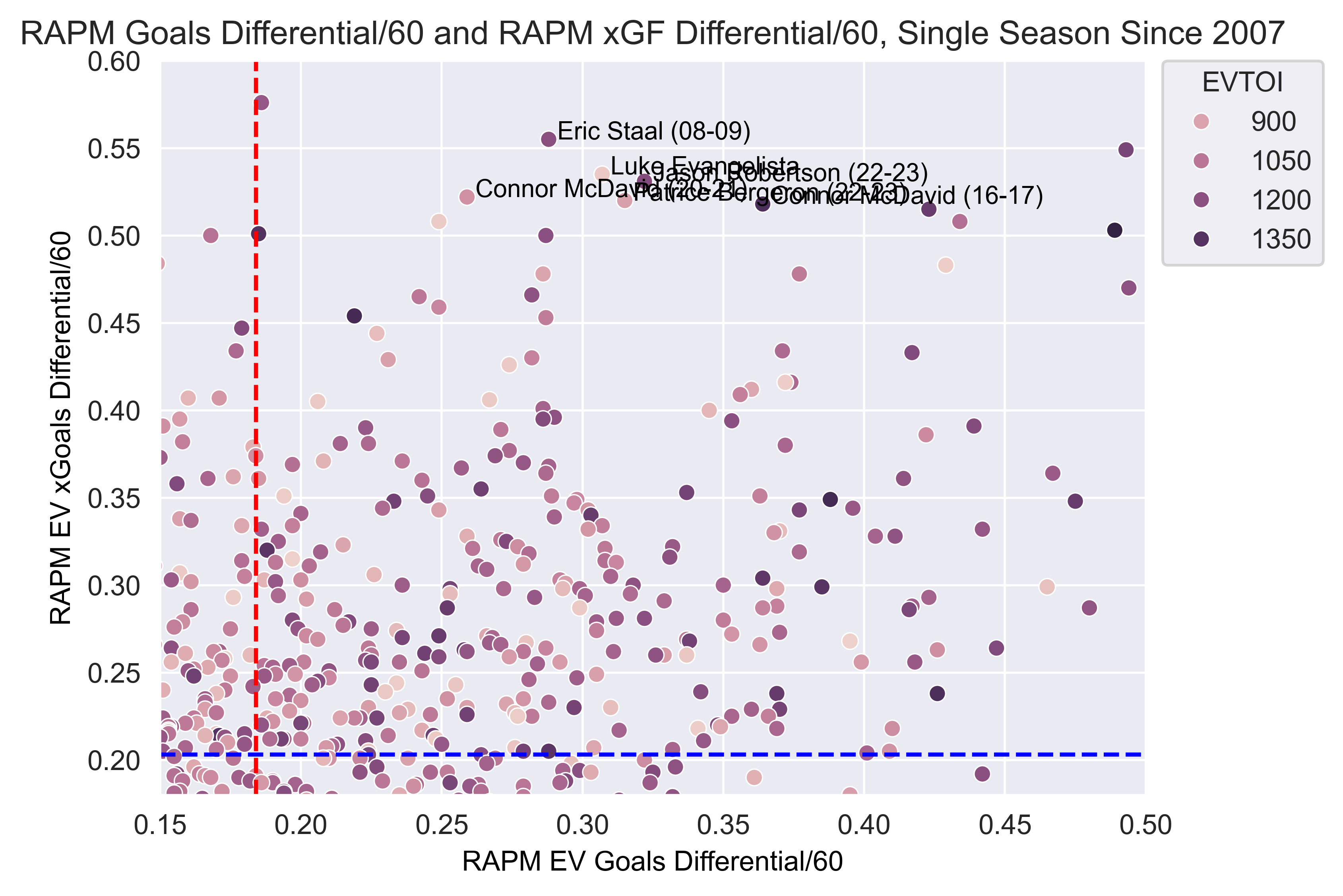
That is two seasons from Connor McDavid, Eric Staal in his prime, and two recent seasons from Jason Robertson and Patrice Bergeron. That is the company that Evangelista finds himself in with his even-strength performance. After steady improvements each season, this one looks like the origins of a superstar.
10 – Yakety Sax
The top of the Minnesota Wild lineup is having a great year, but we can’t overlook what Yakov Trenin has done. He has started over 65% of his shifts in the defensive zone, and has excellent RAPM goal and expected goal differentials at even strength – this is whom he compares to by those three measures:
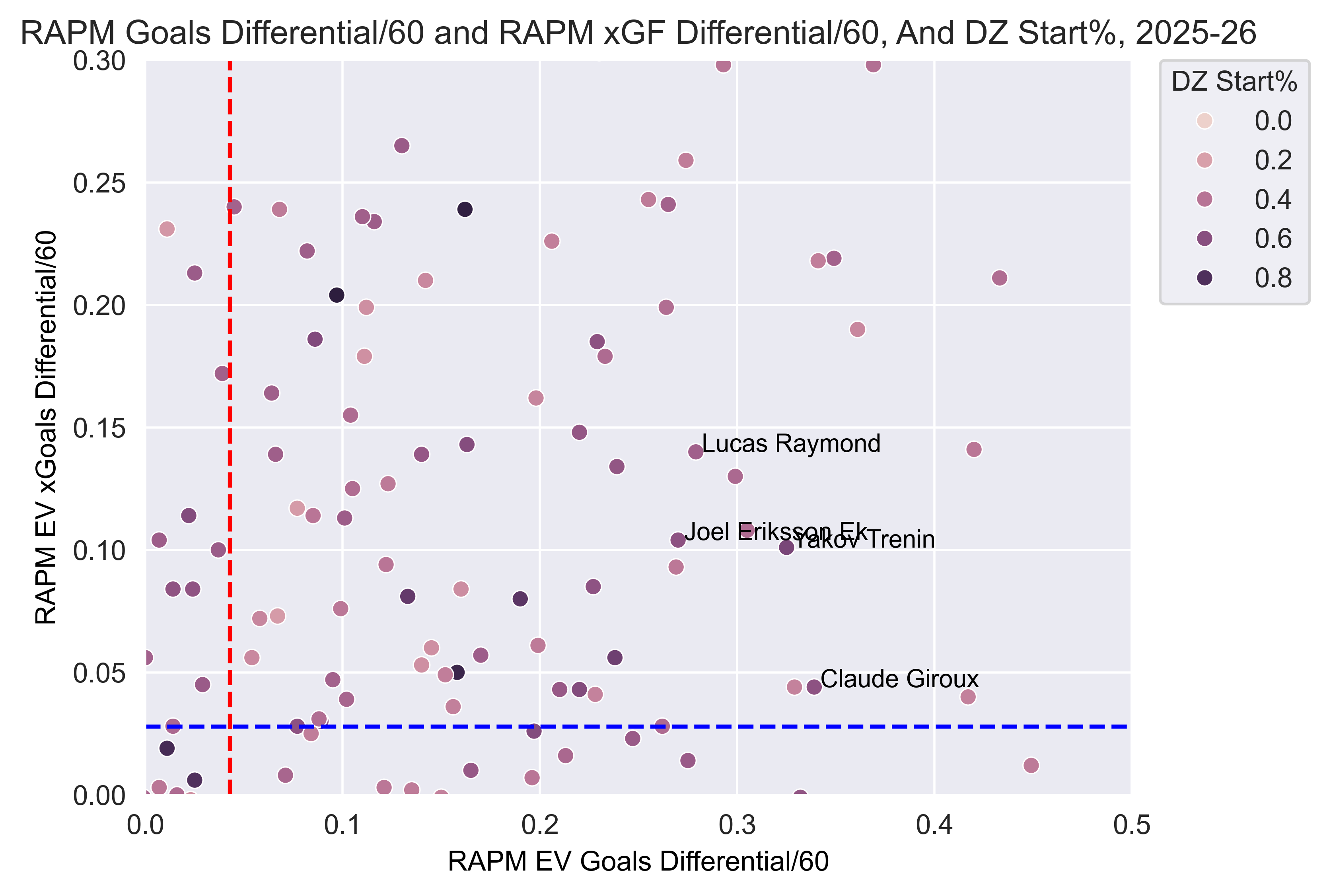
We see teammate Joel Eriksson Ek, an elite top winger from Detroit, and Ottawa’s steadiest two-way winger. Trenin may not put up the stats that his superstar teammates do, but he’s taking a lot of defensive responsibilities and having excellent results in those minutes. That kind of depth is critical for a team pushing for a Stanley Cup.
Until next week.