10 Interesting (To Me) Stats For This Week - June 24
Welcome back for another week of ’10 Interesting Stats’. It is a big week in the NHL as it’s the first full week of the offseason and free agency is looming. Before that starts, we have the Entry Draft taking place this weekend, so it’s worth digging into the draft, prospects in general, and player development. We are going to have five general points about drafting and prospects before digging into this year’s group, specifically.
Note: I am not a scout, nor someone who grinds prospect tape. I have a few sources I trust for analysis, I watch things like the World Juniors, Memorial Cup, and Frozen Four, but my focus is on the NHL. So, take the prospect portion with a grain of salt.
1 – Old Dog, New Curve
For years, the common wisdom with how players aged in the NHL was that a player would peak around 24-25 years old before hitting their downswing. The decline would be very slow through the end of their 20s and then accelerate in their 30s.
More recently, Dom Luszczyszyn of The Athletic found that a player’s peak extends to their age-27 season before declining a bit up to 29 years old and then the drop got worse from there. That holds true when looking at Evolving Hockey’s Goals Above Replacement model. Over the last four seasons, players who had at least one game in the NHL between the age of 18-22 and also had at least one game between 23-29 years of age saw an improvement of nearly 16%:

Because we’re only looking at four years, we don’t have seasons of players in their late 20s, but the general idea holds that as good as players are at 18-21 years old, they rarely hit their stride until their mid-20s. Keep that in mind before getting too excited about your favourite prospect.
2 – Know Your Worth
Our understanding about the value of draft picks – what is the 1st overall pick worth vs. 22nd overall, for example – has evolved a lot. Staying with Luszczyszyn’s work, five years ago he looked at draft pick value based on draft slotting. By his old player value model of Game Score Value Added, here is a table of draft picks equivalent to a typical 4th overall pick:
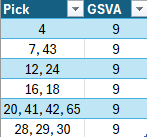
Remember that we aren’t even comparing to a top-3 pick (by these estimates, 1st overall is about twice as valuable as 4th overall). So, just 4th overall is worth two picks in the mid-teens or three picks towards the end of the first round. Just something to keep in mind when teams make trades that include first-round picks.
3 – It’s Just a Start
Fans get very excited about drafts and while they are important, it is just one component of roster building. Hockey Prospecting keeps track of all players drafted and how many of those players turn into NHL regulars. Between the 2011 and 2021 seasons, the top three teams by percentage of skaters drafted turning into NHL regulars are Columbus, Anaheim, and Buffalo:
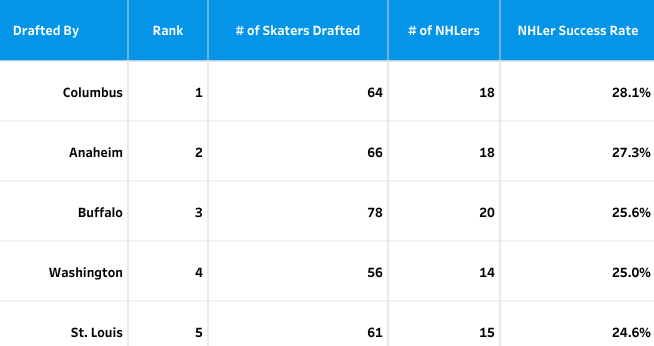
Since 2012, the year after the first draft in the sample, those three teams have combined for 49 playoff wins; there are 13 individual franchises with more in that span. The top-5 in that graphic is rounded out with Washington and St. Louis to highlight that yes, Stanley Cup winners also need to draft well, but drafting well is far from a guarantee of franchise success.
4 – Long Way to Go
To build off the aging curves mentioned earlier, over the last four Cup Finals, there have just been four instances of a player being under 22 years old, that player’s team reaching the Final, and that player having a regular role:

Alex Newhook was part of the 2022 Colorado roster that won it all but played just 12 games. Even if we add him, that makes four players across four years and eight rosters. Being a productive regular season player at 20 years old is nice but doing that in the playoffs is a whole other ballgame.
5 – On the Horizon
Keeping on the theme of needing time to develop, that goes for entire franchises, too. Analyst David Johnson had a post recently to this effect and he’s been consistent in saying teams need at least five years, if not up to eight, for their rebuild to really hit its peak. That makes sense when we think of players peaking between the ages of 23-29.
In the point above, we looked at players under the age of 22. What if we expand that to just 25 years old? Here are the total number of players under the age of 25 who appeared in the Cup Final in the last four years, separating the Cup-winning roster from the runner-up:
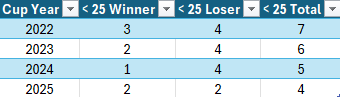
No team making it to the Final in the last four years had more than four players under the age of 25 appear in the Cup Final, and the last four Cup winners had no more than three (Samuel Girard would have made four during Colorado’s 2022 run but got hurt during the postseason). Again, there is a long time between a core being drafted and the roster being ready for a deep playoff run.
6 – Clear #1
Whether looking at Elite Prospects, TSN, The Athletic, Dobber Prospects, McKeen’s Hockey, or most other rankings, defenceman Matthew Schaefer is at the top, and the player he is often compared to is Ottawa defenceman Jake Sanderson. It is noteworthy because according to Hockey Prospecting, Schaefer has a much higher draft-year (D0) chance of being both a full-time NHLer (at least 200 career games) and a star producer (career 0.45 points/game):
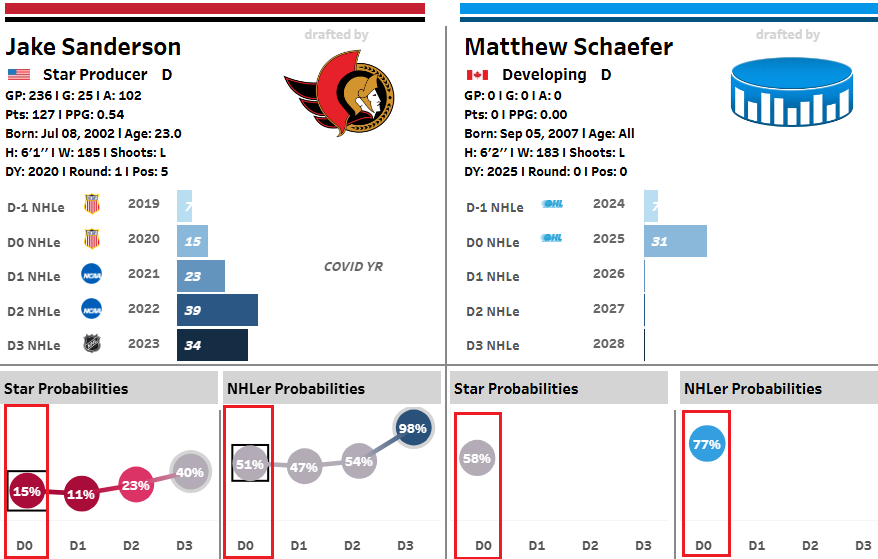
Schaefer is likely going to the New York Islanders, and they have five NHL defencemen signed, as well as Noah Dobson, Alex Romanov, Scott Perunovich as RFAs and Tony DeAngelo as a UFA. Even as a first overall pick, Schaefer probably spends another year playing Junior hockey.
7 – There’s Some Good in This World, Mr. Frondell
If there’s a divisive player at the top of many draft boards, it’s forward Anton Frondell. There are some spots that have him in the 3-5 range overall, some have him in the 6-10 range, and some have him outside the top-10. A physical shooting centre with good defensive ability, Hockey Prospecting has him with an 89% chance of being a star producer and a 99% chance of a being a full-time NHLer. From 2013-2023, here are the drafted forwards that Hockey Prospecting had with between a 70-90% chance of being a star producer:
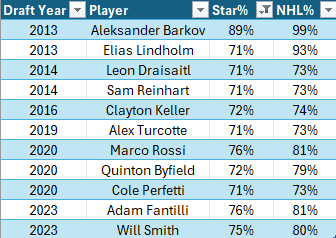
There is one miss in there so far (Alex Turcotte), a few middle-6 options (Elias Lindholm, Marco Rossi, Cole Perfetti), and a couple rising stars (Adam Fantilli, Will Smith). Nearly half the list is made up of genuine top-line forwards, though, and Fantilli/Smith could join them. That seems like a bet a team drafting outside the top-5 should take if Frondell falls that far.
8 – It Means ‘Some Noyers’
Caleb Desnoyers is a 6’2” centre who is stellar defensively, plays well below the dots, and has very good playmaking skills. Those are traits that teams crave in a centre, and he finished his 2024-25 QMJHL season with 1.5 points per game. This century, there have been three centres to manage 1.5 points per game as a 17-year-old in the QMJHL:
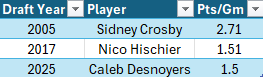
It is safe to exclude Sidney Crosby from this conversation, but it is interesting to see Nico Hischier here because he’s the NHLer The Athletic’s Corey Pronman compared him to. That makes sense, as a defensively responsible playmaking centre, but it also speaks to the kind of upside Desnoyers has.
9 – Holy Schmidt
Part of my draft process is basically this meme:

Standing 5’7, forward Cameron Schmidt is a small player. However, he has great skating and shooting skills while being a competent playmaker. Both his 40 goals and 78 points led a Vancouver Giants team that was 9th out of 22 WHL teams in scoring. That type of scoring profile compares well to a prospect that went 6th overall in the 2024 Draft:

The difference is Schmidt is five inches shorter than Tij Iginla, and no forward in the 2025 NHL playoffs was listed shorter than 5’8. Being that small is a problem, but if Schmidt can add a couple inches, there could be a scoring gem for teams in the second round.
10 – Our Boy The Zubek
NHL Central Scouting has Slovakian defenceman Patryk Zubek ranked 130th among European prospects only, so he may not even get drafted in 2025. However, he’s the only defenceman in the history of the Under-20 Slovakian League to average at least a point per game, he is listed at 6’3 and over 200 lbs., and one of his top Hockey Prospecting draft-year comparable players is a guy who, at his best, was one of the top offensive defencemen in the NHL:
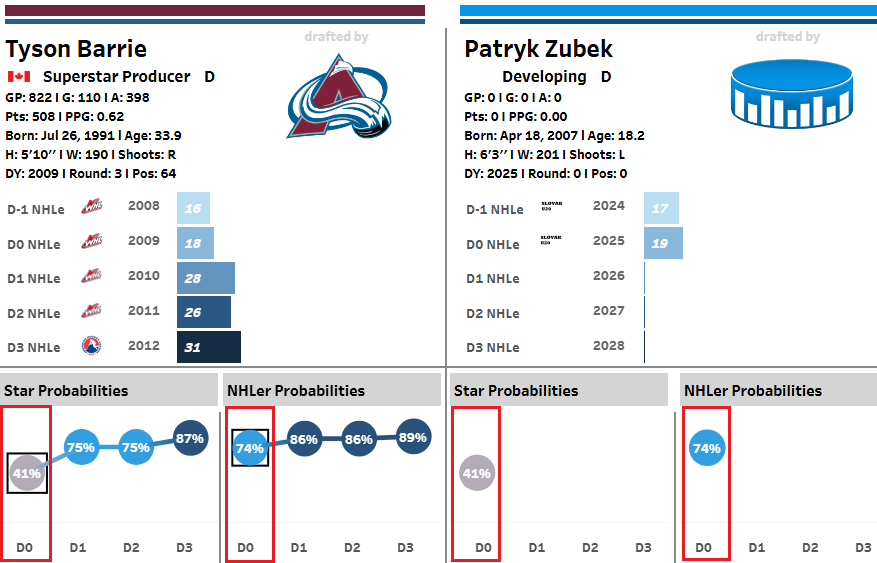
I know nothing about this player. Most prospect lists don’t even have him ranked. But if I see a defenceman produce at an historic rate in his home league, standing 6’3, and models like this have him with a reasonable shot at being an NHLer, he’s a player I grab in the sixth or seventh round as a lottery ticket.
Until next week.