10 Interesting (To Me) Stats For This Week - January 6
Welcome back to another week of ’10 Interesting Stats’. This week, we’re looking at player efficiency. Specifically, we’re looking at the shot attempts a team creates with a given forward on the ice, the tracked scoring chance contributions (individual chances plus assists on teammate scoring chances, or SCC/60 minutes) of that player, and who contributes the most scoring chances with below-average rates of team shot attempts. This goes back to the start of the 2024-25 season, limiting our sample to forwards with at least 250 tracked minutes, and it’s all at 5-on-5.
Team data is from Evolving Hockey, tracking data is from All Three Zones, and it’s current as of the morning of January 4th.
1 – What Does it Matter?
Just so we’re not wasting time here, we should see if scoring chance contributions matter for goal scoring. To do that, we are taking our sample of forwards and seeing if there’s a correlation between the player’s SCC/60 rate and the goals-for/60 of their team with that player on the ice:
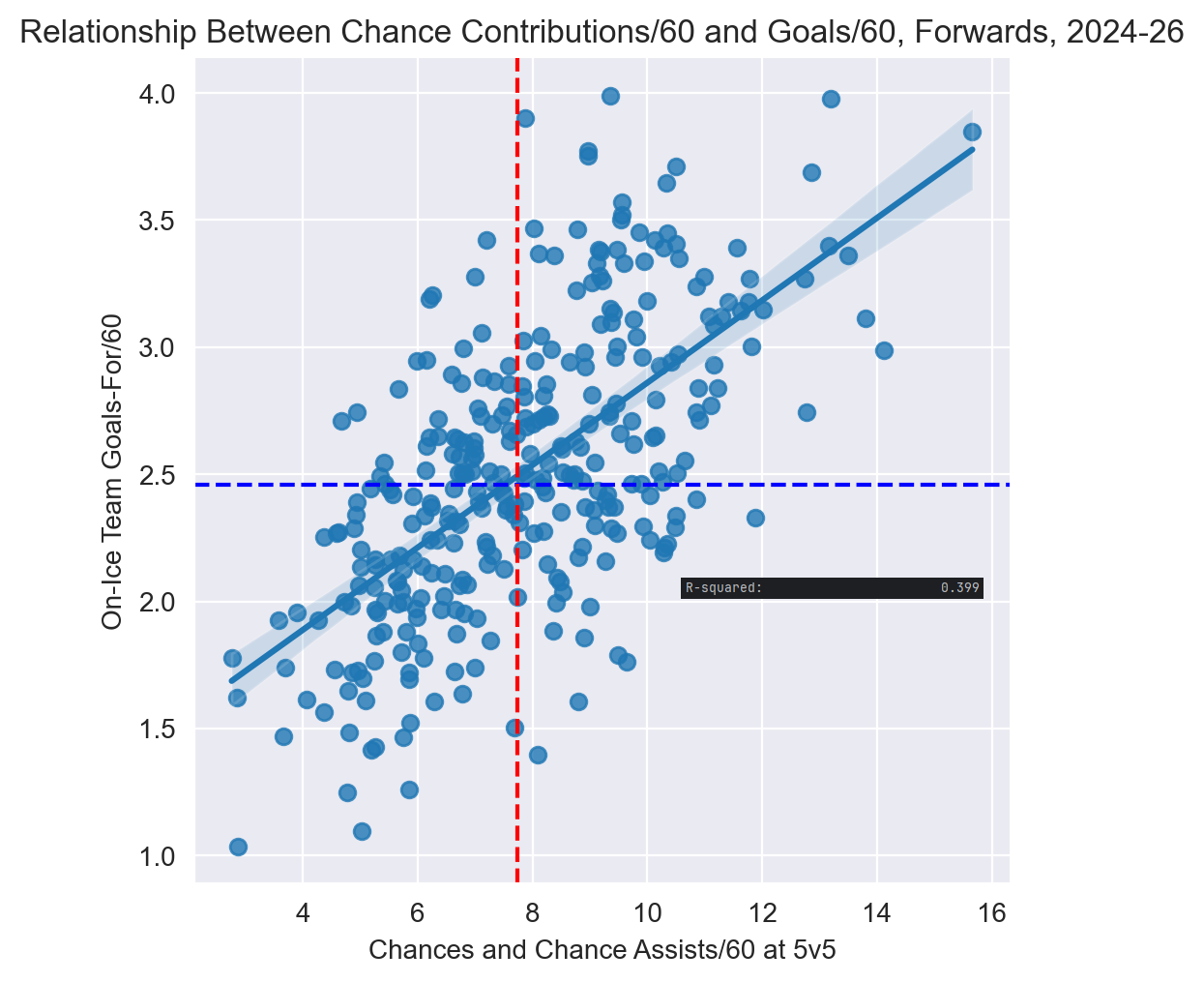
In short, yes, there is a strong correlation (especially for anything in hockey) between a forward’s SCC/60 rate and their team’s goal rate with them on the ice at 5-on-5. Being able to contribute to a lot of chances tends to lead to a higher goal-scoring rate, so we want to focus on players contributing a lot of chances.
2 – The Gold Standard
The impetus for this column was San Jose’s Macklin Celebrini. We all know how well he’s producing, but the reality is he’s doing it in a way no other forward is. Below is where Celebrini stands by SCC/60 and team shot attempts per SCC/60 (lower numbers are the more efficient forwards) while having a below-average rate of team shot attempts:
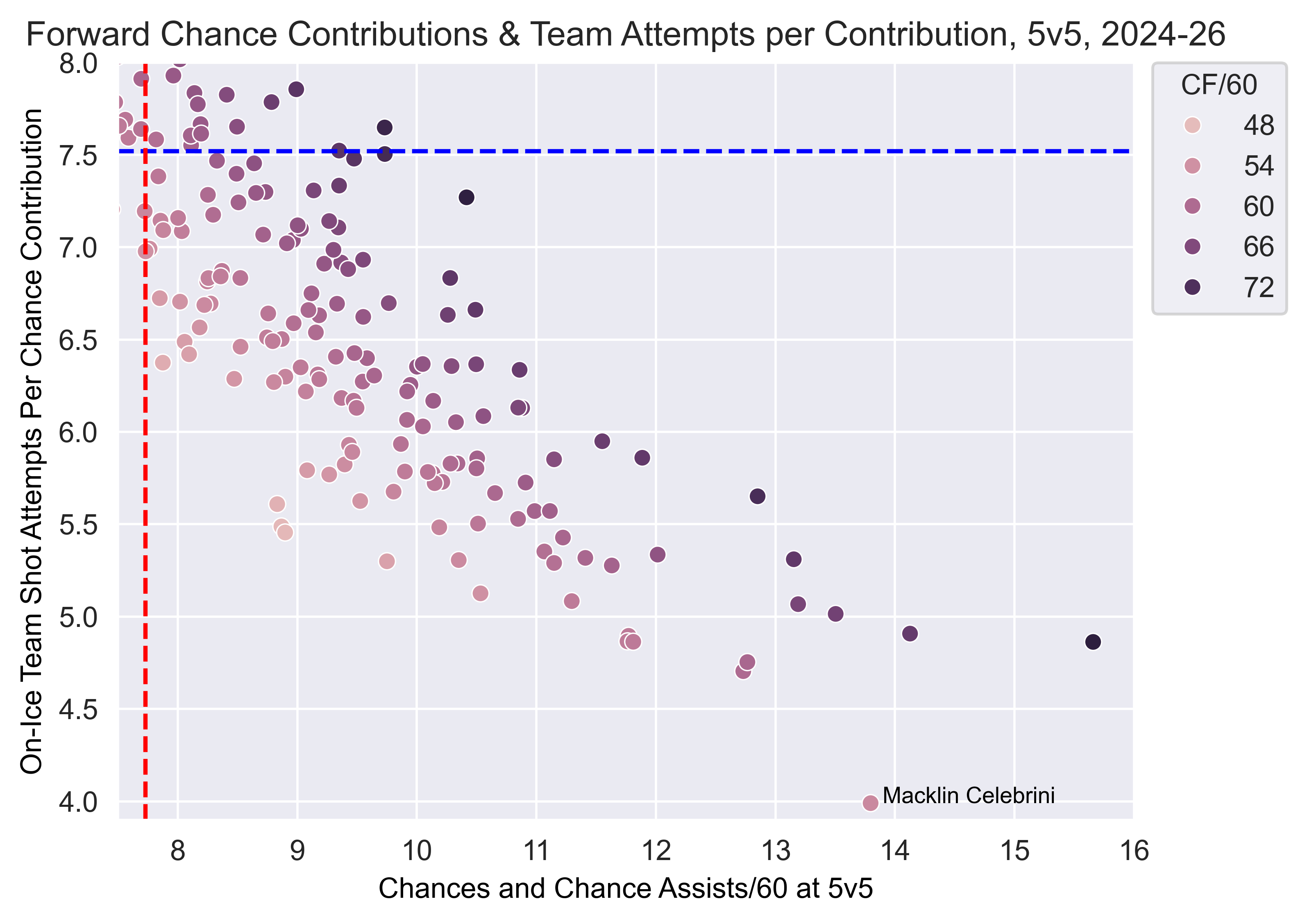
Celebrini has requiring 3.99 team shot attempts for each of his chance contributions and the next-closest player is at 4.70. That is a bigger gap than the second-place player (Auston Matthews) and the 20th-ranked player (Juraj Slafkovský). There has not been a forward better in the NHL at maximizing the danger of each team shot attempt over the last 1.5 seasons than Celebrini.
3 – Get Him Out of There
The St. Louis Blues are an average scoring team at 5-on-5 since the start of last season, but they are scoring 3.0 goals per 60 minutes with Jordan Kyrou on the ice, or about 20% higher than average. To no one’s surprise, he’s done it with a high rate of SCC/60 while being very efficient with his contributions per shot attempt:
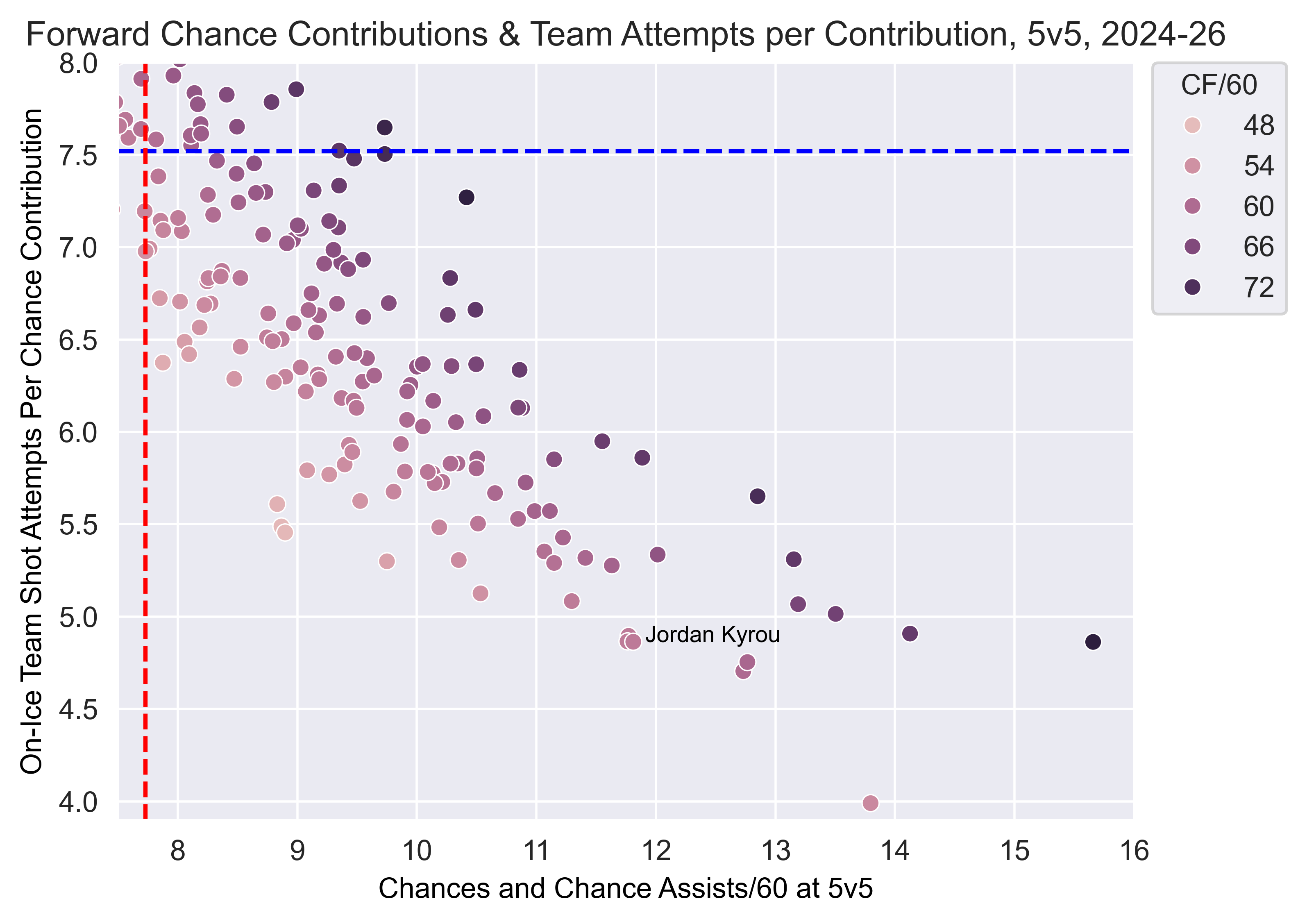
Only Kyrou is named here, but he’s in a cluster with two other wingers right around his name: William Nylander and David Pastrňák. Kyrou is not those guys, but that he’s the name constantly bandied about in the trade rumour mill should perk up the ears of the other 31 general mangers in the NHL.
4 – The Teammate
It has not been a great production year for St. Louis forward Robert Thomas, but like Kyrou, he is one of the most efficient players at contributing to scoring chances while having a low volume of team shot attempts:
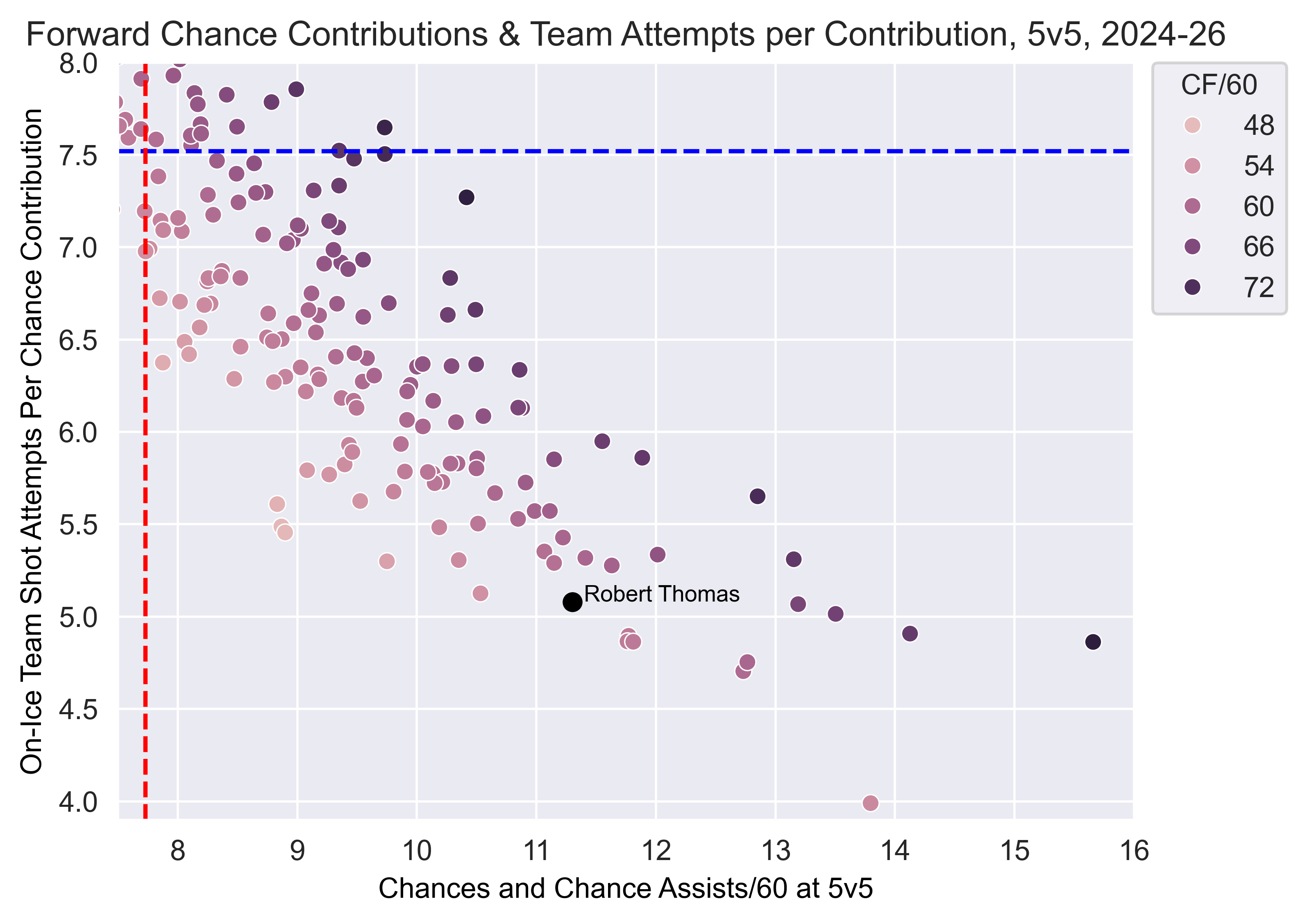
There might not be much interesting with two good offensive teammates having similarly efficient offensive numbers, but they’re important to highlight because they rarely play together – Thomas has spent less than 25% of his 5-on-5 time next to Kyrou over the last 1.5 seasons. These are two incredibly efficient forwards playing on two different lines for the same team. It seems St. Louis has a type.
5 – Sick, Brah
A lot has been made of Pittsburgh’s Justin Brazeau starting the season with 12 goals in his first 24 games, and yes, a high shooting percentage helps a lot. But that disguises the fact that Brazeau has been very efficient at contributing to scoring chances with a low team shot volume:
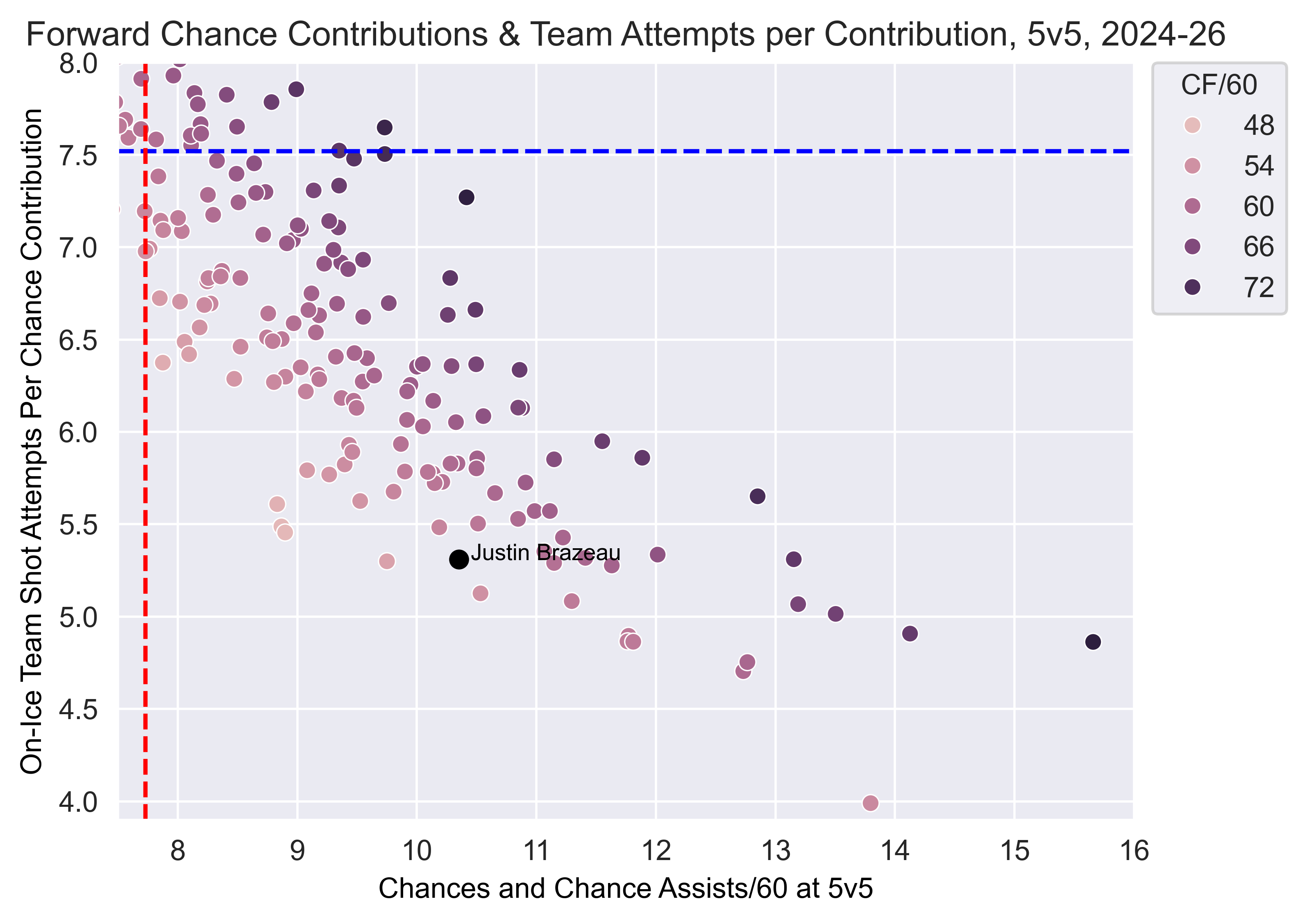
Remember that the 2024-25 season is included, and while his tracking sample isn’t big (just under 280 minutes), this highlights that he’s both getting some good fortune thus far in 2025-26 and has also been one of the best forwards in the league at creating the most with the least. He is looking like a diamond in the rough for the Penguins, and the second half of the season will tell us whether he’s just had a good run, or whether this is a seriously undervalued offensive player.
6 – The Other Connor
Clocking in with the 15th-best rate of SCC/60 relative to team shot attempts is Chicago’s superstar forward Connor Bedard. While he doesn’t have the total SCC/60 rate of the elite in the league like Nikita Kucherov or Connor McDavid, he’s 26% above average and very efficient:
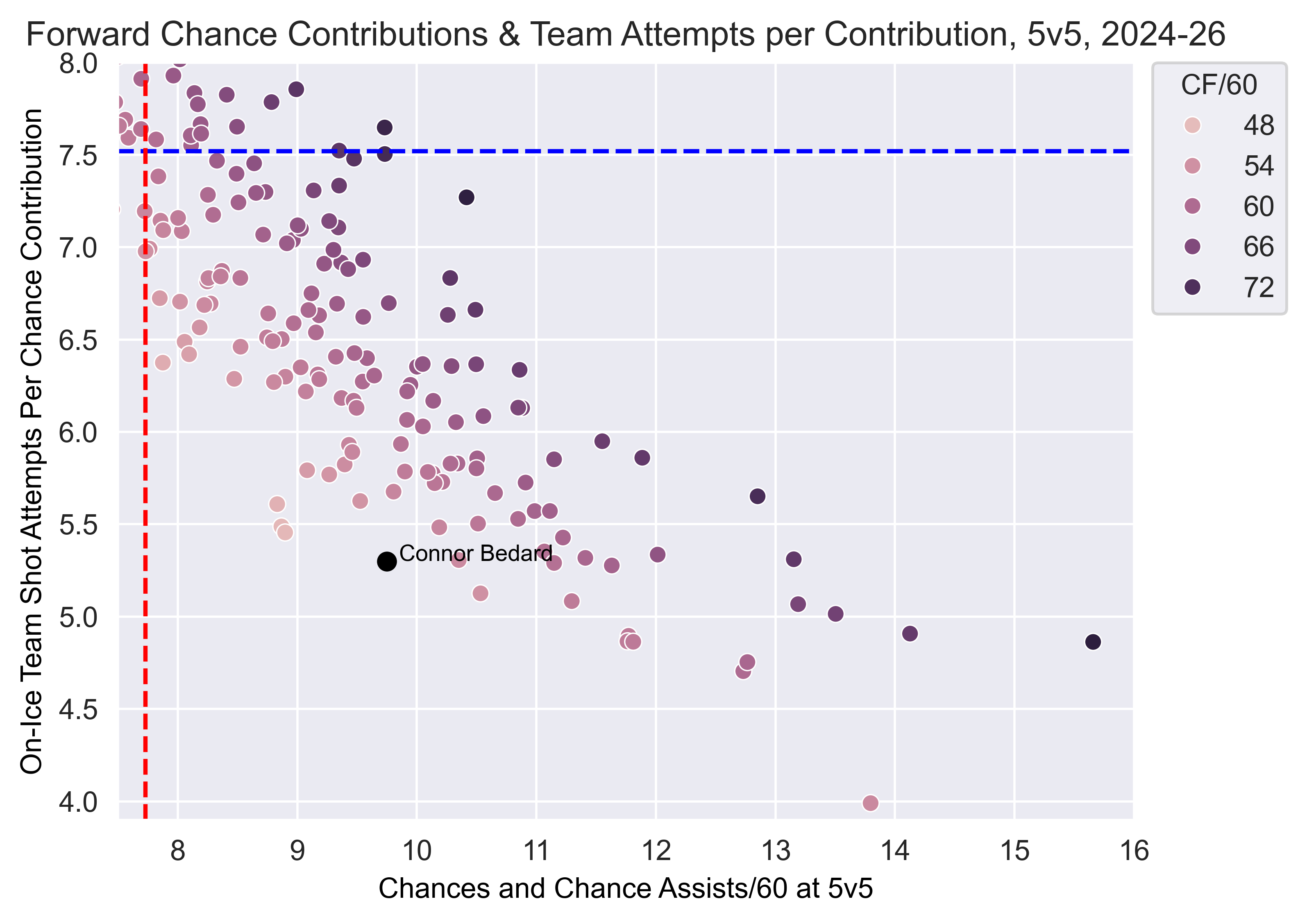
Before his injury, Bedard was pacing for over 110 points, and seeing what he’s done at 5-on-5 without a lot of shot attempts indicates that this is a forward truly doing as much as he can on a team that doesn’t create much. We may have to wait until next season, but if Chicago can start creating a lot more volume, we’re looking at a guy who should be a 100-point threat year after year.
7 – The Teammate, Part Deux
In San Jose, Celebrini reigns as the king of creating the most out of the fewest shot attempts. There are a couple others worth noting, but we will highlight Will Smith here, as his team shot attempts per SCC/60 over the last 1.5 seasons ranks in line with names like Nikita Kucherov, Cole Caufield, and Kirill Kaprizov:
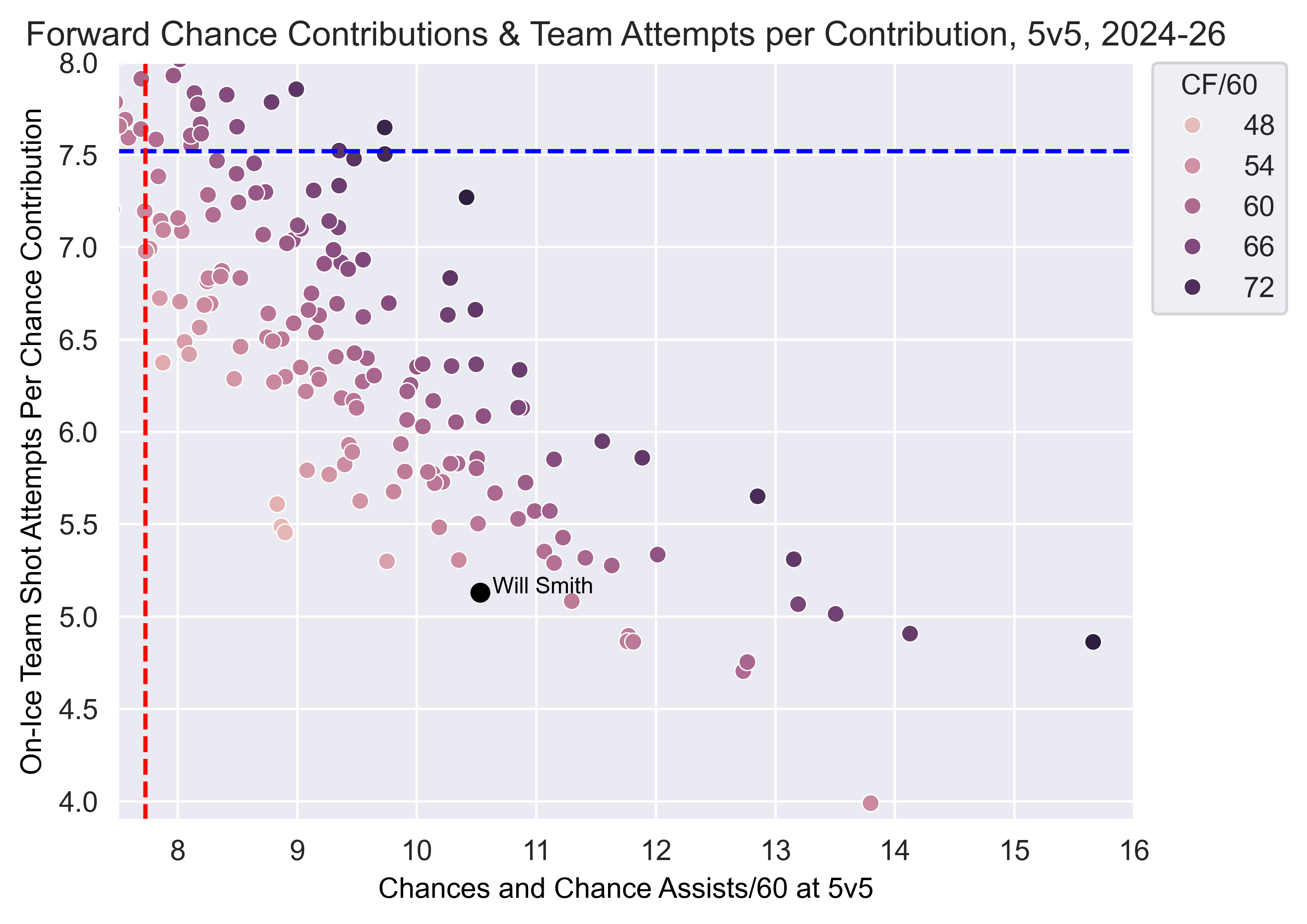
The difference between Smith/Celebrini and Kyrou/Thomas is that Smith has spent a lot of time next to Celebrini over the last 1.5 seasons – about 54% of his 5-on-5 time. Smith still has to play well to stay in that role, and it does leave him with 46% of his 5-on-5 time away from Celebrini. We don’t want to draw firm conclusions yet, but it’s hard to ignore that Smith has been good enough to have above-average goal-scoring rates even without Celebrini on the ice, and this efficiency helps a lot.
8 – Slafter is the Best Medicine
Montreal’s Juraj Slafkovský has really come alive over the last couple of months, but the reality is he’s been good at contributing to chances for a while, ranking 20th overall by rate of team shot attempts per SCC/60 over the last 1.5 seasons:
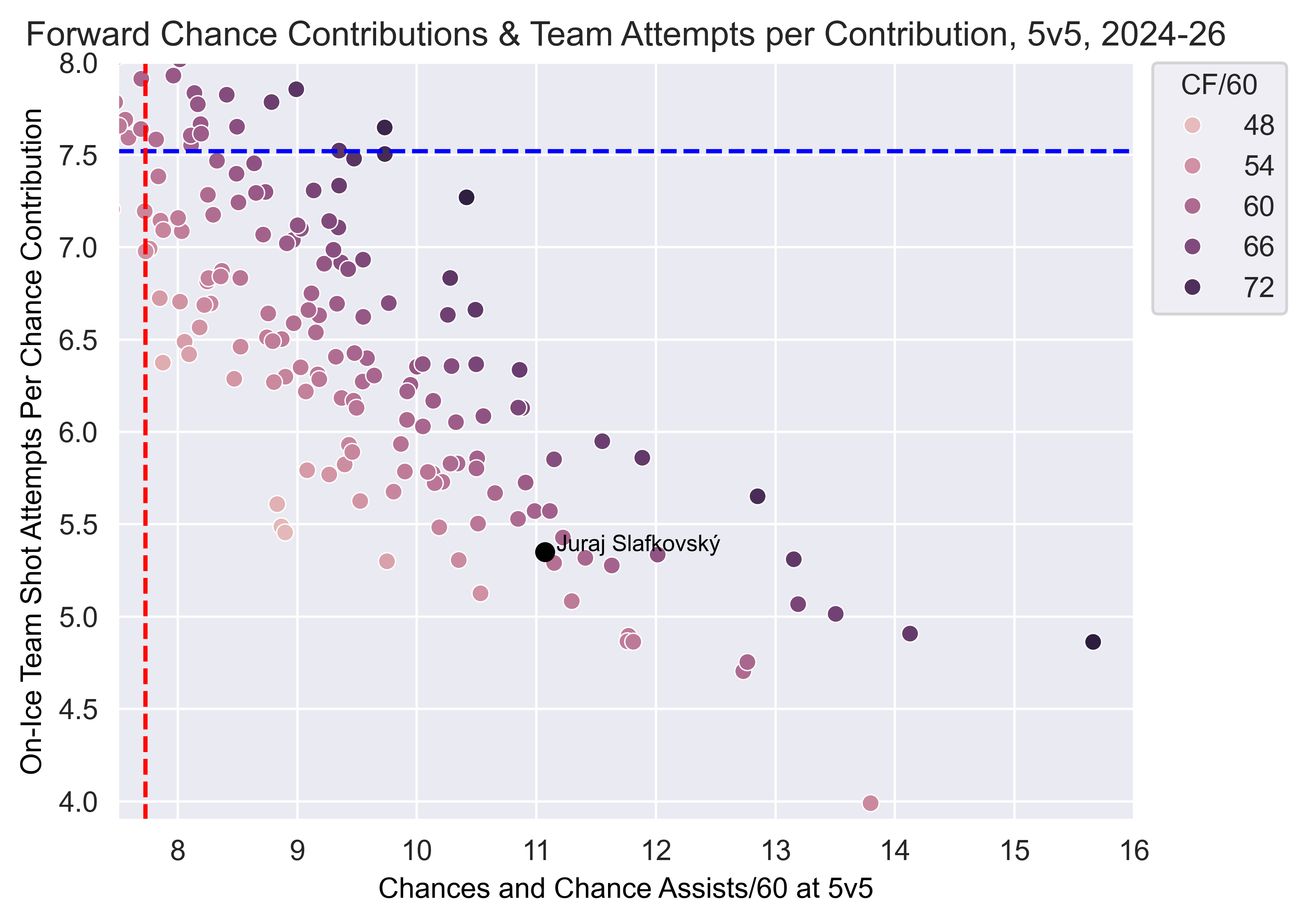
To give a comparison, the closest comparable in this sample by ratio of attempts per SCC/60 and overall SCC/60 is Clayton Keller. Keep in mind that Slafkovský is still just 21 years old and doesn’t even have 250 NHL games to his name. He is a threat to reach either/both of 30 goals and 60 points this season, and he’s still approaching his prime. At 6’3”, there is a scary offensive player brewing here.
9 – Underappreciated
We have written about him a couple times recently, but it’s worth hammering home just how good Detroit’s Alex DeBrincat has been. He has the third-best rate of shot attempts per SCC/60 over the last 1.5 seasons (only Celebrini and Matthews are higher) and he’s done it with a top-10 rate of overall SCC/60 in that span:
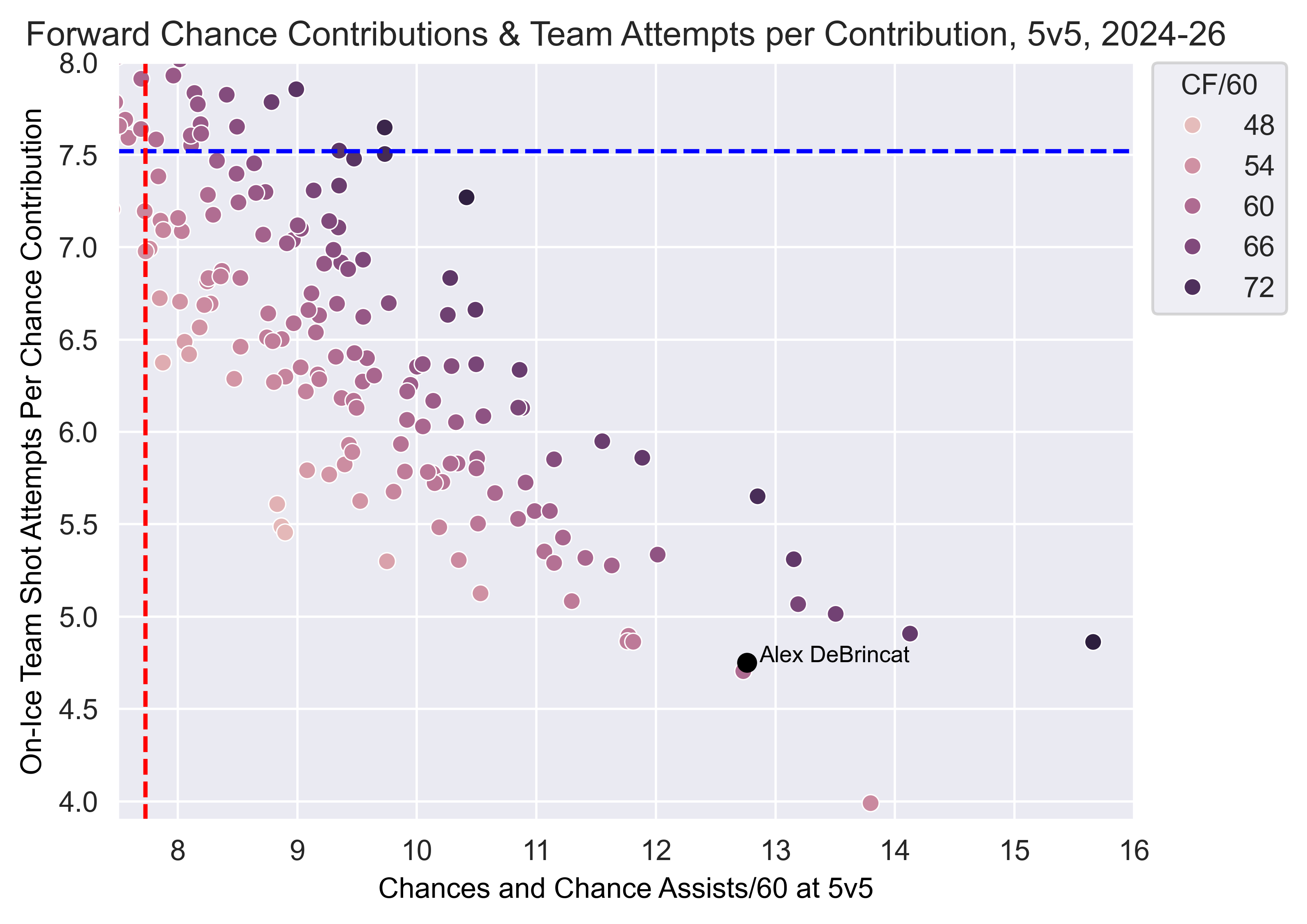
The data point he’s overlapped with, meaning a near-identical rate of SCC/60 and ratio of team attempts to SCC/60, is Auston Matthews. I dare say that if a forward can do something offensively that leads to goal scoring as well as Auston Matthews, over a span of 1.5 seasons, that player should be getting a lot more praise than he does.
10 – Maybe I’m Wrong?
Anyone that reads my writing knows I’m not a fan of San Jose’s Philipp Kurashev. However, it’s always important to examine what we think we know, and that’s why we have to mention that Kurashev has a top-25 mark for ratio of team shot attempts per SCC/60:
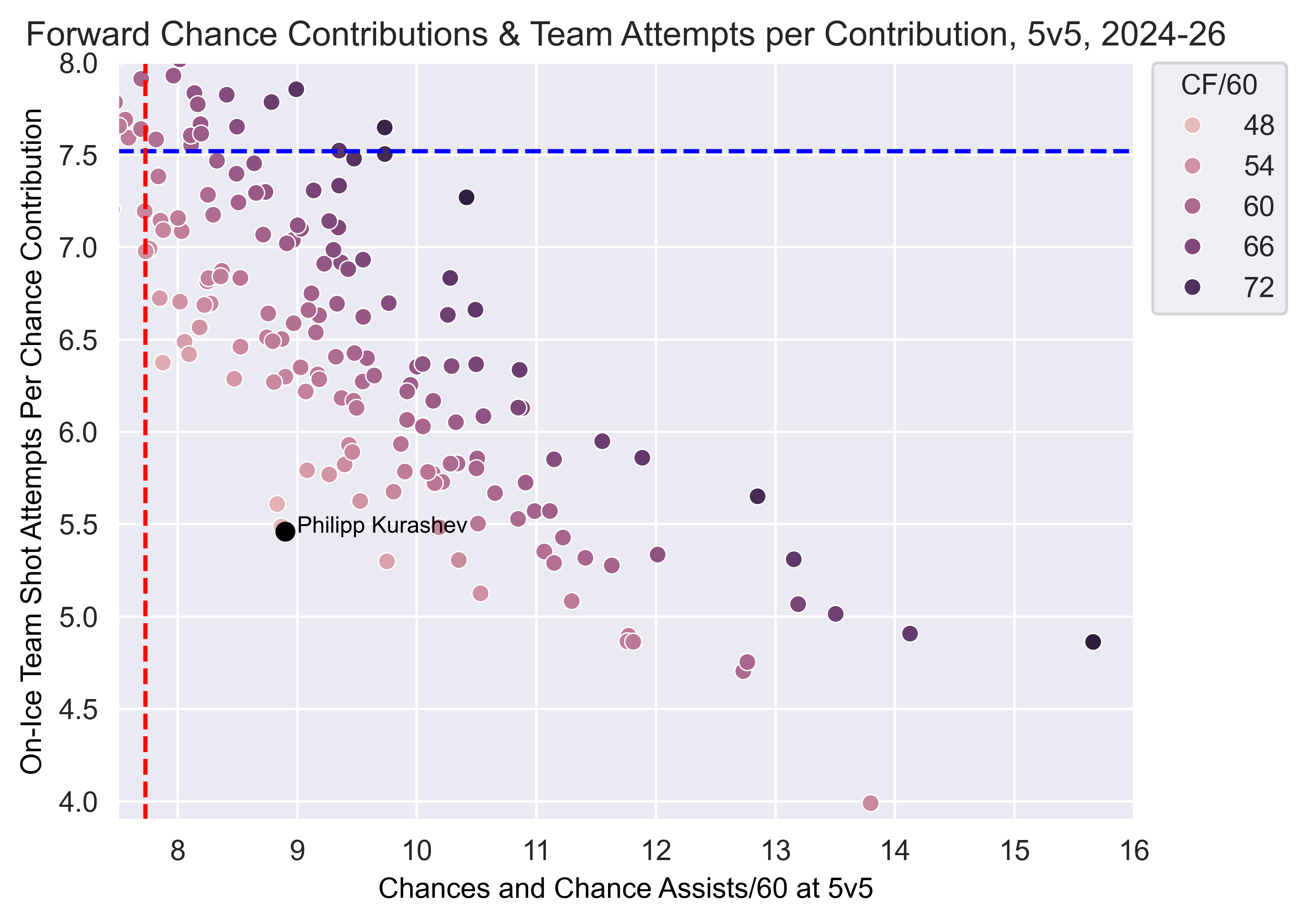
He has played with both Bedard and Celebrini over the last two seasons, but just 33% of his time with Bedard in 2024-25 and 29% with Celebrini in 2025-26. Kurashev’s overall chance contributions and shot volume aren’t high, but he is good at making a lot out of a little, and that’s absolutely worth something.
Until next week