10 Interesting (To Me) Stats For This Week - September 30
Welcome back to another week of ’10 Interesting (To Me) Stats’. This week, the preseason previews continue and this time we are looking at new coaches in new locations. There are several teams that changed their head coach, but we are going to focus on five interesting spots: Glen Gulutzan in Dallas, Lane Lambert in Seattle, Jeff Blashill in Chicago, Mike Sullivan with the New York Rangers, and Rick Tocchet in Philadelphia. We will look at what each coach did with the previous team(s), and what they need to do/will do with their new squad.
Coaching graphics are from HockeyViz, team/player data is from Evolving Hockey, and tracking data is from All Three Zones.
1 – Glen Gulutzan (Dallas Stars)
Below is a graphic showing former Dallas coach Pete DeBoer’s estimated impact on the Stars’ expected goals numbers in 2024-25 (left) and new coach Gulutzan’s final season in Calgary back in 2017-18 (right). See the black box that says ‘Always’? Notice how DeBoer’s is in the bottom-right while Gulutzan’s is in the top-left:
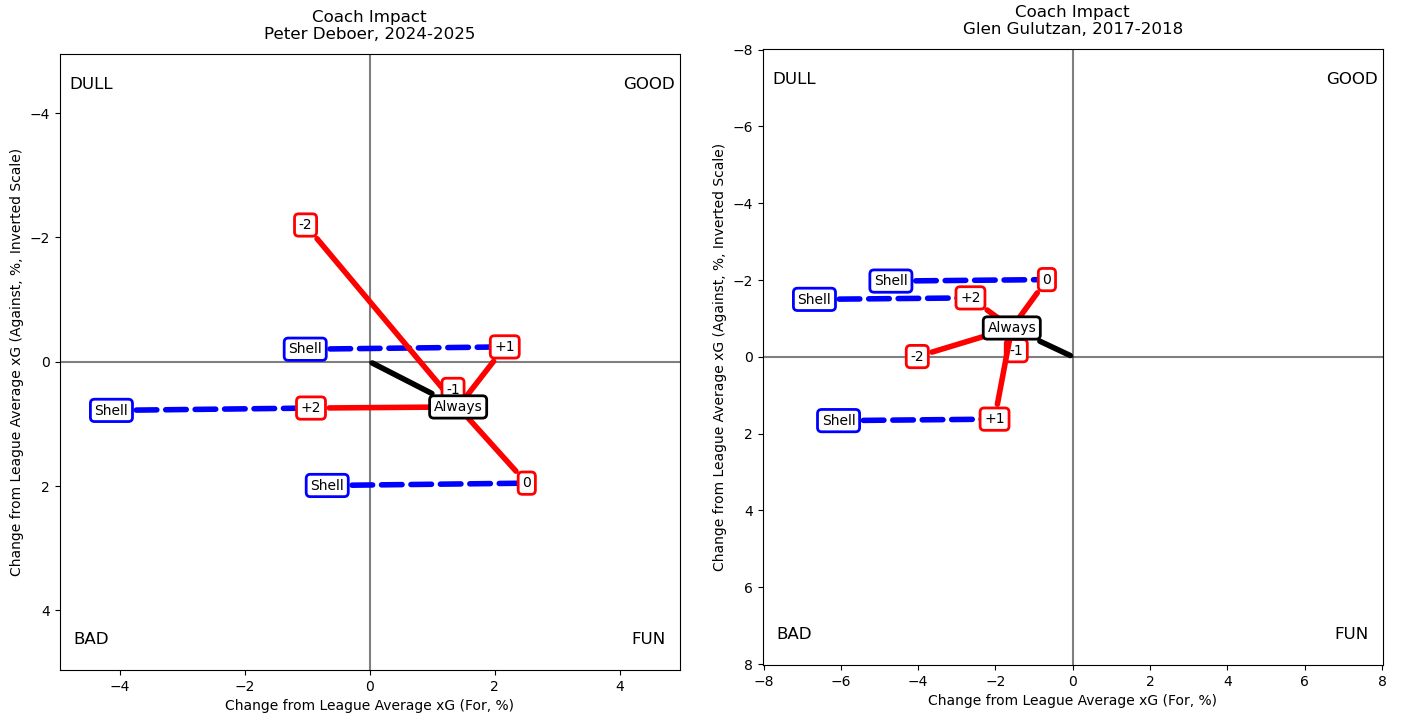
That means DeBoer sacrificed some defence for more offence, while Gulutzan sacrificed some offence for more defence. Will he bring a similar approach to the Stars? That wouldn’t be ideal for the production of their top guys, even if it gets them over the Conference Finals hump.
2 – Old Dog, New Tricks?
From 2014-2016, the Calgary Flames were one of the most efficient scoring teams in the NHL, ranking fifth by goals-for per 60 minutes at 5-on-5 above their expected goals-for rate. Then the Flames hired Gulutzan in the 2016 offseason, where he spent two seasons. In his two years with Calgary, the Flames were the fourth-least efficient team in the league by goals-for below expected goals. Compared to the two seasons before he arrived, Gulutzan’s Flames had the largest scoring efficiency decline in the NHL in the following two seasons:
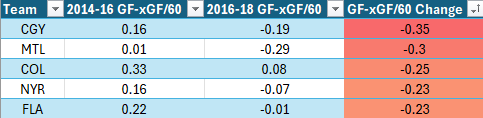
Gulutzan has surely changed his approach over the last seven years, but Dallas was a high-end offensive team in recent seasons. How much has he changed, and how much will he change Dallas?
3 – Lane Lambert (Seattle Kraken)
Seattle’s first three seasons saw them with good defensive metrics but poor goaltending from Philipp Grubauer. In 2024-25, the team was poor defensively but got great goaltending from Joey Daccord. If they can improve defensively, and Daccord stays stellar, this will be a hard team to score against. Lambert’s one full season with the New York Islanders saw him give them average defensive impacts:
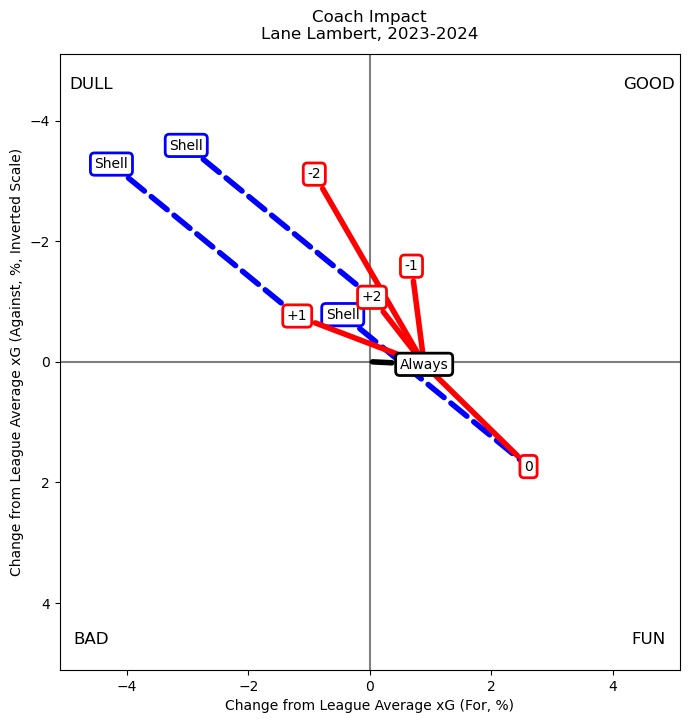
Just being average defensively, with Daccord being a fringe top-10 goalie, would give Seattle very solid goals-against numbers. It is their only path to pushing for a playoff spot, so we’ll see if Lambert can do this for the Kraken.
4 – Power Up
If improved defence can help the Kraken push for a playoff spot, more power play production could get them over the hump. Seattle is 27th by goals per minute on the PP over the last two years, and when looking at where they shot from in 2024-25, it’s obvious to see what happened (purple is lower than league average, darker is worse):

Getting shots from the point is one thing, but only getting shots from the point is far too one-dimensional. Regardless of how they split the power play time, if they can create more from the dangerous areas on the PP, this team is hopeless.
5 – Jeff Blashill (Chicago Blackhawks)
Chicago hired Blashill to be their coach as the team hopes to finally leave the basement and crack the 70-point barrier for the first time in five years (seriously). Blashill most recently spent many years with Detroit and his coaching impact left a lot to be desired as he had negative impacts on both expected goals-for and against (the ‘Always’ box in the bottom-left):
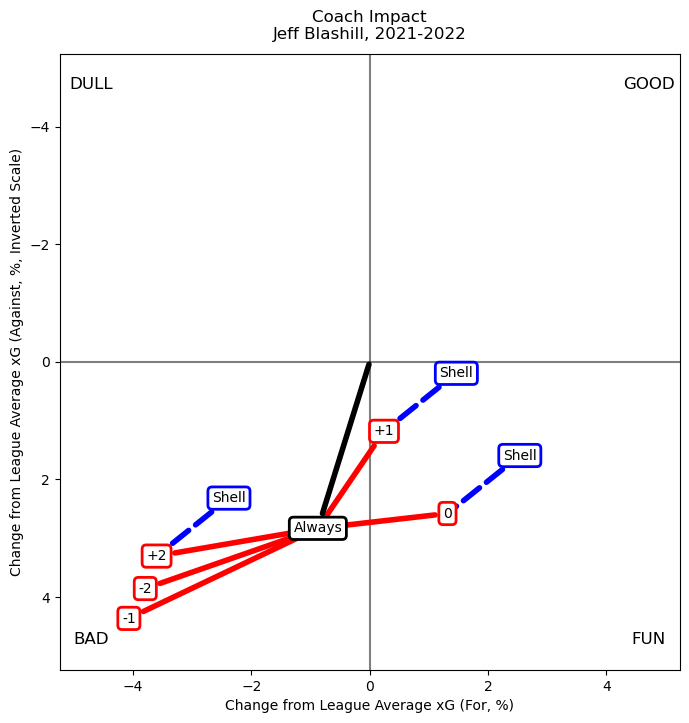
That just isn’t acceptable from a coach. He doesn’t have to turn the Blackhawks into a playoff team right away, and they don’t even need a Columbus-like leap, but Chicago had the worst expected goals share in the league from January 1st onward. If he can’t improve them from *shuffles notes* dead last, then he may not last more than one season.
6 – The Real Core
If Blashill wants to get the Blackhawks moving up the standings, it’ll be through their defencemen. Veteran Connor Murphy is stellar, but the future is Artyom Levshunov, Sam Rinzel, and Alex Vlasic, among others. That they’re so young may be why the 2024-25 Blackhawks were bad-to-abysmal when it came to zone entries allowed to the opposition at 5-on-5:
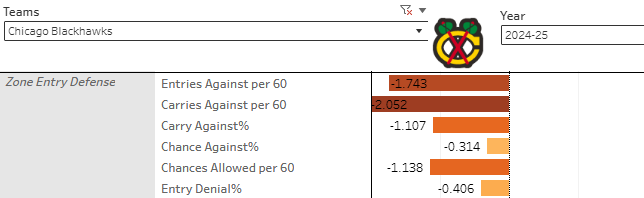
Quite simply, these areas have to get a lot better for the Blackhawks to start showing some promise. Adding Spencer Knight in net (hopefully) gives Chicago their goaltender of the future, but even if he’s solid, he can’t continually bail out a team that is this bad defensively. Another year of their blue line basically being retail store security on Black Friday morning would be a massive disappointment.
7 – Mike Sullivan (New York Rangers)
After three straight years of missing the postseason, the writing was on the wall for Sullivan getting the heave from the Pittsburgh Penguins. Instead of posting his impact, let’s look at Pittsburgh’s draft picks. In the seven drafts from 2017-2023, or after their last Stanley Cup, the Penguins made 36 picks. This is how those 36 picks have fared:
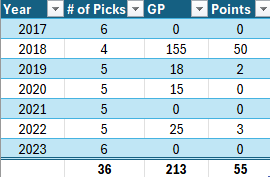
That is a grand total of 213 NHL games from those 36 picks. The kicker is 152 of those games came from Calen Addison and he was traded before he played a single game for the Penguins. So, in total, Pittsburgh has gotten 61 NHL games from 35 draft picks across seven years.
In fairness, only two picks were in the first round: Owen Pickering in 2022 and Brayden Yager in 2023. Yager was also traded for Rutger McGroarty, so if we add McGroarty’s NHL games to the Penguins total, they are up to… uh… 69 games from 35 draft picks. The last skater the Penguins drafted that had any sort of long-term NHL career was Daniel Sprong in 2015, and he’s in the KHL now. While the Penguins are holding out hope for both Pickering and McGroarty, the reality is the team hasn’t drafted a full-time NHL skater in a decade. Whatever we might think of Sullivan, failing to replenish the cupboard left the team with 3-4 stars and a bunch of spare parts year after year.
8 – What Does Everyone But The Fox Say?
The Rangers need a lot more from their non-Adam Fox minutes. Over the last two seasons, 119 defencemen have played at least 1600 minutes at 5-on-5 with one team. Fox led all those defencemen in goal share, and expected goal share, relative to his teammates. The only other Rangers defenceman to be over 50% was his frequent partner Ryan Lindgren:

Having Igor Shesterkin is great, but he can’t be relied upon to keep them in games night in and night out. They have overhauled the blue line and brought in a new coach, but if the Rangers want to get back to the postseason, they can’t have their second and third pairs getting caved in regularly.
9 – Rick Tocchet (Philadelphia Flyers)
To get a hint of what Tocchet could do with the Flyers, on the left is how the 2022-23 Vancouver Canucks fared defensively by things like chances allowed per 60 minutes, high-danger passes against, and shots both off the forecheck and off the rush, and the right shows them in 2023-24, Tocchet’s first full year with the team:

Those are drastic, across-the-board improvements. The Flyers did well preventing shots from in close last season, they just were poor at giving up their blue line. If they can limit those close shots and Tocchet makes them defend their blue line better? It’s a whole new team defensively.
10 – Shifting Focus
Over the last two seasons, the Flyers were 9th in the league by percentage of their 5-on-5 shots coming off the rush. Comparatively, the Canucks were 25th in the league:
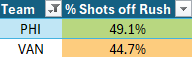
What Tocchet brings to the Flyers remains to be seen, but if he brings the same approach to offence as he did with the Canucks, it will represent a dramatic shift in how they approach their attack. How the team responds to that is a fair question, because that is a significant year-over-year change.
Until next week.