10 Interesting (To Me) Stats For This Week - May 20
We are back for another week of ’10 Interesting Stats’ and with the NHL playoffs rounding into the two Conference Finals, now is the time to preview each series. We will look at a pair of matchups or performances from each of the four teams that could (or will) determine the outcome.
Data is from Natural Stat Trick, Evolving Hockey, or MoneyPuck.
1 – Lurking in the Depths (Edmonton)
It is no secret that a lack of forward depth has been an issue for years in Edmonton. That has not been the case in the 2025 playoffs: by share of goals scored at 5-on-5, Edmonton’s depth in this postseason has not only been light-years better than the previous four playoff runs, but they’ve also been better than when Edmonton has had at least one of (if not both) of Connor McDavid or Leon Draisaitl on the ice:
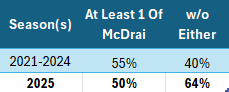
This is the most encouraging sign of Edmonton’s playoff push. Not only is the depth thriving, but they’re in the West Final without monster 5-on-5 contributions from their top two stars. If McDavid and Draisaitl take over like they can, Edmonton may be headed back to the Stanley Cup Final.
2 – (Lack of) Killer Instinct (Edmonton)
One area Edmonton is really lacking in the postseason is on the penalty kill. While substandard goaltending has been an issue, the Oilers are legitimately giving up a lot of good looks. By expected goals against per 60 minutes at 4-on-5, here is how the 2025 Oilers stack up against the previous Cup winners going back to 2014. In short, they have the worst goals against rate and second-worst expected goals against rate:
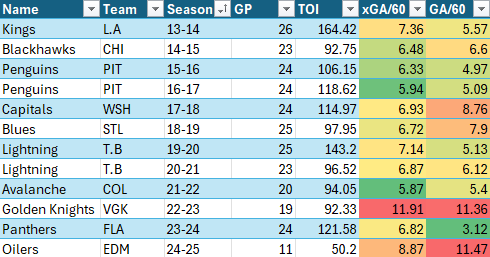
It isn’t impossible to win a Cup with a poor penalty kill – Vegas proved that a couple of years ago – but it sure would make life a lot easier if things improved from here on out, especially since they’re facing a Dallas Stars team that has 12 power-play goals on 39 opportunities in their 13 playoff games.
3 – You Shall Not Pass (Carolina)
We try not to over-analyze goaltending in small samples because of how random it can be, but it would be malpractice to not mention how good Frederik Andersen has been for Carolina. It isn’t ‘oh he’s had a few good games’ but rather ‘he’s on a generational goalie run right now’. By Goals Saved Above Expected per 60 minutes from Evolving Hockey, Andersen is having the best playoff performance of any goalie since the 2014 playoffs (minimum 8 games played):

Notice that he’s also requiring just 12.4 shots against for every Goal Saved Above Expected accumulated, also the best in the sample. It is always good to have a goalie playing this well, but it’s worth noting he was excellent in the 2023 postseason when Carolina made the East Final, and then they were swept by Florida.
4 – Top Guys (Carolina)
The duo of Seth Jarvis and Sebastian Aho was tremendous after being reunited in Game 3 against Washington: three goals for, zero goals against, 80% expected goal share. Very quietly, they have been one of the best forward duos in the league over the last three years, comparing closely by 5-on-5 goal share to the top-line duos from Florida, Toronto, and Colorado:
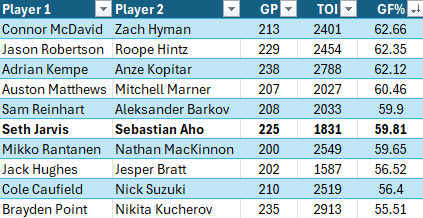
That dominance has extended to the postseason where Carolina has outscored the opposition 22-11 at 5-on-5 with Aho and Jarvis on the ice since the 2022 playoffs. Aho had just two points (both assists) in the series win against Washington, so if he and Jarvis really get going at 5-on-5, they can single-handedly win multiple games in any round, and they might be in a better matchup than it appears (more on that later).
5 – Miro Crush (Dallas)
Miro Heiskanen returning to the Dallas lineup in Game 4 against Winnipeg was a big turning point for the team. It wasn’t as if they were in trouble – they had a 2-1 series lead at that point – but, alongside Thomas Harley, it gives the Stars a top pair that is quite literally one of the best in the NHL. In fact, they are 1 of 2 defence pairs over the last two regular seasons to have at least 500 minutes together at 5-on-5 and both an expected goal share and actual goal share of at least 59%, coincidentally alongside a pair from their third-round opponent:

Mattias Ekholm is still injured for Edmonton, so this ostensibly gives Dallas something that the Oilers don’t have (or won’t have until Ekholm returns). Heiskanen looked like his old self by his third game after the return, and that is a great sign for the Stars.
6 – The Old Guard (Dallas)
That Dallas made it this far with just two goals from Matt Duchene and Tyler Seguin is a good sign. A better sign is the fact that with that duo on the ice at 5-on-5 in the postseason, Dallas is creating 3.12 expected goals per 60 minutes (from Evolving Hockey). That makes them 1 of 6 forwards pairs to have at least 80 minutes together and produce between 3-3.2 expected goals per 60 minutes. Here is the goal scoring rate of those other five pairs compared to Seguin/Duchene:

This is a pair that has been creating very well, they’ve just been a bit snake-bit. They are due for some positive regression and are good enough at 5-on-5, and on the power play, to turn the tide of a closely-matched series. Edmonton’s superb depth was outlined earlier in the article; this matchup is one to keep a close eye on.
7 – That’s The Bottom Line(s)
In the preview of the second round, Florida’s third line was singled out because of their tremendous success against Tampa Bay. That continued against Toronto as this trio outscored the Leafs 6-2 at 5-on-5 and did so carrying 65% of the expected goal share. To compare, here is how Florida has done at 5-on-5 in the postseason with their Big Four off the ice (Barkov, Reinhart, Bennett, Tkachuk) and how Carolina has fared with their own Big Four on the bench (Aho, Svechnikov, Jarvis, Staal) by shot share (SF%), expected goal share (xGF%), and goal share (GF%):

Carolina is a team that thrives in part because of its depth. That depth will be tested in this series as Florida’s bottom two lines, and especially the third line, are making a big (positive) difference.
8 – Trouble At The Top
As strong as Florida’s depth forwards have been, their top defence pair hasn’t been all that good defensively. With Gustav Forsling and Aaron Ekblad on the ice, Florida is giving up far more shots, expected goals, and actual goals against at 5-on-5 than when they’re on the bench:

To be clear, Florida is creating a lot of offence with them on the ice so that pair is still carrying a plus-3 goal differential. They are coming up against an Aho line (whom we talked about earlier) that has found its groove, though, so Forsling and Ekblad will need to be a lot better in their defensive zone to contain that line.
9 – Now You Can Rest (Vegas)
At the outset of the second round, William Karlsson’s excellent play for Vegas was highlighted in this column. His team was bounced out of the postseason in five games against Edmonton, but he kept that excellent play rolling against Edmonton as the team was plus-3 with him on the ice at 5-on-5. Overall, the team was minus-7 at 5-on-5 (7 goals for, 14 goals against), so the goals for/against differential between him and his team was the largest in the second round:

Again, it’s great he played so well and highlights how he remains one of the more underrated forwards in the league. It also speaks to how poorly Vegas’ top forwards played, which is why they’re now watching the playoffs on TV like the rest of us.
10 – Narrative Shift (Winnipeg)
Connor Hellebuyck was much better in the second round than the first, though there’s a caveat. To start with, his rate of goals saved above expected at even strength was second among goalies in Round Two, and nearly double third-place Logan Thompson (the two Edmonton goalies were excluded):

The caveat is that the Dallas power play shredded the Winnipeg penalty kill, scoring five times on 16 opportunities. That hurt Hellebuyck’s overall numbers, but it’s tough to put all the blame on any goalie for poor penalty kill numbers in such a small sample. Either way, he was much better in the second round, and that should help quiet the chatter around his postseason record.
Until next week.