10 Interesting (To Me) Stats For This Week - December 9
Welcome back to another week of ’10 Interesting (To Me) Stats’. Researching a DFS slate a few days ago, I seemed to notice a pattern of teams giving up a lot of expected goals against per 60 minutes (xGA/60) on the penalty kill having high penalty-kill save percentages. Patterns, both real and imagined, pique my curiosity so let’s see if that is indeed the case this season, in prior seasons, and what happens afterwards.
This penalty kill data is at 4-on-5 only, excluding 3-on-5 and 3-on-4 situations, and taken from Evolving Hockey. All data is current as of the morning of Monday, December 8th.
1 – Survey Says: Yes, Kind Of
To start with, we should check to see if this supposed pattern of teams giving up a lot of expected goals in fact do have a higher save percentage. In short: yes, they do, because of the 15 teams giving up more xGA/60 than the league average (dotted blue line), 11 of them are also above the league average by save percentage (dotted red line):
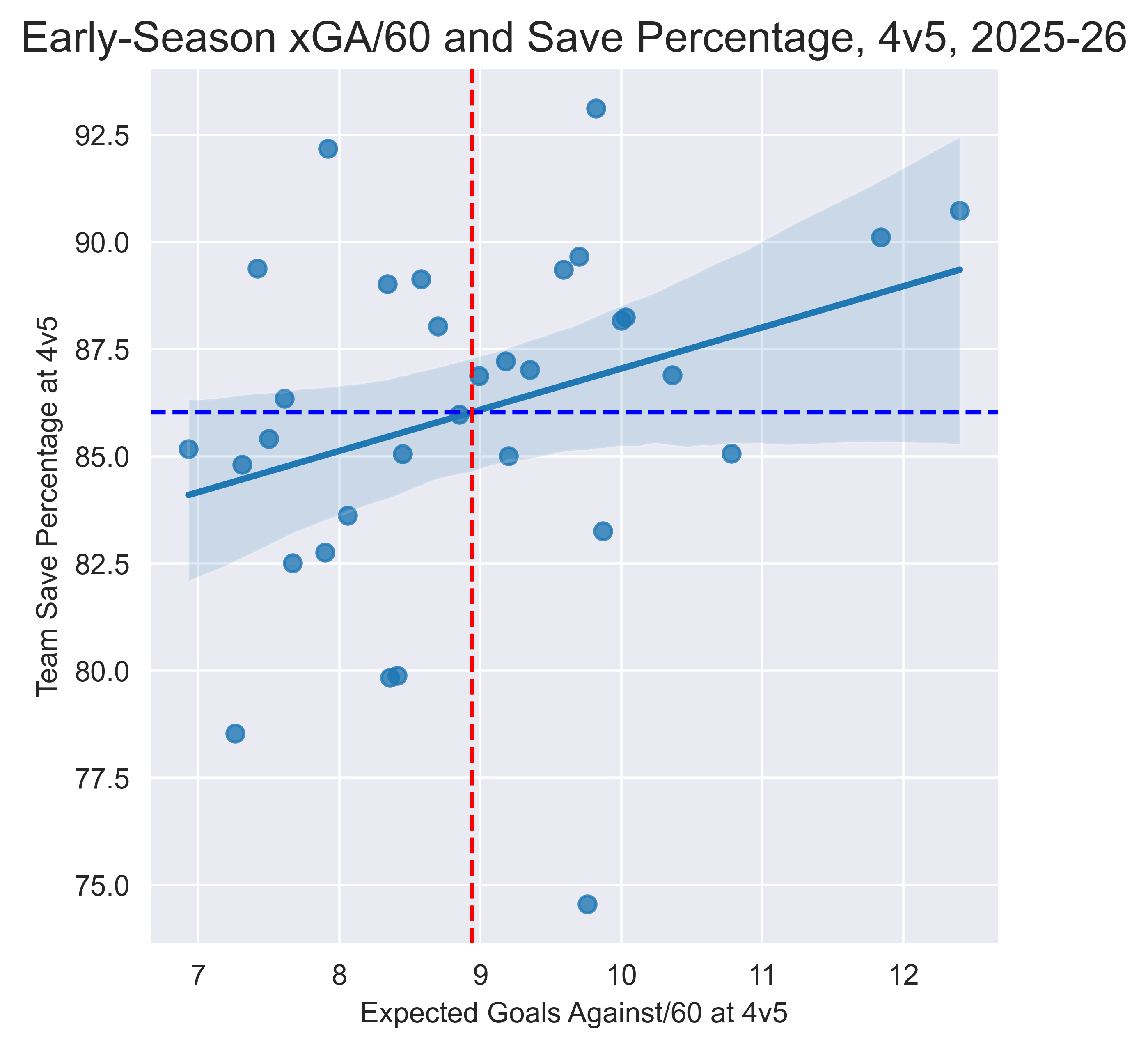
Intuitively, this makes sense. A power-play goal ends the penalty kill, teams with a high xGA/60 will typically give up more shots against, so if the opposition isn’t scoring on the power play, it gives them more time to land shots on goal, driving up the save percentage of the team on the penalty kill. As with anything related to the NHL, this isn’t one-size-fits-all, but it is a general trend this season.
2 – Survey Says: No, Kind Of
The next question is whether teams with high PK xGA/60 rates are an anomaly from this season, or if it has been the case in prior seasons. The answer is ‘sort of’. The three seasons from 2021-2024 saw the opposite of what we’re seeing this year as teams with a high early-season xGA/60 on the penalty kill often saw lower save percentages, showing a clear downward trend (solid blue line):
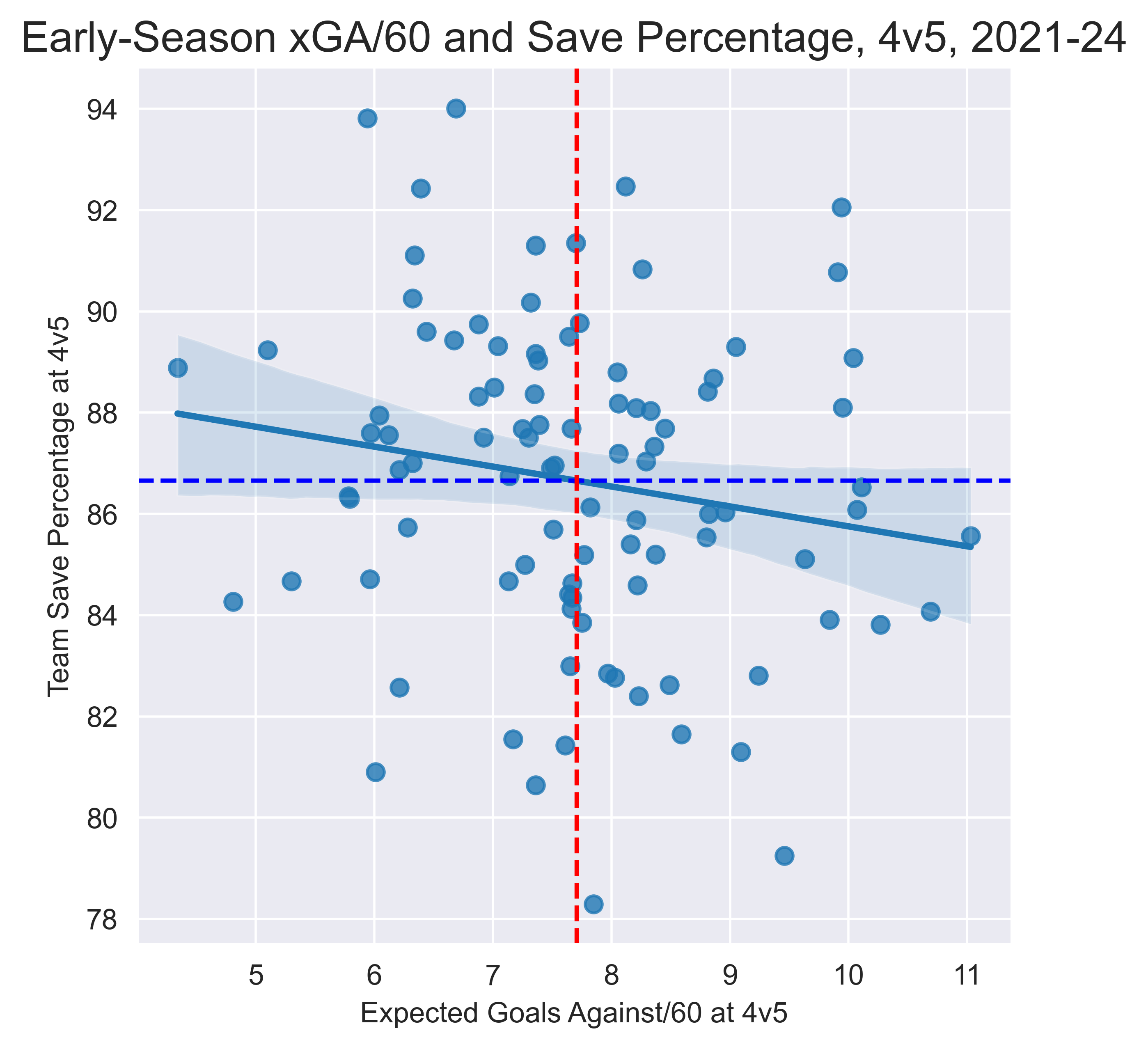
At least as it pertains to the three years from 2021-2024, it did not seem to be the same case as we are seeing so far this season – teams did generally have lower PK save percentages if they gave up a lot of expected goals against.
3 – Survey Says: Yes, Kind Of, Part Deux
For those keeping score, we’ve looked at the 2025-26 season, and the three years from 2021-24. What we haven’t looked at is the 2024-25 season, and it stands out because there is a clear deviation here. Again, we just saw how the three years from 2021-2024 saw a clear downward trend in PK save percentage from teams with higher xGA/60 rates, but that was not the case in 2024-25:
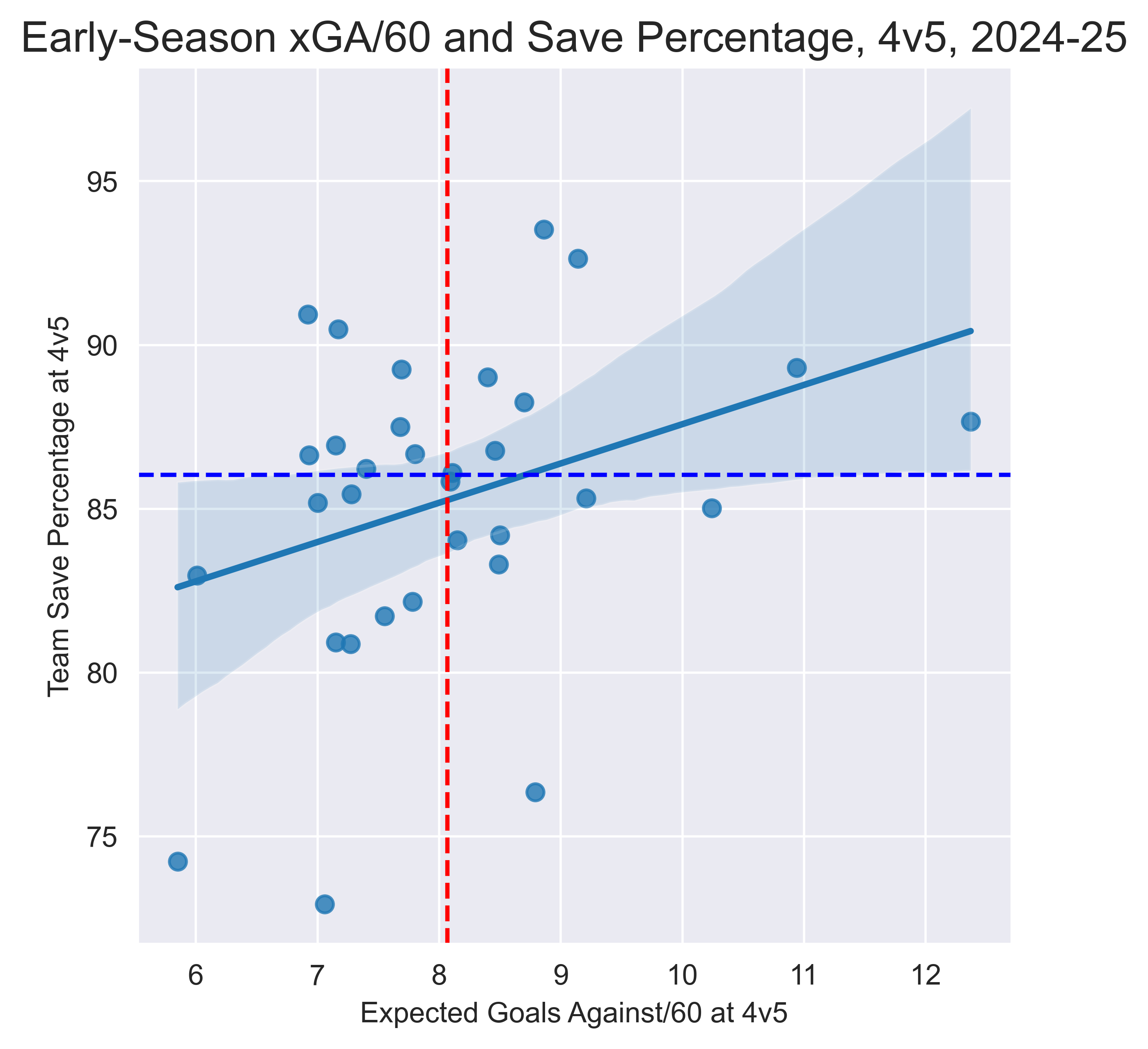
This has five teams giving up more than 9.0 xGA/60 at 4v5 to start last season, none of them were under an .850 save percentage, and they averaged an .880 SV%. Meanwhile, four of the five worst save percentages were from teams giving up fewer than 7.5 xGA/60. There was a three-year trend of high xGA/60 rates lowering PK save percentages, but that changed in 2024-25.
4 – What Comes Next?
Now that we’ve seen a trend reversal from the early portions of the 2021-2024 seasons compared to the last two years, the question is: what happens over the course of the rest of the season? Let’s start with the three-year sample from 2021-24 that we looked at earlier when the trend was high xGA/60 often meaning a lower PKSV%. Over the rest of the individual seasons, that downward trend continued:
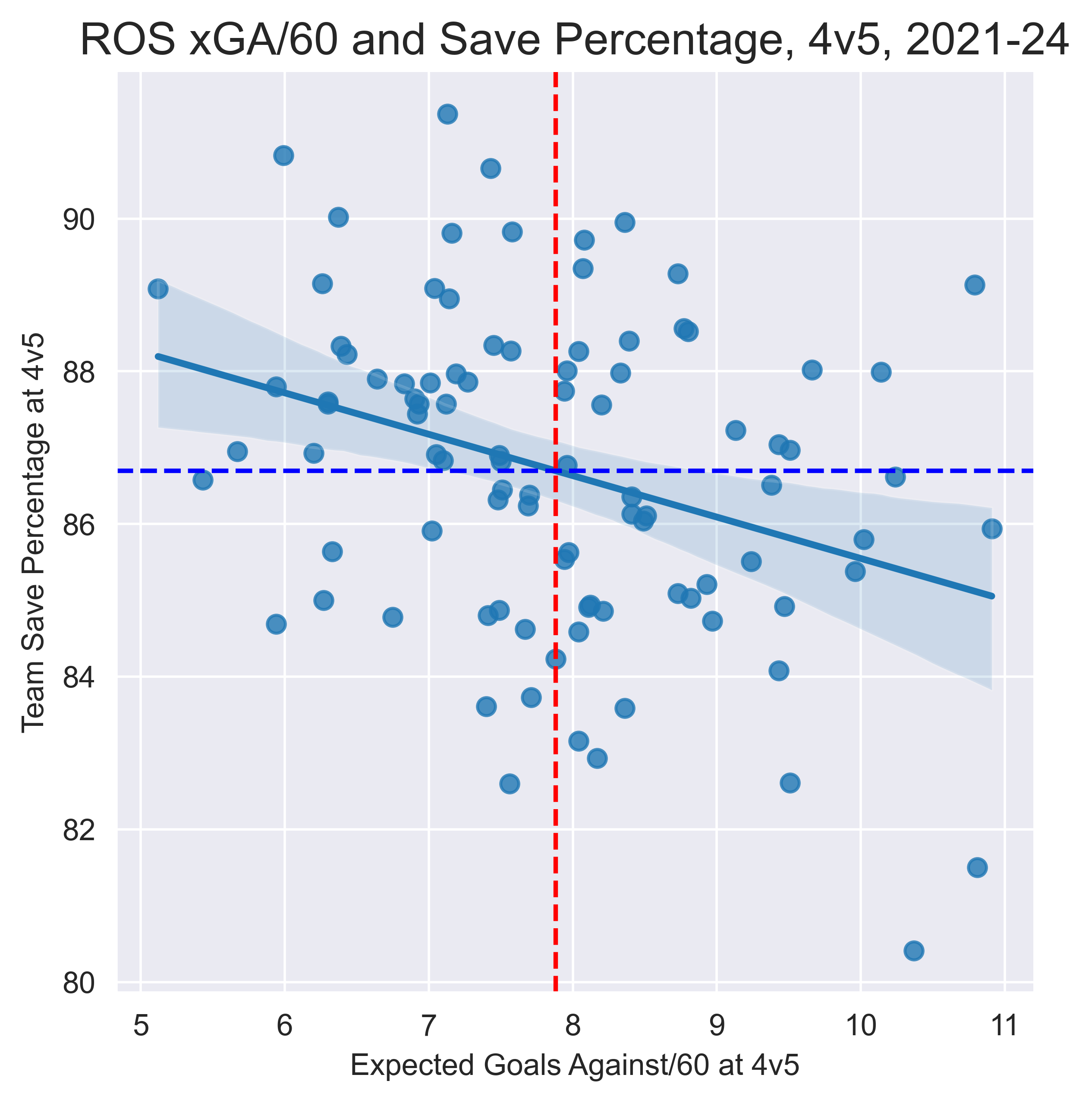
Of the nine teams to post a rest-of-season save percentage under .840, six of them gave up more xGA/60 than the league average. Conversely, the four highest rest-of-season PK save percentages all had xGA/60 rates lower than the league average. So, for those three years, the early-season downward trend was similar to the rest-of-season downward trend.
5 – What Comes Next, Part Deux
Earlier, we saw that downward trend reverse itself in the early portion of the 2024-25 campaign, meaning higher xGA/60 rates often led to higher PK save percentages. Did that hold for the rest of the 2024-25 season? Again, kind of:
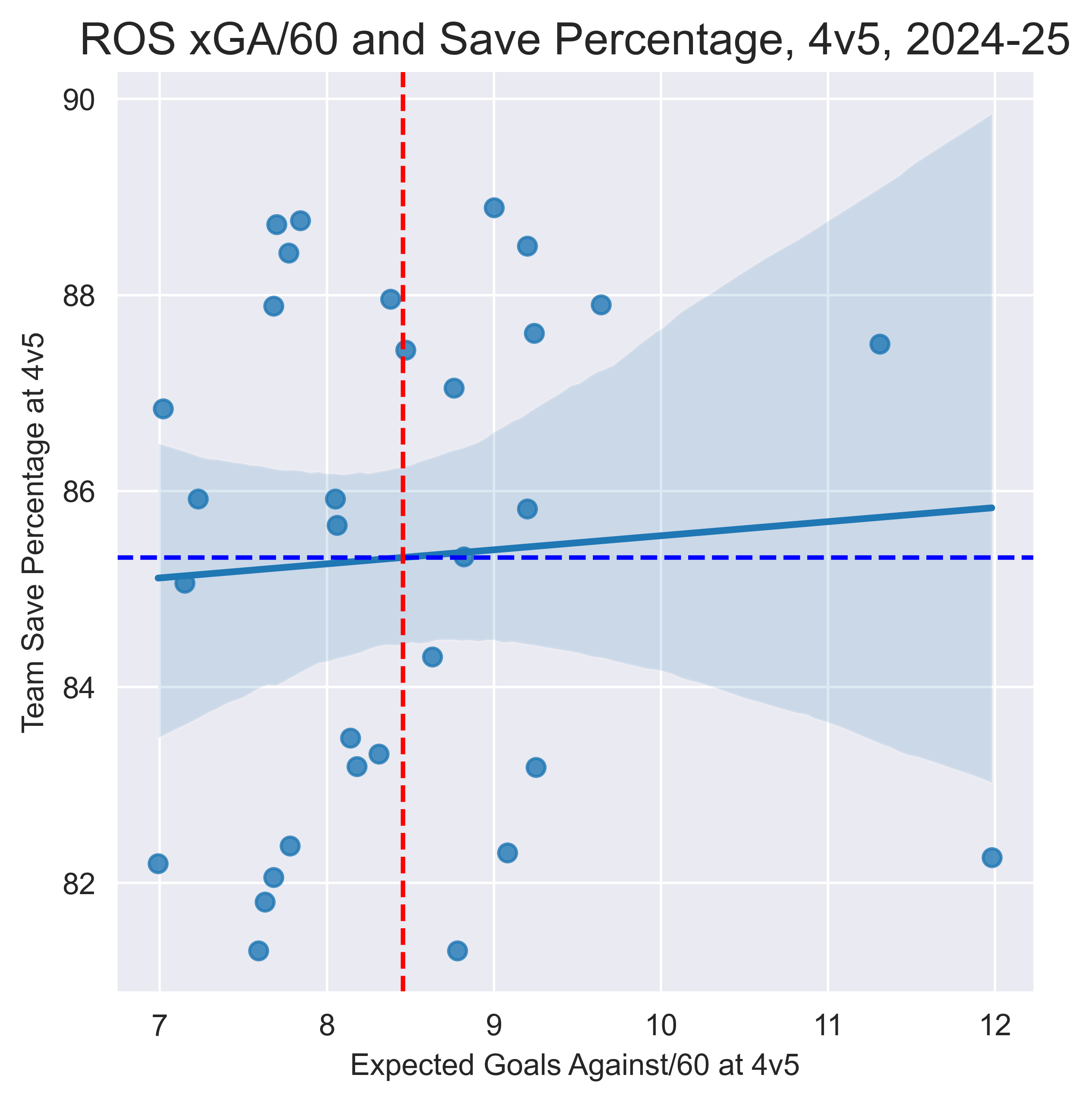
For the rest of the 2024-25 season, there is an upward trend between xGA/60 and PKSV%, but it is not steep, and we see a lot of variance. Just as an example, there were eight teams with an xGA/60 higher than 9.0, and by rest-of-season save percentage, they ranked 4th, 7th, 9th, 10th, 16th, 24th, 26th, and 27th. It isn’t the same upward trend we saw earlier in the season.
6 – What Comes Next, Part Trois
That is all done without looking at what happened with individual teams. So, let’s go back to the 2024-25 season, take a gander at xGA/60 rates from the early portion of the season, and what happened to save percentages the rest of the way. To be blunt, for the teams giving up a high rate of xGA/60 early last year, it wasn’t great:
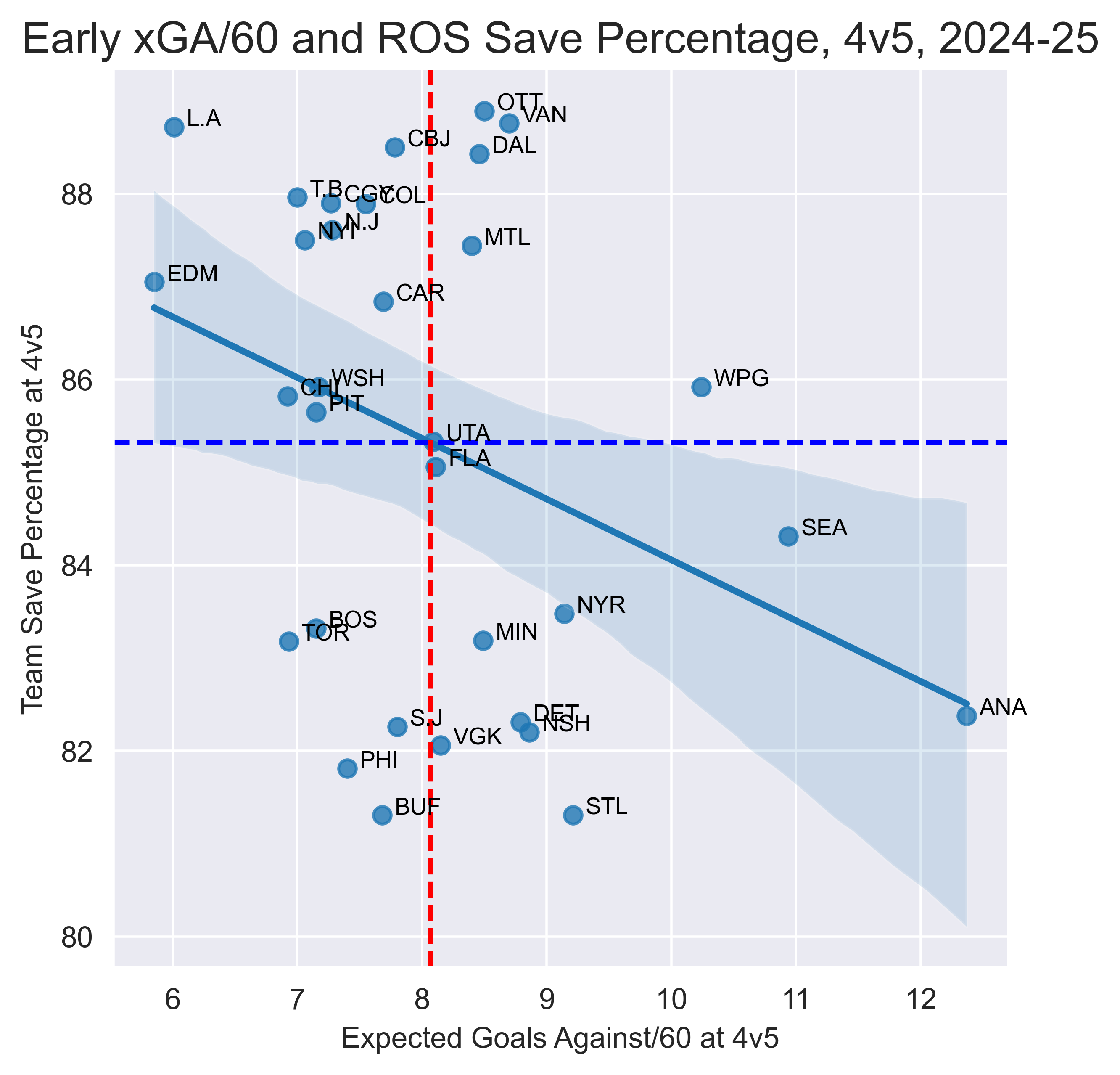
Of the seven teams with the worst early-season PK xGA/60 rates, all but one (Winnipeg) had a worse-than-league-average save percentage over the rest of the season. Conversely, 11/16 teams with a lower-than-league-average xGA/60 rate early in the season had a rest-of-year save percentage higher than the league average.
7 – On An Island
Assuming the rest-of-season downward trend we saw last year between PK xGA/60 and PKSV% is the same as this season, what does it mean for certain teams?
To start with, let’s head to New York to see what the Islanders are up to. What they’re up to is being 1 of 7 teams with a PK goal against rate under 5.5 per 60 minutes despite both Ilya Sorokin and David Rittich having among the highest xGA/60 rates in the league:
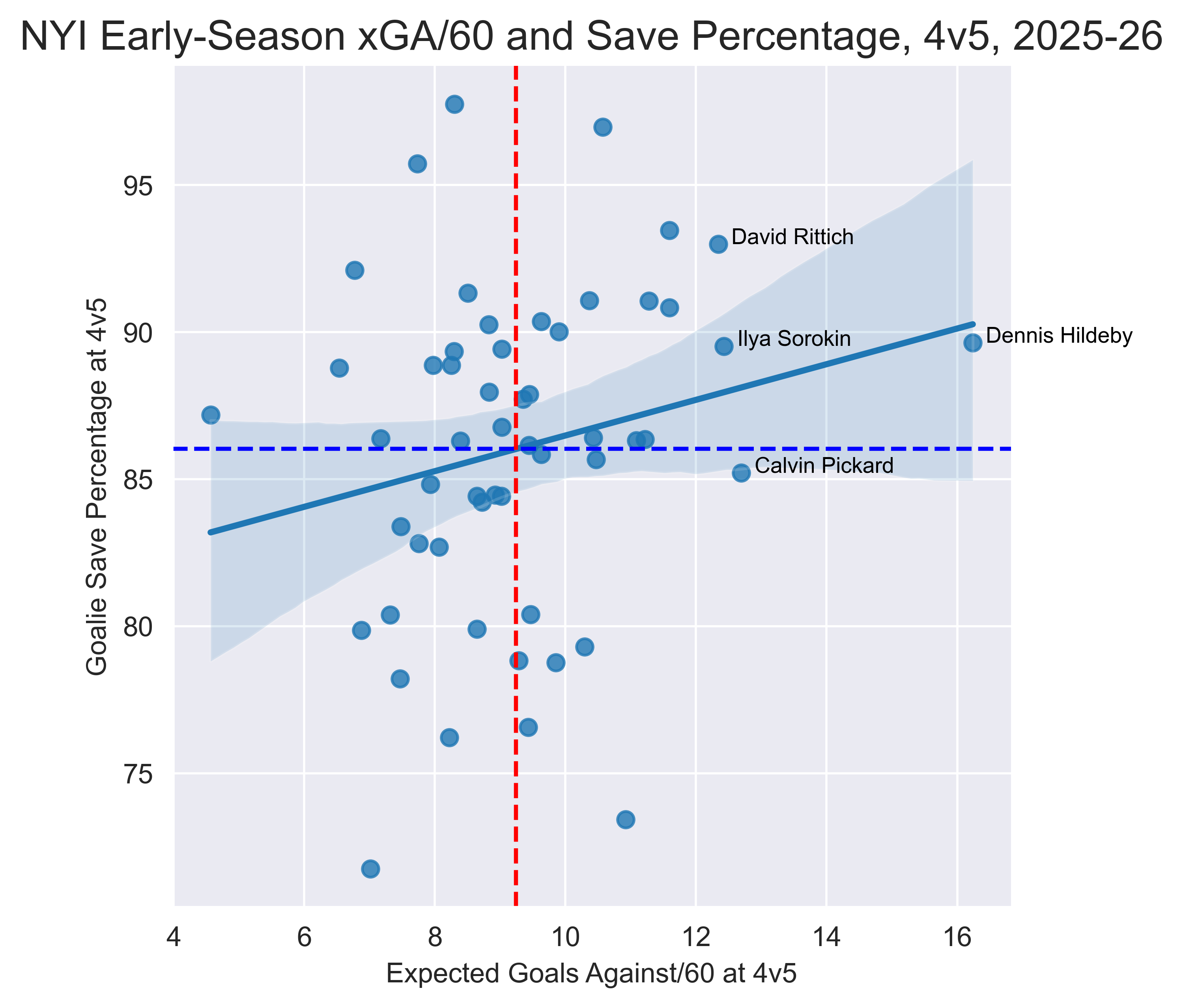
Kudos to the goaltending tandem for being so strong on the PK early in the season, but they likely need a lot more support the rest of the way. Anaheim gave up an extremely high xGA/60 rate early last season and the team PKSV% fell under .830 over the next four months. The Islanders will want to avoid a similar fate.
8 – The Big Smoke
The Toronto Maple Leafs haven’t started the season the way they want to, but their PK goals against rate is better than the league average, which is a miracle considering all their goalies have an xGA/60 rate at-or-worse than the league average (and poor Dennis Hildeby):
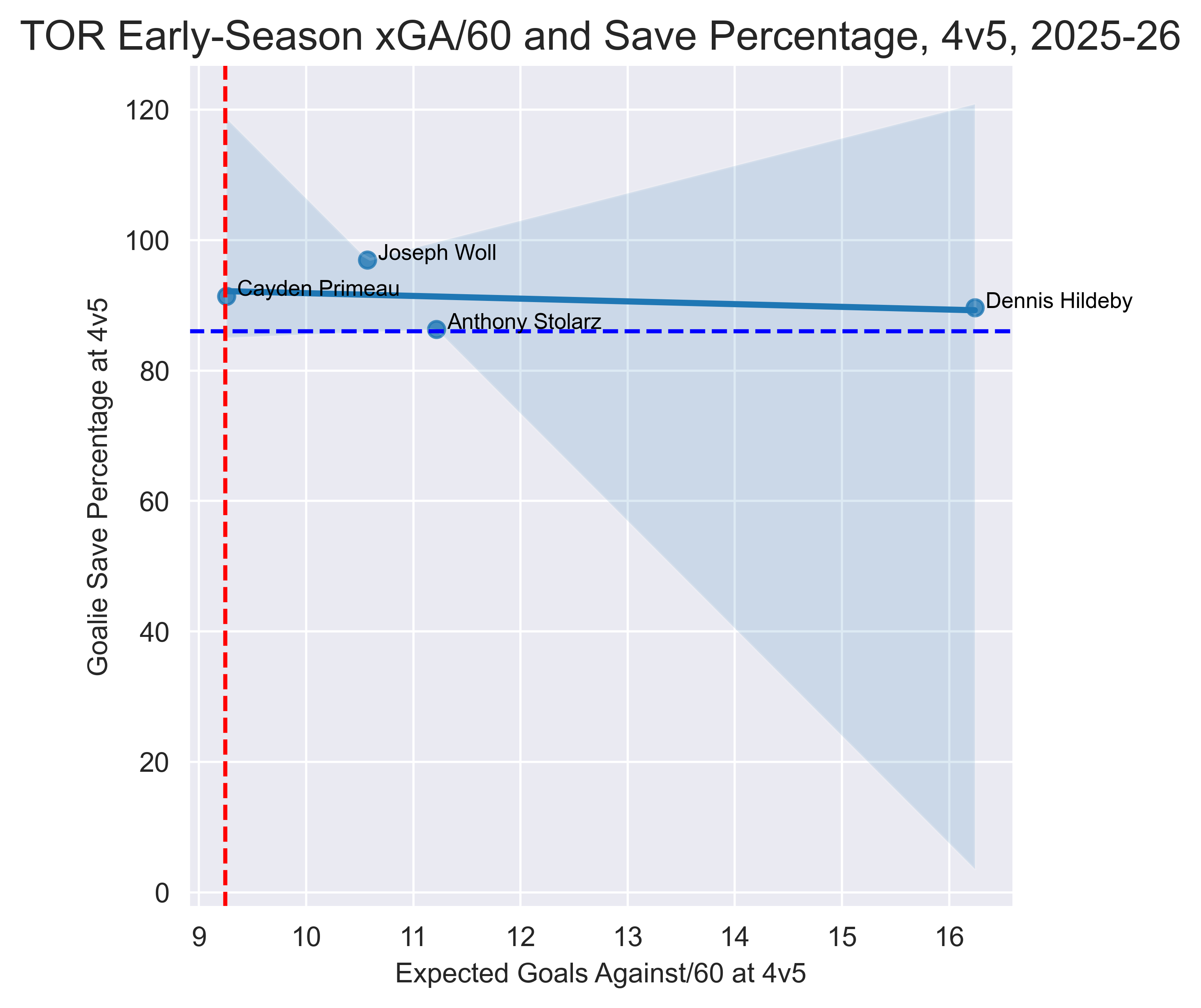
It should go without saying that if the Leafs want to stay in the top-half of the league by rate of goals against on the PK for the rest of the season, the players in front of the goalies have to improve, because the netminders have all been exceptional but the team can’t rely on that for 54 more games.
9 – Oil Leak
Going to Western Canada, the Oilers’ goals against rate on the PK isn’t great – 18th overall – but it’s far from terrible. They should also be thanking their goalies, even if Calvin Pickard’s PK save percentage is slightly worse than league average because he has also seen the highest xGA/60 rate of any goalie in the sample:
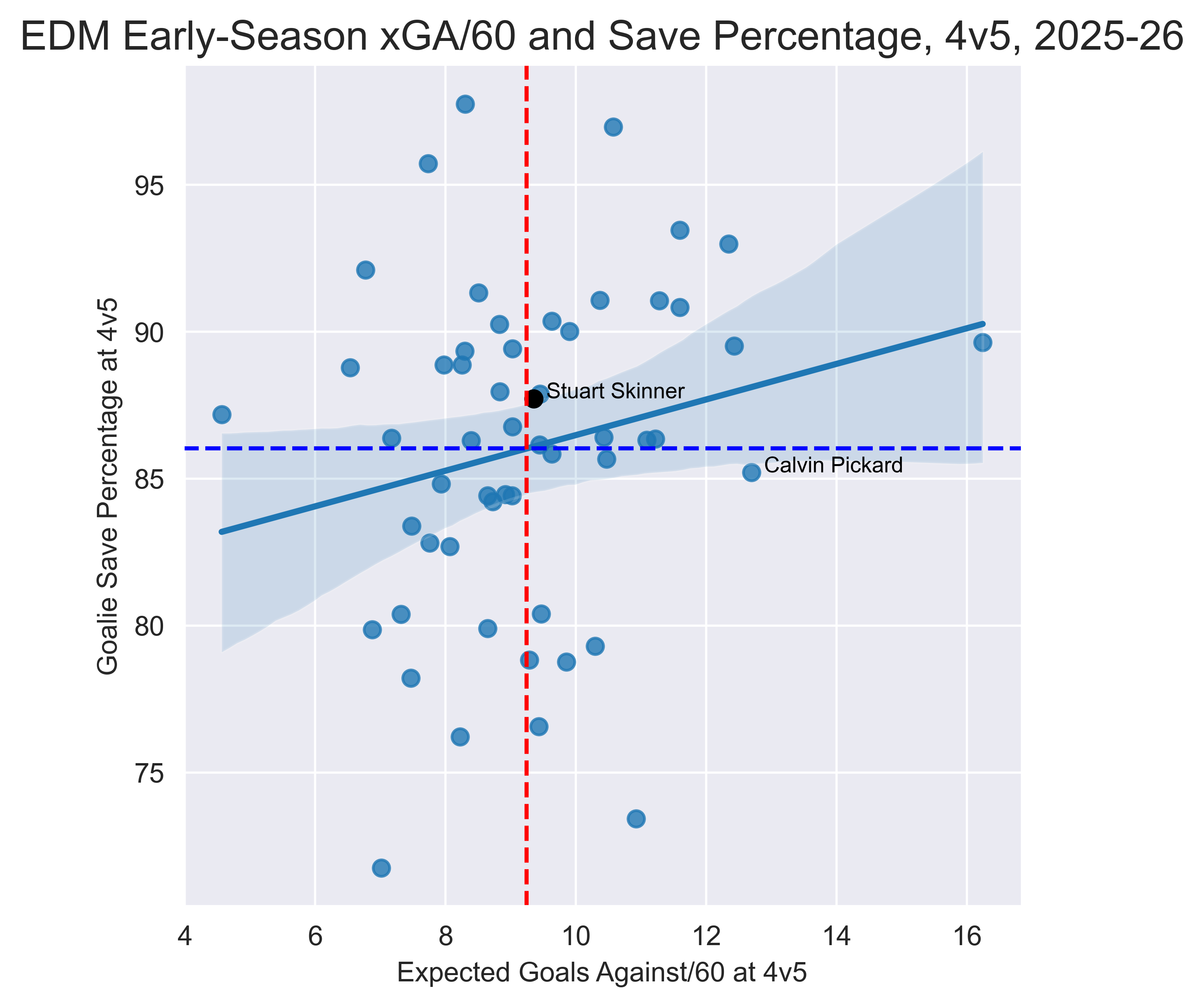
Edmonton has won three of their last four games, outscoring their opponents 19-7. Maybe it’s the start of their turnaround, but they need to do a much better job in front of their goalies on the penalty kill or the goals against are likely going to rise.
10 – Sharks Bite
The San Jose Sharks have managed to stay in the thick of the playoff race two months into the season and their goaltending is a big reason why. That is true on the PK as well, but much more so for Yaroslav Askarov than Alex Nedeljkovic:
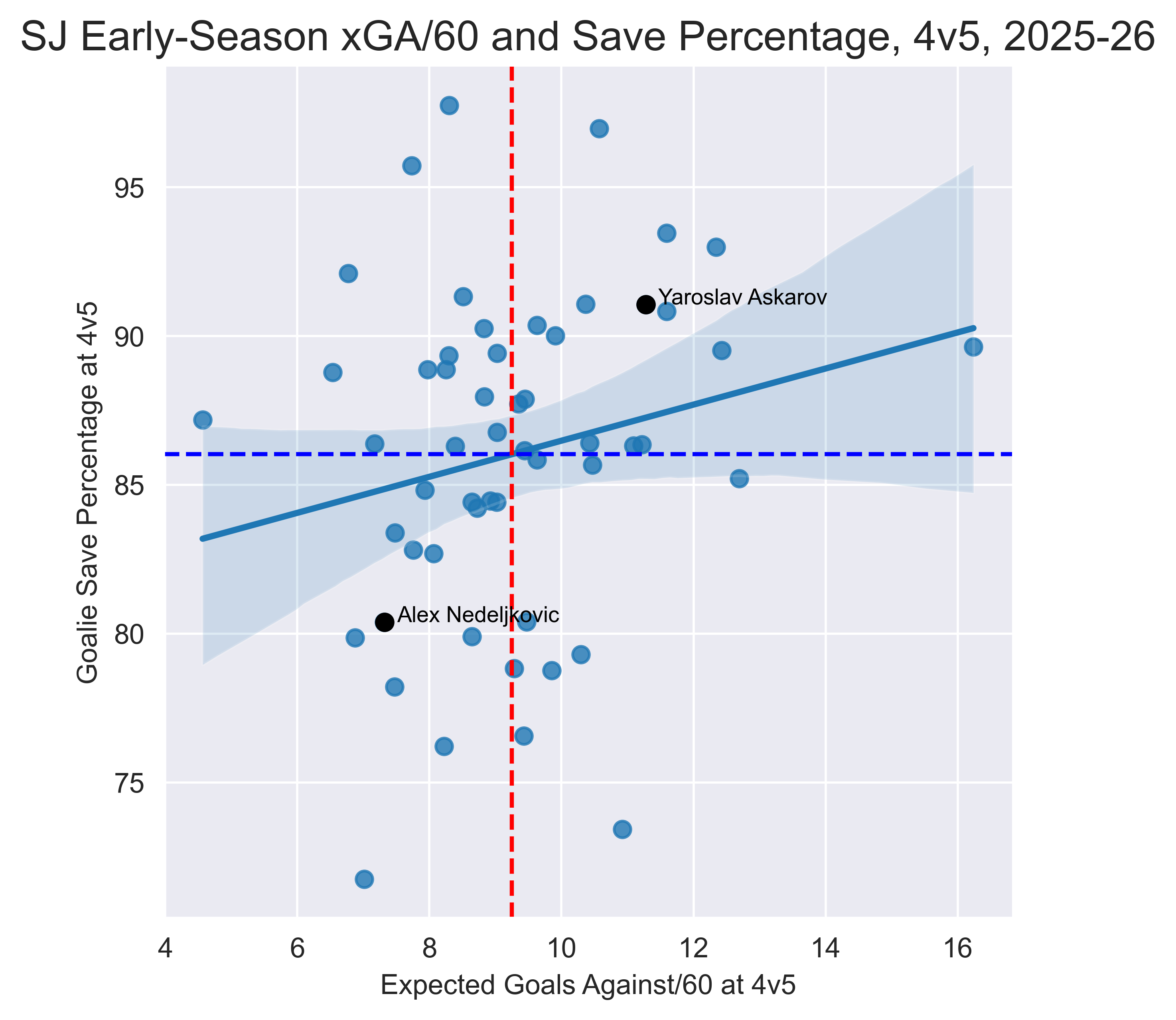
Askarov has been the much better goalie overall this year, but the Sharks are giving up a lot of xGA/60 on the PK in his starts. If they want to stay in the playoff race, they need improvements in a few areas, and their penalty kill is certainly one of them.
Until next week.