10 Interesting (To Me) Stats For This Week - June 16, 2026
Welcome back to another week of ’10 Interesting (To Me) Stats’. This week, we’re going to review some 5-on-4 power play tracking data from All Three Zones.
Last week, I had a thread on BlueSky talking about what kind of tracking stats lead to PP goals for teams and PP points for players. As for the power-play points, we found three stats for both forwards and defencemen that were useful, and this write-up will cover two for each position:
· Forwards – Scoring Chances for each Zone Entry they create and High-Danger Passes for each Zone Entry they create.
· Defencemen – Carried Entries per Zone Entry and the number of Passes they make for every Shot they take.
We will highlight which players performed well at their position across the last two seasons, and what that could tell us about their PP production potential next year. Using various minimum totals, the total sample is 45 forwards and 12 defencemen.
1 – Dylan Larkin (Detroit Red Wings)
Due to Larkin’s trade request, it is worth diving into what he brings outside of his 5-on-5 play. Over the last two years, his 27 power-play goals are tied for seventh in the NHL, and he’s 1 of 40 players with at least 50 power-play points. The reason for that dual production is he has one of the higher scoring chance rates in our sample with a good high-danger pass rate:
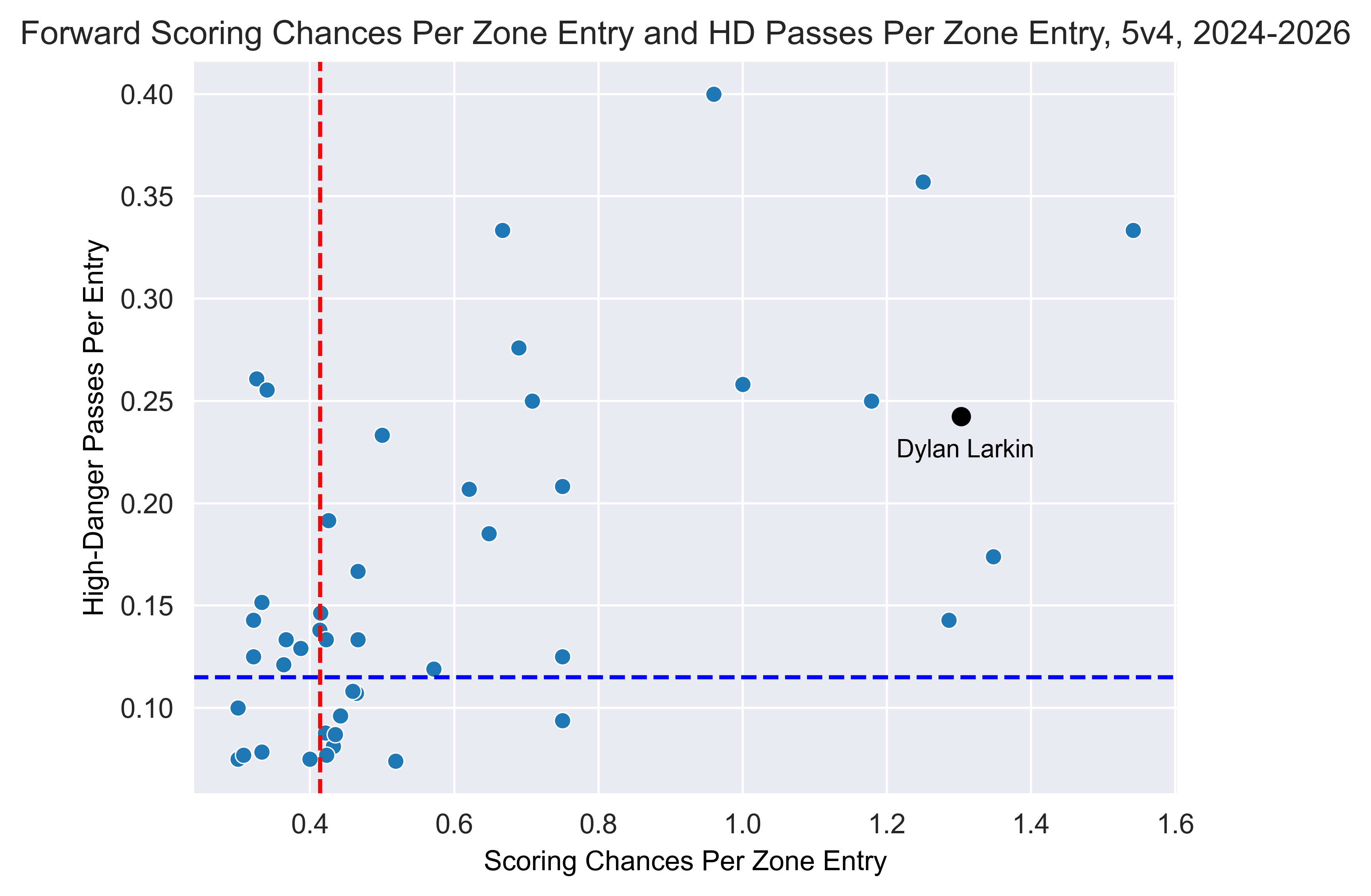
Larkin is a good 5-on-5 player, which is a big part of what makes him a coveted centre. He is also one of the most impactful PP forwards in the league. He will be able to dictate where he wants to go thanks to his trade clause, but it’s a wonder what he’d do in Minnesota with Matt Boldy, Kirill Kaprizov, and Quinn Hughes on the ice for the man advantage.
2 – Oliver Bjorkstrand (Tampa Bay Lightning)
In 98 games with Tampa Bay, 10 of Bjorkstrand’s 17 goals were on the power play. He is a pending free agent, so we should note that Bjorkstrand did have a very similar rate of scoring chances for each zone entry he created to Larkin, but the high-danger passing lagged behind:
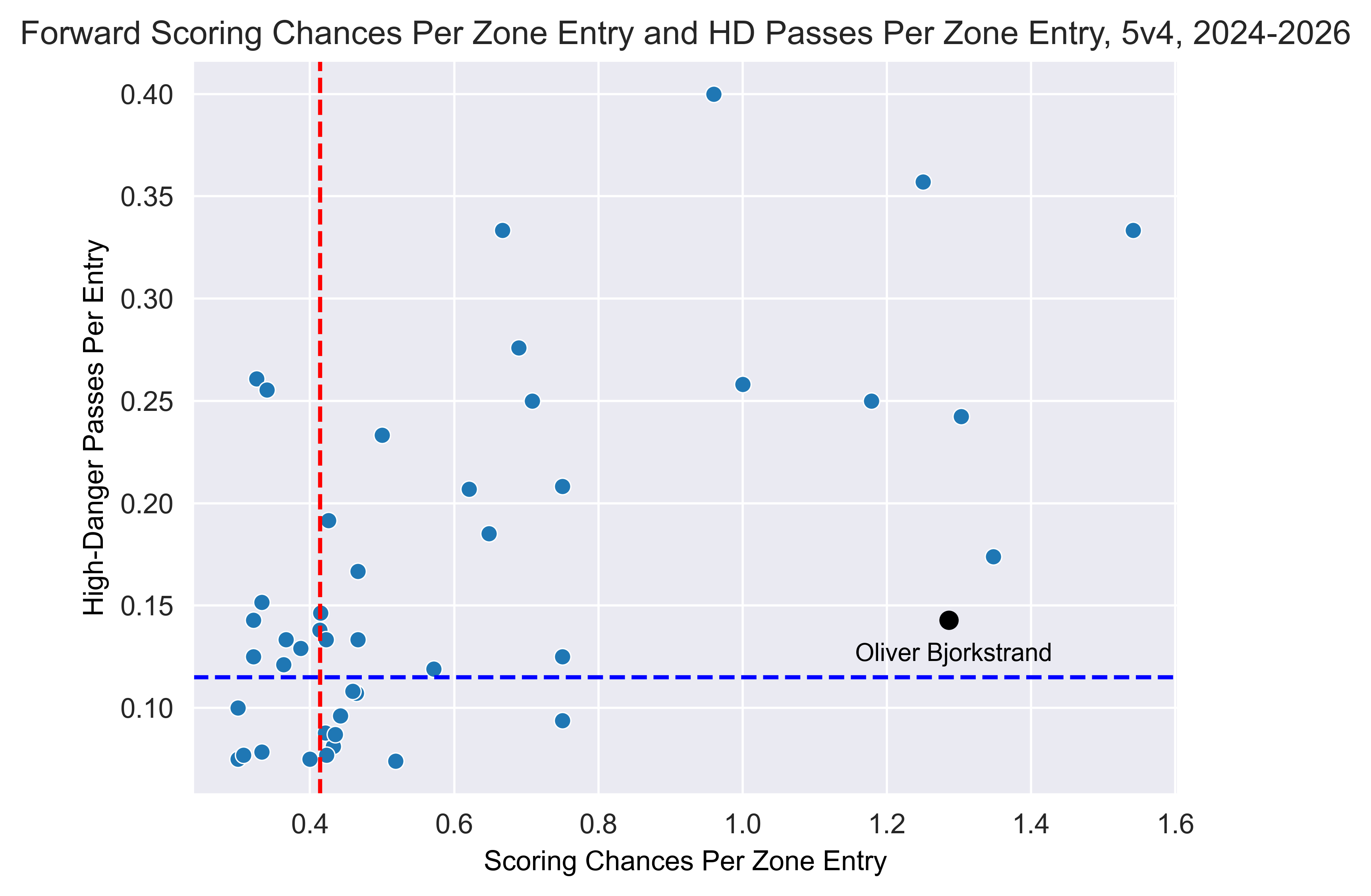
Bjorkstrand was a good second liner for several years but never really seemed to fit in with the Lightning. At the least, he can be a PP goal scorer for a team that needs that kind of boost, and maybe he can regain some of the 5-on-5 talent he showed in Seattle and Columbus.
3 – Mika Zibanejad (New York Rangers)
Zibanejad is known as a power-play goal scorer, and with good reason as he has the fifth-most PP goals over the last decade. It shouldn’t overshadow the fact that, like Larkin, he can also add in some good playmaking, too, which is why he has the highest rate of HD passes per zone entry in our sample:
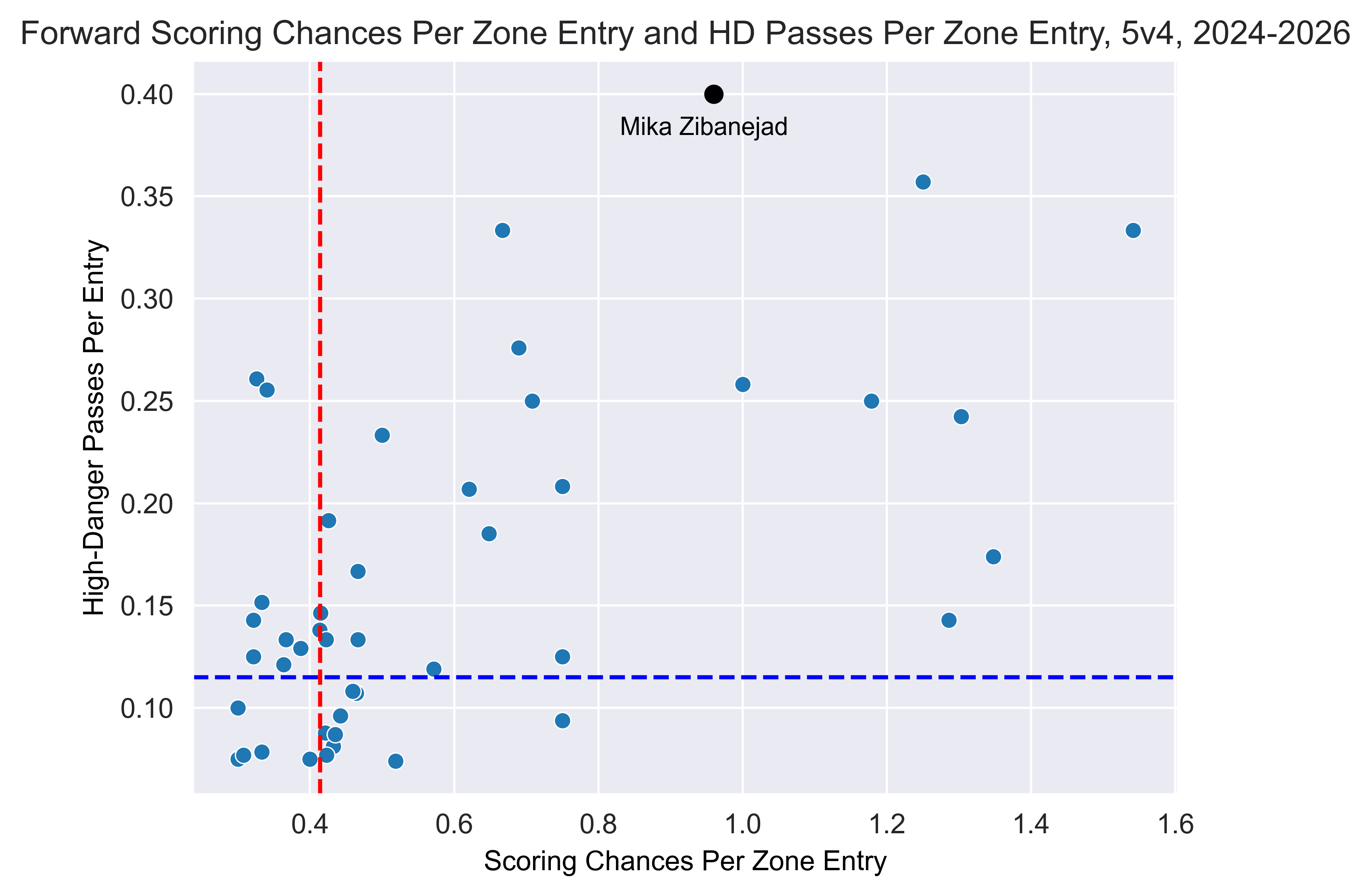
After the Artemi Panarin trade, Zibanejad posted 16 PP points in his final 29 games, putting him in a tie with Connor McDavid for 2nd by PP points in that span. With Panarin gone, Zibanejad should get more puck touches on the power play, and while repeating his 35 power-play points from a year ago will be tough, he has the skills necessary to come close.
4 – Filip Forsberg (Nashville Predators)
Nashville has a new General Manager, and the team will re-tool its group to push for a return to the postseason. What the lineup looks like is uncertain, but what is certain is Forsberg will be there, and he will be impactful not only at 5-on-5, but on the power play:
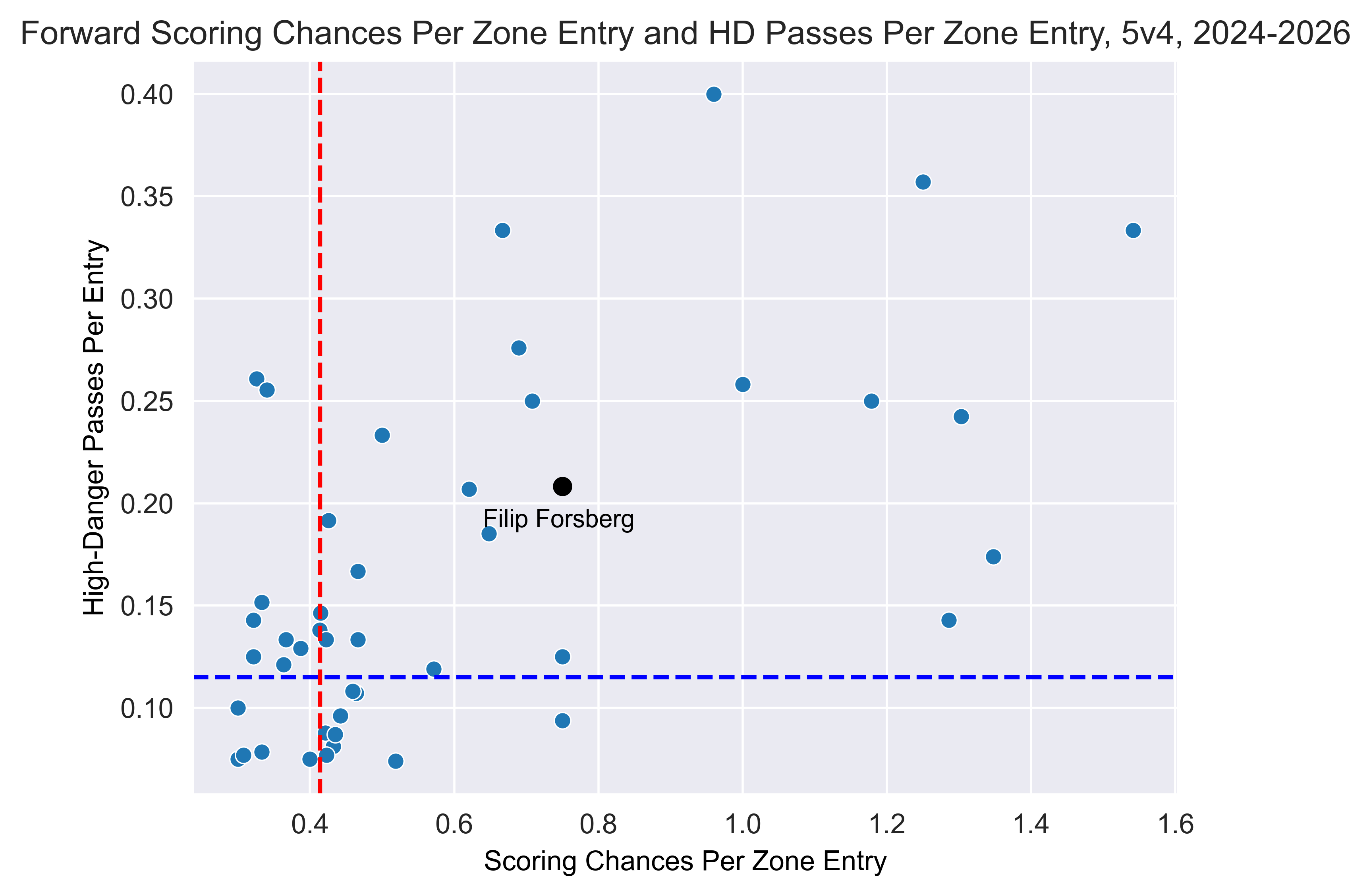
Forsberg is not elite in either area, but is very good in both, and being a balanced player has advantages, such as the opposition not being able to cheat to a pass or a shot. The only questions are whether his aging teammates – each of Roman Josi, Ryan O’Reilly, Jonathan Marchessault, and Steven Stamkos are at least 35 years old – can support him, and whether they all return for the 2026-27 season.
5 – Dylan Cozens (Ottawa Senators)
Here we get to a player who clearly does one thing well, and that’s rip scoring chances. Cozens has the same rate of chances per zone entry as we just saw with Forsberg, but his high-danger passing is below average:
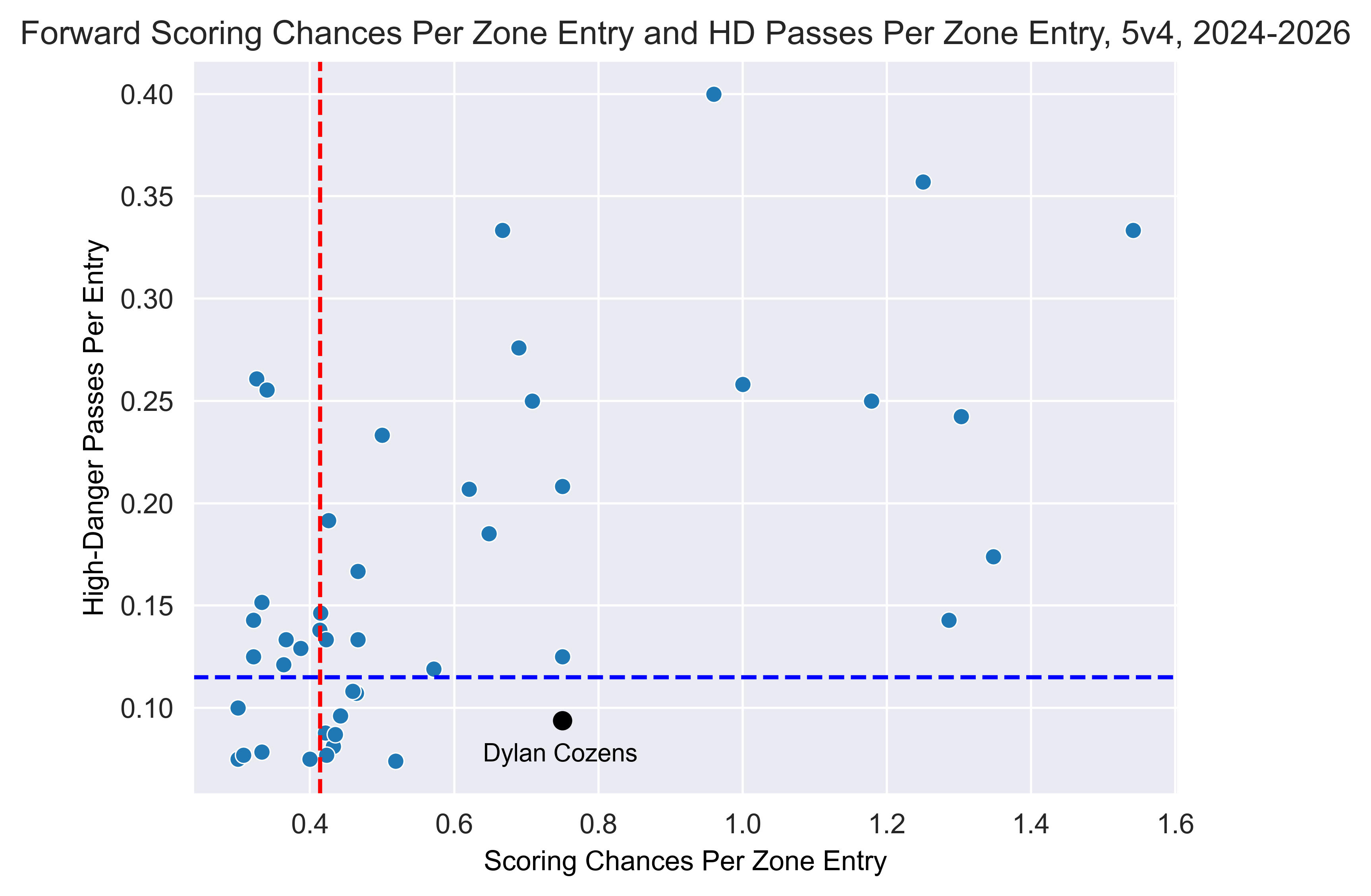
Cozens’ high-danger passing notwithstanding, what is important is that he maintains a regular top PP role. Regardless of his skills, just having a role on a top unit for a team that leads the league in PP opportunities over the last two years will lead to production, which is how he’s managed 21 PP assists in 103 games with the Senators. If the band is back together for the 2026-27 campaign, there’s no reason Cozens can’t push for 25+ PP points again.
6 – Mikael Granlund (Anaheim Ducks)
On a team laden with a few very young, but very high-end, forwards, it is the veteran Granlund that sticks out. Unsurprisingly, he has one of the highest rates of HD passes for each of his zone entries created on the power play over the last two seasons. What is a bit more surprising is that his rate of scoring chances is not only above average, but in the top-third of our sample:
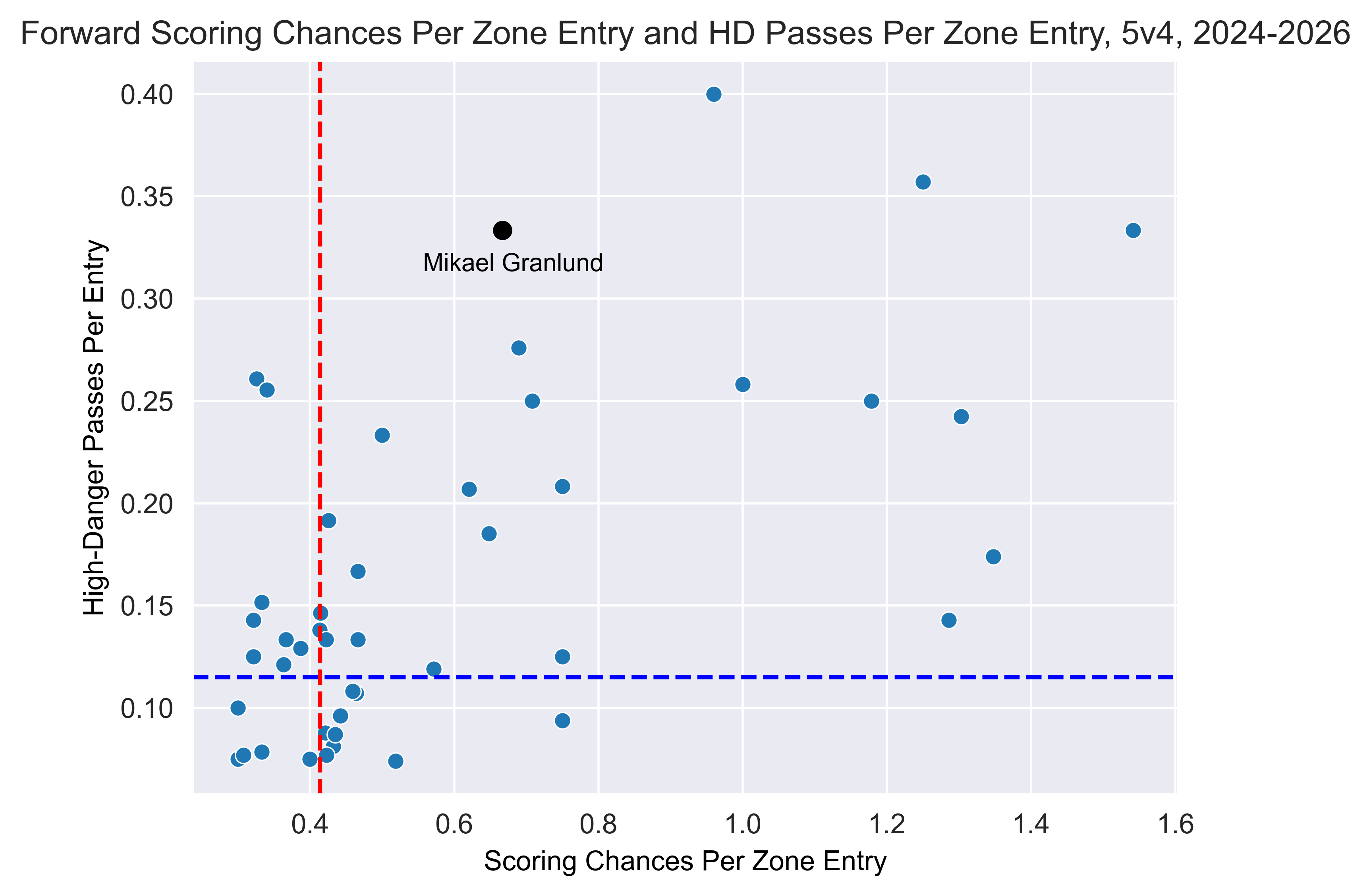
At 34 years old, Granlund is on the downside of his career, but playmaking often ages very well, and he can do just that for the Anaheim power play. What his 5-on-5 role is next season remains to be seen as the young Ducks core improves, but his skills are something their power play needs.
7 – Jordan Eberle (Seattle Kraken)
Eberle was an interesting name to see on our list because the Seattle power play has generally been poor for years. However, like Granlund, he provided a solid rate of scoring chances per entry with a great rate of HD passes per entry:
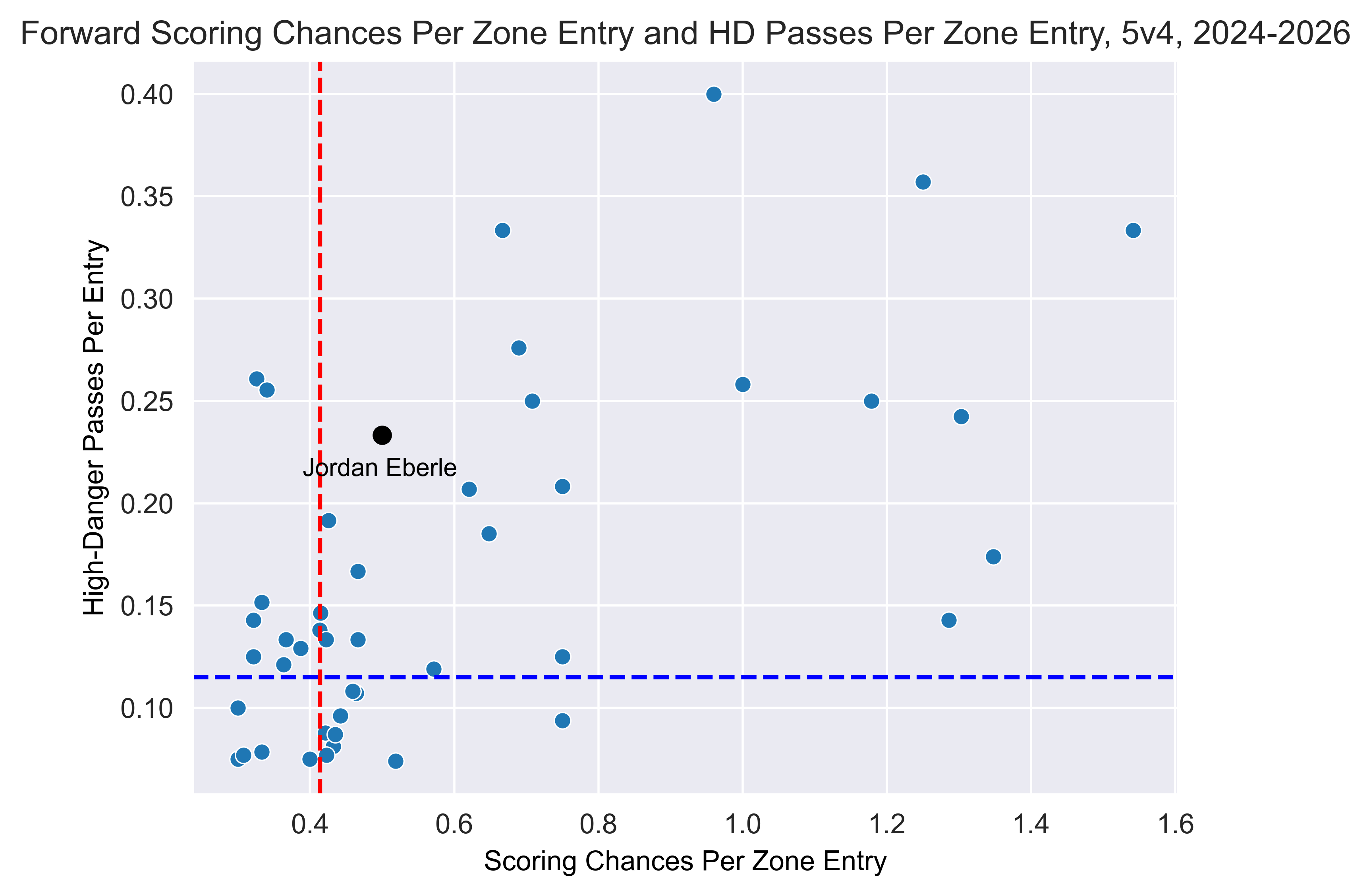
Eberle’s problem isn’t really his problem, but his team’s. If he has these numbers for Tampa Bay or Vegas, his PP production is probably 50% higher than it’s been these last two years. But he doesn’t, and until the team around him gets more dangerous offensively, Eberle’s PP upside is capped.
8 – Jackson LaCombe (Anaheim Ducks)
It seems as if LaCombe’s name shows up in this column every other week, but there’s always a reason, and the reason this week is of the 12 defencemen in our sample, he’s inside the top-4 by both the carries per zone entry and passes per shot taken:
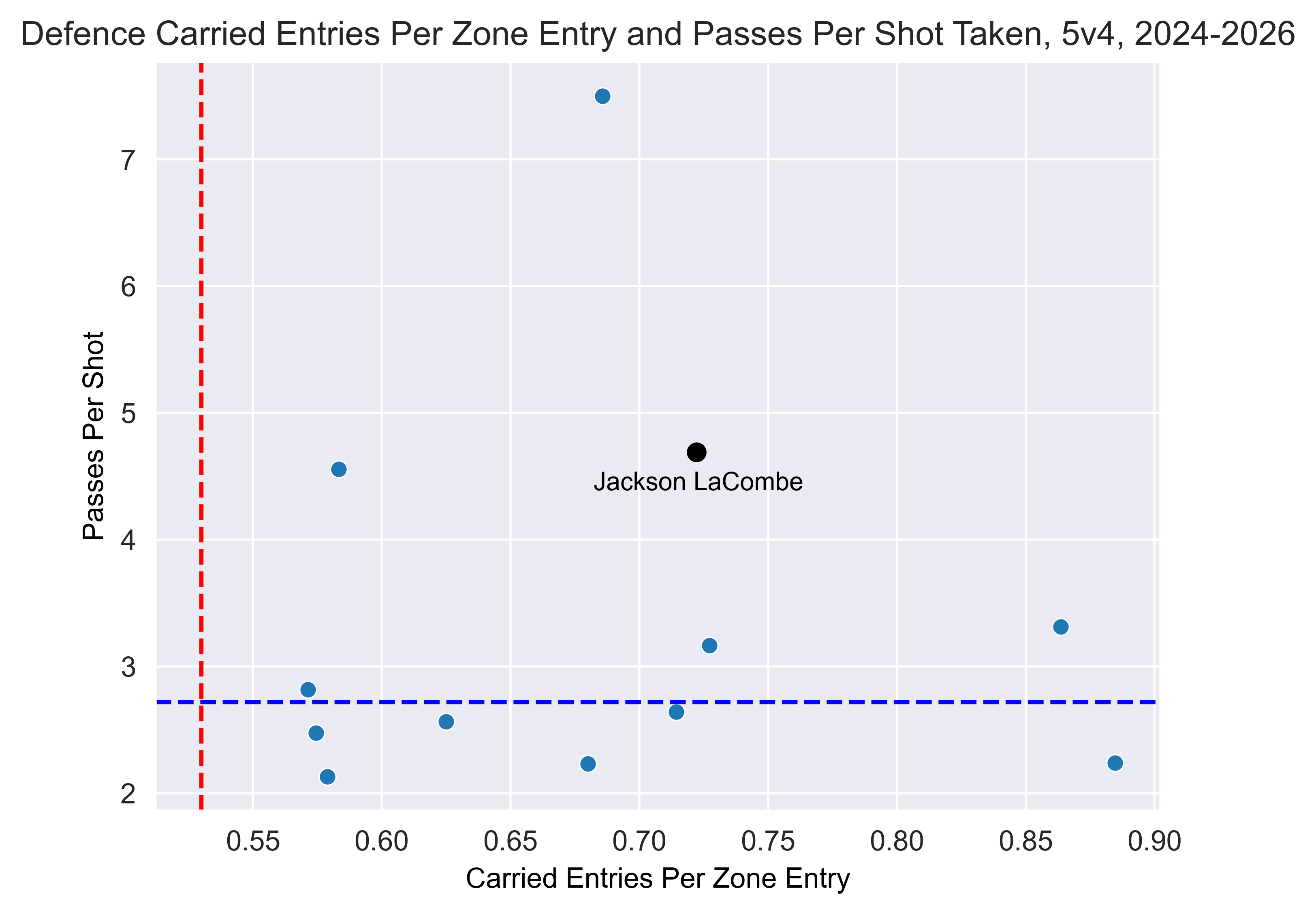
LaCombe lost his PP role to John Carlson when the latter was acquired, but if Carlson doesn’t re-sign, LaCombe is the clear top PP option for the Ducks. With the improvements he and his young forwards have made, we should expect his power-play production to rise in the coming seasons, and maybe as soon as 2026-27.
9 – Lane Hutson (Montreal Canadiens)
It is one thing to understand that Hutson is a distributor who facilitates for his teammates. It is another to see just how far ahead he is of every other defenceman on our list by passes per shot on the power play over the last two years:
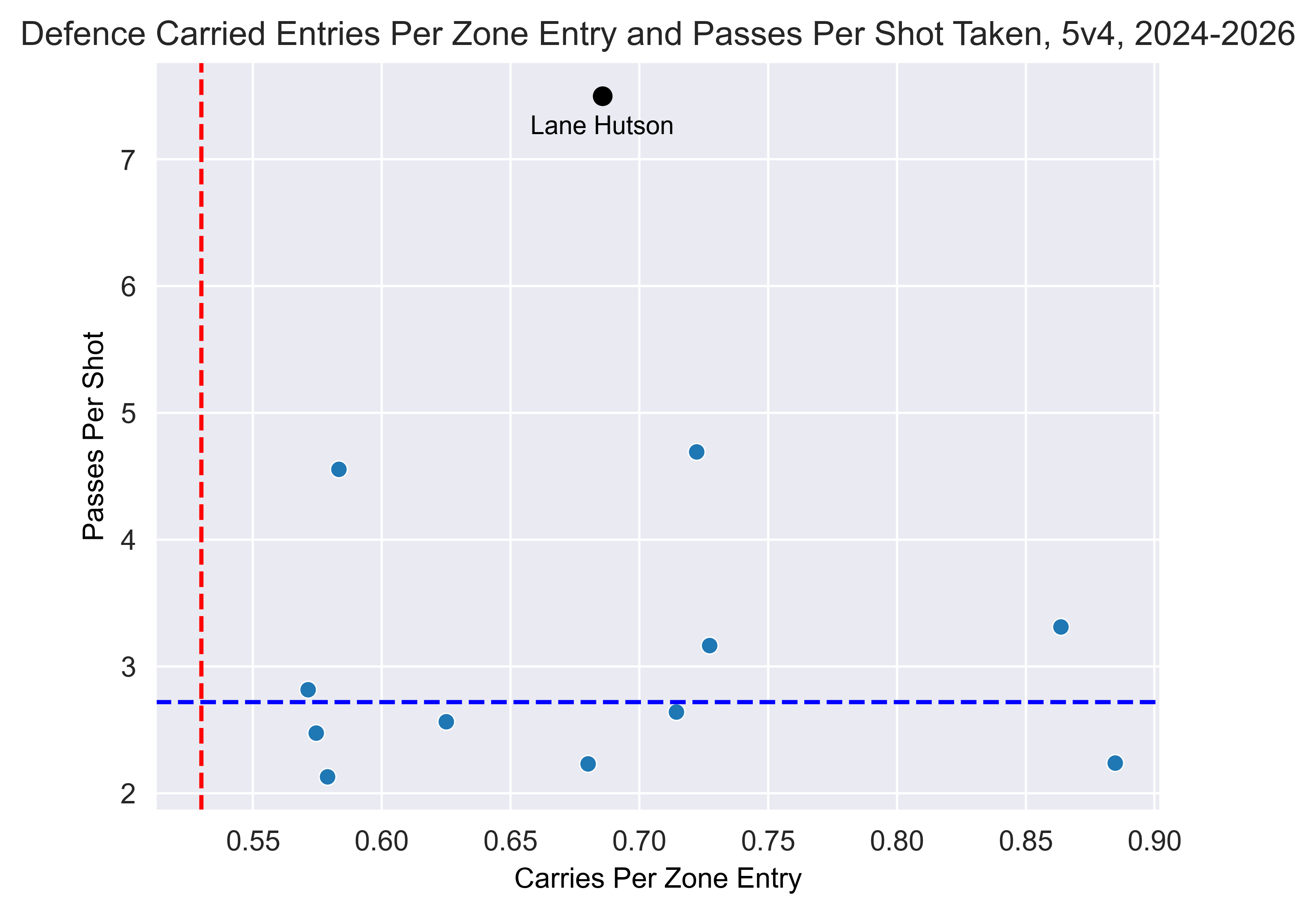
The gap between Hutson’s passes per shot (7.5) and the next-closest player (LaCombe at 4.69) is larger than LaCombe and the 12th defenceman (Jake Sanderson, 2.13). If Hutson can turn his shot into a genuine threat, this level of playmaking will have the Montreal power play be that much more dangerous.
10 – Jamie Drysdale (Philadelphia Flyers)
Hutson is in a tier of his own for passes per shot. In the tier below him are two defencemen, one being LaCombe and the other being Drysdale, and the latter’s rate is over 37% higher than the next-closest blue liner (Roman Josi):
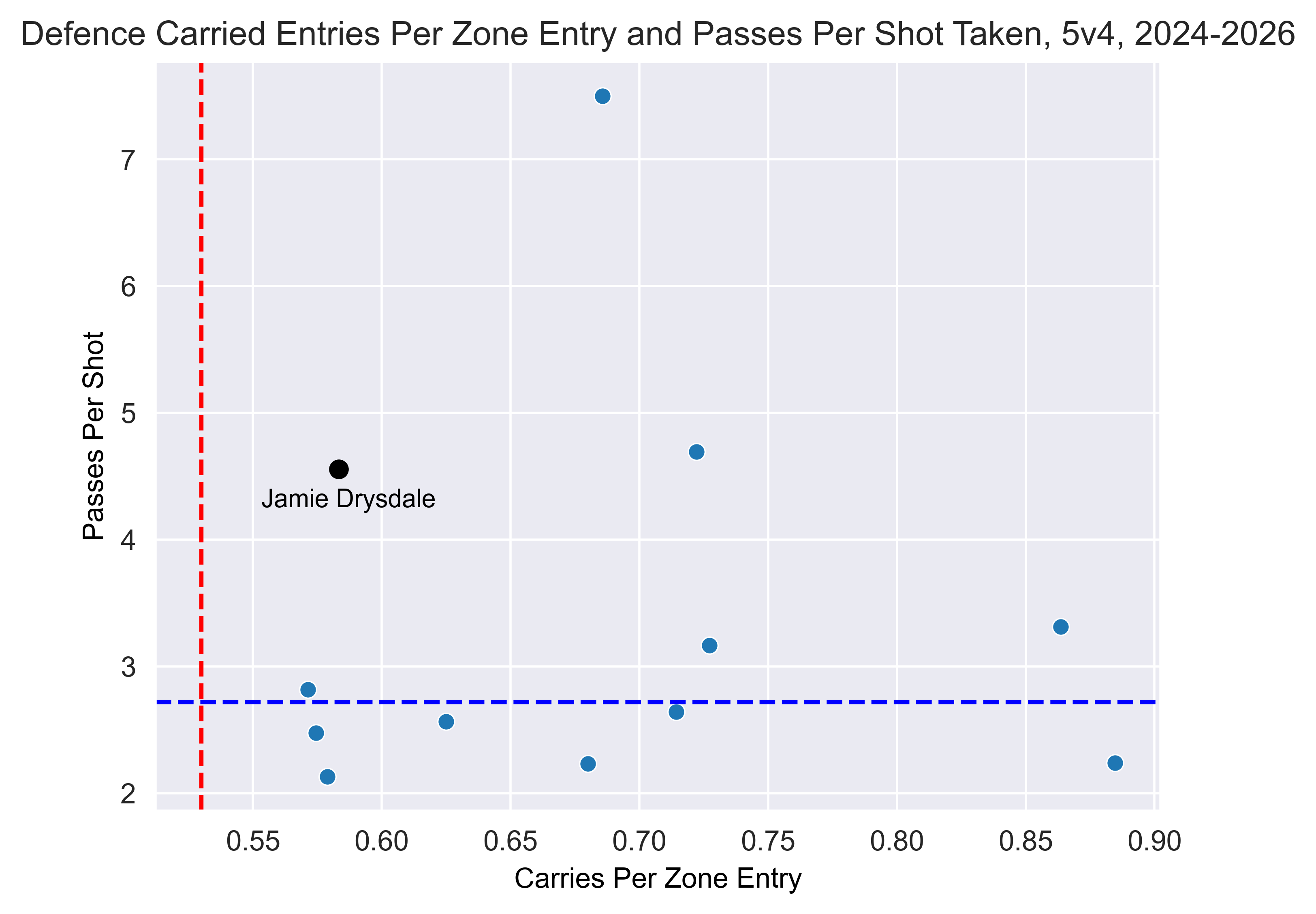
Back in April, this column covered some 5-on-5 improvements Drysdale had in the 2025-26 season. Adding to that is good work on the power play (likely) hampered by skating on a Flyers team lacking reliable, high-end talent. However, if Matvei Michkov rebounds and Porter Martone’s ascension continues, no one may be a bigger beneficiary than Drysdale, both at 5-on-5 and on the power play.
Until next week.