10 Interesting (To Me) Stats For This Week - April 19
Happy Easter weekend out there and welcome back to ’10 Stats’. This week’s edition is coming a few days early because the NHL playoffs are starting so we’re going to do a sort of preview. This week’s edition will cover each series and offer up one (dis)advantage each underdog can exploit to win their first-round matchup other than ‘goalie gets hot/cold’.
As usual, player data is from Natural Stat Trick or Evolving Hockey, tracking data is from AllThreeZones, and viz from HockeyViz. All data as of the morning of April 18th, and underdogs are determined using the betting lines at Pinnacle from the same time.
1 – Special Devil-ivery (New Jersey vs. Carolina)
Not having Jack Hughes or Jonas Siegenthaler is a huge loss for the New Jersey Devils and puts them firmly as underdogs to the Carolina Hurricanes. Despite those losses, the Devils have still managed immaculate play on their special teams. The Siegenthaler injury came on February 4th while Hughes was injured on March 2nd. New Jersey is the only team in the league to be top-8 by goals against per 60 minutes on the penalty kill since February 4th and top-8 by goals-for per 60 minutes on the power play since March 2nd:

No matter the injuries, New Jersey has been able to maintain their status as one of the best teams in the league both on the power play and penalty kill. If they want to get past Carolina, those special teams need to continue their excellence for the next two weeks.
2 – This Is The Way Demigod Made Me (Montreal vs. Washington)
Without heaving too much pressure onto rookie Ivan Demidov’s shoulders, Montreal creating an advantage with their non-top line forwards will be important. Since Alex Ovechkin returned from injury at Christmas, this is how Washington has fared at 5-on-5 with the Tom Wilson/Pierre-Luc Dubois forward pair on the ice, how Montreal has fared with Cole Caufield/Nick Suzuki, and the rest of the forwards from each team:

Washington has had the edge in results from their forward depth, but it’s not a wide chasm of disparity. If Demidov – probably the top drafted prospect to not play in the NHL for most of this season – can drive positive results in his postseason debut, it would go a long way to Montreal managing the upset.
3 – Cooked Ham (Ottawa vs Toronto)
‘Addition by subtraction’ is a mean-spirited term in sports parlance but it’s something that is unfortunately (or fortunately) true for the Ottawa Senators. Defenceman Travis Hamonic has had a very tough season, and he ended up playing just over half of Ottawa’s games in calendar 2025 (24/46). There is a very good reason for that because by shot attempt share, goal share, and expected goal share with Hamonic on and off the ice at 5-on-5, Ottawa is two completely different teams:

To be clear, being a 50.6% goal share team without Hamonic still isn’t great, but it is fine, and it’s the difference between being the Carolina Hurricanes at 5-on-5 and being generationally awful. Ottawa needs more than just this improvement to move past Toronto, but not having dead weight on the blue line improves their chances at creating positive results across all their forward lines.
4 – Even The Playing Field (Tampa Bay vs. Florida)
Defence and goaltending are vital to playoff success, but don’t underrate how important it is to actually score goals: Each of the last three Stanley Cup winners have finished no worse than fifth by 5-on-5 goals per 60 minutes in the postseason. That is why it’s important to note that Tampa Bay’s top two forwards pairs (Kucherov/Point and Hagel/Cirelli) have not only outscored Florida’s top two forwards pairs (Reinhart/Barkov and Bennett/Tkachuk) at 5-on-5, but it’s not even close:

This also presumes that Matthew Tkachuk will be healthy for Game 1, which is still uncertain. Tampa Bay’s top two lines have been exceptional this season and if they can keep that up in the first round, it would go a long way to seeing them move on to the second round.
5 – Grounded Jets (St. Louis vs. Winnipeg)
Winnipeg finished the regular season tied for third by goals-for per 60 minutes at all strengths. A big reason for that was a power play that led the league in goals scored per 60 minutes (third by total PP goals scored because of fewer opportunities than Detroit and Ottawa).
However, injury has forced Nikolaj Ehlers from the lineup and the Jets may be without Gabriel Vilardi as well (he’s TBD). That takes two key members off the top power-play unit and while there hasn’t been a large sample with both out of the lineup, the sample that exists is a big downgrade from what the power play did with them in the lineup:

This is crucial because as good as St. Louis has been under new coach Jim Montgomery, their glaring weakness is a penalty kill giving up the second-most goals per minute since December 1st. If Winnipeg’s power play is a shell of what it was, and they cannot exploit that weakness from St. Louis, it may be enough to tip the series to the Blues.
6 – Shooting Stars (Dallas vs. Colorado)
Dallas being without defencemen Miro Heiskanen and Nils Lundkvist, and the potential loss of forward Jason Robertson, puts them behind the eight-ball immediately. However, Dallas still has one of the best offences in the league (especially if Robertson plays), and they did this by creating a lot of high danger shots – the Stars were tied for the fifth-highest rate of high-danger passes from their forwards this season, and third among playoff teams. Conversely, Colorado was below average at allowing high-danger passes against, and gives up the fifth-most of all playoff teams:
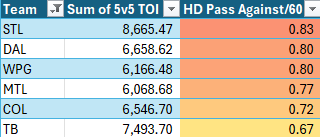
This is also a weakness for Dallas, so Colorado is in the driver’s seat, but if the Stars want to advance, they’ll need a lot of goals, and this is one area where they can create good opportunities.
7 – Minn To The Max (Minnesota vs. Vegas)
Minnesota has endured a lot of injuries this season but looks healthy(ish) heading into the postseason, which is the most vital information here. Secondarily, Vegas finished the season 9th by goal scoring at 5-on-5 and 6th among playoff teams. They did that by creating the second-most offence off the rush in the league, but preventing shots off the rush was an area where Minnesota excelled:

If the Wild can slow down the Golden Knights’ attack and turn this into forechecking/grinding games, they stand a chance at an upset. Otherwise…
8 – Kill ‘Em All (Los Angeles vs. Edmonton)
For the fourth year in a row, the Kings and Oilers face off in the first round. In a total of 18 games in the prior three series, Edmonton scored a preposterous 25 power-play goals. While Edmonton’s full-season power play numbers aren’t great this year, they have had a lot of key injuries (Zach Hyman earlier in the season, Leon Draisaitl and Connor McDavid over the last month-plus). Since Hyman’s injury return in early December, Edmonton’s top PP unit is scoring 12.7 goals/60 minutes at 5-on-4 when that unit is healthy, which is the elite power play we remember.
Here’s the catch: In that same post-December 5th stretch, the Kings’ penalty kill is allowing the second-fewest goals against per 60 minutes with a man in the penalty box:
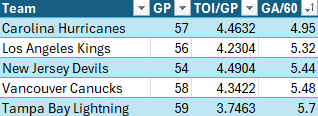
If the Kings can keep the Oilers power play in check, it may be enough to see Los Angeles topple their rival for the first time in four years. That is a big ‘if’, though.
9 – The Opps
We will finish by hopefully dispelling a couple playoff myths.
First off, the idea that referees put their whistles away in the postseason is just flat-out false. It could be that the level of intensity rises so the bar for a penalty is higher, but when comparing the last three regular seasons and postseasons, teams are short-handed (TSH) just as often (actually, slightly more often) every 60 minutes in the playoffs than in the regular season:
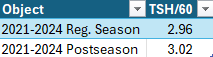
Maybe the bar goes up, but so does the rate of power plays opportunities.
10 – Squad Goals
Defence does win championships, but teams still need to score (as outlined in the Tampa Bay-Florida section). To highlight this, yes, goal scoring rates do decline in the playoffs, but not as much as we may think:
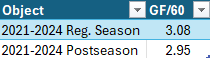
That decline is about 4.2% from the regular season. To put it into perspective, playoff games last about 62.2 minutes on average (factoring in overtimes), so that drop-off means roughly one fewer goal every eight games. Teams still need to score to win in the playoffs – just ask the Toronto Maple Leafs.
Until next week (April 29).