10 Interesting (To Me) Stats For This Week - May 5
Welcome back to another edition of ’10 Interesting (To Me) Stats’ as we continue the NHL playoff coverage. We are down to the final eight teams and all four series have very specific matchups we should watch for.
As always, player data is from Natural Stat Trick and tracking data is from AllThreeZones.
1 – Washington
At 5-on-5 in the regular season, 19.6% of Washington’s 5-on-5 shot attempts were of the high-danger variety, fourth in the league behind very good offensive squads in Dallas, Winnipeg, and Tampa Bay. At the time they eliminated Montreal, Washington also led the postseason in this regard.
The rub is that while Carolina does a tremendous job limiting shots against overall at 5-on-5 (lowest rate in the regular season), 29.5% of the shots they did give up were of the high-danger variety. That was the highest rate in the league and in some very bad company:
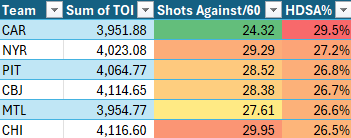
Washington was great both in the regular season and in the first round at getting to the middle of the ice for their shots. Carolina was awful at allowing that specific type of shot. It is a mismatch in Washington’s favour, and big enough to tip the entire series.
2 – Carolina
With the return of Aliaksei Protas, Washington’s forward group is back at full strength. It is something Carolina has typically boasted, but Andrei Svechnikov’s regular-season struggles made it more of a question mark than in prior seasons.
That is why it’s hard to overstate the importance of Svechnikov’s play in the first round. Whether skating on the depth line with Jesperi Kotkaniemi, or on the top line with Sebastian Aho, he made both lines better by driving shot attempts, and to a significant degree:

An injured New Jersey team is not the same as a healthy Washington team, but if Carolina wants to advance, they’ll need contributions from all four lines. To do that, they’ll need Svechnikov to carry forward this performance and shake off the below-average play he’s often shown in the last couple of years.
3 – Toronto
Toronto will need three lines in this series, which is what makes the play of their ‘fourth’ line so important.
By the end of the Toronto-Ottawa series, their ‘fourth’ line of Calle Järnkrok, Scott Laughton, and Steven Lorentz was their third line, at least by ice time. Importantly, that new third line was finding success by carrying the play by both shot attempt share (CF%) and expected goal share (xGF%):

Toronto will need a repeat performance from the Laughton line if they want to compete with Florida’s depth and advance to the East Final.
4 – Florida
To expand on the point of Florida being a three-line team, we know how good Aleksander Barkov and Sam Reinhart are together, and we’ve seen Matthew Tkachuk and Sam Bennett have great success for years. The addition of Brad Marchand to the duo of Anton Lundell and Eetu Luostarainen, though, is a big one as that trio not only outscored Tampa Bay 4-0 in their time together at 5-on-5 in the first round, they did so while comfortably controlling the play:

That is what makes the play of the Laughton line so important. If Toronto’s top two lines are playing at their best, they can match up well against Florida’s top two lines. But if Toronto’s bottom-6 forwards aren’t at their best, they’ll be eaten alive by this Lundell line.
5 – Edmonton Oilers
Edmonton went 0-for-5 on the power play in their first two postseason games and then went 5-for-8 over their final four games. It was a big reason for their advancement to the second round.
Zach Hyman returned from injury back on December 5th, and here has how Edmonton’s top PP unit has fared at 5-on-4 since that time, including the postseason, around the core three players of Connor McDavid, Leon Draisaitl, and Evan Bouchard:

This is important because while Vegas doesn’t give up a lot of power-play opportunities, they finished the regular season 26th by goals against per minute a 4-on-5, were 22nd from the Four Nations break onward, and were fine (not great) against Minnesota, a team that has had a bad power play all year. If the Oilers can take advantage of a great PP matchup, however infrequent those opportunities are, it’ll go a long way to getting them back to the West Final.
6 – Vegas
In the second half of Game 4 against Minnesota, Vegas moved William Karlsson to the top line alongside Jack Eichel. Vegas won that game 4-3 in overtime, won the next two games, and moved on to the second round.
It is hard to overstate the impact Karlsson had on the top line. Through the first three games, Eichel had zero points, and he was getting rolled over by the Wild. Then, Karlsson was moved up, and Eichel’s performance at 5-on-5 improved drastically across the board:
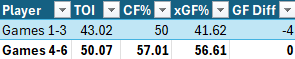
Vegas wants to get these results from Eichel and Mark Stone without needing to promote Karlsson, but playoffs are not the time to make hope a plan. If this is the change needed, so be it, because they can’t have the Eichel/Stone duo get run over by the likes of McDavid and Draisaitl.
7 – Dallas
After Dallas’ thrilling Game 7 win over Colorado, we got word that both Miro Heiskanen and Jason Robertson are likely to return in Round 2 – it’s just a matter of whether it’s Game 1 or later in the series.
Dallas will have a decision to make on defence once Heiskanen returns. While Alex Petrovic is likely to get scratched – he only played five regular-season games and is in the lineup because of extremely poor play from Mathew Dumba – they might want to give that move a lot of thought. The defence pair of Petrovic and Lian Bichsel led Dallas’s defence pairings by both shot attempt share and expected goal share at 5-on-5, and it wasn’t really close:

The pair was outscored (+2/-3) but considering how bad the third pair was after the Heiskanen injury, this is finding a water fountain in the middle of the Sahara. Petrovic likely sits, but it won’t be because of how he and Bichsel played together.
8 – Winnipeg
The health of key members from the Winnipeg Jets lineup is both imperative and uncertain. Notably, star defenceman Josh Morrissey was injured early in Game 7 against St. Louis and did not return. If he misses any time, the rest of the blue line will need to pick up the slack, and Dylan Samberg in particular. He seems up for the task as his performance in the first round was tremendous, being 1 of 2 defencemen to be at least one standard deviation above average by expected goal share and actual goal share relative to their team at 5-on-5:

Samberg had a great regular season and has carried that play into the postseason. He is now facing a Dallas Stars team with three good-to-great scoring lines, so if Morrissey misses more games, Samberg will be a key factor in keeping the Jets in those games.
9 - Ottawa
The playoffs aren’t the time for moral victories, it’s important to highlight a key success for the Ottawa Senators: The third defence pair of Tyler Kleven and Nikolas Matinpalo.
This third pair for Ottawa struggled in the regular season but came up big for the team in the playoffs. In their minutes together, they were the only Ottawa defence pair to be above 50% by both expected goal share and actual goal share at 5-on-5:

To be clear, with Ottawa’s line matching, this pair was largely kept away from Toronto’s top line, and it is a small sample, so grain of salt and all that. All the same, if this pair can drive positive results in the 2025-26 regular season, even in secondary matchups, it gives Ottawa a point of strength that they’ve been missing.
10 – Colorado
There will be a lot to dissect from the Colorado-Dallas series, but here’s one very important point: With Jonathan Drouin on the ice at even strength, Colorado was outscored 6-0, and he was their only forward with a negative shot attempt differential. What is worse is that his most common line mate was Brock Nelson, and Nelson’s numbers were considerably better without Drouin on his line:

Drouin missed nearly half the season due to injury, so maybe there’s a lingering issue here, but he played poorly in the postseason, and that’s not great timing for him as he hits free agency this offseason.
Until next week.