10 Interesting (To Me) Stats For This Week - June 9, 2026
Welcome back to another week of ’10 Interesting (To Me) Stats’! A month ago, this column reviewed some of the top performers from the first round of the NHL Playoffs. Today, we’re going to do the same kind of review, but only considering players whose teams made it past the first round, using numbers for the entire postseason.
Tracking data is only 5-on-5 play and it’s from All Three Zones. Player/team data is from Natural Stat Trick. The red and blue lines are the playoff average in those stats at the player’s position.
1 – Nikolaj Ehlers (Carolina Hurricanes)
Of the seven tracking stats I used for this evaluation, and of the 87 forwards in the sample, Ehlers ranked inside the top-8 in all seven categories, and top-5 in five of them, covering playmaking, transition play, offence off the rush or cycle, and more. It has been nothing short of an MVP effort.
We will focus on the offensive style, as he’s been among the most involved forwards in these playoffs both off the rush and off the cycle/forecheck:
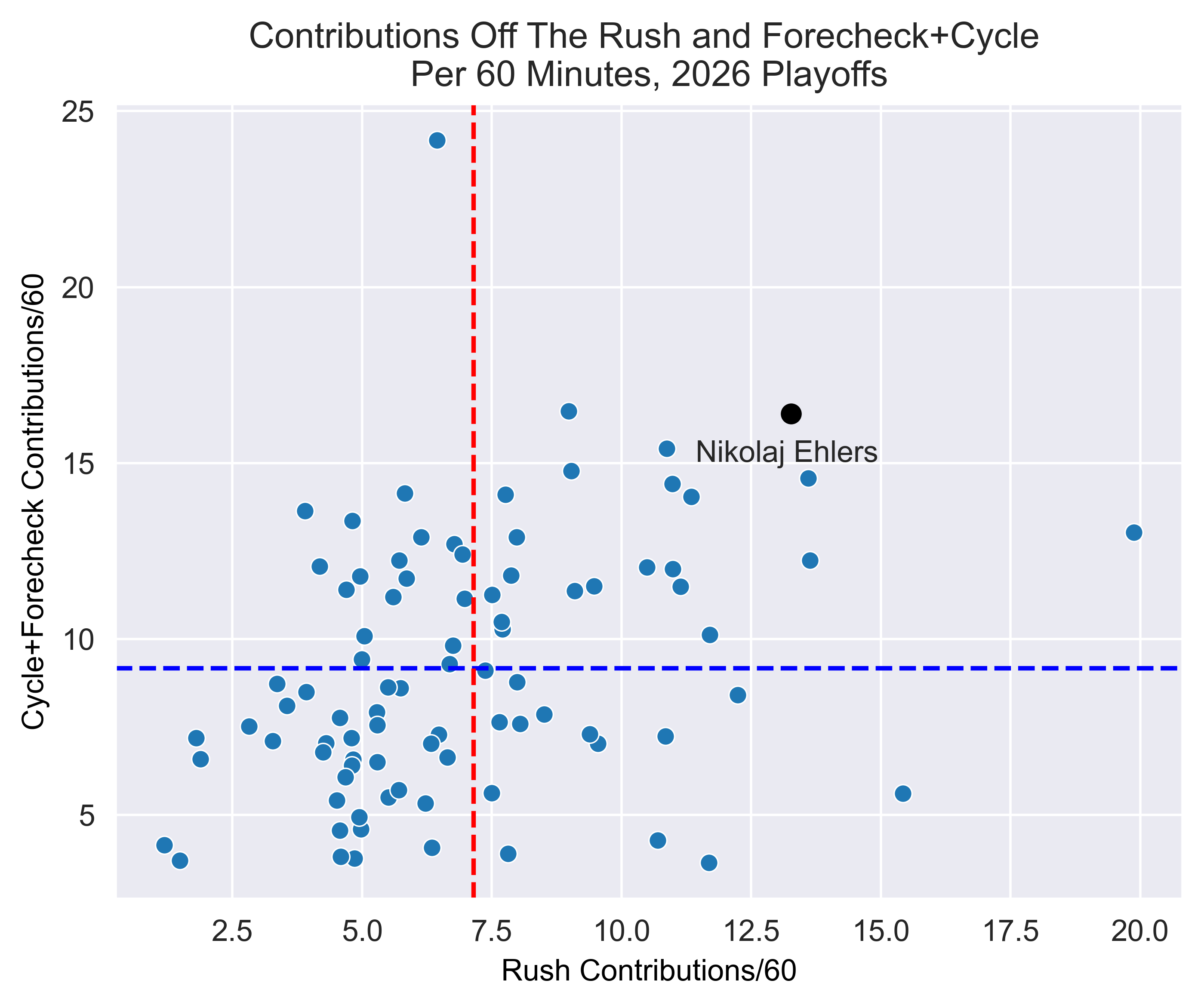
The other stats are all great for Ehlers, but the fact that he’s been able to have great performances elsewhere while having high rates off both the rush and cycle shows his true versatility. Just an incredible three-round performance.
2 – Mark Stone (Vegas Golden Knights)
Mitch Marner has (justifiably) been getting a lot of attention during Vegas’ run to the Cup Final. What should be highlighted is that despite being in his mid-30s and fighting injury, Stone led all forwards in the data by scoring chance assists, backing it up with a top-10 rate of contributions (shots and assists) off the cycle/forecheck:
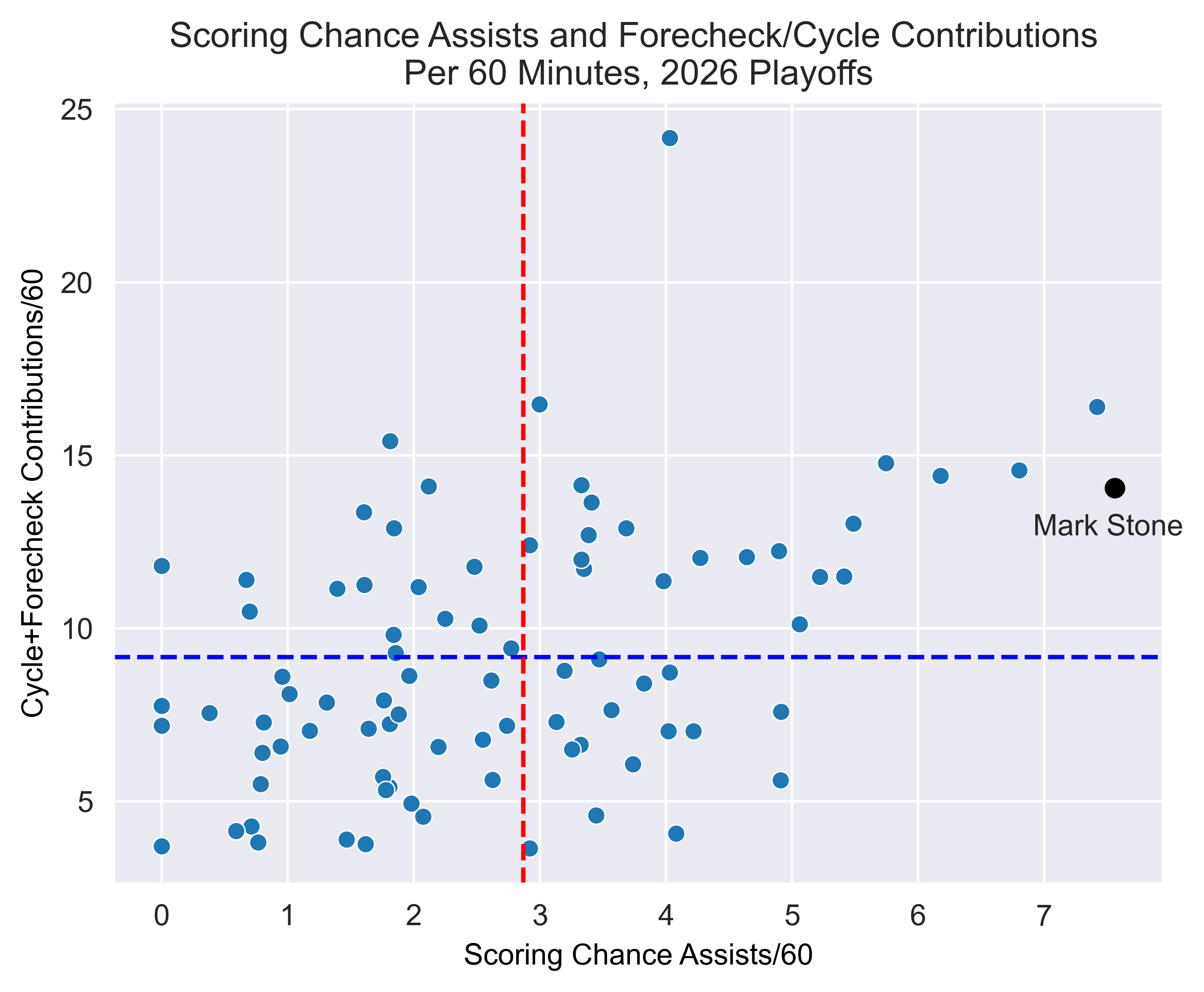
Stone missed time in the first three rounds, but at 5-on-5, he led their forwards in assists per 60 minutes, clearing the next-closest Vegas forward (Jack Eichel) by 20%. Stone is clearly not playing at the level that he’s capable of, and injuries are a big reason why, but he’s still finding ways to contribute how he can. Being able to help elevate players around you despite being a step behind (regardless of the cause), is one of those things that can help teams to a Stanley Cup.
3 – Jack Quinn (Buffalo Sabres)
Back in April, this newsletter highlighted Quinn’s improved tracking data from the regular season. He continued showing those improvements through Buffalo’s two postseason rounds, especially if we highlight the chance assists and cycle/forecheck contributions that we just noted for Mark Stone:
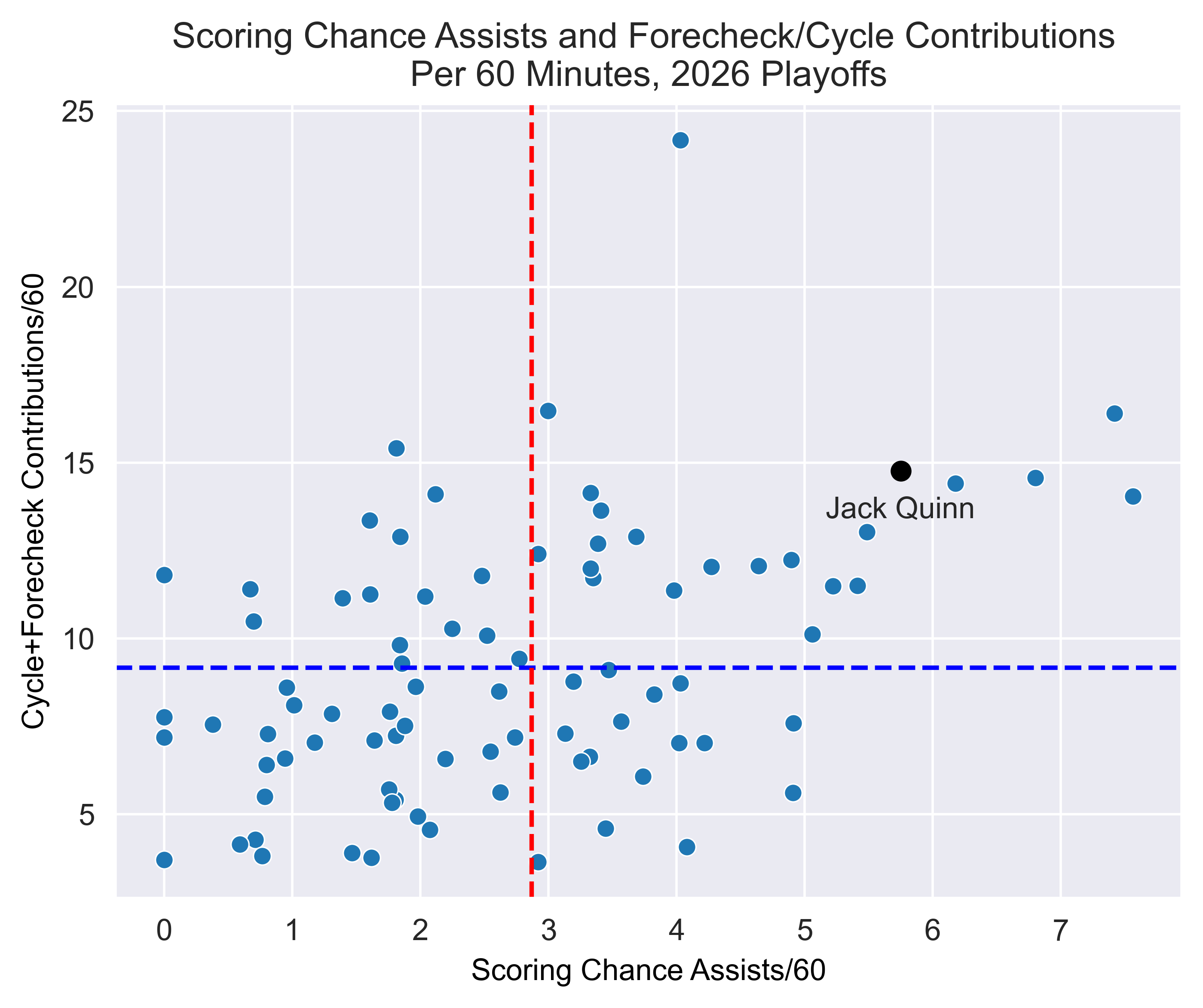
Quinn was the fifth-ranked forward by both chance assists and cycle/forecheck contributions through Buffalo’s two rounds. It didn’t lead to a lot of production – just three points at 5-on-5 in 13 games – but that is the kind of underlying process we like to see from a young player looking to regain his form after a brutal Achilles injury. Quinn’s strong playoff performance after a similarly strong regular season is a great sign for the Sabres.
4 – Taylor Hall (Carolina Hurricanes)
In 13 games across the first three rounds, Logan Stankoven scored nine goals, and that will attract attention. It is a tremendous performance, no doubt, but someone has to get Stankoven the puck, and Hall assisted on six of those nine goals. Unsurprisingly, then, Hall had an elite rate of scoring chance assists and was sixth in our data by high-danger passes (from behind the net or across the slot):
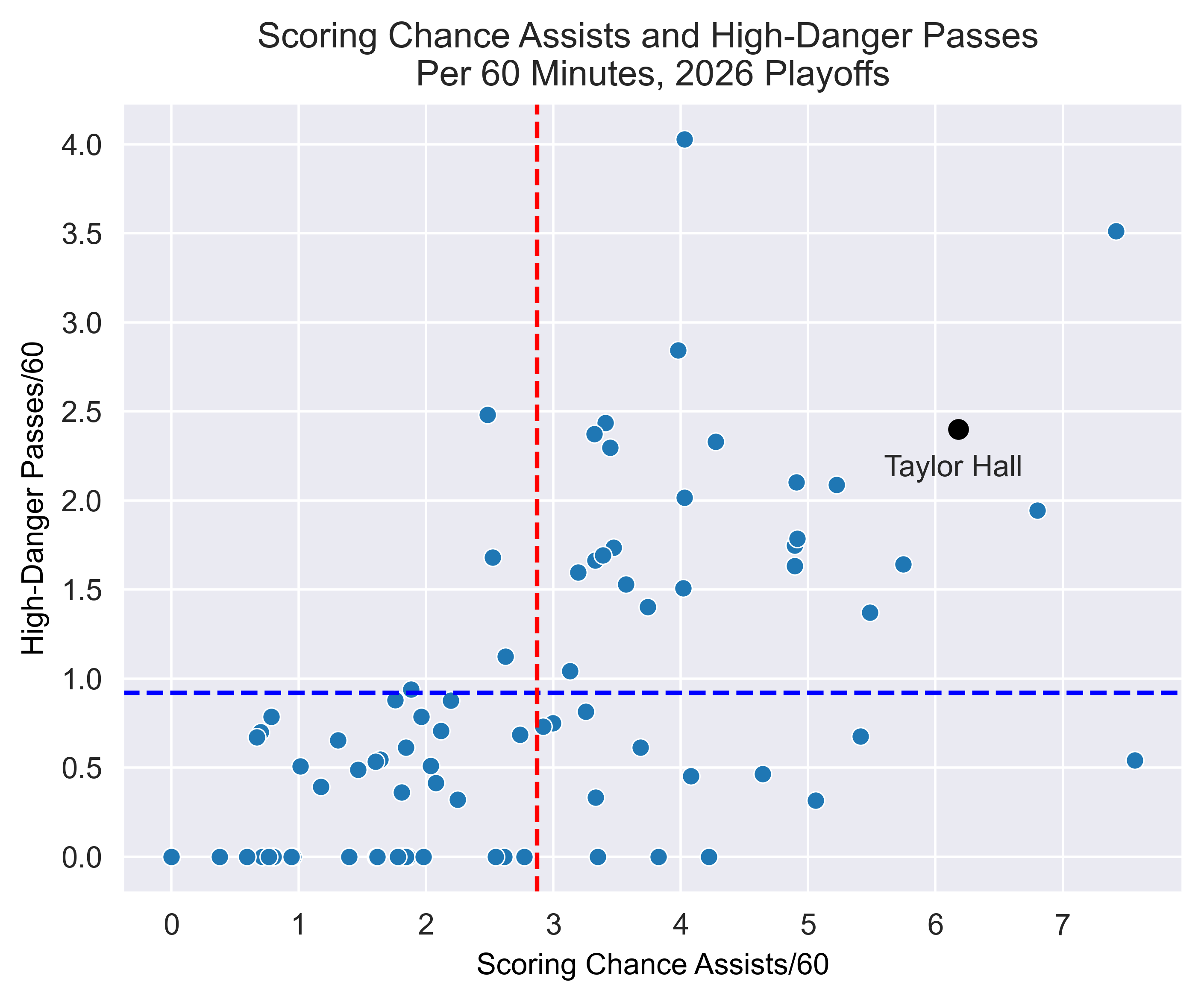
Hall not only led the Hurricanes by assists per 60 minutes at 5-on-5 through three rounds, he led the entire postseason (minimum of 100 minutes). Additionally, his goal-scoring rate was third among all regular forwards, trailing only Stankoven and Brandon Hagel. That Hall and Ehlers were so dominant offensively while playing on the second and third lines alleviated the pressure on Carolina’s under-performing top line. That kind of depth is what makes them such a dangerous team.
5 – Nathan MacKinnon (Colorado Avalanche)
The Avs fizzled out in the third round, failing the reach the Cup Final once again despite a tremendous regular season and stellar first two rounds. As with Ehlers, MacKinnon performed extremely well across the board, but we’ll highlight his rate of zone entries and the percentage of those entries he carried into the zone himself:
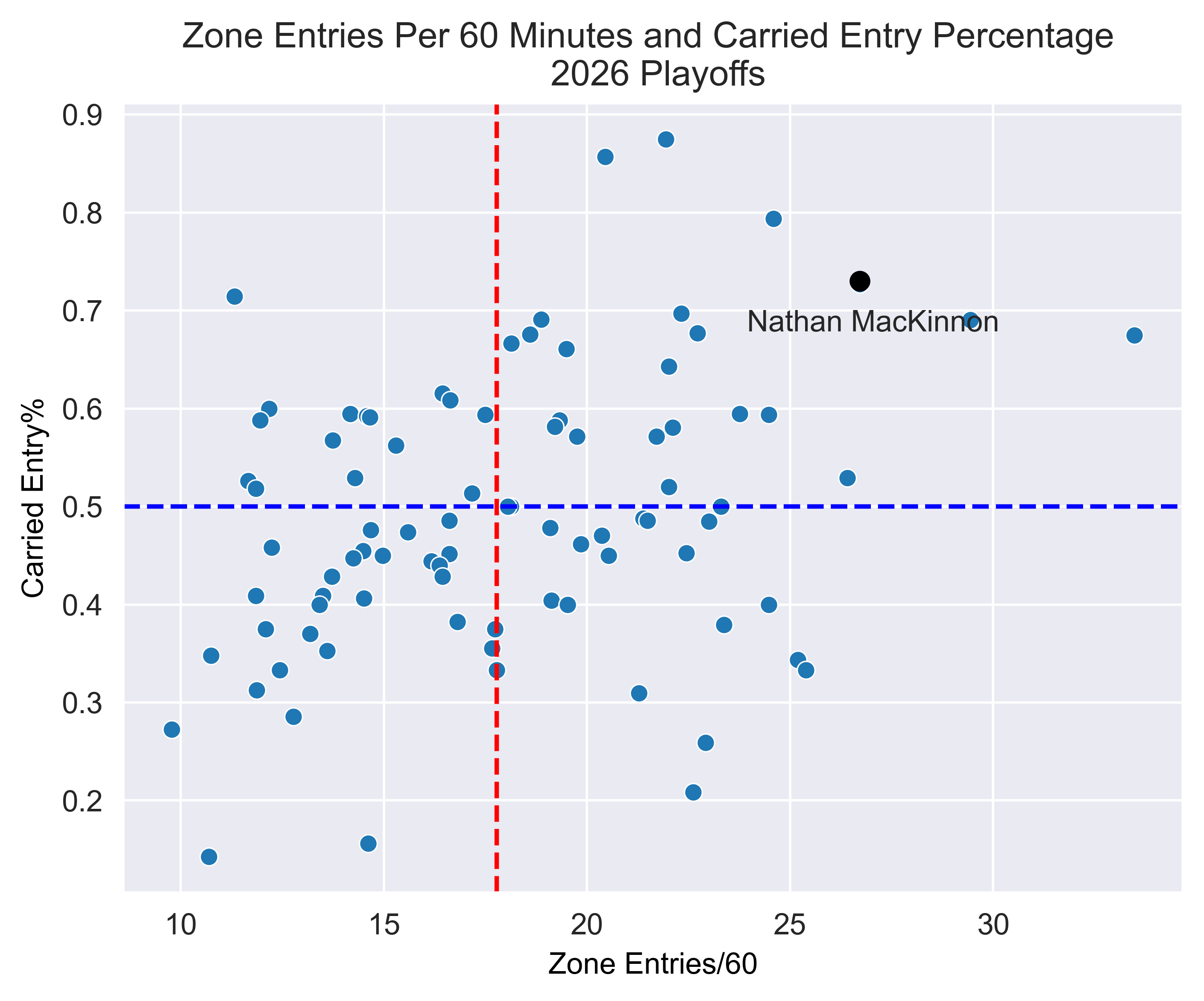
Of the 87 forwards in our data, MacKinnon was third by rate of zone entries and fourth by percentage of those entries carried in. He is typically great in transition anyway – it’s a reason why he’s an MVP-calibre player year after year – but he was phenomenal in the postseason when transition play can get dragged into the mud. He turns 31 years old in September but shows no signs of slowing down.
6 – Beckett Sennecke (Anaheim Ducks)
The newsletter covering the first round highlighted Leo Carlsson’s tremendous play off the rush and cycle/forecheck, similar to what Ehlers did for three rounds. In addition to Carlsson’s dual-threat play was what Sennecke did in transition. If Carlsson was similar to Ehlers, then Sennecke’s entry rate and carried entry percentage was reminiscent of what we just saw for MacKinnon:
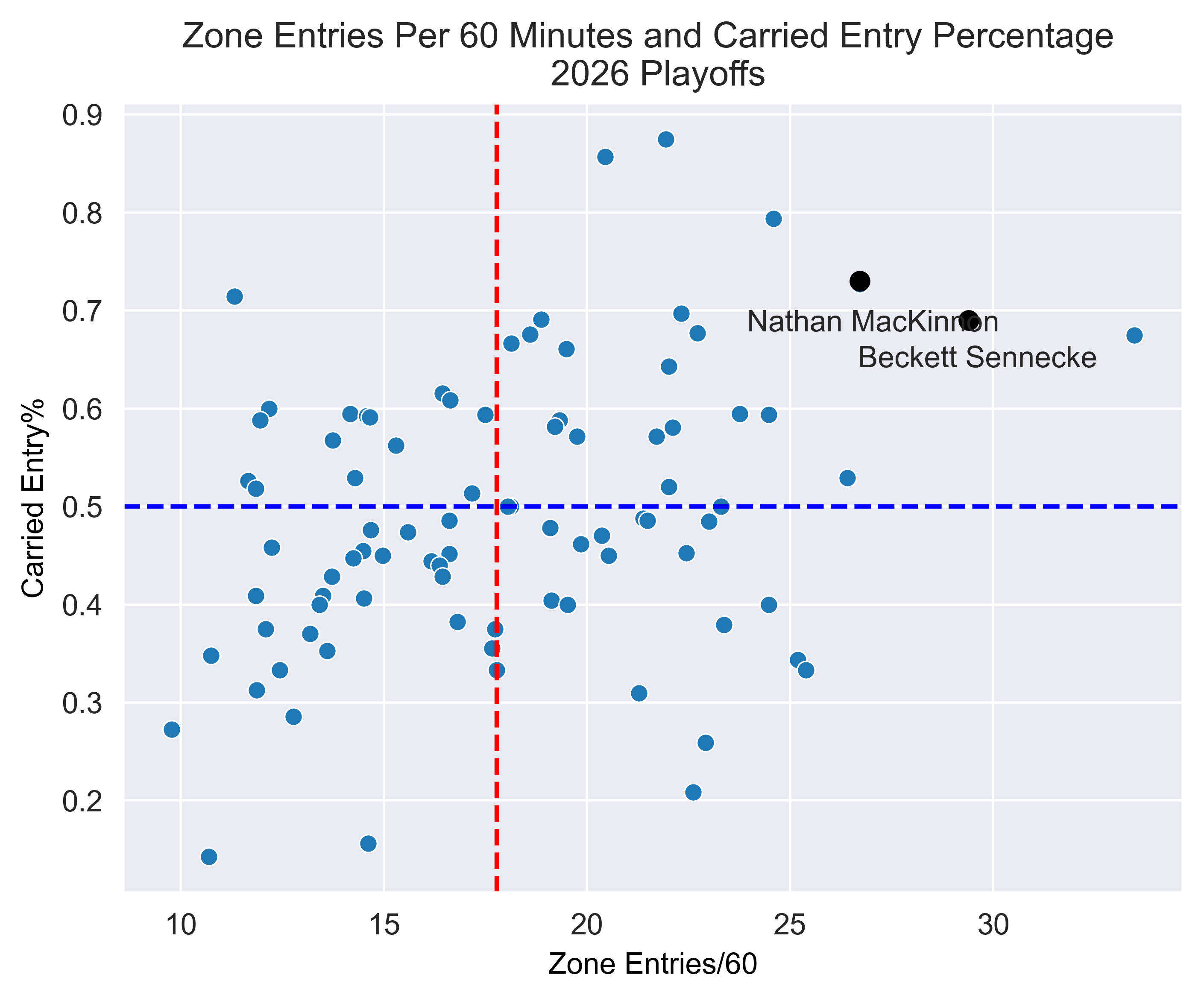
In our data, Sennecke had the second-highest rate of zone entries and eighth-highest percentage of those entries being carried in. Keep in mind that this is a 20-year-old rookie putting up Nathan MacKinnon-esque transition numbers in the playoffs. After a great rookie regular season, Sennecke was arguably even better in the postseason. He has all the tools to be a superstar sooner rather than later.
7 – Jackson LaCombe (Anaheim Ducks)
Staying with Anaheim, we can’t ignore how good LaCombe was in the postseason. He was the offensive driving force for the Ducks, leading the league’s defencemen by scoring chance contributions (assists plus his individual chances) as well as zone exits with possession:
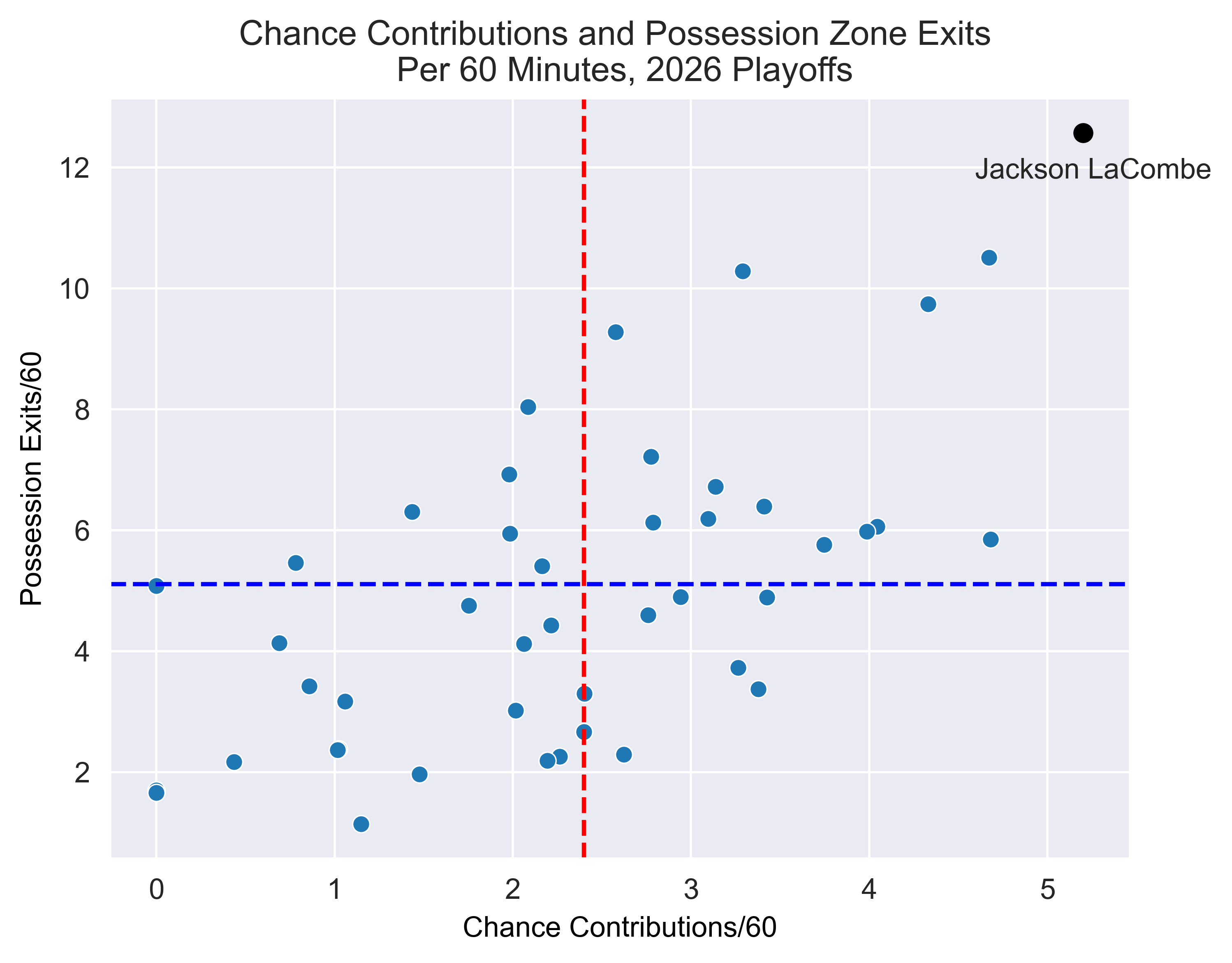
In a postseason that featured Cale Makar, Quinn Hughes, Rasmus Dahlin, Lane Hutson, Miro Heiskanen, and Evan Bouchard, LaCombe having the top rates of chance contributions and possession exits is nothing short of outstanding. He ascension to being one of the league’s most impactful defencemen continues.
8 – Rasmus Dahlin (Buffalo Sabres)
LaCombe was an elite performer for the Ducks, and Dahlin was the same for the Sabres. Looking at his rate of chance contributions, but switching to zone entries rather than exits, here is where Dahlin stacked up compared to the other blue liners from the final eight teams:
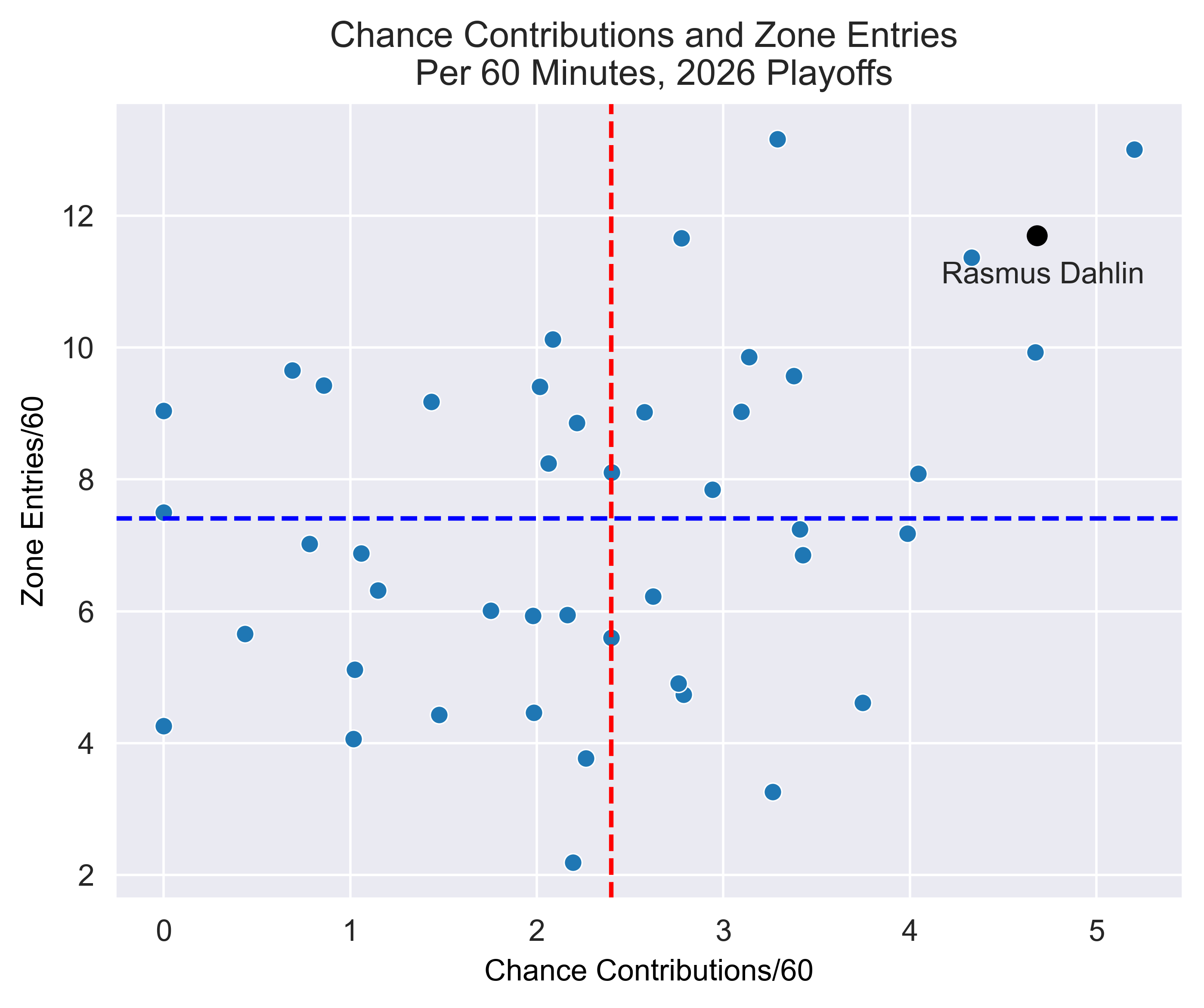
Dahlin was second by chance contributions, trailing only LaCombe, and third by zone entries. Dahlin was the engine for the team’s offence at 5-on-5, mirroring what he’s often done in the regular season. Showing this level in the postseason is nothing but good news for the Sabres as they look to rack up more playoff appearances, and hopefully some deeper runs.
9 – Quinn Hughes (Minnesota Wild)
Sometimes we do have to point out the obvious, and with Hughes, it’s that he’s very good. Shocked, right? Here is what he did entering the offensive zone, as he led all defencemen by zone entries and percentage of those entries being carried in:
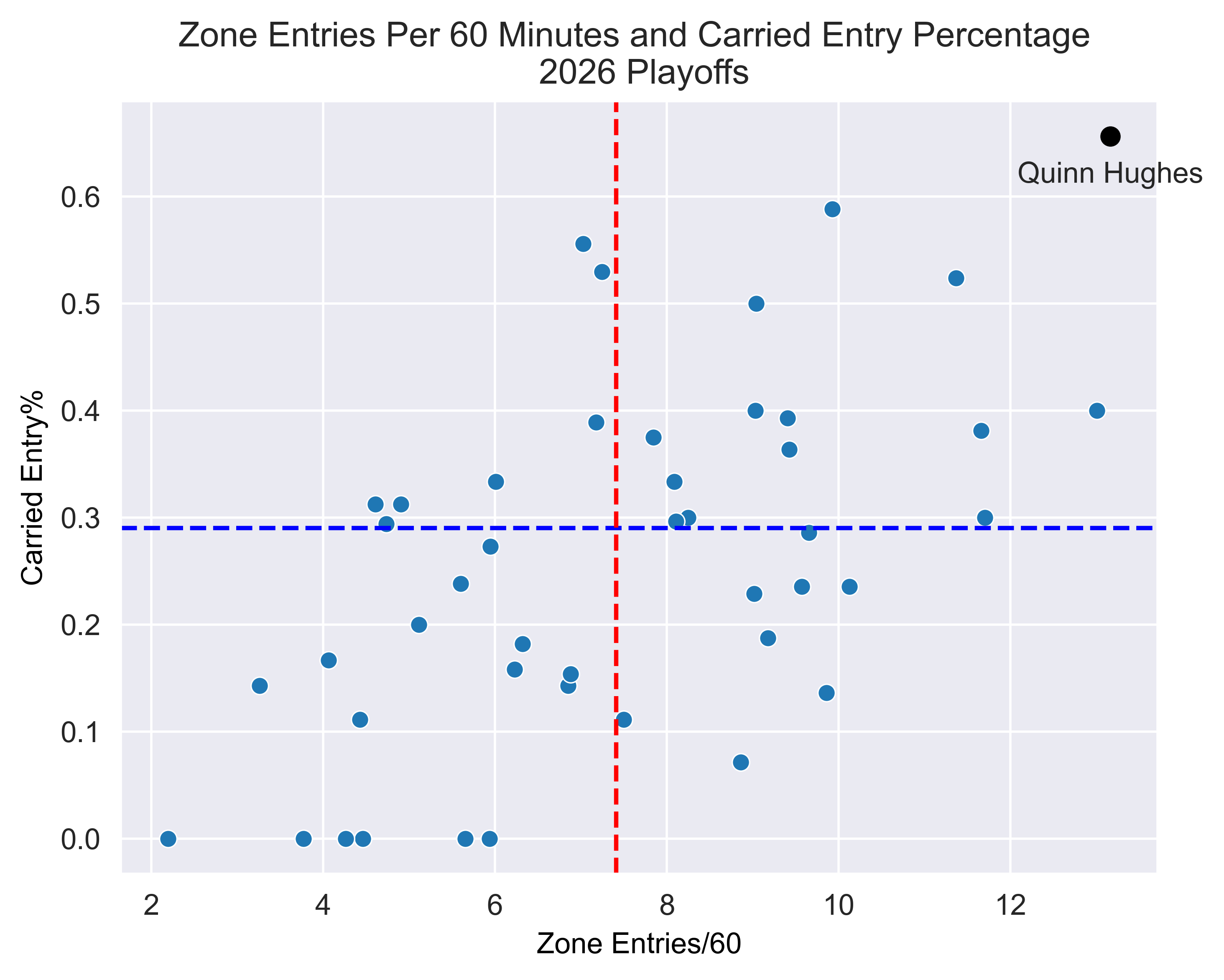
To put this into context: Hughes’ rate of zone entries compared to teammate Joel Eriksson Ek, and Hughes’ percentage of entries carried in compared to Sebastian Aho. Those guys are the top centres for teams that made it past the first round, by the way. Hughes did everything he could to get the Wild deep into the postseason, and just further cemented his status as either the best, or certainly a top-3, defenceman in the world.
10 – Owen Power (Buffalo Sabres)
Rasmus Dahlin got a lot of the attention for Buffalo, and he deserved that attention. It shouldn’t completely overshadow just how good Power was as his rate of zone exits with possession, and combined percentage of botched defensive zone retrievals and failed zone exits (lower percentages are better), were among the best in the league:
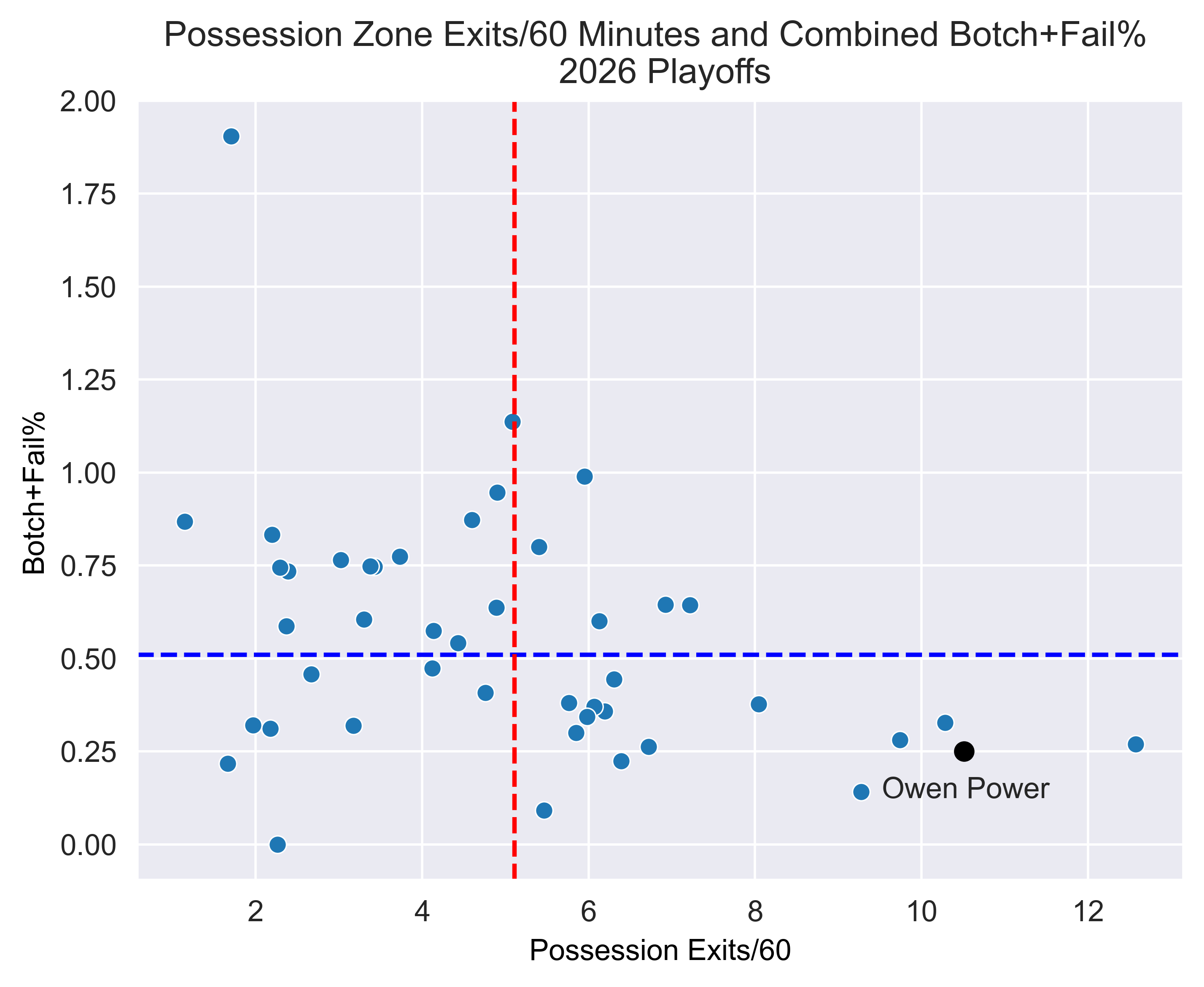
Dahlin turning in elite performances on the top pair is key to Buffalo’s success. Power being able to move the puck with such efficiency when Dahlin is off the ice will be very important to keeping Buffalo in playoff contention for seasons to come. If Power has really taken that next step to becoming a dominant two-way blue liner, it improves the Sabres so, so much.
Until next week.