10 Interesting (To Me) Stats For This Week - November 11
Welcome back for another week of ’10 Interesting Stats’. There was an interesting article from Bcurlock on Twitter discussing how the Edmonton Oilers’ 5-on-5 offence has suffered, and it may be that they are activating their defencemen less on the attack. It got me wondering if indeed that is the case, and what it looks like across the league, so let’s do that. We are using tracking data from All Three Zones to see what the offensive zone entry numbers look like for defencemen this year, and in prior seasons.
Data current as of the morning of November 10th, 2025.
1 – The Macro View
Before looking at the Oilers, or other teams, it’s important to take stock of what’s going on across the league. So, using the tracking data, here is the rate of zone entries by defencemen for this season, the prior four seasons, and the changes therein:
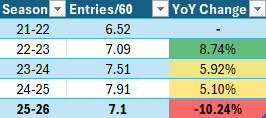
With the caveat that the total minutes tracked for defencemen to this point is about 16% for all of last year, so things can certainly change over the next five months, there has been a substantial drop in 5-on-5 zone entries by defencemen across the league. Why this is the case is another matter, but it’s clear that most coaches are getting their blue liners to jump into the play much less often than 12 months ago.
2 – Bcurlock is B-currect
Even factoring in that the zone entry rate by defencemen across the league is down 10% from last year, Bcurlock’s observation about the Edmonton blue line is indeed the right one as the team’s rearguards have seen a sizeable drop in zone entries per 60 minutes at 5-on-5 compared to last year:

The drop of a little over 16% is substantial, but by no means among the highest in the league. All the same, it does seem that the Oilers are playing it safer at 5-on-5, and it may be hurting their offence. They are also giving up more expected goals and actual goals through 16 games as they did through 16 games last season (per Natural Stat Trick), so if this is being done to improve the team’s defence, it’s not working yet.
3 – One-Man Gang
When looking at which teams have improved their entry rate by defencemen the most, the team at the top makes a lot of sense as The New York Islanders have seen the biggest zone entry jump in the league:

To no one’s surprise, rookie Matthew Schaefer is a huge part of this as his zone entry rate (18.2/60 minutes) is more than double the average of the rest of their defence group (7.53/60). The Islanders do have a very small tracking sample, so a grain of salt and all that, but Schaefer is a huge reason for the Islanders’ offensive turnaround.
4 – New Era?
There are two teams seeing an increase in zone entry rate by defencemen of at least 20%. One of those teams is the Islanders, and the other is the Vegas Golden Knights:

This is worth highlighting because Vegas is a team that is typically below the league average in this respect year after year and had been in the bottom-5 in each of the prior two seasons. This season, they’re far above average and sit seventh in the league. It hasn’t shown up in the team’s offensive 5-on-5 numbers yet, but this would indicate a significant change in their offensive attack. Adding to the intrigue is that while top guys like Shea Theodore are leading in this respect, depth options like Zach Whitecloud and Kaeden Korczak have also increased their zone entry rates.
5 – A New Offensive Engine
Over the summer, I wrote about how the Chicago Blackhawks needed their defencemen to get more involved in the offence if this team wanted to take a step forward in their offensive attack. Well, their expected goals rate is up 22% from last year, their actual goals-for rate is up 33%, and it’s hard not to think it’s because they’ve seen the third-largest improvement in zone entry rate from defencemen:

This isn’t to take away how good Connor Bedard, Frank Nazar, Andre Burakovsky et al. have been, but to highlight that they aren’t the only reasons the team has improved their offence to such a high degree. The Blackhawks needed more from their young defence group, and they’re getting it.
6 – The Pilot Lights
Once again, the Calgary Flames are among the worst offensive teams at 5-on-5, sitting 27th by 5-on-5 goals rate. You can probably guess where this is going – they have seen the largest drop in zone entry rate by defencemen in the league, and it’s not really close:

Some of their defensive metrics have improved, but a drop in team save percentage has led to more goals against. If the Flames continue to be completely allergic to having their blue liners jump into the rush, it’s hard to see their offence getting significantly better from here on out.
7 – Avalanche of Offence
By goals-for per 60 minutes, the Colorado Avalanche lead the league at 5-on-5 and it’s nowhere close as they exceed the closest team (Carolina Hurricanes) by 11%. When looking at the individual performances from defencemen by zone entry rate, the top of the board is absolutely hilarious:

Among 113 defencemen with at least 50 tracked minutes, Cale Makar and Devon Toews are first and second by rate of zone entries per 60 minutes. Not only two guys from the same team, but two guys from the same defence pair. Honestly, I don’t even know what to say.
8 – Simon Says
Among the 74 defence pairs with at least 100 minutes together, the New Jersey Devils’ pair of Šimon Nemec and Brenden Dillon sit fifth in goals-for rate at 4.45 (per MoneyPuck). Of the 113 defencemen in the tracking sample, there are six that are at least one standard deviation above the league average by zone entries/60 and percentage of those entries carried in. Three of the six are from Colorado, two are former Norris Trophy winners, and the sixth is Nemec:
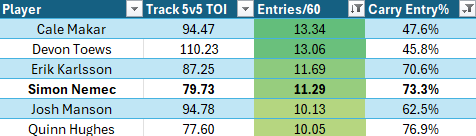
The fun part here is that Nemec has spent less than half his 5-on-5 TOI with either or both of Jack Hughes and Nico Hischier (124.5 of 250.6 minutes). Compared to last year, New Jersey is scoring 33% more often without those two stars on the ice, and it’s hard not to think Nemec’s contributions are a big reason why.
9 – The Hell is Going on?
Anaheim Ducks defencemen Pavel Mintyukov keeps seeing his zone entry rate and carried entry rate drop, going from one of the most carry-heavy defencemen in the league as a rookie in 2023-24 to below average in 2025-26:
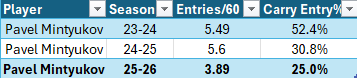
It should be noted that Anaheim defencemen are responsible for 22% fewer zone entries than last year, so it’s not only Mintyukov, but that he’s also below the team average for entries carried in is worrying. Even worse is that the defensive results aren’t getting better. Whatever is going on here, it’s not turning him into the player he looked like he could be.
10 – Toothless
If Florida wanted to be productive offensively with the key injuries they suffered, they would need help from the blue line, and it hasn’t come from Seth Jones just yet. As a team, their defencemen are responsible for 24% fewer zone entries than the 2024-25 season, and Jones has seen a huge drop from his short Panthers tenure last year, or even compared to when he was in Chicago:
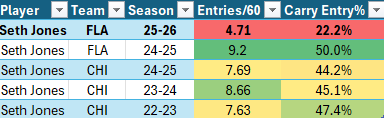
Maybe Florida is trying to play it safe and tread water until Matthew Tkachuk returns in a month or two. Whatever the reason, Jones is hardly figuring into the zone-entry attack, so there seems to be a good reason why his 5-on-5 point production rate (0.49) is the worst of his career.
Until next week.