10 Interesting (To Me) Stats For This Week - November 25, 2024
With the NHL’s adjusted schedule due to American Thanksgiving, we are a day early this week. We will be back on the regular schedule next week, but here are 10 interesting (to me) stats right now. Data from Natural Stat Trick or Evolving Hockey, viz from HockeyViz, and tracking data from AllThreeZones.
Miss Me Yet?
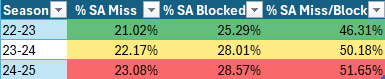
At various times, I’ve written about rising shot blocking rates. What is notable is that it’s not just shot blocking that has risen, it’s missed shots, too:
That is important for scoring goals:
· Last season, the 10 teams that had at least 51% of their shot attempts missed or blocked scored 3.0 goals per 60 minutes. The 10 teams that had the lowest percentage of shot attempts missed or blocked averaged 3.17 goals per 60 minutes.
· In 2022-23, the goal-scoring rates between the teams that had the highest and lowest percentage of shots miss or get blocked was 2.99 goals/60 and 3.26 goals/60.
· So far this season, those rates are 2.80 goals/60 and 3.12 goals/60.
Generating shots is great, but hitting the net is very important, and there may be a reason some teams are struggling to score beyond just bad luck.
Getting Shot Blocked In The (Hockey) Club
On that topic, Utah went into their game on Sunday night 29th in the league by shots on goal per 60 minutes despite being 17th by shot attempts generated. Unsurprisingly, they lead the league by percentage of shot attempts missed or blocked, and the bottom of the list features a lot of teams that don’t surprise, either:

Of note here is that if this persists, it would be three straight seasons for Seattle to finish among the 10 teams with the highest percentage shots attempts missing or blocked. It isn’t all one thing, but it seems to be a reason they’re 29th by goals/60 since the start of last season.
Also, Buffalo, Montreal, and Utah are three of the four youngest teams in the league. Something I found interesting.
Holtz Me Close
There are 76 forwards who have managed at least 0.83 individual expected goals per 60 minutes at 5-on-5 (ixG/60; minimum of 200 minutes). Those 76 forwards have averaged 0.93 actual goals per 60 minutes, and 70% of them (53/76) are averaging at least 0.6 goals per 60 minutes. If a player were to skate 12 minutes a night at 5-on-5 for 82 games, and score 0.6 goals per 60 minutes, they would score about 10 goals at 5-on-5 in a full season.
Vegas’s Alex Holtz has one goal, and it was over a month ago (October 22nd).
Instat credits Holtz with 32 shots at 5-on-5, and half of them are coming from the home plate area in front of the net:
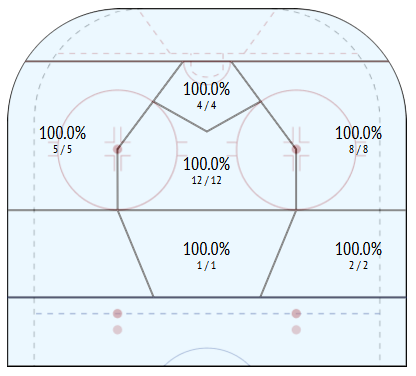
It has been a tough start to Holtz’s first season in Vegas, but if he can keep this up, it seems likely he will improve his scoring a lot in the next five months.
Start Making Svech Happen
On the topic of individual expected goals, of those forwards with 200 minutes played at 5-on-5, there are 25 who have managed at least 1.0 ixG/60 and totaled at least 30 shots on goal. Those 25 forwards have averaged 1.0 goals per 60 minutes. Dead last on that list by actual goals per 60 minutes at 5-on-5 is Carolina’s Andrei Svechnikov:

Svechnikov has seven goals on the season, but just one of them has come at 5-on-5, and it is 20 games in. Over the prior three seasons, he averaged one 5-on-5 goal every 3.8 games. Considering his shot quality and shot volume, a positive shooting percentage regression bodes very well for his goal production over the next 60-some games.
Jason’s Slashed Production
With a goal and three assists in his last two games, maybe Dallas’s Jason Robertson is turning things around. There are any number of reasons why he had the slow start – foot surgery late in the offseason, declining shot rate, lack of offence generated with Evgenii Dadonov on his wing – but the power play stands out: Robertson averaged a power play point every 2.4 games from 2022-2024 but that average is one every 9.5 games this season.
The good news is that Dallas is generating 12% more expected goals per 60 minutes on the power play this season than the league average (left), but the bad news is that number is down from 30% above average last year (right):
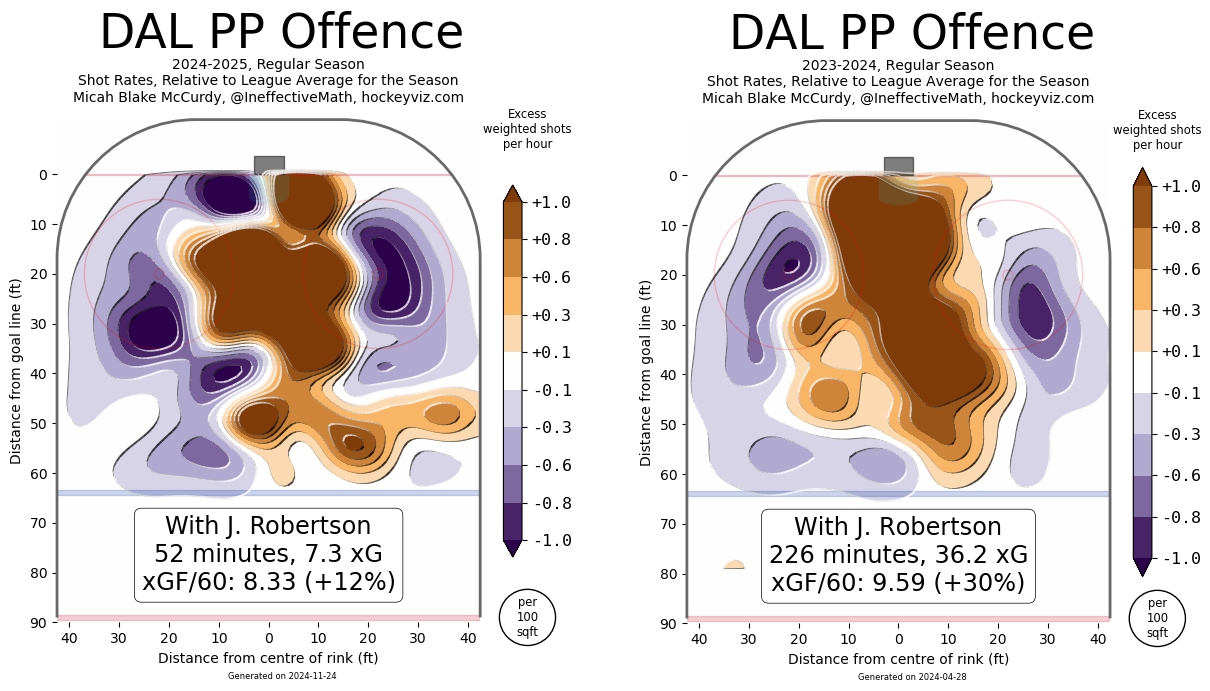
Dallas is shooting 4% with Robertson on the ice for the power play this season, a number that was 17.4% across the prior three years. Repeating his 28 power play points from 2023-24 seems to be out of the question, but once that team shooting percentage regresses upward, his point production will increase with it.
Low-Danger Cozens
With Dylan Cozens on the ice this season, Buffalo is scoring 2.28 goals per 60 minutes at 5-on-5. With him off the ice, that number is 2.92 goals per 60 minutes. Team shooting percentage is a part of it – they are shooting 8.1% with him on the ice – but it’s more than that.
Tracking data has Cozens making 0.67 high-danger passes per 60 minutes at 5-on-5. The other 13 forwards in the sample are averaging 1.21 high-danger passes per 60 minutes, and he’s the lowest of the team’s top three centres:
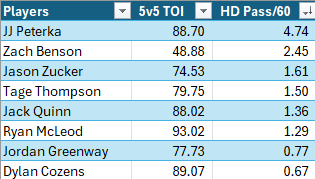
Buffalo isn’t generating much for quality shots with Cozens on the ice, and that shows up in the team’s goal-scoring rates in those minutes. If they want to push for a Wild Card playoff spot, he needs to be a lot better offensively over the next 60 games.
Haunted Blue Line
On the season, Shayne Gostisbehere’s on-ice goals against rate at 5-on-5 is a seven-year low and his expected goals against rate at 5-on-5 is a career-low. Ghost has been excellent defensively, and a reason for that might be that of the 107 defencemen with at least 60 tracked minutes, he is second in the league by denying opponent zone entries:
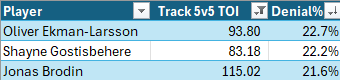
Between his time in Detroit and Arizona, that denial entry percentage was under 12% for three straight seasons. Whether he can maintain this through the rest of the season and, more importantly, into the playoffs, is another matter. But if he can, he’s not only an asset on the power play, but an asset at both ends at even strength.
Soucy’s Failure
Vancouver defencemen are failing to exit the zone on 29.7% of touches and the league average is about 26.1%. Of the 57 defencemen with at least 100 tracked minutes, Soucy has the third-worst failed exit percentage, and the two guys ahead of him play for potential Draft Lottery teams:
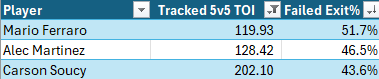
Vancouver’s second defence pair has been an Achilles’ heel all season, and if this persists, it’s going to be a problem when playoffs roll around.
Samberg? I’m a Fan-berg
It was unfortunate that Winnipeg defenceman Dylan Samberg suffered a broken foot in Saturday’s game because he was having an excellent season: second on Winnipeg’s blue line by expected goal share and a plus-4 goal differential at 5-on-5. Importantly, he has helped carry Neal Pionk – who was last on their blue line by goal share and expected goal share over the prior two seasons – to a plus-4 goal differential and very good expected goal impacts:
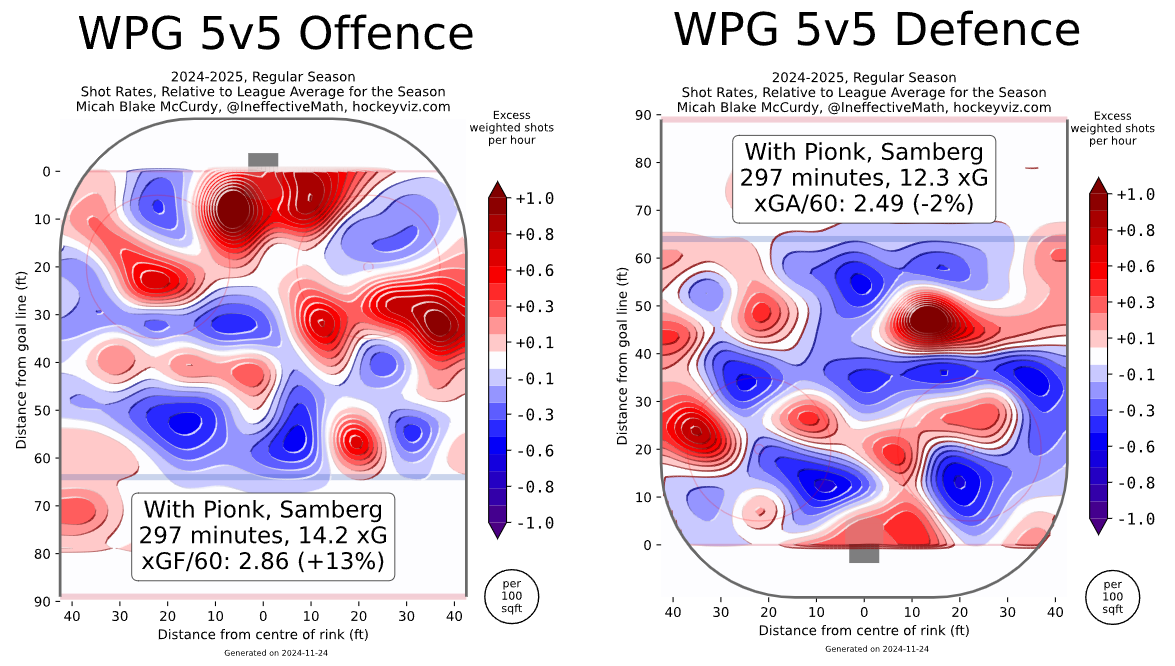
Samberg’s injury will test the blue line depth, and I suspect the results will get worse until he returns.
Dostál Going Postál
There are 44 goalies with at least 4000 minutes played since the start of the 2022-23 season. In that span, Anaheim goalie Lukáš Dostál sits eighth by goals saved above expected per 60 minutes, and ahead of names like Thatcher Demko, Jake Oettinger, and Andrei Vasilevskiy:
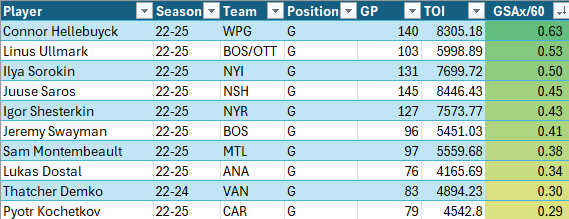
Anaheim is in a tough spot because John Gibson has two more years left on his deal and Dostál is an RFA after this season. Regardless, Dostál has been great both in the AHL and NHL for several seasons and doesn’t turn 25 years old until June. They have their goalie of the future, it’s just a matter of what to do with Gibson.
Until next week.