10 Interesting (To Me) Stats For This Week - April 15
Welcome back for another week of ’10 Interesting (To Me) Stats’. This week we’re going to start by looking at two different teams on two different trajectories, then dig into some key depth players and their performance this season. As usual, player data is from Natural Stat Trick or Evolving Hockey, tracking data is from AllThreeZones, and viz is from HockeyViz. All data as of the afternoon of Monday, April 14th.
1 – No York Rangers
The New York Rangers were eliminated from playoff contention over the weekend, but one area that doesn’t need work is their 5-on-5 offence. On the season, they sit sixth by goals per 60 minutes at 5-on-5 after finishing 20th the season before. They excelled at creating high-danger shots by leading the league by rate of high-danger passes (across the slot or from behind the net):
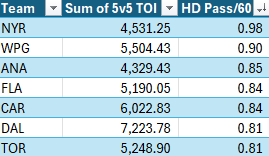
The scoring even improved as the season wore on, ranking fourth in the league by goals/60 at 5-on-5 since Christmas. The Rangers certainly struggled in specific areas, but goal scoring at the strength where over 80% of the game is played was not one of them. Importantly, it wasn’t good fortune that led to good goal scoring, but just genuinely creating dangerous shots.
2 – No Laffing Matter
One common characteristic of top offensive players is being able to create offence in a variety of ways. At 5-on-5, that means both off the rush and off the cycle/forecheck. Rangers winger Alexis Lafrenière looked to be on that trajectory as he was above average by both measures across the 2022-23 and 2023-24 seasons. He excelled more off the rush than off the forecheck, but could do both, and it was a great sign.
That came to a halt in 2024-25. Lafrenière was once a forechecking menace but that all but disappeared this season as he became much more reliant on rush-based offence:
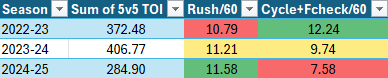
Lafrenière has just 18 shots on goal this season via tip or deflection against 32 last season and 30 the season before. Scoring declines are multi-factorial, but Lafrenière having a one-dimensional attack is an issue.
3 – Did You Say “Utes”?
The Utahs will not qualify for the postseason, and it may be a season of ‘What If’: Since December 21st, which is when their downturn started, they sport a 54.7% expected goal share at 5-on-5, which ranks sixth in the league. However, they have just a .521 points percentage in that span, taking 50 of a possible 96 points. Here is how Utah fared compared to the average of the other 11 teams with at least a 51% expected goal share at 5-on-5 since December 21st:

Those nine points are the difference between vacation plans for late April and a playoff spot. Utah is a team on a big upswing and with some tweaks to the roster, and growth from their young players, they should figure into the playoff picture next season.
4 – Wait, What?
Perusing some Buffalo Sabres stats, something stuck out in a big way: Ryan McLeod, brought over from Edmonton in the offseason, leads their team in assists per 60 minutes at 5-on-5. McLeod’s rate of 5-on-5 assists is in the 91st percentile of the league’s forwards and it’s not entirely a mirage as his rate of scoring chance assists (helpers on teammate chances) and high-danger passes at 5-on-5 are by far the highest of his career:
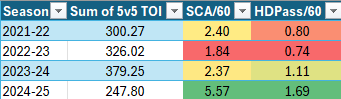
There isn’t a high rate of high-danger passes, which makes me think it could be more of a one-off than a genuine shift in his skill set, but that his playmaking dimension has increased so much since leaving Edmonton’s bottom-6 forward group is giving me pause. Either way, this is a very encouraging sign for a player who has generally shown offensive improvement in each of his four full seasons.
5 – U Amadio, Bro?
Playoff teams have stars, but playoff teams also have unsung heroes and Ottawa offseason signee Michael Amadio has been the latter. In fact, here is the list of forwards who got top-6 minutes at 5-on-5 (about 12:30 per game or higher), are in the 75th percentile by both goal share and expected goal share relative to their team, and fewer than 50% of their faceoffs are in the offensive zone:
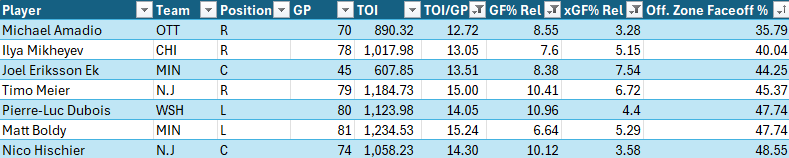
Notice how Amadio has fewer than 36% of his 5-on-5 faceoffs in the offensive zone and every other forward on this list is between 40-50%. Amadio has been an exceptional addition to the team’s forward group and more play like this gives the Senators a deep forward group.
6 – It Must Be The Ganja or Joel Kiviranta
Star-powered teams just need their depth to break even by goal differential, and that has been the case (and then some) for Joel Kiviranta as Colorado is +6 at 5-on-5 with him on the ice (+29/-23). Looking across the league, here are the wingers at least one standard deviation above average by goals against and expected goals against per 60 minutes at even strength (minimum of 850 minutes):
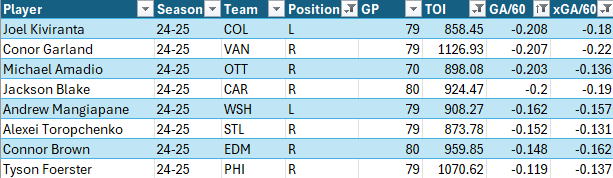
The defensive play from Colorado’s forward depth aside from Kiviranta has been very good – Logan O’Connor and Parker Kelly are also having stellar seasons – so Kiviranta isn’t an exception, but he’s certainly carried his weight through the regular season and if he (and his fellow bottom-6 forwards) can maintain this in the postseason, Colorado may be looking at another run to a Stanley Cup Final.
7 – Foli-Whoa
Minnesota winger Marcus Foligno has long been one of the best defensive players in the NHL, and this season is no different. However, things got worse when Joel Eriksson Ek and Kirill Kaprizov were injured as Minnesota averaged 3.2 goals against per 60 minutes at 5-on-5 from January 27th (the day after Kaprizov’s injury) to April 10th (the day before he and Eriksson Ek returned) with Foligno on the ice. However, the forward group is now healthy, and it’s a wonder when they reunite Foligno with Frédérick Gaudreau because the Wild have outscored the opposition 16-13 with those two on the ice at 5-on-5 (363 minutes) and have been stifling defensively:
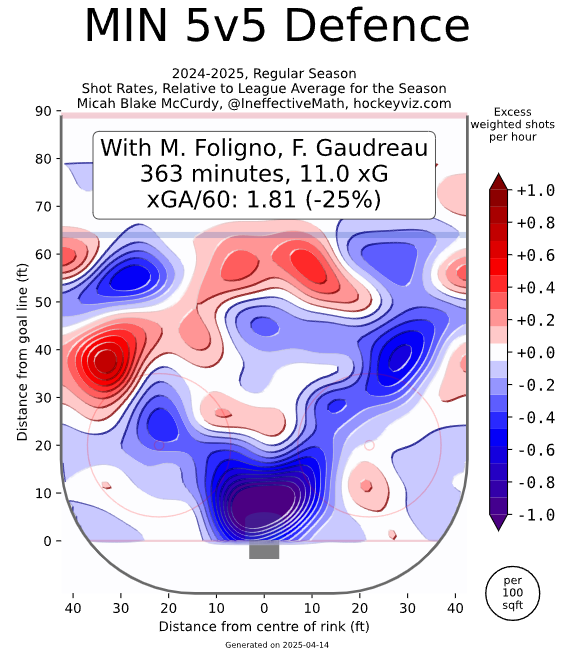
The Wild need to get their players healthy, including a couple more injuries over the weekend, or none of this matters, but this is a dangerous team who can prevent a lot of goals when they’re healthy and at their best.
8 – Lord Eyssimont
Since Mikey Eyssimont was acquired by Seattle in early March, the team is breaking even by 5-on-5 goal differential (+8/-8) with him on the ice, which isn’t bad for a team that is -11 on the season. He has done that by driving great shot attempts, shot on goal, and expected goal differentials at 5-on-5 compared to his team. In fact, here are the players he compares to league-wide in those areas since the trade:

Quite obviously, Eyssimont is not a Barkov/Matthews-level player. But this is another instance where if he can be a fourth-line player that drives even goal differentials, and great shot differentials, then it’s a boost for a Kraken team that needs it for next season.
9 – Far From Where You Want To Bee
Going over some numbers from the Calgary Flames, it stuck out to me that some of the team-relative stuff we just reviewed for Eyssimont were really, really good for Flames winger Joel Farabee. In fact, he leads their forwards by expected goal share relative to the team since February 1st. The problem is the Flames are -4 in his 5-on-5 minutes (+8/-12) and goals matter when trying to reach the postseason. The question is why the discrepancy?
Here is the crux of it: Of those eight goals that the Flames have scored with Farabee on the ice in his 29 games with the team, Farabee has three of them. In fact, his line mates are shooting a combined 3.4% so far in his Calgary tenure:

To put that into perspective, Tampa Bay defenceman Erik Černák is shooting 3.3% this season. In other words, Farabee’s average Flames line mate has had the finishing ability of Erik Černák. So it goes.
10 – Silli Season
It has been another tough season for young Columbus forward Cole Sillinger. The Blue Jackets are getting crushed defensively with him on the ice, and when looking at his age-19, age-20, and age-21 seasons as a whole when compared to other players, the comparisons are both flattering and eye-watering:

It is safe to say that Sillinger does not have the offensive upside of Lucas Raymond, so the best-case scenario here seems to be a Pavel Zacha-like trajectory. The worst-case scenario is… much worse than that. The team has a big decision to make either this summer or next.
Until next week.
***FYI: Next week’s column will come this week on Saturday, April 19th because of the Easter weekend holiday and I also want to get a quick playoff preview out.