10 Interesting (To Me) Stats For This Week - September 2
Welcome back for another week of ’10 Interesting (To Me) Stats’. Last week’s edition looked at 10 non-playoff teams and what needs to happen for them to push back towards a playoff spot. This week, we’re going in the other direction, and looking at 10 playoff teams from 2025 and what they need to do to stay there.
As usual, player and team data is from Evolving Hockey, unless otherwise stated.
1 – Montreal Canadiens
The big surprise of the 2024-25 season was Montreal adding 15 points from the year before and landing in the final Wild Card spot in the Eastern Conference. There are a number of things that need improving, like cutting down penalties against and finding a genuine second scoring line, but this chart of 5-on-5 shots against goaltender Sam Montembeault shows a big one (red is bad, darker red is worse, taken from HockeyViz):

It should be noted that things got better once Alexandre Carrier arrived via trade in mid-December. Noah Dobson was added in the offseason and despite his own defensive issues, he’s a massive upgrade over David Savard. The Canadiens need to keep their various improvements on the upswing if they want to return to the postseason, but clearing the net-front area must be a top priority.
2 – St. Louis Blues
Adding Pius Suter and Nick Bjugstad will help the Blues’ forward depth, but it’s the blue line that is the real problem here. The bottom half of the blue line is very questionable thanks to a declining 33-year-old Justin Faulk and three unproven players in Tyler Tucker, Matthew Kessel, and Logan Mailloux. In fact, all four of those defenceman have been a drag by goal impact and expected goal impact per 60 minutes at even strength over the last two seasons:

Mailloux only had a handful of games while Kessel and Tucker have yet to play a full season. But the Blues need that third pair to solidify because if Faulk drags down the second pair and that third pair doesn’t improve, it is something that can sink an entire season. Outside of horrific goaltending or a lot of injuries, if the Blues miss the playoffs, it’s probably because half their blue line was bad-to-very-bad.
3 – New Jersey Devils
Last year gave the blueprint as to how New Jersey might miss the postseason, and that’s having too many injuries to cover up all at once. Assuming they stay moderately healthy, what will determine a return to the postseason is their goaltending. One thing that didn’t get much discussion from New Jersey’s season was Jacob Markström wasn’t very good. In fact, of the 30 goalies to make at least 40 appearances, he had the fourth-highest rate of shots required for every Goal Saved Above Expected (GSAx):
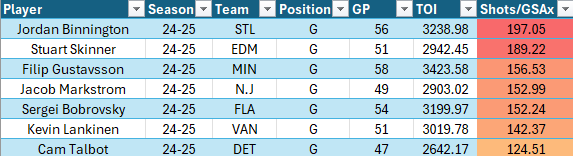
Of those 30 goalies, 24 of them finished with a positive GSAx. Those 24 goalies averaged about 75 shots for every GSAx, so Markström was about twice as worse. And it wasn’t just a function of his team because his backups Jake Allen and Nico Daws averaged 54 shots every GSAx. If Markström gets worse – he turns 36 years old in January – then the Devils could find themselves in real trouble.
4 – Minnesota Wild
Like New Jersey, last season gave us a reason why Minnesota can miss the playoffs, and it’s, “Kirill Kaprizov misses half the year while Jonas Brodin and Jared Spurgeon average 24 games missed each.” The other issue is their special teams. They were minus-14 by special team goal differential in 2024-25 after being minus-10 in 2023-24. That makes them one of the worst teams in the league by special team goal differential over the last two seasons:
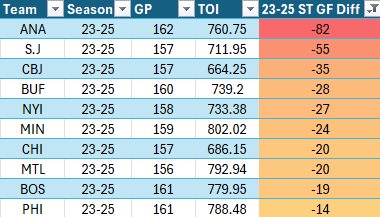
Those are all the teams whose special team goal difference was worse than minus-10 over the last two campaigns. Outside of Minnesota, does anyone feel secure about the playoff chances of the other nine teams? The Wild are a great defensive team at even strength, but all it takes is one down year defensively and this kind of special team performance will have them booking vacations for late April.
5 – Ottawa Senators
Ottawa’s even strength scoring issues have been discussed often in these pages, so we’ll look at something else, and it’s the blue line. Similar to St. Louis earlier, the top-half of the defence group looks great between Jake Sanderson, Thomas Chabot, and Artem Zub. The question is what happens when those guys are off the ice because Ottawa got crushed at 5-on-5 when that trio was on the bench:

It isn’t as if good teams never have bad numbers with top defencemen off the ice – Dallas was outscored by 16 goals at 5-on-5 with their top three blue liners on the bench/injured while Colorado was outscored by 15 goals – but the difference is those teams don’t struggle to score goals while Ottawa does. They don’t have huge margins created by the top of the roster to have the bottom be a big drag.
6 – Edmonton Oilers
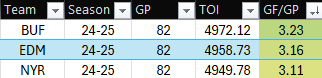
Despite some offseason departures, Edmonton still has two of the absolute best players in the world and arguably the best blue line in the league. Aside from awful goaltending and injuries to key players, what could really be an issue is their scoring. It sounds weird to say that about Edmonton, but they were quietly not a top-10 team by goals per game last year, and finished between two non-playoff teams:
Leon Draisaitl turns 30 years old in October and Connor McDavid is 29 in January. Zach Hyman and Ryan Nugent-Hopkins are 33 and 32 years old, respectively, and both had down years. If their non-elite forwards can’t score and some age-related declines start to kick in? Well…
7 – Carolina Hurricanes
This was something touched on during the playoffs, but Carolina struggled defensively at even strength last year, which is weird to say about a modern Carolina team. Nonetheless, Natural Stat Trick has two teams similar to the Hurricanes by rate of shots against per expected goal against, and percentage of shots against being high-danger shots:
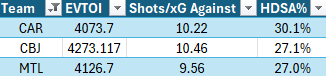
Carolina limits overall volume, which is what really separates them from Columbus and Montreal, but cleaning up defensive numbers like these will take a lot of pressure off their goalies and any race for a playoff spot.
8 – Los Angeles Kings
Two big changes to the Kings’ defence group were adding Cody Ceci and Brian Dumoulin as Vladislav Gavrikov signed in New York and Jordan Spence was traded to Ottawa. Over the last three years, relative to their teammates, the Gavrikov/Spence duo added nearly five goals per 82 games while the Ceci/Dumoulin subtracted just over five goals per 82 games:

If that swap does result in a 10-goal swing, that is worth about two wins. Two fewer wins last season would have left the Kings just five points clear of missing the playoffs. A lot can happen in an 82-game season, so if the gap between them and missing the playoffs is just five points, the margin for error is now minimal. And what if Ceci/Dumoulin are even worse than expected?
9 – Toronto Maple Leafs
Mitch Marner’s loss will be obvious everywhere, but it’s special teams where he really will be missed. Over the last four seasons, there have been 116 forwards with at least 200 minutes of both power play and short-handed ice time. Of those 116 forwards, Marner is fifth by combined Goals Above Replacement per 60 minutes on the PP and PK:
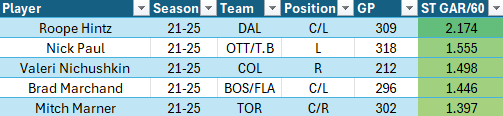
Matias Maccelli and Max Domi may be able to pick up a good chunk of the even-strength playmaking that Marner had, but no one on the roster comes close to what Marner did on special teams. If Toronto’s special teams see a big drop off, they could find themselves closer to a Wild Card spot than first place in the division.
10 – Colorado Avalanche
With their goaltending issues solved, the next step for Colorado is re-establishing a second scoring line, because that didn’t exist last year. Here is how Colorado fared by 5-on-5 goal differential without Nathan MacKinnon on the ice, and how the four division-winning teams last year managed:
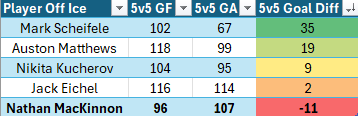
Each team had a positive goal differential, and averaged a plus-16 rating. Colorado almost definitely should be a playoff team and a Cup contender, but if that secondary scoring doesn’t show through and MacKenzie Blackwood isn’t great like he was? They will run into some trouble.
Until next week.