10 Interesting (To Me) Stats For This Week - November 25
Welcome back for another week of ’10 Interesting (To Me) Stats’. Today, we are looking at forwards and their on-ice shooting percentages (OISh%) at all strengths, which is simply the team’s shooting percentage when that player is on the ice. Data is from Natural Stat Trick and current as of the morning of Monday, November 24th.
1 – Times, They Are A-Changin’
Whatever the cause (team tactics, more skilled lineups, changes in how the NHL tracks shots on goal), shooting percentages have been rising for years. When looking at individual forwards so far this season (minimum of 200 minutes), and at the same point in the 2023-24 season, we see how much OISh% has jumped:
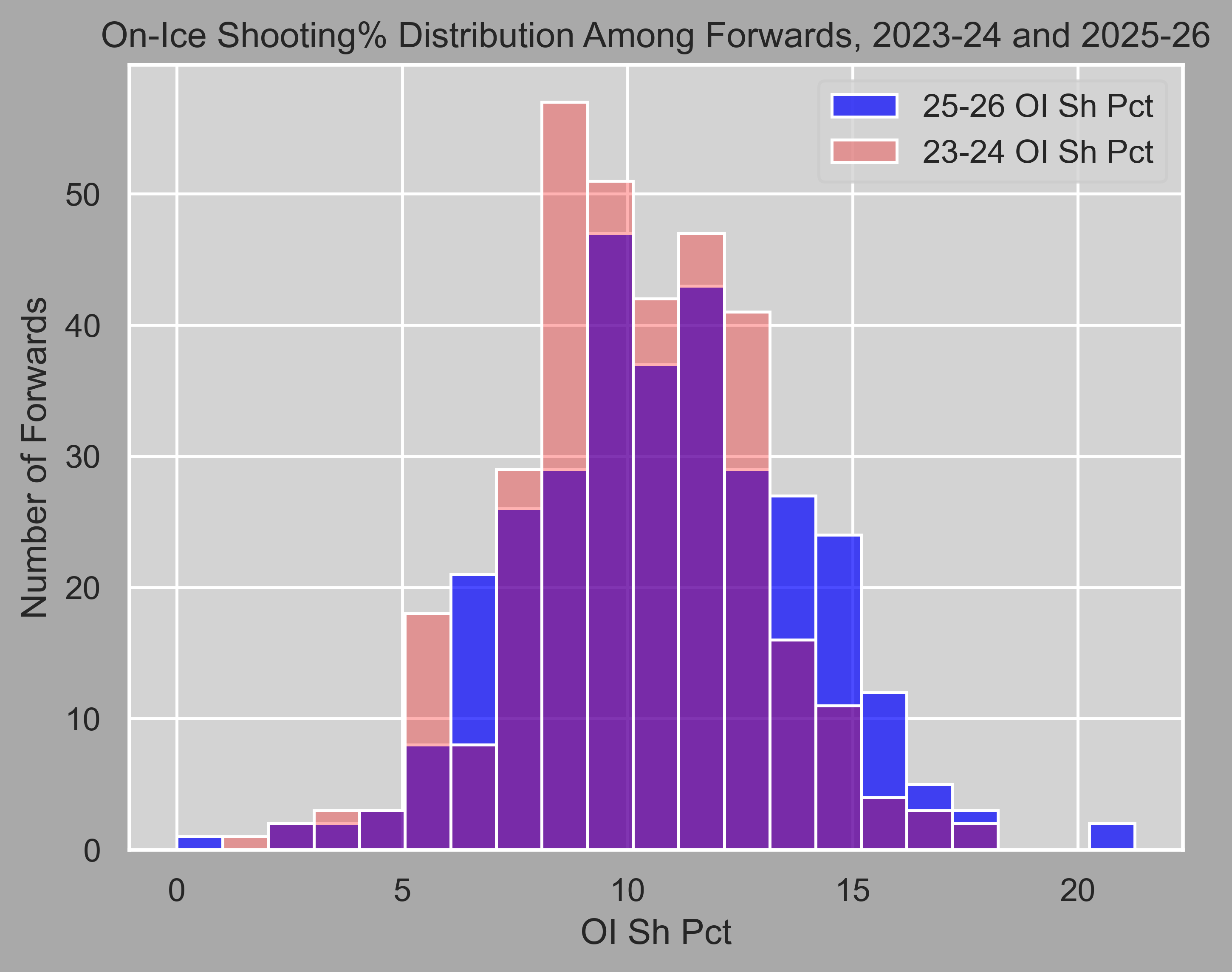
The blue bars on the right show how many more forwards have an OISh% of at least 14% this year compared to the same point just two seasons ago (the purple bars). To put it another way: 59.5% of forwards this season have an OISh% over 10%, whereas 50% of forwards were over 10% two seasons ago.
2 – Starting to Stabilize
That is how this season compares to 2023-24. What about 2024-25? Well, the bars with red poking out the top represent how many more forwards in the 2024-25 season were in that range of OISh% compared to this year, and the bars with blue poking out the top represent the same for the 2025-26 season compared to last year:
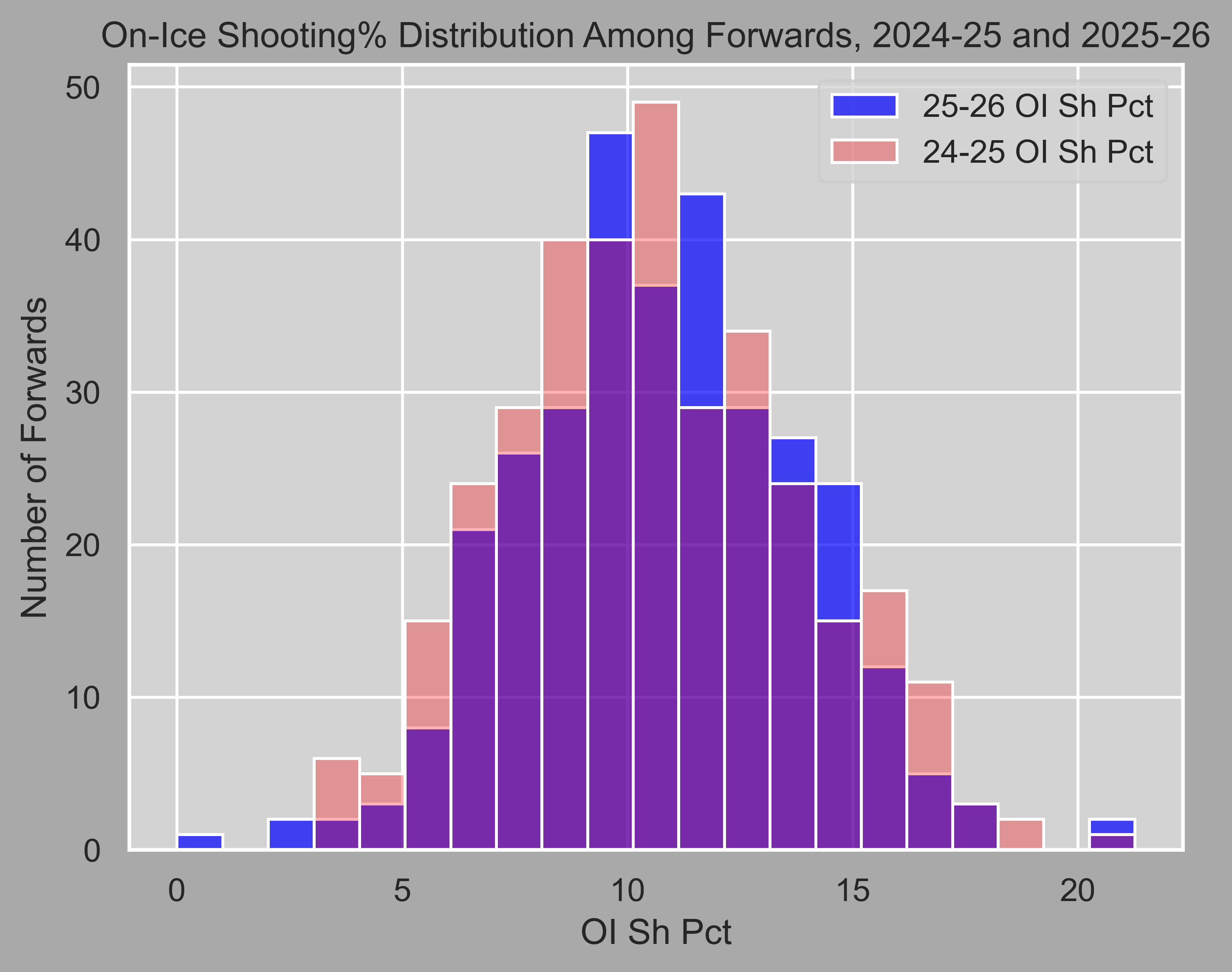
Overall, at this point of the 2024-25 season, 55.5% of forwards had an OISh% over 10%. Remember that in 2023-24, that percentage of forwards was 50% while this season it’s 59.5%. So, there are more this year, but the 2024-25 season had a sizeable increase that was a harbinger of things to come.
3 – Reach For the Top
As far as regression is concerned, we should see what happens as the extreme. To do that, we are going to look at this point of the 2024-25 season and how players that were at least one standard deviation above the league average by OISh% fared the rest of the season. One standard deviation above the league average OISh% was roughly 13.78%, so this is how forwards with an OISh% in the early portion of the 2024-25 season performed over the rest of the year:
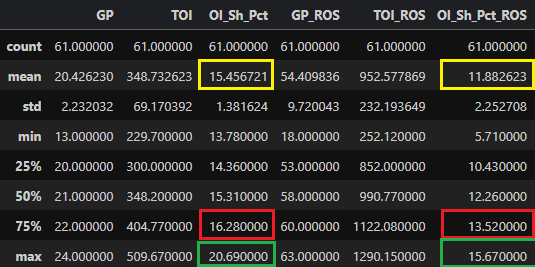
Let’s break it down:
· Yellow Boxes: The left yellow box is the average OISh% of those top forwards in the early portion of the year (15.46%), and the right yellow box is the average OISh% of those same forwards for the rest of the 2024-25 campaign (11.88%). So, the average drop was about 3.6%.
· Red Boxes: The left red box is the OISh% upper limit that three-quarters of high-percentage forwards reached early in the year (16.28%). The right red box is the forwards’ OISh% upper limit that three-quarters of them reached the rest of the way (13.52%). So, three-quarters of the forwards went from a high of about 16.3% to a high of about 13.5%.
· Green Boxes: The left green box is the highest OISh% of the forwards in the sample for the early portion of the 2024-25 season, and the right is the highest OISh% of the forwards in the sample for the rest of the 2024-25 season. So, the top performer went from over 20% to under 16%.
In short, based on last season, the top OISh% performers so far should drop between 3-4%, three-quarters of the forwards should be no higher than 14%, and the absolute upper limit should be around 16%.
4 – The Demigod
With 17 points in 21 games, Montreal Canadiens rookie Ivan Demidov is off to a great start, especially considering he’s skating just 14:30 per game. We do love to see it, but the problem here is that he leads all forwards by OISh% this season, exceeding 21%:
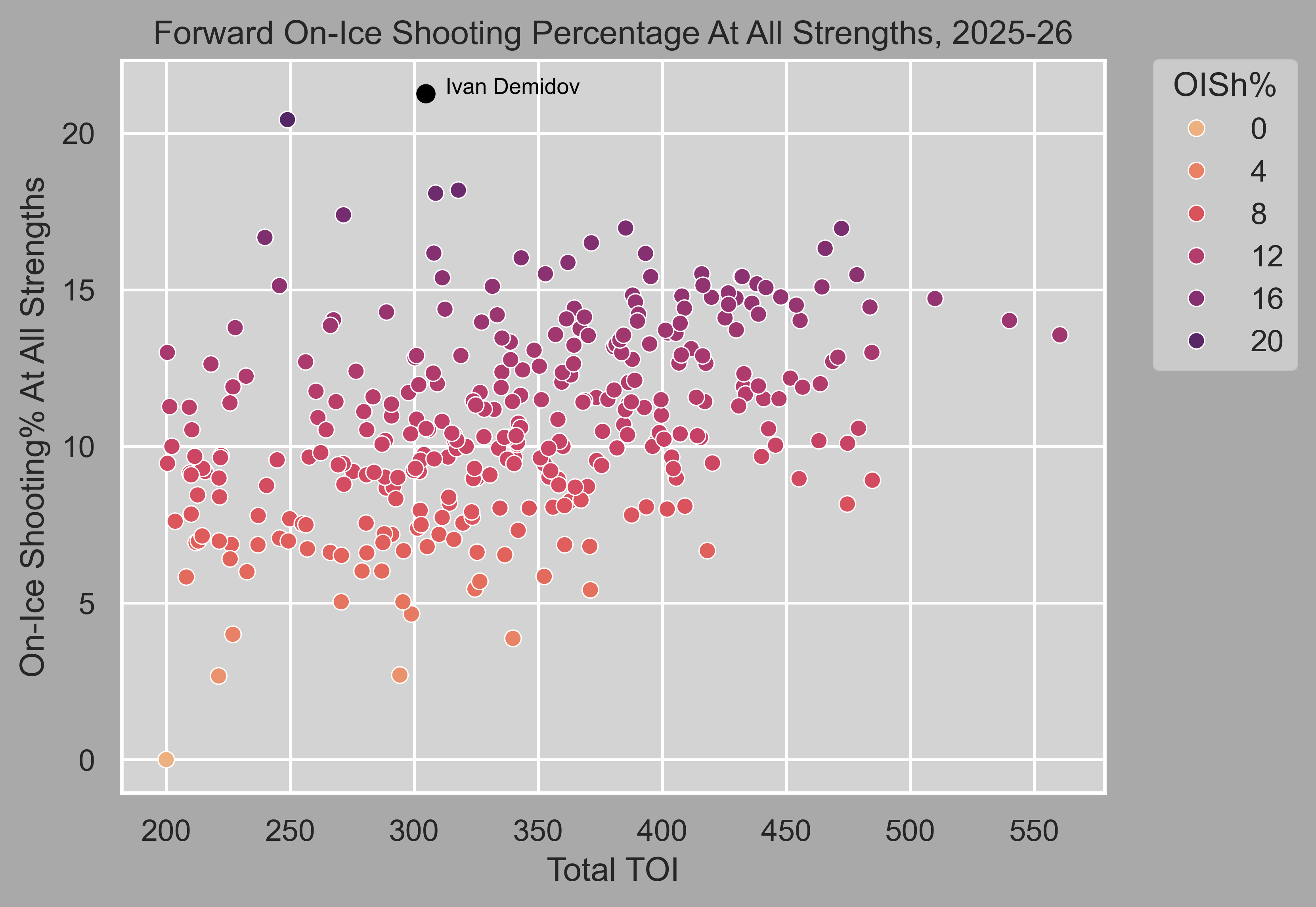
If the team kept up the same shot volume and OISh% with Demidov on the ice, he’d be on the ice for about 79 more goals the rest of the season. If the upper limit moving forward is 16%, that drops to 59 goals. Without more ice time or more shot volume, he drops from about 0.81 points per game (66-point season) to 0.61 points per game (50-point season). And that is if Demidov is at the top of the upper limit the rest of the way. If he’s not, well…
5 – Shake ‘n’ Drake
There are a few forwards with an OISh% of at least 18%, and one of them is Ottawa’s Drake Batherson, who currently sits at 18.2%, or the third-highest mark of any forward with at least 200 minutes:
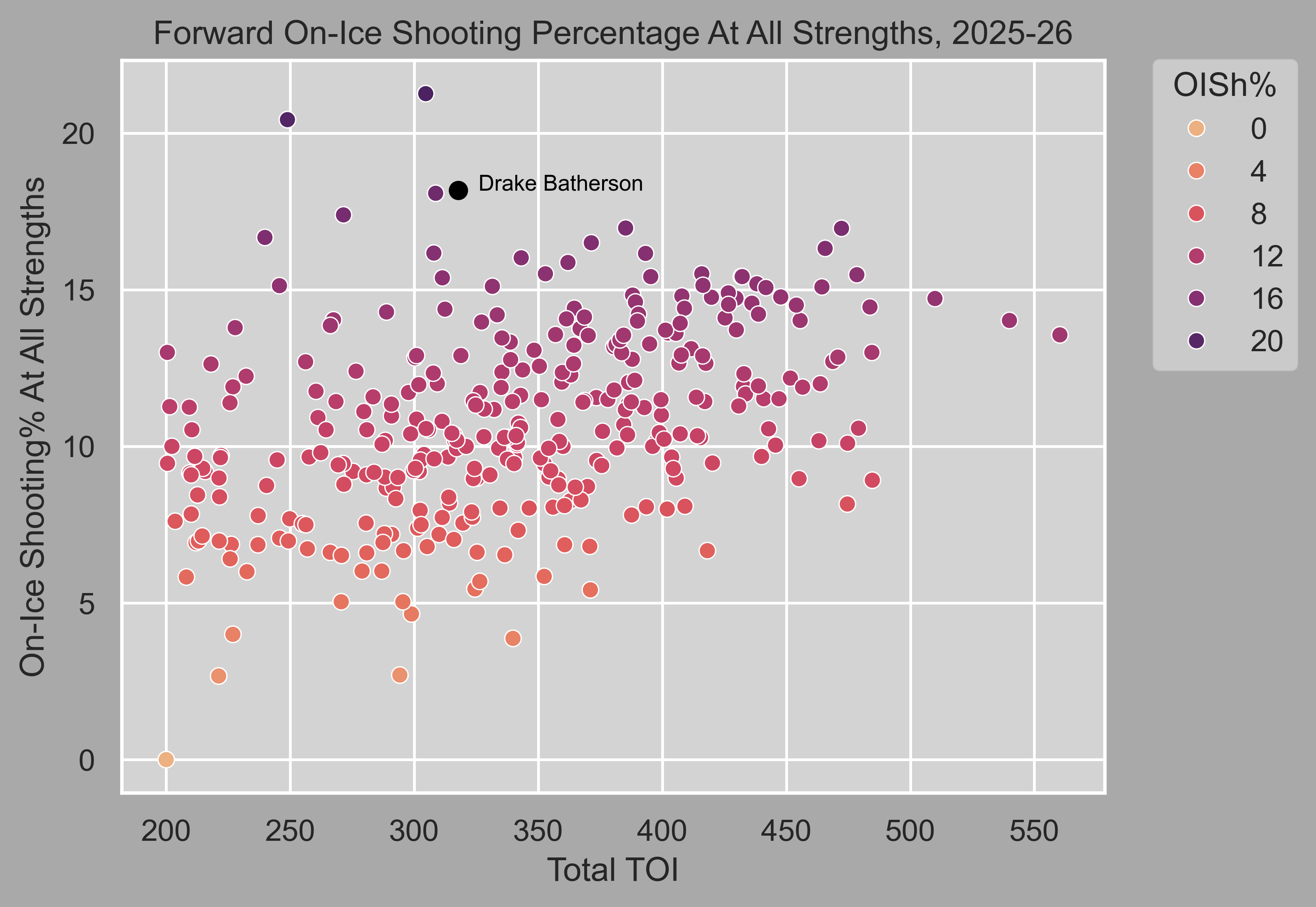
The big problem is Ottawa generated 35.5 shots per 60 minutes with Batherson on the ice last year. This year, that number is 29.1 shots per 60 minutes, so the impending drop in OISh% is going to hurt a lot more this year than it would have 12 months ago because of the volume decline. He has been over a point-per-game player so far, but this is not going to be a point-per-game player the rest of the way unless the shot volume rises dramatically.
6 – Puttin’ On the Hintz
Another one of the players with an OISh% over 18% is Dallas’ Roope Hintz, as his 18.1% is just slightly behind that of Batherson:
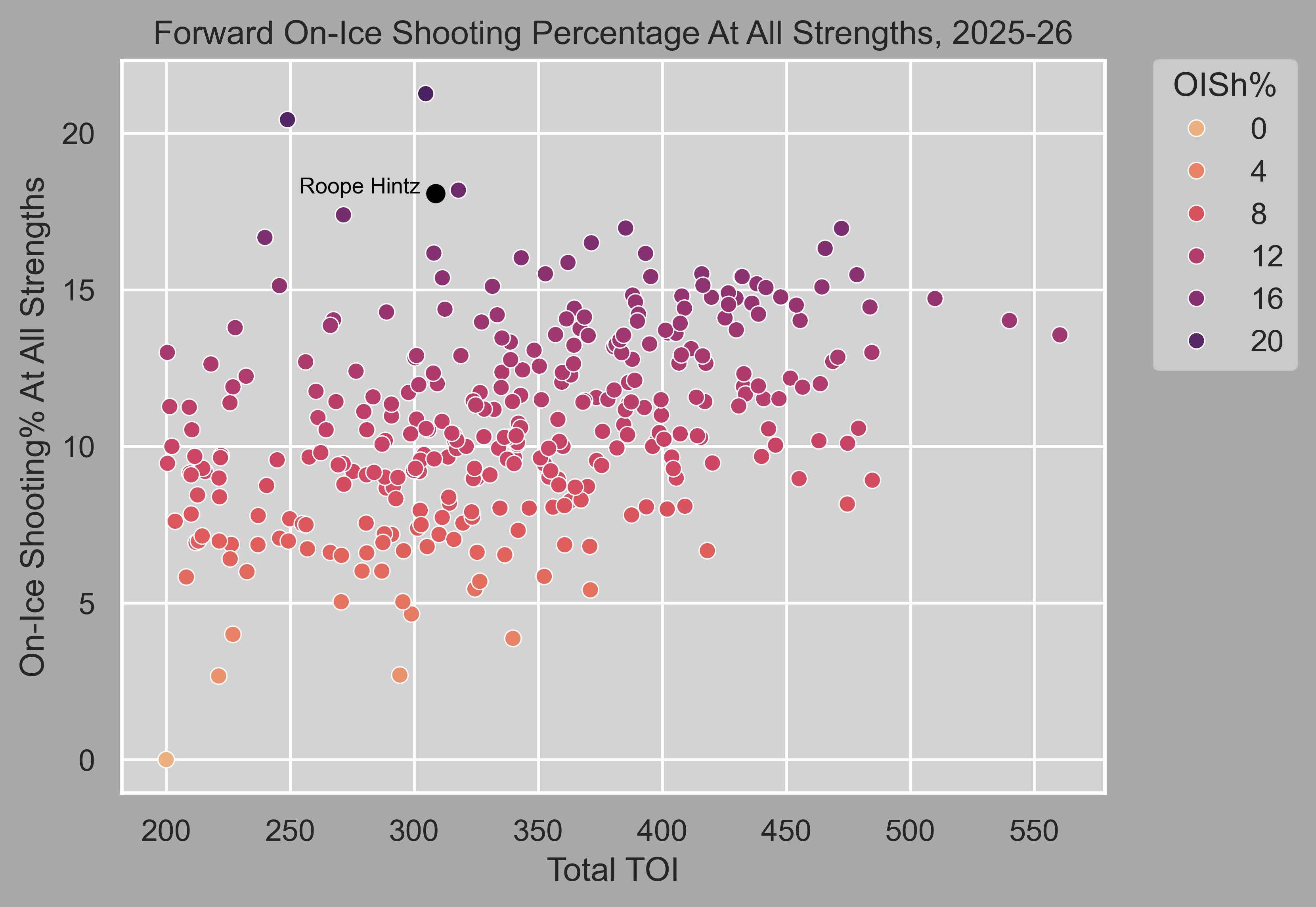
Dallas has been one of the top teams by shooting percentage for years (top-4 each of the last three seasons) but no Stars forward exceeded 14% OISh% last year. The good news is Hintz’s goal participation is low (53.1%) so he’s due for positive regression there, and there is also high shot volume, but the incoming decline in OISh% could be enough to wash that out, keeping him around a point-per-game player.
7 – Give Him Time
It’s funny how we go from ‘What’s Wrong With Connor Bedard’ to ‘Should Connor Bedard Be On Canada’s Olympic Team?’ with six weeks of regular-season play, but that’s what happens when you have one of the 10 highest OISh% rates in the league:
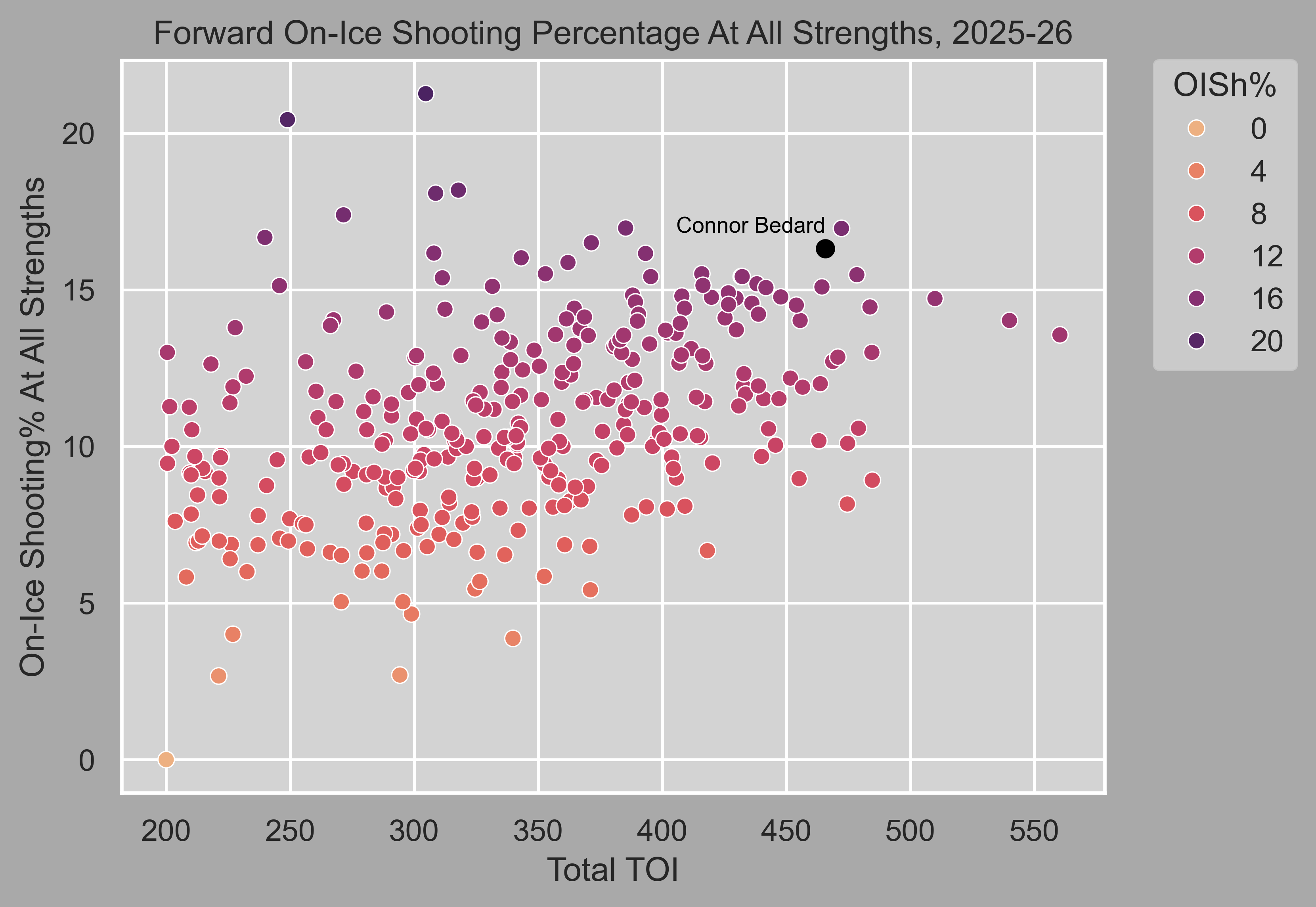
To be clear, there are a lot of genuine improvements compared to last year with much higher team shot volume, expected goal rate, and individual shot rate. But if his OISh% sees an average drop that we outlined earlier (about 3.6%), and everything else stays the same, it will cost him about 18-20 points the rest of the way. He would still be over a point-per-game player, but closer to 70 points in the next 60 games rather than 90 points.
8 – The Other Guy
We are seeing calls for San Jose’s Macklin Celebrini to be on Team Canada’s Olympic roster. Whether he should or not, it’s important to keep in mind that he has one of the highest OISh% rates in the league:
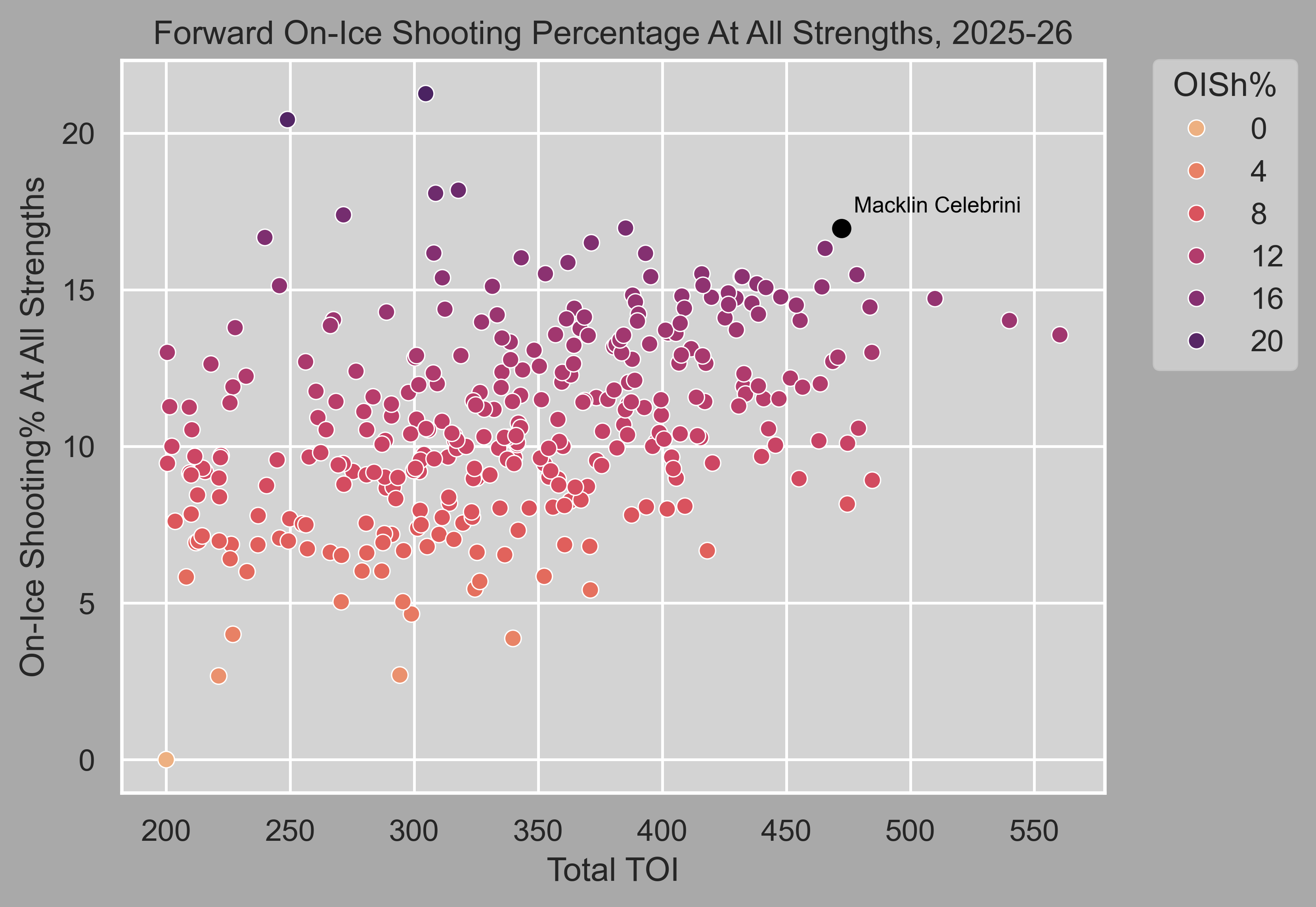
Unlike Bedard, there aren’t other improvements. The Sharks are generating nearly six fewer shots per 60 minutes with Celebrini on the ice compared to last year, the expected goals rate is down, and his per-minute shot volume has seen roughly a 20% decline. He is also figuring in on 89% of goals scored with him on the ice (the league-high last year was David Pastrňák at 88%). There is nothing but giant red flags for Celebrini’s production the rest of the way unless San Jose’s offensive numbers improve significantly.
9 – Turning Back the Clock
At 1.14 points per game, Pittsburgh forward Evgeni Malkin has his highest points/game rate since 2019-20. You can probably guess where this is going:
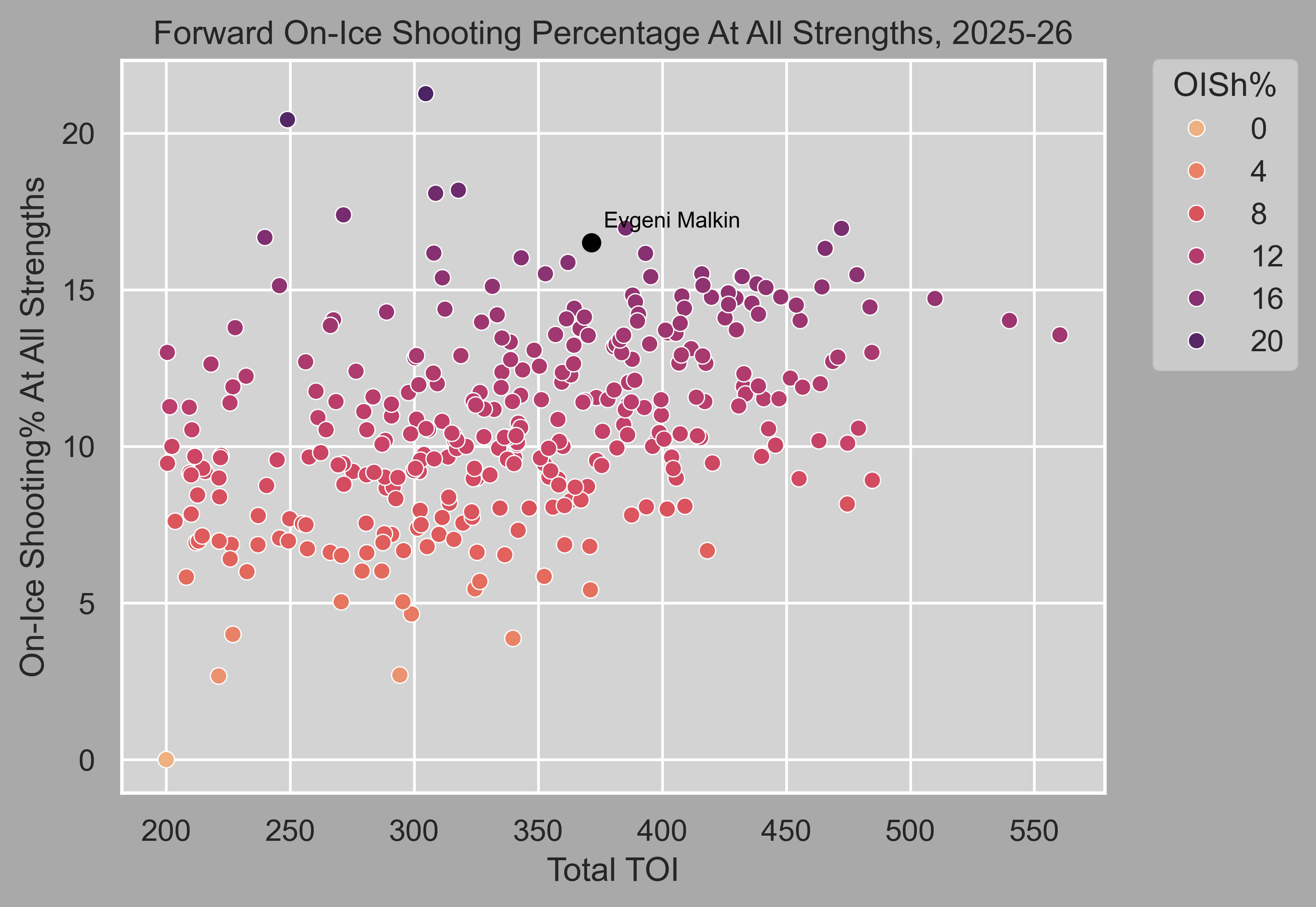
Malkin has been a key part of Pittsburgh’s start which sees them in the thick of the playoff race. Call me skeptical that a 39-year-old with an OISh% this high exceeds a point-per-game pace the rest of the way. If he can stay anywhere close to 1.0 points/game, that is a win.
10 – MacK The Knife
Colorado’s Nathan MacKinnon is your points leader with 37 points in 22 games. Unsurprisingly, he’s also sitting with one of the highest OISh% rates in the league:
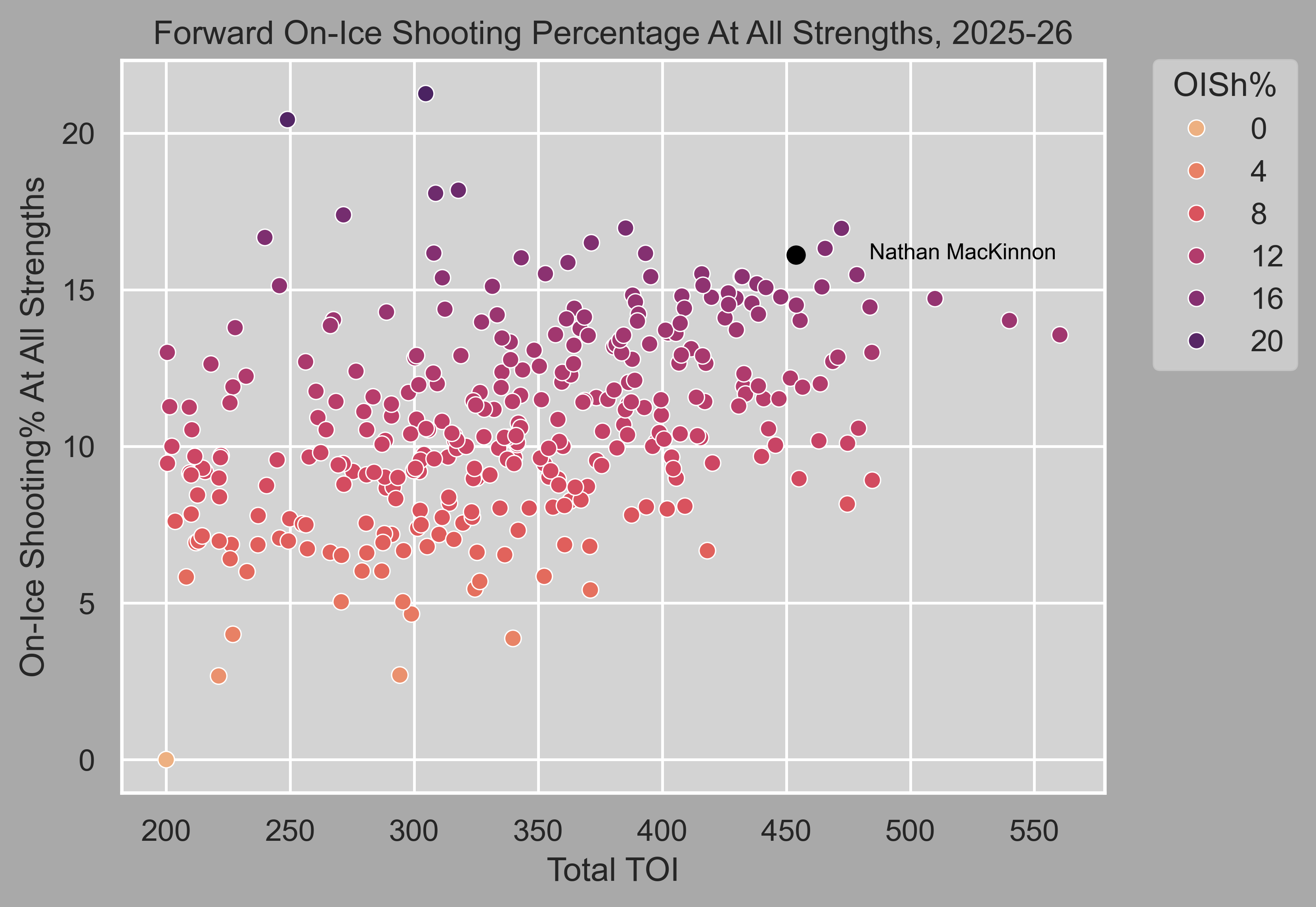
In his 140-point MVP season, MacKinnon’s OISh% was 13.9%; so far this season, it’s 15.5%. Shot volume and expected goal rates are around where we’d expect them to be for MacKinnon, and having just a 14% OISh% the rest of the way takes him from 1.68 points/game (138-point pace) to 1.53 points/game (125-point pace).
Until next week.