10 Interesting (To Me) Stats For This Week - June 23, 2026
Welcome back to another week of ’10 Interesting (To Me) Stats’.
Before going further, a reminder that this newsletter is slowly migrating to a new host, and there will be more hockey writing on the new site. You can subscribe here.
*
In light of the Carolina Hurricanes’ Stanley Cup win, it is worth reviewing what kinds of changes teams made to their offence in the 2025-26 season.
We will look only at 5-on-5 play and drill down to three types of shots:
1. Shots off the rush
2. Shots off the cycle/forecheck
3. Shots off high-danger passes (passes from behind the net or from across the slot)
These rates will be relative to the league average at the position, so forwards are only compared to forwards and defencemen to defencemen. For today, the focus is on just the forwards with tracking data from All Three Zones. Any other team/player data is from Evolving Hockey.
1 – Carolina Hurricanes
For years, the Hurricanes were a cycle-heavy team that relied on point shots and relentless forechecking to generate their goals. That changed in 2025-26 as they became a much more rush-heavy team, and the result was the franchise’s first league title in 20 years:
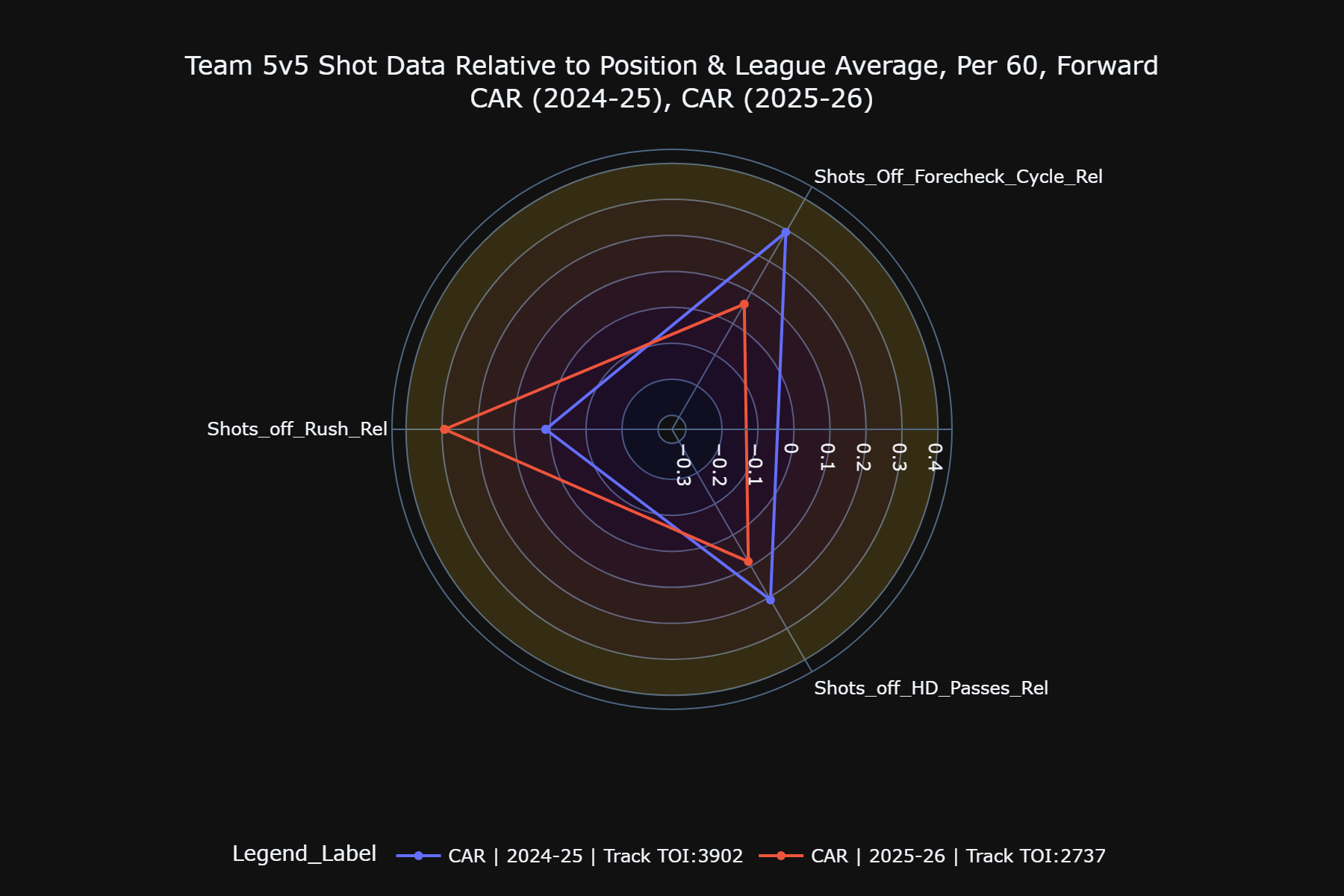
There was a division among the forwards as the top of the lineup – Sebastian Aho, Andrei Svechnikov, Jackson Blake, and the like – were responsible for the increase in rush offence while the bottom of the lineup – Jordan Staal, Jordan Martinook, Mark Jankowski, and so on – did not change their rush-offence profile much. Regardless of who did what, the Rod Brind’Amour-era Hurricanes now have a championship that stands a testament of their ability to change.
2 – Boston Bruins
Few teams saw as big of an overall turnaround in 2025-26 as the Bruins, who improved by 24 points on their 2024-25 campaign, increased their 5-on-5 goals-for rate by 22%, and returned to the postseason. As we just saw with the Hurricanes, it seems a big reason for Boston’s offensive rejuvenation was their rush offence:
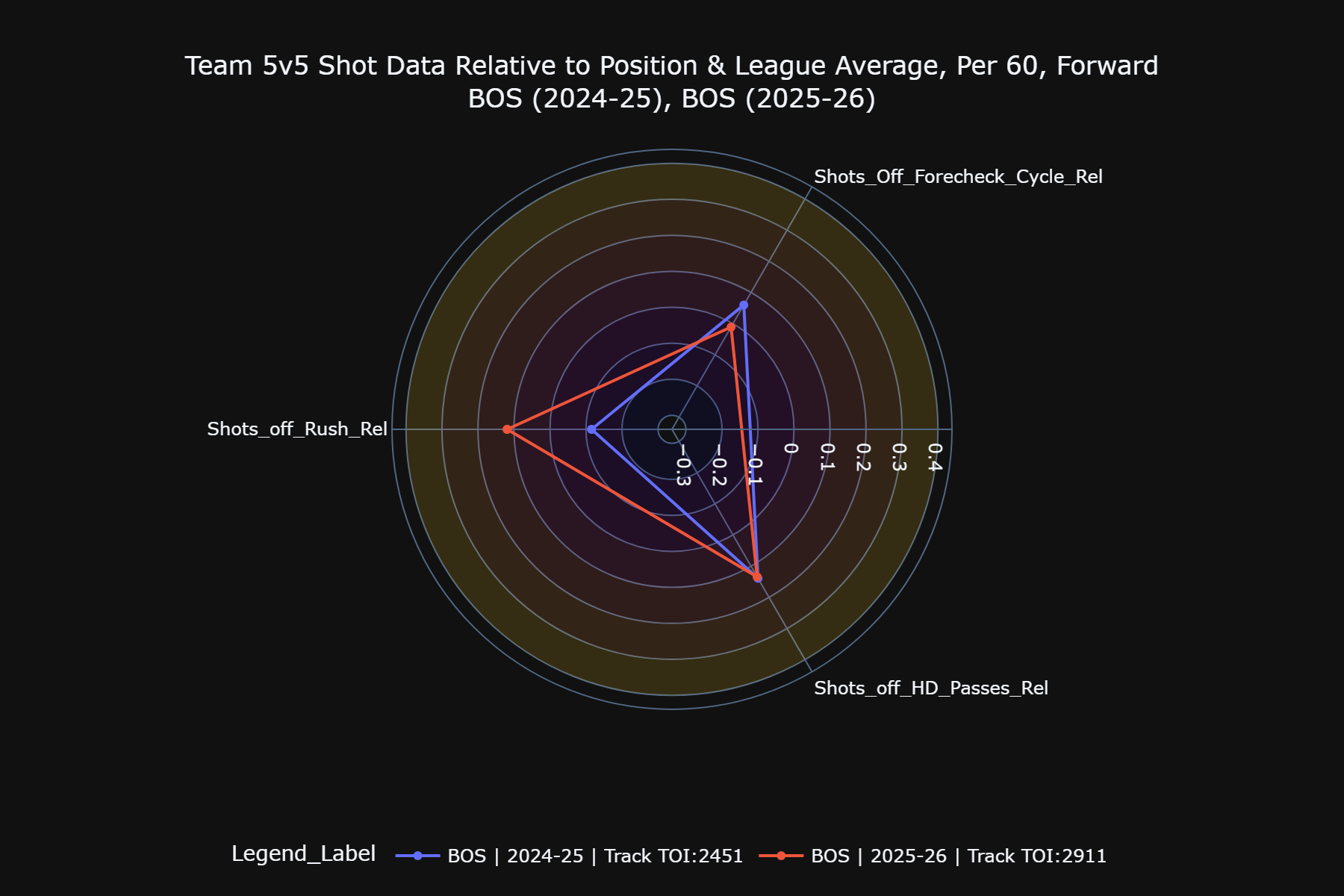
Remember that this is relative to the league average, and teams have been focusing more on offence off the cycle/forecheck over the last couple of seasons, so Boston’s ‘increase’ is less a huge improvement in rush offence and more not having a decline in rush offence. Regardless, much like Carolina, Boston’s 5-on-5 offence zigged when the rest of the league zagged, and they were rewarded with a playoff appearance.
3 – Buffalo Sabres
In 2024-25, Buffalo forwards created offence off the rush at a rate about 6% higher than league average. That jumped to nearly 19% in 2025-26, even as the team saw small declines in shots off the cycle/forecheck and off high-danger passes:
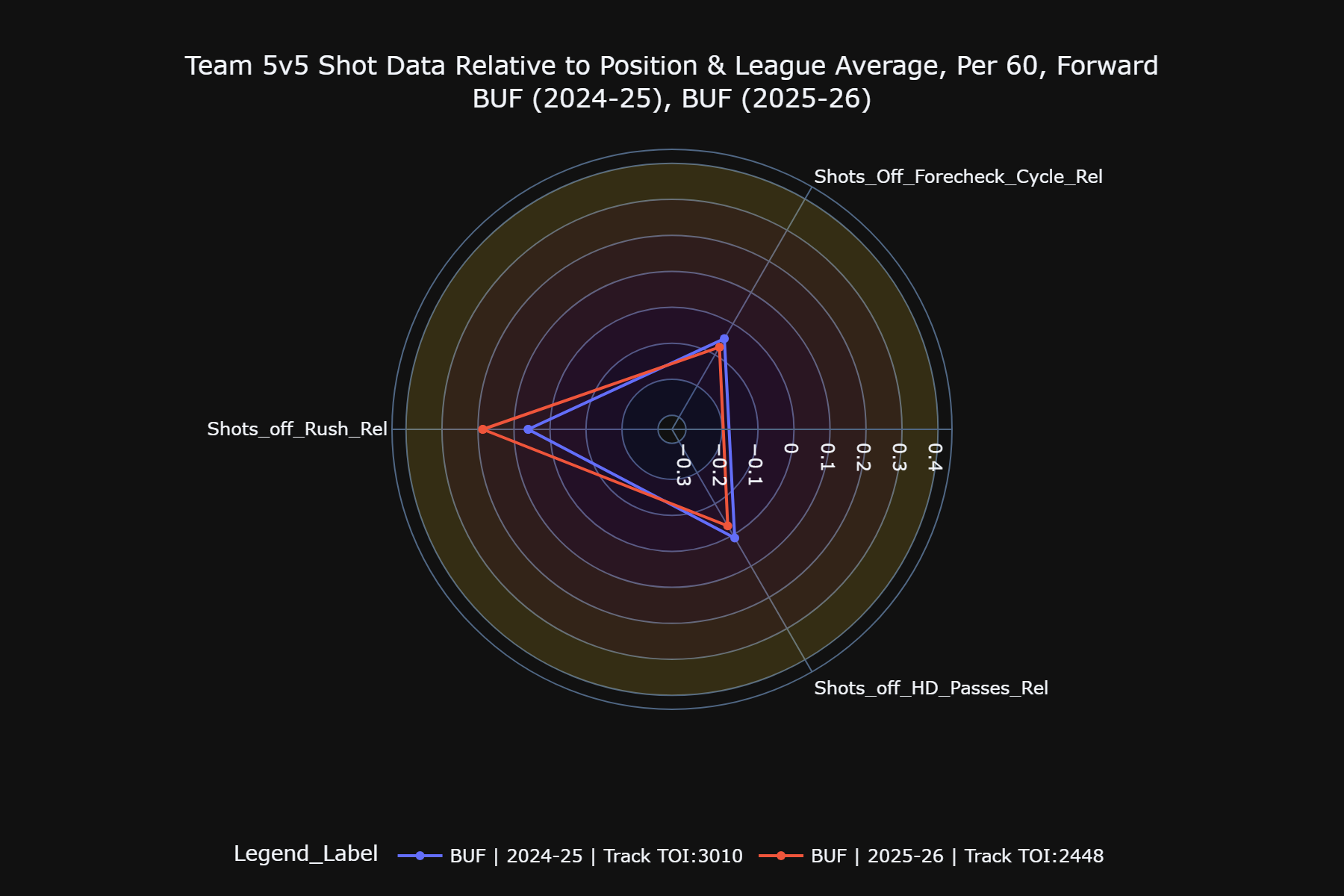
This is interesting because the Sabres of 3-4 years ago were heavily reliant on rush offence to score goals at 5-on-5. When they hired current coach Lindy Ruff for the 2024-25 season, they moved away from that, but the team’s results declined. In 2025-26, they returned to being a team that more frequently shoots off the rush and reached the postseason for the first time in 15 years. It is an open question as to whether their offence undergoes more changes in 2026-27.
4 – Anaheim Ducks
Heading into 2025-26, one fascinating question was what the Ducks’ offence would look like under new coach Joel Quenneville. The answer, as we’ve seen with the first three teams reviewed thus far, is a rush-heavy offensive style:
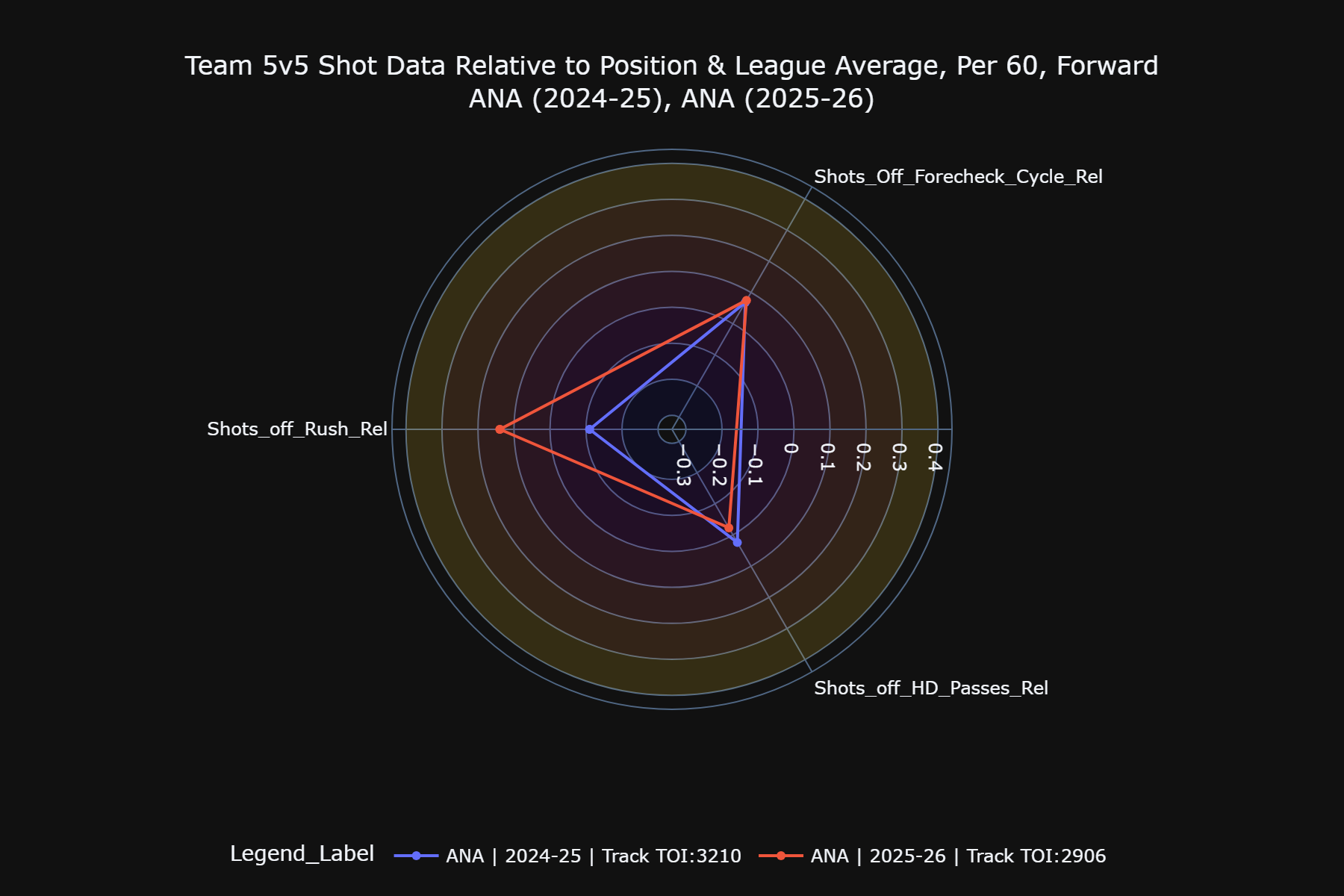
We could say this is just a young team’s offence improving naturally, but that they created virtually the same rate of shots off the cycle/forecheck, and fewer shots off HD passes, indicates there’s more to it. It led to Anaheim’s first postseason appearance since 2018.
To this point, we’ve now covered four teams: the Stanley Cup winners, a team with a 24-point improvement, a franchise who returned to the playoffs for the first time in 15 years, and now a roster that turned in their best season in eight years. The one thing they all have in common is moving towards more rush offence as most franchises were moving towards more forecheck/cycle offence. This is a copycat league, so it’s a wonder what other teams decide to do for the 2026-27 campaign.
5 – Dallas Stars
After three straight Western Conference Final losses with Pete DeBoer as the coach, the Stars hired Glen Gulutzan to be their coach for the 2025-26 campaign. Unlike what we’ve seen with the four teams already discussed, the 2025-26 Stars forwards completely abandoned their rush-heavy offence:
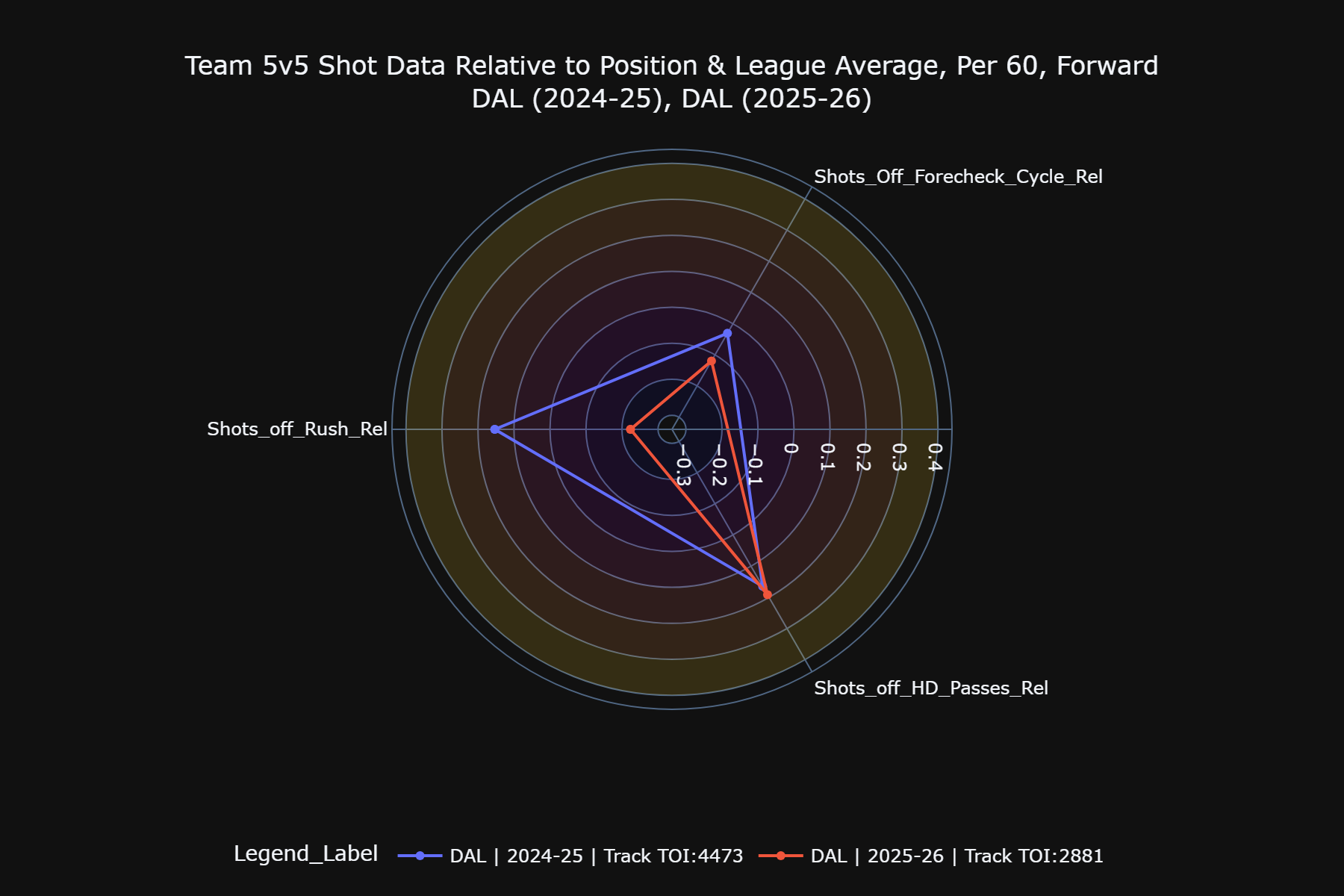
Dallas had injuries up front to Roope Hintz, Tyler Seguin, and Matt Duchene, but this large of a drop indicates more of a team-wide philosophy than a few injuries. It led to a decline in 5-on-5 goal scoring, but their decline in 5-on-5 goals against was 2x larger than the decline in 5-on-5 goals-for. So, the change resulted in fewer goals against, but as we saw in their first-round loss against Minnesota, it left them incapable of scoring at 5-on-5, and their postseason produced Dallas’ lowest expected goals-for rate in any playoff appearance since 2008.
6 – Ottawa Senators
When teams are entering a potential Stanley Cup window, we need to look for improvements rather than outright domination. This is the case for Ottawa as the 2024-25 season saw their forwards produce the lowest rate of shots off high-danger passes of any team in the league, but they improved to 25th in the league in 2025-26:
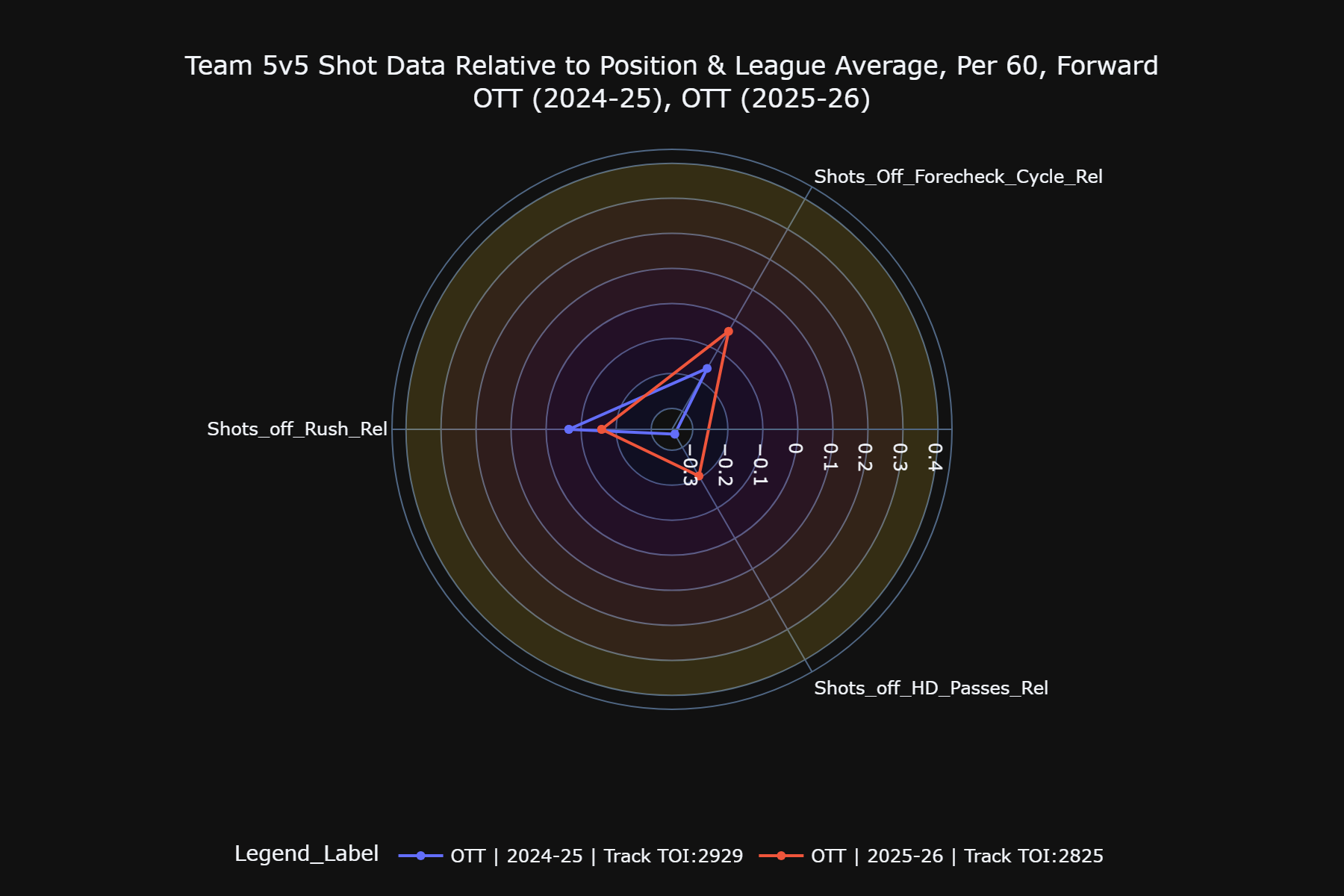
Being 25th still isn’t great, but it was a 14% season-over-season improvement. Along with a sizeable increase in offence off the cycle/forecheck, Ottawa saw their 5-on-5 goal rate skyrocket, going from 28th in the league two years ago to 9th last year. Any further improvements in the 2026-27 season should see the Senators be a top-10 team at 5-on-5.
7 – Vancouver Canucks
What does it look like for a team to finish dead last in 5-on-5 scoring? How about going from nearly league-average by shots off high-danger passes in 2024-25 to a distant dead last in shots off high-danger passes in 2025-26:
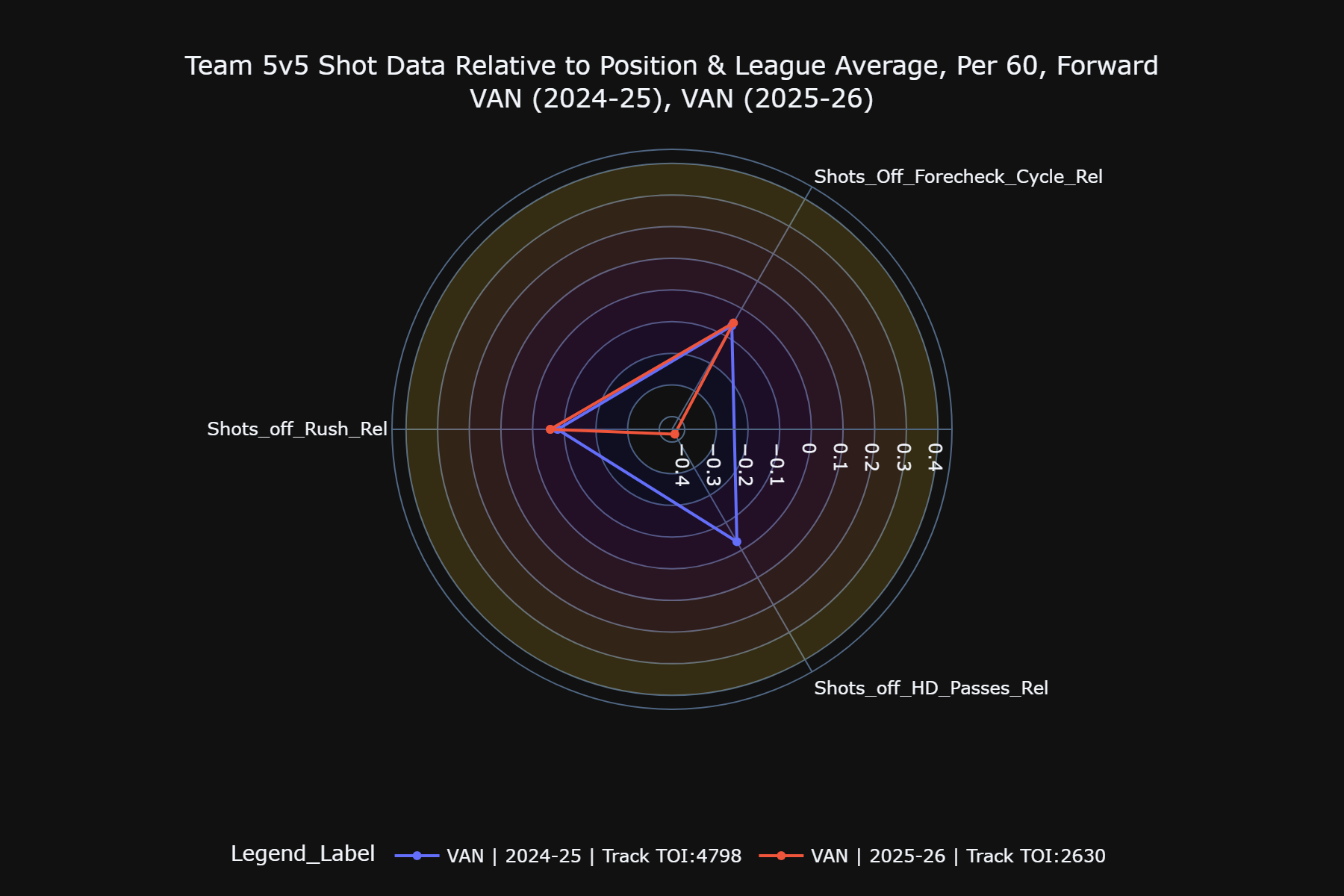
It is little wonder that the Canucks made a coaching change after just one season with Adam Foote behind the bench. Trading JT Miller in January of 2025, and then Quinn Hughes in December of 2025, was one obvious culprit of the lack of HD passes, but a 44% drop in one year is a flashing red danger sign. Hopefully, a healthy roster and a new coach can start turning things around in 2026-27.
8 – Utah Mammoth
As someone who reviews a lot of stats daily during the regular season, it kept surprising me that Utah was scoring so much at 5-on-5 despite a modest shot rate. With the benefit of hindsight, the massive leap in shots off high-danger passes provides the context we need:
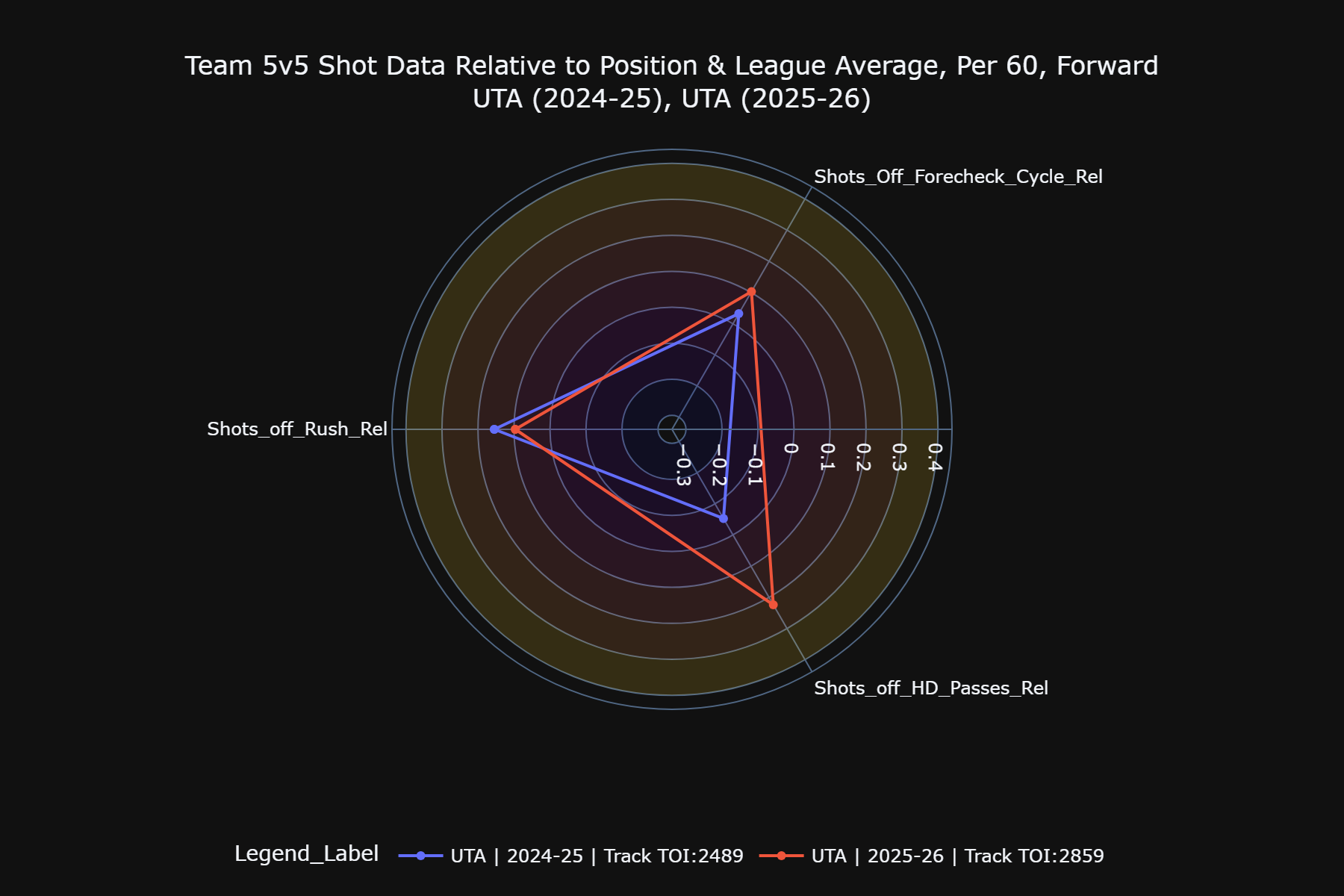
In 2024-25, Utah’s rate of shots off HD passes was a little below average (19th in the league), but jumped to 6th in the league, or an increase of about 21%. With a full, healthy season from Logan Cooley and more growth from him and Dylan Guenther, the Mammoth have all they need to be a top-5 scoring team in 2026-27.
9 – Seattle Kraken
The impetus for today’s article was my reaction to realizing what Seattle did offensively in 2025-26. To be more accurate, it’s what Seattle didn’t do offensively in 2025-26, which is… *Luthen Rael voice* EVERYTHING:
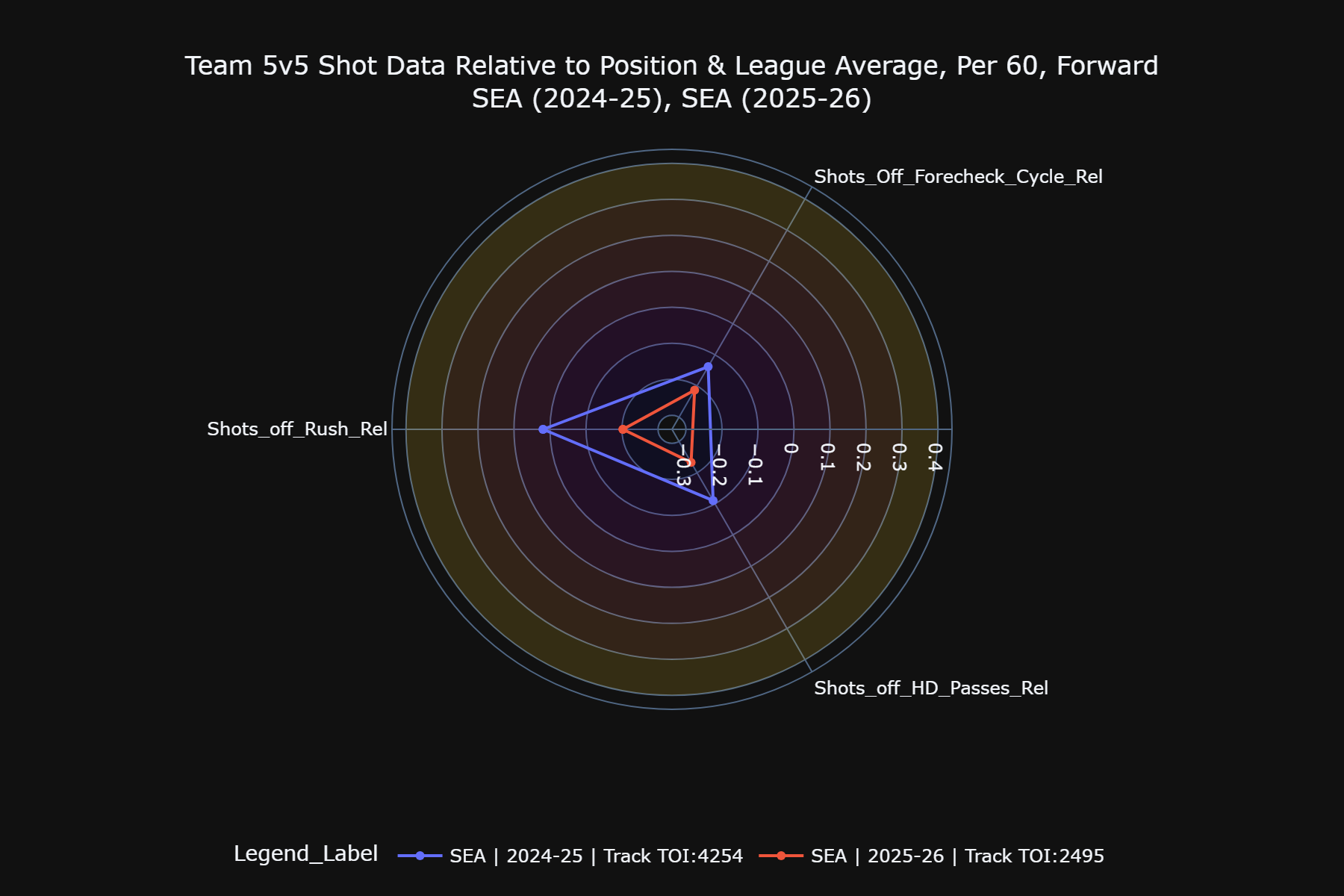
It isn’t that Seattle was great in 2024-25, but the 2025-26 season saw their forwards finish 31st by shots off the rush, 31st by shots off the cycle/forecheck, and 26th by shots off HD passes. They need Guys like Jake O’Brien and Berkly Catton to become Dudes, or this franchise is in trouble.
10 – Philadelphia Flyers
The improvements the Flyers made in 2025-26 were not on the offensive end, but the defensive end, and that’s what led them to the postseason. It is notable that all three of their shot metrics saw sizeable drops:
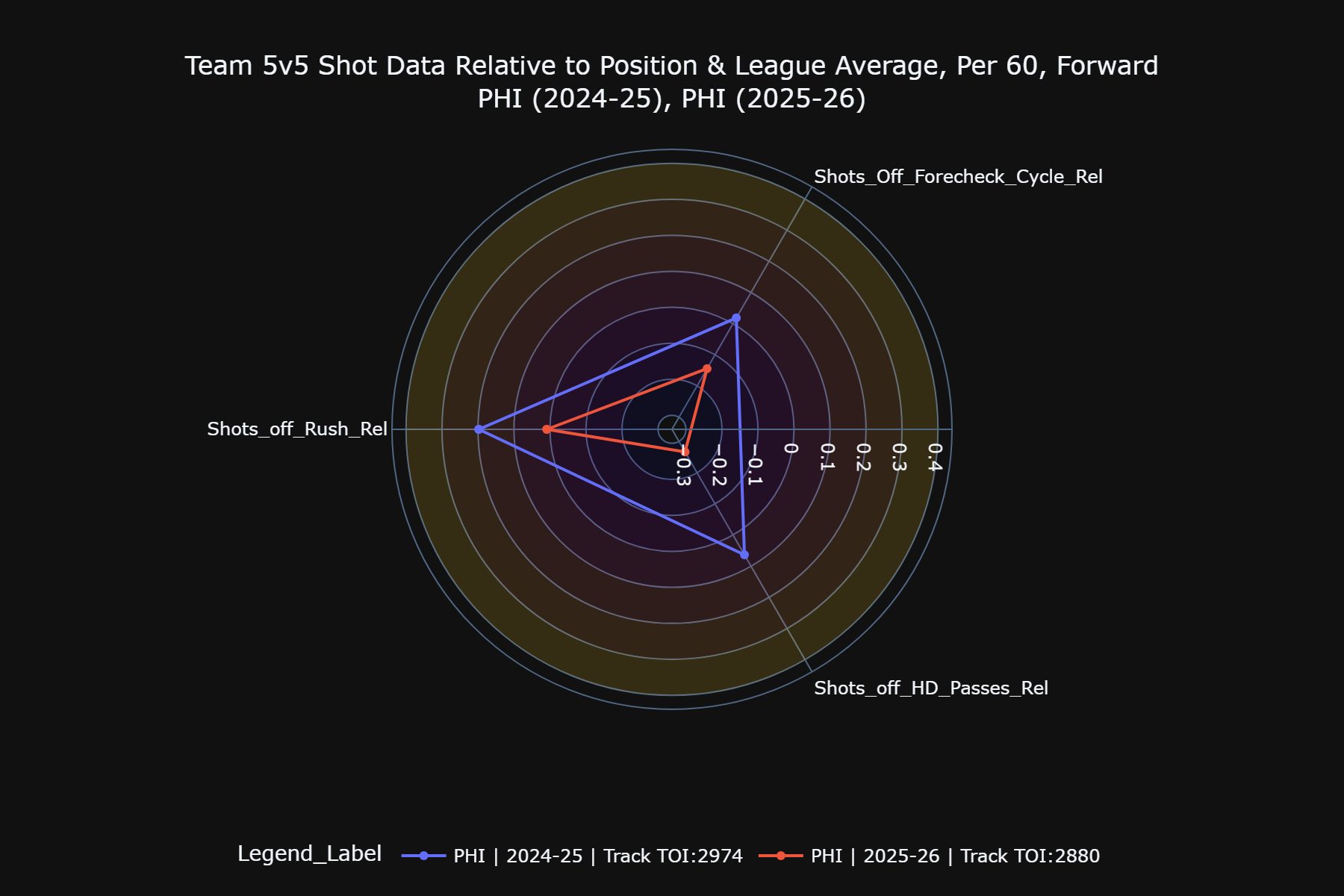
A shooting percentage increase helped the team maintain their goal-scoring rate as their goals-against rate plummeted. The big drop in all shot metrics is a bit concerning, but assuming Matvei Michkov decides to do offseason workouts, a full season from Porter Martone, and Trevor Zegras now having a year under his belt with his new teammates, the shot rates should rebound in 2026-27. Just don’t expect them to be a top-10 offence; the Flyers’ team defence will determine their success or failure.
Until next week.