10 Interesting (To Me) Stats For This Week - April 7
Welcome back to another week of ’10 Interesting (To Me) Stats!’ Next week’s newsletter will focus on playoff matchups, so let’s use this week’s column to discuss individual trophy winners.
The focus for today’s newsletter will be two individual awards: the Norris Trophy for the league’s top defenceman and the Selke Trophy for the league’s top two-way forward. We will discuss others at some point, but those two are the topics for today, covering five players for each trophy. The players will be listed in no particular order.
We are using player data from Natural Stat Trick and Evolving Hockey with tracking data from All Three Zones. There is also competition data from Puck IQ. Data is current as of Monday, April 6th.
Norris Trophy
1 – Lane Hutson (Montreal Canadiens)
Evolving Hockey’s ‘Goals Above Replacement (GAR)’ model evaluates player value by taking their even-strength offence and defence, special teams impact, and penalties taken/drawn into account. For reference, last year’s runner-up (Leon Draisaitl) posted 28.8 GAR. The winner in 2023-24 (Nathan MacKinnon) posted 36 GAR. This season, Hutson is second among both defencemen and all skaters in the league with 28.5 GAR overall, and he sits third by GAR per 60 minutes:
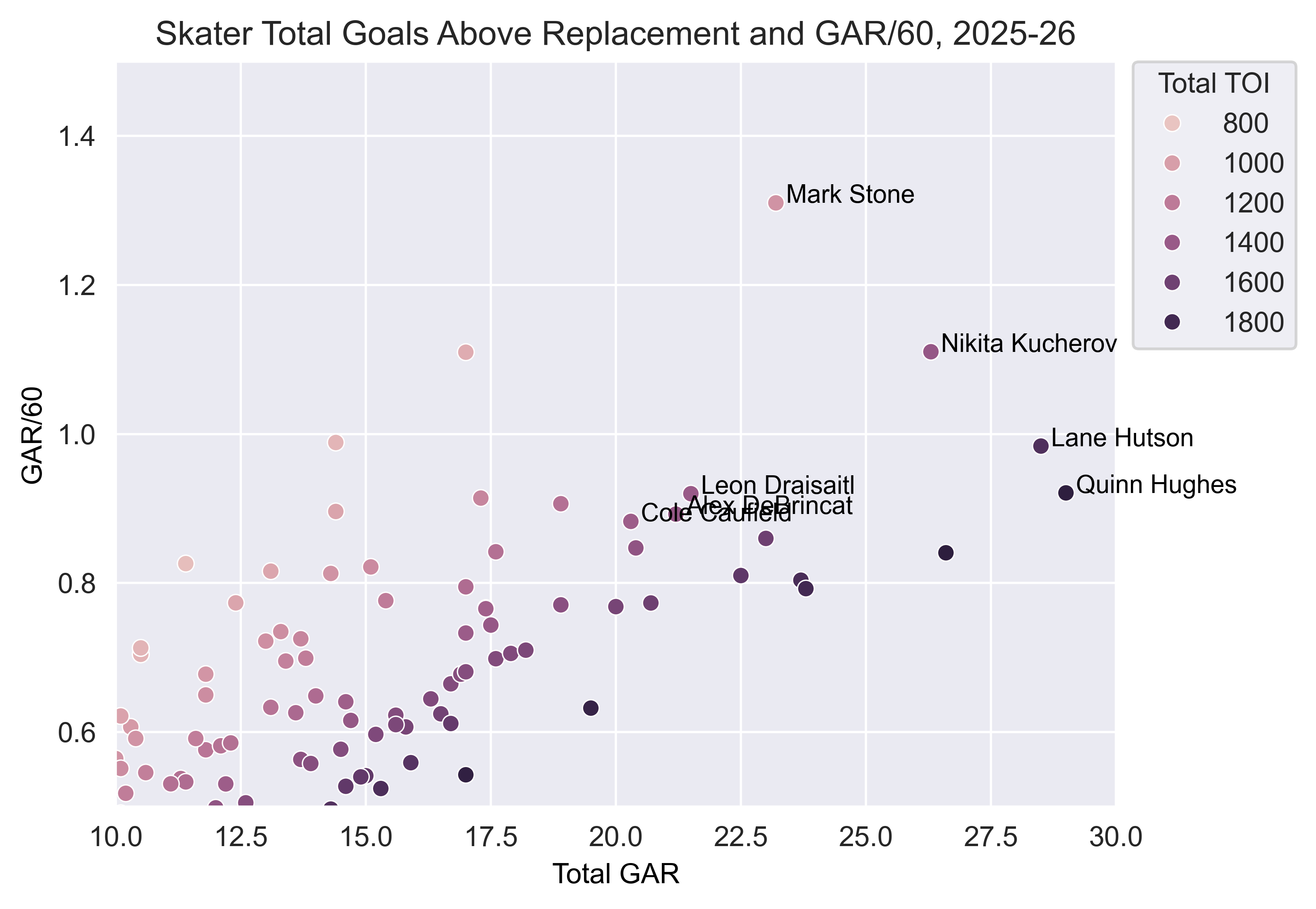
The only comparable skaters by the GAR model are Nikita Kucherov and Quinn Hughes, but the sheer volume of minutes played put Hughes and Hutson at the top. At the least, he’s one of the two elite performers on the blue line by this measure, and it’s why he deserves heavy Norris Trophy consideration.
2 – Quinn Hughes (Minnesota Wild)
It is kind of fun to have Hughes and Hutson at the top of the GAR and GAR/60 model because Hutson has often been compared to Hughes early in his career. They are different types of players even if the end result is the same, but Hughes (and Hutson) are in a tier above the other top GAR defencemen:
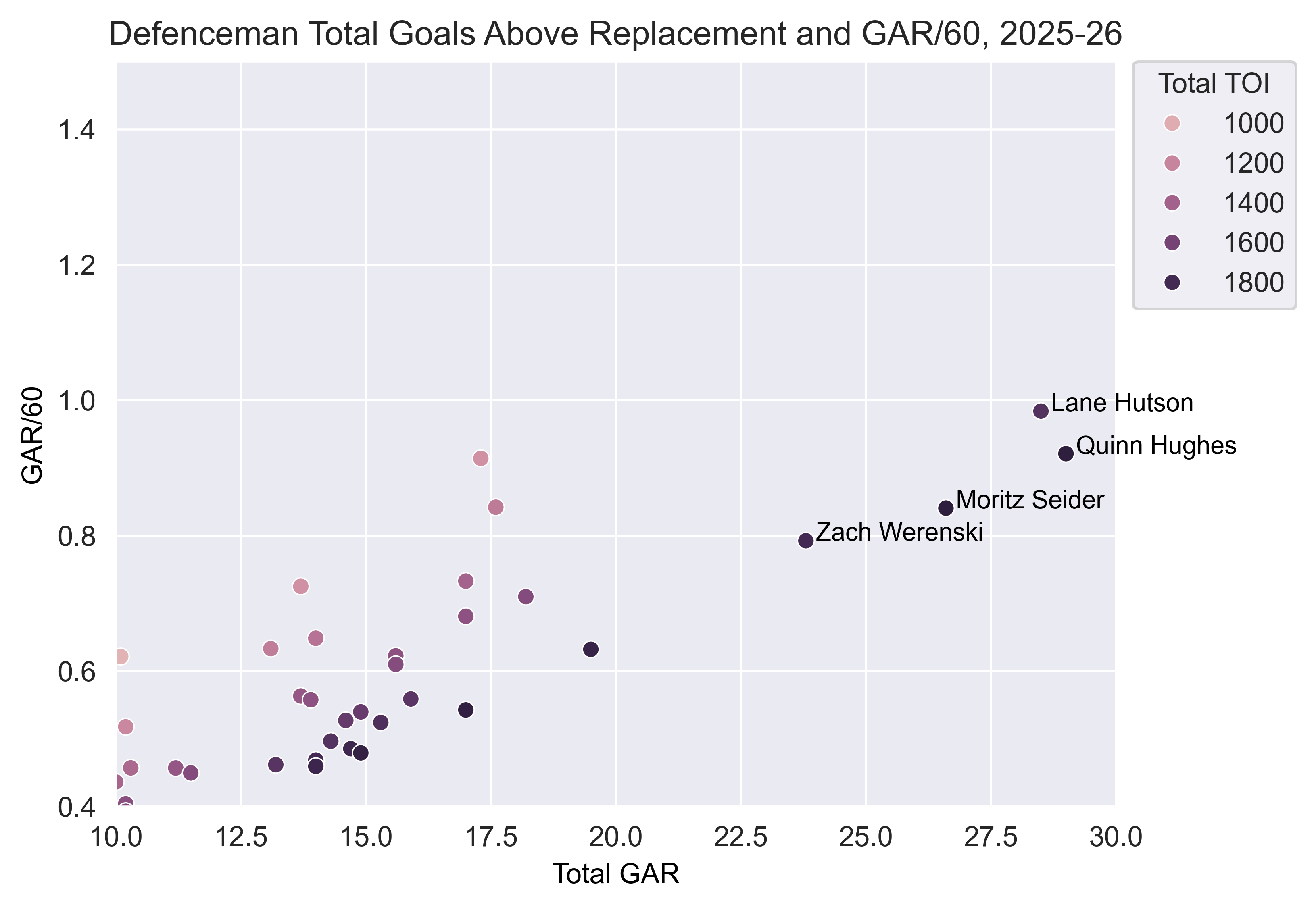
We see Hughes and Hutson close together with Moritz Seider and Zach Werenski behind them. Aside from just this model, the impact Hughes has had on the Wild since the trade is huge: the team had a 51.7% goal share in 32 games before the trade and has had a 55.2% goal share since the trade. This season that is the difference between being a top-5 team or being outside the top-10.
3 – Moritz Seider (Detroit Red Wings)
What makes Seider such a good defenceman is his ability to not only be immensely valuable, but to do it in difficult conditions. We just saw how he was next to Hughes and Werenski by GAR and GAR/60, but per Puck IQ, he’s 1 of 6 defencemen to be in the 84th percentile or higher by EVTOI against ‘elite’ competition and 16th percentile or lower by percentage of shifts starting in the offensive zone:
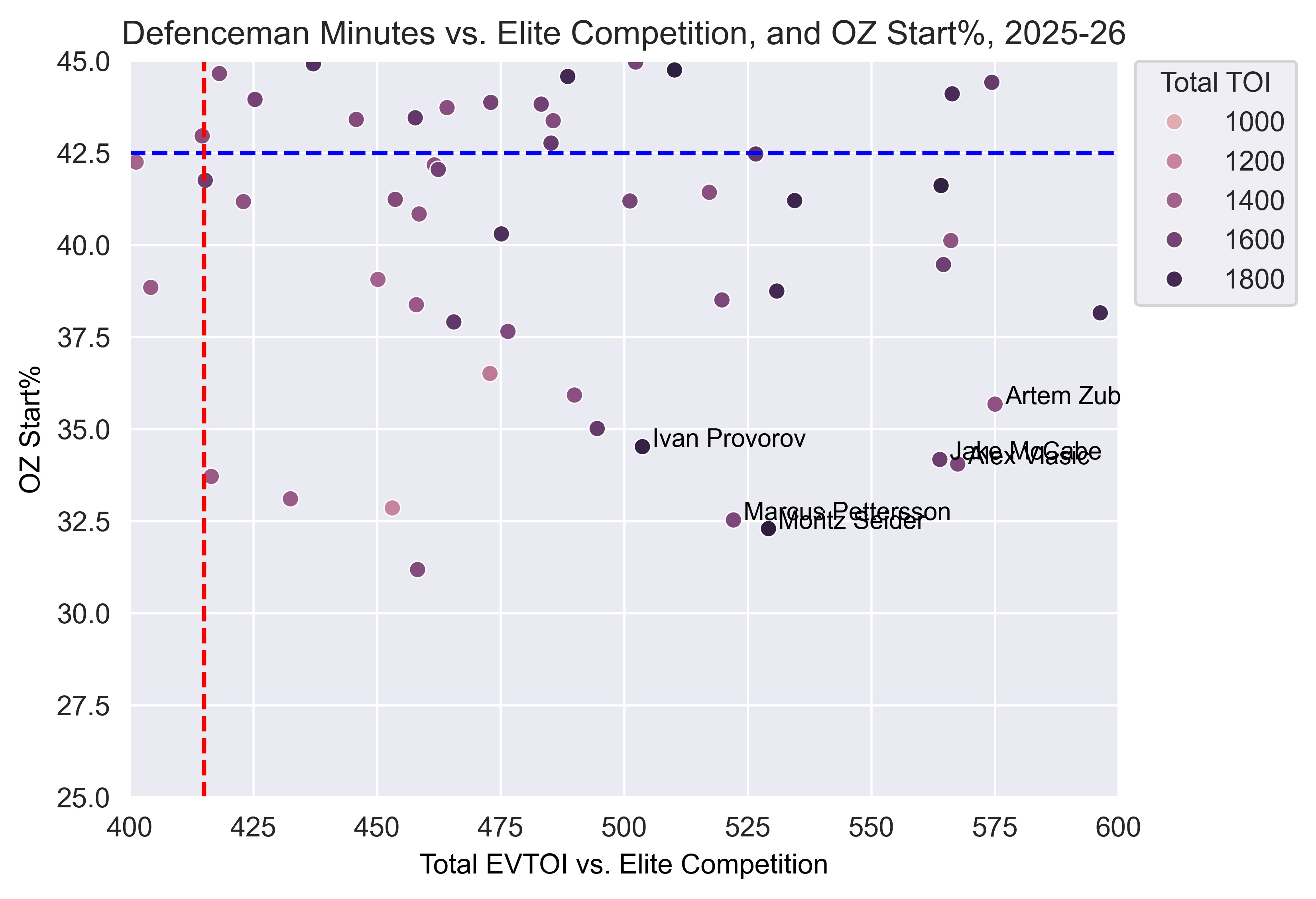
The red and blue dotted lines are the median totals for each category. So, not only has Seider been among the elite defencemen by what he’s brought at both ends of the ice, he’s done it facing stiff opposition with few starts in the offensive zone. He has truly been outstanding this season.
4 – Zach Werenski (Columbus Blue Jackets)
As shown in the Hughes section, Werenski is among the top defencemen by GAR and GAR/60 this season, or at least in a second tier with Seider. He has done it a bit differently than Seider, though. Here are the comparable defencemen by combined zone entries+exits per 60 minutes, total scoring chance contributions/60, and percentage of zone entries carried in:
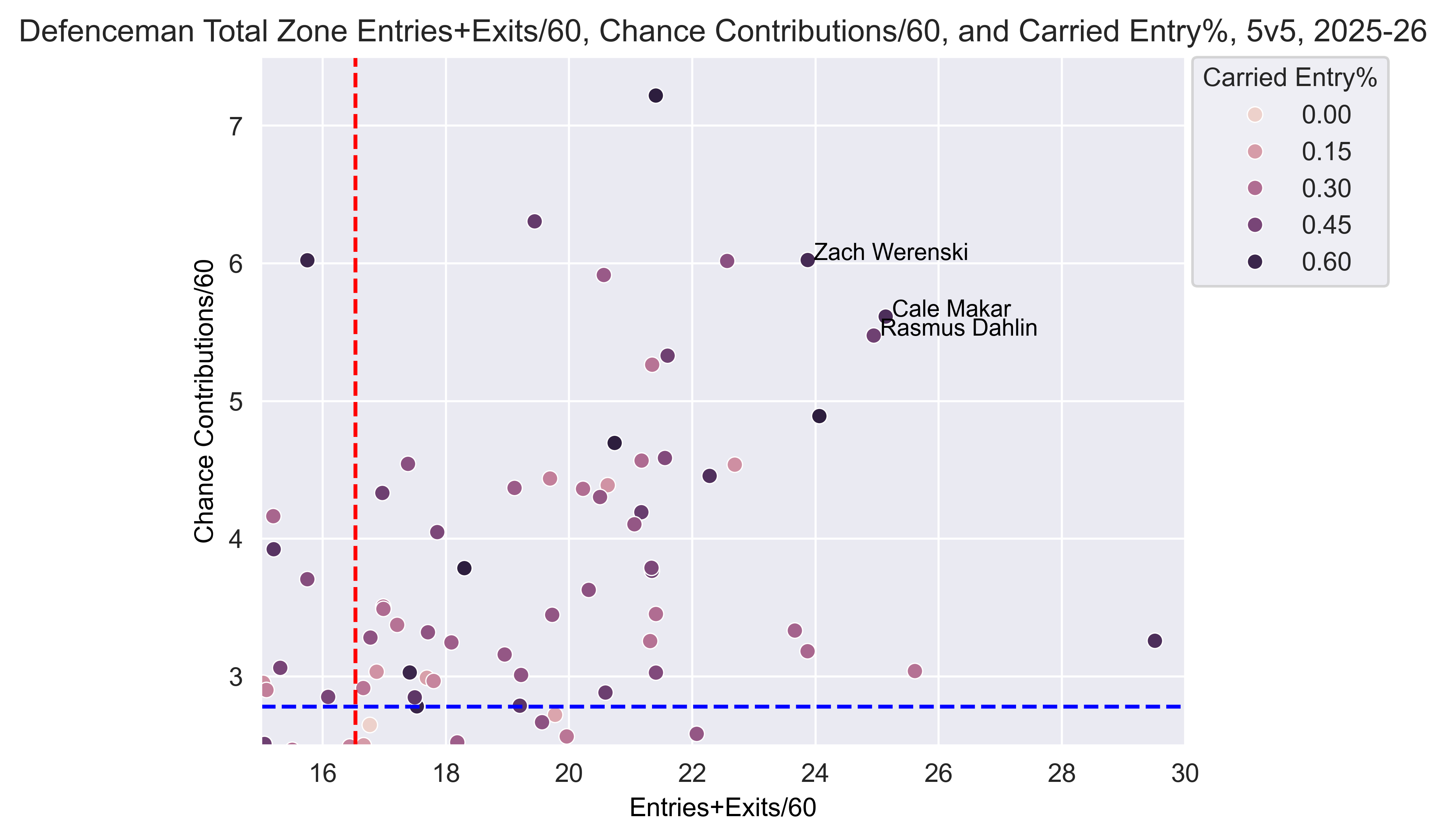
It is also worth mentioning that at 26:27 TOI per game, Werenski is second in TOI per game this season, trailing only Hughes. Columbus is still in the thick of the playoff race, and with how heavily involved Werenski is with the puck with so much ice time per game, he is a big reason why that’s the case.
5 – Evan Bouchard (Edmonton Oilers)
All the consternation around the Oilers has disguised the fact that Bouchard is having the best offensive season of his career, surpassing the 20-goal mark for the first time and threatening for 90 points. He has been tremendous at creating offensive opportunities for the Oilers as here the comparable defencemen by rate of assists on teammate scoring chances and percentages of zone entries at 5-on-5, as well as penalty differential value overall, this season:
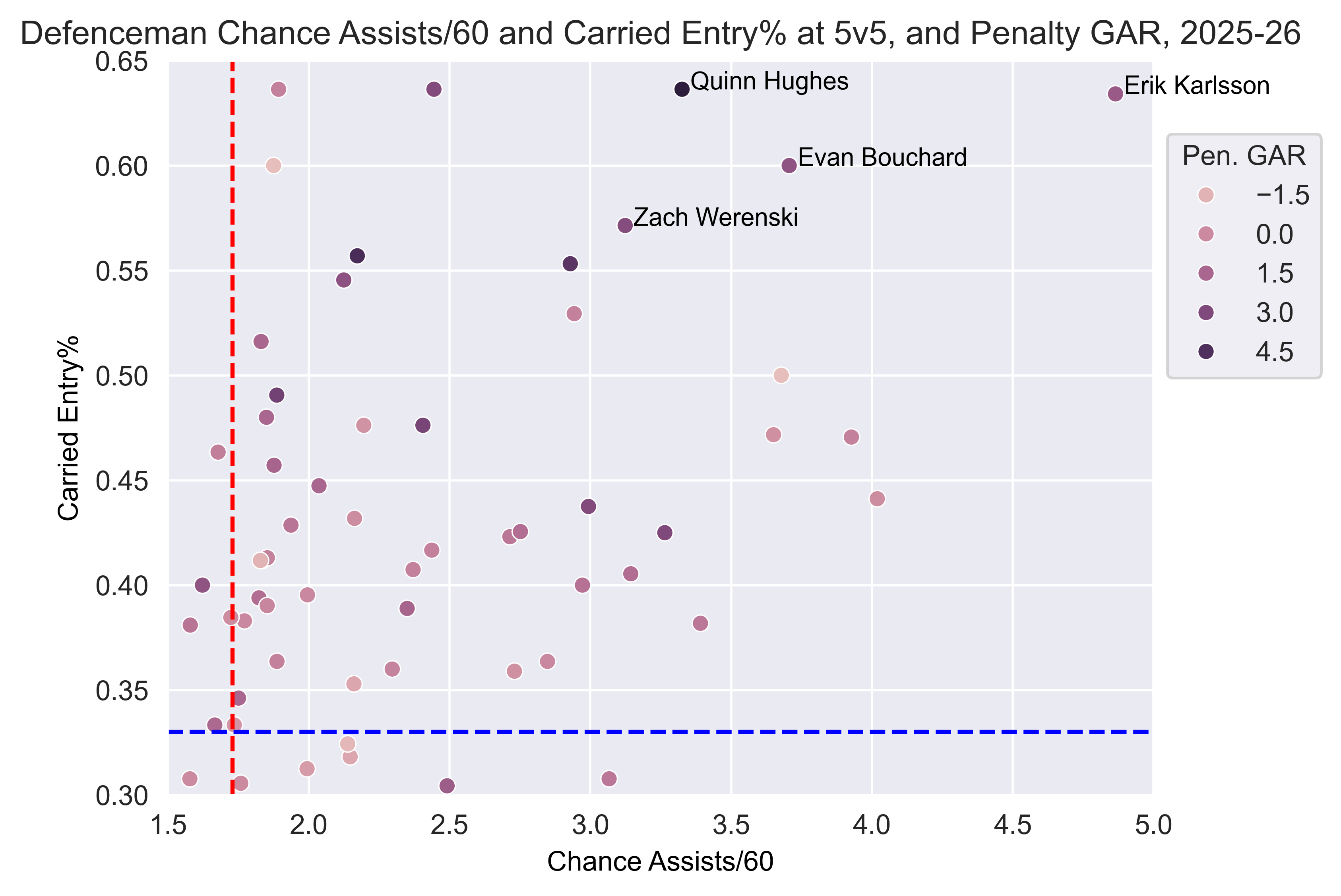
The defensive side of things haven’t been good for Bouchard, and that’s what will keep him from being a top-3 Norris finalist, but he has been tremendous offensively and is worth mentioning here.
Selke Trophy
6 – Nick Suzuki (Montreal Canadiens)
Suzuki might reach 100 points this season, so the offensive value is obvious. Less obvious is his stellar defensive work. He is on a very short list of forwards with at least 400 minutes facing ‘elite’ competition, at least 84th percentile by GAR on the penalty kill, and above average by defensive zone retrievals/60 minutes:
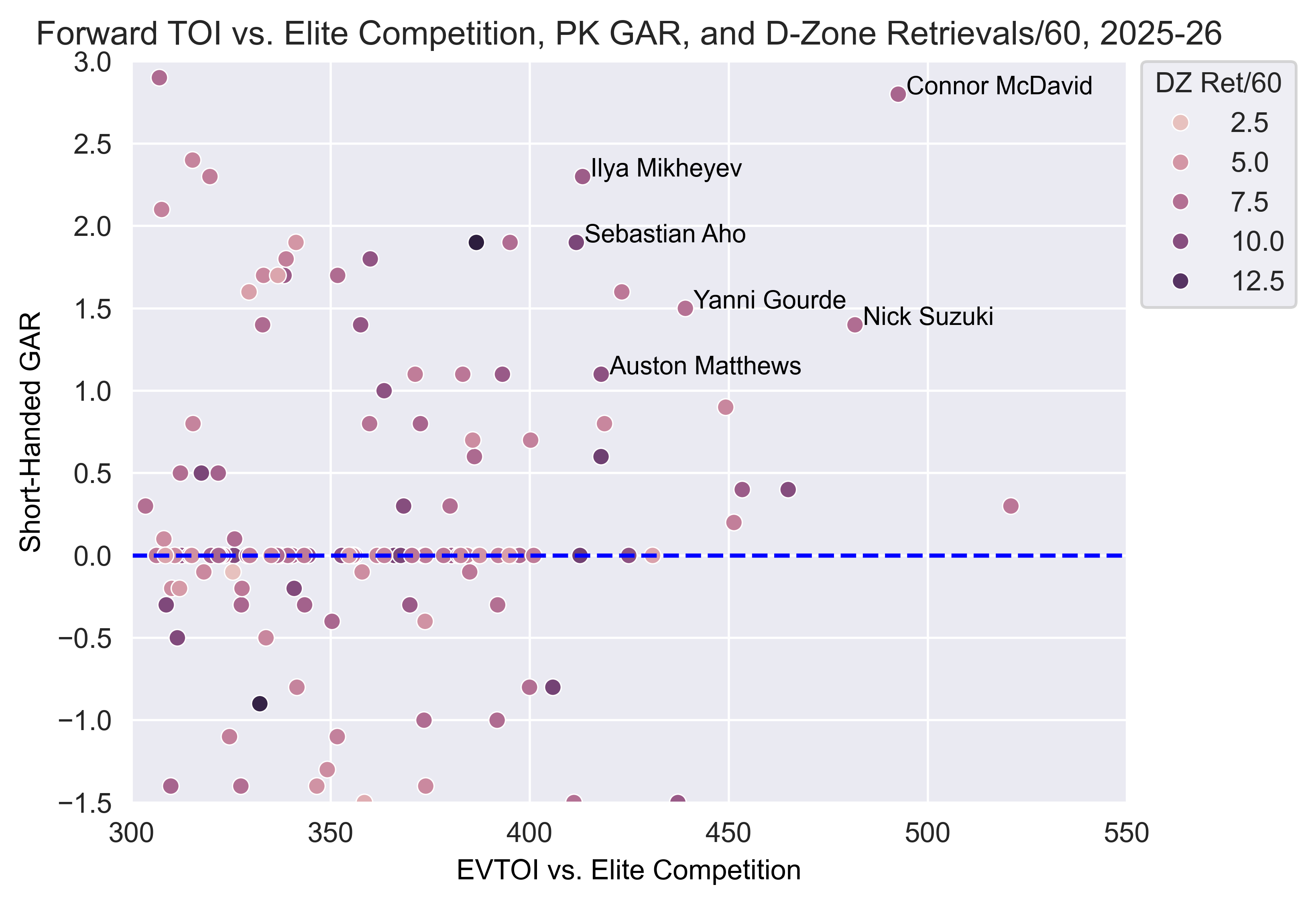
Suzuki faces a lot of top competition, has been very good on the penalty kill, and is responsible for a high rate of defensive zone retrievals. That he’s doing this and still might reach 100 points is why he should be a Selke Trophy candidate.
7 – Noah Cates (Philadelphia Flyers)
Cates has 17 goals and 26 assists, both being career-high marks. That is solid offensive contribution, but it’s what he does at the other end of the ice that makes him so valuable. Using Evolving Hockey’s evaluations, Cates has been one of the most impactful forwards defensively both at even strength and on the penalty kill:
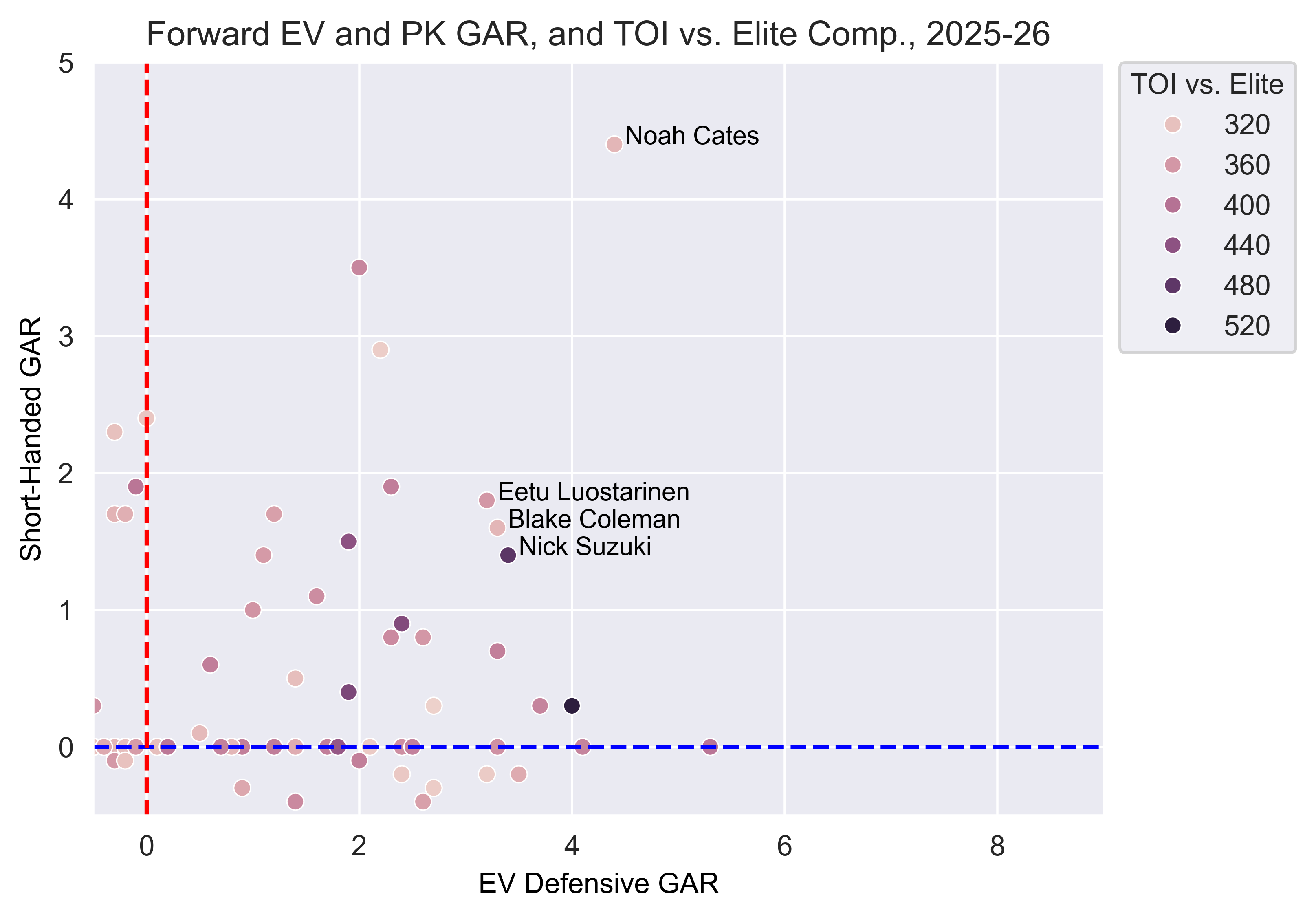
Cates is top-15 by defensive GAR at even strength, leads all forwards on the penalty kill, and he might play all 82 games this season. When looking solely at defensive play, there is a good argument that Cates has been the best defensive forward in the NHL this season.
8 – Blake Coleman (Calgary Flames)
Coleman may be having his best season since his time in Tampa Bay; it’s just masked by playing for a bottom-5 team in the NHL. Among the 152 forwards in our sample with at least 300 minutes against ‘elite’ competition, he is 1 of 4 forwards to start fewer than one-third of shifts in the offensive zone with at least an 84th percentile rate of overall defensive GAR:
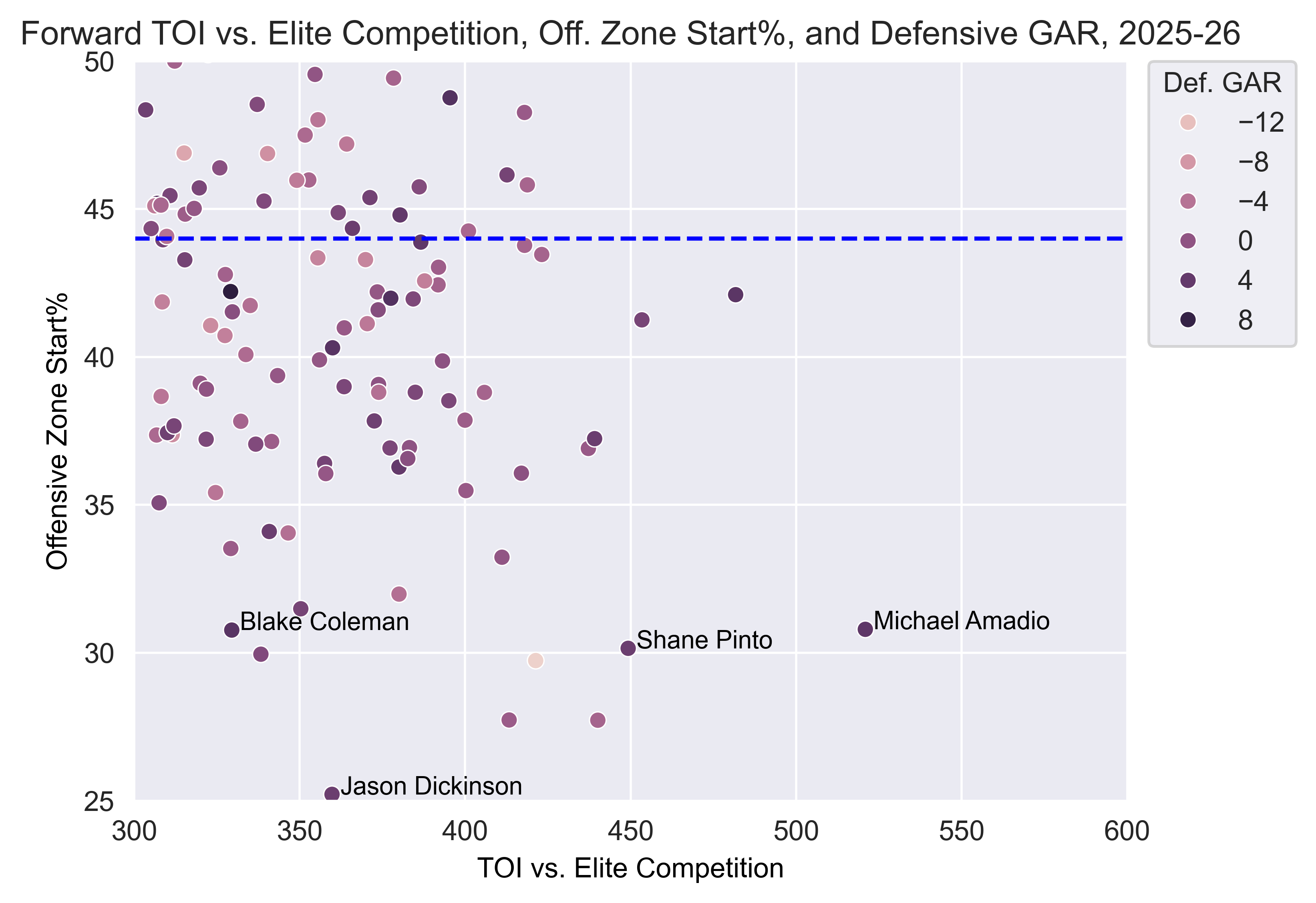
Coleman is one goal shy of a 20-goal season (skating for one of the worst offensive teams in the league) while being a very effective penalty killer who is given few offensive zone starts. Coleman has been an outstanding two-way forward for the Flames.
9 – Michael Amadio (Ottawa Senators)
We just saw Amadio’s name in the section on Coleman, showing very low offensive zone starts. What is notable for Amadio is that among forwards responsible for a higher-than-average rate of defensive zone retrievals+exits per 60 minutes, he has the second-highest percentage of his TOI coming against ‘elite’ competition and fourth-highest rate of defensive GAR. These are the comps:
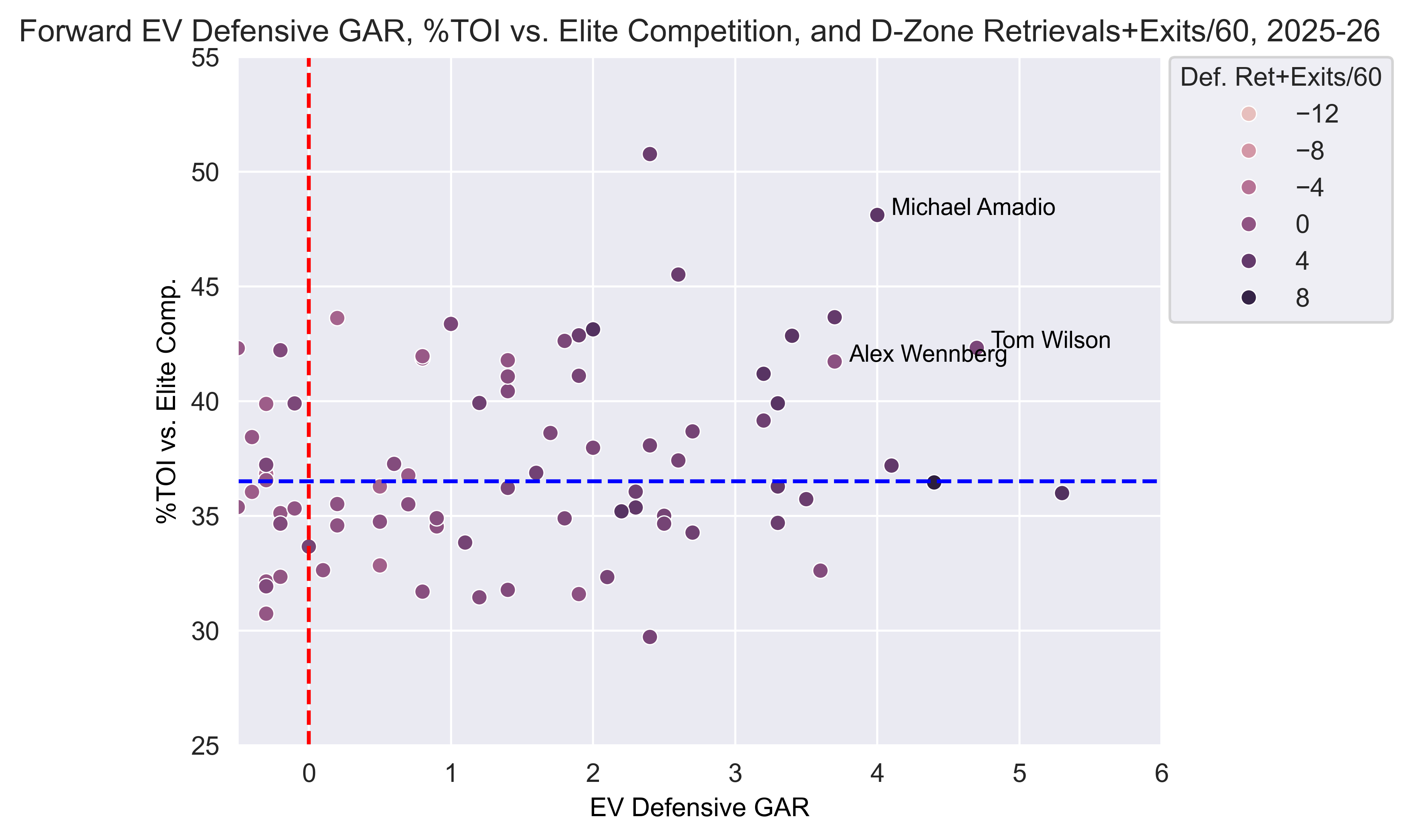
Additionally, Amadio has been an effective penalty killer for the Senators. It is fair to wonder whether he or Shane Pinto should be listed here, but what separates Amadio from Pinto, for me, is that he’s more involved with puck touches in the defensive zone (16% more retrievals and exits per 60 minutes).
10 - Matty Beniers (Seattle Kraken)
Beniers sits one goal and four points shy of a 20/50 season, and he’s doing it while being given immense defensive responsibility. Of the 152 forwards with at least 300 minutes against ‘elite’ competition, he has the fourth-highest rate of defensive zone exits+retrievals/60 and is 12th by overall defensive GAR:
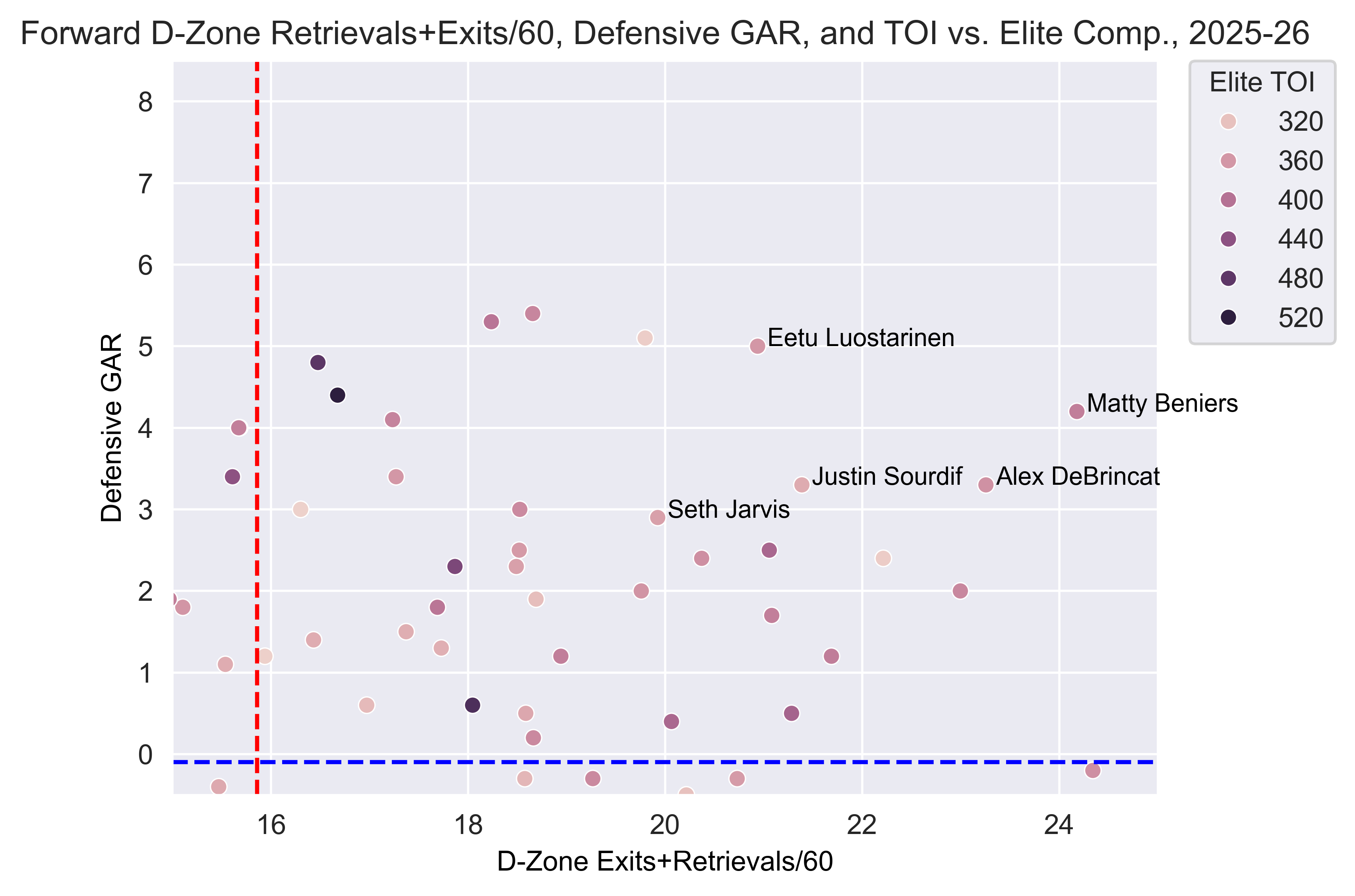
Of note is that among the 12 forwards responsible for at least 22 zone exits+retrievals/60 minutes, he has the highest penalty-killing GAR. At this point it’s fair to wonder if Beniers will ever have the offensive impact expected of a 2nd overall pick, but this makes four good-to-great defensive seasons in a row, so that half of his game cannot be denied.
The methodology for what constitutes ‘elite’ competition as defined by Puck IQ can be found here.
Until next week.