10 Interesting (To Me) Stats For This Week - April 29
Welcome back for another week of ’10 Interesting Stats’. We are continuing some playoff coverage now that we are a little over halfway through the first round. Let’s look at what helped get each series to where they are right now.
Player data is from Natural Stat Trick, tracking data is from AllThreeZones, and some shot data is from Frozen Tools. This is as of the afternoon of Monday, April 28th, so games from Monday night are not included.
1 – You Shall Not Pass
Toronto pushed their series against Ottawa to a 3-0 lead before Ottawa finally got on the board with a Game 4 overtime win. The Leafs have held the Senators to just five goals at 5-on-5 in the four games, and a big reason is how Toronto is stopping Ottawa’s offence before it can even start.
Here is how the tracking data has Toronto faring defensively by both percentage of zone entries carried in by the opponent resulting in a scoring chance or dumped in resulting in a scoring chance, or just outright denying zone entries at all:

This type of performance is reminiscent of Toronto’s first couple months of the season. In fairness, Ottawa is not a creative offensive team, so take this with a grain of salt, but if Toronto can take the series and carry this type of defensive performance forward, it bodes very well for a deep playoff run.
2 – Kitchen Party
While Tampa Bay goalie Andrei Vasilevskiy hasn’t been awful, he was not his usual self through three games with a negative Goals Saved Above Expected (per Evolving Hockey). It might have something to do with how Florida is doing a very good job at getting quality shots away through their first three games. At 5-on-5, here is the rate of high-danger shots against Vasilevskiy faced in the regular season, his average shot distance faced, and how those measures compare to the playoffs thus far:

Florida’s defence is what’s gotten them a 2-1 series lead, not their offence, but it is notable they are making life miserable for Vasilevskiy. Just over 30% of the shots Vasilevskiy has faced at 5-on-5 have been of the high-danger variety, the second-most of all playoff goalies (Sam Montembeault is higher). That must change if Tampa Bay wants to get past their state rival.
3 – Danger Close
In the regular season, no team in the league had at least 50% of their shots on goal come from within 30 feet of the net (Dallas was closest, just a shade over 49%). Also in the regular season, the Washington Capitals got 45.9% of their shots on goal from within 30 feet of the net. So far in the postseason, that number is well over 50%, and the highest of any team outside of the Florida/Tampa Bay series:
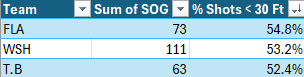
Montreal struggled in the regular season by giving up a lot of high-danger shots, and that has been the case again in the postseason. If that doesn’t change quickly, either their goaltending needs to be superhuman or they are going home.
4 – Walk Hard
When discussing Carolina’s defencemen, a lot of the oxygen goes towards the play of Jaccob Slavin or the durability of Brent Burns. It is a pair of offseason additions, though, who’ve been tremendous for the Carolina blue line in their series against New Jersey. With the pair of Sean Walker and Shayne Gostisbehere on the ice, the Hurricanes are overwhelmingly dominant by shot attempt share (CF%), expected goal share (xGF%), and high-danger shot share (HDCF%):

There hasn’t been much in the way of goals yet, breaking even at +1/-1 so far at 5-on-5, but if this pair can provide that kind of success moving forward, it gives the Hurricanes a great depth pair that they really need.
5 – I Was Saying Booooo-chard
The problem with evaluating defencemen is there can be too much focus on the final five seconds of the play, because they’re the last skaters visible in a highlight pack as the opposition is scoring. However, there is a give-and-take with defencemen in which we have to consider all the positives with the negatives.
Case in point here is Edmonton defenceman Evan Bouchard. While has definitely had some defensive lapses in their series against Los Angeles, and those have resulted in goals against, that ignores the good he’s doing. Here is how Bouchard compares to other Edmonton defencemen, as well as a pair of the top blue liners in the world, so far this postseason by what percentage of their total takeaways and giveaways are actual takeaways (per NHL):
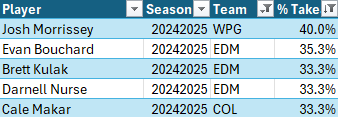
With how often Bouchard has the puck on his stick, there will be good and bad. He needs to be better, no doubt, but so do a lot of Oilers players.
6 – Grounded Jets
In the regular season, Winnipeg averaged 58.6 shot attempts and 27.5 shots on goal per 60 minutes at 5-on-5. In the postseason, those numbers are 52.3 and 22.7. When looking at why Winnipeg is struggling to generate offence at 5-on-5, it starts with getting out of their own zone. Here is the comparison between the regular season and postseason for the percentage of Winnipeg’s zone exits that are carried out and how often they fail to exit the zone at all:
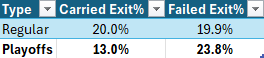
Here is the kicker: Those playoff tracking numbers are just for Games 1 and 2, which Winnipeg won. They struggled to get out of their zone in their wins, and by just watching the games in St. Louis, things didn’t get better in Games 3 and 4. The inability to get out of their zone with the puck is a big problem the Jets need to solve.
7 – Bronze Knights
The upside of having good depth is that when top players go cold, there are secondary options to lift the team. At some point, though, the stars need to shine, and Vegas’s stars need to start doing exactly that. Jack Eichel has not been on the ice for a 5-on-5 goal yet, and when he’s on the ice with Mark Stone, they are getting dominated whether they are matched Minnesota’s Kirill Kaprizov or not:
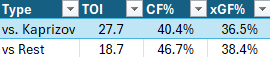
Losing your minutes against another top line is one thing. Losing your minutes against the depth lines? That is a big problem. Vegas can win their series against Minnesota even without much from Eichel and Stone, but they can’t make a deep playoff run without them.
8 – Jake The Great
Dallas went into Game 5 with the series tied 2-2 and they owe a big thanks to their goaltender. At 5-on-5, Dallas gave up just two goals against per 60 minutes, and that is with Jake Oettinger facing the third-most shots against per 60 minutes, and the second-most high-danger shots against per 60 minutes, of any playoff goalie:

Dallas’s defence was very suspect over the final couple months of the season and they have given up the most expected goals against per 60 minutes at 5-on-5 in the playoffs. Despite that, Oettinger has his team down to a best-of-3 to move on to the second round.
9 – Just Score, Baby
Defence may win championships, but teams still need to score goals, and that has been the story of the first round thus far. Going into Monday night’s action, teams were averaging about 3.0 goals per 60 minutes at all strengths, just a shade higher than the regular season average of 2.98. Here is the interesting note: Every team averaging at least 3.0 goals per 60 minutes is either tied or leading their series, and they have a .613 winning percentage:

Of course, we are just a little over a week into the playoffs, so let’s see where things stand a month from now.
10 – Do Something Else
Speaking of offence, it is true that teams have tightened up defensively at 5-on-5 in the playoffs (as they often do). When looking at the tracking data, teams are seeing far fewer assists on teammate scoring chances (SCA/60), as well as high-danger passes, when compared to the regular season:
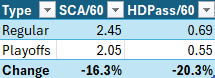
Goal scoring at 5-on-5 is down a reasonable amount when compared to the regular season – about 10%. Greasy goals seem to be the name of the game at 5-on-5, which is obvious to anyone that has watched even a few playoff games thus far.
Until next week.