10 Interesting (To Me) Stats For This Week - March 11
Welcome back to another week if ’10 Interesting Stats’ and this time around, we’re doing something a bit different. The Trade Deadline passed last Friday, and there were a lot of big shake-ups from both Stanley Cup contenders as well as non-playoff teams. Let’s take a look at some of the key trades using data from Natural Stat Trick, player tracking data from AllThreeZones, and viz from HockeyViz.
1 – Going on a Rant-anen
The biggest trade was Carolina shipping out Mikko Rantanen – whom they acquired six weeks earlier – to Dallas for Logan Stankoven, two first-round picks, and two third-round picks. I wrote about why Stankoven looks like a future star at Elite Prospects, so I’ll dig into Rantanen here.
Two things can be true about Rantanen: He is a very good player, and he was also elevated by playing with a world-class playmaker in Nathan MacKinnon. It is something similar to Zach Hyman going to play with Connor McDavid. Here is how both MacKinnon’s and Rantanen’s 5-on-5 production fared with and without each other on the ice over the last three seasons:

I would say the caveat here is that over the last three years, Colorado has been deeper on the wing than at centre. So, when MacKinnon didn’t have Rantanen on his line, he did have guys like Valeri Nichushkin, Artturi Lehkonen, and Jonathan Drouin. Rantanen now has a great chance to skate with Jason Robertson and Roope Hintz, who are an elite top-line duo, so let’s see if he can reverse his non-MacKinnon trend. There are no guarantees here.
2 – Cozens Swap
One fascinating trade was Buffalo sending Dylan Cozens to Ottawa for Josh Norris. Having recently discussed Cozens, let’s look at Norris.
Like Rantanen, two things have been true about Norris: He is a very good goal scorer, as his 0.98 goals per 60 minutes at 5-on-5 over the last four years with Ottawa is a top-50 mark in the league in line with names like Brandon Hagel and Matt Boldy. He is also a poor driver of goal scoring for his teammates as he is 1 of 4 players in the last four years to play regularly on their team’s top two lines while skating at least 2000 minutes, be more than one standard deviation below average by assist rate, and score over 35% of their team’s goals when they’re on the ice:

Readers will notice the other three players are wingers, not centres. Buffalo does have good playmaking wingers like Alex Tuch and JJ Peterka, but if they have to elevate Norris’s production with no reciprocation, it is a wonder how much offensive value Norris really brings.
3 – Rat Packed His Bags
In probably the wildest trade of the deadline, Brad Marchand, who was drafted in 2006 by Boston, spent his entire career in the organization, and was their captain, was dealt to rival Florida Panthers.
Marchand is injured and the hope is he’ll return before the end of the month. While he is not the player he was five years ago, he still does have a playmaking dimension to him as these are the comparable forwards in the league by rate of scoring chance assists (helpers on teammate chances, or SCA/60) and high-danger passes (across the slot and from behind the net, or HD Pass/60) at 5-on-5:
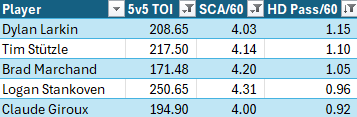
Considering likely line mate Matthew Tkachuk was having his worst scoring season in years, the hope is Marchand can help boost his scoring come playoff time.
4 – My Client, Brock Nelson
A week before the deadline, at my season-long writing site Dobber Hockey, I wrote about how Brock Nelson going to Colorado made a lot of sense. Lo and behold…
Scoring depth had been a huge problem for the Avalanche. Using parameters of at least 700 minutes at 5-on-5 this season, as well as at least 13.5 minutes per game at 5-on-5, we have a sample of 111 top-line forwards. The average drop in team goal scoring rate with those 111 forwards off the ice is -21.7%. Here is how MacKinnon rates comparatively:
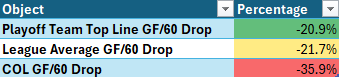
There are teams worse off – Tampa Bay and Vegas need more from their depth, which is probably why both teams added a couple middle-6 forwards in recent weeks – but Colorado wasn’t in a good spot, but adding Nelson should help a lot here.
5 – Balls to the Walman
On the topic of boosting scoring, up until the deadline, the Edmonton Oilers were 12th in the league by goals per 60 minutes at 5-on-5. Each of the prior three seasons had seen them inside the top 10, and they averaged 4th by goals/60. Being 12th is clearly a big step down.
Enter Jake Walman. Traded from San Jose, if there’s one thing he does well, it’s help his teams score. Here is how Detroit and San Jose fared over the last three seasons with Walman on and off the ice at 5-on-5 by goals per 60 minutes:

Walman isn’t great defensively, but he is about average, and being a very good offensive defenceman should help the Oilers find the goals they have been missing all year.
6 – Pagan Poetry
Tampa Bay is looking to solve their depth issues – they had been entirely reliant on four, maybe five forwards – by trading for Oliver Bjorkstrand and Yanni Gourde. For Bjorkstrand specifically, one thing that stands out about his profile is his offensive versatility. For his Seattle tenure, he was generally able to generate well both off the rush and off the forecheck. This season alone, here are the names he compares to by rate of offence created both off the rush and cycle/forecheck compared to their respective team’s average:

This is a good thing for Bjorkstrand and his potential in Tampa Bay. The Lightning’s top forwards all are able to create both off the rush and forecheck, and that Bjorkstrand can do the same should help the transition to his new team.
7 – Whiskey Tango Foxtrot, Charlie
Boston shipped Charlie Coyle to Colorado for reclamation project Casey Mittelstadt. The idea with Coyle in Colorado is that he should be able to bring some defensive prowess to their bottom-6 forwards, maybe chip in some goals, and provide insurance in case their top forwards suffer injuries.
The issue here is this: Is he actually good defensively? Below, in the green box, is five straight seasons of Coyle’s defensive impact being lower than league average:
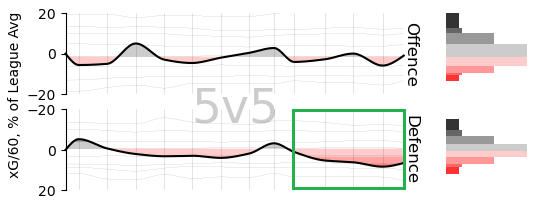
Over those five seasons, all with Boston, the team averaged 2.41 goals against per 60 minutes at 5-on-5 with him on the ice. Relative to his teammates in that span, that rate is 0.36 goals against/60 worse. That number is even worse over the last two seasons post-Patrice Bergeron. So, here’s the question: If he’s such a good defender, why doesn’t he defend good?
8 – We are Laugh(ton)ing
Toronto traded a first-round pick and a prospect for Philadelphia forward Scott Laughton. In an eerie echo of what Colorado did by trading for Coyle, it has been a while since Laughton had a positive impact defensively on his team. Though not to Coyle’s level, it has been four seasons since Laughton had at least a league-average defensive impact:
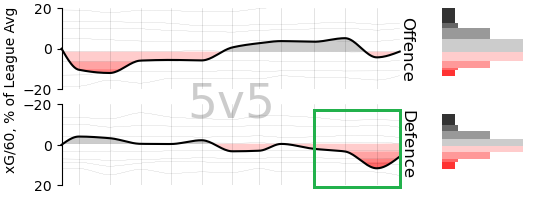
Lest we rely solely on pretty pictures to tell us the story, the Flyers allowed 3.09 goals against per 60 minutes at 5-on-5 with Laughton on the ice over those last four seasons. With him off the ice, that number was 2.66 goals against per 60 minutes. Don’t make me tap the ‘Why Doesn’t He Defend Good’ sign.
9 – The Next Kuz
Andrei Kuzmenko finds himself on his third team this season, and fourth team in two seasons, with the trade to the Los Angeles Kings. He had a great year with Vancouver back in 2022-23 but hasn’t found nearly the same success since he stopped shooting 27%.
The issue with Kuzmenko is he’s not much of a playmaker (league average, in all likelihood) so he relies on his goal scoring to bring offensive value. The problem with that is he just does not shoot the puck. Since entering the league, just 17.9% of his team’s 5-on-5 shots with him on the ice come off his stick. That is in the 8th percentile of regular forwards and in line with production luminaries like this:
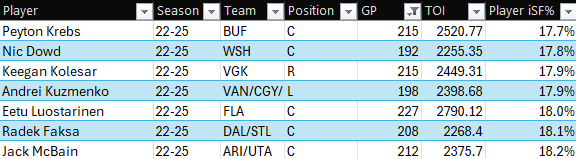
Players don’t need to take a high percentage of their team’s shots to score goals, as Leon Draisaitl and Mark Scheifele have proven. Those guys, though, are the exception, and if Kuzmenko can’t shoot 20%, and he’s not much of a playmaker, there is a lot of ‘What Would You Say You Do Here’ energy.
10 – Kim’s Son
Tommy Novak was traded by Nashville for some reason that will never make sense. We won’t waste time here: Over the last three seasons, here are forwards comparable to Novak by each of high-danger passes, scoring chance assists, and scoring chance contributions (assists and individual chances) per 60 minutes at 5-on-5:
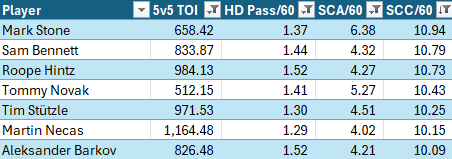
Novak was traded for Michael Bunting, but I guess the silver linings for Nashville are that Bunting is injured, older, and more expensive.
Until next week.