10 Interesting (To Me) Stats For This Week - October 7
Jackson LaCombe, Philip Broberg, Dylan Samberg, Jake Walman. These are just a few defenceman who showed some promise in a lesser role and then took a big jump in their mid-20s. Some guys just never take that next step (Scott Perunovich and Erik Brannstrom), but when they do, they are found-money for their teams. Who are some guys who could follow in those footsteps? Let’s look at that.
Player data from Evolving Hockey and tracking data from All Three Zones.
1 – Mason Lohrei (Boston Bruins)
As outlined in this column a few weeks ago, there have been far too many turnovers for Lohrei to be a reliable defenceman. But that’s the bad; as for the good, here is the closest comparable to Lohrei by assists on teammate scoring chances per 60 minutes at 5-on-5 over the last two seasons, as well as zone entries per 60 minutes and percentage of those entries carried in:

Devon Toews was a good defensive defenceman from his first year, so it’s not exactly apples-to-apples, but it shows the upside Lohrei has if he can be just an average defender. Lohrei has two years on his contract, so this year is the first of two kicks at the can to prove he can be that.
2 – Ryker Evans (Seattle Kraken)
It is a tough break for Evans that he suffered an upper-body injury in the preseason and looks like he’ll be out well into November. He looked poised to establish himself as one of the top defensive defenceman in the league, and that’s not hyperbole as here’s the list of comparable blue liners by defensive impact at even strength over the last two seasons:
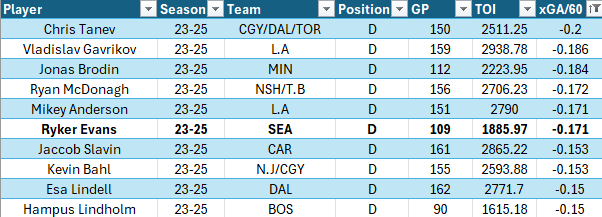
Evans looked very much to be on the Mikey Anderson trajectory, which is a great defensive defenceman who was limited offensively, but with the chance at improving that after another full season where he stabilized his career. He can still do that if he returns in mid-November and is great from there on out, but having to play catch-up after the league has been underway for six weeks could throw a wrench in those plans.
3 – Jayden Struble (Montreal Canadiens)
With all of Montreal’s additions and draft picks, it’s easy to overlook Struble, and just how good he was last year. Not only did he have great results when he had Hutson as a partner (most players did), he made nearly every single Canadiens skater better defensively when he was on the ice:
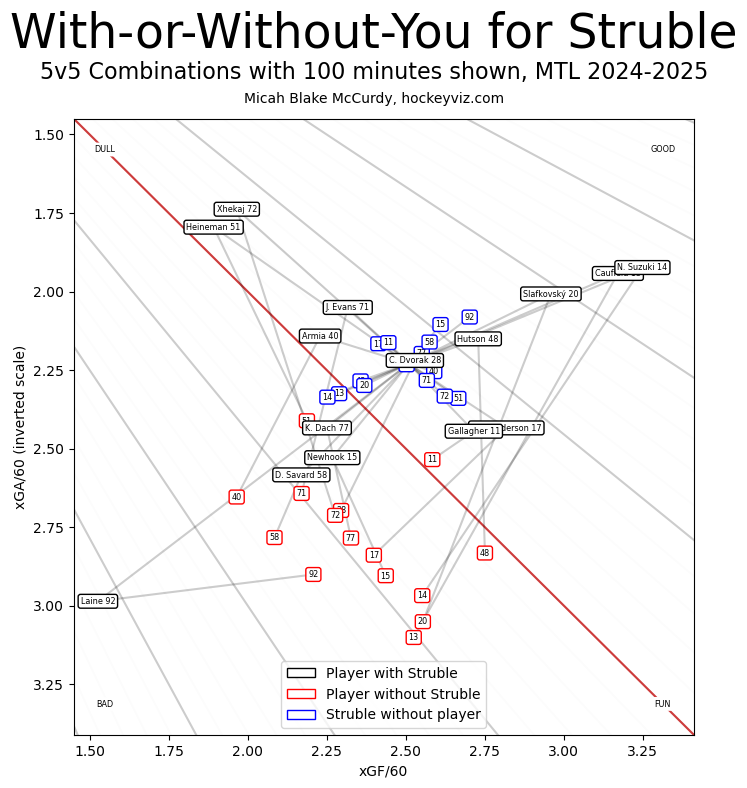
Notice how nearly every black box (the player’s minutes with Struble) is higher on the chart than the red boxes (the player’s minutes without Struble)? That means he had a positive defensive impact pretty much across the board (Patrik Laine is the lone exception). One year doesn’t make a career, but if he can do that again, it’ll go a long way to giving the third pair good results and making the transition after Mike Matheson’s contract runs out easier.
4 – Kaeden Korczak (Vegas Golden Knights)
It looks like Alex Pietrangelo will be out for the season, and that moves every Vegas defenceman up one rung. This is a good opportunity for Korczak who has just 77 games played across four seasons, posting more AHL games (123) in that span. With Pietrangelo injured, Korczak is one of just two right-shot defenceman on the Vegas blue line and could play into a prominent role if he does he’s done in limited action over the last three seasons:

Those are similar defenceman by impacts on both actual goals for/against and expected goals for/against at even strength. Again, that is without even a full season of games played, but that he’s had great expected goals impacts in limited action in three straight seasons is a good sign. Can he do it against tougher competition on one of Vegas’ top two pairs? If he can, he’s a genuine top-pair defenceman waiting to ascend.
5 – Braden Schneider (New York Rangers)
The knock on Schneider has been his defensive game, and it’s a fair criticism as opponents carry the puck into the zone against him 62.5% of the time and he denies zone entries just 6.5% of the time, both marks much worse than the league average. It is also fair to ask is how much of this is on Schneider and how much of it is on the way the team was coached because here are comparable teams to the Rangers over the last two seasons by those carry-against and entry-denial measures:
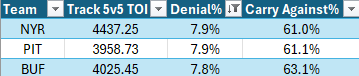
If you compare defensively to the Penguins and Sabres, and you have Adam Fox, I suspect that the coaching staff has earned some blame here. New York now having Pittsburgh’s old coach behind the bench may not breed confidence in Schneider turning his defensive game around, but he’s improved his offensive game considerably over the last two years. Like Lohrei, if Schneider can just approach average defensively, he’s an impact defenceman in the making.
6 – Nils Lundkvist (Dallas Stars)
Lundkvist has a real chance to be a key cog of Dallas’ blue line because they have three right-shot defencemen: Lundkvist, Ilya Lyubushkin, and Alex Petrovic. The other two names aren’t big roadblocks, and Lundkvist has shown great chemistry with budding superstar Thomas Harley in their limited action together over the last two seasons (per Natural Stat Trick):

“Has chemistry with Thomas Harley” should be something most NHL defencemen can do, but Lundkvist continuing to be so good next to Harley would allow Dallas to use a Heiskanen-Lindell shutdown pair, and then have their third-pair options play third-pair minutes. Lundkvist has shown flashes of second-pair ability before, and now is the time to show he can do it for a full season.
7- Egor Zamula (Philadelphia Flyers)
Here is a funny thing: these are comparable defencemen to Zamula over the last two seasons by percentage of defensive zone retrievals being botched, and zone exit failure rate:
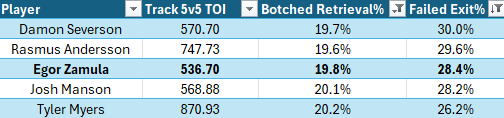
What is funny is that each of those defencemen are mainstays for their teams, but it’s also a who’s-who of ‘what hockey people think of this guy doesn’t line up with what actually happens on the ice’. By that I mean they almost all have negative impacts on goal differential (the only one that is positive is Manson but that has been sliding each of the last couple seasons). Zamula has shown some offensive promise, but if he can’t clean up his defensive play, he won’t last in the NHL. If he can? He has a long career ahead of him.
8 – Declan Chisholm (Washington Capitals)
Chisholm is a fascinating player because his tracking data shows someone who is solid at defending his blue line, isn’t a turnover machine, is good in transition, and can jump into the play. He also has very good expected goals impacts over the last two years. And despite all that, the gap between expected-actual goals impact is among the 10 worst in the league:

All the ingredients are there for Chisholm to be a difference-maker, but sometimes we have great ingredients, set the oven to 450 degrees instead of 350 degrees, and just burn the shit out of the cake. Let’s see if Chisholm can make good instead of burn the shit out of his cake.
9 – Brandt Clarke (Los Angeles Kings)
The Kings trading Jordan Spence makes it clear Clarke is The Guy of the future, so here are Clarke’s comparables over the last two seasons by rate of scoring chance assists and zone entries, while carrying those entries in at least 40% of the time and failing to exit the defensive zone less than 20% of the time:

Clarke still has some work to do defensively, but he’s the Kings’ best puck-mover now, and is probably their only puck-mover when Drew Doughty is off the ice. Whether the Kings give Clarke the minutes to really make an impact is another matter, but he seems ready to do just that.
10 – Conor Timmins (Buffalo Sabres)
A few weeks ago, this column covered how Timmins and Michael Kesselring can be prone to turnovers and how that might hurt their upside with Buffalo. That is the downside. The upside is that Timmins’ overall package has made him an impact defenceman already as HockeyViz’s Synthetic Goals measure shows improvement every season he’s been in the league:
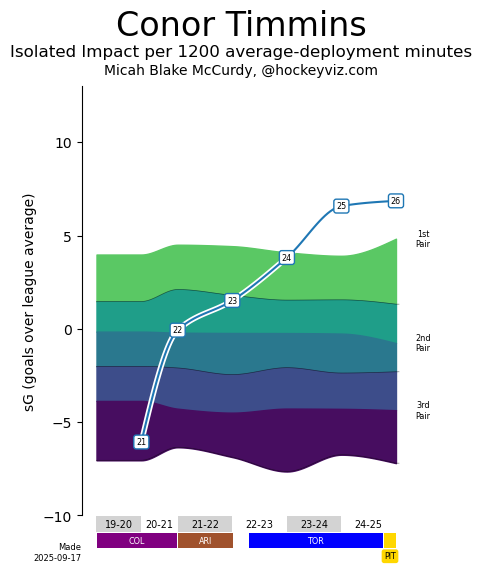
The issue for Timmins is like Chisholm’s in that his expected goals impacts have far outweighed his actual goals impact (though he’s a positive player over the last three years, where Chisholm is negative). Timmins has also had a hard time staying healthy, but he will crest the 200 games played mark this season and has shown a lot of high-end ability in the past. If he puts it all together for Buffalo, he gives the Sabres a difference-maker on defence aside from Rasmus Dahlin, and that’s something they desperately need.