10 Interesting (To Me) Stats For This Week - April 21
Welcome back to another week of ’10 Interesting (To Me) Stats’! With the NHL playoffs having just started, there’s not a lot to cover there just yet, so let’s start our offseason reviews by highlighting improvements from young players.
Today’s newsletter will focus on improvements in tracking data from 10 young forwards in the league (age-24 or younger this season). The tracking data is at 5-on-5 and from All Three Zones, with player age data from Hockey Reference. We are limiting the sample to forwards across the 2023-25 seasons with at least 200 tracked minutes who were between the ages of 18-23, and those same forwards in 2025-26. It gave us 53 forwards.
The improvements are shown as percentage changes from the prior two seasons. So, if a player averaged 2.0 scoring chance assists/60 minutes across the prior two seasons and increased to 3.0 chance assists/60 this season, that is a 50% increase ((3 - 2) / 2).
The red and blue dotted lines in the following graphs represent the average percentage change in each stat among the 53 young forwards.
1 – Marco Kasper (Detroit Red Wings)
After a good rookie season with 37 points in 77 games while showing solid defence, Kasper cratered to 19 points in 81 games. It needs to be highlighted, then, that he added a big playmaking dimension to his game as he showed the largest positive percentage change in scoring chance assist rate (helpers on teammate scoring chances), and it helped him to one of the largest improvements in overall scoring chance contributions:
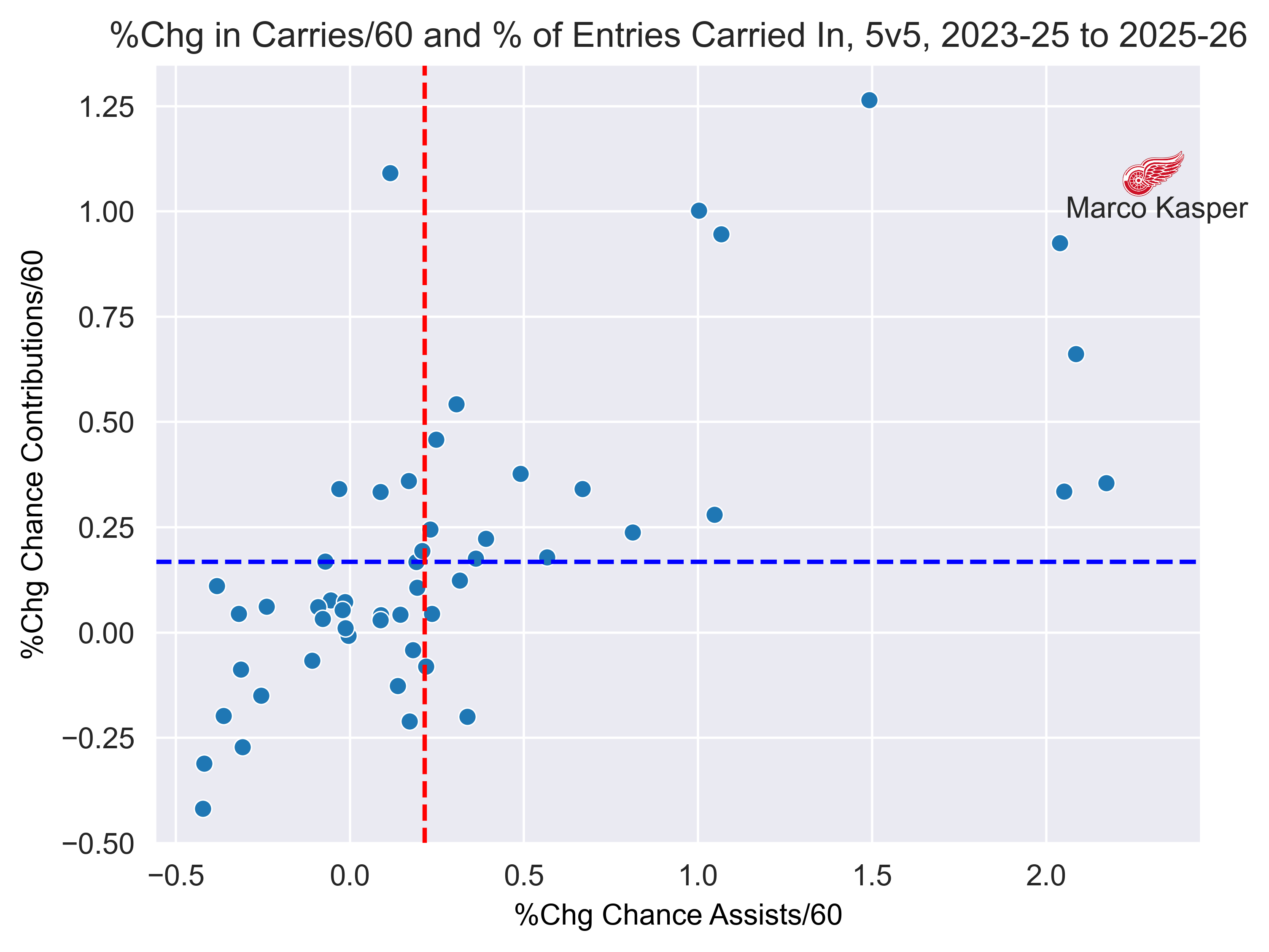
This clearly didn’t show up in his assist rates, but a young player adding skills like this is more important for his long-term development than just raw point totals. Look for Kasper to have a production rebound in 2026-27.
2 – Mavrik Bourque (Dallas Stars)
Bourque didn’t have quite the same change in overall scoring chance contributions that Kasper did, but Bourque did have the second-highest change in chance assist rate per 60 minutes in 2025-26:
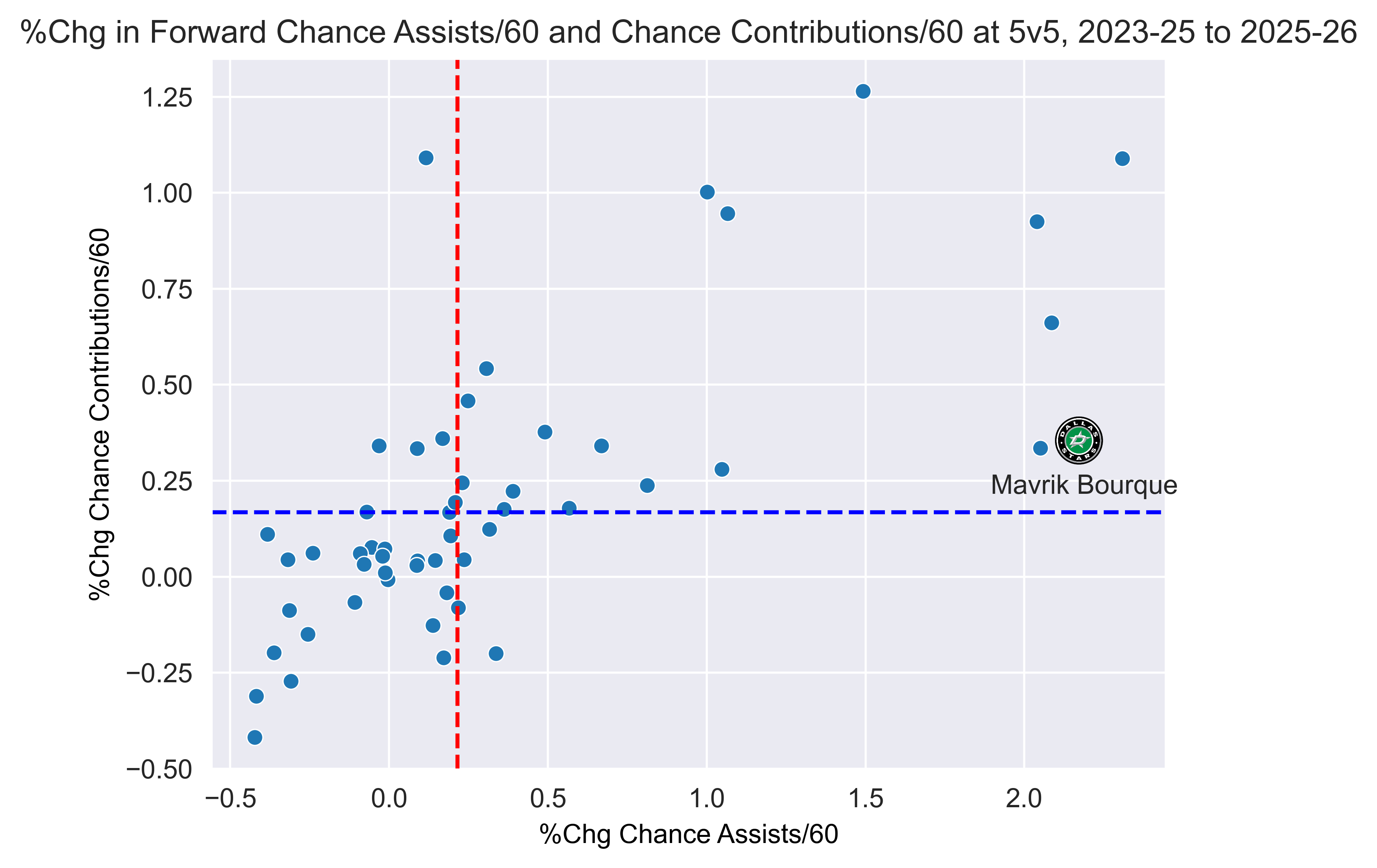
This improvement did show up in Bourque’s assists as his rate of primary helpers at 5-on-5 increased by 33% from a fourth-line rate to a mid-tier third-line rate. Not elite by any means, but a sizeable improvement, and another jump like this next year would see him turn into a bona fide second-line scoring winger. Maybe we see that kind of jump from him in the 2026 postseason.
3 – Jack Quinn (Buffalo Sabres)
Quinn finished the 2025-26 campaign with career-highs in goals, assists, shots, hits, and blocks. After some brutal injury issues as a young player, Quinn seems to have found his game as he had the largest improvement in total chance contributions/60 this season with the sixth-largest increase in chance assists/60:
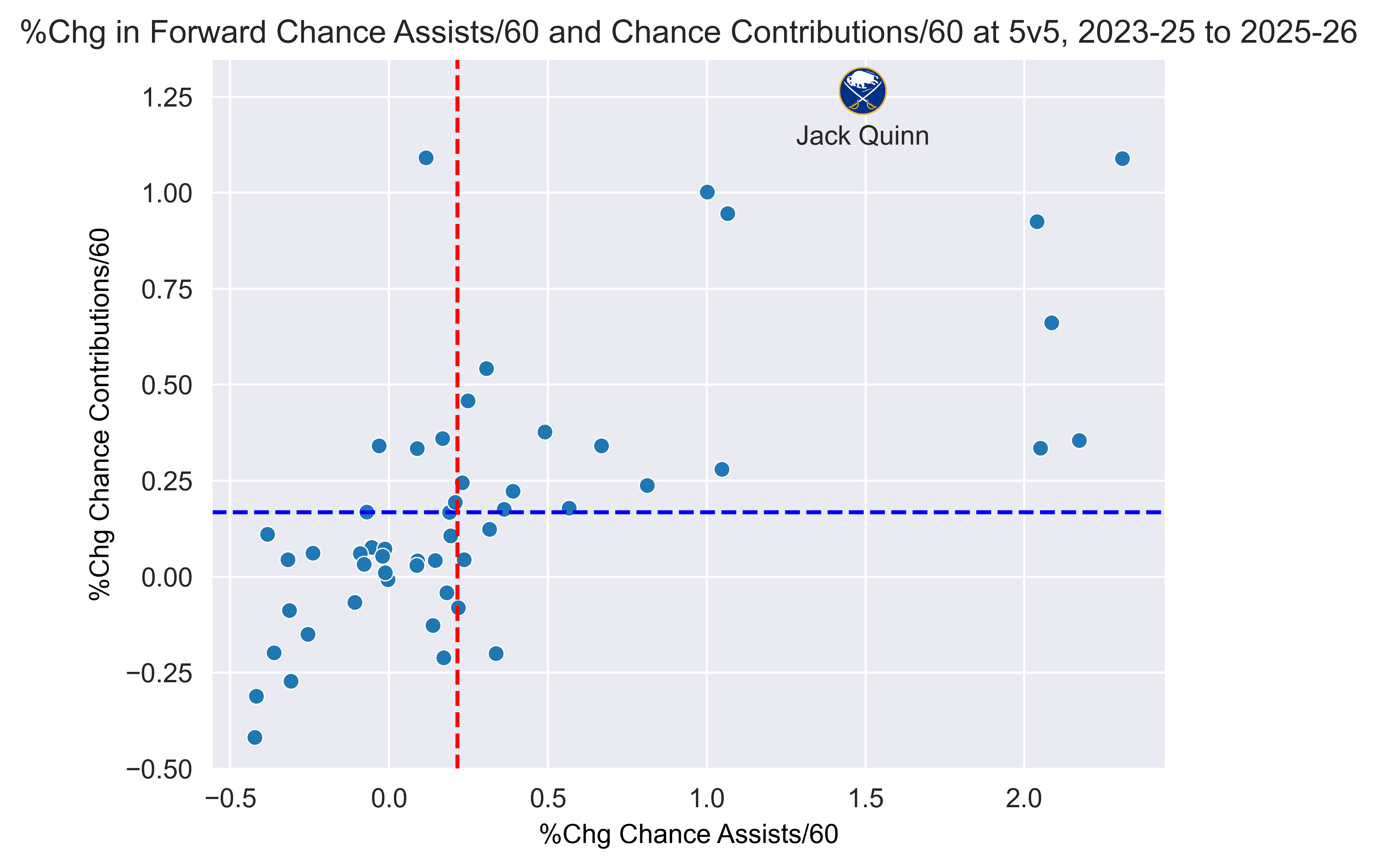
What is key is that Quinn was already a solid playmaker, but that leap in chance assists/60 pushes his overall rate into a tier with names like Connor Bedard and Luke Evangelista. His shot rate at 5-on-5 (8.3 per 60 minutes) was inside the 90th percentile of the league, so this season might really be the breakthrough for Quinn to become a high-end, dual-threat offensive weapon. He is capable of a 30-30 season next year.
4 – Adam Fantilli (Columbus Blue Jackets)
As mentioned with Kasper, a young player adding dimensions to their game is important for long-term development. Fantilli posting 59 points in 82 games isn’t much of a leap from the year prior, but there are leaps in the tracking data because he had the seventh-largest chance assist increase and 11th-largest increase in contributions (shots and assists) off the cycle/forecheck:
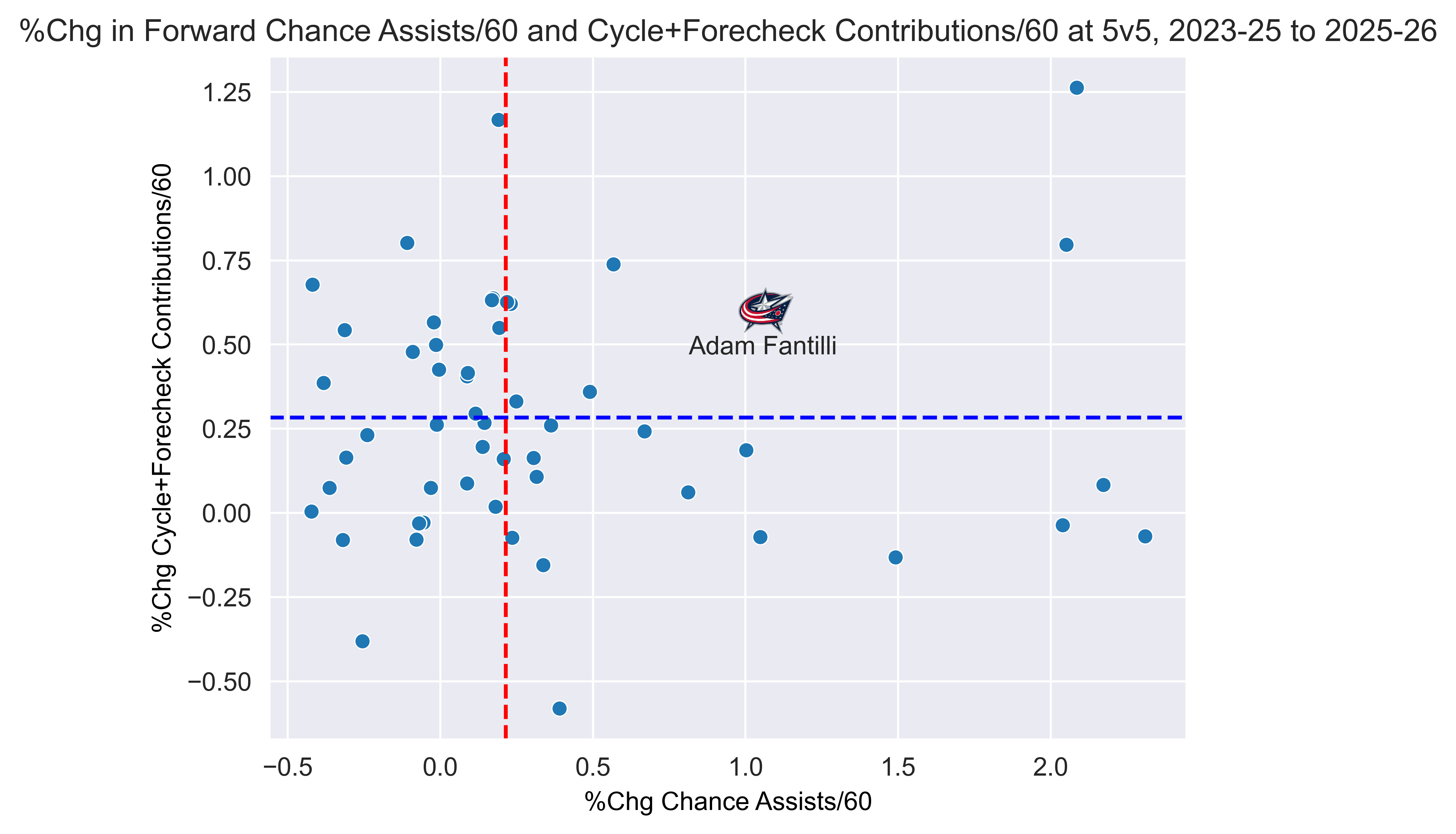
Fantilli saw his rate of assists at even strength increase by 26%, so the playmaking improvement translated directly to better assist production. Being able to create offence below the hashmarks, while elevating his teammates’ goal scoring, is something that will help cement Fantilli as a top-line centre for the next decade.
5- Ridly Greig (Ottawa Senators)
Greig only managed one more point in 2025-26 than he did in 2024-25, but his 5-on-5 production rate increased by a whopping 57%. In our sample of forwards, he had the second-largest percentage increase in scoring chance contributions and also had higher-than average increases in both contributions off the rush and off the cycle+forecheck:
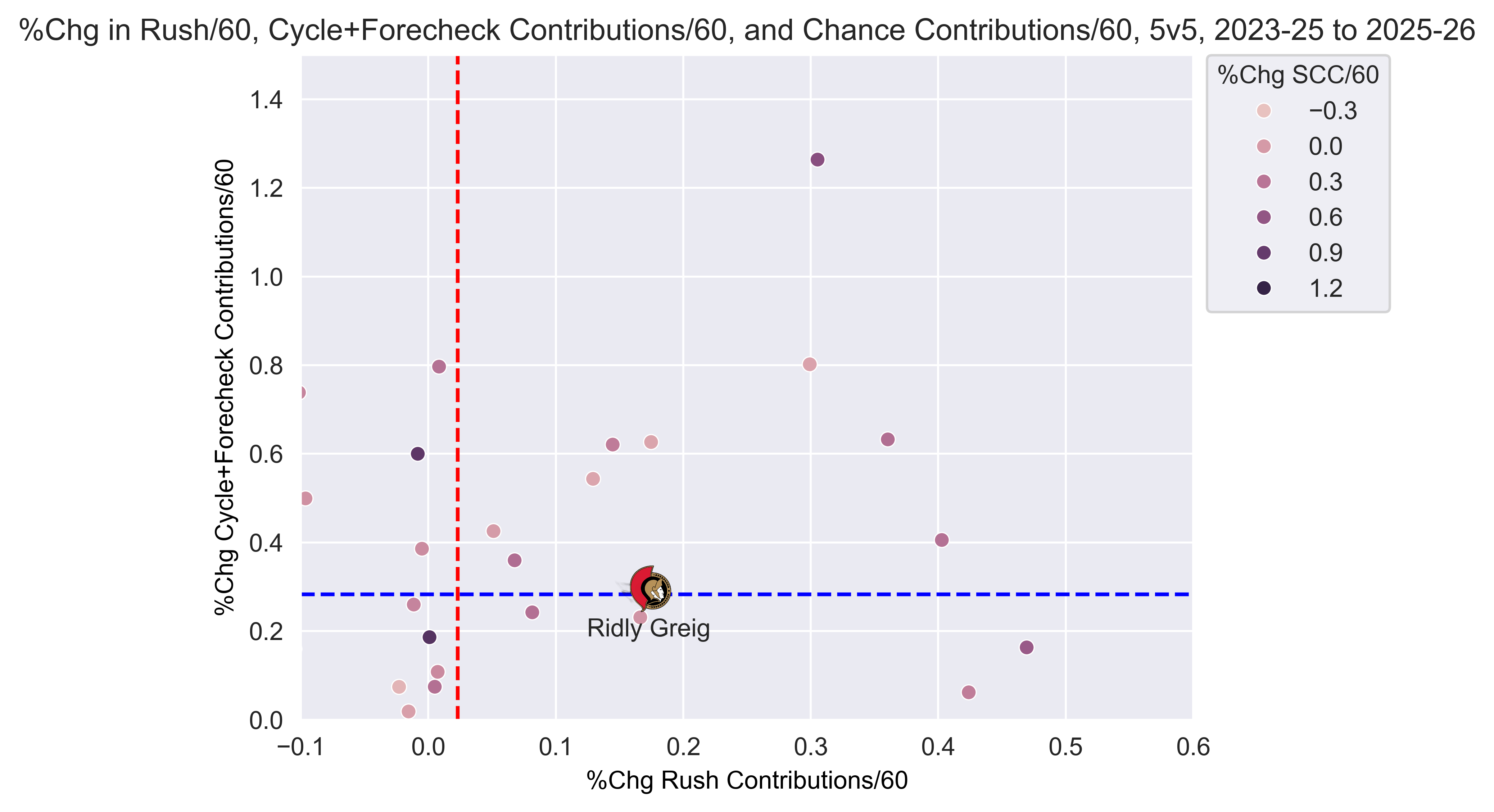
Greig surpassed the 200-game plateau this season and will turn 24 years old in August. He showed genuine, significant improvements in his offence, even if the raw point totals didn’t show it. With the Sens showing a formidable core, the best is yet to come for the young shift-disturber.
6 – Zach Benson (Buffalo Sabres)
Injuries threatened to derail Benson’s third year in the league, but 15 points in his final 16 games of the regular season showed his offensive ability. This potential offence also shows up in his changes in contributions both off the rush and off the cycle/forecheck this season:
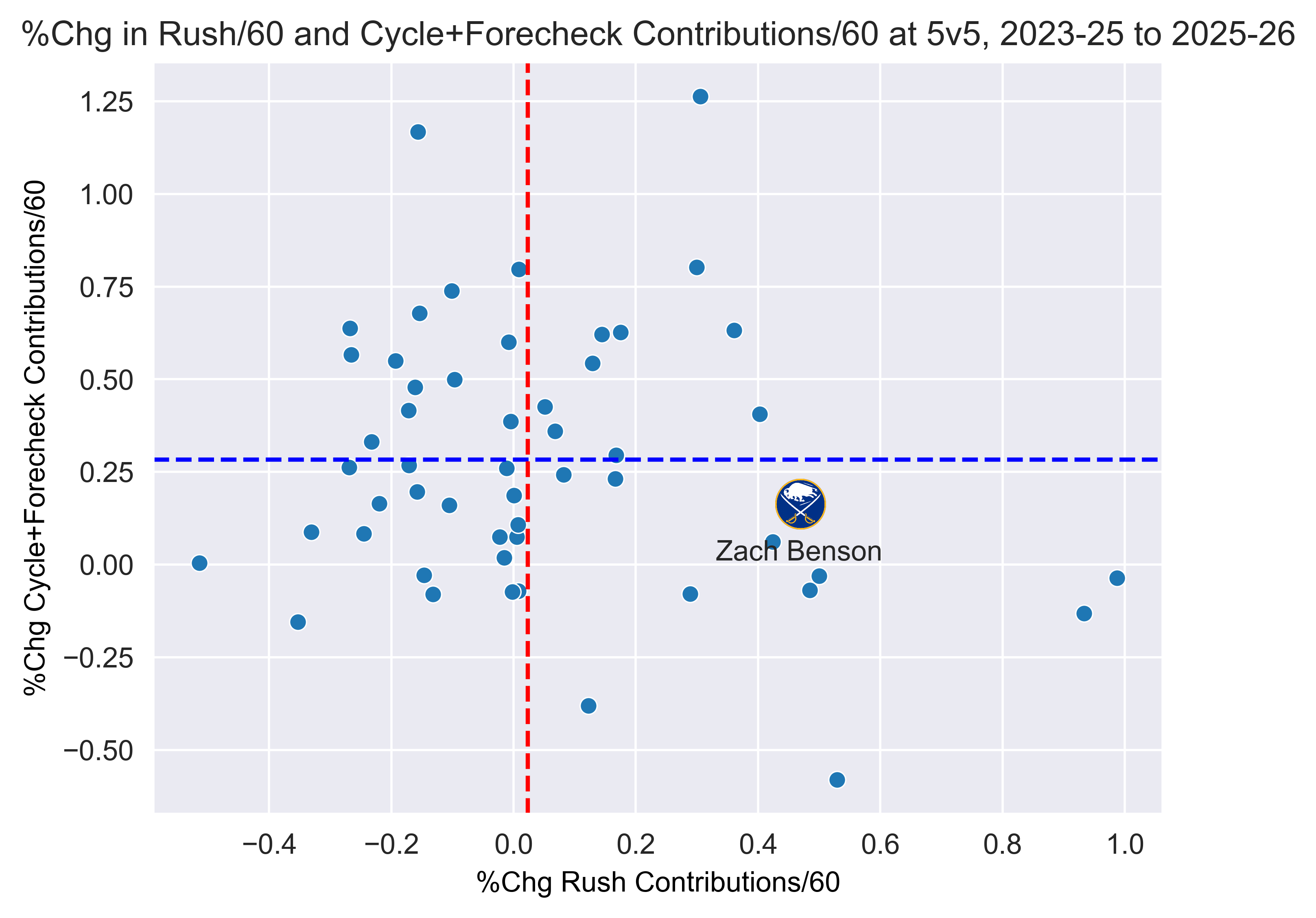
His change in offence off the cycle/forecheck is below the average change of these forwards, but still an improvement. His offence off the rush, meanwhile, was the sixth-largest increase of all forwards in our sample. He also crossed the 200-game threshold this season, will get some playoff experience, and will hopefully be 100% healthy to start the 2026-27 campaign. If he gets a meaningful role next season, look for him to have his genuine breakout year.
7 – Leo Carlsson (Anaheim Ducks)
While Benson’s contributions off the cycle didn’t improve at a rate exceeding the average of young forwards, Carlsson’s certainly exceeded that average. He also exceeded the average improvement in contributions off the rush, making him just 1 of 10 forwards in our sample to have increases above the 53-forward average in both areas:
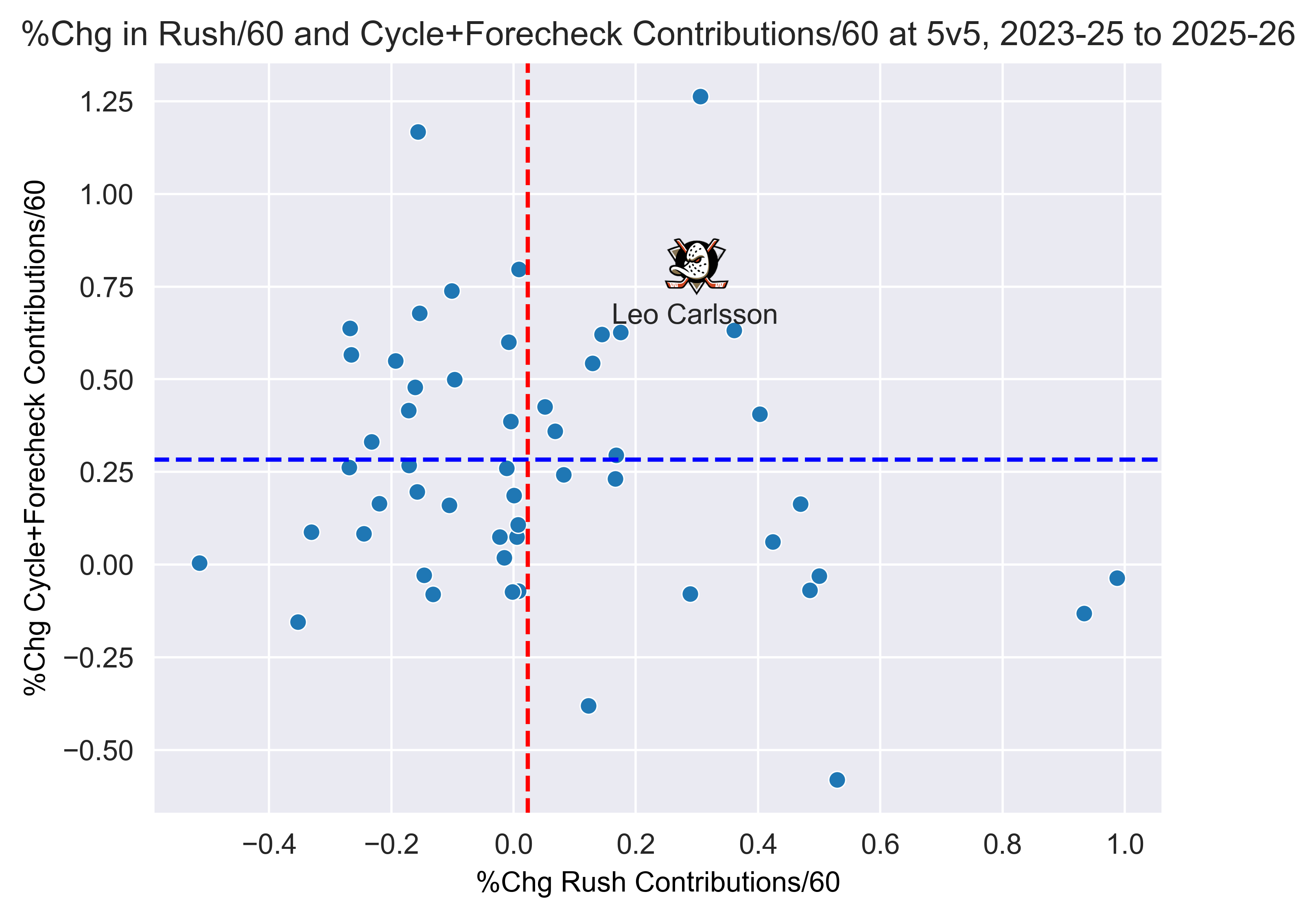
This isn’t a huge surprise – highly touted young player who posted nearly a point-per-game season had significant underlying improvements – but it’s always important to highlight just how big the change is. He is another name that crested the 200-game plateau late in the season and the team around him will only get better. Look for Carlsson to take another leap in 2026-27.
8 – William Eklund (San Jose Sharks)
Another one of those 10 forwards who saw bigger-than-average increases in both contributions off the rush and cycle is Eklund, as his changes aren’t far off what Carlsson did in Anaheim:
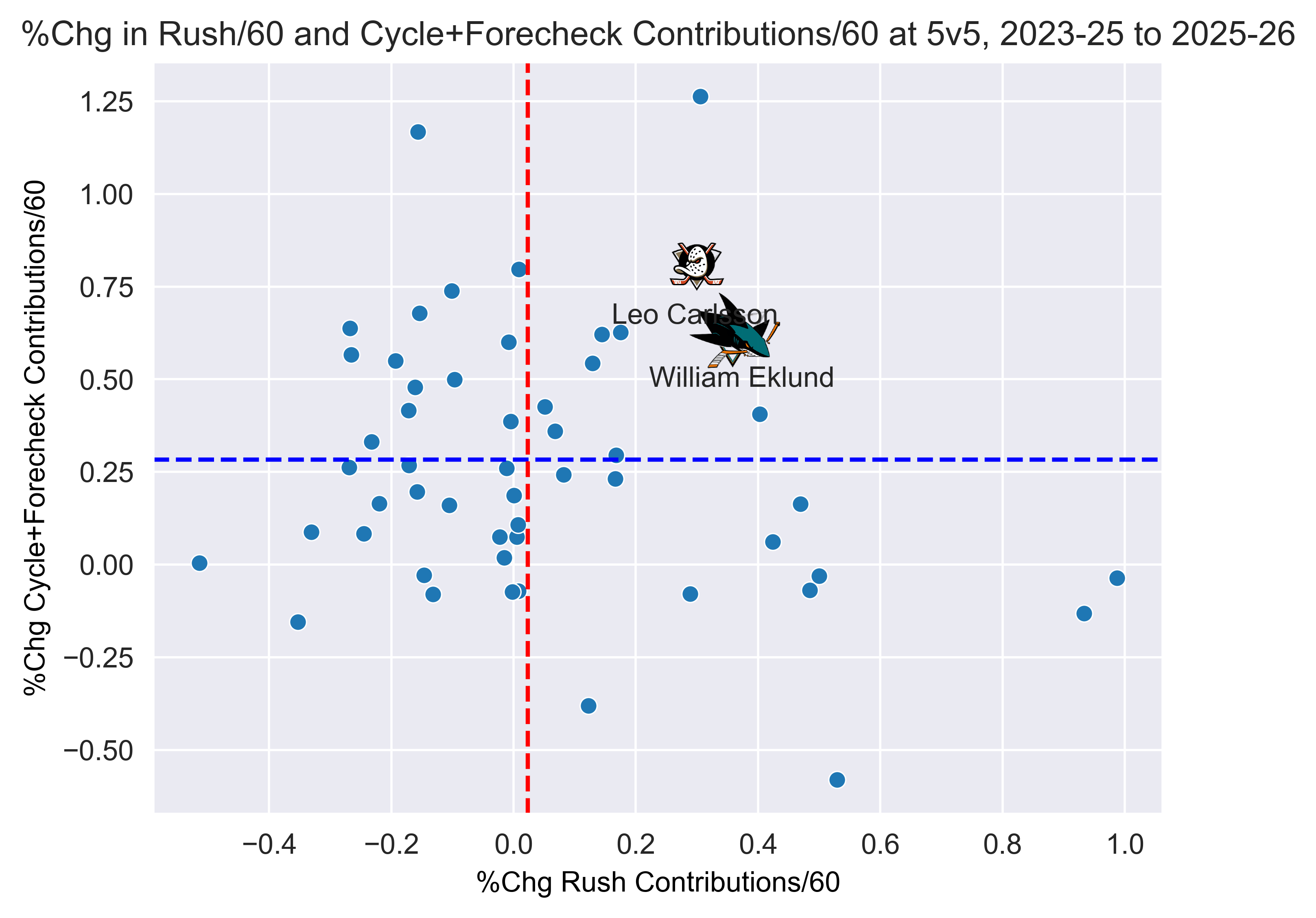
What is key here is Eklund spent just 22.5% of his 5-on-5 ice time next to Macklin Celebrini, a sharp decline from 41% the year prior. Being able to contribute more offence in more ways than he had been able to up until this season, and doing so while spending less than one-quarter of the ice time next to the team’s franchise player is a very good sign for Eklund’s development.
9 – Cutter Gauthier (Anaheim Ducks)
It is easy to write off Gauthier as a pure shooter given his 41-goal season, but that would be disguising just how much he boosts the offence when he’s on the ice. In fact, of our 53 forwards, he had the third-largest increase in his rate of zone entries with an above-average increase in percentage of those entries being carried in:
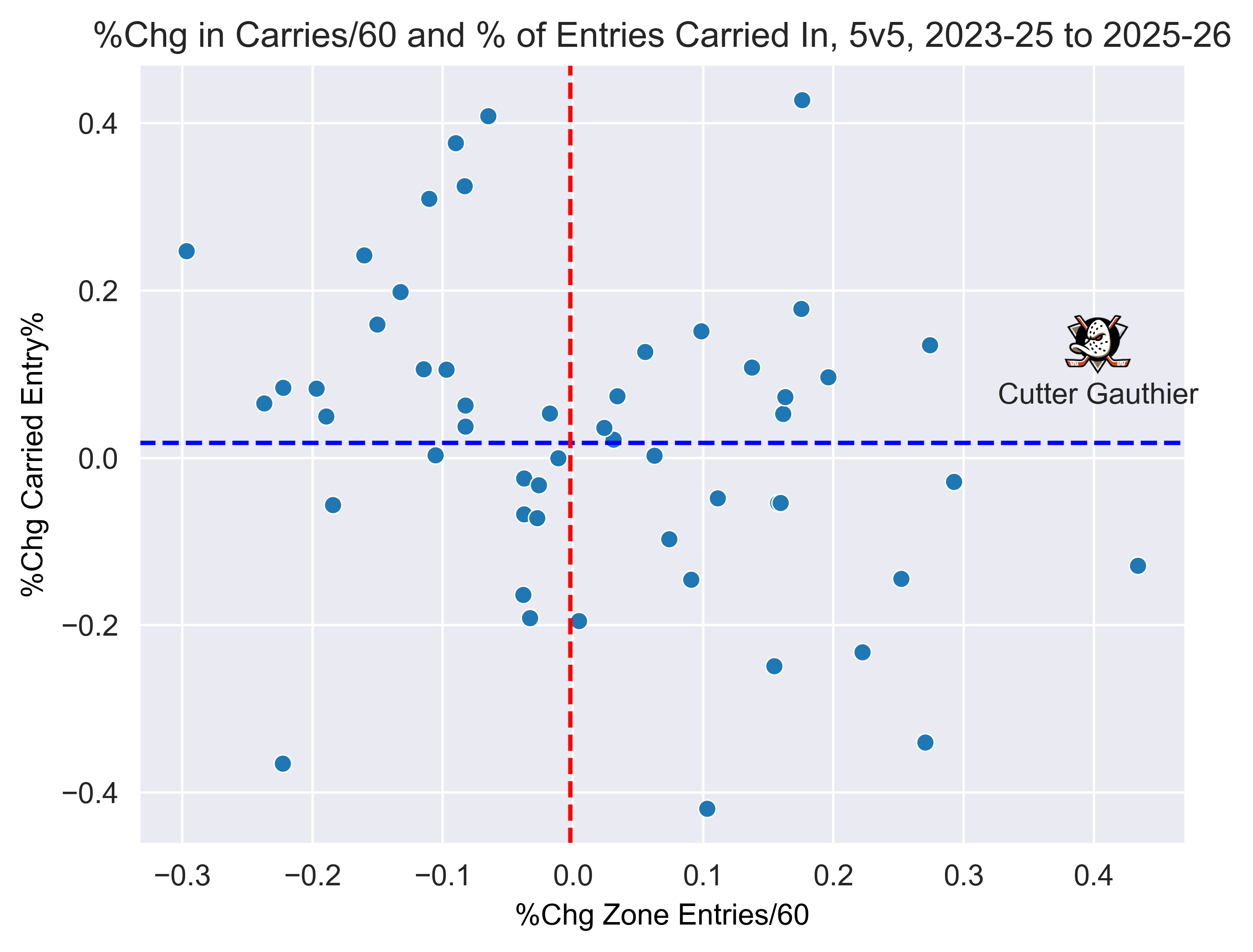
His overall rates of entries and carry percentage aren’t among the elite forwards just yet, but this is a sizeable jump in both areas compared to his rookie season, and another leap like this next year will put him in that conversation.
10 – Hendrix Lapierre (Washington Capitals)
There are a number of young Capitals skaters showing improvements, which makes it easy to overlook what Lapierre has done. He had a large, positive change in his rate of zone entries and paired that with the largest increase in percentage of those entries being carried in:
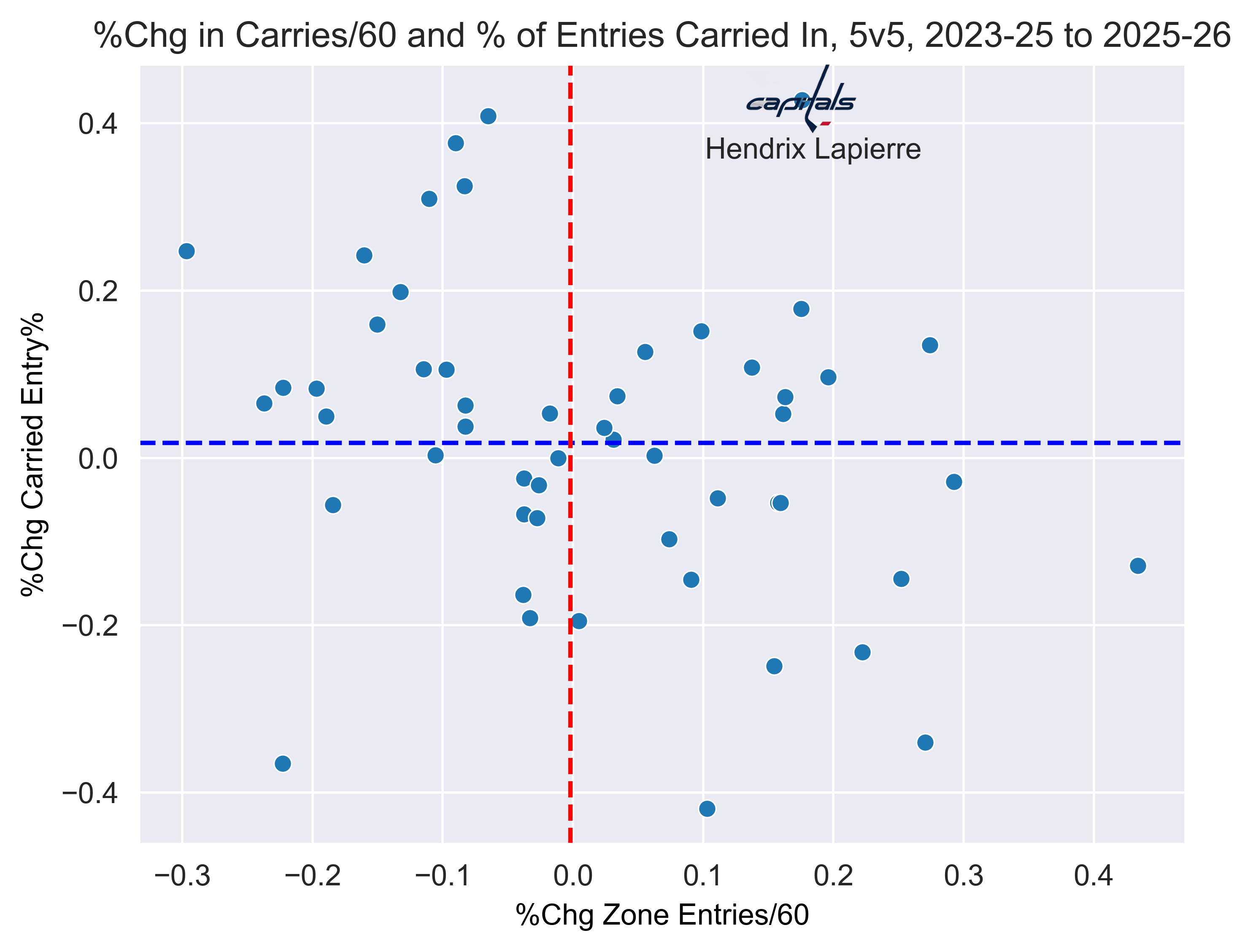
Lapierre hasn’t been able to drive goal-scoring for his line mates yet, but this shows improvement in areas where he can do that in future seasons. He has an uphill battle because the Caps are deep up front and the coaches don’t trust him with more than a fourth-line role yet, and as a pending RFA, maybe he doesn’t even return to the team.
Until next week.