10 Interesting (To Me) Stats For This Week - March 10
Welcome back to another week of ’10 Interesting (To Me) Stats!’ Last month, this newsletter covered how some forwards were faring this season relative to their teammates. Today, we’re doing the same thing, but exclusively evaluating defencemen in the context of their teams. That evaluation will be a percentage relative to their teammates, so if a player averages 4.0 scoring chances per 60 minutes, and his team’s average is 2.0, the relative difference is 100%.
Player and team data is from Evolving Hockey, tracking data is from All Three Zones, and this is all current as of Monday, March 9th. The sample is comprised of defencemen who have skated at least 500 minutes at 5-on-5 and have 100 tracked minutes, which is 185 players (excluding Quinn Hughes and Zeev Buium, who were traded for each other halfway through the season).
The red and blue dotted lines are the league average difference in each tracking stat. When discussing market shares, it’s just the overall league average.
1 – Return of the Mc
With 45 points in 51 games, Charlie McAvoy’s 0.88 points per game is a career-high. This isn’t a fluke, either, as he’s 1 of 10 defencemen to be in the 84th percentile or higher by contributions off the rush (rush shots and assists on teammates’ rush shots) and contributions off the cycle/forecheck at 5-on-5 relative to his team. He rates very close to a burgeoning star out in Los Angeles:
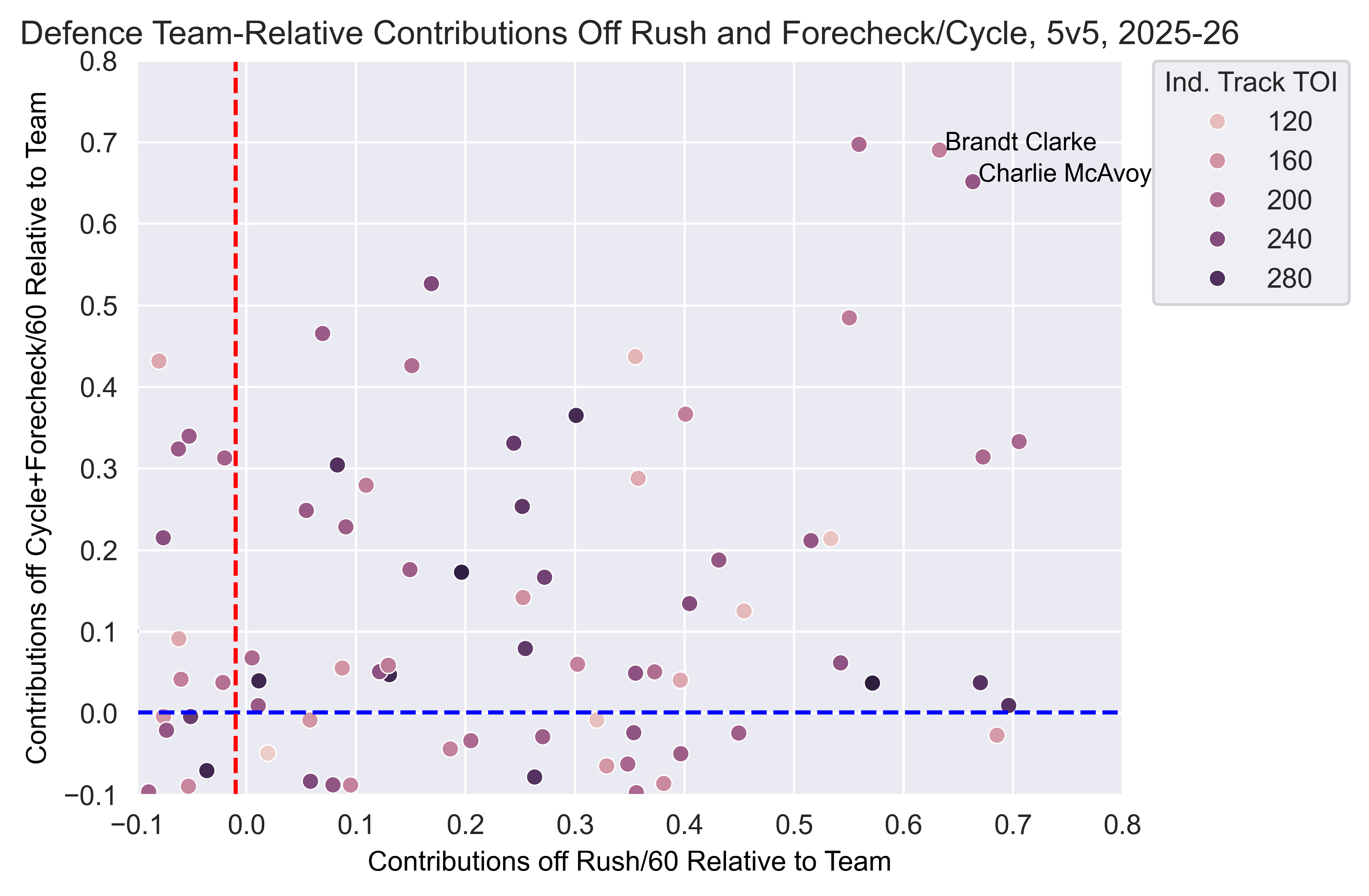
After a couple of seasons of declining production and offensive impact, McAvoy’s offensive game has turned around in a big way this year. It has come at the expense of his typically stellar defensive work, but he’s still been a lock top-pair guy who has helped Boston turn around the franchise after a dismal 2024-25 season.
2 – Not Firing Blanks
Nick Blankenburg was traded from Nashville to Colorado ahead of the Trade Deadline, and considering how good Colorado’s defensive group is, that should raise some eyebrows. In fact, along with McAvoy and some others, Blankenburg is 1 of those 10 defencemen above the 84th percentile of contributions off the rush and cycle/forecheck relative to their team:
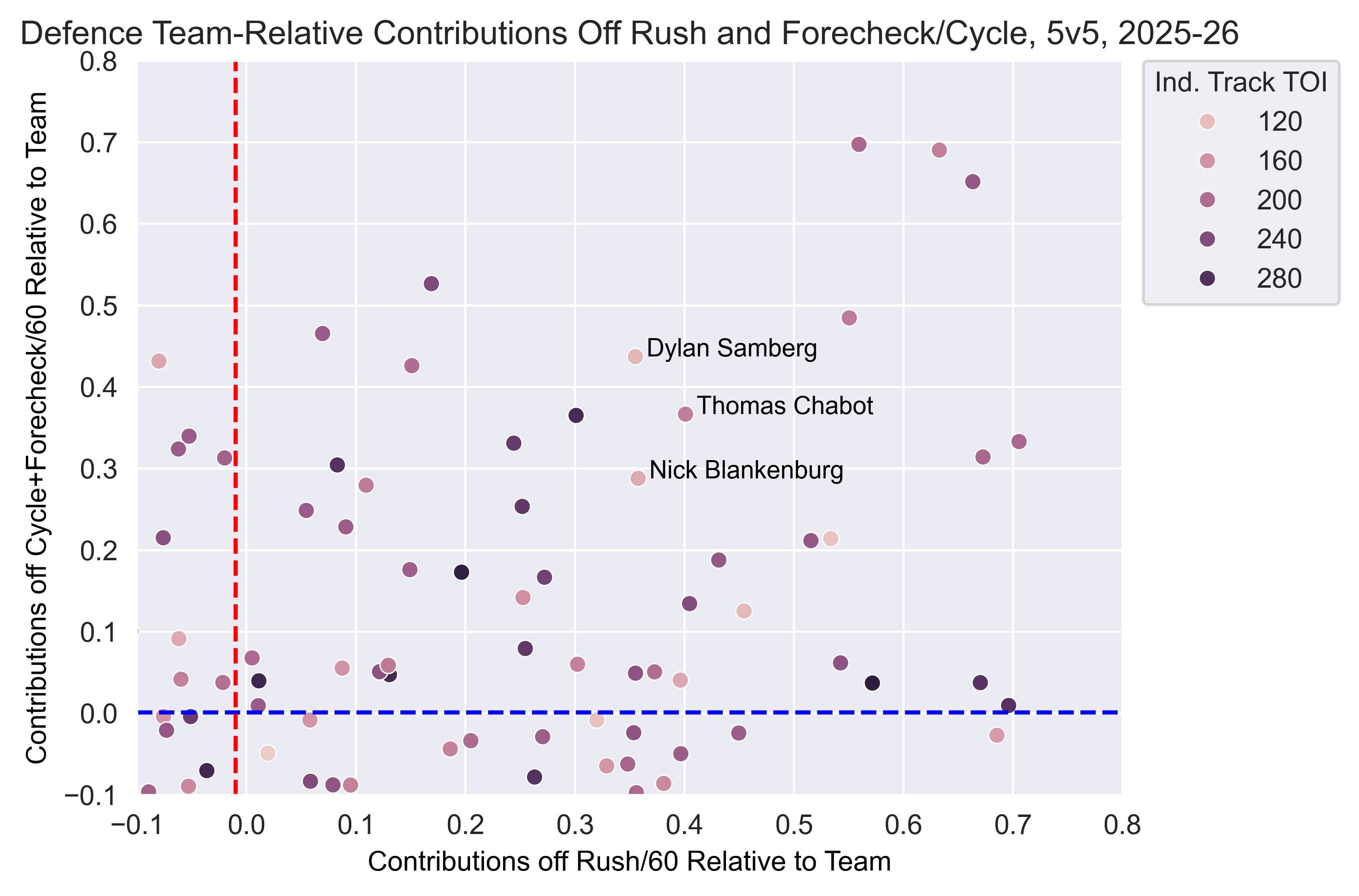
That is Blankenburg alongside Thomas Chabot and Dylan Samberg, which is a very good group for Blankenburg to find himself, and likely something the Avalanche have noticed as well. When he’s in the lineup, he should fit seamlessly on Colorado’s bottom pair as a play-driver who can help the team at both ends, but he’s likely stuck as the 7th defenceman for now.
3 – Tour de Force
The Seattle Kraken find themselves firmly in the playoff race out West and while Brandon Montour has missed games, he’s been able to both score goals and assist his teammates whenever he’s been healthy. In fact, he is 1 of 5 defencemen who is 84th percentile or higher by relative rate of scoring chance assists at 5-on-5 (helpers on teammate scoring chances) as well as the percentage of his team’s shot attempts he takes individually (shot attempt market share). Here are three of the other four names:
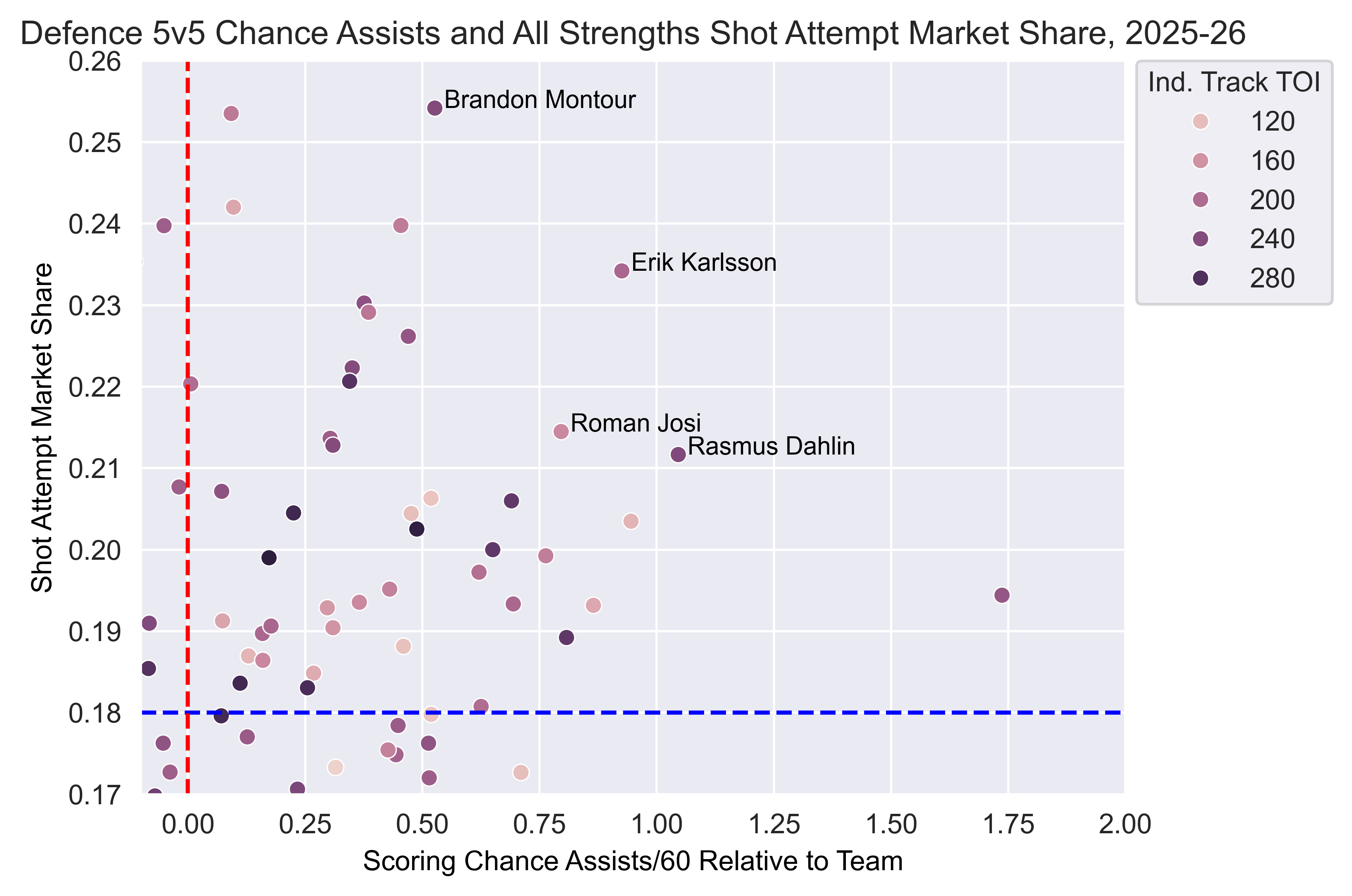
Comparing well offensively to Erik Karlsson, Rasmus Dahlin, and Roman Josi is a good place to be. Seattle is not a great offensive team, but Montour is certainly doing his part to be a dual-threat defenceman.
4 – Noah’s Mark
It was just mentioned that there are 5 defencemen exceeding the 84th percentile by rate of chance assists relative to the team and shot attempt market share. Montour compared well to three excellent offensive defencemen, and so does Montreal’s Noah Dobson:
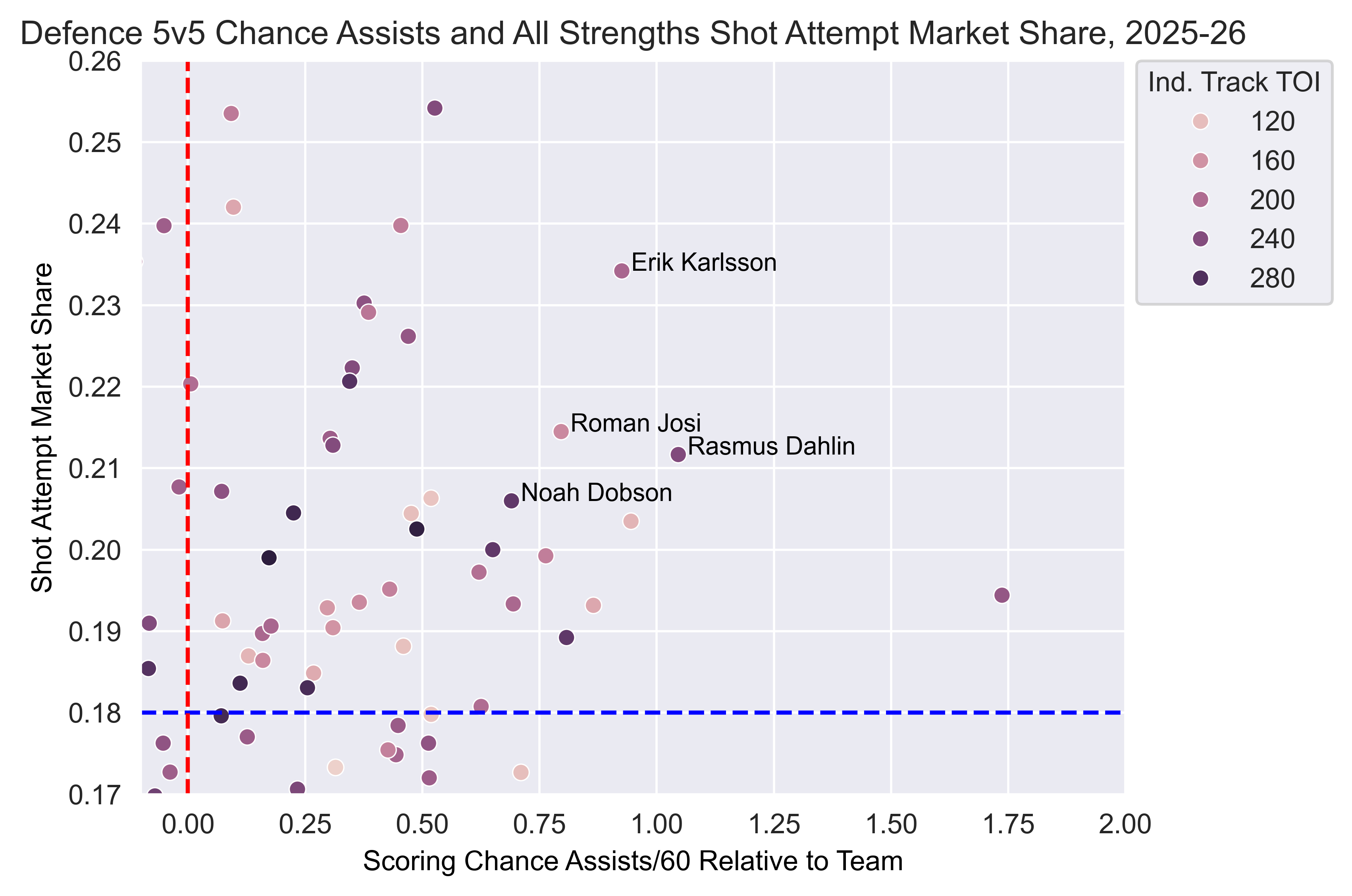
With 12 total goals, Dobson needs one more goal to tie a career-high, his 24 even-strength assists are the second-highest mark of his career, and all this is with 20 games remaining. Dobson was brought in to be a reliable puck-moving, offensive defenceman for Montreal and he’s been exactly as advertised.
5 – I Mean, Come On
This newsletter has discussed botch+fail% before, but for the uninitiated: a botched defensive zone retrieval is when a defenceman fumbles the puck either when it’s dumped in against him or when the opposition loses possession after a shot. A failed zone exit is what it sounds like. Botch% and fail% are stats that tell us who struggles to move the puck out of the zone, and defencemen who keep those combined percentages low generally help their team create offence. That means low botch+fail% are better.
When we consider the rate of zone entries by a defenceman, what percentage of those entries are carried in, and the aforementioned botch+fail%, the New York Islanders’ Matthew Schaefer has one peer:
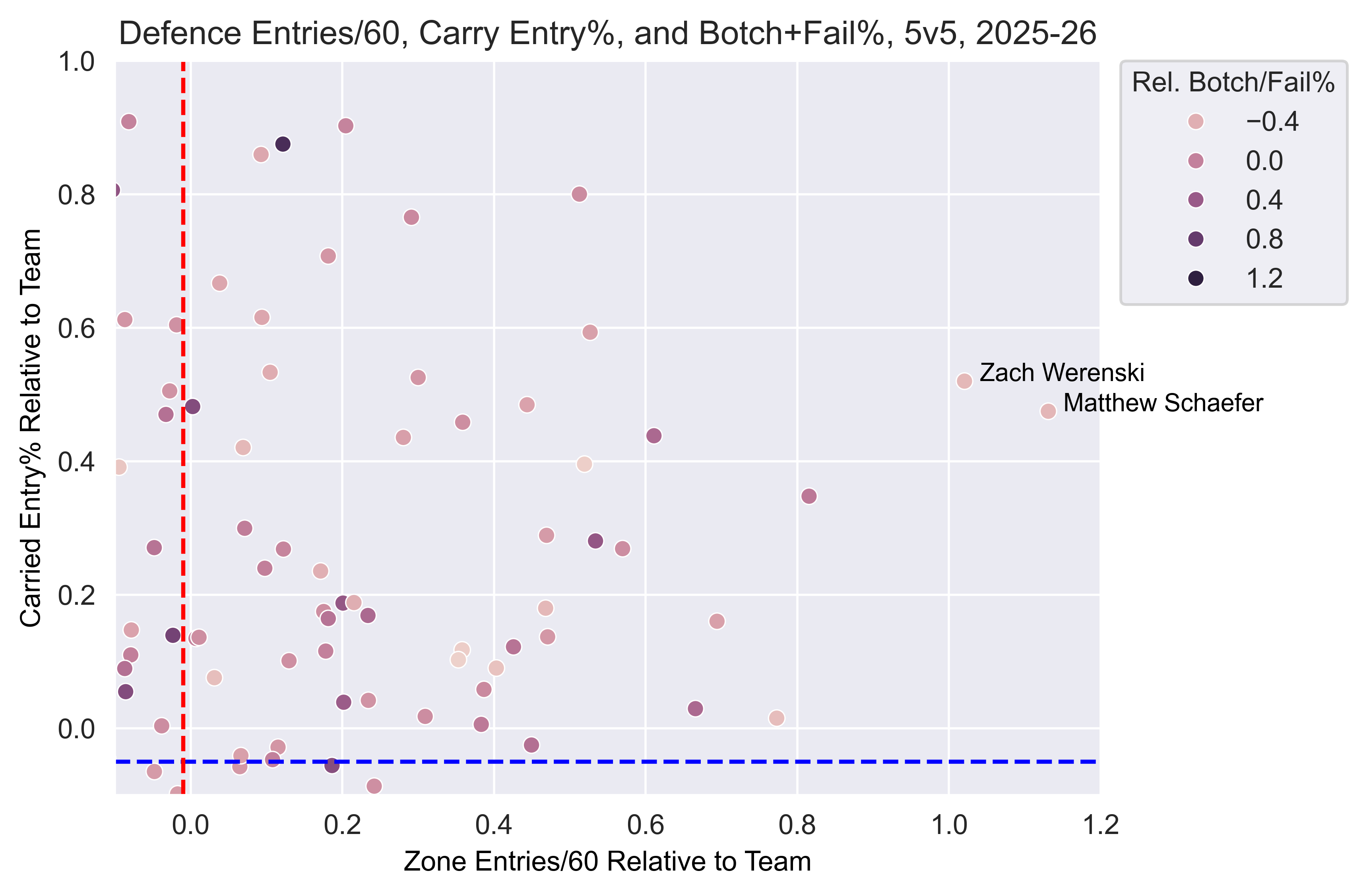
Safe to say that if an 18-year-old rookie defenceman is comparing to this version of Zach Werenski, he’s doing something absolutely incredible. If this is what Schaefer’s 18-year-old rookie season looks like, what does his 24-year-old season look like?
6 – Olé
Anaheim traded for defenceman John Carlson, and that means a smaller role for their younger defencemen. Though Olen Zellweger hasn’t taken a huge step forward yet, when we use the same parameters we just used for Schaefer, Zellweger shows extremely well to a couple top offensive defencemen:
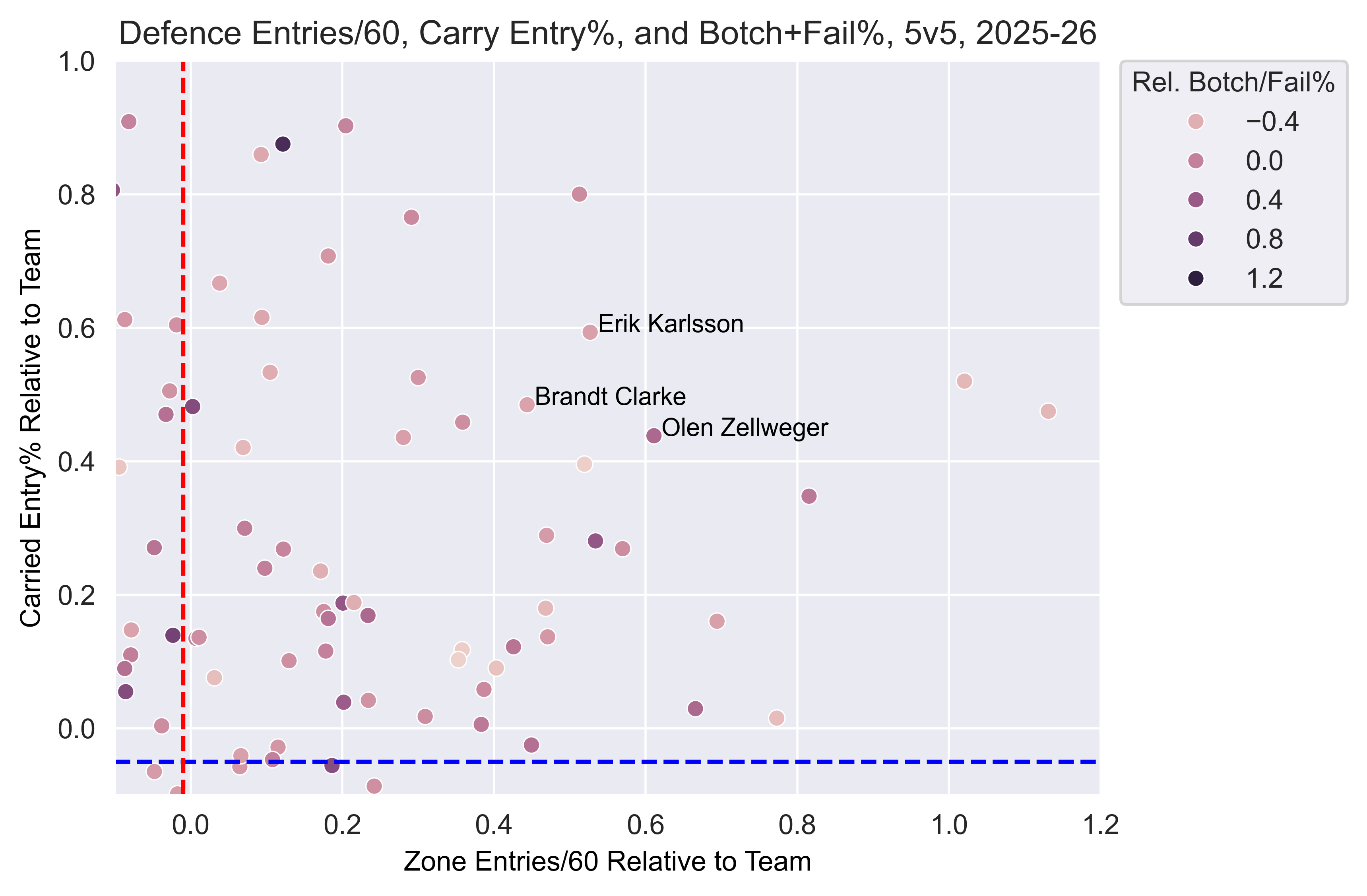
Karlsson is Karlsson and Clarke is having an excellent year. Zellweger leads the Ducks’ blue line by goal share at 5-on-5 and when we see just how good he is transitioning the puck, maybe we should be surprised by that.
7 – League of His Own
We have mentioned Brandt Clarke’s name a couple times already, and he’s showing well in several areas, so let’s look at some overall stats. Using team-relative scoring chance contributions (individual chances + chance assists), zone entries+exits, and the botch/fail% we just discussed, here is where Clarke stands:
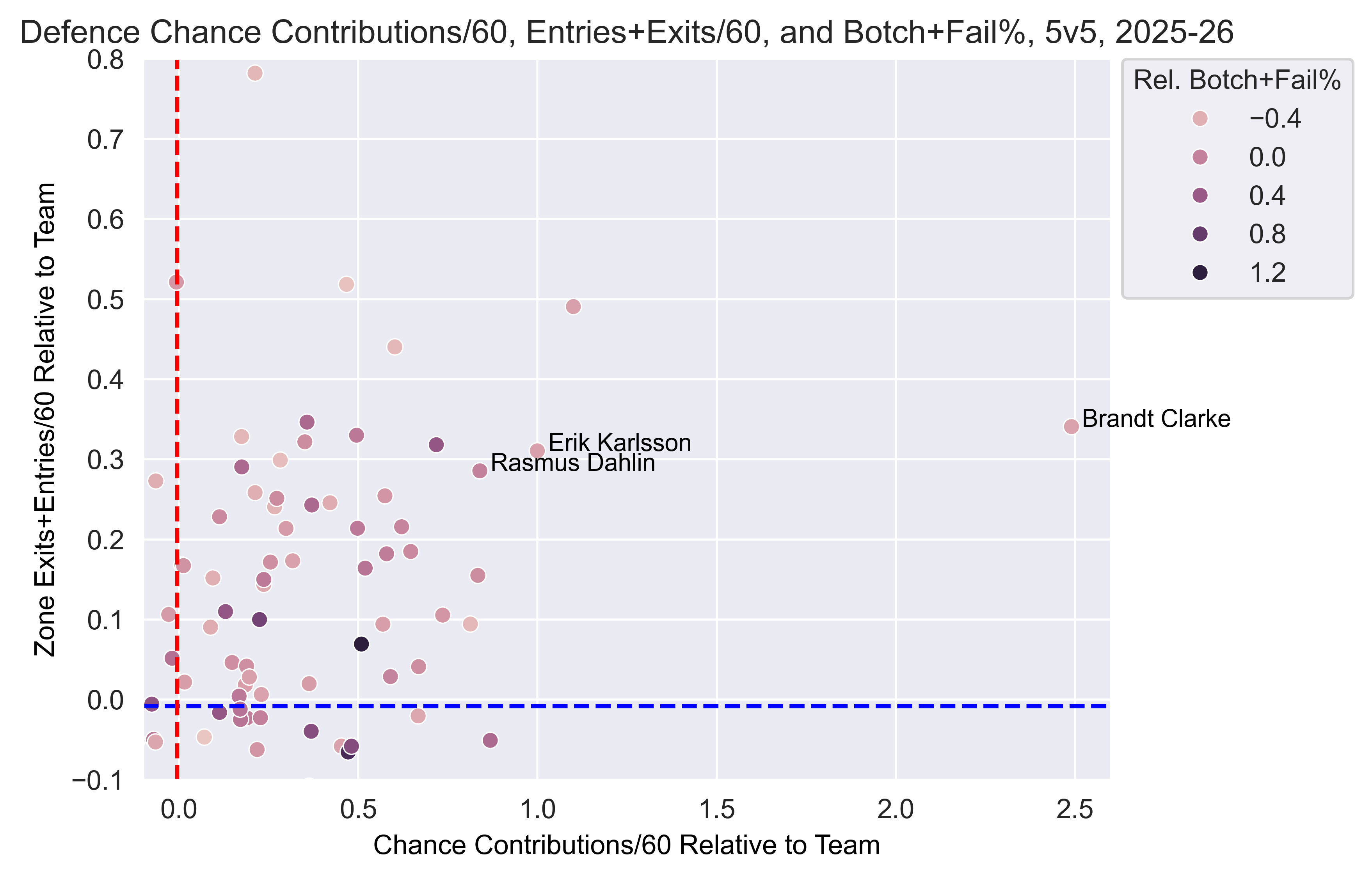
The chance contributions stand out. Clarke is in a tier of his own when looking relative to his team as he’s 5x higher than the next-closest Kings defenceman. It is fun to think about what Los Angeles would look like without him.
8 – King Philip
We have written about Philip Broberg a few times this season, so what’s one more? He is worth mentioning because when we look at the same parameters we just used for Clarke, and try to look at contributions both in scoring chance contributions and transition work, Broberg rates very close to a pair of Norris Trophy contenders (past and present):
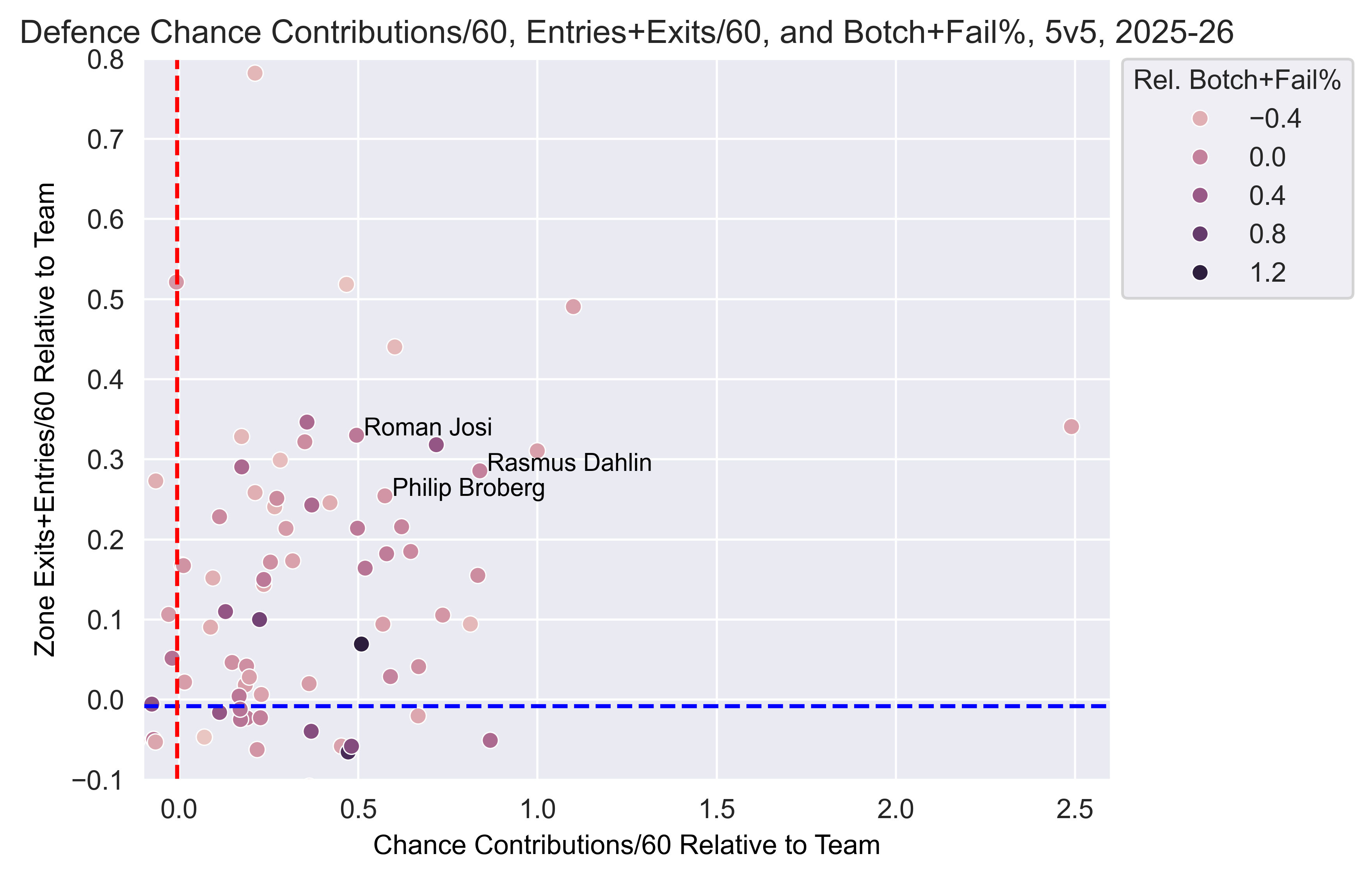
Broberg crested the 200-game plateau back in January and he turns 25 years old this summer. He is in the thick of his prime and has been on an upward trajectory for three years. At this time next year, we might be looking at a top-25 defenceman in the league.
9 – Duck Hunt
When going over the market share numbers – the percentage of team shot attempts and expected goals taken by defencemen – something stood out, and that’s what new Anaheim defenceman John Carlson has done. He is just a bit lower than the 84th percentile by market share of shot attempts, but is very high by market share of expected goals, and when we add that with his attempts needed per expected goal, he compares to a name we’ve already seen:
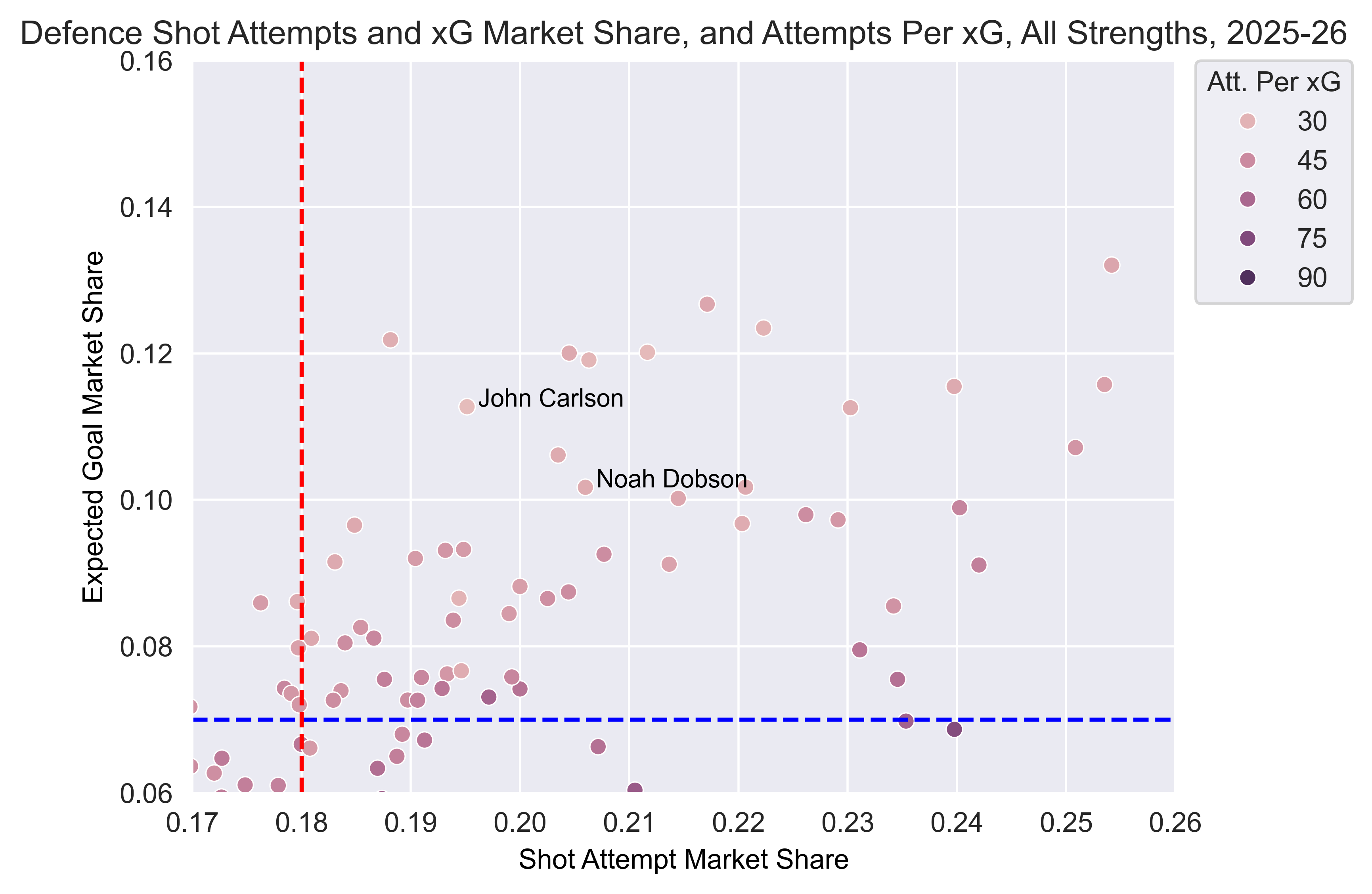
We mention Carlson because he’s going to an Anaheim team that does very well creating shot quality, and his calling card isn’t his shooting but his passing. This kind of profile on his new team should fit very well.
10 – Flying Rasmus
Vegas defenceman Rasmus Andersson was a shooting machine back in Calgary, which is highlighted by the same stats we just used for Carlson in terms of shot attempt and xG market share in addition to attempts per xG:
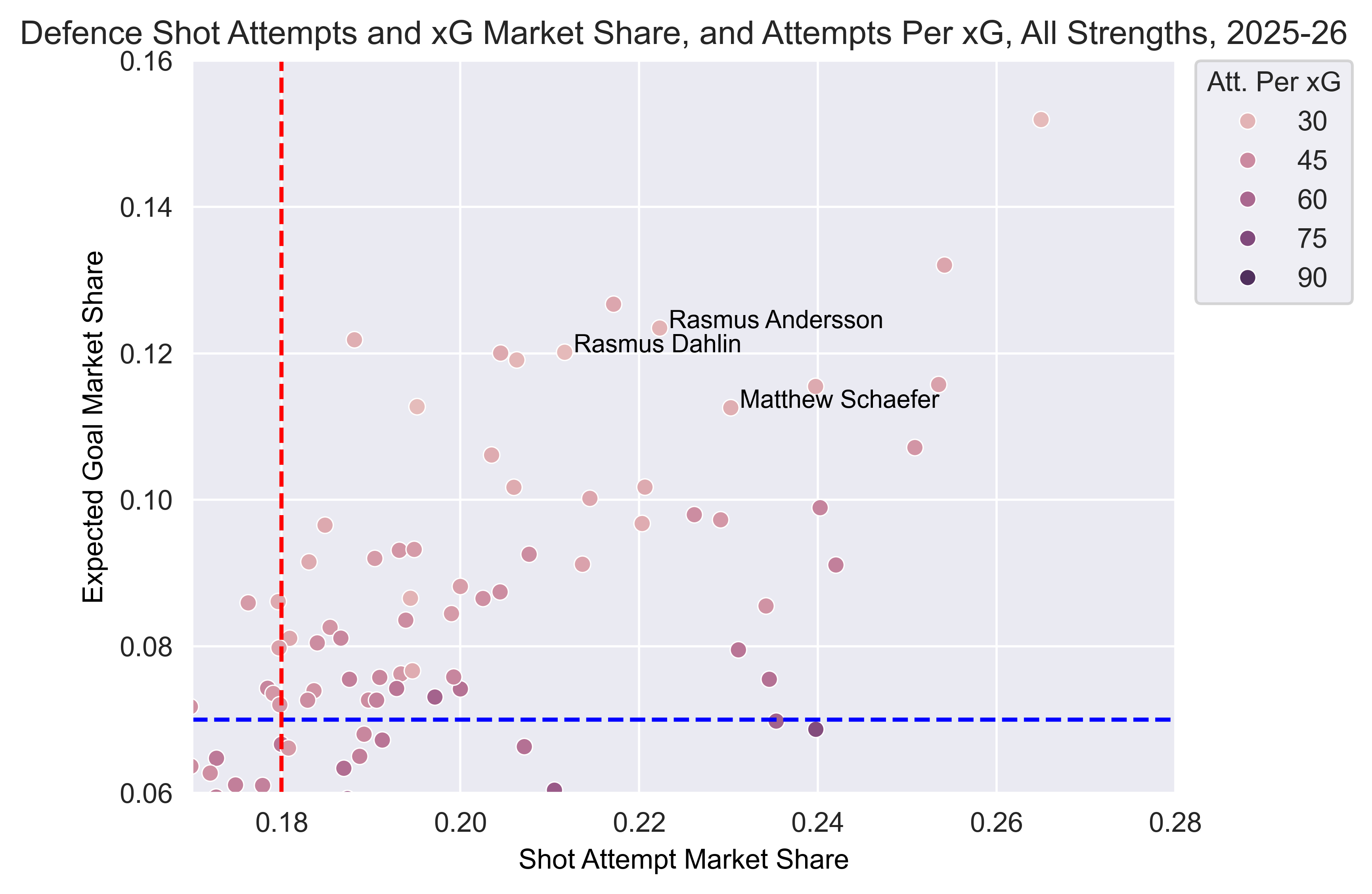
Andersson might see some scoring issues in Vegas because he’s lost 2:46 per game in ice time, but he clearly has the ability to score from the blue line, and that gives the Vegas Golden Knights a dimension they haven’t had this season outside of Shea Theodore.
Until next week.