10 Interesting (To Me) Stats For This Week - December 30
Welcome back to another week of ’10 Interesting (To Me) Stats’. We are nearing the end of calendar 2025, so it’s appropriate to do a retrospective, and we’ll do that using 5-on-5 tracking data from All Three Zones. We are going to look at some of the top performers from games tracked in 2025 among both forwards and defencemen. Forwards require at least 150 tracked minutes (about nine players per team), defencemen need at least 140 tracked minutes (about six players per team), and the data is current as of Monday, December 29th.
1 – The Dual Threat
When a defenceman is far-and-away the top 5-on-5 point producer for a calendar year, it would stand to reason there are a lot of things that player does well. This is absolutely the case for Zach Werenski (who leads Cale Makar by 8 points) as he’s in a league of his own when it comes to contributions off the rush and off the cycle/forecheck on a 60-minute basis:
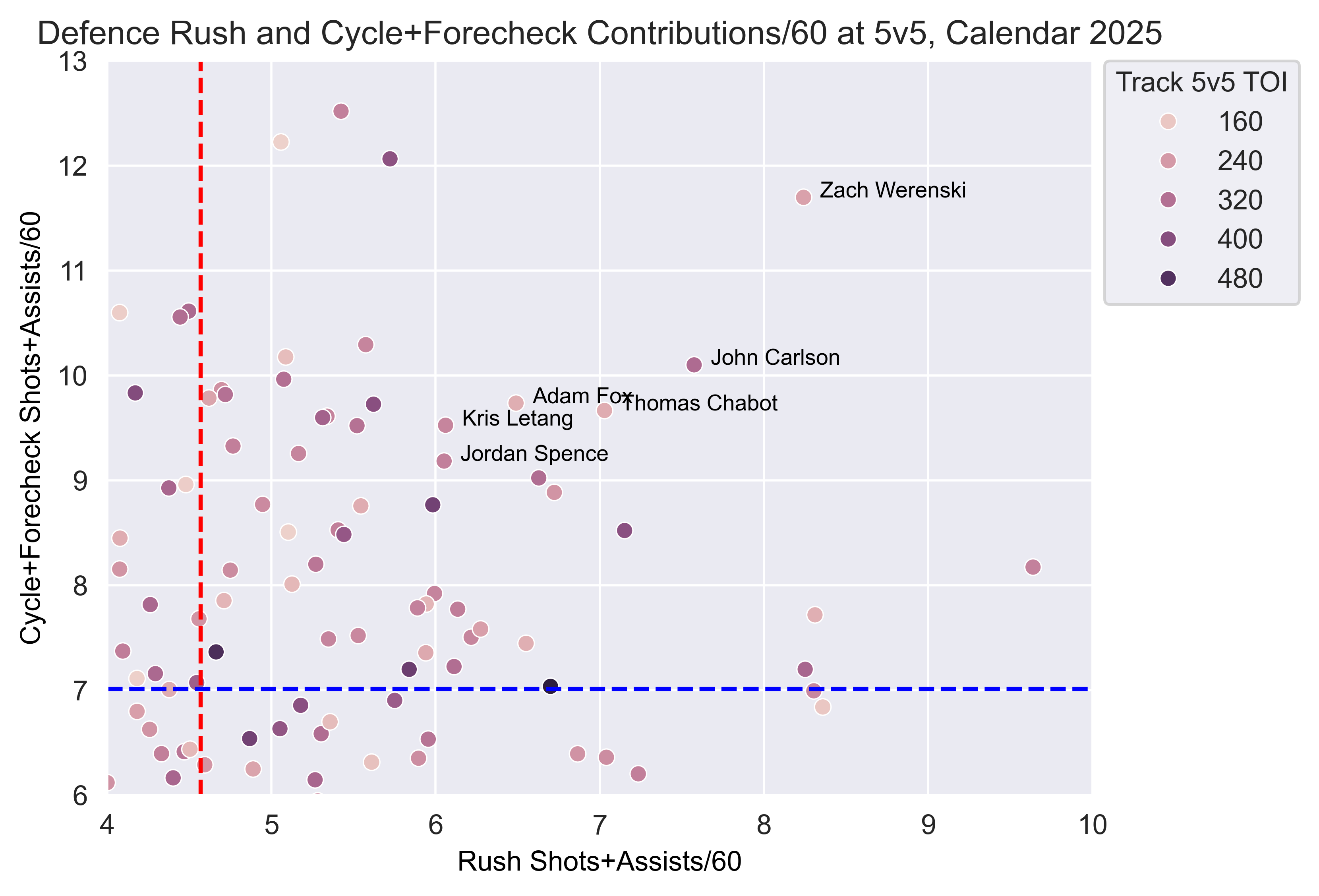
The red line is the league average for rush contributions from defencemen, the blue line is the league average for contributions off the cycle/forecheck, and the players with labels are at least one standard deviation above average in both areas. There were a handful of true dual-threat defencemen over the last 12 months, but Werenski is head-and-shoulders above the rest.
2 – Give It Time
While the Mikko Rantanen trade has worked out very well for Dallas so far, the Hurricanes certainly look as if they have a future star in Logan Stankoven. Using the same rush and cycle/forecheck parameters as Werenski, here are the forwards who were one standard deviation above the league-average forward in both areas over the last year:
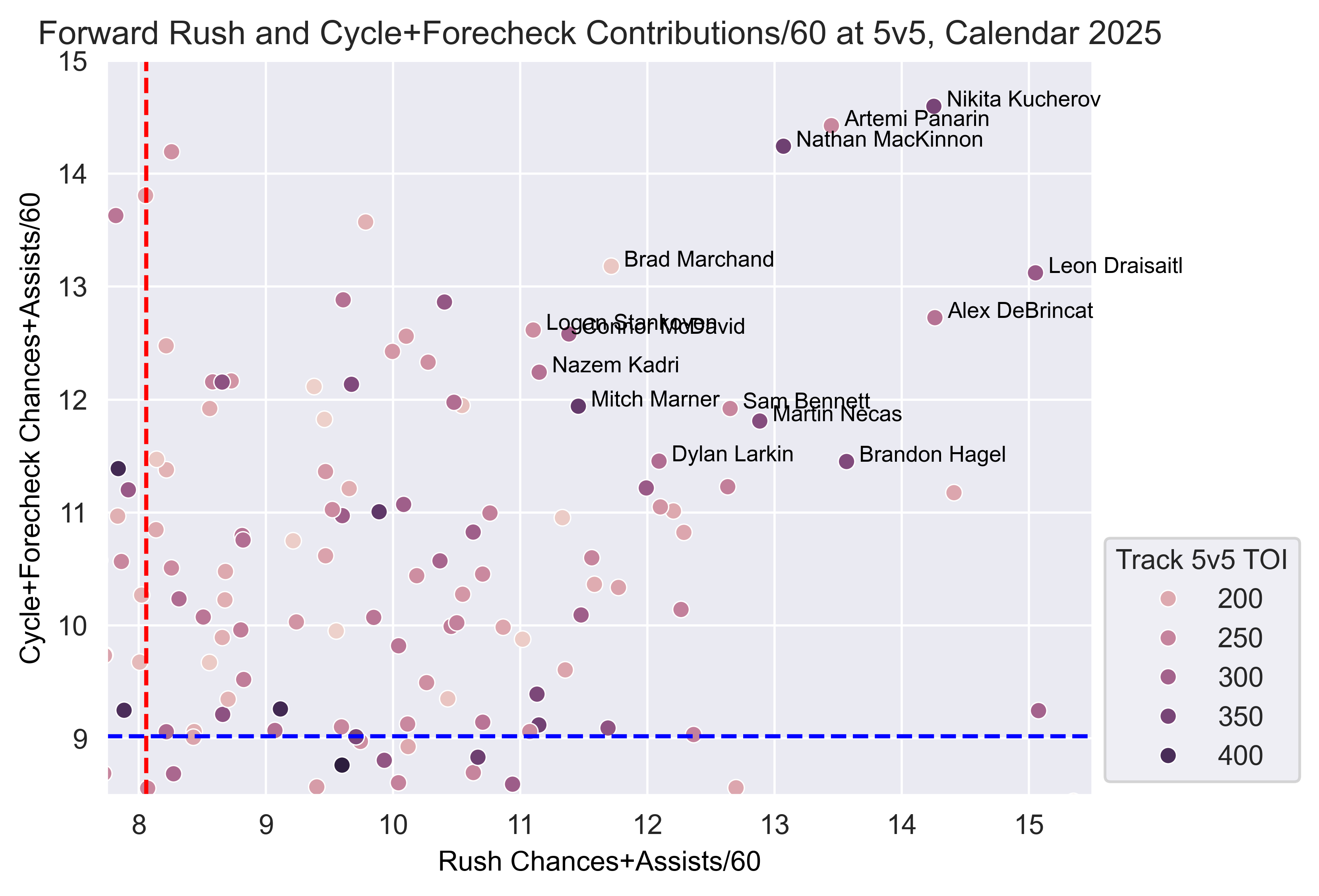
You will notice some former MVPs like Nathan MacKinnon, Nikita Kucherov, and Leon Draisaitl, star wingers like Mitch Marner, Artemi Panarin, Martin Necas, and Brandon Hagel, and then two overlapping names in the upper-middle of the chart. The overlapping names are Logan Stankoven and Connor McDavid. If Stankoven can keep up his dual-threat nature to the level of names like Marner and Marchand, it won’t be long before the points start flooding in.
3 – The Next Depth Gem
Colorado’s Sam Malinski is growing into a personal favourite around these parts, and below is a chart showing combined contributions off the rush, cycle, and forecheck on one axis and combined rate of zone entries and exits on the other among defencemen. These names are at least one standard deviation above league average by both:
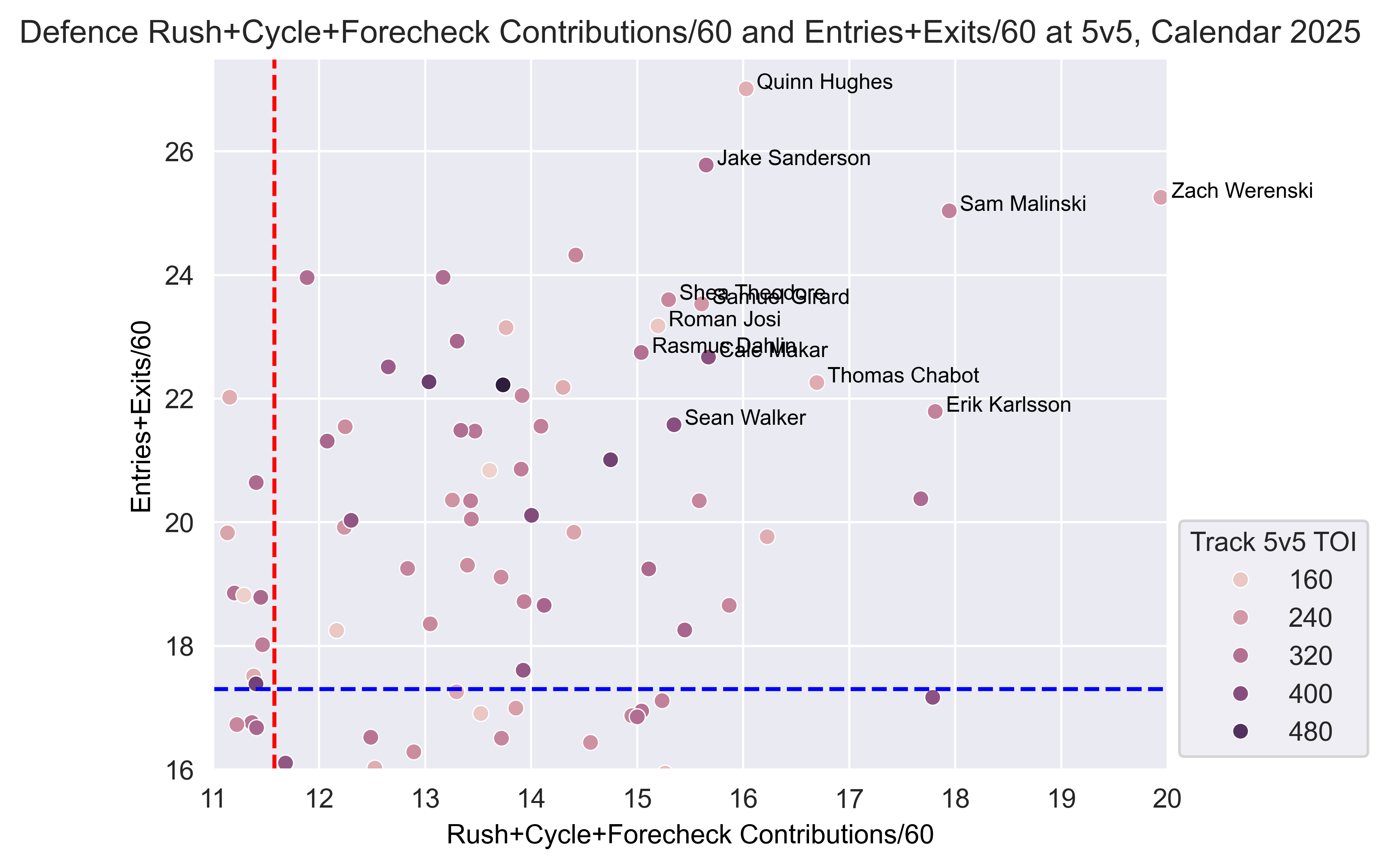
There are 12 names on that list, four of them are former Norris Trophy winners, current top stars like Zach Werenski, Rasmus Dahlin, Shea Theodore, and Jake Sanderson, a few underrated options like Thomas Chabot, Sean Walker, and Sam Girard, and then Malinski. He is often used in a depth role but it’s hard to crush a depth role any harder than Malinski has. It is a wonder how high the upside is here.
4 – Da Bink Cat
A couple of weeks ago, this column covered Team USA Olympic bubble hopefuls, and one name included was Alex DeBrincat. That looked at just his 2025-26 effort so far, so let’s expand to include the second half of the 2024-25 campaign. Using the same parameters that we just used for Malinski but applying them to forwards, here are forwards one standard deviation above average in both areas for calendar 2025:
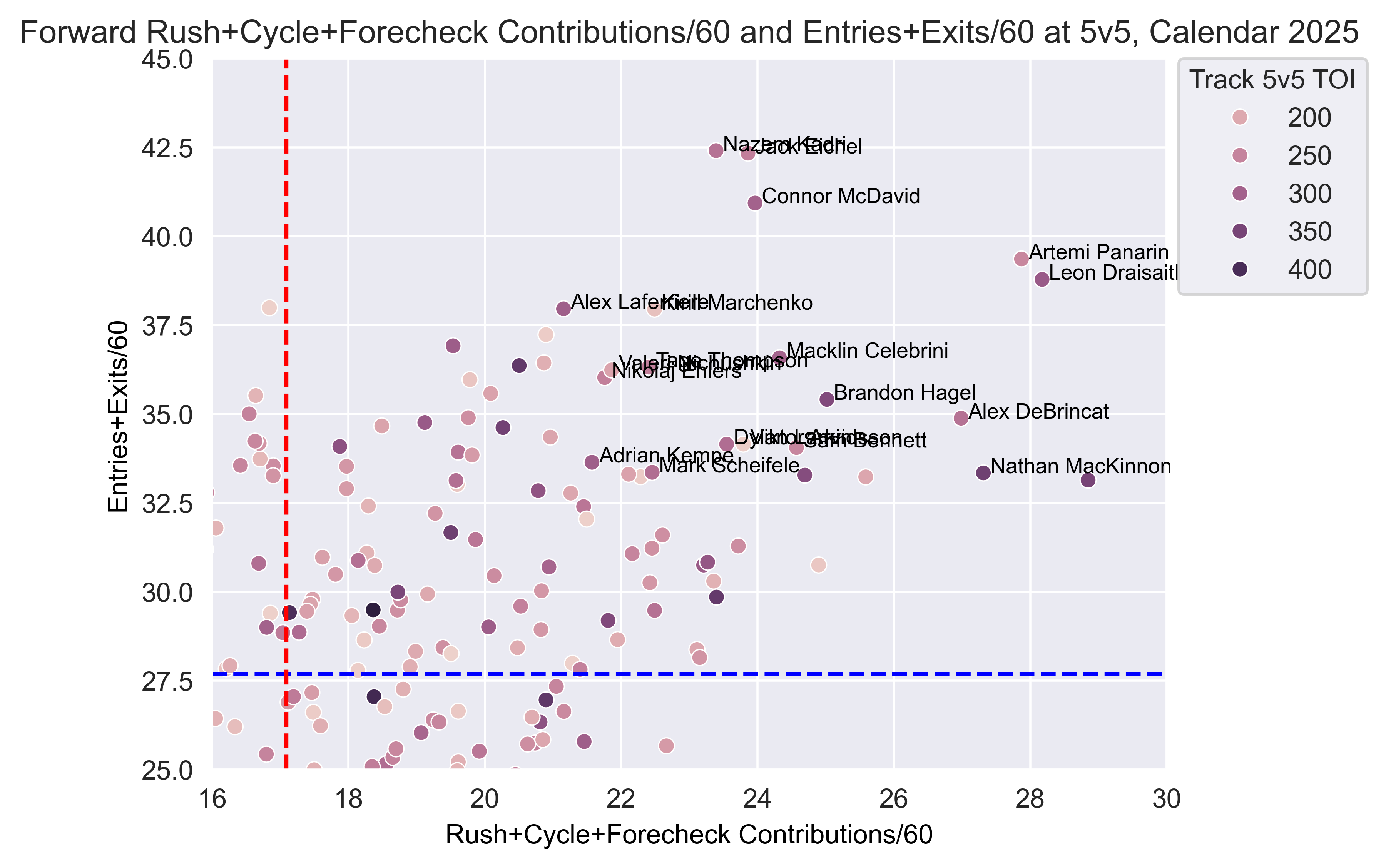
There is DeBrincat in the middle-right, nestled between Nathan MacKinnon and Brandon Hagel. Is that good? It seems good. Team USA has a pile of forward talent but with the way DeBrincat has been playing for the last year (or more), leaving him at home may be a mistake.
5 – You Just Made the List
In the section on DeBrincat, there was a name that popped up that surprised me. Not that he’s a bad player, but the level at which he was performing was very startling. So, let’s use the same parameters we just used for DeBrincat but zoom in a little bit. Look at the top left. See the overlapping names? That is Jack Eichel and Nazem Kadri:
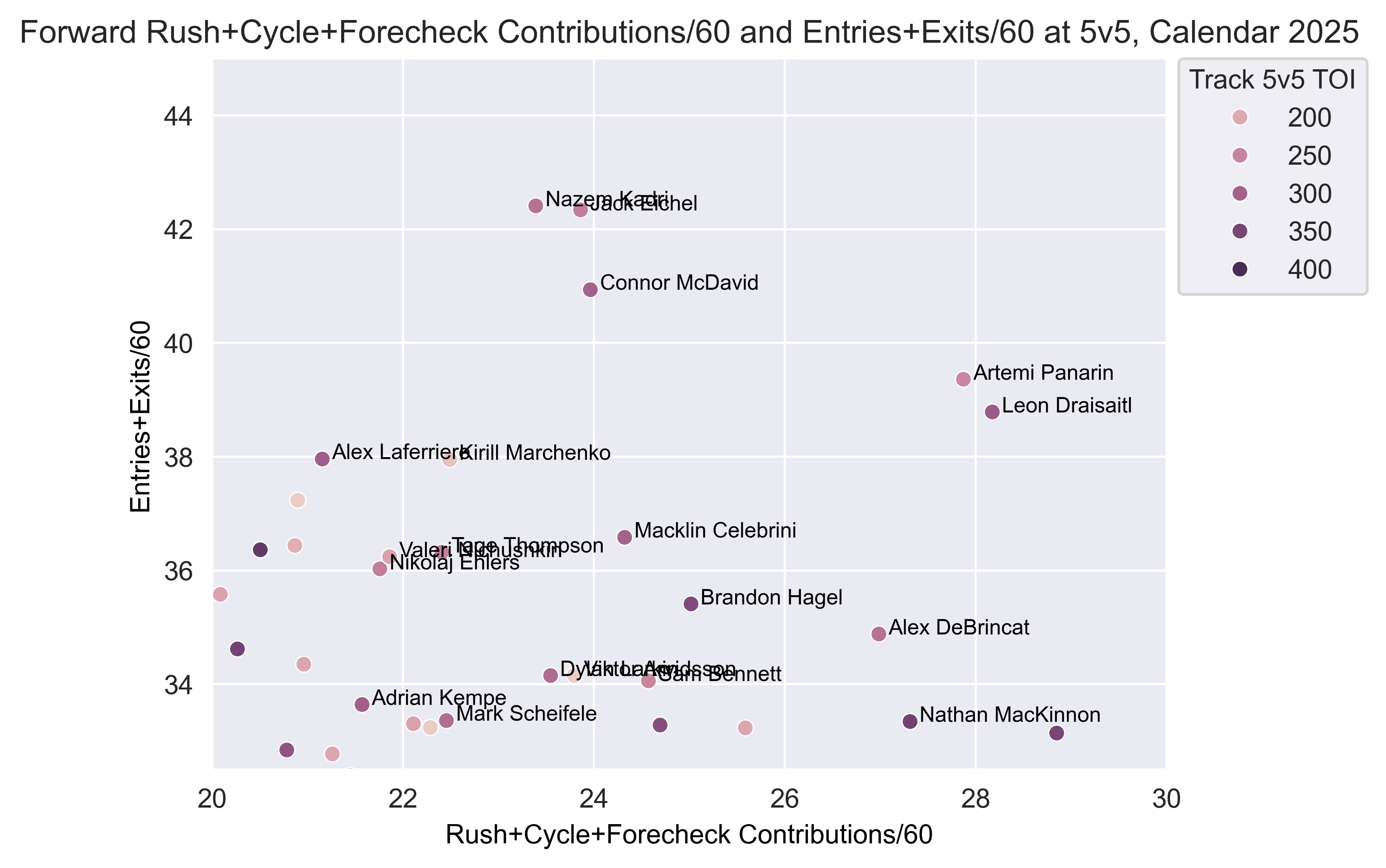
Not only have Kadri’s offensive and zone exit/entry contributions mirrored Eichel, but the name closest to them is Connor McDavid. Calgary is working on a second straight season of being a bottom-8 offensive team at 5-on-5, and it’s a wonder what Kadri’s stat line would look like if he were in Dallas or Tampa Bay instead of Calgary.
6 – Norris On The Horizon
Looking at defencemen and their rate of zone exits, defensive zone retrievals, and combined percentage of failed exits and botched retrievals, here are the names at least one standard deviation above average in all three areas:
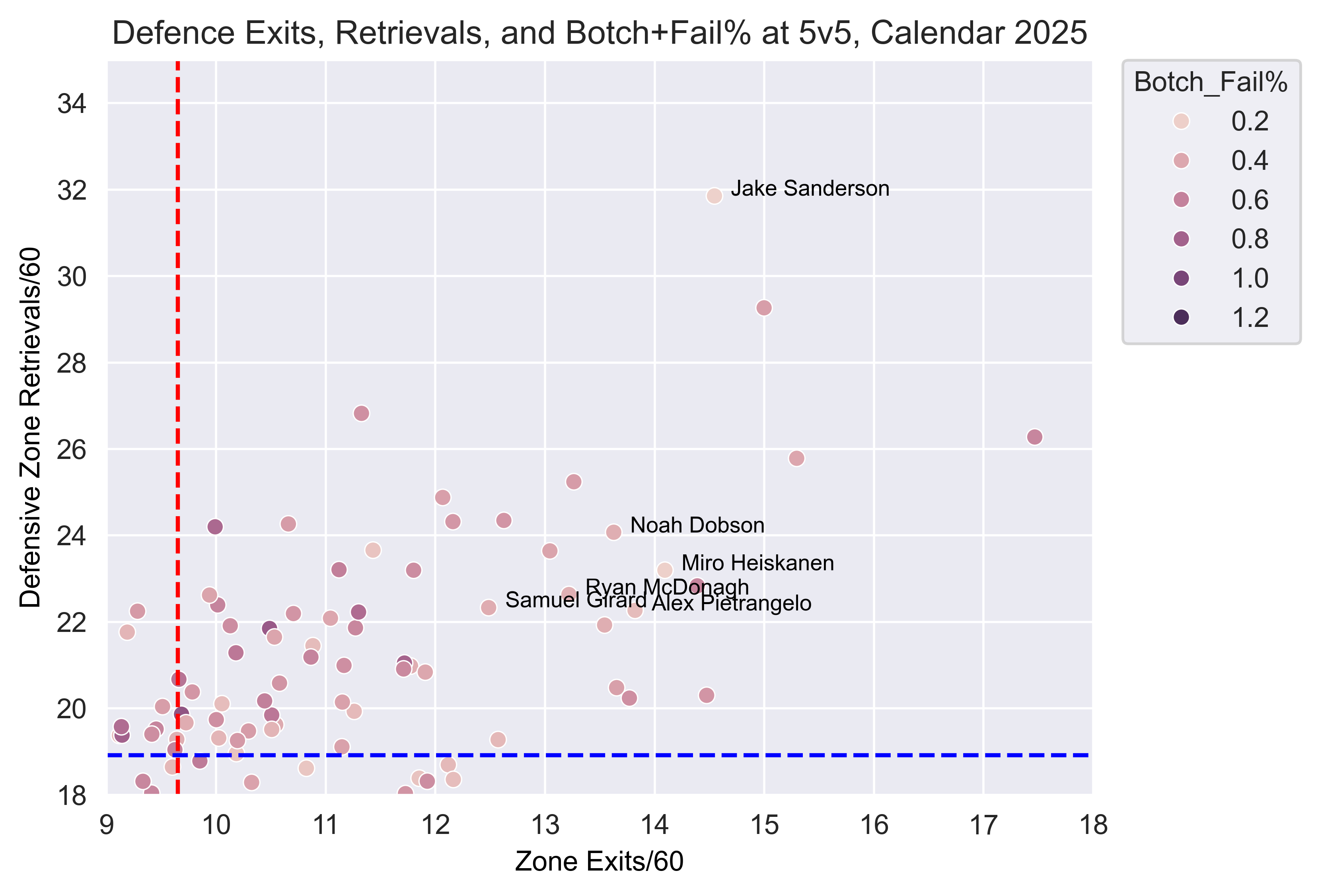
The five-man group is a great collection of defencemen, but what sets Ottawa’s Jake Sanderson apart is he leads the league in defensive zone retrievals per 60 minutes by a good margin. Not only does he lead the league in retrievals per 60 minutes, but he’s also tied for the lowest percentage of failed exits and botched retrievals. Sanderson is tasked with a lot of minutes, a lot of defensive retrievals in those minutes, and has been perhaps the least error-prone defenceman in the league over the last 12 months. It is astounding what he’s done, and he just turned 23 years old in July.
7 – [meme of a Bugatti parked next to a run-down bungalow]
Looking at the opposite end of the ice, here are the defencemen one standard deviation above average by rate of scoring chance contributions (individual chances and assists on teammate chances), zone entries, and percentage of zone entries carried in:
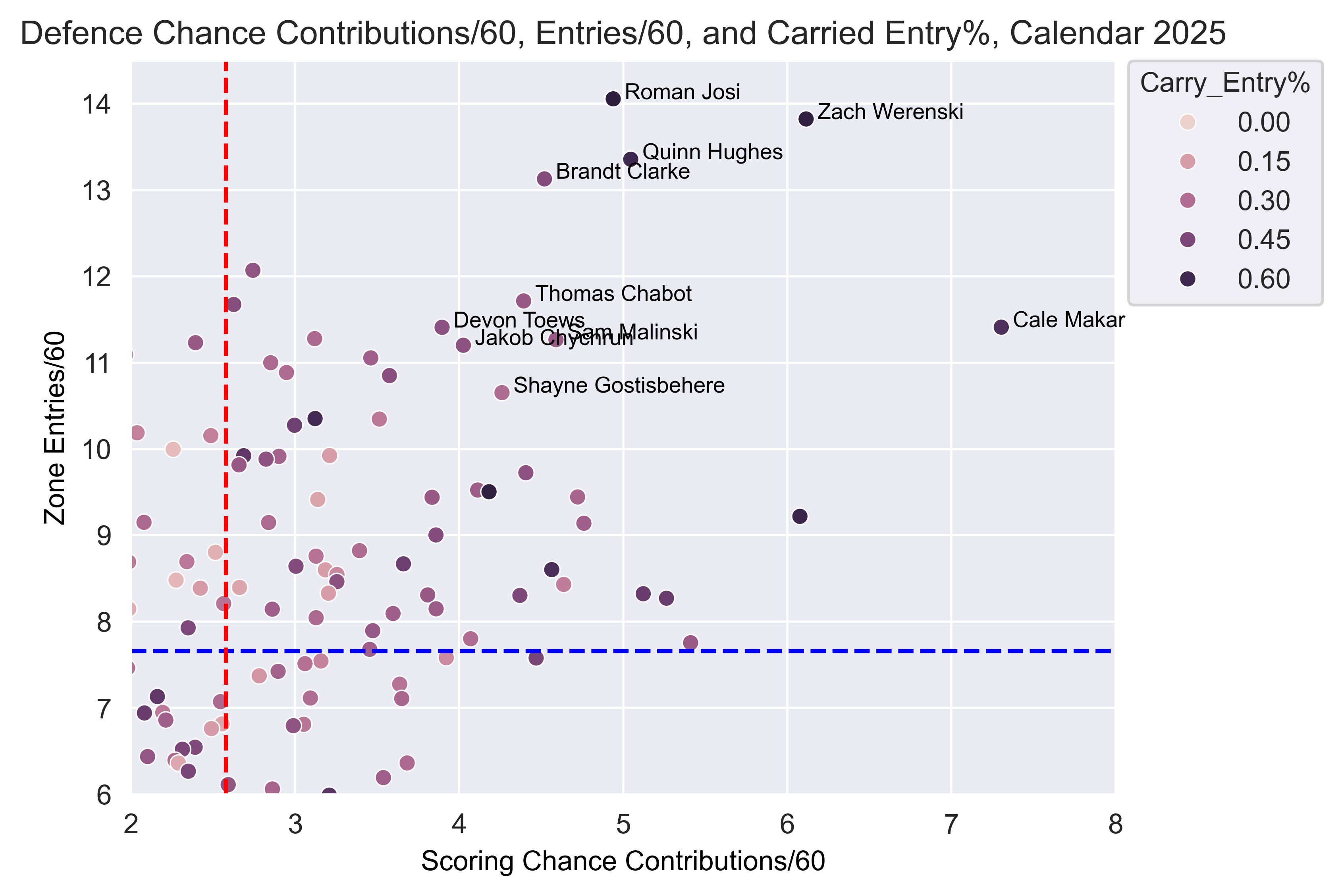
We see the usual names like Makar, Werenski, Josi, Hughes, and Chabot, and the name closest to Quinn Hughes is Los Angeles’ Brandt Clarke. He has the game of an offensive dynamo, it can just be hard to tell with modest usage and a low-scoring environment around him. Make no mistake: this is a guy showing all the tools of a high-end offensive force from the blue line.
8 – One Last Time
Before his injury, Evgeni Malkin’s season was off to a great start with 29 points in 26 games. His solid offensive play goes back to the end of last year because here are the forwards one standard deviation above average by scoring chance assists, high-danger passes, and percentage of chance assists being high-danger passes:
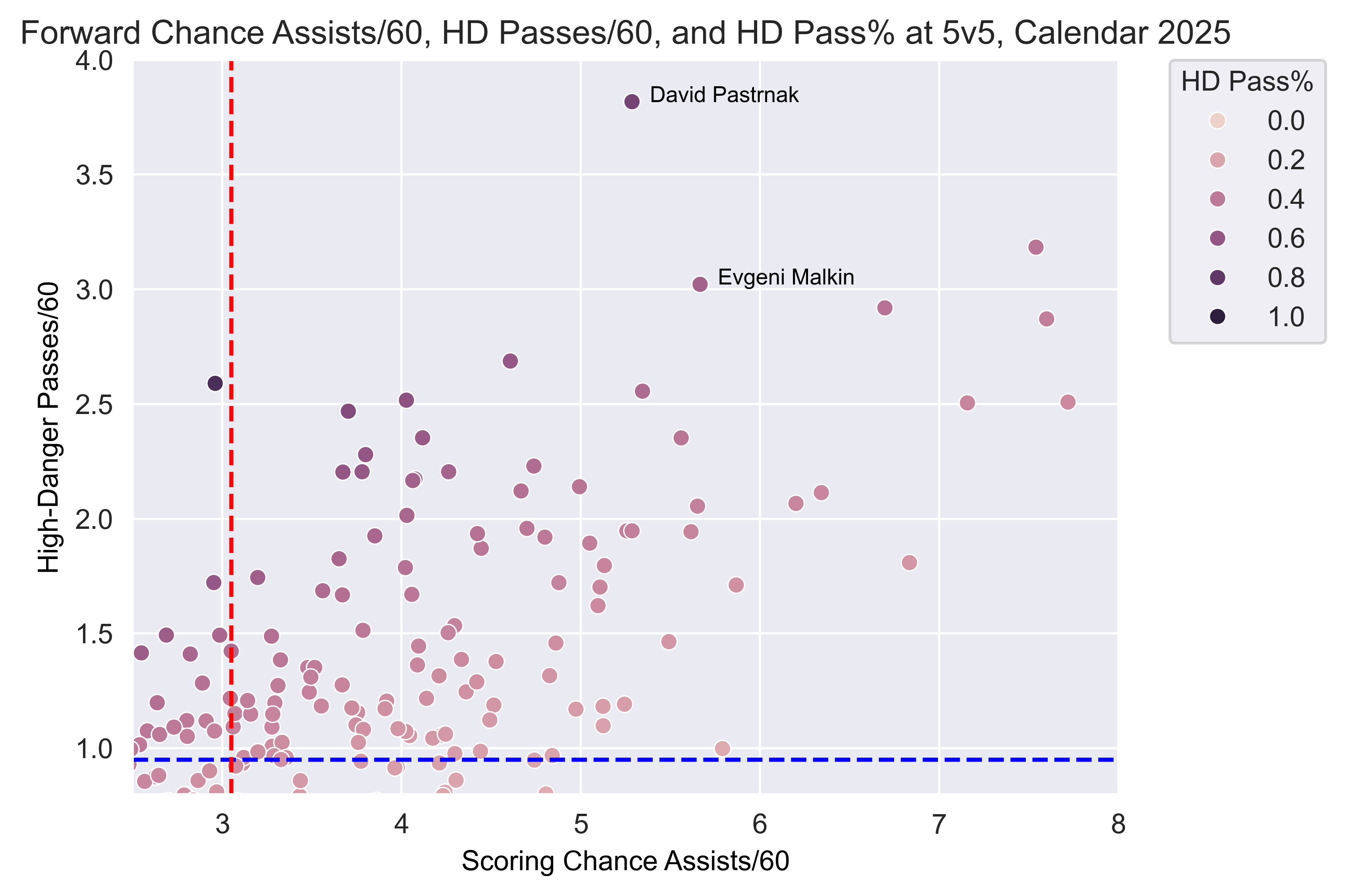
I feel comfortable saying that if you and David Pastrňák are the only two guys qualifying in three separate playmaking categories together, you’re probably doing something right. Let’s hope Malkin finds that level again when he returns.
9 – Another Dimension
Looking at defensive work from forwards, we are isolating those one standard deviation above average by rate of zone exits, rate of defensive zone retrievals, and combined percentage of failed exits and botched retrievals. It is a fascinating list:
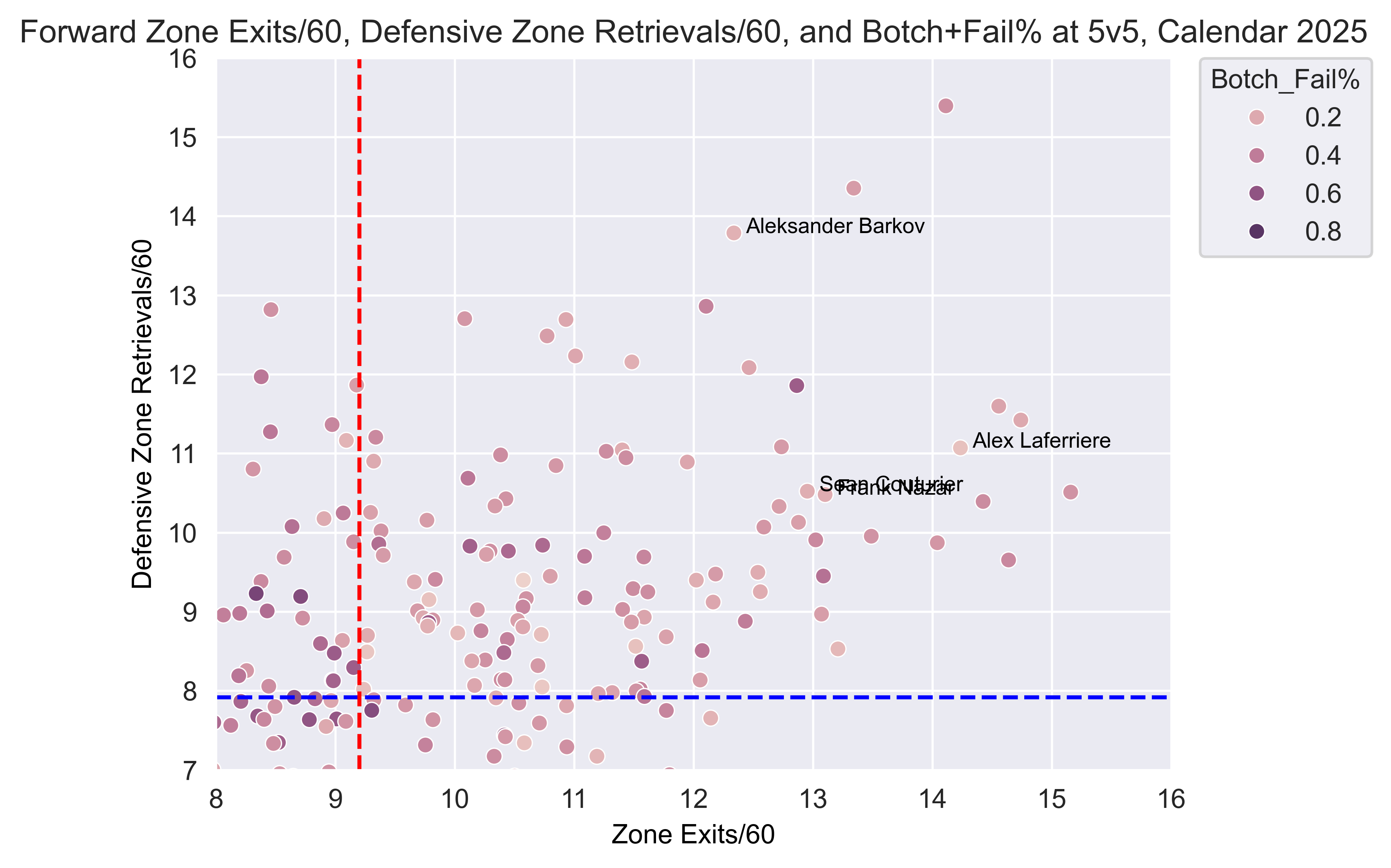
We see Aleksander Barkov (no surprise), Alex Laferriere (top line goals- and expected-goals against impacts, per Evolving Hockey), and the two overlapping names are Sean Couturier (former Selke winner) and Frank Nazar. Yes, one of the forwards with the heaviest defensive responsibilities with a very low turnover rate is a 21-year-old with 89 career games for a rebuilding team. I can’t wait to see the kind of player he is with another 100 games under his belt.
10 – He Does It All
What if we take one of the defensive dimensions – defensive zone retrievals – and look at forwards tasked with a lot of retrievals who are also at least one standard deviation above average by both rush/cycle/forecheck contributions and scoring chances contributions (individual + assists)? Well, this is what you get:
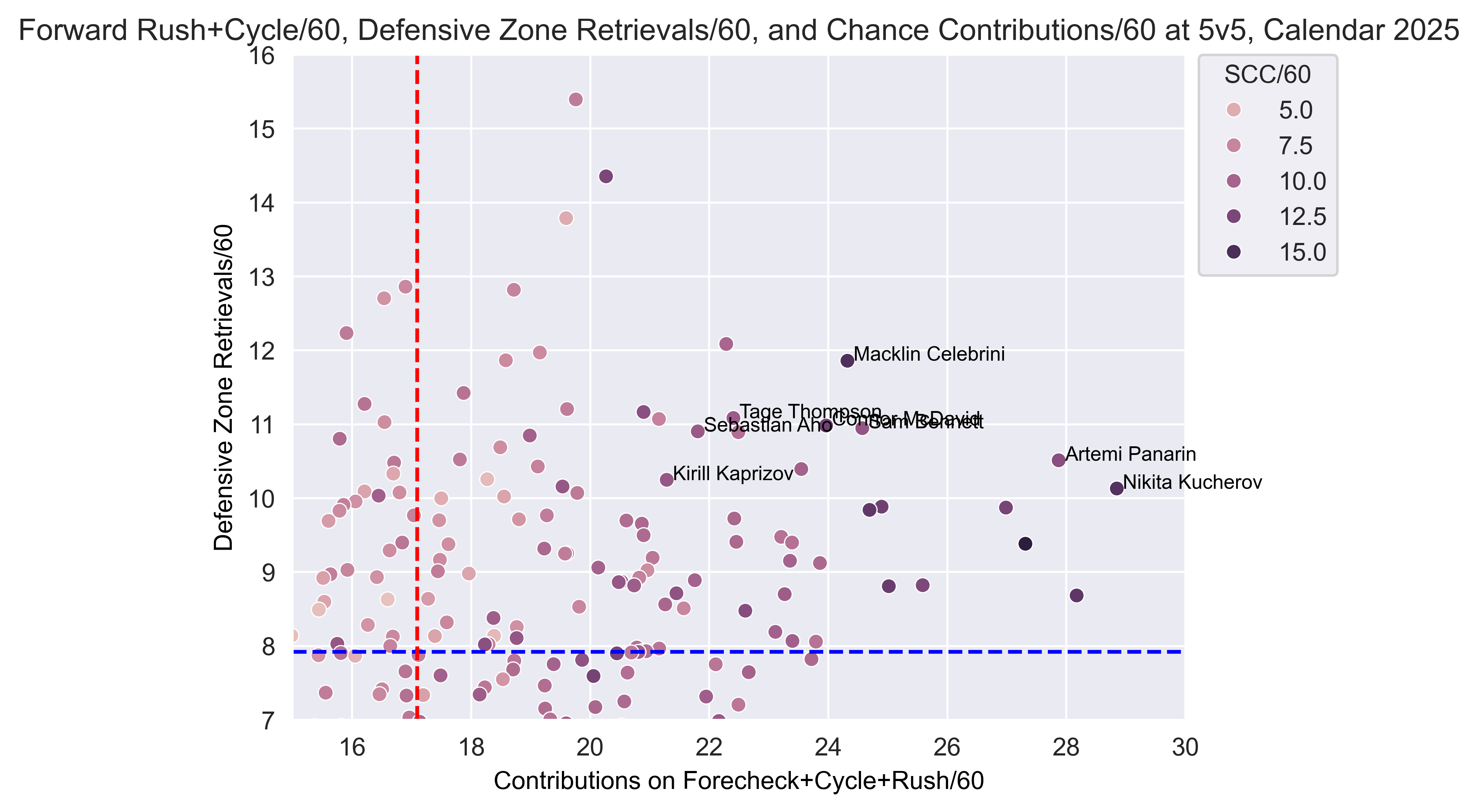
The names are Kucherov, Panarin, McDavid, Kaprizov, Aho, Bennett, Thompson and… Macklin Celebrini. A forward with one of the highest rates of defensive zone retrievals in the league doesn’t turn 20 years old until this summer and is third in points for the 2025-26 season. Lol. Lmao, even.
Until next week, and Happy New Year, everyone.