10 Interesting (To Me) Stats For This Week - May 26, 2026
Welcome back to another week of ’10 Interesting (To Me) Stats’. Last week, this column covered veteran forwards who saw some improvements to their playmaking in the 2025-26 regular season. Today, we’re going to continue with playmaking stats, but comparing forwards.
Over the last few weeks, I’ve been working on an app to automatically generate graphs. It is still the very early stages – the hope is to have dozens of possible graphs, but I only have the basics of three done so far – but I wanted to show a bit of what I’ve been working on.
The following graphs will review some playmaking stats on a 60-minute basis and how players compare to the league average in those stats. So, if Connor McDavid makes 1.5 high-danger passes per 60 minutes, and the league average among forwards is 1.0, then he is 50% above league average.
Each stat will be explained as we use it, the tracking data is from All Three Zones, and this is all at 5-on-5. Other data is from Evolving Hockey.
1 – Connor Bedard and Nathan MacKinnon
MacKinnon’s development as a playmaker was highlighted last week. When I was toying around with the app, this was the first comparison I made, and found this interesting:
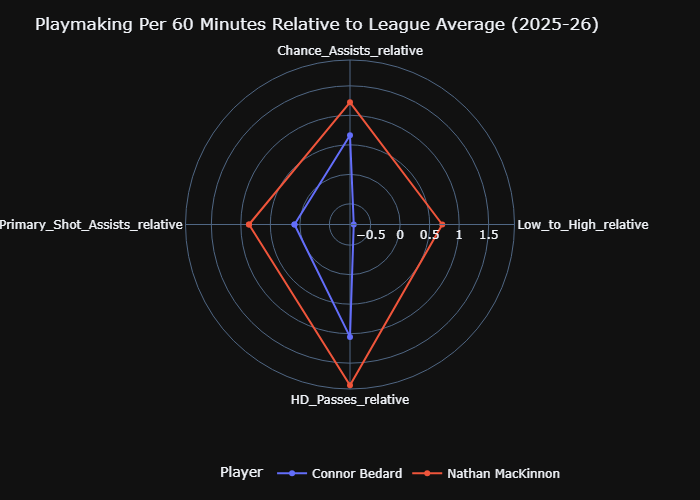
‘Primary Shot Assists (PSA)’ are any passes leading to a teammate’s shot, ‘Chance Assists (SCA)’ are passes leading to a scoring chance, ‘Low-to-High (LTH)’ are passes back to the blue line for a point shot, and ‘HD Passes (HDP)’ are the most dangerous type, either seam passes across the slot or from behind the net to the slot. Ideally, players have higher ratios of SCA or HDP than PSA or LTH.
That is why Bedard stood out here. His rates are all lower than MacKinnon’s, but his PSA and LTH rates are far lower while maintaining very good SCA and HDP rates; he’s consistently looking for the most dangerous areas. That is something that can drive his team’s goal scoring in future seasons, and a great development for a 20-year-old on an otherwise bad team.
2 – Juraj Slafkovský and Logan Cooley
The top two forwards from the 2023 draft will be compared to each other for the rest of their careers, so why not start now. Cooley missed a big chunk of the 2025-26 season due to injury, but here’s how he stacked up against Slafkovský:
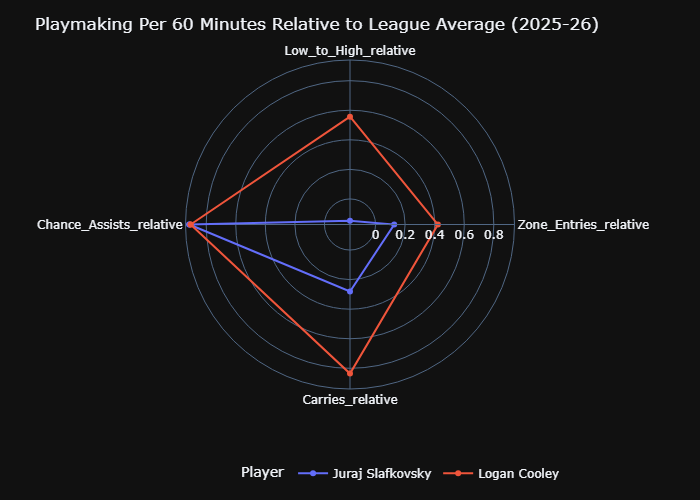
Cooley has a massive edge on zone entries and carried zone entries, but Slafkovský also skated on a line with Nick Suzuki, who does a lot of the entry work. Notably, Slafkovský and Cooley both have similar SCA rates, but Cooley has a lot more passes to the blue line. Both players just turned 22 years old in the last couple months, so this will be a fun pairing to keep tabs on for years to come.
3 – Matthew Knies and Will Smith
Both forwards are considered secondary options to their team’s superstar(s), but both players have been very productive in their young careers. The key here is just how good Knies’ playmaking was both off the rush and off the cycle/forecheck:
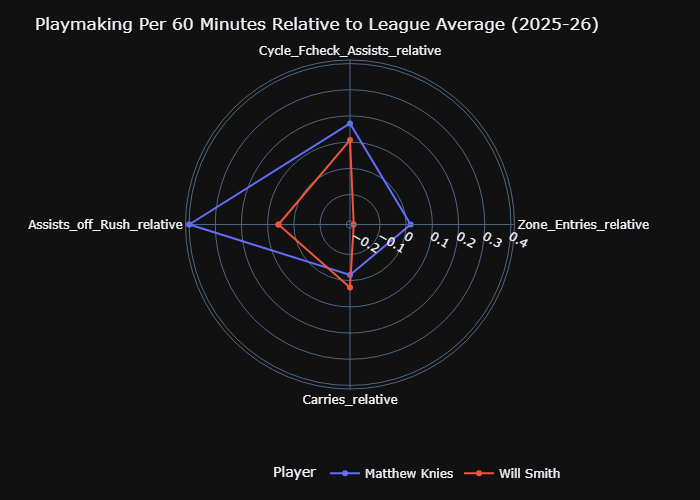
Knies doesn’t get a lot of credit for his playmaking, but his first assist rate at 5-on-5 was in the 91st percentile of regular forwards this season. It came at the expense of his shot rate and goal scoring, but if he can put those things together in the future, he has all the makings of a true dual-threat power forward, and those are exceptionally rare.
4 – Leo Carlsson and Adam Fantilli
Another pair of forwards drafted in the top-3 of their draft year, let’s compare the zone entry, carried zone entry, SCA, and LTH rates for Carlsson and Fantilli:
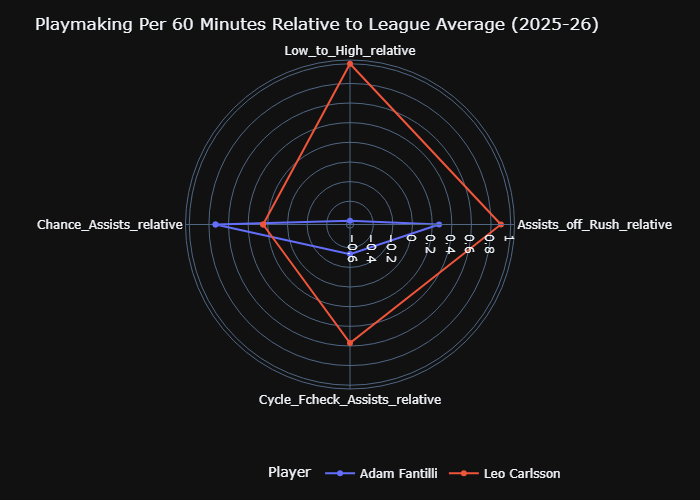
Carlsson is an absolute monster on zone entries, and that’s nothing new. What really stands out is that Fantilli’s SCA rate is nearly 80% higher than the league average and he had very few LTH passes. He genuinely tried to elevate the scoring of his line mates and eschewed the low-quality shots from the blue line. That combination is a positive step in his development as a well-rounded top-line threat.
5 – Beckett Sennecke and Ryan Leonard
Even if Leonard is a year older, both forwards were rookies this season, and both forwards are key parts of their franchise’s future. The graph below isn’t meant as a ding against Leonard, but more to highlight just how good Sennecke was in his first year with the Ducks:
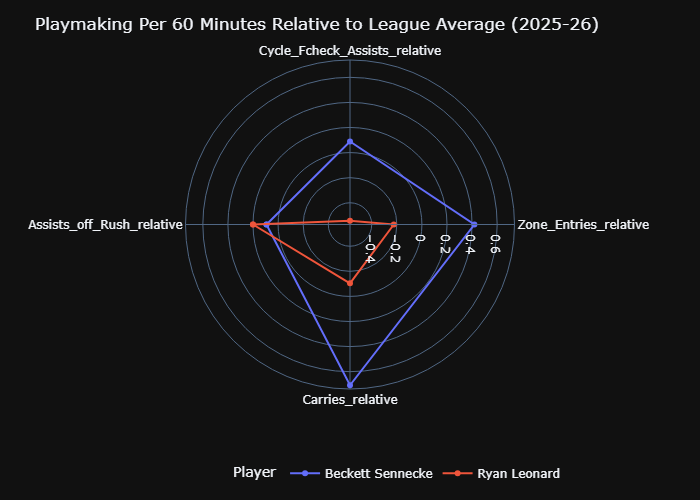
Sennecke’s rate of carried zone entries was nearly 80% higher than the league average, and he backed that up with a zone entry rate over 40% higher than the league average. He started the season as a 19-year-old (he turned 20 in late January) and doing this as a rookie is hyper-impressive. Considering how good Carlsson has been on zone entries to start his career, the Ducks look like they have a 1-2 punch they can use on separate lines to help ensure they gain the offensive blue line with control on a regular basis. That kind of foundation can sustain a franchise for a decade.
6 – Clayton Keller and Nikita Kucherov
Keller and Kucherov are both cornerstones of their respective franchises, but the latter is a perennial MVP whereas the former is a perennial all-star. When looking at their rates of SCA, HDP, and assists off the rush or cycle/forecheck, that distinction becomes apparent:
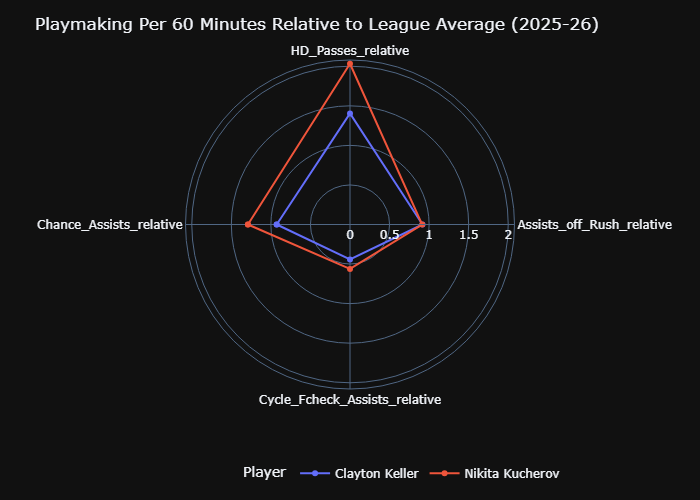
This comparison is intentional because compared to something like 98% of forwards in the league, Keller’s rates shown here would stand out as exceptional. It highlights the gap that exists between all-star, top-line scoring wingers, and MVP-calibre top-line scoring wingers. Keller is great, but Kucherov is who he is because of distinctions like this.
7 – Mitch Marner and Luke Evangelista
If all goes right for Vegas, Marner may be the playoff MVP. That is why this comparison is being made, because most casual hockey fans probably have no idea who Evangelista is even though his playmaking compares very well to the potential postseason MVP:
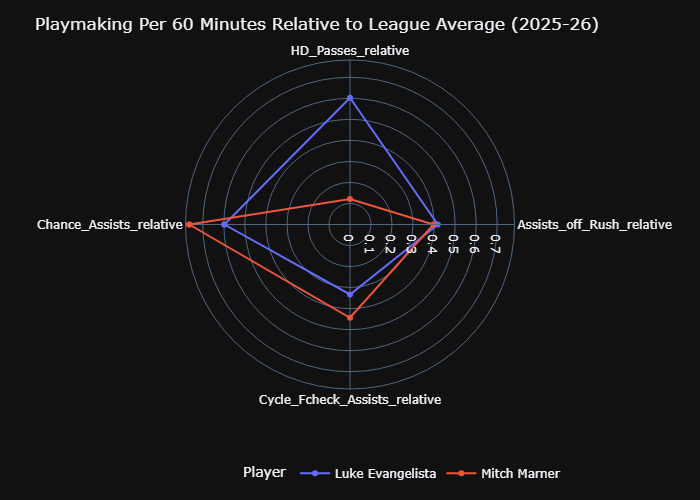
The assists off the rush and cycle/forecheck are similar, Marner has a decided edge in SCA, but Evangelista has a massive edge in HDP. The 2026-27 season will be Evangelista’s age-24 year, and he passed the magical 200-game plateau in 2025-26. He is a hidden gem on a team in flux, and if he were on the top line of a playoff team, he would be a household name by now. He is setting up to be the NHL’s next great playmaking winger.
8 – Josh Doan and J.J. Peterka
Two players traded for each other last summer, it’s easy to overlook what Peterka did this season because he was moved down the lineup in Utah:
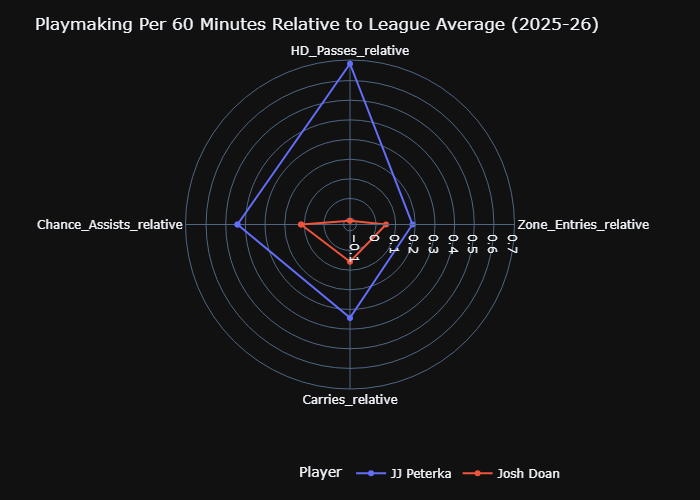
Here we have chance assists, high-danger passes, and the zone entry data. All of it is decidedly in Peterka’s favour. There are other areas where Doan excels over Peterka, and they are two different types of players, but this should help highlight that Peterka still has immense offensive skill, regardless of the line he plays on.
9 – Lucas Raymond and Jordan Kyrou
Raymond just posted his third straight 25-goal, 70-point season while Kyrou had a down year offensively and sees his name in trade rumours again. For that reason, we should highlight what Kyrou did this season by SCA, HDP, and zone entry work:
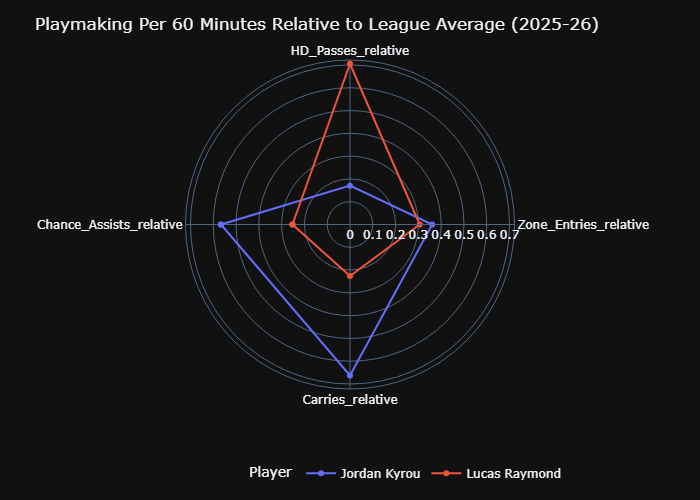
Raymond had a huge edge in HDP, but Kyrou had small-to-large edges in the other three categories. It should also be mentioned that Kyrou’s defensive impacts this season were a career best. The Blues might end up trading him, and if I were a GM of any of the other 31 NHL teams, I would be inquiring.
10 – Trevor Zegras and Nikolaj Ehlers
Two forwards who found themselves skating for a new team in 2025-26, this is an interesting comparison because of how they can be so much alike in one area but so different elsewhere:
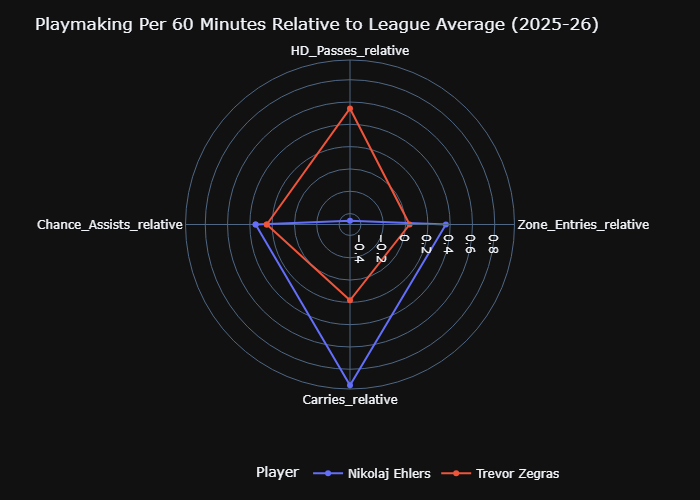
They had similar SCA rates, but Ehlers did much more work on zone entries while Zegras was much better at generating HDP. Ehlers had a productive campaign, but his rate of first assists was down 21% from his three-year average. Zegras, meanwhile, saw his first assist rate improve by 17% over his three-year average. Quality matters.
Until next week.