10 Interesting (To Me) Stats For This Week - January 13
Welcome back to another week of ’10 Interesting (To Me) Stats’. This week, we’re looking at changes in player (or team) offensive styles so far in 2025-26. Which players (or teams) are creating more (or less) off the rush? Or off the cycle? How about improving/declining playmakers or transition work? These things matter when evaluating player performance so let’s dig in to style changes compared to the two prior seasons at 5-on-5. These differentials are per 60 minutes and not a percentage change.
We are limiting the sample to forwards with at least 90 tracked minutes this season and 250 tracked minutes across the prior two seasons (242 forwards). Tracking data is from All Three Zones and is current as of Sunday, January 11th.
1 – Flying High
Our sample has 10 forwards increasing both their offensive contributions off the rush (shots and assists on teammate shots) and forecheck/cycle by at least one standard deviation, and two of those names come from the Anaheim Ducks:
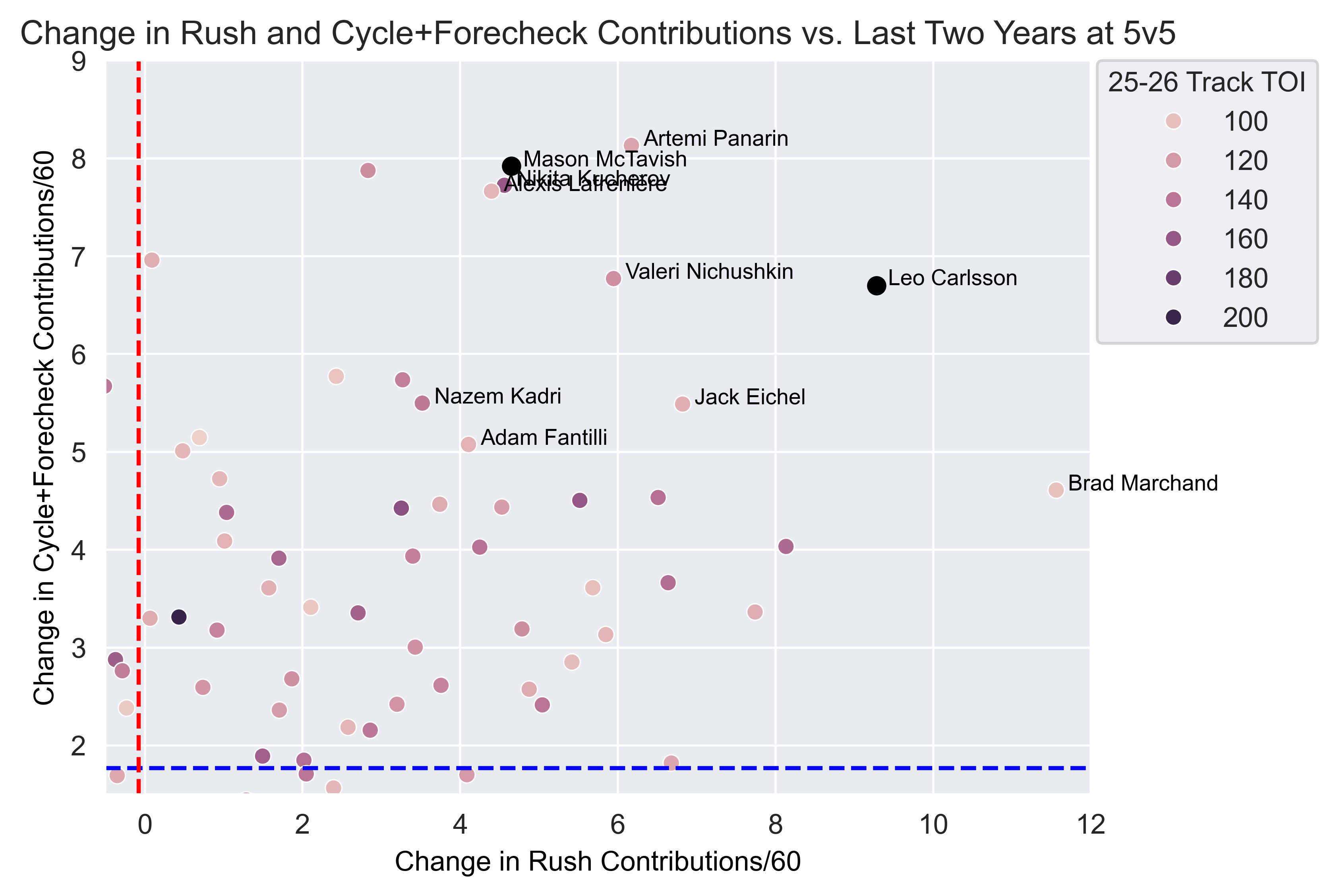
Anaheim has hit some very tough times of late, going 2-11-2 in their last 15 games. It shouldn’t overshadow the fact that Leo Carlsson has taken a massive step forward offensively while Mason McTavish has his highest primary assist rate of his young career. This is a young team that will make a lot of mistakes but if the offence keeps trending like this, the positives outweigh the negatives.
2 – We’re Laffin’
There are two things true about New York Rangers winger Alexis Lafrenière this season: the production is down but there is a lot of good news under the hood. A new coaching regime has seen him create far more off the cycle than the previous two seasons, and a fair bit more off the rush, too (his name is overlapped with Nikita Kucherov near where McTavish is):
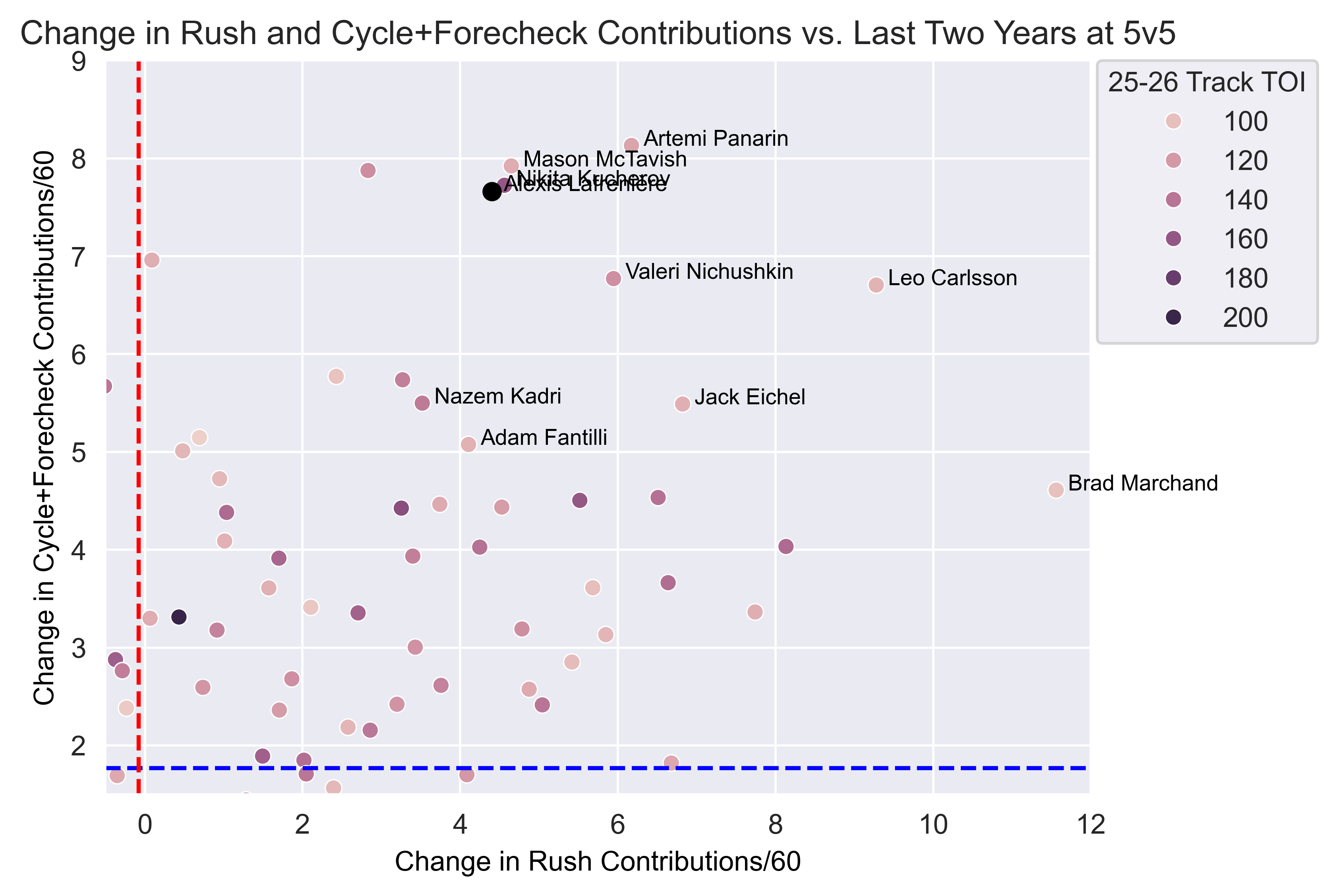
The big problem is that the Rangers score extremely well when Lafrenière is on the ice with defenseman Adam Fox (4.6 goals/60) and very little without Fox (1.7 goals/60). With Fox on the long-term injured reserve, Lafrenière is in tough to have a big second-half turnaround, but his offensive improvements are a good sign for a team that needs to start looking to the future.
3 – Bork Bork Bork!
At the other end of the spectrum, there are five forwards to see a decline of at least one standard deviation by both their contributions off the rush and off the cycle. Funny enough, all five are from the Western Conference (though two were recently traded to the East), and one of them is young Dallas forward Mavrik Bourque:
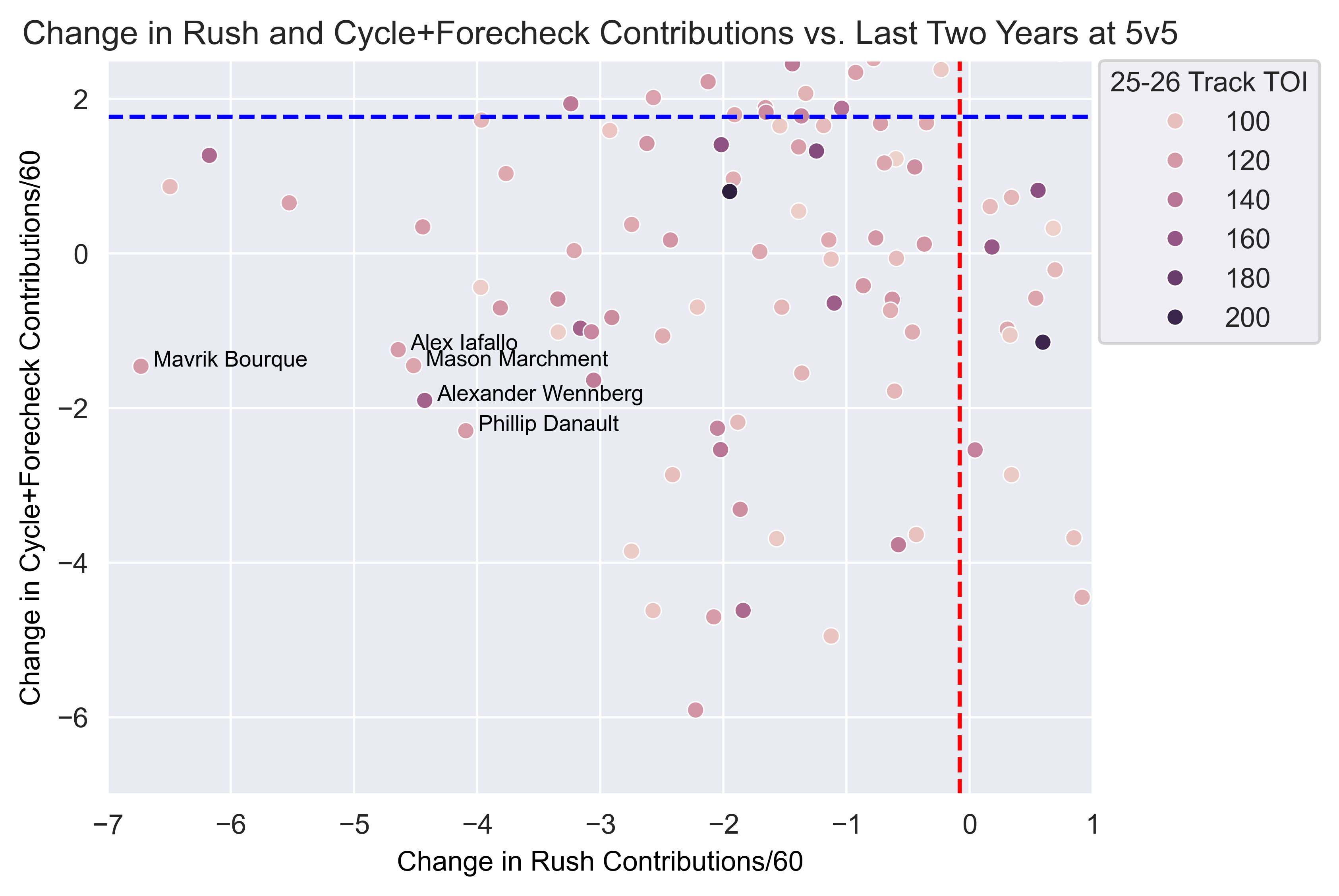
The result for Bourque has been a slight decrease in 5-on-5 production compared to his rookie year, though he does have the lowest on-ice shooting percentage of any regular Dallas forward. There may be a bit of bad luck going on here, but the fact that Bourque has seen such a large chance contribution decrease indicates some issues with his offensive play beyond some bad luck.
4 – Tale of Two Players
Going through the data, something stuck out to me: the wild, wild differences between Toronto Maple Leafs centres Auston Matthews and John Tavares. The former has seen a huge decrease in offence created off the cycle while the latter has seen as huge increase in offence off the cycle:
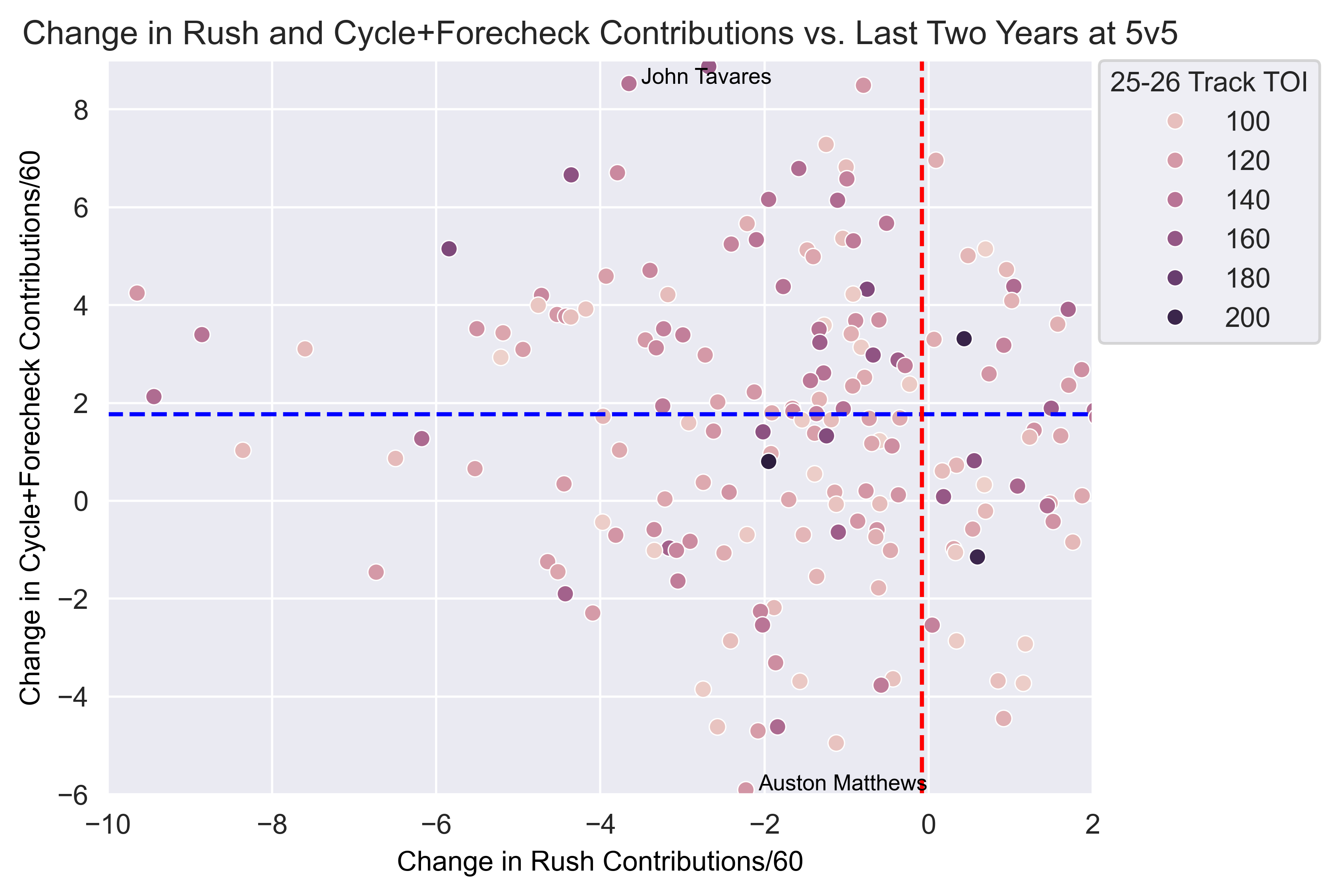
Notably, both are creating far less off the rush, and considering they play on different lines, it informs us of a change in Toronto’s offensive approach. But that they’ve had such wildly different changes in offence off the cycle might speak to how well Tavares has played and perhaps some continuing issues with Matthews’ health. It will be interesting to see where these numbers wind up at the end of the season.
5 – Mr. Fant-astic
As with Lafrenière, there are two things true of Columbus forward Adam Fantilli’s season: it is easily his worst 5-on-5 production season of his young career, but there are a lot of positive signs, nonetheless. Two of those signs are that Fantilli is 1 of 19 forwards in our sample to improve his rate of scoring chance assists (SCA/60, or assists on teammate scoring chances) and his rate of total scoring chance contributions (SCC/60):
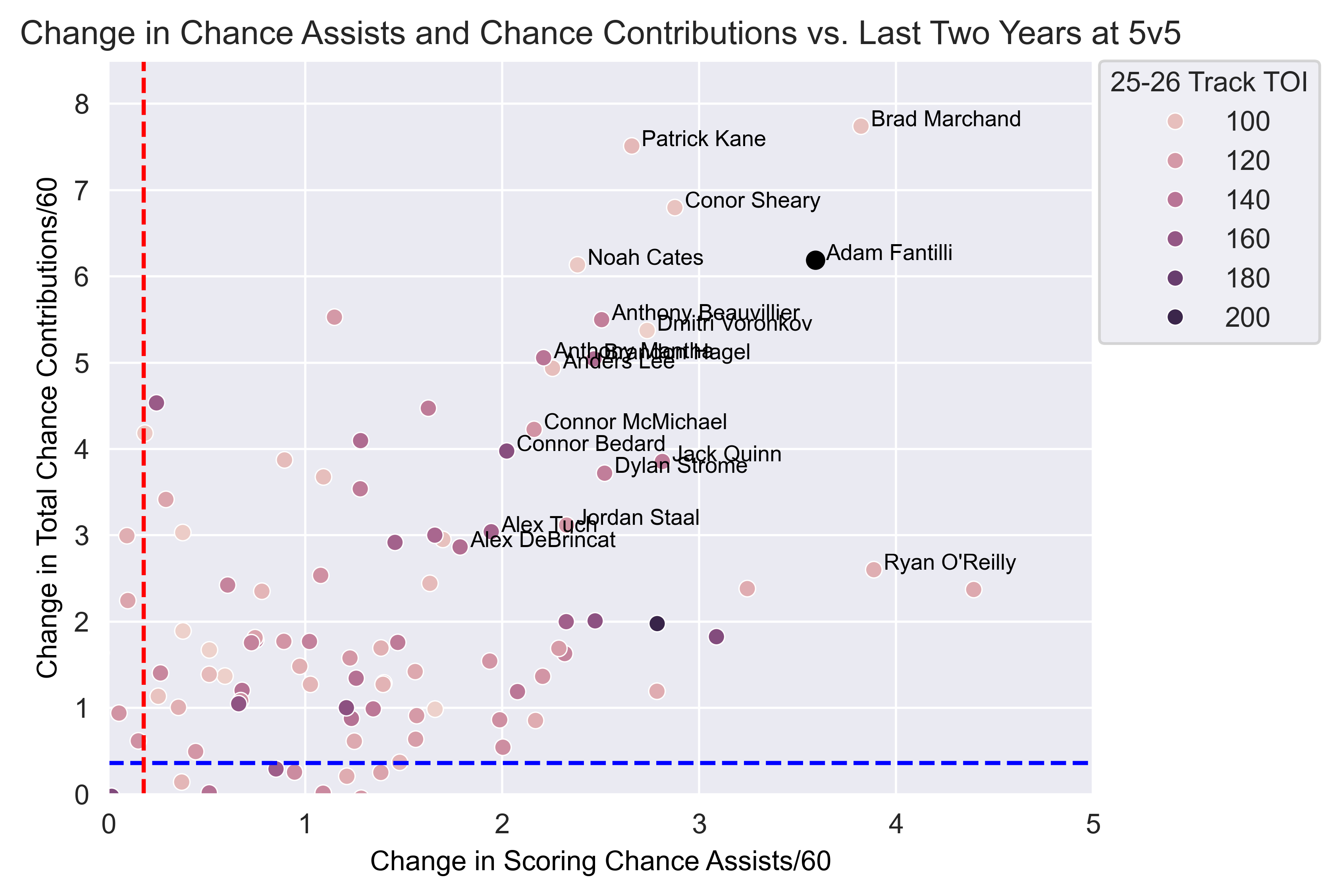
SCA is a component of SCC, so improving one can often improve the other, but Fantilli has increased his rate of SCA/60 from below-average across his first two seasons to a 90th percentile rate in his third year. Career-low individual and team shooting percentages with him on the ice are the reason for the production decline, but there are good developments in his playmaking without sacrificing shot volume. That is a great sign for his future.
6 – Jack is Back
After a down 2024-25 season, Buffalo Sabres winger Jack Quinn has his highest 5-on-5 points/60 rate of any season where he’s played at least 40 games (and highest per-minute goal differential, too). It isn’t by accident or pure luck, either, as Quinn, like Fantilli, is 1 of 19 forwards to improve both their SCA/60 and SCC/60 by a big margin:
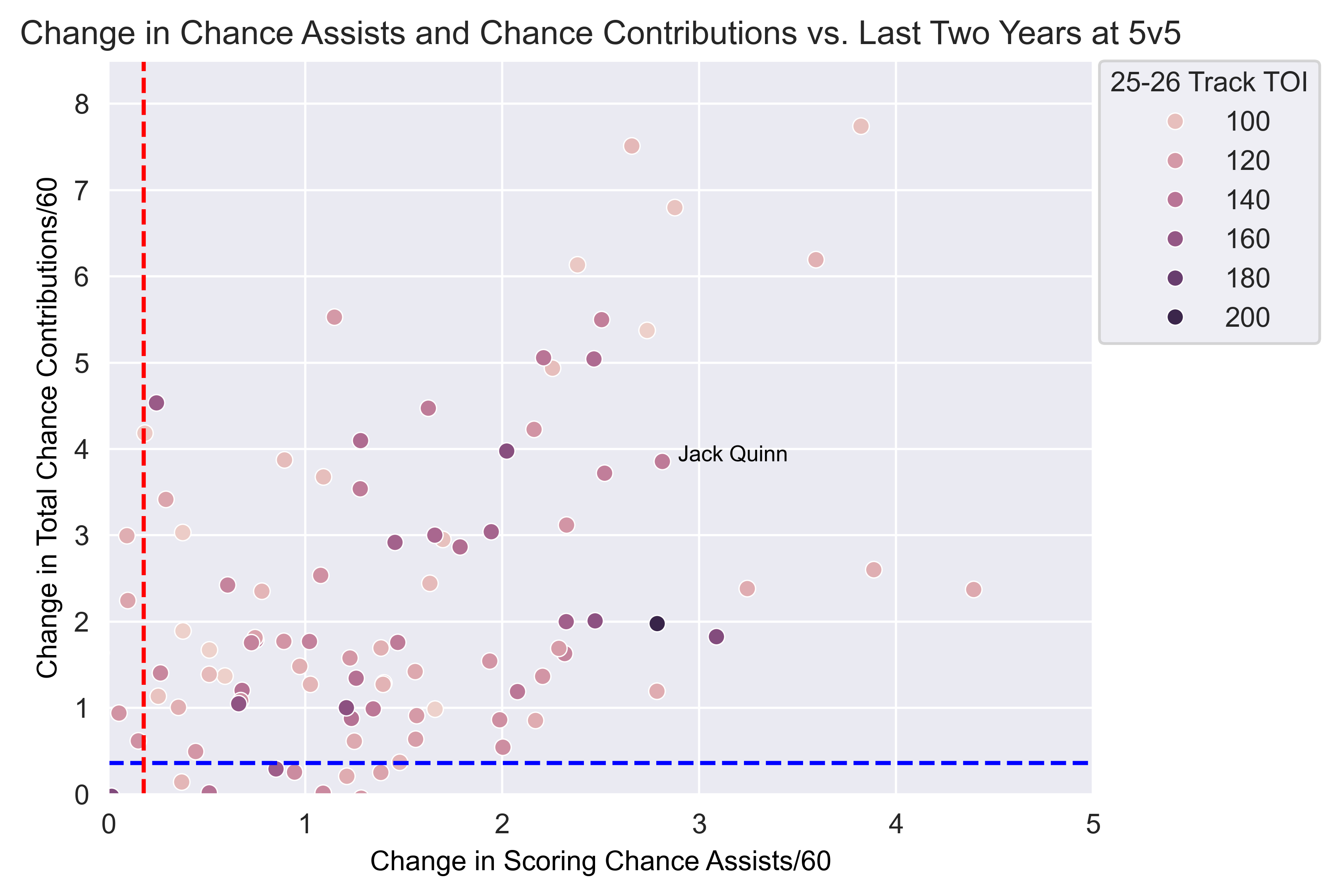
The trade-off here is his defensive impact has gotten much worse and while that hasn’t hurt his goals against yet, it’s something that could get very ugly in the second half. Regardless, the team needed him to help replace the offence lost in the J.J. Peterka trade, and Quinn has done that, and then some.
7 – (Stares at Camera) KEVIN!
Across his first three seasons with the Los Angeles Kings, winger Kevin Fiala averaged 1.2 assists/60 at 5-on-5. So far in 2025-26, that rate sits at a paltry 0.38, and he has zero secondary helpers. With the red and blue lines representing the average league-wide change from the last two years, here is where Fiala stands:
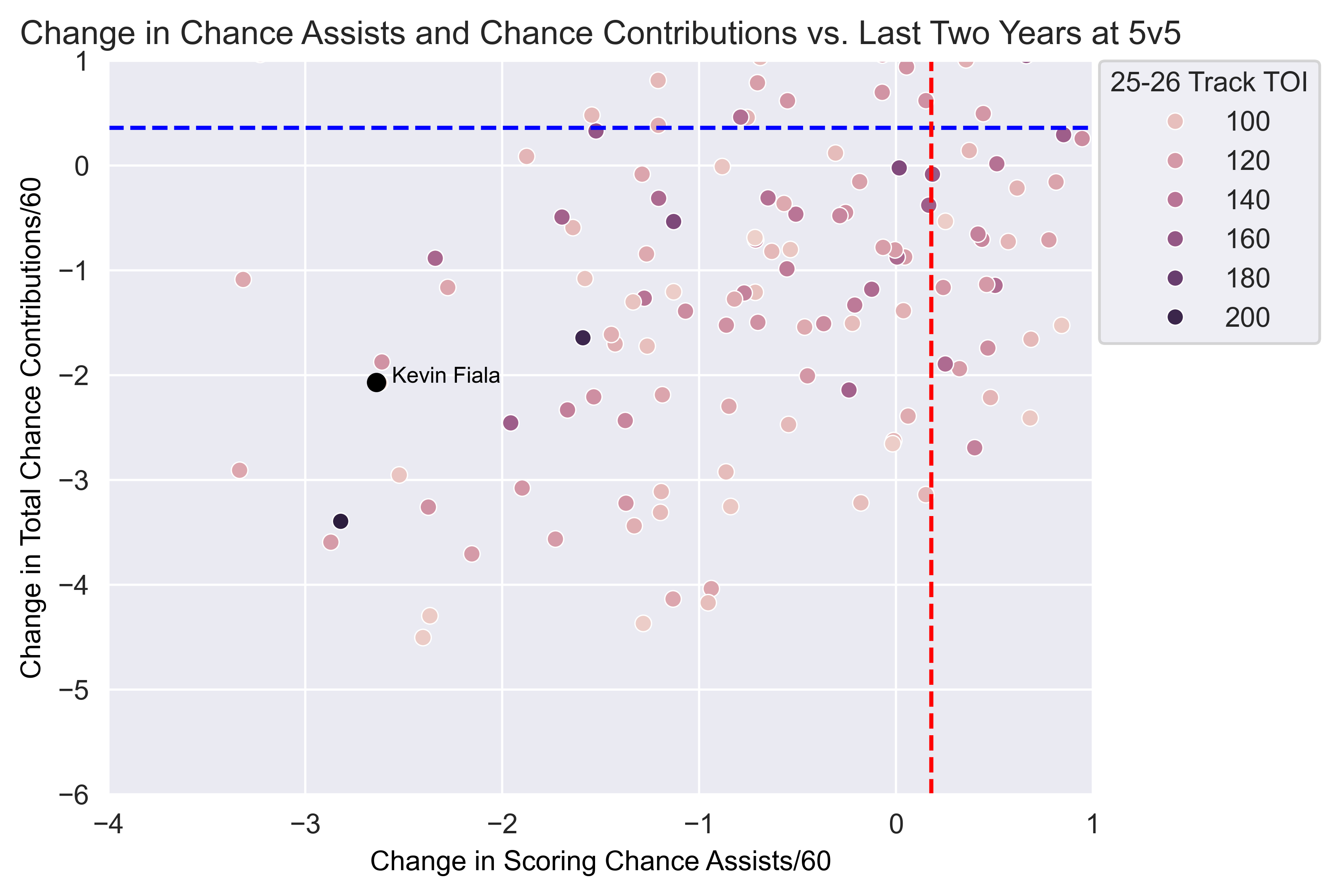
It should be noted that Fiala’s line mates are shooting under 4% with him on the ice against a three-year average of 8.3%. His playmaking drop is part of that, but Los Angeles is a bottom-5 team offensively at 5-on-5. My money is on team effects and sample size mattering a lot more than any degradation of Fiala’s playmaking talent.
8 – A Pro’s Pro
After a breakout 2024-25 season with monster team shooting percentages, Washington Capitals winger Aliaksei Protas has seen a predictable 5-on-5 production drop, though his points/60 rate is still comfortably that of a top-line winger. Additionally, he is one of a handful to see an increase of at least one standard deviation by rate of zone entries/60 and percentage of entries carried in:
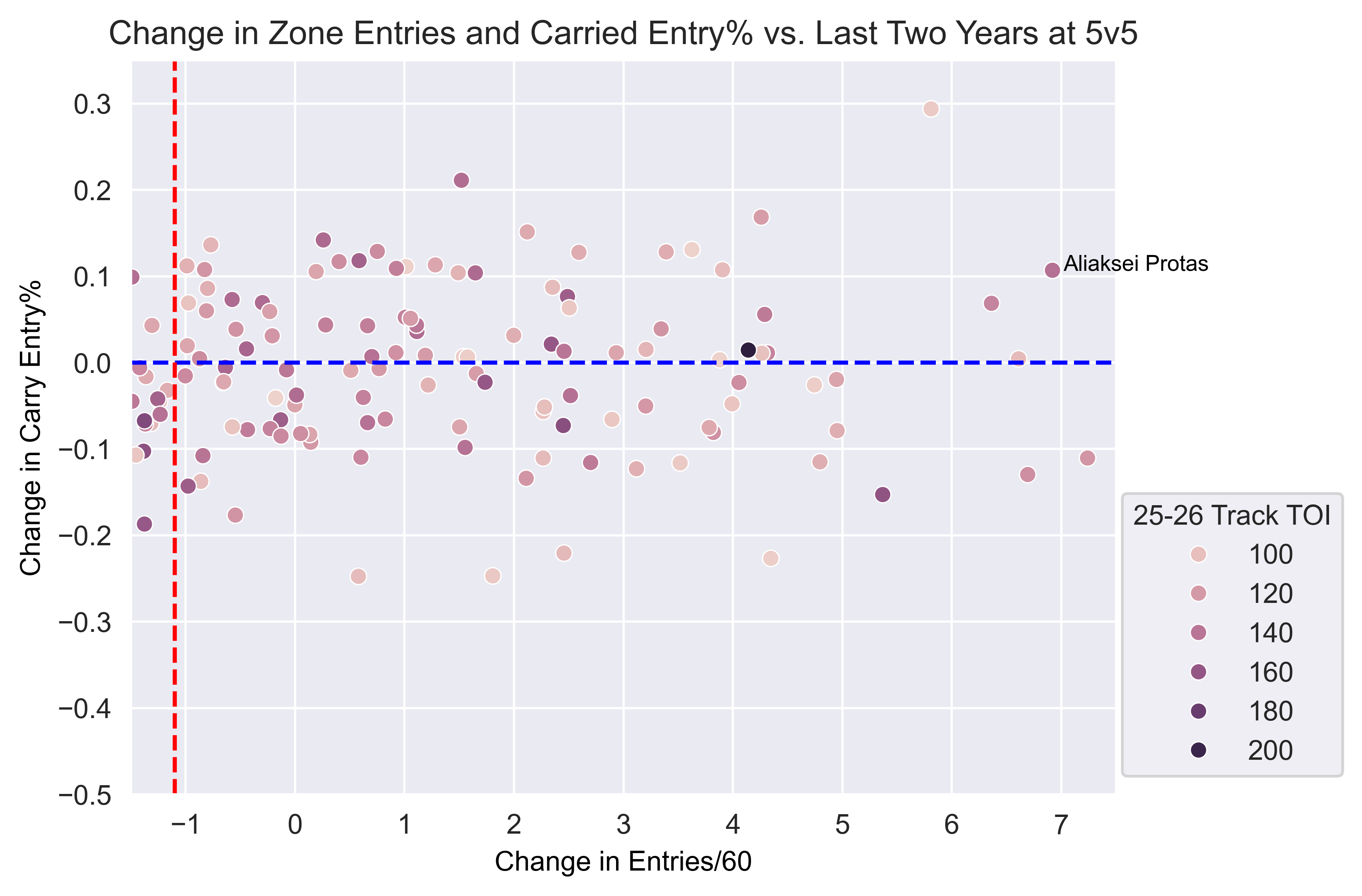
With Pierre-Luc Dubois injured, a lot of the transition work has fallen to Protas, and it’s led to similar goal-scoring and goal differential rates at 5-on-5 when compared to his breakout year. All around, Protas is becoming one of the most dangerous even-strength wingers in the league.
9 – I Am The Law!
The sixth-largest increase in rate of zone entries, and the second-largest increase in carried entries, belongs to a Utah Mammoth winger. No, not that one. Not that one, either. Or him. Ok, ok, it’s Lawson Crouse:
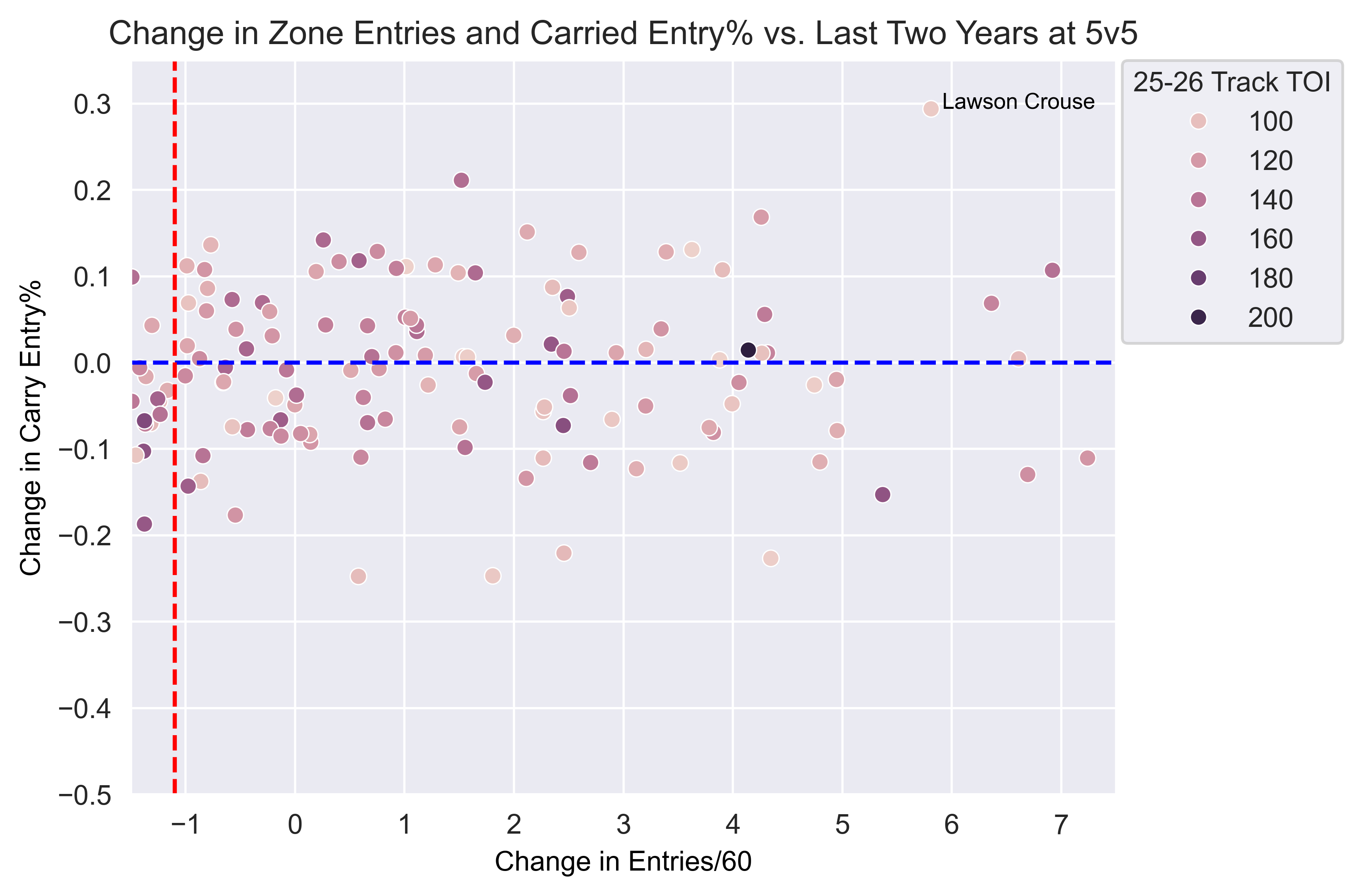
Crouse has one of the smaller tracking samples in the data (just over 95 minutes), so let’s not draw any firm conclusions yet. All the same, his third line has been able to create a lot of offence, and he’s recently fit in very well on the top line. Let’s see where he stands at season’s end, but this is a great first half.
10 – Pray For MoJo
Context is always key, so it’s important to highlight that the Minnesota Wild forwards are generating 8.5% fewer zone entries in 2025-26 compared to the two years prior. With that in mind, winger Marcus Johansson is 1 of 7 forwards to see a decline in both rate of zone entries and carried entry% of at least one standard deviation:
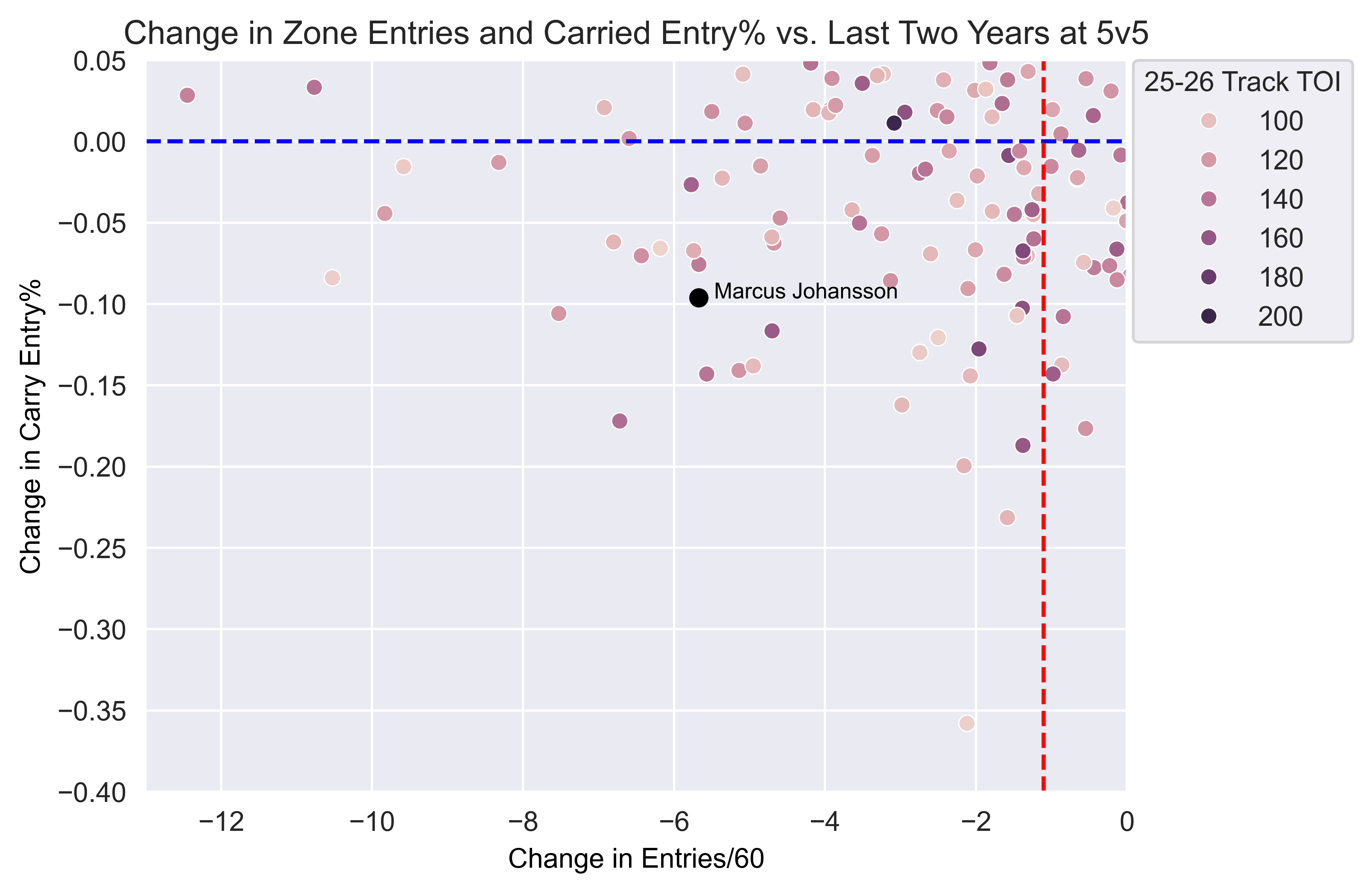
Johansson has been very productive, but it’s fair to wonder how much of it is his play and how much of it is skating with Matt Boldy and Joel Eriksson Ek. Considering Johansson is 35 years old, my lean is towards his line mates.
Until next week.