10 Interesting (To Me) Stats For This Week - July 15
Welcome back for another week of ’10 Interesting (To Me) Stats’. We are building off last week’s newsletter which looked at some of the under-the-radar signings, and this week reviewing some of the lower-tier players on the move in the last week, as well as key names still left on the free agent board.
Player data from Evolving Hockey, contract information from PuckPedia, and tracking data from AllThreeZones.
1 – Oh, Henry?
In a surprising trade, the San Jose Sharks sent defenceman Henry Thrun to Toronto for enforcer Ryan Reaves. Thrun is 24 years old and hasn’t really taken a big step in his development, but he’s also been on a Sharks team with the worst two-year stretch of any franchise since the 1999-2001 Atlanta Thrashers. In fact, when looking at just the Sharks’ defencemen over the last couple years, only two rearguards were better than team-average by successful zone exits, failed zone exits, and both total exits and defensive zone retrievals per 60 minutes:

All this is to say that despite a heavy workload on the blue line, there were some puck-moving aspects where Thrun did well. It is far from a guarantee of success moving forward, but there should be optimism about what he can do on a team that has more than eight NHL-calibre players.
2 – Mack Attack
Coming off a successful rookie season that saw him post 15 goals and 16 assists while winning a Stanley Cup with Florida, Mackie Samoskevich signed a one-year deal for the league minimum, which is quite strange for a 22-year-old who had a good year. Regardless, here are the two forwards he compared to by impacts both on expected goals-for and expected goals against this past season:

It is interesting to see Brink’s name here as he took a big step forward production-wise in 2024-25, improving his 5-on-5 points rate by 36% over his rookie 2023-24 season. The problem for Samoskevich is that unless Evan Rodrigues is traded (which seems very possible given Florida’s salary cap issues), he may be stuck on the fourth line. Let’s see how the rest of the offseason shakes out.
3 – The Unwelcome Mat
Dallas opened some cap space by sending defenceman Mathew Dumba and a second-round pick to Pittsburgh. It isn’t hyperbole to say Dumba has been one of the worst defencemen in the league over the last four years as his even-strength goals impact ranks 121st out of 126 regular defencemen (4000+ minutes). Here are the two names that compare on either side of him:

There was a stretch where Dumba was a capable second-pair guy. That hasn’t been the case for a few seasons now, and it’s unlikely to get better on a Pittsburgh team that is sneak-tanking for Gavin McKenna.
4 – He’s the Man, Son
Colorado defenceman Josh Manson signed a two-year extension and with one year left on his current deal, that means he’ll be with the Avalanche until the end of his age-36 season. He is getting up there in age, but he’s still very solid defensively and does a great job at limiting the opponent’s puck possession. Over the last two seasons, here is how he compares to the other Colorado defencemen, and all regular league defencemen, by percentage of opponent zone entries being carried in against him:
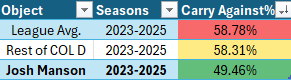
Manson is kind of one-dimensional, having much more of a defensive impact than an offensive one, but on a team like this, he doesn’t need much offensive impact. As long as he’s healthy, he is a big part of one of the best blue lines in the league.
5 – Show Some Skin
After a year in Edmonton, Jeff Skinner signed a one-year deal in San Jose. While his production has dropped off, his goal-scoring rate at 5-on-5 over the last two years (0.98) is still in the 85th percentile of the league. What has really declined is he’s creating offence off the rush far less in his last couple seasons than the couple years before that. The good news is he’s going to a San Jose team who created 48.2% of their offence off the rush last year, the fourth-highest rate in the league:
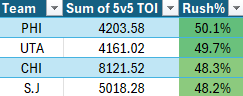
This is going to be a very bad team again, and Skinner’s defence is non-existent. However, there is some talent in the top-6 for him to play with, which gives him a chance at improving his production, and particularly his assists.
6 – Grzzly Bear Market
It may be easy to look at Matt Grzelcyk’s 40-point season and wonder why no team has signed him just yet, but this seems to be a case of a player where the age-related decline is hammering him. Consider that we have 157 defencemen who played at least 2000 minutes at even strength between 2019-2022 and 2000 minutes between 2022-2025. Of those 157 defencemen, Gryzlecyk has had by far the largest decline in expected goals impact, and the closest options don’t inspire confidence of a turnaround:
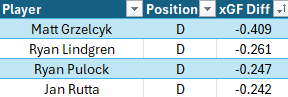
It seems likely a bottom-tier team gives him a one-year deal, or an invite to training camp, but Grzelcyk was a very good puck-moving depth defenceman at one point. Going into his age-32 season, that no longer seems to be the case.
7 – Jack’s New City?
Over the last four years, forward Jack Roslovic has made some big changes to his game, but it seems to come at a cost in other areas. Here are his 5-on-5 rates from the 2021-2023 seasons and then 2023-2025 seasons. We are looking at shooting measures like rate of goals, shot attempts, and expected goals (all yellow) and passing measures by rate of primary assists, scoring chance assists, and high-danger passes (all light purple):

A couple years ago, Roslovic was a genuine top-line playmaker. Recently, that playmaking has dropped off as he’s increased his shooting and scoring measures. Either makes him a one-dimensional offensive threat. But… what if he could do both in the same year? Seems like a bet a bad team should make.
8 – To the Victor Go the Spoils
Victor Olofsson saw a huge rebound by both expected goals and actual goals impacts in his one year with Vegas compared to his years in Buffalo. It is part of a trend as Brandon Montour (BM), Evan Rodrigues (ER), Jack Eichel (JE), Sam Reinhart (SR), and Olofsson (VO) have, in aggregate, seen massive improvements in expected goals for and against impacts since leaving Buffalo at some point in the last five years (positive xGF is good, negative xGA is good):

To put this in context of players, the average change in impact from these five names since leaving Buffalo is like going from Anthony Duclair to Lucas Raymond. A team should want to see if Olofsson’s post-Buffalo improvements are for real.
9 – Simply Fabbrilous
Once upon a time, Robby Fabbri was a player I was very excited to see get to the NHL and produce as a top-6 scorer. He had injuries early in his career and as much as I want to believe, this may be the end of the road for him. He has played under 60% of possible games over the last seven years, which is 49 out of every 82 team games. Also, HockeyViz has his synthetic goals level (an all-encompassing value of a player in a given year) as lower than ever after years as a fourth-line option:
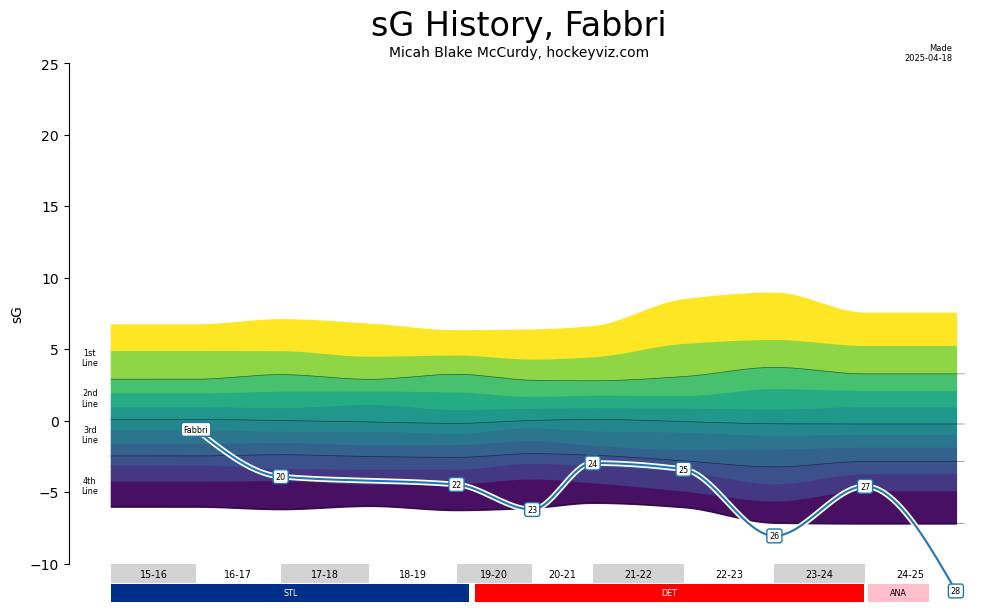
Fabbri probably gets a training camp invite somewhere and goes to the AHL. With this track record and on the precipice of turning 30 years old, this might be it for him.
10 – Diamond in the Rough?
There are 253 forwards to have played at least 400 minutes at even strength in each of the last four seasons. Of those 253 forwards, only 47 have had a positive impact on team expected goals against in all four seasons. One of those 47 forwards is Joel Kiviranta, who has goals against and expected goals against impacts very similar to a guy who just signed for two years at $4.125M in St. Louis:

Pius Suter is a better offensive player, and a centre, which is why he’s signed and Kiviranta is not. But Kiviranta has shown very good defensive ability in a bottom-6 role, and that makes him a better player than a lot of depth forwards across the league. Teams needing to solidify their fourth line should take a flier here.
Until next week.