10 Interesting (To Me) Stats For This Week - September 23
Welcome back for another week of ’10 Interesting (To Me) Stats’. Last week, we looked at defencemen with both good and bad puck-management skills in terms of retrieving the puck in, or failing to exit, the defensive zone. Let’s build off that and look at team-wide data.
I had two threads over on BlueSky (first here and second here) that talked about how not being able to retrieve the puck and exit the zone actually cost teams offensively much more than it did defensively. In that spirit, let’s look at how (or if) this impacted things by individual teams, and which rosters stand to benefit or suffer in this area in 2025-26.
Goal data from Evolving Hockey, tracking data from AllThreeZones, and viz are from me. This is all at 5-on-5.
1 – The Defence’s Case Holds Water
First, let’s look across the 2021-22 and 2022-23 seasons. We are looking at the combined percentage of botched retrievals and failed zone exits by each team’s defence group, that team’s goals-for per 60 minutes at 5-on-5, and the relationship between the two. What we saw last week with individual players negatively impacting goal scoring holds on a team level (the red dotted line is the league average total botch/fail percentage and the blue dotted line is the league average goals-for/60):
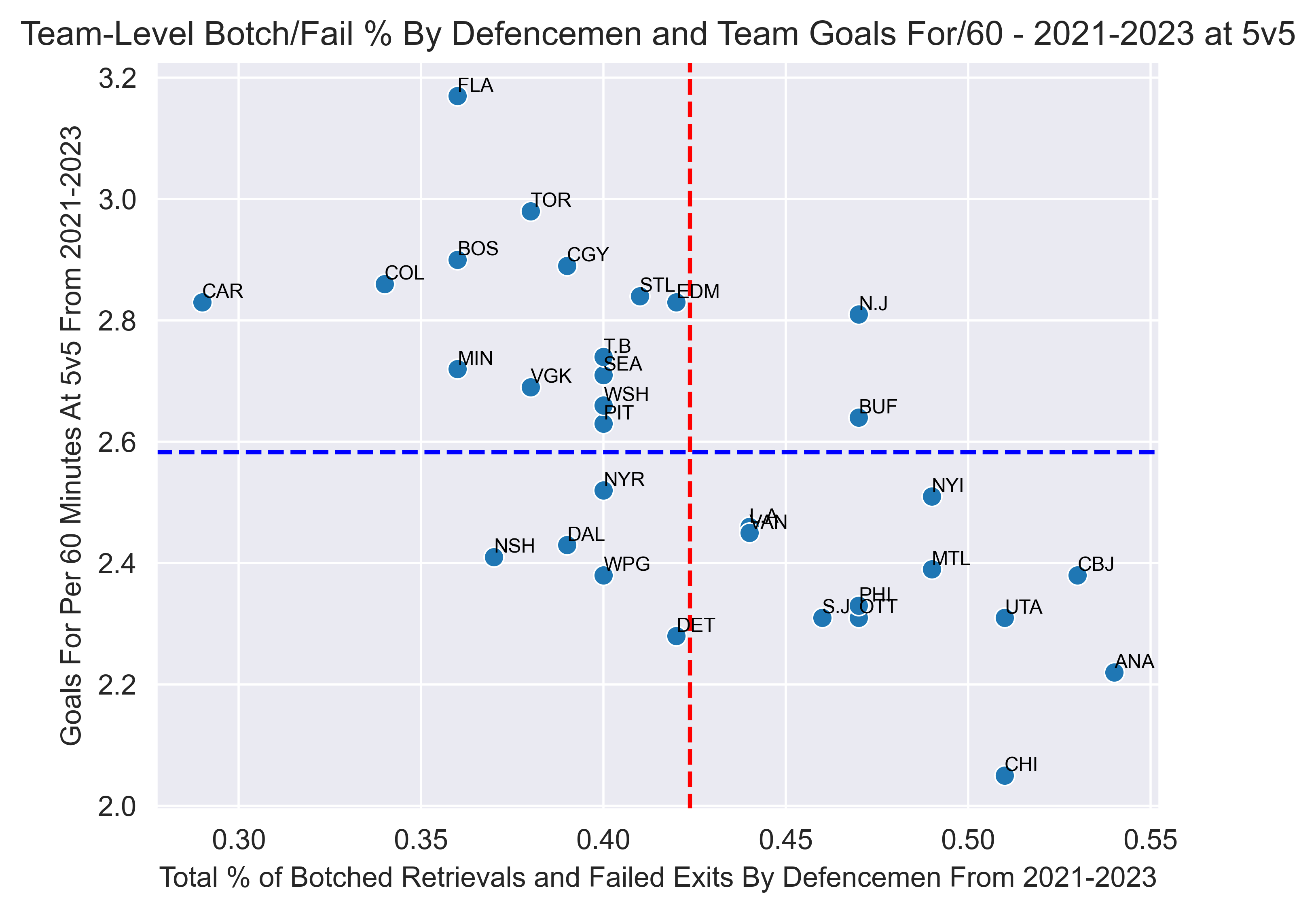
The upper-right quadrant is particularly interesting. Of the 16 teams to be above average by goal scoring only two had a combined percentage worse than league average (Buffalo and New Jersey). At least across those two seasons, great or poor puck management from defencemen had a big hand in their team’s offence.
2 – No! The Defence Is Wrong!
For more recent data, here is the same chart as the one above but looking at the 2023-24 and 2024-25 seasons:
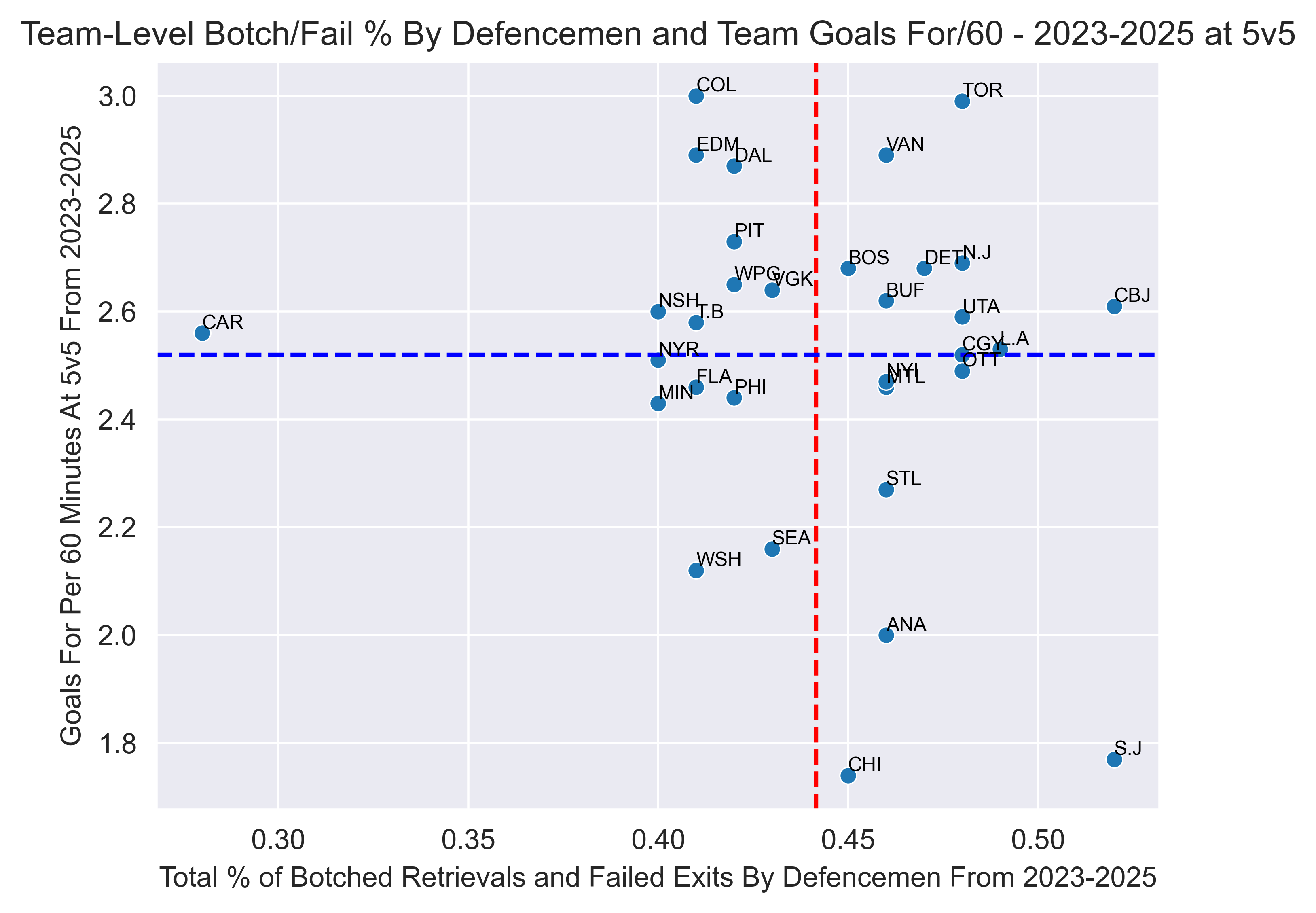
There is still a negative relationship, but not as pronounced as the previous graph. Here is what’s interesting: this stretch from 2023-2025 only has three teams either higher than 50% (Columbus and San Jose) or lower than 40% (Carolina). The previous pair of seasons had 14 teams either above 50% or lower than 40%. Overall, defencemen have become much, much better at managing the puck and it’s bunching the league towards the middle. That is why the negative relationship is not as pronounced as it was.
3 – Flaming Out
To look at players on individual teams, let’s start with the Calgary Flames, coming off a year where they missed the postseason due to a tiebreaker. They also finished 29th in 5-on-5 goal scoring and when looking at their defence group for 2025-26, there is a lot of improvement required:
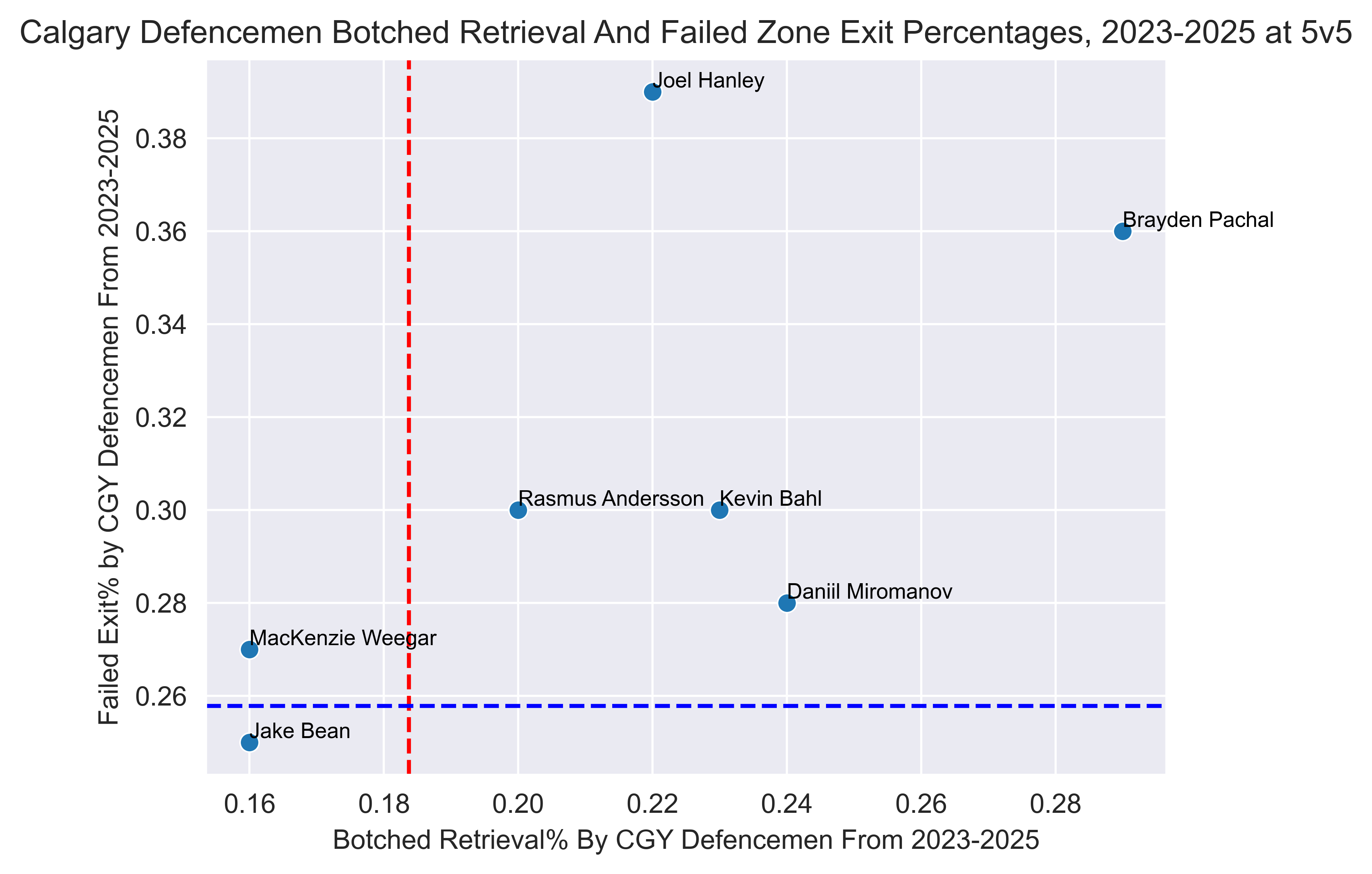
This is where rookie Zayne Parekh could have a big impact. If he can step into the league and manage the puck well, it gives half the blue line good puck-moving skills. If he can’t, this could be another tough goal-scoring year for the roster.
4 – Bucking The Trend
A couple of sections earlier, Columbus was mentioned as a team that has a poor botch/fail percentage over the last two seasons, and yet they are second in the league in goals per 60 minutes at 5-on-5 over those two seasons. A big reason is who is good and who is bad at puck management on their blue line:
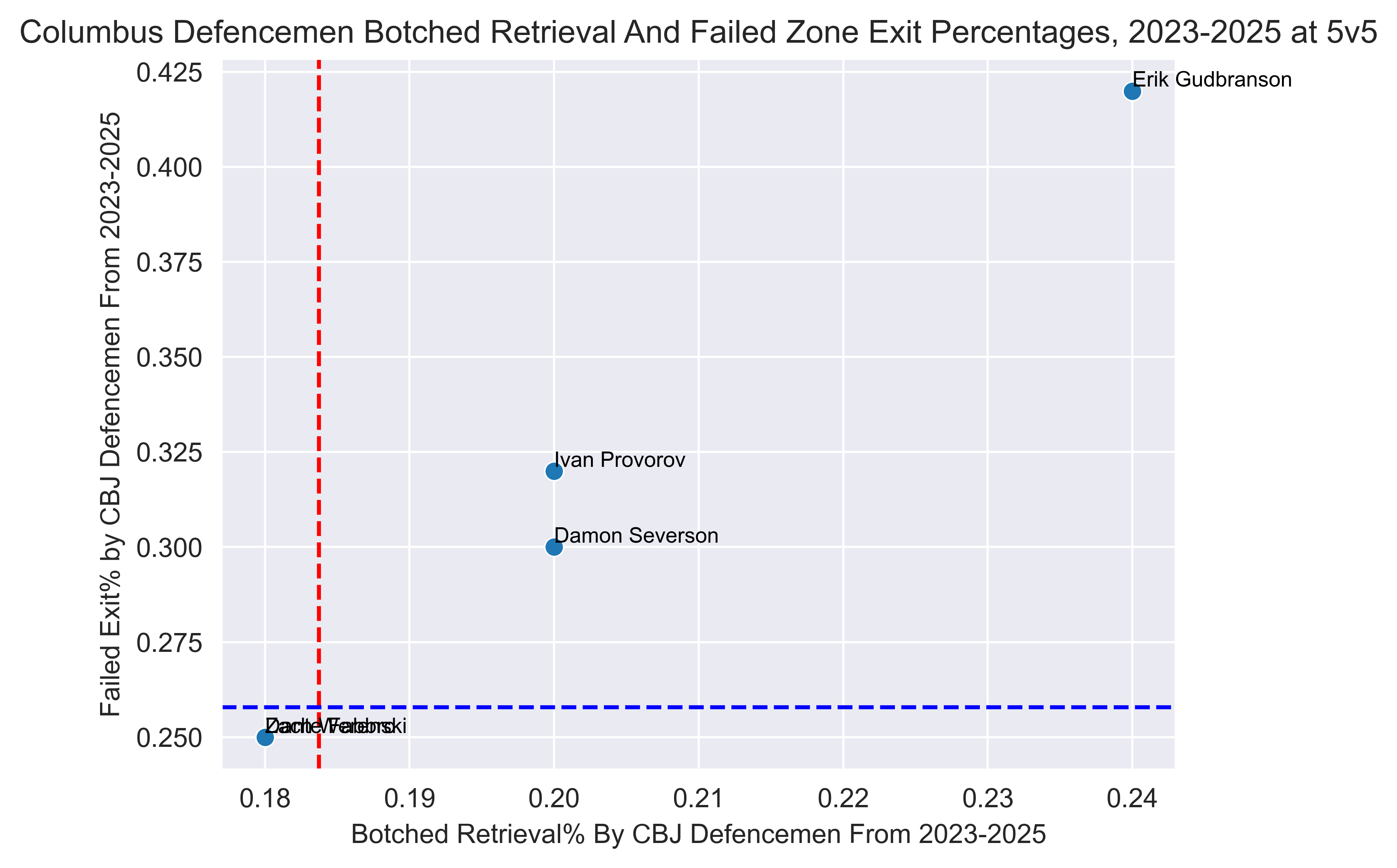
Those overlapping names in the bottom-left are Zach Werenski and Dante Fabbro. Werenski gets heavy minutes and the team scores 30% more often when he’s on the ice than when he’s not. As long as he’s healthy and skating over 40% of the team’s 5-on-5 ice time, they’ll be just fine.
5 – You Shall Not Pass (Or Score)
In probably the craziest chart in this entire article, here are Detroit’s defencemen for the upcoming season and how their puck management skills fared over the previous two seasons. Detroit Red Wings fans already know what’s coming:
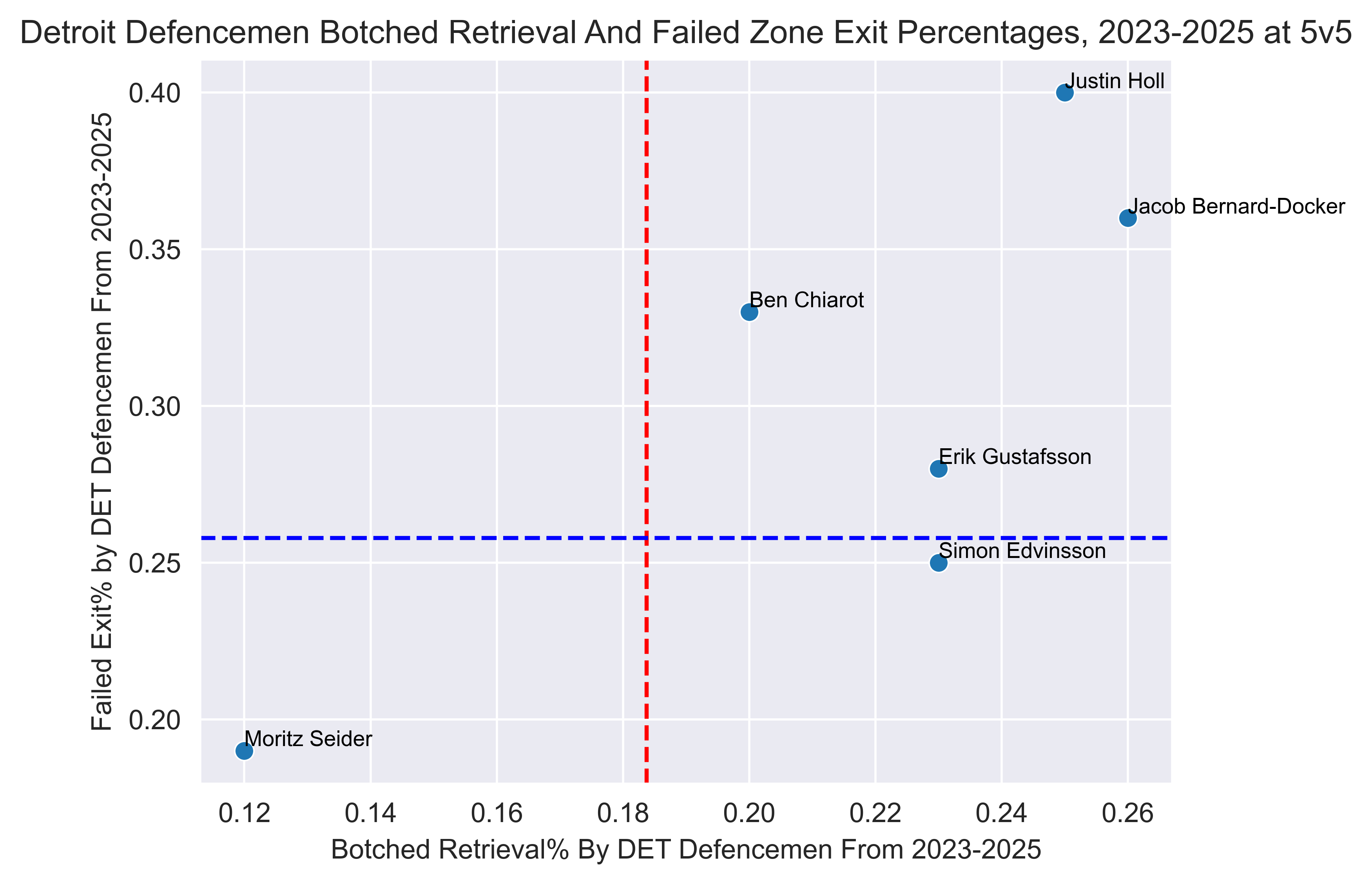
Shout out to Moritz Seider here, because he’s been tremendous at getting the puck moving for his team. But no shout out to the rest of the roster because holy shit. The silver lining is that Simon Edvinsson just finished his first full season and he’s showing well enough, so if he gets even better, that will make a difference. But most of that blue line has not been very good and signing Travis Hamonic in the summer will not help. A lot will come down to Edvinsson because if he can get anywhere close to the Seider range, it would at least give them two guys they can use on two pairs. It’s something, but there’s a long way to go for everyone else.
6 – Don’t Crown ‘Em
Los Angeles signed Cody Ceci and Brian Dumoulin over the summer. To the surprise of probably no one, this isn’t giving their defence group a very rosy outlook in terms of being able to move the puck:
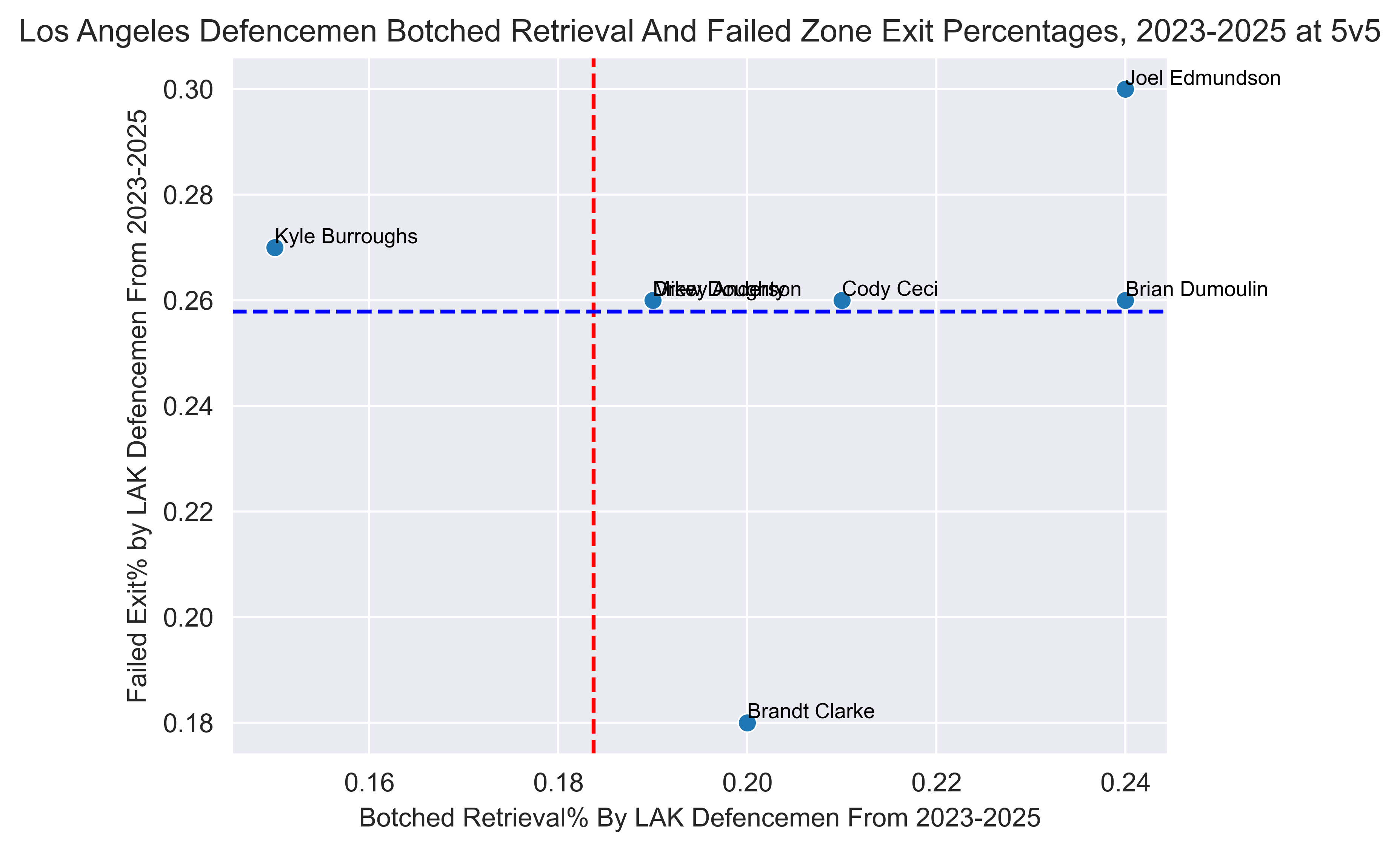
The overlapping names are Drew Doughty and Mikey Anderson, which is kind of funny in its own right. Otherwise, there is not a single defenceman on this roster who has been better than average by both botched retrievals and failed exits. Some guys are close in one area or the other, but close only counts in cornhole and playing with proximity mines in Goldeneye. For a team that had the league’s second-best goals against rate at 5-on-5 last year, it’s a wonder why they would hamper their offence like this.
7 – The Outlier
Carolina is such a fun team because they break so many metrics all the time. From 2023-25, they had by far the lowest team botch/fail percentage at 28% (no other team was below 40%). Here is how their 2025-26 blue line stacks up:
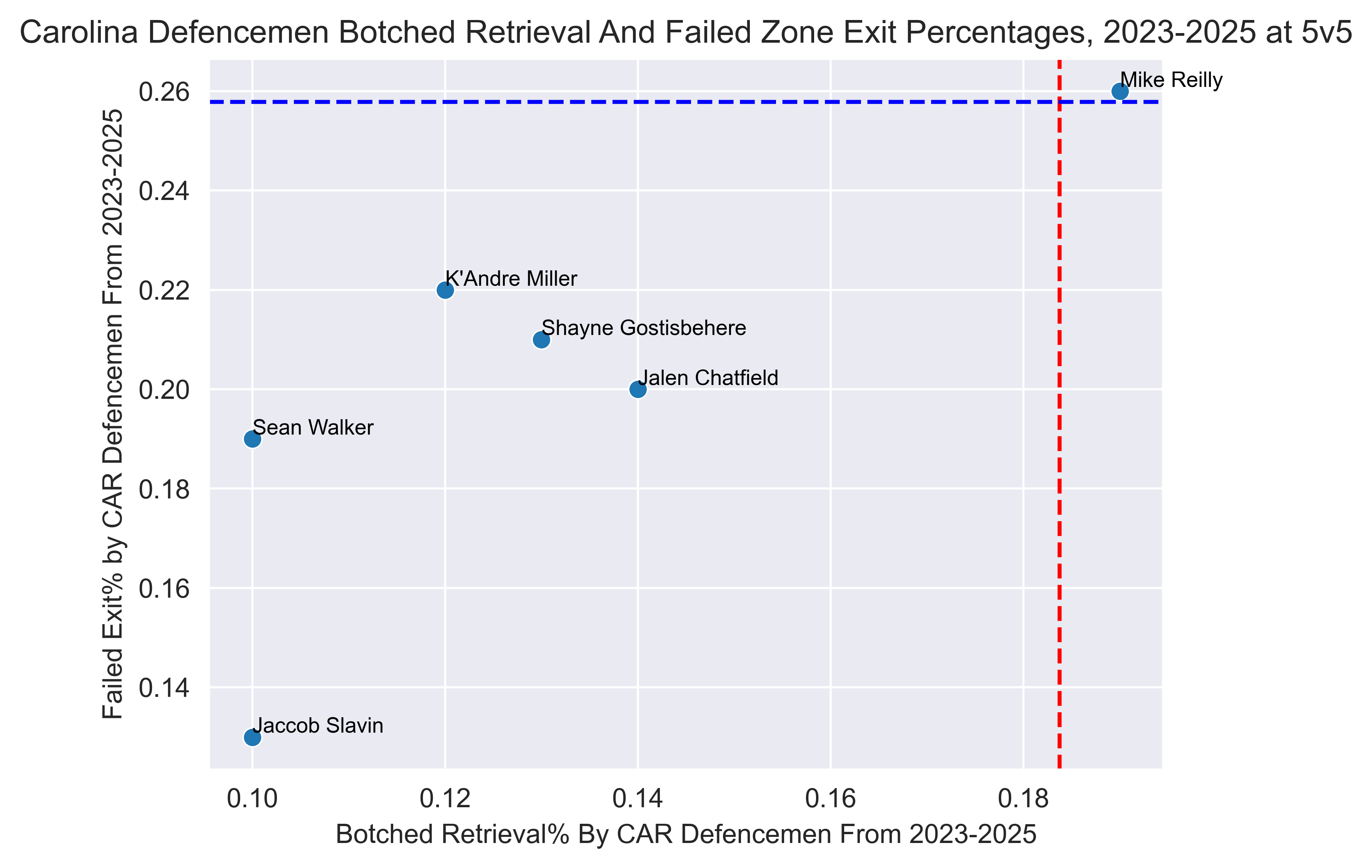
Jaccob Slavin is the best in the league at puck management, which is one reason he’s so revered, but K’Andre Miller is notable here. Keep in mind that this is what these players did from 2023-25, so while most of those Carolina defencemen had those percentages with the Hurricanes, Miller did not. What is he going to do with these excellent puck percentages on a roster that is the best in the league at that particular skill? My guess: He’ll be pretty good.
8 – Three-Headed Monster
When we think of Colorado’s blue line, we of course think about Cale Makar and Devon Toews. While Sam Girard is not on their level as an overall defenceman, the list of defencemen on their level (at least Makar’s) can be counted on one hand. Girard has been a very good puck manager in his own right:
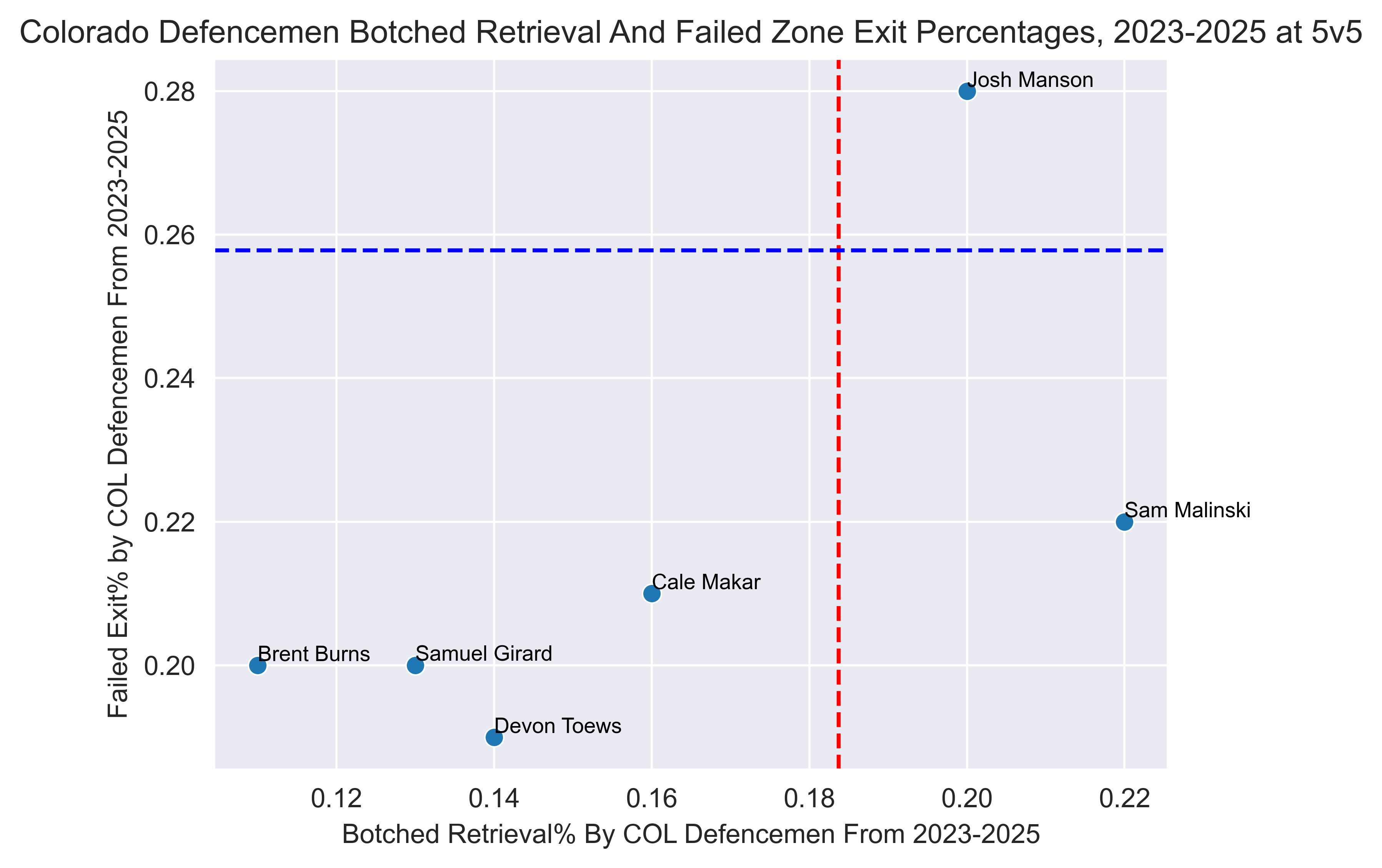
If Burns can repeat what he did in Carolina but in a lesser role, and Sam Malinski takes a step forward, this is the best blue line in the league; hell, it might be already. A player like Girard would be a top-pair blue liner on a quarter of the teams in the league, and it’s why he got more even strength ice time per game than any Colorado defenceman not named Makar or Toews.
9 – Let’s Get Wild
The Minnesota Wild are known for their defence, and rightly so as they’ve been a top-5 team by expected goals against at 5-on-5 in every season since 2012. Not a typo: they have had 13 straight seasons as a top-5 team by expected goals against, which is preposterous. Their puck management situation, though, is the inverse of Columbus: their defencemen have great percentages but the team has had a very tough time scoring at 5-on-5:
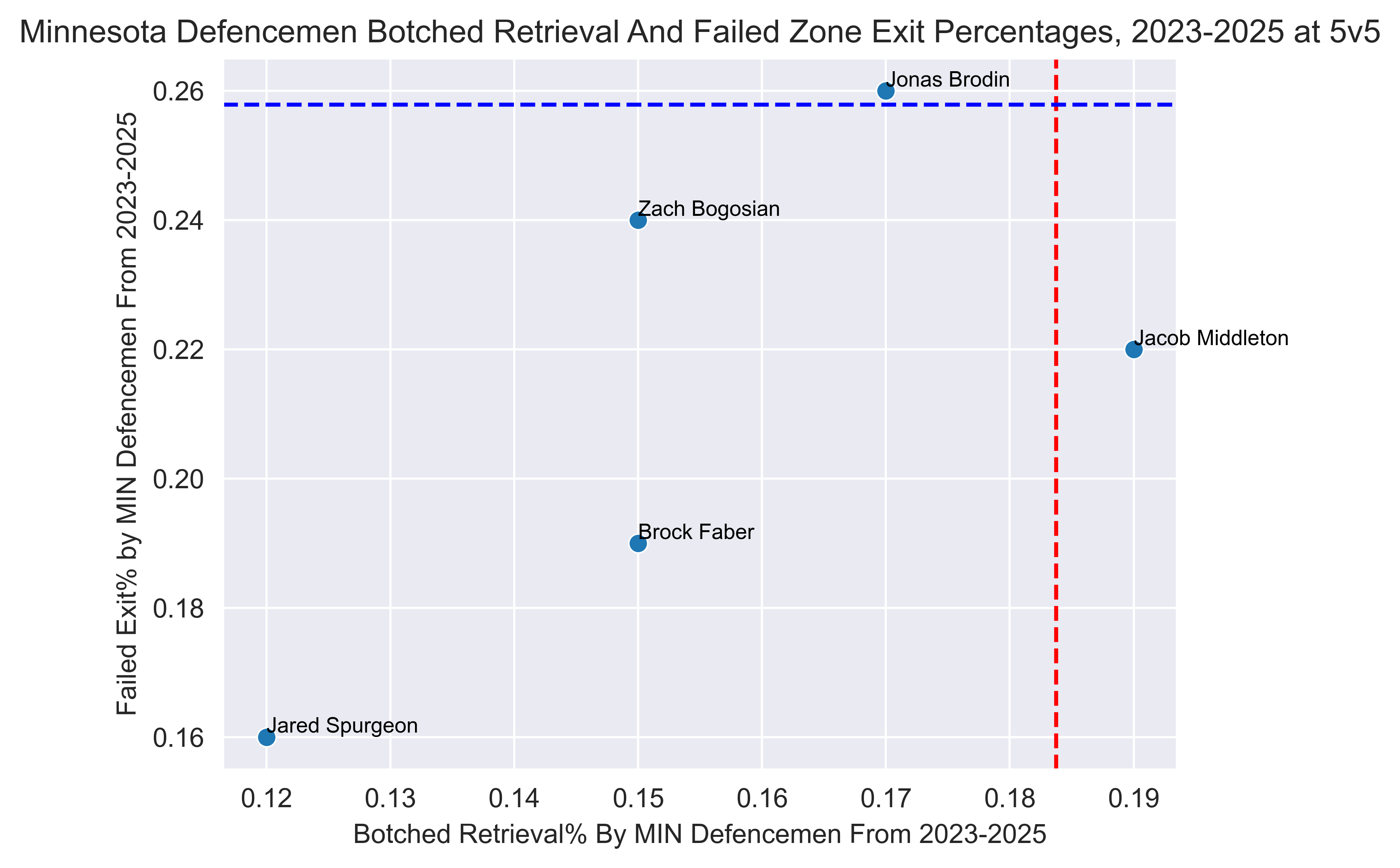
The goal-scoring problem is even with Kaprizov – Minnesota was 21st in the league by goals/60 at 5-on-5 at Christmas last season, which is when Kaprizov got hurt. There is something else going on, and they can’t afford to be a bottom-5 offensive team again.
10 – No Surprise
Miro Heiskanen is one of the best defencemen in the league in puck management, and a lot of their 2025-26 defence group is also very good:
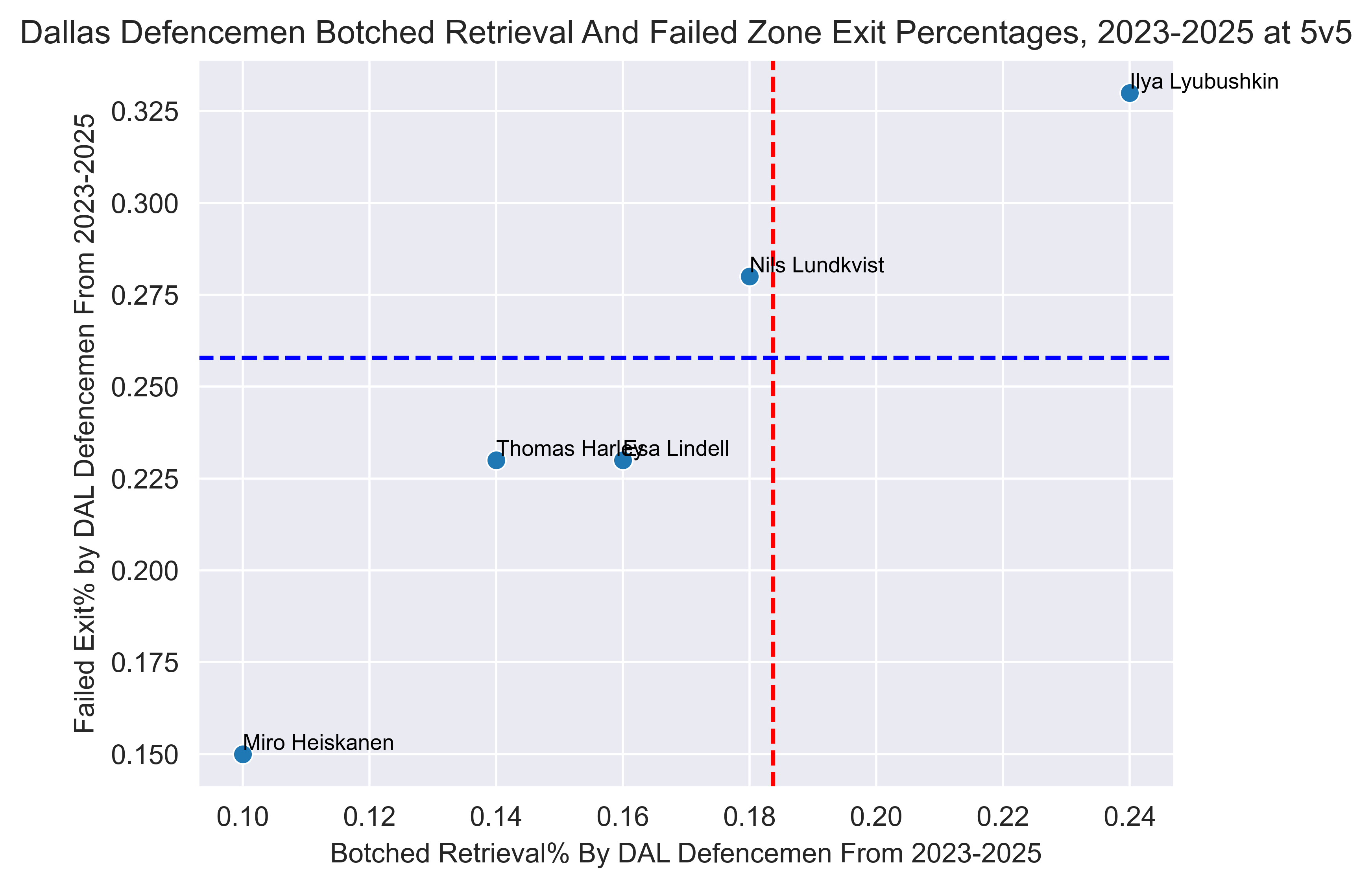
Not shown is Lian Bichsel who was a rookie last season. His botch percentage was 14.6% and his failed zone exit percentage was 22%. If we were to put him on this chart, he’d be somewhere between Thomas Harley and Esa Lindell. This is a great blue line that is the true engine of Dallas’ offence.
Until next week.