10 Interesting (To Me) Stats For This Week - January 21
Welcome back to another week of 10 Interesting (To Me) Stats. This week, we’re going to focus on defencemen, those succeeding and not, and where certain players are excelling. As always, data is from Natural Stat Trick or Evolving Hockey, player tracking from AllThreeZones, and viz from HockeyViz, and as of Monday morning (January 20th).
1 – Toothless Shark Bite
Earlier this month, we talked about teams getting some playmaking from the blue line. It is worth adding onto that, so let’s look at what defencemen are doing off the rush.
On the season, the bottom-10 teams by goals per 60 minutes at 5-on-5 are averaging 4.4 shots/assists per 60 minutes off the rush from their blue liners (the top-10 scoring teams are about 5.2 rush shots/assists per 60 minutes). When looking at the team at the bottom of the rush shots/assist leaderboard, the name makes sense:

There is more than one way to create offence, and San Jose has some nice prospect defencemen on the way, but this group just doesn’t get involved offensively and is not helping the team score goals.
2 – Ohhhhh What A Rush
While we’re discussing creating offence off the rush, it’s worth mentioning the Washington Capitals. Last season, NHL teams averaged 4.6 shots/assists off the rush per 60 minutes at 5-on-5 from their defencemen, and Washington was well below average at 4.1 per 60 minutes, finishing 26th in the league. As a team, the Caps finished the season 29th by goals per 60 minutes at 5-on-5.
So far in 2024-25, the Capitals have had a huge turnaround and are the top scoring team at 5-on-5. Unsurprisingly, not only did their rush offence from their defencemen increase, but it leads the league:

While the addition of Jakob Chychrun has certainly helped here, their only regular Capitals defenceman that is below the league average (4.62/60) by rush offence at 5-on-5 is Rasmus Sandin, and he’s just below average (4.58). It has been a team effort to create more offensively, and the defencemen are a large reason why.
3 – Edmonton Should Have Liked It And Put A Ring On It
Former Edmonton Oiler draft pick, and current Utah defenceman, Michael Kesselring currently leads their blue line by points per 60 minutes at 5-on-5 and is roughly in the 85th percentile league-wide by that measure. He not only leads regular Utah blue liners by offence create off the rush at 5-on-5, but is in the 92nd percentile of the league (at least 130 tracked minutes):
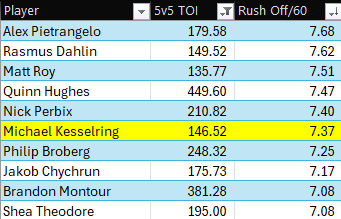
It isn’t helping the team’s goal rate, but it is helping his production, and he now has a higher points/60 rate at 5-on-5 over the last 2.5 seasons (119 games) than Rasmus Dahlin, Mikhail Sergachev, and Jakob Chychrun. He has been a stellar find for Utah’s future.
4 – Vancouver Ca-Fucked
Despite being seventh in the league by 5-on-5 shooting percentage, the Vancouver Canucks rank 20th by 5-on-5 goals per 60 minutes. A lot has been made about their inability to create off the rush, and that is certainly the case as they are generating the third-lowest rate of offence off the rush from their defencemen:

The Canucks have generally been able to finish at a well-above-average rate at 5-on-5 under coach Rick Tocchet, and that’s always nice to see. The problem is that when you create so few opportunities (Vancouver is near the bottom of the league in shots per minute), any decline in shooting percentage is magnified. That is happening in 2024-25, and it’s putting the playoffs in peril.
5 – Mad About Hughes
Staying with Vancouver, there is a huge gap between what Quinn Hughes is doing for the Canucks and what their other defencemen are doing:

No other Canucks rearguard is above the league average, the closest is Filip Hronek, and he has spent 78% of his 5-on-5 time next to Hughes. Vancouver exists in two states: Quinn On The Ice and Quinn Off The Ice. Regardless of what is going on with the forwards, this team needs more from their non-Hughes minutes.
6 – Powering Down
So far this season, the league average for defencemen denying their defensive blue line to the opposition’s puck carrier is 9%. Buffalo Sabres defenceman Owen Power is well below that at 4.5%. Since the start of the 2023-24 season, that number is 5.6%, so it’s not just this year. When looking for other defencemen that are below average at denying the blue line, and are allowing a lot of scoring chances per minute, Power doesn’t find himself in very good company:
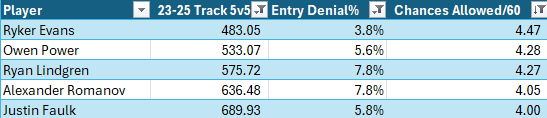
There is enough offence from Power to make up for the defensive lapses, and he just turned 22 years old in November, so there is more growth to come. It is still something he needs to work on if he really wants to elevate himself to the next echelon of players at his position.
7 – He Is The Borg
The New York Rangers traded for defenceman Will Borgen back in December after trading away Jacob Trouba. In his 14 games with the Rangers, Borgen has largely skated with K’Andre Miller as a defence partner, and they often take shutdown matchups and a lot of defensive zone starts when the team is at home. Despite that tough role on a team that was sliding, the Borgen/Miller pair has a positive goal differential at 5-on-5 (+10/-9) and have been break-even by expected goals for/against:
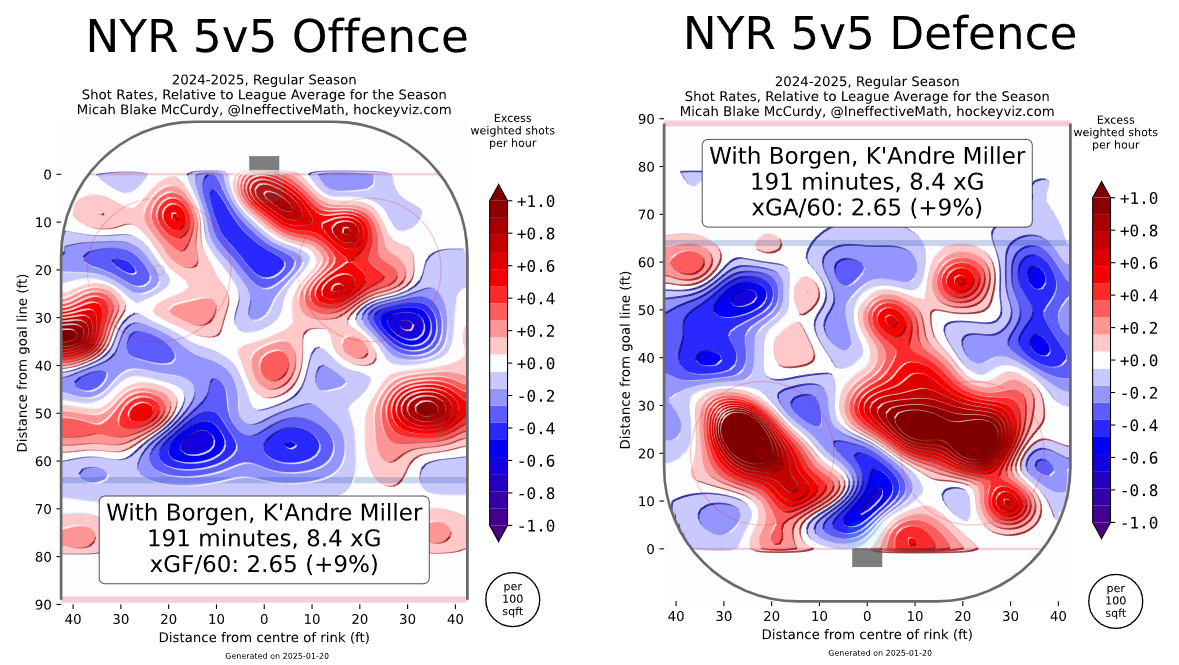
Considering how poorly the team was playing prior to Borgen’s arrival, and the very tough minutes he and Miller are tasked with, it is hard to call this anything but a success so far.
8 – Phlying High
Philadelphia defenceman Jamie Drysdale has been fighting injuries for a few seasons, and that includes some time missed in 2024-25. He has played 20 games since returning in early December from his latest setback, and has been a brand-new player, finding himself among some very notable names by team-relative goal share and team-relative expected goal share at 5-on-5 since his return:

There is a positive goals impact to match that expected goals impact, and they are signs that he’s turned a corner. Let’s see how the next 35 games go, but so far, so good.
9 – Samberg Is The Man-berg
Back in late November, we talked about Winnipeg’s second pair of Neal Pionk and Dylan Samberg. Samberg had a huge, positive impact on Pionk and the team was outscoring the opposition 18-14 in their 5-on-5 minutes together, carrying a 55.2% expected goal share across 20 games.
Samberg was injured on November 23rd, and from November 24th through January 9th, a span of 21 games, the Jets were outscored 13-12 in Pionk’s minutes, carrying a 40.4% expected goal share – without Pionk on the ice, the team’s goal differential was +12 (29-17) and they had a 57.4% expected goal share. It was clear that Samberg’s injury had a huge impact.
Well, Samberg has played five games since returning from his injury, and you’re not going to believe this, but the team has outscored the opposition 2-1 with Samberg-Pionk on the ice and are once again controlling the play:

If the Jets want to make a deep playoff run, they need contributions across the roster, and Samberg carrying Pionk to successful minutes would help immensely.
10 – Simon Says, “I’m Good’
The Detroit Red Wings have been much better under new coach Todd McLellan, and a big reason why is the power play. There has been another important development, though: Detroit is crushing the opposition in Simon Edvinsson’s 5-on-5 minutes, and that’s happening despite him playing most often with Albert Johansson, a rookie with 25 career games. In fact, Edvinsson is near the top of the league team-relative expected goal share and actual goal share at 5-on-5 in his 12 games with McLellan behind the bench:

Edvinsson has been good-to-very-good defensively since he stepped into the league and now he’s starting to produce well offensively, and he’s helping balance Detroit’s blue line by playing very well away from Seider. That is a crucial development for him and for the Red Wings’ future.
Until next week.