10 Interesting (To Me) Stats For This Week - April 28
Welcome back for another week of ’10 Interesting (To Me) Stats’. Last week, we used tracking data from All Three Zones to see which young forwards took a leap in some key tracking metrics. This week, we’re doing the same thing but focusing on defencemen.
All data presented is at 5-on-5. We are limiting the sample with the following parameters:
· At least 125 tracked minutes across the two seasons from 2023-2025.
· At least 125 tracked minutes in 2025-26.
· Under the age of 24 in 2024-25.
The changes are percentage changes relative to the prior two seasons. So, if a defenceman had 1.0 scoring chance assists per 60 minutes across the 2023-2025 seasons, and that improved to 1.5 scoring chance assists/60 in 2025-26, it is a 50% improvement.
The red and blue dotted lines in the following graphs represent the average percentage change among the under-24 defencemen across the league.
1 – Olen Zellweger (Anaheim Ducks)
It was a weird year for Zellweger who finished in the 94th percentile for shot rate among defencemen at 5-on-5, but it is the playmaking improvements worth mentioning here. Among the 14 defencemen in our sample, he had the largest improvement in scoring chance assist rate (helpers on teammate chances) and fifth-largest improvement in percentage of his zone entries carried in:
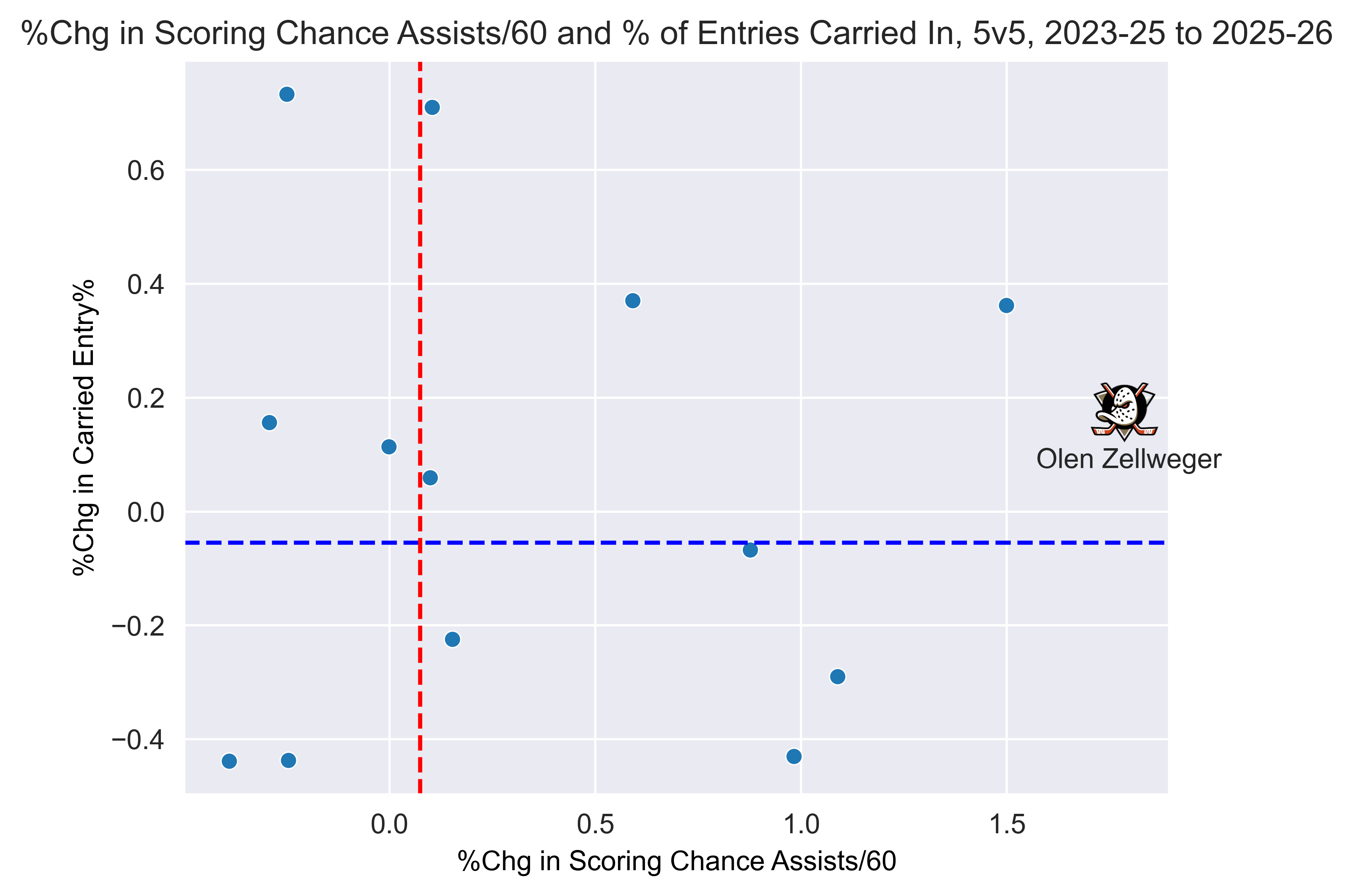
At 5-on-5, Zellweger was arguably Anaheim’s best offensive defenceman. However, he hasn’t earned the trust of the coaching staff, leading to healthy scratches, including the postseason. If the coaches can’t trust him, a rebuilding team elsewhere would do well to check in on Zellweger’s availability in a trade.
2 – Jamie Drysdale (Philadelphia Flyers)
Few young players have had their development disrupted by injury over the last five seasons like Drysdale, who played just 123 games across three years from 2021-2024. However, he had a full-ish season in 2024-25 and built on that in 2025-26. It led to him having the second-best improvement in chance assists in our sample and the fourth-best improvement in entries carried in:
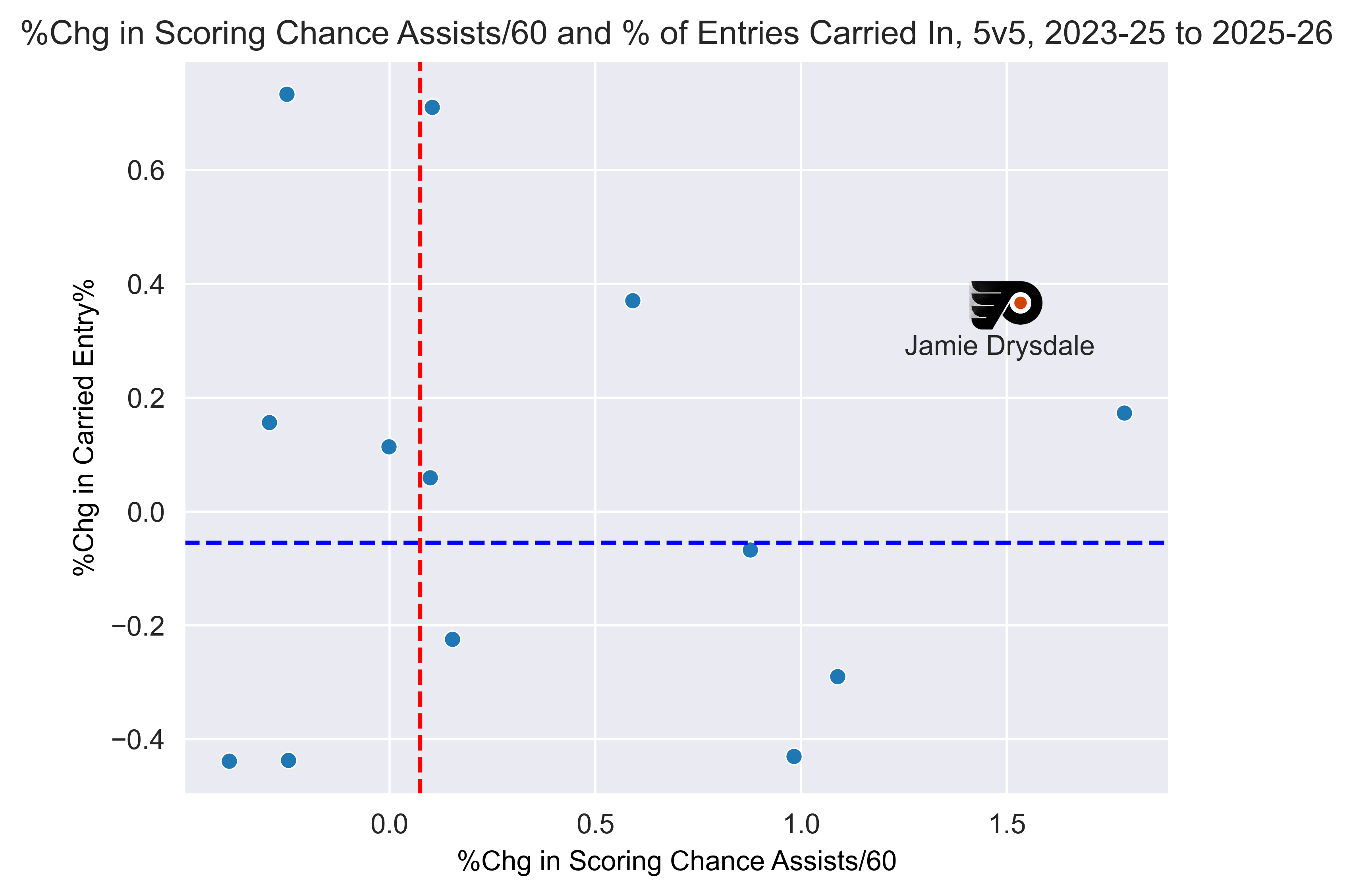
Drysdale has settled into a nice second-pair role with the Flyers and is showing the promise at both ends of the ice that he was traded for. He turned 24 years old earlier this month and with a couple healthy seasons under his belt, it looks as if the best is yet to come.
3 – Simon Edvinsson (Detroit Red Wings)
Detroit struggled to score at 5-on-5 in 2025-26, finishing 30th by goals per 60 minutes. In the ‘good news’ column, Edvinsson took big strides in his offensive zone involvement, showing significant improvements in contributions to scoring chances (assists combined with his individual chances) and contributions to the cycle/forecheck:
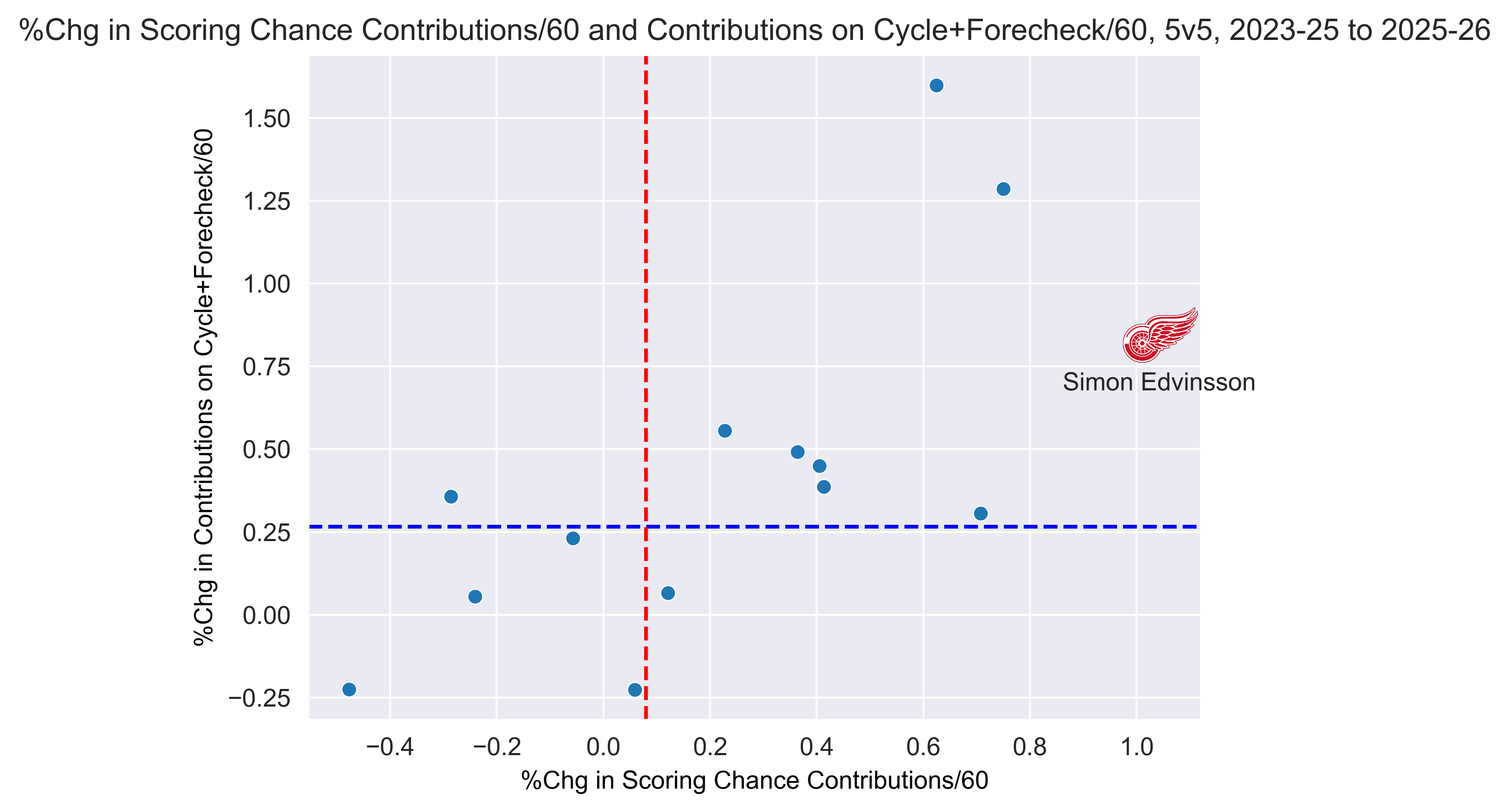
Edvinsson had the largest improvement in contributions to scoring chances and third-largest improvement to contributions on the cycle+forecheck. He was very involved in the offensive zone, he has just 175 NHL games to his name, and he just turned 23 years old in February. Alongside Moritz Seider, Edvinsson is rounding into a foundational piece of the Detroit blue line for the next decade.
4 – Wyatt Kaiser (Chicago Blackhawks)
Artyom Levshunov and Sam Rinzel might draw more attention, but it’s Kaiser that showed genuine improvements to his game. Using the same chance and cycle+forecheck contributions we used for Edvinsson, here is where Kaiser landed in our sample of defencemen:
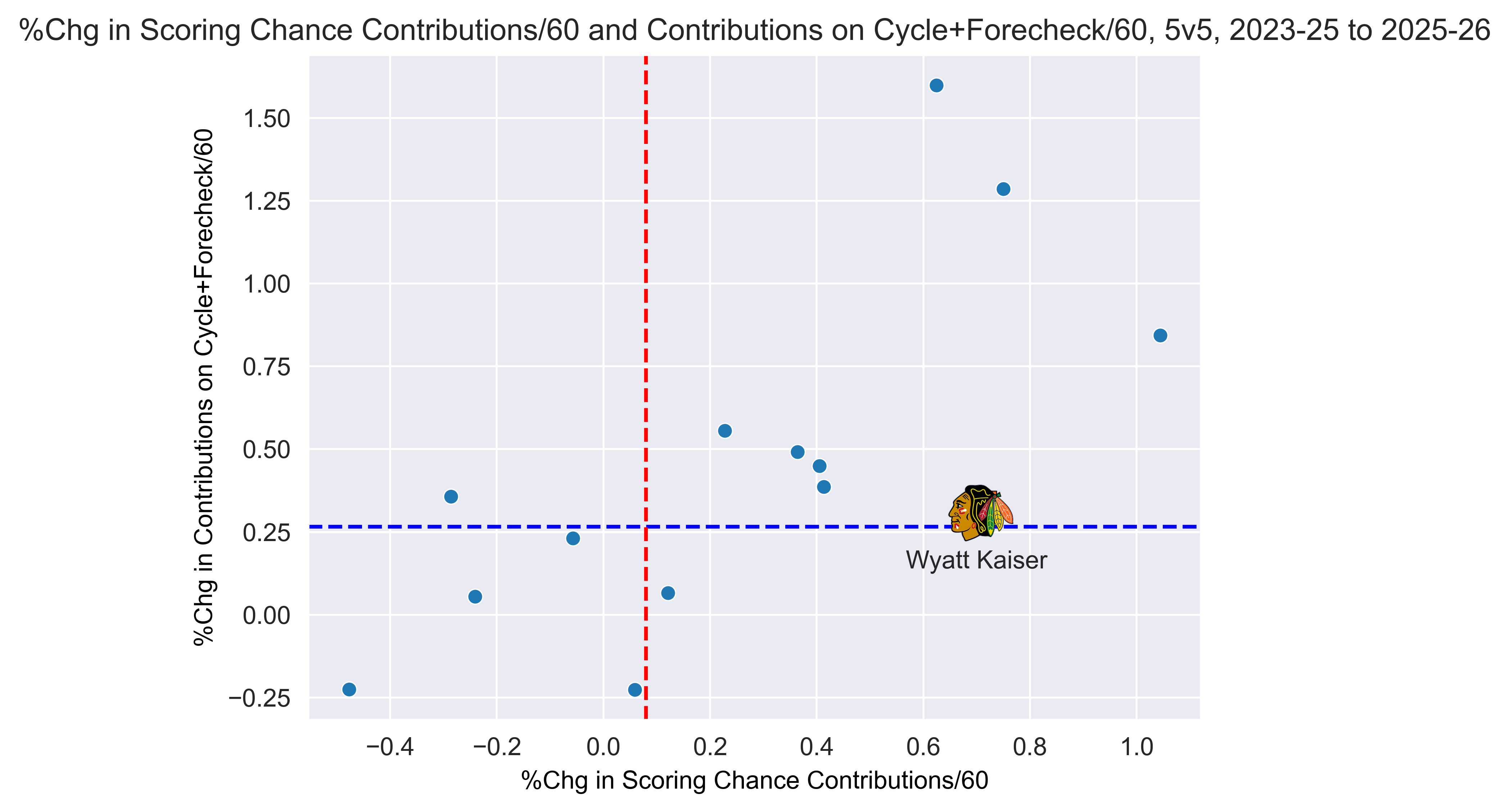
Kaiser was about average by changes to his cycle+forecheck contributions, but simply keeping up in improvements among his cohorts on an awful Chicago team is impressive enough. Even more impressive was having the third-largest improvement in scoring chance contributions. He still needs to make more improvements because he was so far behind to start his career, but Kaiser is certainly trending in the right direction.
5 – Denton Mateychuk (Columbus Blue Jackets)
The two ways to generate offence at 5-on-5 are off the rush or off the cycle+forecheck. Players and teams typically favour one or the other, but those who can do both are usually the high-end offensive players and teams. This is where Mateychuk comes in because he saw big improvements in his contributions both off the rush and the cycle+forecheck:
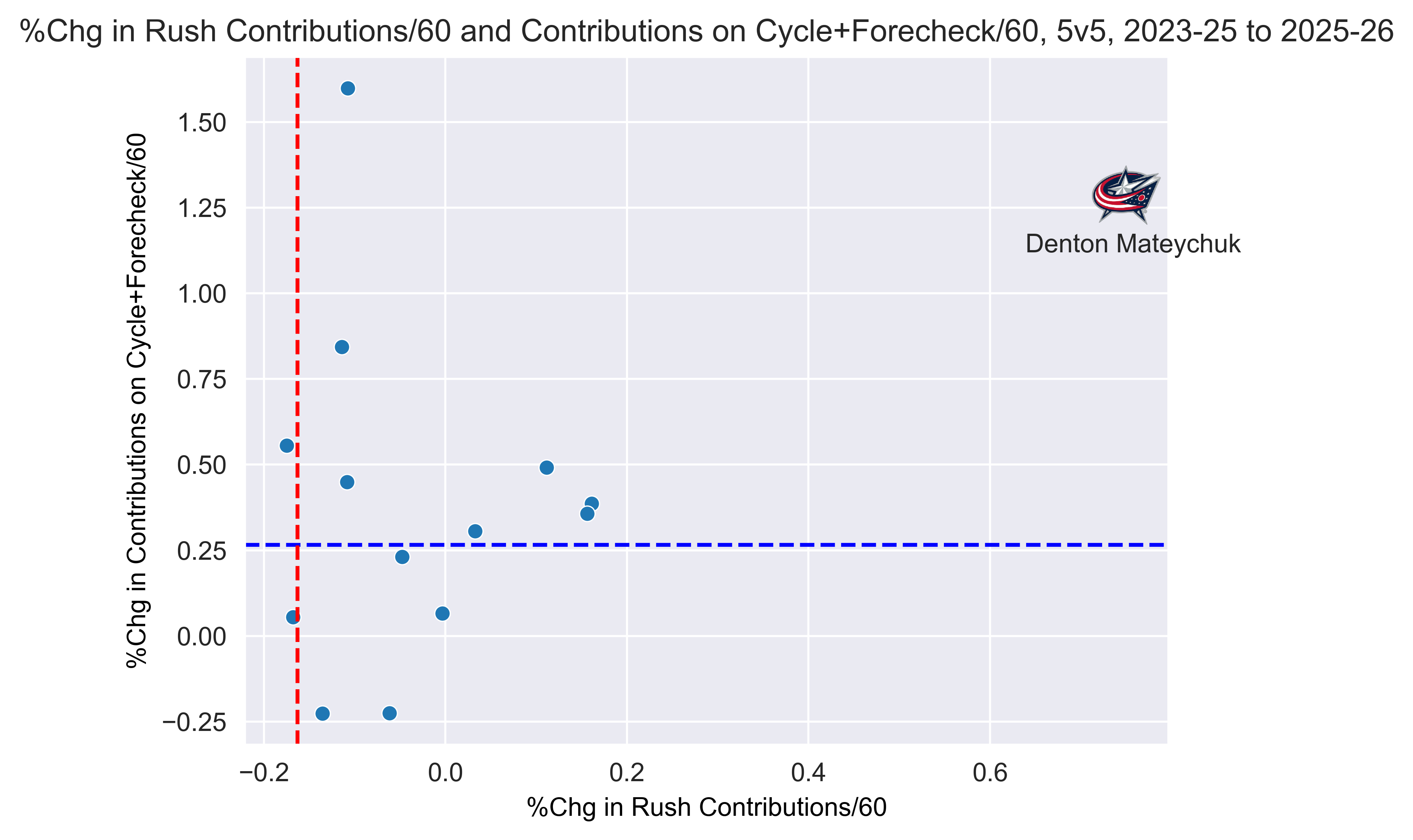
Mateychuk had the largest improvement in contributions off the rush by a wide margin, and the second-largest improvement in contributions off the cycle+forecheck. Across the league, Mateychuk’s overall rates in both areas compared to Charlie McAvoy and Josh Morrissey. If that’s where he stands now, imagine where the 21-year-old will be in a couple years.
6 – Simon Nemec (New Jersey Devils)
We have discussed Nemec a few times in this newsletter, so let’s do one more to cap off the season. Among the defencemen in our sample, Nemec has the second-largest improvement in contributions off the rush and had an above-average change in his contributions off the cycle:
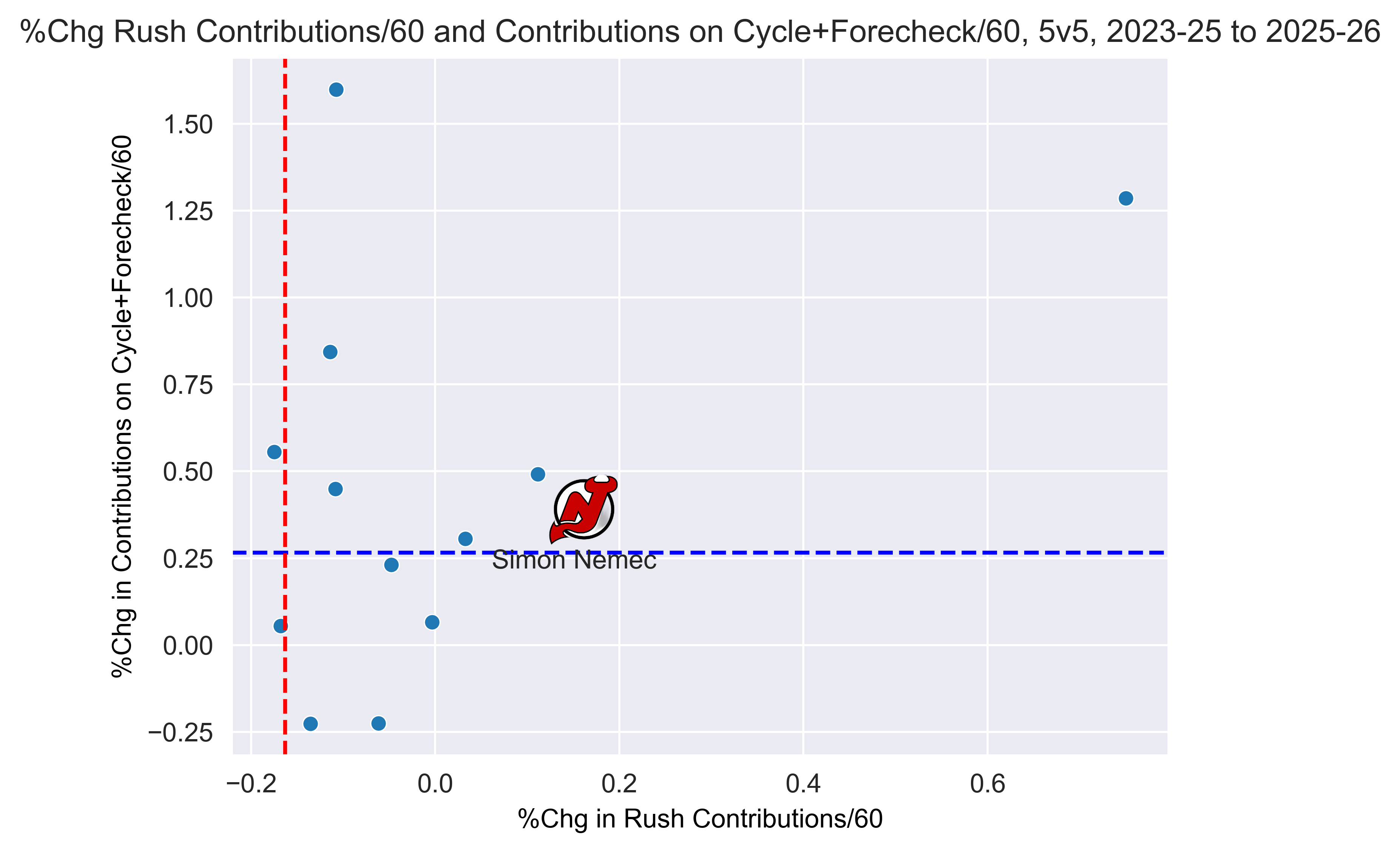
Being involved in a rush play can leave a player exposed defensively because if the puck is turned over and heads towards your defensive zone, you can be caught out of position. Nemec’s defensive impacts reflects that risk, so if he wants to truly elevate his game, he needs to find a balance between aggression and staying back. Regardless, it’s clear he took a step offensively this season.
7 – Emil Andrae (Philadelphia Flyers)
The last defenceman we’ll discuss showing good improvements in both contributions off the rush and cycle+forecheck is Andrae, who has been in and out of the lineup for the Flyers during their postseason run:
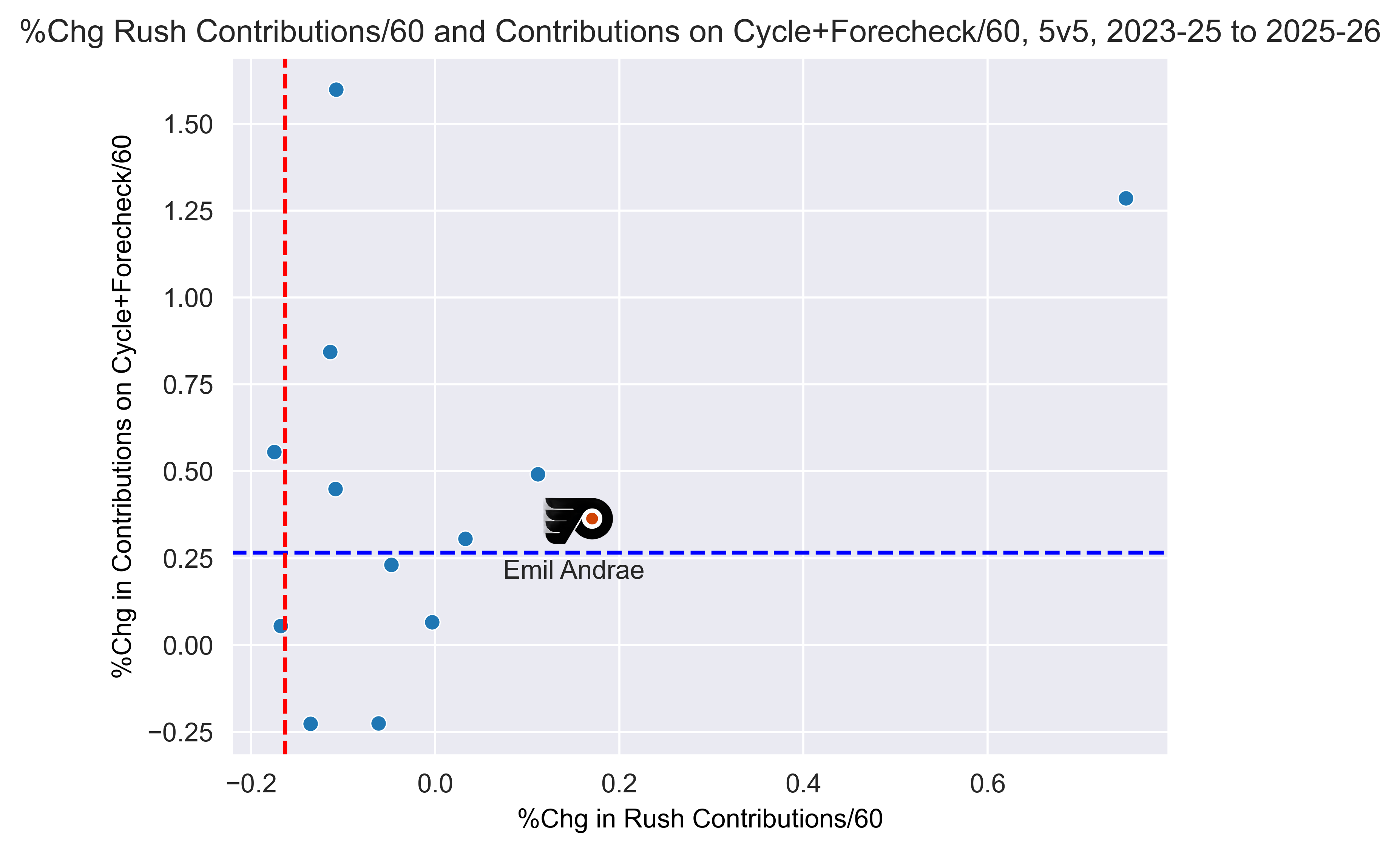
Andrae showed very similar improvements to Nemec, and that rush-heavy nature might be a reason why the Flyers’ coaching staff is hesitant to fully trust him. He requires more rounding to his game, but the good news is the offensive side has leveled up, and now he can focus on other areas.
8 – Brandt Clarke (Los Angeles Kings)
It was not unexpected, but this was the season that Clarke graduated from a young player showing promising results to a young player who is a pillar of his team. That notion shows up in his improved chance assists and botch+fail%:
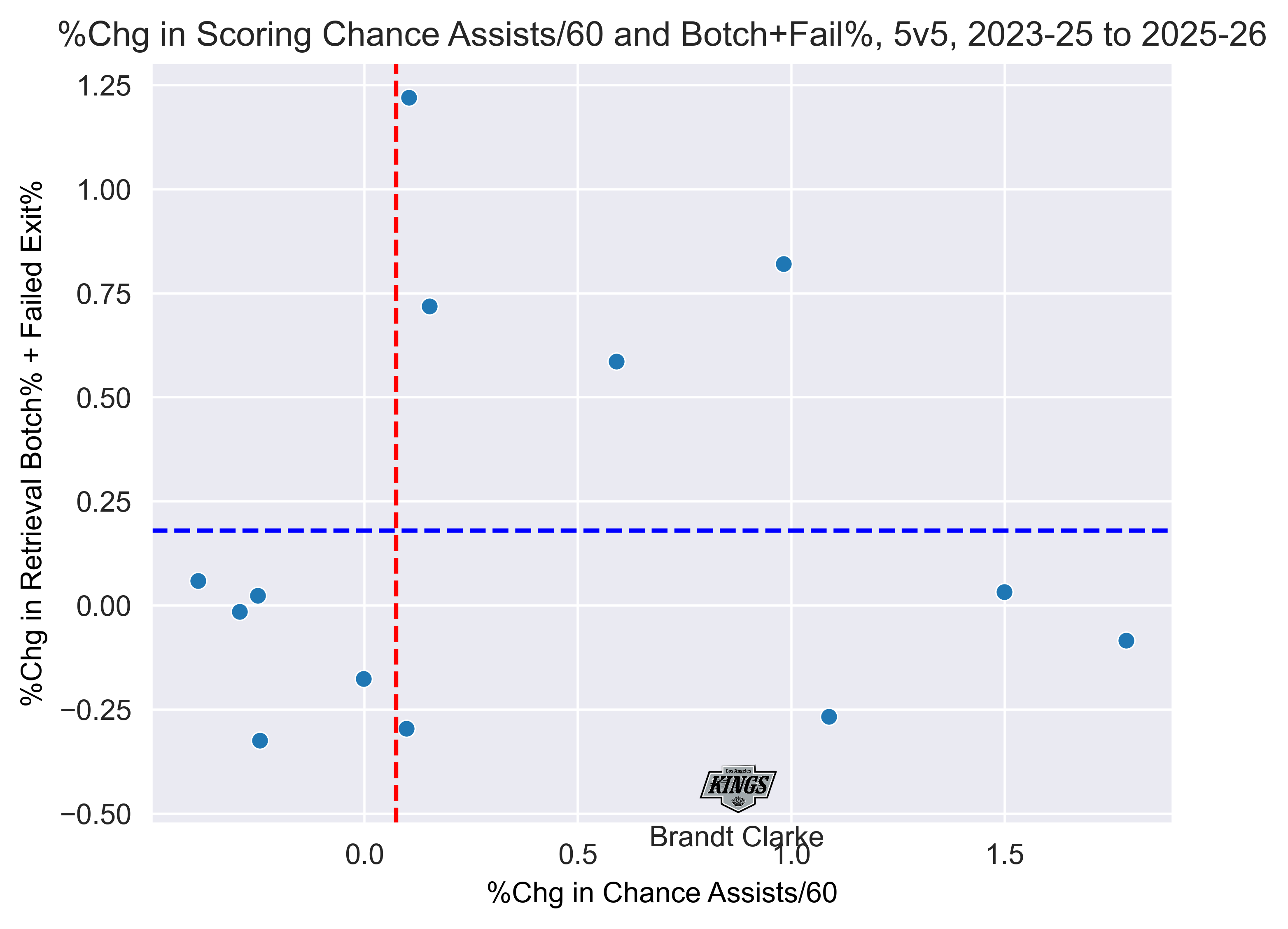
For anyone new here, defensive zone retrieval botches and failed exits, when combined, indicate which defencemen/defence groups can drive offence for their teams (Colorado, Carolina, and Montreal have low team rates, for example). The lower the rates, the better, and Clarke’s declined significantly. His overall chance assist rate also finished inside the top-10 of all defencemen. Los Angeles’ franchise blue liner of the future has arrived.
9 – Owen Power (Buffalo Sabres)
It didn’t show up in his raw production numbers, but Power also took a step forward in his facilitation. He didn’t have a large improvement in his chance assist rate, but he did improve, and he also saw a big decline in his botch+fail%:
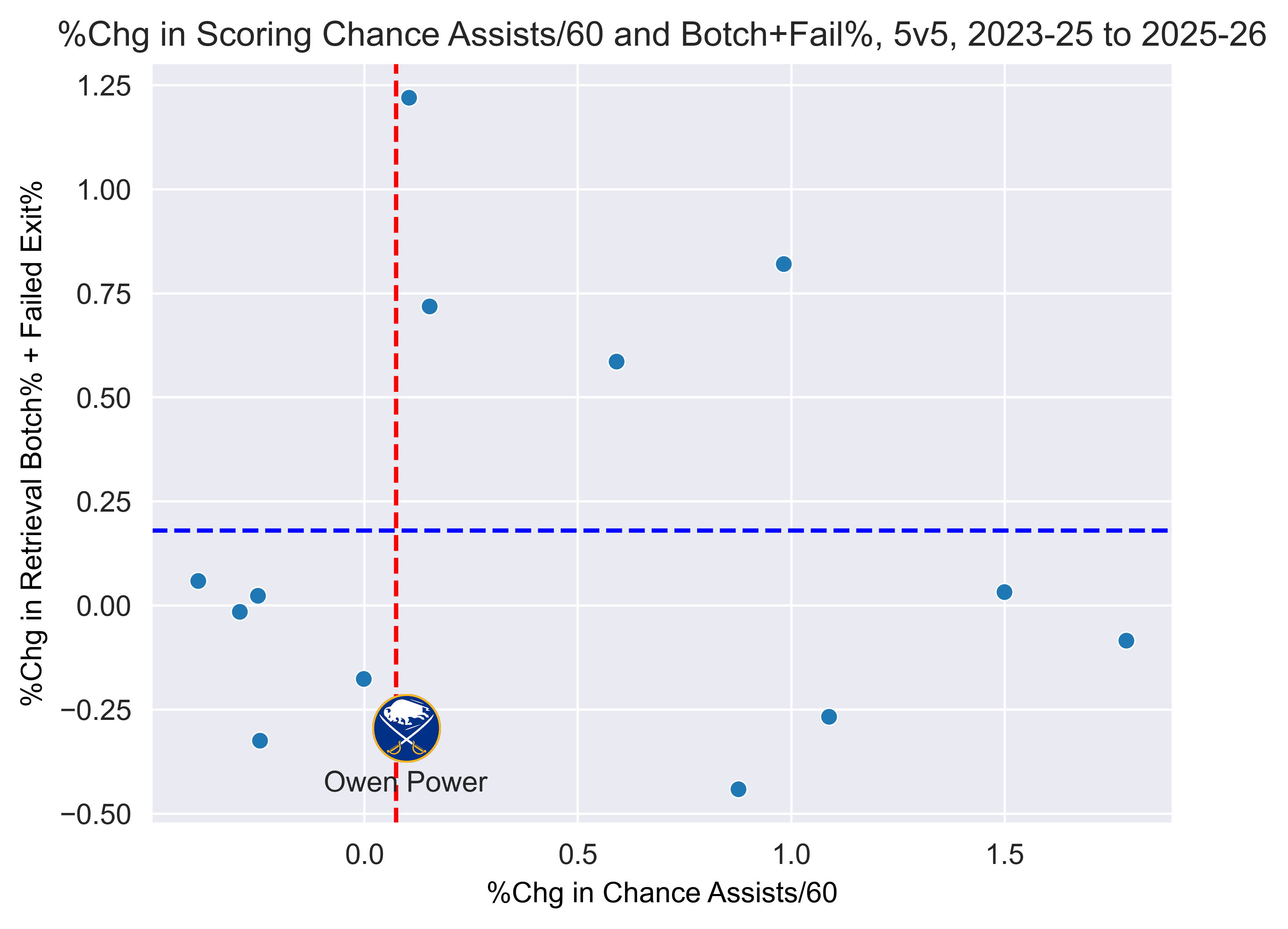
At 5-on-5, Power’s points/60 rate was that of a fringe first-pair guy, so even without a production jump, he was still good in this regard. His overall botch+fail% is still a bit high to be considered a future franchise cornerstone, but he doesn’t turn 24 years old until November, and he’s setting the building blocks he needs to be that guy.
10 – Lane Hutson (Montreal Canadiens)
Hutson didn’t have any major improvements in any offensive area, but what stood out about his tracking data was that he was the only young defenceman from our sample to improve both his rate of zone entries and the percentage of those entries carried in:
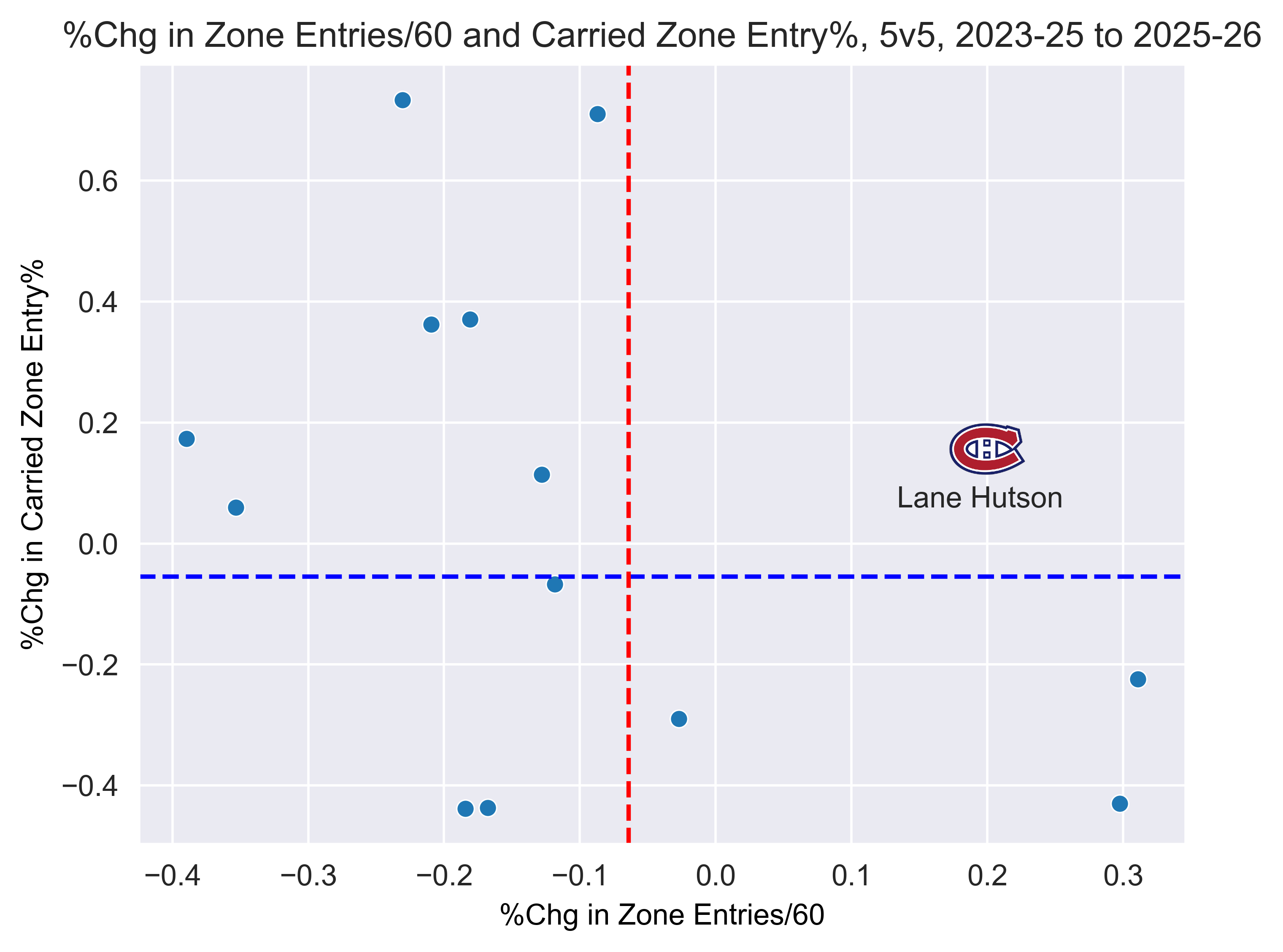
Comparing overall rates across the league, Hutson’s zone entries and carried entry% compared directly to Cale Makar. This is a young blue liner who just turned 22 years old in February with 175 total NHL games to his credit, including the playoffs, and he still showed this unique combination in a season where he saw huge improvements in his defensive impact (per Evolving Hockey). Doing all this at his age makes it scary to think what he’ll look like as a more finished product in 2-3 years’ time.
Until next week.