10 Interesting (To Me) Stats For This Week - August 5
Welcome back to another week of ’10 Interesting (To Me) Stats’. This week, we’re looking at potential breakout players. Over at Dobber Hockey, one of the beliefs is that it takes most skaters about 200 games to break out, and that makes sense when looking at aging curves, like this one from The Athletic:
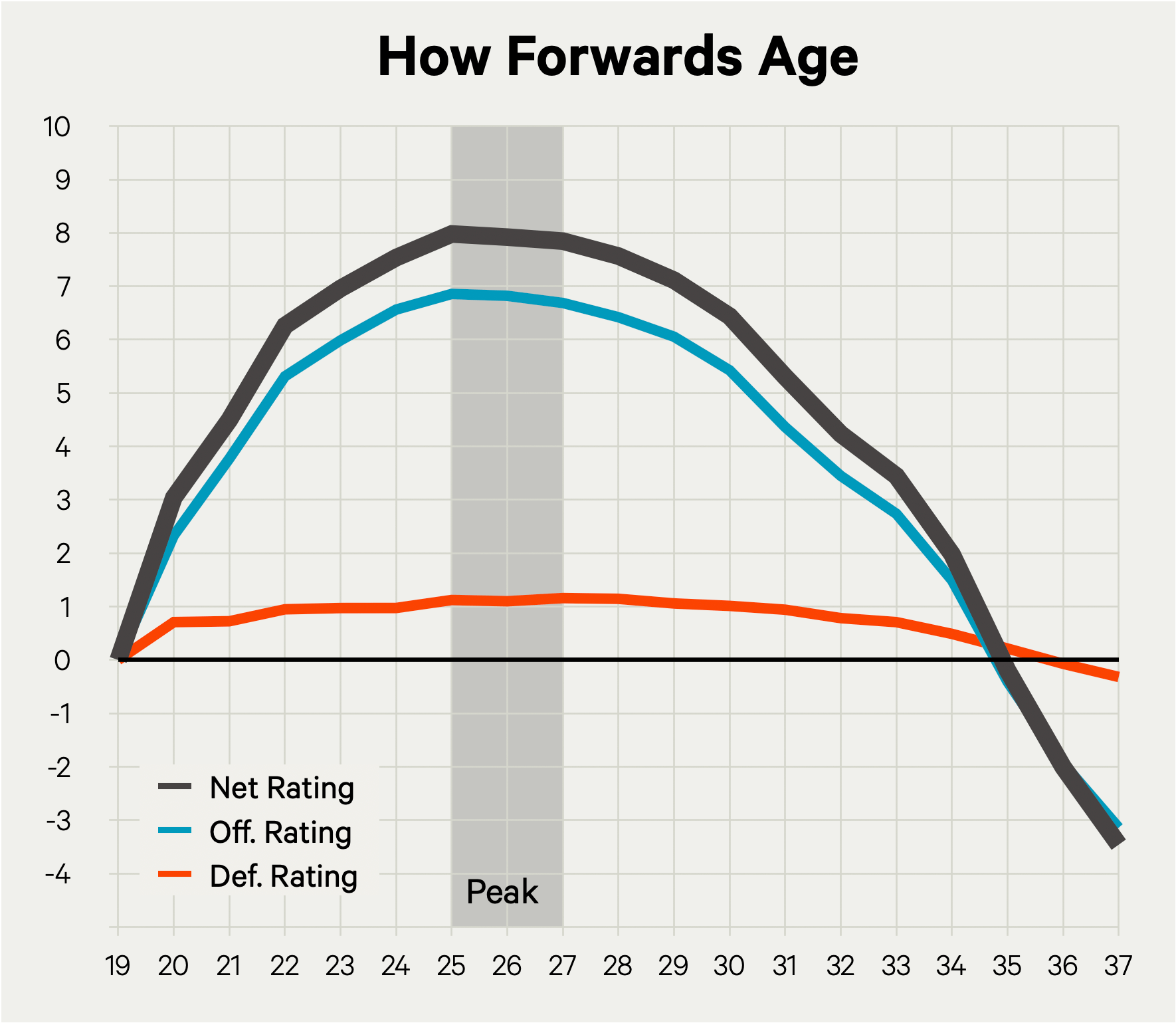
Forward impact increases near-exponentially in their first three seasons before somewhat plateauing for about 8-10 years. In that spirit, let’s look at 10 players who have between 120-240 career NHL games, have shown some upside, and are now in a place to put it all together. Data from Evolving Hockey or AllThreeZones.
1 – Kent Johnson (Columbus Blue Jackets)
Johnson technically had his breakout already, but there is likely another gear coming. He shot 11.4% across his first three seasons, and that exploded to 19.5% in 2024-25, but there were a lot of underlying improvements to support that breakout. Looking at Johnson’s 5-on-5 number, his rate of shot attempts (iCF/60) and individual expected goals (ixG) both increased markedly from his first three years, he added offence off the rush without sacrificing much offence on the cycle/forecheck, and was much more involved on zone entries:

Columbus is still growing as a team, so Johnson might take 1-2 years to really hit full stride, but it looks as if he’s on the cusp of turning into a true #2 or #3 winger on a playoff roster.
2 – Luke Evangelista (Nashville Predators)
Nashville’s forward additions over the last 13 months are keeping Evangelista from being a go-to guy just yet, but he’s getting to the point of being undeniable. As evidence, here are players who played at least 150 games over the last three seasons, were under 23 years old, and had comparable goal, expected goal, and primary assist rates at 5-on-5:

On top of the offensive upside, Evangelista is a solid defensive winger, too. At this point, he’s no higher than the fourth winger on Nashville’s depth chart, but at even strength, there’s a non-zero chance he ends up Nashville’s best non-Filip Forsberg winger in 2025-26.
3 – Jack Quinn (Buffalo Sabres)
Despite being healthy following his Achilles tear in 2023-24, Quinn had a down year in 2024-25 that was somewhat salvaged by solid power-play production. Maybe he needed that year to get back up to speed following that gnarly injury, but what may help Quinn the most is upgrades to the blue line. He struggled to create much offensively unless Rasmus Dahlin was on the ice, but that was a theme for the Sabres, as Quinn and Tage Thompson both saw similar expected goals-for increases with Dahlin:

Being on second/third lines, Quinn gets much less ice time with Dahlin than the top line does. Hopefully, the additions of Michael Kesselring and Conor Timmins can help boost Buffalo’s middle-6 forwards.
4 – Ridly Greig (Ottaw Senators)
Not only did Ottawa make the playoffs last season, but they did it in a year of transition where the team went from a rush-heavy attack to one that focused on the cycle and forechecking. For Greig, that meant a lower percentage of his 5-on-5 zone entries were carried in, but he was responsible for more zone entries than his first two seasons, kept up his rate of scoring chance assists (SCA), and Ottawa created far more scoring chances off the entries he did carry in:

Ottawa struggled to create offence at 5-on-5, but it’ s a wonder how much of that is just a young team that needed time to get up to speed on an entirely new approach to offence. That Greig was as involved, or more involved, in some key playmaking and transition metrics is a good sign that after a stagnant year, he’s primed for another step up.
5 – Tyson Foerster (Philadelphia Flyers)
This is more uncertain now than it was six weeks ago because Foerster suffered an infection to his elbow at the World Championships in the spring, and the prognosis last month is he may not return to the lineup until the regular season has started.
It is too bad because it genuinely looks like Foerster is one of the next two-way star wingers in the league. He has back-to-back 20-goal seasons and since the 2013 lockout, here are the comparable forwards by goals for/against impact, and overall goal and expected goal impacts, who had over two seasons’ worth of games by the end of their age-23 season:

Beniers is one of the two-way stars of the future along with Foerster, Cirelli is one of the best two-way centres in the league right now, and Copp was one of the best 4-8 years ago. With a new coach and improved forward depth, things were lining up for Foerster to really grab attention this season. Hopefully the injury doesn’t derail that.
6 – Bobby Brink – (Philadelphia Flyers)
Our second Flyers forward on the list had 41 points in 79 games last year, finishing second on the team by points per 60 minutes at 5-on-5. Over the last two years, his rate of assists per 60 minutes at 5-on-5 is in the 90th percentile of the league. The 2024-25 season also saw improvements in his rate of scoring chance contributions (individual chances plus assists on teammate chances), zone entries, percentage of zone entries carried in, and chances created off those carried entries:

With Matvei Michkov and Travis Konecny on the roster, Brink will be no higher than the #3 winger. But if the Flyers power play improves and he holds onto his top PP role, he has all the makings of a true breakout season.
7 – Simon Holmström (New York Islanders)
As with Brink, Holmström has lots of ice-time competition but after the Four Nations break last season, Holmström was top-4 among Islanders forwards by share of even-strength (3rd), short-handed (2nd), and power-play ice time (4th). A healthy Mathew Barzal will push Holmström off the top PP unit, but he is now one of the team’s top-4 wingers. The breakout started last year as he was 1 of 4 forwards under the age of 26 to add at least 1.5 minutes per game of 5-on-5 TOI from the year before while being at least one standard deviation above average by improvement in his expected goals impacts:

Without top PP time, a full-on breakout won’t happen, but he can repeat, if not improve, on the upswing he saw last season.
8 – Jamie Drysdale (Philadelphia Flyers)
Injuries have set back Drysdale so much that he’s averaged just 37 games played per season over the last three years. With new coach Rick Tocchet in town and a healthy year under Drysdale’s belt, things are looking. He did have a tough 2024-25 season, but Evolving Hockey had him with the 3rd-largest gap between his expected goals impact and actual goals impact among all regular defencemen. Funny enough, he had a teammate do the basically the same thing in 2023-24, and things worked out for him:

Drysdale is set for some positive regression, gets a new (good) coach, and is now reaching the breakout point of his career.
9 – Jordan Spence (Ottawa Senators)
It could be tough for Spence to have a real breakout because Thomas Chabot, Jake Sanderson, and Artem Zub are all ahead of him on the depth chart, at the least. All the same, here is the list of comparable defencemen over the last three years by goals and expected goals impact at even strength:

Spence isn’t Cale Makar, but Dylan Samberg seems like a good comp here: a guy who succeeds in a lesser role for a few years before ascending as a second-pair option. It might take another year for Spence to truly take flight, but he’s knocking on the door.
10 – Pavel Mintyukov (Anaheim Ducks)
The thing about Mintyukov is he’s still 21 years old and has just 131 NHL games under his belt, all with one of the worst teams in the league. He has also been a machine on zone exits as here are the comparable defencemen over the last two years by rate of defensive zone retrievals, zone exits off those retrievals, total zone exits, and zone exits with possession:

That list is a top-10 defenceman in the league, one of the best shutdown defencemen around, and 21-year-old Mintyukov. The real breakout likely comes next year once contracts of veteran Anaheim defencemen run out, but Mintyukov has all the tools to take a Jackson LaCombe-like leap in the next two seasons.
Until next week.