10 Interesting (To Me) Stats For This Week - March 24
Welcome back for another week of ’10 Interesting (To Me) Stats’. This week, we’re looking at players having up-or-down seasons and why the defencemen they’re playing with are influencing that performance.
In September, this newsletter wrote about something called ‘Botch+Fail%’ using 5-on-5 tracking data from All Three Zones. To summarize quickly:
· ‘Botched Retrieval%’ is how often a defenceman fails to move the puck cleanly when retrieving a dump-in by the opposition or corralling the puck off a shot attempt by the opposition.
· ‘Failed Exit%’ is when a defenceman turns the puck over in the defensive zone, otherwise fails to clear the zone, or flips the puck out of the defensive zone but it doesn’t get into the offensive zone.
The combined ‘Botch+Fail%’ is simply adding those two percentages together. It is important because defencemen with very high Botch+Fail% rates often suppress their team’s scoring while defencemen with very low Botch+Fail% rates often augment their team’s offensive scoring. I wrote about that in the offseason article linked above.
So, which players are having their season’s performance impacted by defencemen with high/low botch+fail percentages? Let’s look at their team’s goal-scoring rates at 5-on-5 when that player is on the ice with a specific defenceman.
The red labels are goal-scoring rates when that player is on the ice without the defenceman, the blue labels are when they’re on with that defenceman, and the horizontal axis is that defenceman’s Botch+Fail%. The league average Botch+Fail% for defencemen is about 52%.
1 – JT Not-So-Money
At 1.33 primary points per 60 minutes at 5-on-5, John Tavares has his lowest primary points rate of his Toronto Maple Leafs tenure. Coincidentally, defenceman Simon Benoit has the seventh-highest Botch+Fail% of the 182 defencemen in our sample. Put it together, and the Leafs are scoring 50% less when Tavares is on the ice with Benoit than without him:
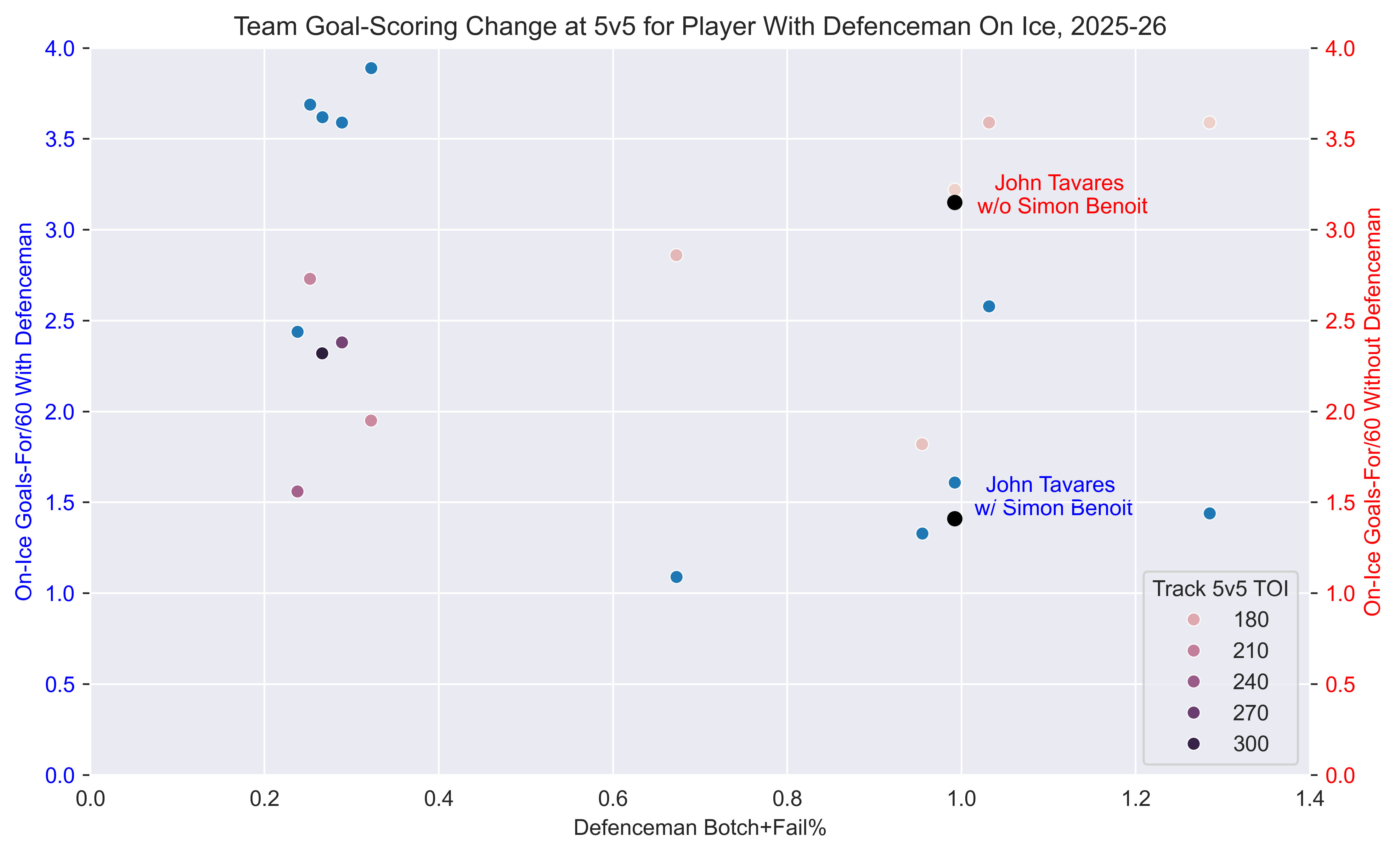
Over the last two seasons, Toronto has scored 2.07 goals/60 minutes at 5-on-5 with Benoit on the ice, and no other defenceman that has at least 1000 minutes with the team is below 2.55. Whatever defensive value he brings is being negated (and then some) by dragging the offence a standstill.
2 – Make It Real or Let’s Forget About It
Robert Thomas had managed 2.1 points/60 at 5-on-5 up until his injury in mid-January, which would have been a three-year low, but his offence has rebounded since his injury return. For that reason, it’s worth highlighting how the Blues have scored this season when Thomas is on the ice with defenceman Logan Mailloux:
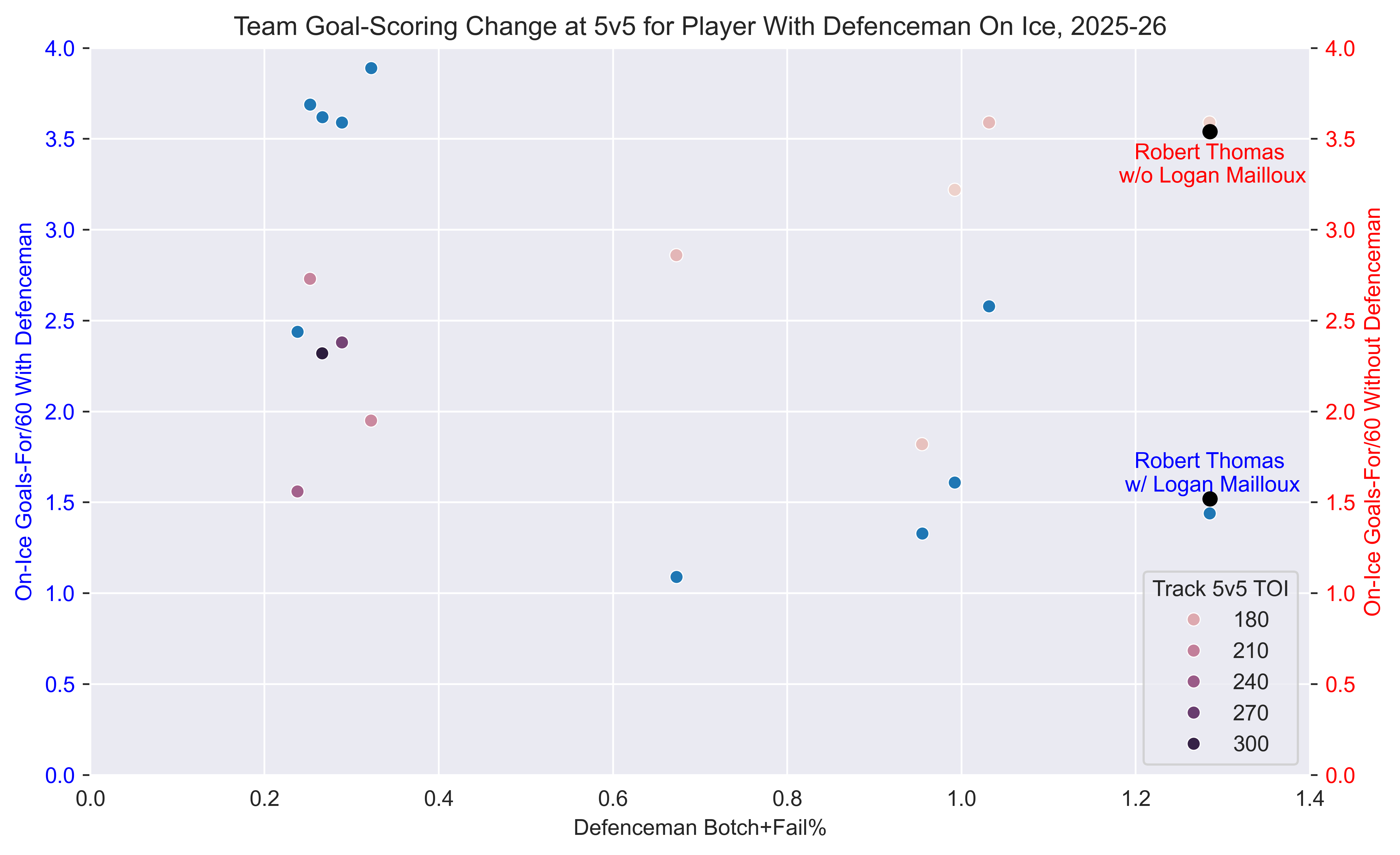
Mailloux is just 22 years old with 62 NHL games to his credit, so there is more growth to come, but this does help give some context of why a big chunk of Thomas’ season, to his standards, looked poor.
3 – Stalled Engine
Another player who had a very tough start to the season was Dallas’ Thomas Harley. It appeared as if he was playing through injury, and he did miss nearly four weeks of action in November/December. It didn’t help that he was playing so much with defenceman Ilya Lyubushkin:
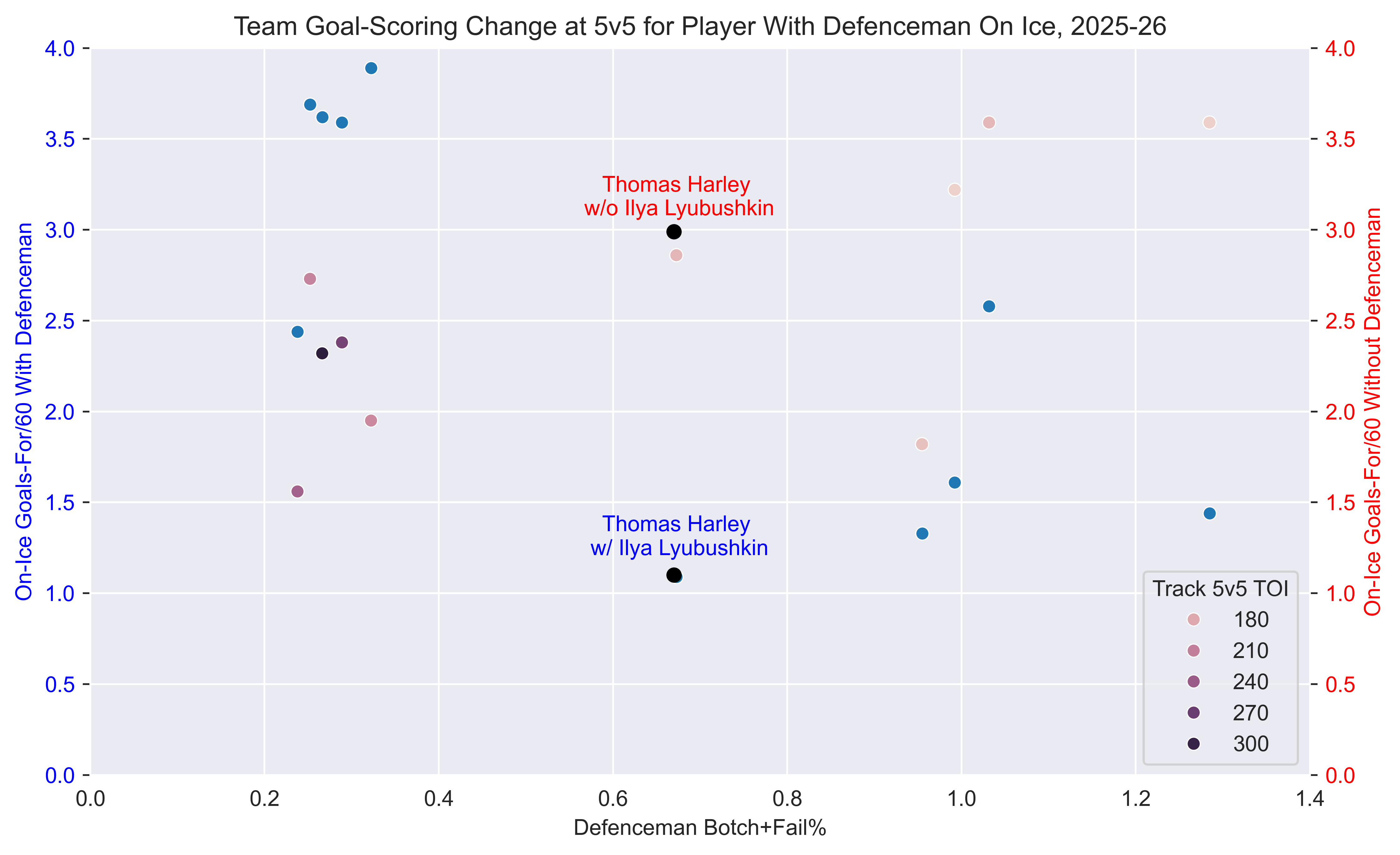
Harley has been playing a lot more with usual defence partner Nils Lundkvist in recent months, and the results have been night-and-day as Dallas’ goal-scoring rate nearly triples when Harley is with Lundkvist as opposed to Lyubushkin, going from 1.09 goals/60 to 3.14 goals/60.
4 – The Way We Were
Defenceman Logan Stanley was traded from Winnipeg to Buffalo at the Trade Deadline, and it’s an interesting deal because Stanley’s Botch+Fail% is one of the worst rates in the NHL, and it had a big impact on the goal-scoring with former teammate Mark Scheifele:
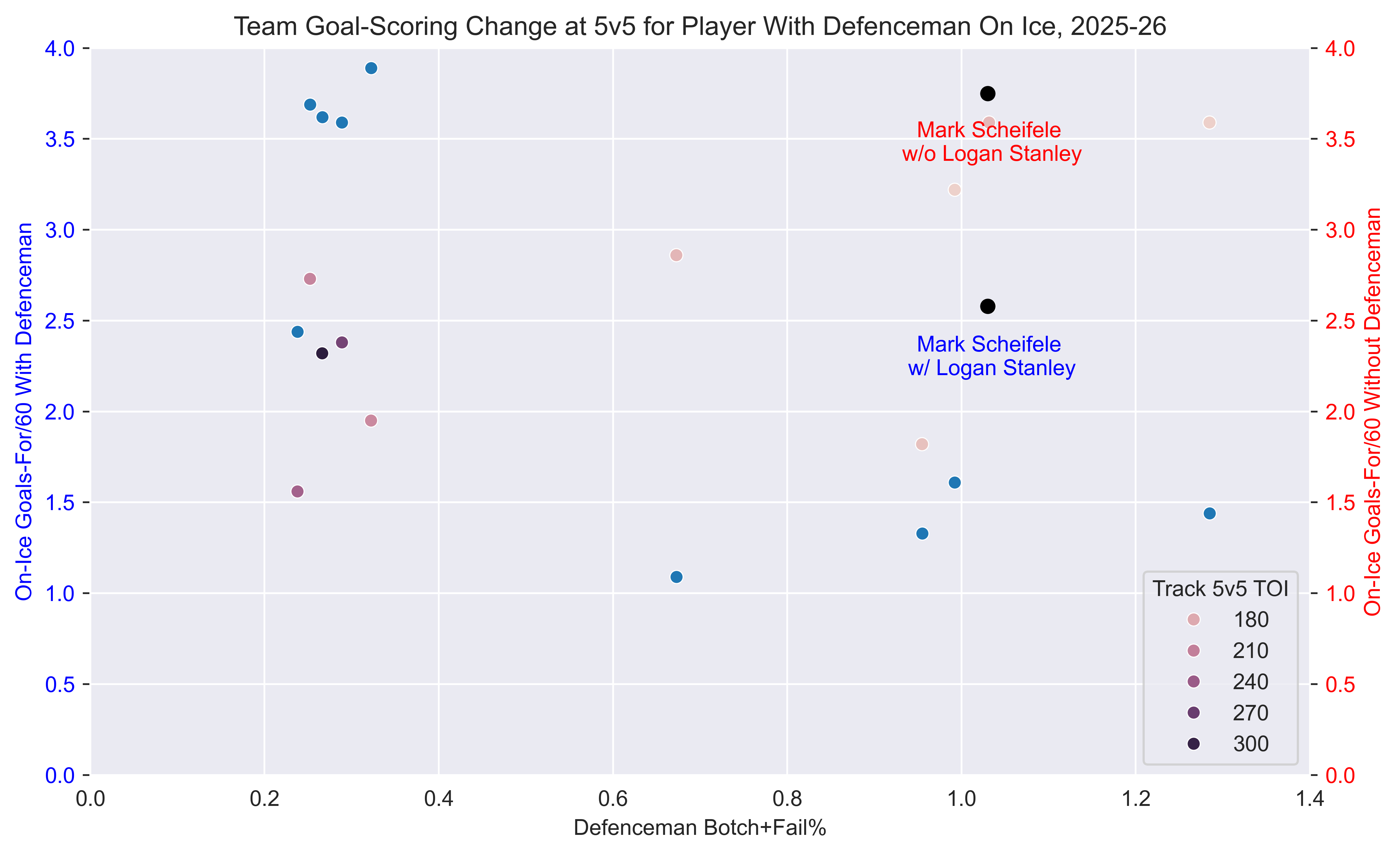
Stanley is off to a good start in his Buffalo tenure, but it’s only been seven games. Regardless, the Jets now have an opportunity to overhaul their depth defencemen in the offseason, and that can help the scoring rates of not only Scheifele but the depth forwards.
5 – Comme Ceci, Comme Caca
As a group, the Los Angeles Kings have had trouble scoring for most of the season, though the addition of Artemi Panarin helps. Either way, it sucks that Kevin Fiala’s season is over because he wasn’t finding his usual offensive success, and it’s a wonder of how much his ice time with Cody Ceci didn’t help:
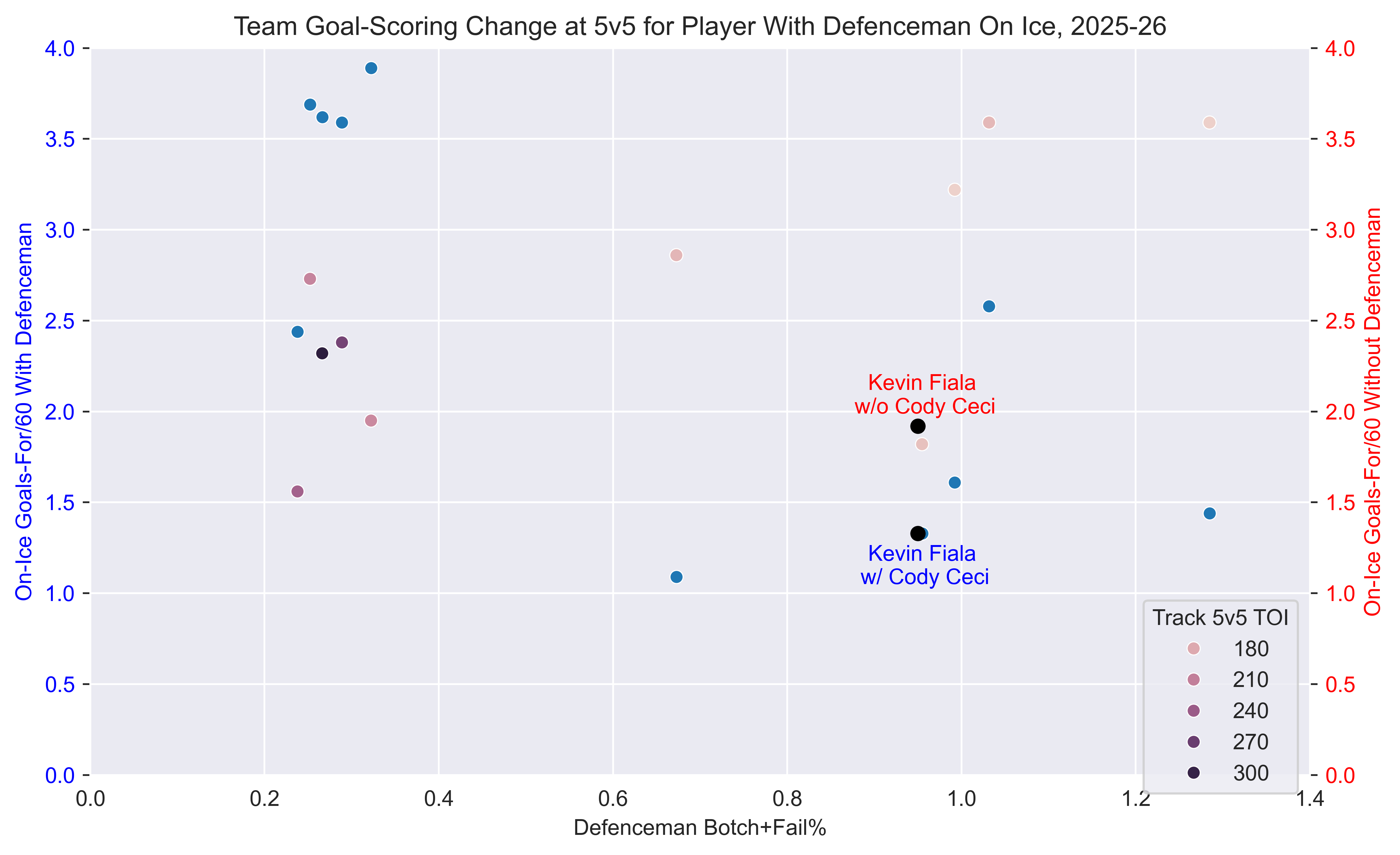
The Kings weren’t scoring much even in Fiala’s non-Ceci minutes, but there is still a clear divide, and the team’s goal-scoring rate with Ceci on the ice is the worst of all its regular defencemen. What would Fiala’s production would look like post-Olympics with Panarin in the lineup? We will have to wait until next season to find out.
6 – Lightning Crashes (The Net)
We could pick a lot of different Tampa Bay forwards who’ve had better results with a few different Tampa Bay defencemen, but we’re going to highlight Yanni Gourde and Darren Raddysh. The main reason for isolating that duo is that Gourde is often used in a shutdown role, Raddysh is having a breakout season, and it’s clear Raddysh is helping Gourde create offence even in that shutdown role:
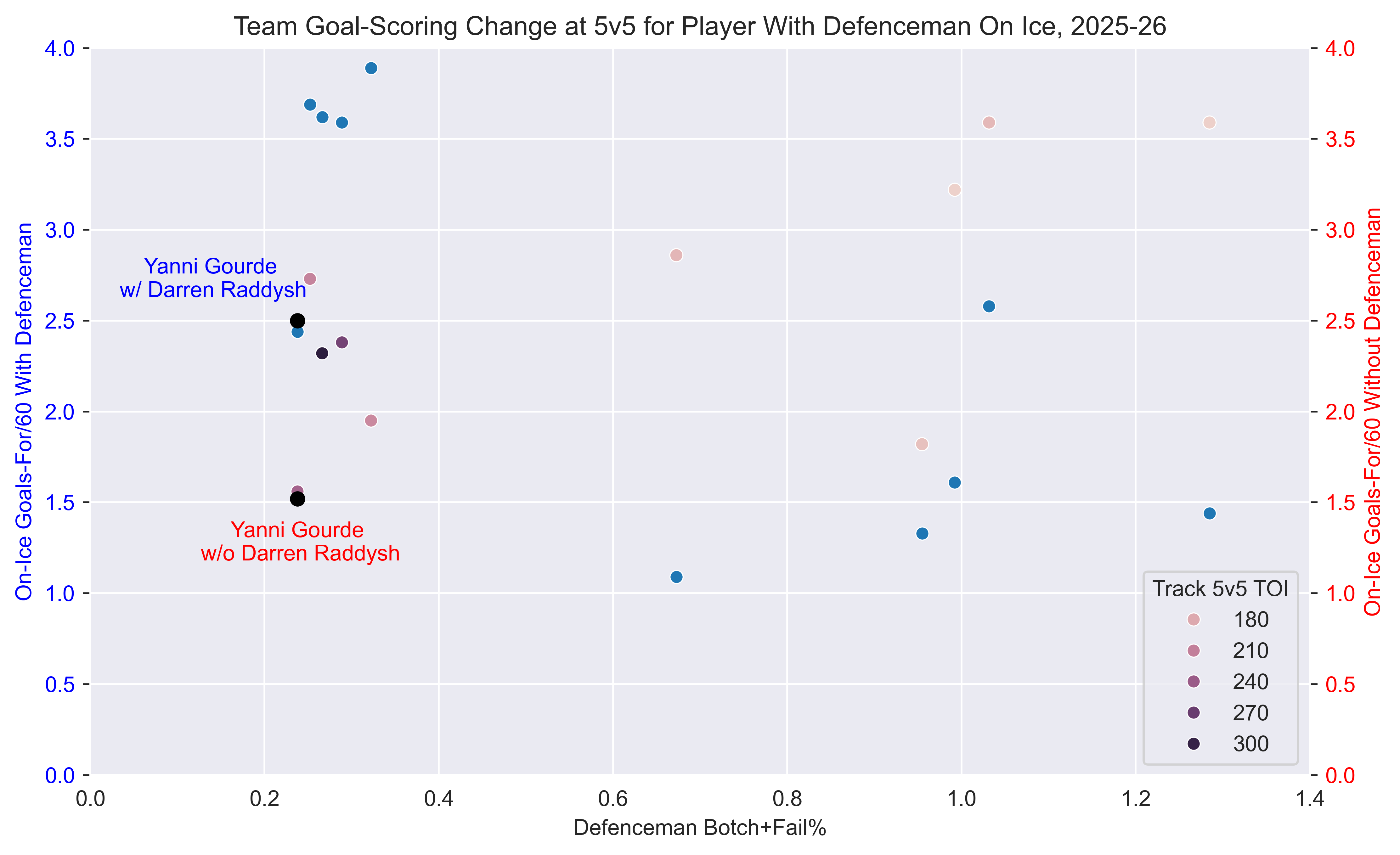
Tampa Bay’s defence group has the lowest combined Botch+Fail% of any team in the league, so they’re helping a lot of their forwards, but being able to take a genuine shutdown line and give them some offensive pop is a pretty big deal as the Lightning march towards the postseason.
7 – Matty Boy
It is kind of funny to have Washington defenceman Matt Roy on the positive side of this Botch+Fail% article considering he came from Los Angeles, and we just talked about Ceci. Either way, here is how Washington has fared offensively when Alex Ovechkin is on (or not on) the ice with Roy this season:
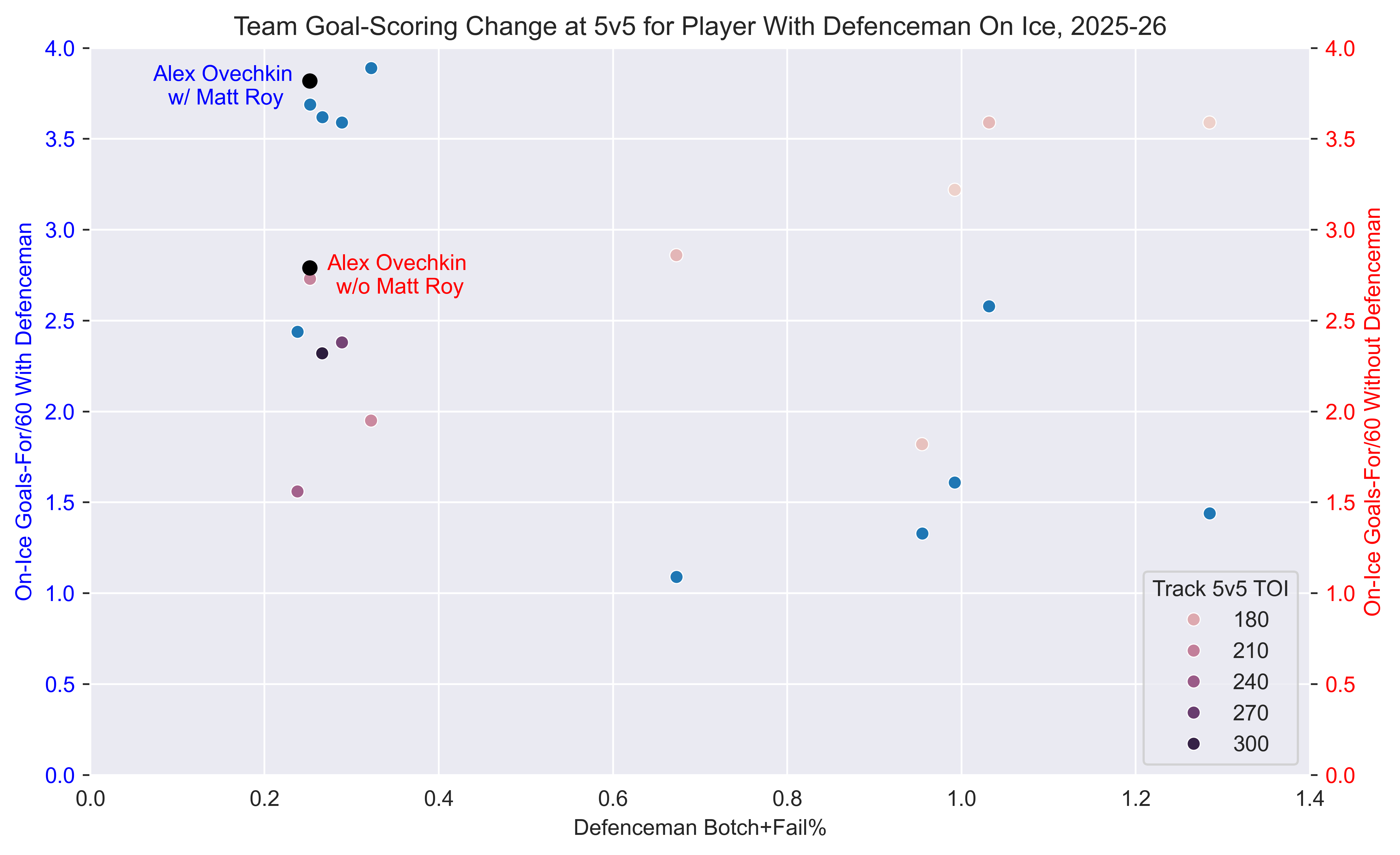
This isn’t a perfect measure because the results are mixed for Roy when he has other forwards on the ice, but there’s a nice boost going both ways between Ovechkin and Roy, though it doesn’t seem as if it’ll be enough to get the Capitals to the postseason.
8 – No Surprise
Going back to Dallas for a minute, Wyatt Johnston is likely going to hit 40 goals and while a huge chunk of that is from the power play (23/38 goals on the PP), it is worth noting how much having Miro Heiskanen on the blue line behind Johnston has helped Dallas’ scoring and Johnston’s production at 5-on-5:
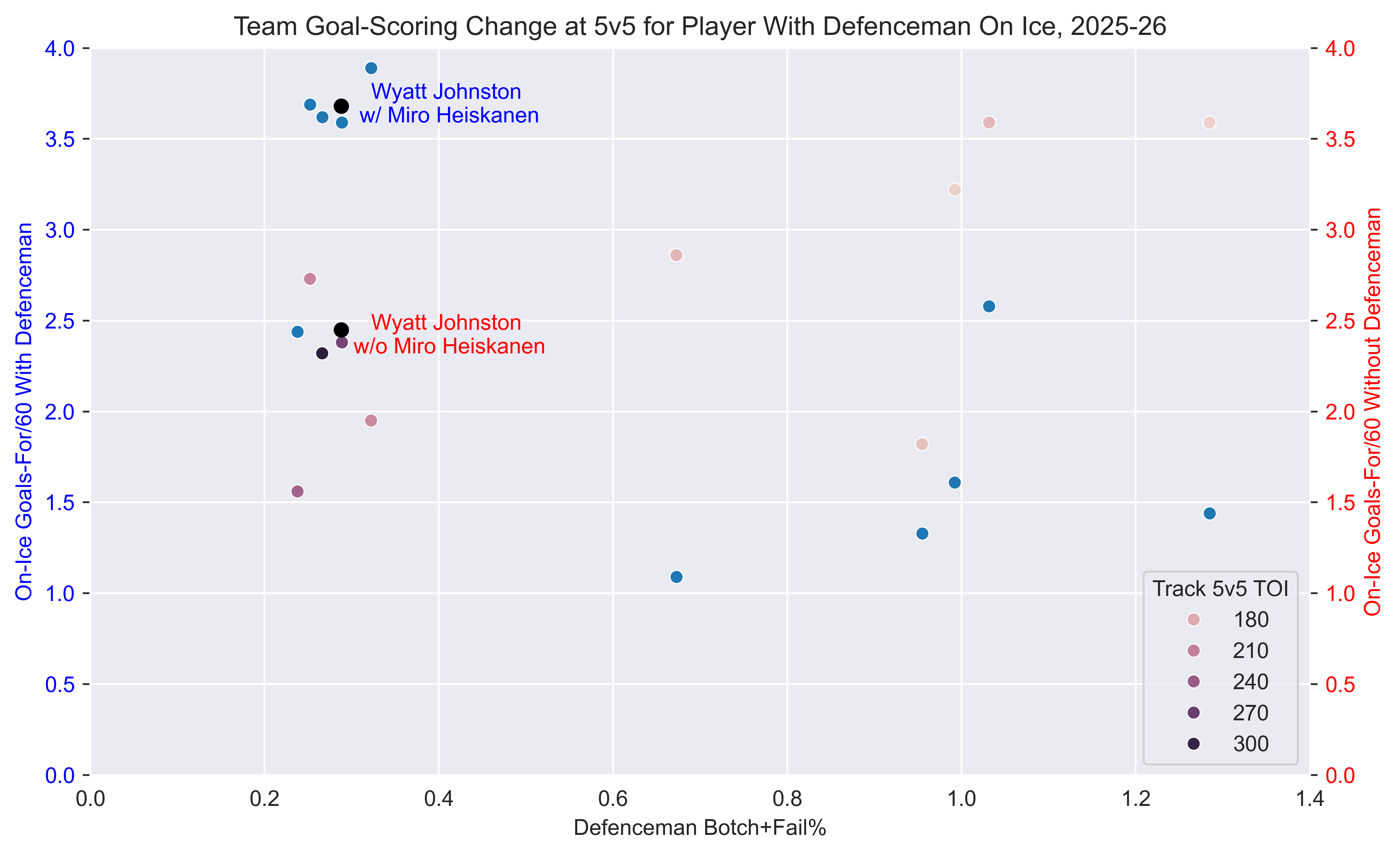
Not that it’s a big surprise, but Heiskanen’s reputation strikes me more as that of a defensive defenceman – and he is great in his own zone – but he’s a much better facilitator and playmaker than he gets credit for and was a big reason for Dallas’ success until their depth defencemen started improving over the last three months.
9 – Nate the Great
Last week’s newsletter covered Utah forward Michael Carcone’s tracking data over the last two years, and he does have good numbers in that regard. What is also true is that defenceman Nate Schmidt has been perhaps the most underrated offseason acquisition by any team in the league, and his impact on Utah’s scoring with Carcone on the ice is obvious:
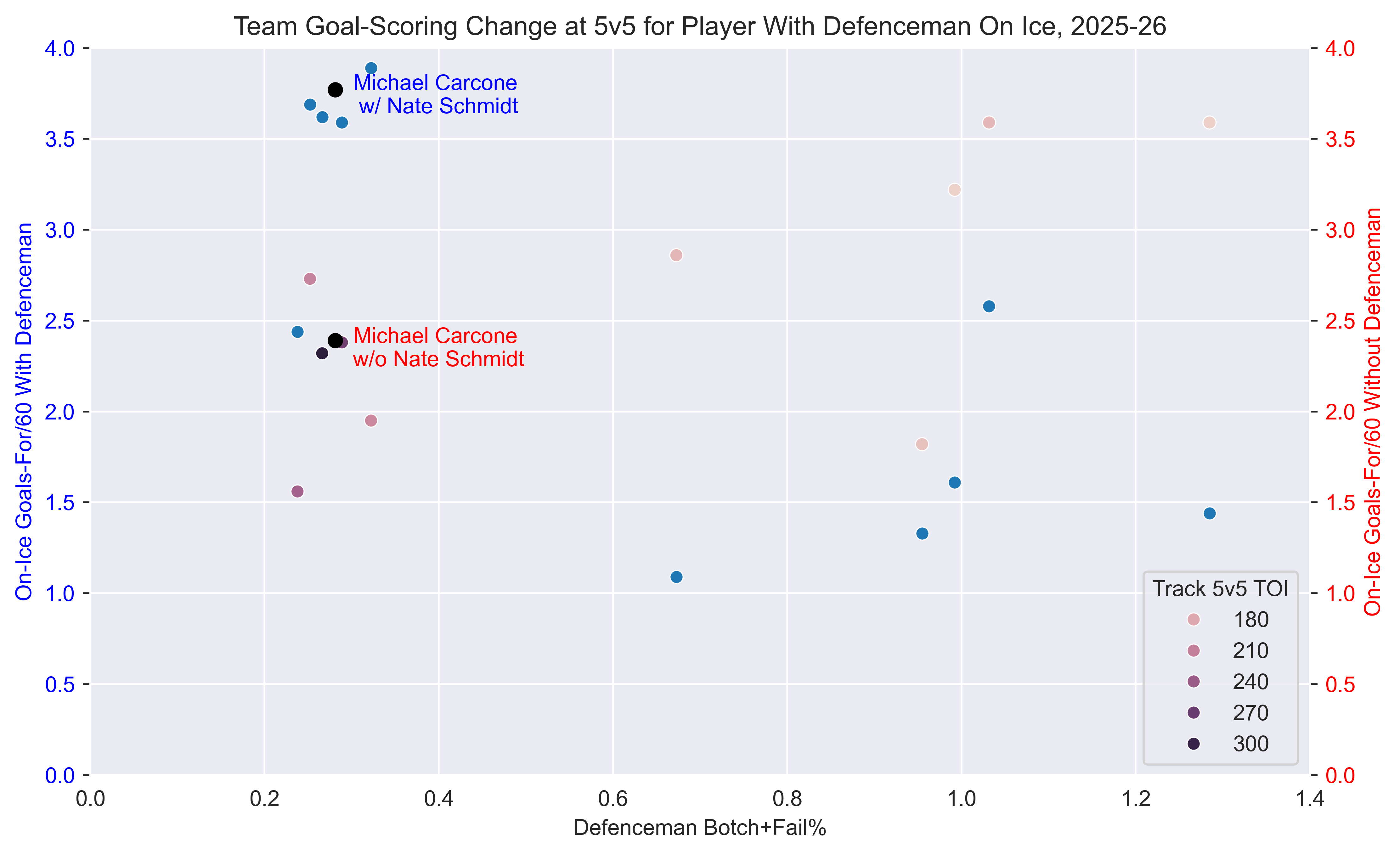
The defensive pair of Schmidt-John Marino has been excellent this year, and the new pair of MacKenzie Weegar-Mikhail Sergachev has very good early returns. That gives the team two legitimate top pairs to work with, and that’s helping their depth forwards like Carcone produce offensively.
10 – Not Too Chabby
In all honesty, Ottawa’s Thomas Chabot might be the most underrated defenceman of the last decade and he’s been a legitimate number-1 defenceman over the last five years. His impact this season is obvious when we look at how he’s helped Dylan Cozens’ line produce at 5-on-5 this season:
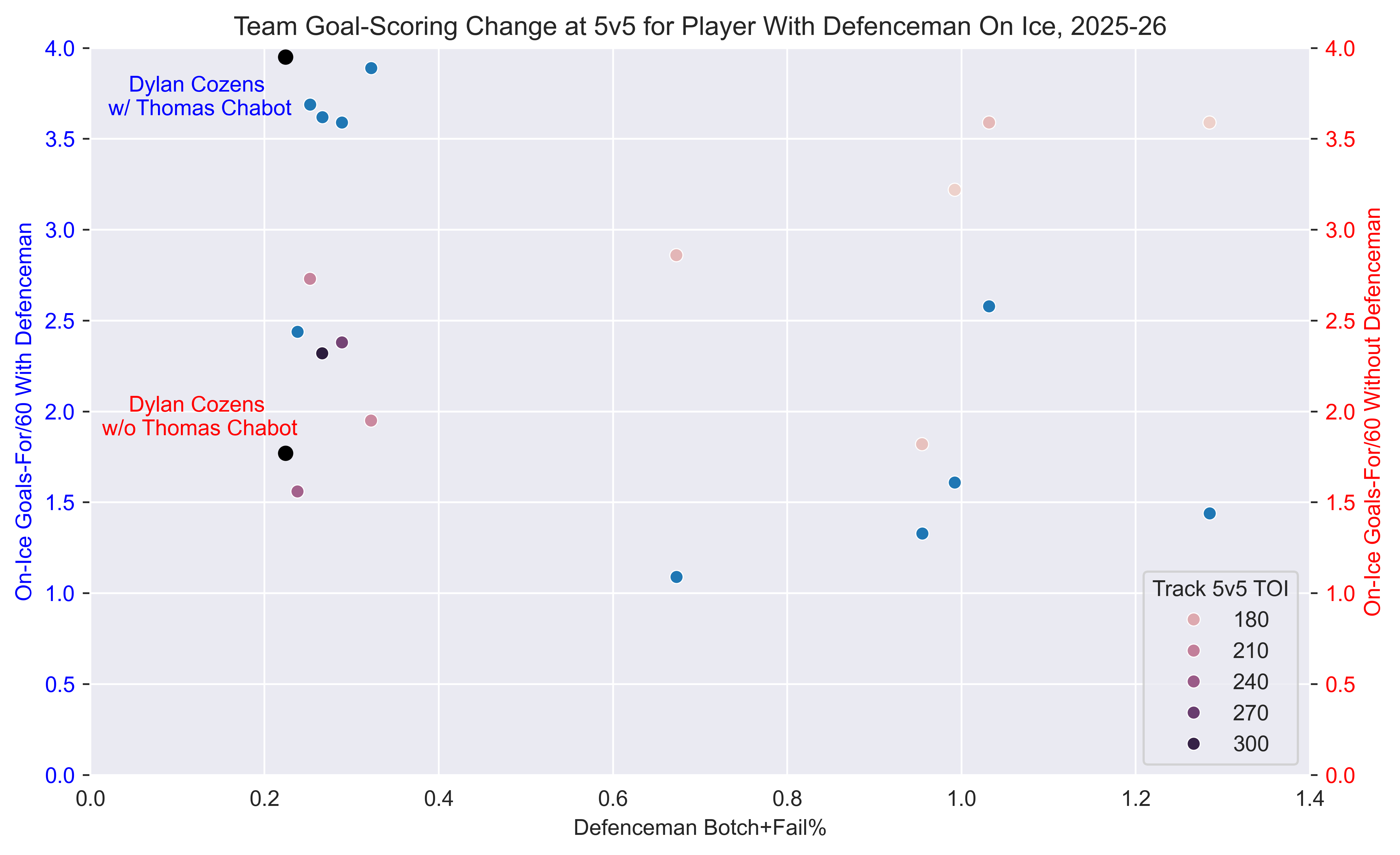
Chabot has also had a small impact on the scoring of Tim Stützle’s line (+9%) and a big impact on Shane Pinto’s line (+36%). Jake Sanderson gets all the attention on Ottawa’s blue line, but this team is not in a position for the postseason without Chabot’s contributions.
Until next week.