10 Interesting (To Me) Stats For This Week - February 18
Welcome back for another week of ’10 Interesting (To Me) Stats’. This week are focusing on tracking data from AllThreeZones and looking at shooting off particular passes, how power plays find success, defensive problems in Boston, and more. Other data is from Natural Stat Trick and Evolving Hockey with viz from HockeyViz.
1 – Back-End Quality
Last week’s post looked at Carolina Hurricanes defencemen and their increasing propensity for shooting. We should add a bit of context to that.
Carolina is 19th in the league by goals per 60 minutes at 5-on-5 since Game 21 of the regular season. Not only are Carolina defencemen taking the largest percentage of their team’s shots at 5-on-5 in this recent stretch, they require the fourth-most shot attempts for every expected goal of all defence groups in the league:

Those four teams are averaging 2.12 goals/60 minutes at 5-on-5 since November 24th. Conversely, the four teams requiring the fewest shot attempts per expected goal from defencemen (Columbus, Philadelphia, Nashville, Utah) are averaging 2.37 goals per 60 minutes. Shocker alert, but defencemen taking a lot of low-quality shots might not be good for a successful offensive attack.
2 – The Scoring Paradox
It is notable that the 2024-25 rate of 2.40 goals per 60 minutes at 5-on-5 is a four-year low in the post-COVID NHL. It is down nearly 5% from just last season and over 7% from two seasons ago. That is despite the NHL average 5-on-5 shooting percentage being 8.77%, or the highest in four years. Teams are landing far fewer shots on net per game, and that’s offsetting the increase in shooting percentage.
But teams are genuinely creating better quality. Tracking data shows that player shots off a high-danger pass (a pass from behind the net or across the slot) are a four-year high, and nearly 7% higher than just last season:

Importantly, there has been a much larger increase from forwards than defenceman despite the share of team shot attempts from defencemen rising across the league. If teams can keep doing this, while also starting to land more shots on goal, we could see scoring rebound in future seasons.
3 – A Holtz World of Hurt
It has been a down year for Vegas winger Alex Holtz with just three goals in 49 games after scoring 16 goals in 82 games last season.
When looking through that high-danger pass data referenced in the last section, something stood out to me: Across the 2022-23 and 2023-24 seasons, Holtz had the most shots off high-danger passes per 60 minutes in the league (minimum 300 tracked minutes). So far in his 140 tracked minutes this season, he has zero shots off high-danger passes:

Maybe there is a reason why Holtz shot 12.8% at 5-on-5 across 101 games in the prior two seasons but is down to 5.1% in 2024-25.
Aleksander Barkov was included as an added bonus because maybe there is also a reason why his goals/60 at 5-on-5 are the lowest (0.46) since his rookie season and down 43% from the previous two years (0.81).
4 – Sergalicious
The final note on shots off high-danger passes comes from Utah.
At 0.33 goals per 60 minutes at 5-on-5, defenceman Mikhail Sergachev has a career-high rate so far this season and is 39% higher than his two-year average. While defencemen get shots off those high-danger passes at a much lower rate than forwards, it is notable that in 212 tracked minutes this season, Sergachev has more shots off high-danger passes than he did in over 610 tracked minutes across his prior two seasons:
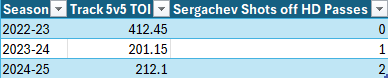
This may not persist because, as a team, Utah is below average in generating these types of shots, but it does make sense that Sergachev is currently pacing for his best 5-on-5 goal-scoring season of his career.
5 – The Setup Is Half the Battle
Scoring on the power play often requires several moving parts working together to create a chain of advantages leading to the goal. At its essence, though, there is one thing successful power play teams often have in common: they can set up in the offensive zone.
In 2023-24, the league average for zone entries at 5-on-4 that led to the power play team setting up in the zone was 41.5%. This season, that is 41.3%. Here is how well teams are scoring at 5-on-4 based on being above those averages or below those averages in the last two seasons:

The goal-scoring gap has closed between the above- and below-average setup teams when compared to 2023-24, but there is still generally an advantage in being able to get your power play in position. There is still also one-third of the season left to play so it will be interesting to see where this ends up a couple months from now, and our next section explains a big chunk of that gap.
6 – WinniPPeg Sets
In 2023-24, Winnipeg’s percentage of power-play entries leading to their skaters getting set up in the offensive zone was a league-worst 32.4%. Perhaps unsurprisingly, the Jets finished 22nd in the league by goals per 60 minutes at 5-on-4.
So far in 2024-25, the Jets lead the league in 5-on-4 goal scoring, and it nowhere close as their goals-for per 60 minutes (12.48) is nearly 30% higher than the next-closest team (Detroit, 9.61). They must be setting up their power play a lot more often, right? Right? Well:
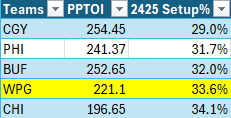
It is funny how much an outlier they are. They have more goals at 5-on-4 (46) than the combined total (44) of the two teams just below them by Setup%. Winnipeg is carrying the puck into the zone at a high rate, but setting up the power play at a low rate, so it’s a wonder if they’re trying to create more off a quick-strike rush. They are an outlier, though, and that makes them interesting.
7 – Long Island Iced PP
The New York Islanders have 27 games left to play, so there is time to turn things around. However, as things stand, their 3.71 goals per 60 minutes at 5-on-4 is one of the worst marks in modern NHL history (fifth-lowest rate since 2007). The curious part is that their ability to set up on zone entries is at 41.6%, or just above the league average of 41.3%, and in the same range as teams with successful power plays like Vegas and Utah:
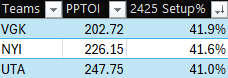
The issue is that the Islanders are generating just 0.51 scoring chances per entry setup, which is by far the lowest in the league (San Jose, 0.59), with the league average sitting 58% higher than that. Maybe they’re a bit unlucky by their shooting percentage, but it also seems as if the Islanders are making their own (bad) luck on the power play.
8 – The Slammin’ Sammys
One thing the Colorado Avalanche need is to start creating advantages when Nathan MacKinnon is off the ice. When their superstar is on the ice at 5-on-5, the team has a 62.3% expected goal share and 60.1% actual goal share (53 goals for, 35 against). When he’s off the ice, the expected goal share plummets to 48.6% and the actual goal share does the same to 43.2%.
That is what makes the Sam Malinski-Samuel Girard defence pair a very intriguing pair to monitor. It is just 166 minutes for that pair on the ice at 5-on-5 without MacKinnon, but the Avalanche have a 53.3% expected goal share in those minutes and have outscored the opposition 6-3:
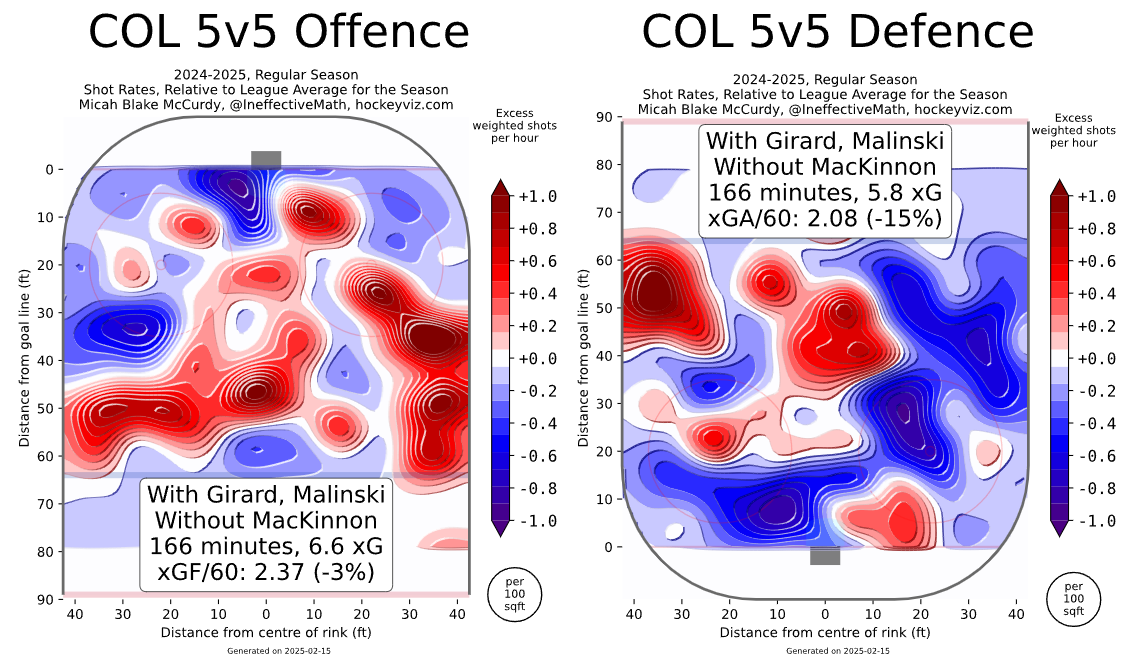
Having a second reliable pair after Cale Makar-Devon Toews that can create an advantage with the middle-6 lines would be invaluable to Colorado, and so far, so good for The Sammys.
9 – Dunkin’ on Boston
In each of the prior three seasons, the Boston Bruins never finished lower than fifth by goals against per 60 minutes at 5-on-5 and had the lowest goals-against rate across those years. That is what makes the fact that they sit 12th by goals against at 5-on-5 this season stand out.
Across the 2021-24 seasons, Boston defencemen denied an opponent zone entry on 9.6% of entries, an above-average rate. It wasn’t elite, but it was solid, and they were good at preventing chances when the opponent did gain entry.
That denial ability has absolutely cratered in 2024-25 as Bruins defencemen are last in the league at denying opponent zone entries:
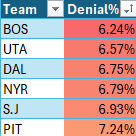
The injury to Hampus Lindholm has hurt them here, so hopefully things will get better once he returns to the lineup.
10 – Lohrei? More Like, Loh-no!
On the topic of Boston defencemen, it stuck out to me that of their six defencemen with at least 1000 minutes at 5-on-5 over the last two seasons, Mason Lohrei has the highest goals against rate per 60 minutes (2.81), and it’s not even close (Andrew Peeke, 2.37).
Over the last two seasons, there are eight defencemen who have at least 250 tracked minutes at 5-on-5, retrieve the puck in the defensive zone at least 20 times every 60 minutes, and fail to exit the zone at least 37% of the time. Lohrei is on this list, and it’s not a distinguished one:
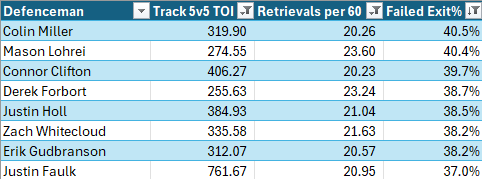
Lohrei is talented offensively, still has just 93 career regular season games, and just turned 24 years old in January, so there is growth to come. However, these tracking numbers, along with some expected goals against numbers, paint a poor defensive picture and the offence has been nowhere good enough to make up for it. Once Lindholm returns, Lohrei could find himself in the press box if things don’t improve.
Until next week.